




Abstract
Stress among nonprofit workers is well documented. Methods for reducing that stress are not well understood. Specifically, little research examines the value of peer support in reducing stress among those engaged in compassionate care work. In this study, 93 workers from 15 nonprofit organizations completed a Qualtrics survey about their work-related stress, personal relationships with coworkers, perceptions about the value of coworker relationships in mitigating work stress, and efforts by their workplaces to promote positive relationships among their employees. Results indicate that most experience work-related stress, have close and important relationships with coworkers, are likely to confide in coworkers about work stressors, and believe that feeling close to coworkers helps to relieve stress at work. The implications of these findings are explored.
Stress among nonprofit workers is well documented (Bride and Kintzle 2011; Ludick and Figley 2017; Quinn, Ji, and Nackerud 2019; Teratanavat, Raitano, and Kleiner 2006). Although often personally rewarding, working with people in difficult life circumstances or who are traumatized can be emotionally draining (Ivicic and Motta 2016; Quinn et al. 2019). Some develop vicarious traumatization and compassion fatigue (Dworkin, Sorell, and Allen 2016; Gil and Weinberg 2015; Ludick and Figley 2017), and some experience “burnout” (Grant and Campbell 2007; Kulkarni et al. 2013; Maslach and Leiter 2005; Schaufeli, Leiter, and Maslach 2009). The term burnout in fact is typically associated with the long-term impacts of compassionate care work (Peterson et al. 2008). In addition to emotional challenges, caseload size, irregular hours, low pay, ineffective management, supervisory relationships, limited resources, and role ambiguity create stress for nonprofit workers (Teratanavat et al. 2006; Visser et al. 2003).
The impact of stress can be substantial. Workplace stress has been found to impair job performance (Castanheira and Chambel 2013; Deng et al., 2019) and negatively impact one’s personal life (Benz 2005; Bolino and Turnley 2005; Hawksley 2007). Nonprofit and social work that involves trauma counseling has resulted in emotional numbness, irritability, sleep disorders such as insomnia and recurring nightmares, and difficulty concentrating (Quinn et al. 2019).
Other physical manifestations of workplace stress include tension headaches, depressed mood, extreme anxiety, and stomach problems (Hawksley 2007; Wahrendorf and Chandola 2016). Stress is a common explanation for people taking extended leave from nonprofit work (Deery, Walsh, and Zatzick 2014), and turnover in these professions is especially high (Barak, Nissly, and Levin 2001; Pollack 2008).
For people in demanding jobs, social support reduces stress and increases job satisfaction (Orgambidez-Ramos and de Almeida 2017; Rodwell, Noblet, and Allisey 2011). Social support is enhanced by balancing authority and having employees participate in the management of the workplace. This includes employee input on decisions, scheduling, and planning. Discouraging formalities in the work place and offering options such as flexible scheduling, telecommuting, and job sharing increase social support and reduce stress (Teratanavat et al. 2006). Counseling, including marital and grief therapy, and drug and alcohol interventions also mitigate work-related stress (Kushnir and Milbauer 1994; Rousseau 2011). Providing job orientation and trainings, especially education about an employee’s specific responsibilities and performance evaluation expectations, reduces tensions. Meditation, yoga, deep breathing, hypnosis, and physical exercise have been found to alleviate symptoms of burnout (Kushnir and Milbauer 1994; Rousseau 2011), and work places that offer their employees memberships to fitness clubs and spas report reductions in work-related stress (Kushnir and Milbauer 1994; Rousseau 2011). Having supervisors with strong leadership skills lessens stress (McMurray et al. 2010), and as management stress decreases, work climate and productivity improve (Martin et al. 2009). Peer support groups elevate self-esteem and mental well-being (Schwartz and Sendor 1999). Two studies specifically consider the value of coworker relationships in mitigating stress in nonprofit settings, and both find that positive relationships with supervisors and coworkers are associated with less work stress (Fenlason and Beehr 1994; Quinn et al. 2019). Given the limited research in this arena, we examine nonprofit workers’ perceptions of the value of coworker relationships in reducing stress. More specifically, we hypothesize that among compassionate care workers, significant bonding with coworkers familiar with the emotional demands of their workplace will reduce their work-related stress.
Method
Upon approval from our university’s internal review board, the first researcher met with directors of five local nonprofit agencies to explain the study, and sought distribution of the Qualtrics survey link to their employees. Other nonprofit organizations received an e-mail about the study requesting distribution of the survey link to their employees. In addition, the survey link was posted on an online nonprofit community forum, and acquaintances were given the link to share with their nonprofit employees. The resulting convenience sample of 93 represents 15 nonprofit organizations. These organizations operate throughout Colorado’s Front Range and serve low-income and troubled youth populations. While all participants were employed by nonprofits, organization size and job positions were not assessed. More than half of the sample (54.8 percent) identified as female, and 81.7 percent identified as white. More than two thirds (68.1 percent) are married, and 26.7 percent reported their annual income as over $50,000, while 13.3 percent make less than $20,000. Participants range in age from 19 to 68 years with a mean of 35.7.
Survey questions were based on prior studies of workplace stress and revised for nonprofit employees and our research focus. Statements addressing workplace stress and stress impacts on one’s personal life were derived from Scott and colleagues (2009), and include items such as “I feel stressed when I am at work,” “I am often performing work duties outside of work hours,” and “My personal life has suffered because of my work-related stress.” Quality of coworker relationships was measured with statements derived from Rousseau (2011), and include items about whether participants enjoy working with their colleagues, know about their colleagues’ personal lives, and are comfortable confiding in coworkers about work-related stresses. Items addressing whether workplaces encourage positive interactions among employees and organize activities outside of work to facilitate employee bonding were based on research by Mayton (2015) and Rousseau (2011). A 5-point Likert-type scale with responses ranging from strongly disagree to strongly agree was used for most survey items. Demographics measured include age, ethnicity, gender, and annual income. The data were analyzed using the Statistical Package for the Social Sciences (SPSS).
Results
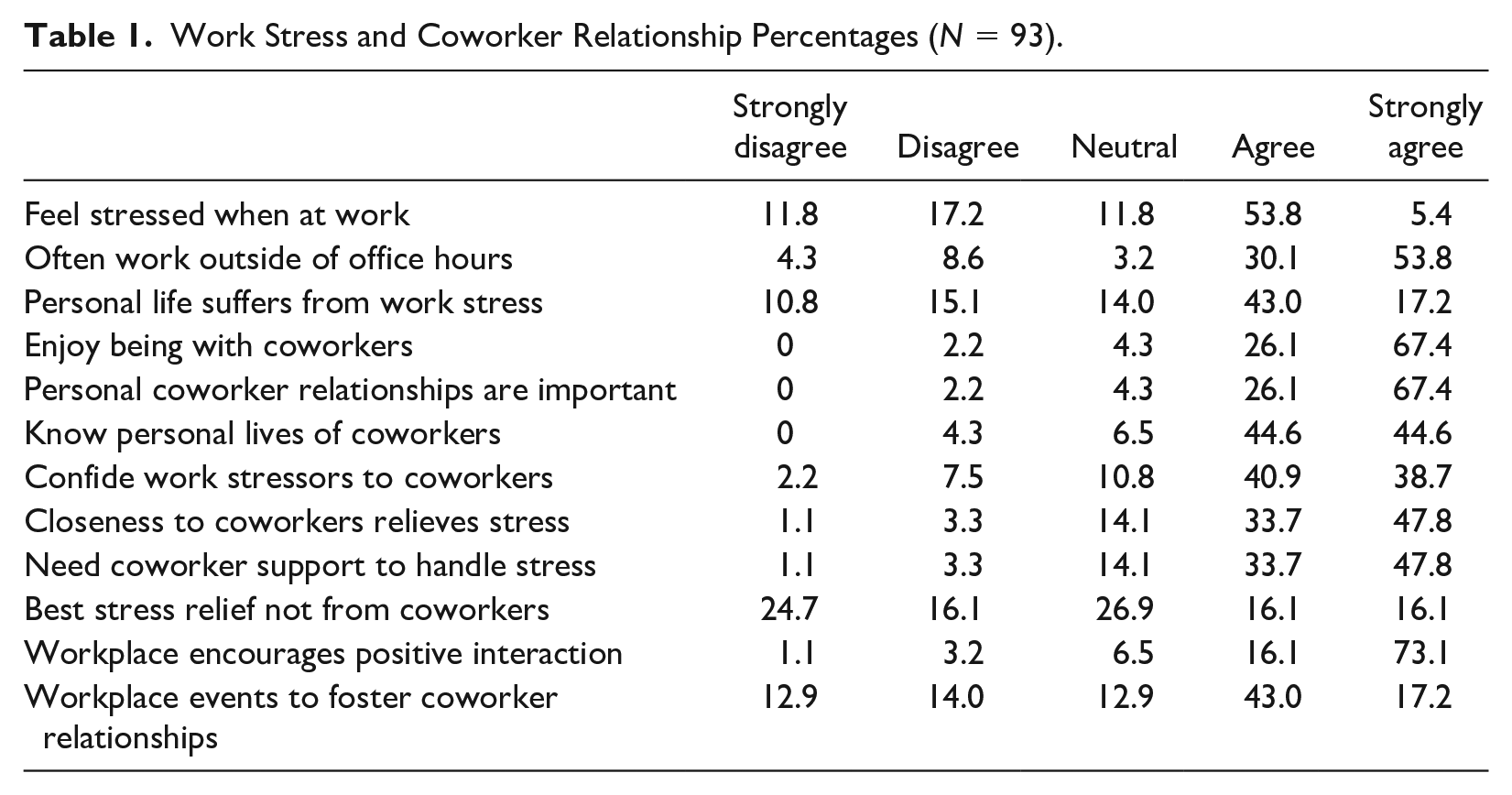
Participants reported a considerable amount of work-related stress. Nearly sixty percent (59.2) feel stress at work, 83.9 percent often work outside of regular office hours, and 54.9 percent average more than 40 hours of work per week (see Table 1). Of those experiencing stress at work, 85.5 percent acknowledge that stress impacts their personal lives. At the same time, these participants overwhelmingly view their coworkers positively as 93.5 percent enjoy being with their coworkers, 93.5 percent value their personal relationships with coworkers, and 89.2 percent are familiar with their coworkers’ personal lives. In terms of the value of these relationships for relieving work stress, 79.6 percent are comfortable confiding in their coworkers about work stresses, 81.5 percent agree or strongly agree that feeling close to their coworkers helps to relieve work stress, and just 32.2 percent propose that the best ways to relieve work-related stress were to not involve their coworkers (see Table 1).
Work Stress and Coworker Relationship Percentages (N = 93).
Work-related stress is negatively correlated with workplaces facilitating positive interactions among employees (r = −.228; p < .05). When workplaces encourage positive interactions, participants are closer to their coworkers (r = .247; p < .05), are more likely to confide in them about work stressors (r = .540; p < .001), and are more likely to feel that being close with their coworkers helps to relieve work stress (r = .341; p < .01) (see Table 2). Similarly, when workplaces organize outside-of-work activities, employees tend to be closer to one another (r = .460; p < .001), are more likely to confide about work stressors (r = .481; p < .001), and are more likely to feel that being closer to coworkers helps to relieve work stress (r = .263; p < .05). Knowing about coworkers’ personal lives and being comfortable confiding in coworkers about work-related stresses is strongly correlated (r = .538, p < .001). Similarly, those who are comfortable confiding in their coworkers about stressors are more likely to agree that close connections with coworkers help to relieve work stress (r = .497, p < .001).
Workplace Activities, Coworker Relationships, and Stress Pearson Correlations (N = 93).
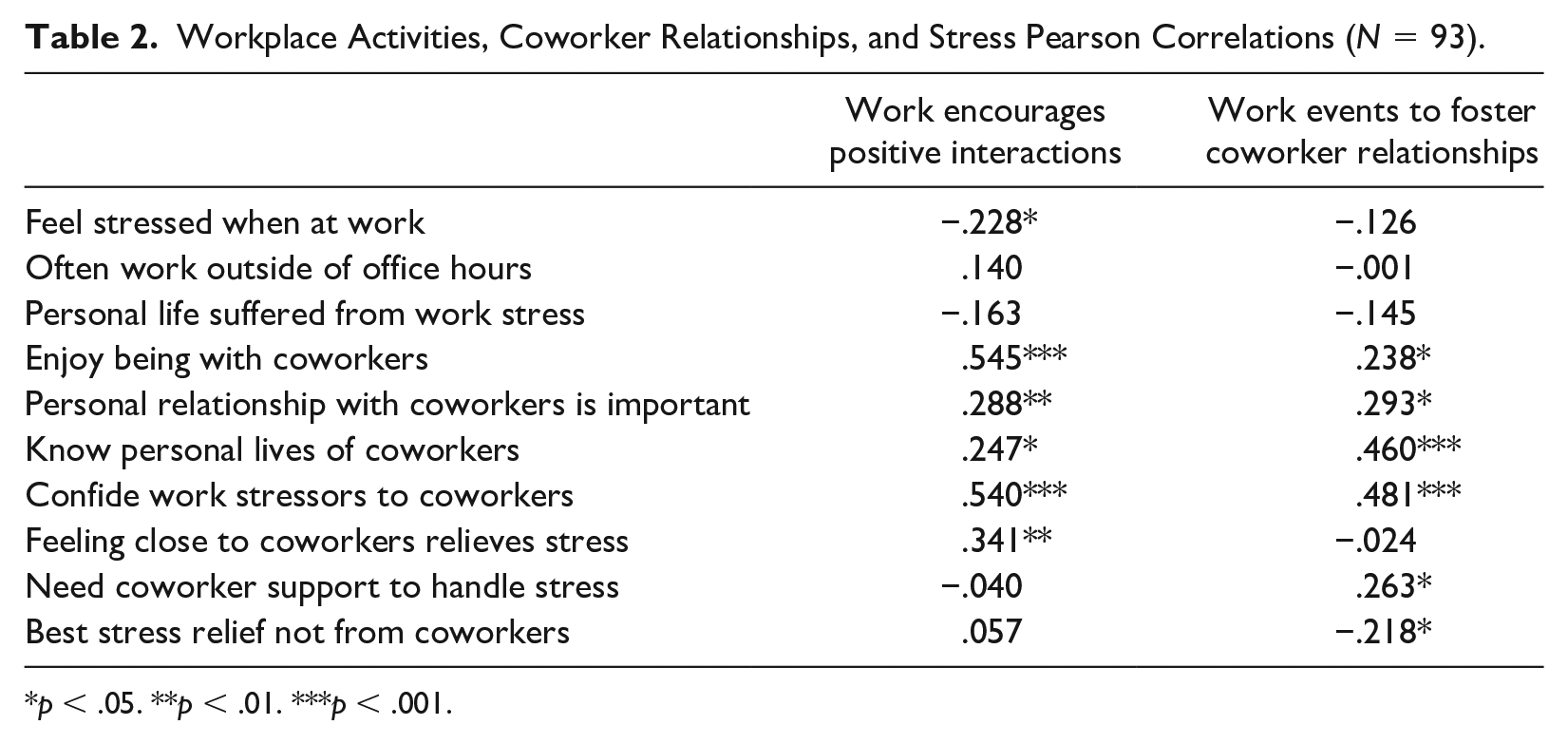
p < .05. **p < .01. ***p < .001.
Discussion
These findings support the growing body of literature documenting stress among nonprofit workers, and suggest that high-quality peer relationships may be a significant source of stress relief. In addition to the strong relationship between knowing about coworkers’ personal lives and confiding in them about work stressors, these participants overwhelmingly believe that feeling close with coworkers relieves their workplace stress. Because of the emotionally charged nature of working with people in difficult life circumstances, personal bonds among nonprofit colleagues who are familiar with the unique stressors of their organization may be an especially valuable untapped resource. Internal efforts by employers to nurture interpersonal connections among employees might include partnerships where work had previously been assigned to individuals, forming project teams, and creating inviting communal spaces for coffee breaks. External socializing opportunities, such as off-site celebrations of significant life events and regular happy hours, may contribute as well.
Many questions remain unexamined, including how such profound connections develop and are maintained in the workplace. Certainly, these findings may vary by organization type and size, job position, and length of employment. Besides a less stressed and more connected workforce, significant interpersonal bonding may mean greater productivity and less turnover. Assessing how coworker bonds are acquired and nurtured, the features of workplace relationships that are most conducive to stress reduction, and the impacts of those bonds on productivity are useful directions for future research.
Footnotes
Declaration of Conflicting Interests
The author(s) declared no potential conflicts of interest with respect to the research, authorship, and/or publication of this article.
Funding
The author(s) received no financial support for the research, authorship, and/or publication of this article.