



Abstract
The Goffmanian thesis of stigma occurring as an aspect of “spoiled identity” has arguably provided the dominant theoretical understanding of social stigma over the past half century. Yet, there have also been strong critiques of Goffman’s thesis of stigma which range from concerns with the micro-personal nature of his work to question marks over the corpus of materials used by Goffman when originally theorizing stigma. Recent scholarly contributions have theorized a more structural understanding of the role and function of stigma and this, in turn, has arguably forced the question of whether or not Goffman’s thesis of stigma has now become redundant in terms of its application in the social sciences. This paper intends to explore this question by offering a juxtaposition of the theoretical and the empirical. To meet this task, the paper first engages in a theoretical discussion of the Goffmanian thesis of social stigma. Crucially, however, original research, conducted in Ireland, is also presented. This empirical material shows that, despite the very valid concerns with Goffman’s theory of stigma, much of his analysis with respect to impression management is borne out in lived experience. In doing so, aspects of the Goffmanian thesis of impression management as a response to the potential for stigma are affirmed thus demonstrating the continuing applicability of this theoretical strand. New understandings of impression management are also advanced.
Introduction
While there have been many critiques of Goffman’s ([1963] 1990) thesis of stigma, some of which are elucidated further on, there is little danger of Goffman being “lost” to sociology. This is not surprising as Goffman has presented a sociology of stigma, played out at the interpersonal level, which remains useful. Essentially, a reading of Goffman’s ([1963] 1990) Stigma conjures a sense of innate understanding. Although theoretical, what Goffman ([1963] 1990) presents us with, arguably, feels right. Yet, what might this mean for researchers interested in the Goffmanian thesis of stigma in the context of actualizing it in a research process and, furthermore, can the Goffmanian thesis of stigma be explored through analysis? The question that this paper seeks to explore then is whether or not the Goffmanian thesis of social stigma can be applied or “empiricised” in the doing of social science either proactively or retrospectively. Data arising from the research presented here suggest that it can and that, indeed, impression management has a very real place in lived experience. The data presented arise from a series of interviews conducted with welfare recipients in Ireland which aimed to uncover experiences of stigma in the specific context of welfare recipiency. The original aim was not to “test” the applicability of the Goffmanian thesis of stigma in an empirical setting, nor was there an attempt at “abduction” of a particular aspect of Goffman’s work. Yet, given that aspects of Goffman’s ([1963] 1990) thesis emerged strongly from the data via the analysis process, the applicability of the Goffmanian theory of impression management in the context of social stigma is demonstrated, nevertheless. The latter part of the paper will elucidate this through the presentation of data. However, for clarity and context, a theoretical discussion, and one which includes an elucidation of recent critiques of Goffman’s ([1963] 1990) stigma, is first presented. Following this, the research and analysis process is described, and the specific research context is briefly detailed.
Specters of Goffman: Stigma as the “Thing in Itself”
Beginning with a discussion on the historical origins of stigma, Goffman ([1963] 1990:11) evokes the Greeks who enacted stigma through the use of purposely imposed: . . . bodily signs . . . that were . . . burnt into the body and advertised that the bearer was a slave, a criminal or a traitor- a blemished person, ritually polluted, to be avoided, especially in public places.
For Goffman ([1963] 1990), this emphasis on the ascription of physically imposed or otherwise obvious stigmas that have the effect of marking persons out from their contemporaries is about social delineation and othering, the stigma, the ritual pollution or blemish as it were, purported as being the rationale for the practice. Having set the stage, Goffman ([1963] 1990:14) goes on to elucidate his claims as to the nature of stigma by accounting for what he describes as “Three grossly different types of stigma.” As this is key to Goffman’s ([1963] 1990:14) model of stigma, it is worth quoting at length: First there are abominations of the body- the various physical deformities. Next there are blemishes of individual character perceived as weak will, domineering or unnatural passions, treacherous or rigid beliefs, and dishonesty, these being inferred from a known record of, for example, mental disorder, imprisonment, addiction, homosexuality, unemployment, suicidal attempts, and radical political behaviour. Finally there are the tribal stigmas of race, nation, and religion, these being stigma that can be transmitted through lineages and equally contaminate all members of a family.
Having differentiated between the different types of stigma possible, Goffman ([1963] 1990) then contends that there are two specific ways in which these stigmas are manifested, discredited and discreditable. Discredited is used to describe those stigmas that are either already known about or are immediately obvious or both. Discreditable stigmas, on the contrary, may neither be known about or immediately perceivable. Those with obvious physical or tribal stigmas are more likely to be discredited while those with conduct stigmas are more likely to be discreditable and so inclined to continuously engage in a process of “passing” and impression and information management as a result (Goffman [1963] 1990).
Having presented his thesis of what stigma is, Goffman ([1963] 1990) then moves to discuss how individuals who possess various stigmas go about managing them. In doing so, he situates his thesis of stigma in earlier work (Goffman [1956] 1990) and differentiates between what he calls “virtual identities”—the identities that the bearers of a stigma present to the world—and “actual identities”—the identities that people can assume in spaces of relative safety and comfort, places where they can “be themselves.” When assuming virtual identities, the stigmatized person is almost constantly engaged in processes of identity management, such as “covering” and “passing,” for the discreditable individual who believes their stigma may as yet be unknown, or managing tension in the case of the already discredited stigma bearer who tries to minimize the impact of their “spoiled” identity. It is important to note that what Goffman ([1963] 1990) arguably does here is to describe stigma as the “thing in itself.” If we then take Goffman’s ([1963] 1990) thesis as more or less given, we are left with people managing stigma, the “thing in itself,” or attempting to manage their information to prevent a stigma, the “thing in itself” becoming known about. While on its own, this presentation of stigma may seem unsatisfactory, in the sense of being narrow or limited, when situated in Goffman’s ([1956] 1990) earlier work on dramaturgy, and most particularly in Presentation of the Self in Everyday Life, it does take on a more fleshed out form.
Originally adapted from the realm of the theater, 1 Goffman’s ([1956] 1990) dramaturgical perspective uses an analogy of the stage and performance to give a sense of the methods which persons employ to manage the “impression” which an “audience” form of them. In Goffman’s ([1956] 1990) language, the person “giving” the impression is called a “performer” and is tasked with the necessity of acquitting a favorable impression in given circumstances. Fleshing this out further, Goffman ([1956] 1990) describes a number of “stages” upon which performances are played out. In the first instance, he describes the “front stage” which he denotes as (Goffman [1956] 1990:32) “that part of the individual’s performance which regularly functions in a general and fixed fashion to define the situation for those who observe the performance.” He then goes on to describe the “backstage” (Goffman [1956] 1990) as a place where “the performer” can be at ease and step out of “character.” These two concepts in Goffman’s ([1956] 1990) dramaturgy are particularly notable in the context of the data presented further on as it will be shown that many of the participants whose data are drawn upon describe what could be considered as aspects of performance in the context of managing impressions.
It is important to point out that there have been diverse interpretations of Goffman’s work (Hancock and Garner 2015; Jacobsen and Kristiansen 2010; Smith 2006). For example, Jacobsen and Kristiansen (2010) highlight that there have been interactionist, functionalist, structuralist, existentialist, phenomenological, critical, and postmodern interpretations of Goffman. In Asylums, Goffman (1961:50) himself stated that his approach is located within the “symbolic-interaction framework” (see Bolton, 2018). Despite these varying interpretations, what is notable is that when Goffman’s ([1956] 1990, [1963] 1990) work on stigma is located within his broader corpus of work on impression management, it is much richer as a result, with stigma becoming the precursor to particular types of performances which revolve around managing aspects of a spoiled identity. As a concept of concern for sociology, stigma can be traced as least as far back as Durkheim’s ([1895] 1982) Rules of Sociological Method. Furthermore, stigma as a concept on its own has tended to be deeply embedded in a range of other sociological approaches. For example, the concept of social environment consisting of persons playing “roles” or playing a “game” has a deep lineage in symbolic interactionism and the work of Mead (1934). Mead (1934), and symbolic interactionism in general, makes the claim that a person or an “actor’s” ability to interpret the world, their very sense of self, emerges from the ongoing process of communication with others. There is a clear symmetry with Goffman ([1956] 1990, [1963] 1990) here, whose emphasis on identity management relies on a presupposed socialization process in which persons develop identity patterns in reaction to the signs and symbols they receive, either overtly or subtly, from others. In an example of how symbolic interactionism has specifically dealt with stigma and the stigmatized, Plummer (1973) has used this interactionist framework in undertaking a sociological study of the stigma of sexuality. Noting that certain views are indicative of how a given society views a particular phenomenon at a given time, he uses the notion of “abstract rules” (p. 55) to denote the range of responses one might accord to a stigmatized person—in this case a gay person—and how that person may, in turn, respond. Again, this abstraction of stigma is consistent with both Goffman ([1956] 1990, [1963] 1990) and the wider symbolic interactionist milieu, and accordingly, Plummer (1973) uses a language of “information control” and “role distancing” as management techniques for the stigmatized and the potentially stigmatized or to use Goffman’s ([1963] 1990) phraseology the “discredited” and the “discreditable.”
A Brief Critique of Goffman’s Stigma
Returning to the work of Goffman ([1963] 1990), while it still reveals potential for theorists and researchers trying to understand the nature of stigma, there are several criticisms that can be reasonably leveled at it. In the first instance, it is micro-sociological in nature and therefore arguably lacks the explanatory power needed to reveal the workings of stigma on a wider societal level. However, the aforementioned criticism may in fact be somewhat misplaced, as wider structural explanations of complex phenomena were not generally a part of Goffman’s repertoire, his work being almost exclusively, and perhaps purposely, confined to the micro-sociological (Marx 1984; Tyler 2018, 2020); it can also be argued that where the micro-sociological can lose sight of the “bigger picture,” the macro-sociological may equally be accused of losing sight of the individual. Therefore, a more apt or precise criticism may be that many of Goffman’s ([1956] 1990, [1963] 1990) assertions, while they may “feel” correct, are in fact somewhat speculative in that they arguably lack an empirical anchor. In fact, the corpus of materials used by Goffman ([1963] 1990) in writing Stigma is highly questionable. In offering her own recent critique of Goffman’s ([1963] 1990) stigma, and first noting Goffman’s distinct lack of actual sociological fieldwork, the emphasis on questionable sociological materials from which to theorize is something that has also been a concern for Tyler (2018:33) who, drawing on Love (2013:420), notes that: Goffman states that his objective in Stigma is to explore what a burgeoning psychological literature on stigma—but “especially popular work”—might “yield for sociology” (Preface). As Love details, it transpires from his footnotes that what Goffman means by “popular work” is memoirs and biographies, letters and newspaper articles “lightly fictionalised [medical] case histories, human interest stories and counterfactuals.”
While there is nothing wrong with the use of such materials in and of itself, it is worrying that the uppermost understanding of the sociology of stigma arguably still derives from Goffman ([1963] 1990) and what is obviously a highly speculative thesis in the sense of from where the abstraction and subsequent elucidation of stigma is actually drawn.
An earlier criticism made in the context of social policy comes by way of Titmuss (1974:45) who suggests that: The trouble . . . with Goffman and many other American writers on the subject of “stigma” . . . is that they are extraordinarily parochial. They generalise and develop sophisticated theories on the basis of American values and mythologies about independence, work, thrift, private enterprise, the self-made man . . .
Drawing the criticism by Titmuss (1974) out further, it might rightly be suggested that Goffman’s ([1963] 1990) conception of stigma is inherently white, gendered, and heteronormative. A kinder reappraisal may suggest that Goffman’s ([1963] 1990) work on stigma is simply “of its time and place.” There is arguably a further flaw that has not featured strongly in the literature surrounding Goffman’s ([1963] 1990) stigma and which devolves upon the assertion that Goffman ([1963] 1990) always assumes awareness of stigma or the presence of a “felt” stigma on the part of the stigmatized and bases much of his explanation for the subsequent behaviors of individuals, which is characterized as a sort of constant management process, on this assumed awareness. This in turn leaves very little room for any theory that incorporates circumstances where stigma remains “unfelt” or where indifference or even a resistance to stigma on the part of individuals or groups is possible (Tyler 2020). Effectively then, this calls for the need to ground Goffman’s ([1963] 1990) thesis of social stigma and impression management in empirical material. Accordingly, the data presented further on begin this task.
Research Design: Brief Overview
Having explored some of the theoretical discussions and debate underpinning the work presented in this paper, it is necessary to shed some light on the research undertaken and on how this was conducted and carried out. First, using qualitative research techniques, this research has sought to produce original data that are both rich and meaningful insofar as the experiences of stigma are concerned. This method of data collection involved the researcher conducting in-depth interviews each of which took the form of a “structured conversation” 2 and which were carried out over a period of approximately two months in various locations in the south of Ireland. Interviews focused on various thematic aspects of participants’ experiences of claiming and receiving social welfare and how these affected their daily lives. Drawing on the work of Baumberg (2016) and Patrick (2016, 2017), the following concepts were used as fieldwork instruments to help give a language to experience:
Claims stigma: The stigma that arises during the process of actually claiming benefit or welfare entitlements;
Stigmatization: The perception that others will devalue your identity as a result of claiming benefits;
Personal stigma: A person’s own sense that claiming benefits conveys a devalued identity.
These concepts were not theorized beyond how they have been dealt with in the work of Baumberg (2016) and Patrick (2016, 2017) and neither was it the researcher’s intention to approach the use of these concepts in an attempt at abduction. Rather they functioned as research tools by simply allowing the researcher to open up a dialogue with participants. A total of 22 interviews were carried out and 19 3 were subsequently transcribed for analysis. NVivo code and retrieve software was used to work with the data throughout the analysis process. In particular, the study focused on those who were or who had been in receipt of the following core group of payments:
Jobseekers Benefit (JB) and Jobseekers Allowance (JA) 4 ;
Illness Benefit (IB) and Disability Allowance (DA) 5 ;
One Parent Family Payment (OPFP) and Jobseekers Transitional Payment (JST). 6
These particular payment schemes were chosen as they provide a comprehensive cross-section of working-age welfare state service users in the Irish context and it was hoped would therefore uncover a wide range of experiences and the potential differences and similarities between these.
Inclusion Criteria
To be included in the research, participants simply either had to have been in, or still be in, receipt of any of the payments listed above. There were no exclusions based on age, ethnicity, or gender or other personal identifiers. This decision was taken because the research interest was broad representation across the core working-age payments related to unemployment as opposed to seeking to test whether there were differences in experiences according to other aspects of identity. The breakdown of participants whose transcripts were selected for analysis is detailed in Table 1:

Note. Breakdown: F (11); M (8); JSA (10): OPFP/JST (4); DA (4); IB (1). JST = Jobseekers Transitional Payment; OPFP = One Parent Family Payment; DA = Disability Allowance; IB = Illness benefit; BTEA = Back to Education Allowance; JSA = Jobseekers Allowance.
Some people have had experiences in more than one geographical area.
The Tús initiative is a community work placement scheme providing short-term working opportunities for unemployed people. The work opportunities are to benefit the community and are provided by community and voluntary organizations in both urban and rural areas.
If you are unemployed, parenting alone or have a disability and are getting certain payments from the department, you may take part in a second-or third-level education course in Ireland or Northern Ireland and get a Back to Education Allowance (DEASP, 2019a).
As can be seen from the above list, a total of 19 interviews, which consisted of 11 female and 8 male participants, were included in the analysis.
Analysis
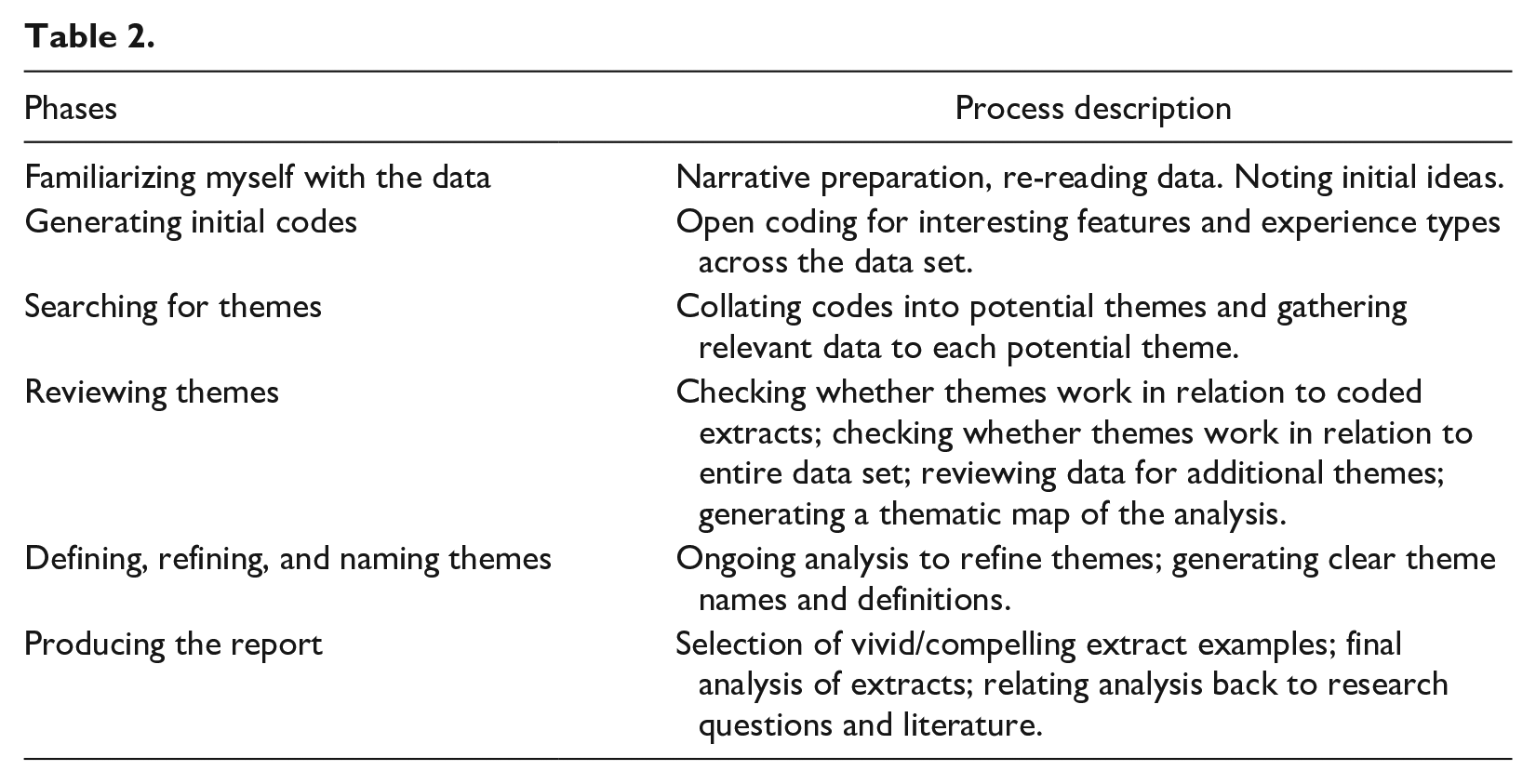
In this study, a latent thematic analysis that is largely based on the model of thematic analysis developed by Braun and Clarke (2006) was employed. In the first instance, thematic analysis was seen as being suitable as it could potentially provide a “rich and detailed, yet complex, account of data” (Braun and Clarke 2006:78). The opposite of a semantic thematic analysis- wherein the researcher simply looks for themes that are inherent in the explicit or surface meanings of the data and nothing beyond that- Braun and Clarke (2006:84) note that a latent thematic analysis . . . goes beyond the semantic content of the data, and starts to identify or examine the underlying ideas, assumptions, and conceptualizations / and ideologies / that are theorized as shaping or informing the semantic content of the data.
For the researcher, this is both a desirable and a necessary component of a thorough analysis. Therefore, analysis has sought to identify themes that capture particular types of form and meaning. For clarity, the stages of analysis entered into by the researcher can be seen in Table 2, which has been adapted from Braun and Clarke (2006:87).
Broader Research Context: A Note on the Irish Welfare Model
Before presenting some data that illustrate the aspects of Goffman’s ([1963] 1990) thesis of impression management with respect to stigma, a note on specificity of the research context is necessary. Unpacking the specificity of the Irish welfare state has always been difficult. Drawing on the work of Esping-Andersen (1990), commonly prescribed welfare state models are usually articulated as follows:
Conservative or corporatist model: Strongly based on the concept of social insurance also known as contributory payment schemes;
Liberal or residual model: Strongly based on social assistance-type payments, also known as non-contributory schemes;
Social democratic or universal model: Strongly based on universal or non-means-tested payments.
In reality, things are seldom this simple and most welfare states have some of the features of all three types. With respect to Ireland, Dukelow and Considine (2014:56) have noted that: . . . in social policy terms, while typically linked with the liberal welfare regime, the range of influences on Ireland’s welfare development has meant that its position as a liberal welfare state is open to some ambiguity. It has been observed that it “defies classification” and is better described as a “hybrid regime,” with links in particular to the welfare tradition of the conservative/corporatist regime.
Since the time in which Esping-Andersen (1990) was writing, welfare provision in Ireland has arguably undergone a paradigmatic shift, much of which has devolved upon increasing levels of welfare conditionality. Welfare conditionality and its effects have seen an abundance of recent contributions in the context of the United Kingdom but have arguably suffered from a lack of cognate data that shed light on the Irish example, although this is slowly changing (see Boland 2018; Boland and Griffin 2015a, 2015b, 2016, 2018; Collins and Murphy 2016; Gaffney and Millar 2020; Millar and Crosse 2018; Murphy 2018, 2020; Whelan 2020a, 2020b; Wiggan 2015). Internationally, literature suggests that ongoing reforms to welfare regimes across jurisdictions since about the 1970s are indicative of the bedding in of neoliberalism as a “global” ideology (Dardot and Laval 2013; Harvey 2007). A pronounced feature of this “bedding-in” has been an emphasis on welfare reform that promotes strict conditionality (Watts and Fitzpatrick, 2018; Umney et al. 2018). In Ireland specifically, 2011 ushered in the beginning of extensive reforms to the social protection system under the then minister, Joan Burton, TD. These saw the establishment of Intreo—a new “one-stop shop” that brought together all employment and income services. Policy followed in 2012 via the Pathways to Work (Government of Ireland 2012) policy document which outlined a series of conditionalities based on new labor market activation schemes was introduced (Dukelow and Considine, 2017; McCashin 2019). Overall, this constituted an emphasis on a “work-first” mode of practice in the Irish welfare state (Millar and Crosse 2018). Much of the data presented in this article bear the hallmark of this changing welfare dynamic.
Encountering Goffman: Impression Management in the Irish Welfare Space
Despite the criticisms leveled at Goffman ([1963] 1990), the data that follows appear to bear out an element of Goffman’s ([1963] 1990) “thing in itself” thesis of what it is to live with, and manage, a “spoiled identity” quite strongly thus demonstrating its continuing applicability. The data show that many of those interviewed regularly engaged in this process to “maintain compliance.” It also shows that this was manifestly twofold with respect to the fact that many of those interviewed found it necessary to apply these techniques to at least two aspects of their lives. First, many of the participants gave descriptions of engaging in impression management in their general day-to-day interactions to maintain compliance with what it means to be a “good citizen” in the eyes of others. This strategy essentially involved managing that part of their identity associated with welfare recipiency by hiding it or by attempting to lessen its impact. It is argued here then that this very act, this continuous process of impression management, engaged to maintain compliance with notions about “goodness” or “good” citizenship, is, in and of itself, causally efficacious in the sense that while it is performatively employed to avoid feelings of shame and stigma, it may also significantly add to feelings and experiences of stigma in the context of welfare recipiency.
Alongside this, many participants have also described engaging in impression management in their contacts with the administrators of welfare in multiple contexts such as in person, through correspondence and through direct action or omission. Again, it is argued that this impression management serves a particular purpose, in this case, the purpose of preserving what it means to be a “good welfare recipient.” Participants often achieve this not only through compliance with welfare conditionality but also through careful management of their own information. It may at first be tempting to conflate or to conceptualize this desire to conform or comply as a successful application of neoliberal governmentality and discourses surrounding responsibilisation. These acts of self-regulation or self-governance do appear to have much in common with ideas around the successful integration of technologies of the self (Foucault 1988). However, the author’s interpretation of the data suggests something different, illustrating that compliance, in many of these instances, is much more likely to be “disguised compliance,” or “partial non-compliance,” that is, the impression, in full or in part, of compliance given in the stead of actual compliance. The concept of disguised compliance is not new and has been explored in literature concerning the social professions, most notably social work (Ferguson 2011). Evidence of similar practices has been uncovered in this study, with participants often appearing compliant when they are not through the careful management of information. Partial non-compliance then is taken directly from the data and conceptualized as being somewhat different to disguised compliance. It is presented as being the acts or actions that a nominally compliant welfare recipient engages in to hide what they see as problematic aspects of their information. These types of compliances then, quite apart from technologies of the self, are much more an aspect of survival. They are about surviving in a welfare space that is discoursed in a language of scarcity and employing the necessary techniques to do so.
Managing Impressions in Day-to-Day Life: Complying with Notions of “Goodness”
Many of the participants interviewed often felt the need to manage the part of their identity associated with welfare recipiency and this took on various forms. In the first instance, it was often as straight-forward as simply lying, whether directly or by omission. For others, it meant making attempts to skirt around this particular area of their lives by framing it in a particular way. For most, it included aspects of both. For example, when asked whether he would ever bring up the fact that he was receiving welfare unprompted, Martin, a recipient of JA, talks about attempting to avoid entering into conversations about this particular aspect of his life when meeting people who may not necessarily know that he is receiving welfare: Not unless I was questioned or unless it came up in conversation I wouldn’t divulge . . . I’d try and avoid it or change the subject.
At times when conversations such as these persisted, Martin was prepared to answer in such a way as to allow him to continue to manage this aspect of his identity: I’d say I’m an engineer in a certain industry . . . I’m an engineer in a certain industry. That’s the usual response I give.
When asked why he felt the need to engage in impression management in this way, Martin was unequivocal: Just from my perspective that’s what I feel I need to do because I just feel that if you divulge anything involv[ing] the social welfare system it’s just like viewed very negatively.
What Martin describes here is, arguably, recognizable as straight-forward impression management. Social welfare is “viewed very negatively”; associating oneself with this is to associate with, and, in-part, take on, this negativity, thus Martin chooses not to divulge where possible. This practice was very common across the participant group and across payment types with the vast majority of participants suggesting that they would not divulge their reliance on welfare if possible and with reasons similar to those given by Martin. Below, Trish, also a recipient of JA, talks at first about lying with respect to her reliance on social welfare: I’ve lied to people once or twice that I was working when I wasn’t working just sometimes not to mention the social welfare part.
Similar to Martin, Trish prefers not to mention to social welfare if possible, going so far as to lie. Again, similar to Martin, where conversations such these persist, Trish has a strategy in place: Well, I’d always say I’m a childminder. And they’d say, are you working at the moment? I could navigate around sometimes. Sometimes I was working . . . But the time I wasn’t I’d lie. I’d basically lie. Just say, yeah, I’m working . . .
When asked why she felt the need to manage impressions in this way, Trish was equally unequivocal: Social welfare equals negativity.
As with Martin, the concept of maintaining compliance with an image of the “good” citizen reveals itself. Trish declares that “Social welfare equals negativity” thus, associating oneself with this is to associate with, and, in-part, take on this negativity, in effect revealing that which “spoils” identity.
Welfare Recipiency: A General Trend toward Keeping It Hidden, the Importance of Context
While impression management is clearly complex and while some of the participants did tend toward a more open strategy, they were very much the exceptions with the dominant tendency among those interviewed being to keep the area of their lives relating to welfare recipiency managed or hidden altogether. However, this is not to suggest that impression management constitutes an either/or, bilateral type, choice between being open or closed about sharing information, rather, for many of those interviewed, it was context specific and multiple factors came into play. For Trish, making decisions about what to divulge tended to devolve upon her sense of the person to whom she was speaking and whether or not she is likely to be negatively judged: It’s like when I meet someone I can kind of read what they’re like first of all. You know, they could have had a different background to me. Sometimes they’re snobby, you know. Sometimes they’re okay.
Trish arguably displays a degree of class consciousness, specifically attaching an importance to the background of people and this ultimately tempers her decision-making process when choosing what to divulge about her personal circumstances. Scarlett, a recipient of OPFP, displays a similar tendency. At first, like others, she tries to avoid conversation in the general area of welfare recipiency: . . . I would try not to. I wouldn’t very openly say that . . . If it comes up in conversation I will say it but I wouldn’t feel particularly—I’m not proud of that, you know.
As with others, Scarlett references a sense of overt negativity surrounding a reliance on welfare recipiency, specifically referring to her sense of pride and, as is also the case with other participants, she is prepared to guide conversations to reflect other aspects of her identity, specifically choosing to refer to the part-time work she had recently taken up at the time of interview: Well, I’m okay now because I work. So I would say I work and I wouldn’t really say anything about generally. Before, I would have just said, “Oh, I’m just a mummy,” you know.
Scarlett describes using an impression management technique which essentially consists of accentuating the “positive” and omitting the “negative” from her own perspective. Interestingly, before taking up part-time employment, Scarlett describes referring to herself as “just a mummy,” choosing this moniker ahead of mentioning a reliance on OPFP, this perhaps suggests that there are degrees to which different aspects of one’s identity have the potential to “spoil.” It also denotes the gendered nature welfare receipt in that Scarlett chooses an identity that is not open to men. Like Trish, Scarlett is also keenly aware of context and of whom she perceives she is speaking too, or to use a dramaturgical phrase “performing for”: I suppose it depends on where I am. But I’d feel I’d be judged for that or looked down on or someone might question my abilities as a parent or my abilities as a person in general . . . it depends again who I’m with and my perception of them, you know, and whether I feel that they would judge me for that or not.
Scarlett is conscious of who she is talking to and what their perception of her might be. She refers specifically to the possibility of being “judged,” “looked down on,” or to having her abilities as a parent or as a person questioned. Again, this speaks to an overt negativity surrounding welfare recipiency and the careful management of information that arises as a result. As with many others, Scarlett engages a strategy of accentuating what she views as the positive aspects of her identity over those she perceives as negative or less favorable and this was a very common impression management strategy for many of the participants. Olive also describes doing something similar: I was working part-time and that was always the thing that was emphasised in talking to people.
So far, the impression management documented here has concentrated on how the welfare recipients engage in impression management in their day-to-day lives. It has been shown that there is a general tendency to attempt to try to avoid the negativity associated with welfare recipiency to maintain compliance with what it means to be a “good” person or citizen. Much of this is wholly consistent with the work of Goffman ([1963] 1990) in relation to managing aspects of a “spoiled” identity. However, as mentioned earlier, the participants interviewed also engage similar tactics when interacting with the administrators of welfare and to this area that attention will now be turned.
Impression Management and Maintaining Compliance When Engaging with Welfare Administrators
Maintaining compliance with what it means to be a “good” welfare recipient often tends to devolve upon the fundamental aspects of welfare conditionality. The data also show that many participants engage in a degree of impression management when interacting with the administrators of welfare to foster a positive image of a “good” client or welfare recipient. To a certain extent, this phenomenon can be described as a type of “disguised compliance.” As mentioned earlier, disguised compliance is a concept of familiar use within the broad spectrum of literature surrounding the social professions such as social work (Ferguson 2011). Essentially, it amounts to the “stage management” of information, actions, and materials to give an impression of “full compliance.” Use of the term “full compliance” is also important as it distinguishes between being fully non-compliant and being only partially so. Many of those interviewed have been compliant with almost all of the various aspects of what is required to successfully manage a welfare entitlement; they may only be non-compliant in a minor way(s). Thus, disguised compliance becomes partially non-compliance. There may also be very good reasons why the people interviewed behave in the way that they do. The welfare space is projected in a language of scarcity as being resource limited, something that claimants and recipients are made to feel in every part of their welfare trajectory (Boland and Griffin 2016; Patrick 2017). In this respect, impression management that fosters the image of the “good” welfare recipient is very much about survival and the need to “keep a hold” of what are much needed resources. It must also be noted that impression management is complex and does not always relate to disguised compliance or even partial non-compliance. Sometimes, the reasons for impression management appear to be as simple as recipients’ putting across to welfare administrators what they feel is a positive image of themselves in the hope of favorable treatment or of being “left alone.” In these instances, the practice of impression management appears to be much like what Goffman ([1963] 1990) describes in Stigma, whereas the reasons for it are arguably different and more readily identifiable as an aspect of dramaturgy outside of a stigma context (Goffman [1956] 1990). The empirical material presented so far shows participants clearly attempting to manage an aspect of a perceived “spoiled identity.” What follows begins to move away from Goffman ([1963] 1990) and appears to be much more about survival in the welfare space.
Fostering the Image of the “Good” Welfare Recipient
Putting across a positive image to welfare administrators as a mode of impression management differed for many of the participants. For example, Jane links forming a favorable impression to work and to the work ethic (see Whelan, 2020b): I feel better about myself when I have a part-time job. And I feel like when I’m on the phone to the social welfare people that if I can say, well, I am working this alongside rearing my two children by myself, I feel a bit better about that—and I feel it’s received better.
Jane states plainly that by virtue of working part-time, she feels she will be better received by welfare administrators and that this eases her communication with them and this was a point she reiterated several times during the interview: This is not to suggest that Jane only engages in part-time employment to manage impressions with the administrators of welfare, her reasons for working and for wanting to work are undoubtedly complex and varied, rather what it suggests is that, for Jane, being able to point to the fact that she is employed part-time forms a useful part of an overall impression management and performative strategy. Nevertheless, aside from this, Jane also engaged in more overt impression management in terms of managing specific aspects of her information. As a common aspect of welfare conditionality, Jane is expected to submit bank statements. Below, it can be seen that Jane is careful to manage her information to not fully divulge all aspects of her income: . . . there’s been times where I would omit a certain month maybe. Like they might have [asked] for six months and I notice that in that last month there that maybe I got [extra] money . . . or something like that—and I just won’t put in that last month and I’ll say, well, if they get back to me and insist upon it I will, but otherwise I’m just putting in five months and see what they say.
Jane can be seen to be engaging in careful, surreptitious, impression management, specifically with respect to her finances. Inherent in this excerpt also are the concepts of disguised compliance and partial non-compliance; Jane appears to be complying with the conditional requirement of legitimate receipt; however, in reality, this is not the case and she tailors her information in the hope that it will go unnoticed (disguised compliance). Nevertheless, while Jane may be attempting to control what information she includes, she is not being fully non-compliant, she does, after all, submit the majority of what is requested and, so, in this sense may be characterized as being only partially non-compliant. Aside then from the act itself, Jane’s motive for the described omission is arguably understandable and entirely sensible: . . . because my fear, you know, is that they would take it off me in a different way and then what was the point of me getting it?
Managing Impressions Due to a Fear of the Consequences
Above, Jane talked about her, not unreasonable, fear that she will lose the benefit of extra income should she reveal it and the general practice of managing information to avoid potential negative consequences was common across the participant group and across payment types. For example, at the time of interview, Mary, as recipient of JA, was suffering from serious social anxiety, but this was something she chose not to disclose as she was afraid of what the consequences might be, a fact she revealed when asked if she had told her caseworker about her anxiety: No, I haven’t, and probably the reason why is because I’m probably nervous that I don’t know what would happen. I don’t know if I would be taken off the Jobseeker’s or if, you know, there would be some consequences from it. And I suppose it’s always a thought in my head that like it’s something that probably should be brought up, but there’s always the fear that like oh, I’ll be taken off it and, you know, I kind of don’t know what’ll happen then after that in a way.
Mary, who originally found herself unable to work due to this anxiety, could potentially be a candidate for DA, which, if successfully applied for, would remove the need for continuous job-searching in the short to medium term. Nevertheless, and despite being at least vaguely aware of the prospect of a different payment, she chooses to keep this aspect of her personal circumstances hidden, afraid of what the consequences might be should she reveal it. As a result, she is expected to engage in a continuous hunt for employment, something with which she struggles: Like I do get very anxious. Because the whole job-hunting experience is anxious for me anyway, but then the experience of nearly knowing someone is kind of looking over your shoulder all the time kind of makes it even more kind of anxiety ridden then because you’re trying to kind of, you know, just, you know, focus on one thing but then you’re like worried that like oh, I’m not doing enough . .
Mary’s experience shows that engaging in impression management with welfare administrators is a complex phenomenon and is not necessarily always undertaken to the betterment of those who engage in it. Trish, for example, was one of the few participants to fully divulge, without reticence, instances of disguised compliance via working “under the counter” while receiving JA: To be honest I always thought I’d have an extra bit of money in my pocket. I kind of look at it from that angle. But I’d always be watching over my back . . . I have done that for a few years, I would admit that. You know, I think everyone has. But you’re never comfortable because you know you’re doing something wrong. And it just takes one person to rat you out . . .
While Trish freely admits to engaging in an act of disguised compliance by working under the counter, it is also clear that it is something she was uncomfortable doing, describing it as “doing something wrong.” This assertion by Trish suggests that while engaging in aspects of disguised compliance may be a reality for some welfare recipients, it is not the “immoral” or “feckless” process that it is often portrayed to be as part of a welfare framing consensus (Jensen and Tyler 2015). Trish did not enter into arrangements such as she describes lightly, she did so to gain “an extra bit of money” and was clearly conflicted in doing so. Ultimately, she suggests she would be happier to work full-time and within the system with the eventual aim of no longer having to engage with the social welfare system: I’d rather full-time than be part-time, you know, because sometimes I think it’s not worth it to be part-time and drawing. Again you’re still dealing with the social welfare, you know. I just don’t want to be dealing with them.
Trish finishes by talking about getting to a place where she no longer needs to “deal” with the administrators of social welfare. Given the complex permutations involved in doing so for Trish and the other participants in the study, it seems a completely understandable desire.
Discussion
Before concluding this paper, it is suggested here that much of what Goffman ([1956] 1990, [1963] 1990) elucidated in Stigma and other work appears to be borne out in lived experience in the context of welfare recipiency. It was noted earlier that there have been valid critiques of Goffman’s ([1963] 1990) text on Stigma which suggested that it may be read as speculative, drawn from a questionable corpus of materials, and lacking an empirical anchor. The empirical data presented in this paper appear to go some way toward constructing that anchor, at least in the specific research context, thus demonstrating the potential and continuing applicability of Goffman’s ([1963] 1990) thesis. New ways to understand the “why” of impression management in the context of welfare recipiency have also been advanced, showing that the reasons people choose to engage in impression management are complex and, in the context of welfare at least, are not always “performed” to offset the stigma of a spoiling attribute of identity.
The central task of this paper was to demonstrate the continuing relevance of Goffmanian sociology to the applied social sciences. Yet, having arguably “encountered” Goffman as demonstrated in the elucidation of the data presented, and having therefore shown the relevance of a particular aspect of Goffmanian theory to applied social science, I want to go further by asking and briefly discussing how useful or meaningful Goffman’s ([1963] 1990) thesis of impression management is. This question of meaningfulness is an important question in light of more recent structural interpretations of the role and function of stigma which appear to move beyond Goffman ([1963] 1990) and symbolic interactionism in general. Therefore, it may be useful to briefly consider some more macro-sociological interpretations in the same thematic space to “push at” Goffmanian theory a little. So, for example, if we take some of the work of Wacquant (2009, 2010), writing in the United States, and consider his contribution to this area, we see that he uses the concept of “social insecurity,” which he presents as a form of neoliberal “statecraft,” to highlight a pursuance on the part of nation states of policies that are essentially designed to punish the poor and vulnerable. Essentially, Wacquant (2009, 2010) argues that a state of social insecurity is continuously created by an ongoing espousal and dissemination of manufactured crisis narratives revolving around members of an “underclass.” These manufactured crisis narratives tend to revolve around typical, figurative, negative stereotypes and include a host of easy targets such as immigrants, members of the traveling community, ethnic minority groups, young unemployed males and single mothers, and welfare recipients. These groups are caricatured as deviant, feckless, lazy, and dangerous, a drain on the state and a burden on the taxpayer. As this discourse “beds-in,” it becomes dominant and ultimately structural functioning as the justification for repressive polices across a range of policy-areas including welfare-retrenchment, workfare and prison-fare programs, and a general shift toward precarious and insecure employment (Wacquant 2009, 2010). The project engaged in by Wacquant (2009, 2010) is important and paints, in broad brushstrokes, a salient theoretical and conceptual picture at the level of social theory. In doing so, it serves as one of a number of points of departure and offers a broad lens or template through which the micro or everyday (symbolic) interactions of the participants in the work presented here, and in other studies, can be viewed. Yet, compelling though it may be, is nevertheless a thesis of the ascription of stigma from above, it tells us very little about what lived experiences are like under such conditions, of how people act, react, and are reacted to. On the contrary, Goffman’s ([1963] 1990) thesis of impression management in the context of stigma and his broader symbolic interactionist work can offer a grounding and an applicability that serves the function of providing a lens through which to interpret empirical materials.
Staying with the same line of reasoning and focusing on the earlier work of Tyler (2013, 2020), who has recently made a significant contribution to the sociology of stigma, we see a similar set of arguments made at a similar level. In earlier work, and drawing on specific examples, in this case the “bogus asylum seeker,” the “illegal immigrant,” the “chav,” and the “gypsy” to name a few, Tyler (2013) uses the concept of the “national abject” to develop a thesis of “social abjection” as a theory of power and subjugation. Tyler’s (2013) theory of national abjection very much mirrors Wacquant’s (2009, 2010) concept of social insecurity in that the groups that are described under its banner essentially become ideological conductors, acting as a form of neoliberal governmentality, the symbolic scapegoats through which the justification for repressive policy-programs is ultimately reached. Notions of “underclass” are clear and again the functional applications of a cultural stigma discourse, in this case explicitly named as a form of governmentality, are apparent. This is a compelling and necessary narrative and one which Tyler (2020) builds upon in more recent work in which stigma is further reconceptualized as a potent and powerful social force with a political role and function and an instrument of state coercion. However, in this more recent work, Tyler (2020) also denotes the impact of the macro on the micro by demonstrating the importance of lived experience. Tyler (2020) does this in a number of powerful ways. In the first instance, she draws on the experiences of others to demonstrate the powerful effect of stigmatizing practices and discourses on individual people and groups. She also very bravely grounds many of her theoretical propositions by writing her own lived experience into the narrative. In doing so, she demonstrates the importance of the micro-sociological within the “bigger picture.” Therefore, although critical of Goffman, suggesting he is more concerned with “how social rules work rather than . . . what they proscribe” (Tyler, 2020:99), she nevertheless demonstrates the importance of social rules and the effect that they have on an individual and at the micro-sociological level. The work presented in this paper, although the angle may be different, seeks to do something similar by demonstrating and then considering how social rules are “performed” in the everyday and based on empirical materials. In this respect, it can be suggested that while high-level structural explanations of phenomena have their place in elucidating a role and function for a concept like stigma, something too is lost in this project. Essentially, “theorising from above” can lose sight of those below and can overburden a concept like stigma which, when it becomes “all things,” effectively becomes meaningless. It can be argued then that, together, theorists such as Wacquant (2009, 2010) and Tyler (2013, 2018, 2020) have engaged in the theoretical under-laboring necessary to instigate a conceptual clear fall. In doing so, they have provided a broad sociological space into which the small-scale researcher may journey to seek to “trouble” common-sense understandings of stigma. Tyler (2020), in particular, grounds this macro-project in lived experience. Goffmanian sociology potentially offers the tools to help with this grounding. Both types of sociology are necessary. Goffman ([1956] 1990, [1963] 1990) and the toolbox provided by the symbolic interactionist tradition are therefore still necessary and useful to applied social science. Indeed, it might be said that a call for a new Goffmanian project of sociology from below, a sociology which makes real the interpersonal nature of social discourse, is a necessary one, particularly if the social sciences are to strike a balance between the theoretical and the applied.
Conclusion
The central task of this paper has been to present an exposition of and an argument for the continuing usefulness of Goffman’s ([1963] 1990) thesis of impression management in the context of stigma to the applied social sciences while also acknowledging some of the very valid critiques that have been leveled at it. The argument made for a Goffmanian approach to the doing of sociology essentially devolves upon the need to situate the micro-sociological within the understandings at the macro-level. The value of sociology in the broad tradition of symbolic interactionism is also acknowledged and its continuing relevance to the applied social sciences is reaffirmed. A core component of how the arguments made here have been advanced has been through the elucidation of empirical materials. Working through these materials, the classical Goffmanian conception of impression management comes alive as the research participants are seen to describe engaging in certain modes of “performance” with respect to their identities as welfare recipients. In the main, these performances revolved around managing aspects of biography that could potentially “spoil” identity in various social situations as part of a desire to conform to internalized norms around what it means to be “good.” However, new understandings of the “why” of impression management in the context of welfare recipiency were also advanced. Much complexity was revealed, and it was shown that welfare recipients often engage in impression management to present themselves as “good” to the administrators of welfare. It was also shown that welfare recipients engage in impression management because of a need to maintain compliance with particular aspects of welfare conditionality. In some instances, impression management strategies engaged in to denote full compliance took the form of disguised compliance, in others it was seen to be more akin to partial non-compliance. The implications of these new understandings allow us to reimagine impression management as something which can become a necessary aspect of survival in the context of welfare, as welfare recipients are forced to use every available strategy to effectively compete for what are discoursed as scarce resources. Of welfare systems, this suggests cold faceless bureaucracies that are to be appeased as opposed to welcoming and supportive spaces tasked with administering social goods. However, despite the value that is inherent in these claims, is, this paper is limited in that what it presents is based on a small-scale study in a specific geographical location. As a result, its applicability in other jurisdictions and to other welfare regimes is left unaddressed. This shortcoming suggests that more scholarship in this area of study and in other jurisdictions—scholarship that takes a ground-up approach as argued for here—is needed to further bear out what has been presented. It is therefore hoped that what has been presented may act as a template, in part at least, for social researchers exploring this research space. Ultimately, it is suggested that the arguments advanced in this paper add to a burgeoning canon of knowledge with respect to the lived experiences of welfare recipients and so joins a growing body of scholarly literature.
Footnotes
Declaration of Conflicting Interests
The author(s) declared no potential conflicts of interest with respect to the research, authorship, and/or publication of this article.
Funding
The author(s) received no financial support for the research, authorship, and/or publication of this article.
