




Abstract
This article investigates the possible negative effects of power in organizations. It demonstrates how holding power may affect an individual’s perception of others, actions, and cognition. Ways in which power may have a detrimental effect on different aspects of a manager’s functioning within an organization, including building relationships, communication, and performance are analyzed. It is argued that individuals are unaware of these effects, and thus it is necessary to introduce methods of their diagnosis and countermeasures on the organizational level. In addition, negative phenomena associated with the power’s distribution among organizations’ units and its structural aspects are analyzed. A set of questions is proposed, which can be used by individuals and organizations to reveal the extent to which adverse effects of power are present in an organization. These inquiries can be used to design and introduce specific countermeasures and improve communications and the quality of interactions within organizations. Selected countermeasures are also proposed in the article.
Holding power is a central element of management, and power itself is one of the most important concepts in social science. Managers are given power because it is necessary to exert influence, introduce changes, turn visions and plans into reality, ensure the completion of tasks, and make organizations reach their goals. However, insights from social science reveal that having power over other people not only allows to transform the organizational reality but is also likely to change power holders. Many of these findings are robust as they have been observed across different settings, research designs, and contexts. Some of these processes can be regarded as positive due to their potential to support managers in fulfilling their obligations (Finkelstein 1992; Vecchio 2007). On the contrary, many are harmful and result in a lack of understanding between managers and subordinates, the negligence of important information, or even corruption (DeCelles et al. 2012).
In this article, an attempt is made to illustrate the ways in which power holders are likely to think, act, and perceive others. By highlighting these phenomena, I seek to raise awareness of the possible effects of power. It is proposed as the first step in an attempt to provide guidelines that may help maximize the utilization of beneficial effects of power and assuage the negative ones. At the same time, it is argued that mere awareness is not likely to be sufficient. There is a growing body of evidence suggesting that even when people are conscious of the fact that their behavior toward others and the way of thinking may change under different circumstances and that these changes might bring negative outcomes, it is difficult for them to have control over these processes (Bargh and Alvarez 2001; Kahneman 2012; Roese and Vohs 2012). People are led by strong motivations that may result in a lack of accuracy in self-assessment. They include the self-serving bias, which can be, for example, connected with managers’ overestimation of the quality of their relationship with subordinates (Byron and Landis 2019). In a given situation, people usually perceive their actions as reasonable even if they are wrong or can be harmful to others (Tripp and Bies 2010). Dealing with them may require a substantial effort that should be exerted on the organizational rather than on the individual level. This proposition goes in line with the argument that any attempts to mitigate negative effects of biases are more likely to bring results if a systemic approach toward them is employed rather than when people try to rely on individual actions, good intentions, or willpower (Ariely and Wertenbroch 2002; Kahneman 2012; Lieberman, Rock, and Cox 2014).
It is important to emphasize that organizations that disregard negative behaviors of power holders (who are expected to serve as role models) need to face the reduction of the quality of interpersonal relationships and employees’ satisfaction and, at the same time, decrease their own potential for obtaining important objectives. Dysfunctional leadership and its effects on the organization have, for example, been analyzed by Kets de Vries (2003, 2019). Its consequences tend to be severe. In this article, I would like to propose one possible way social scientists can assist organizations. Rich research findings on the nature and effects of power can be applied in a real-world setting by precisely defining areas of possible conflicts, miscommunication, corruption, or a sense of injustice. Their identification, in turn, can lead to organizational self-reflection resulting in either incremental or more fundamental changes. To facilitate that process, I present a list of questions, which, depending on circumstances, might be used fully or partially to diagnose and improve the functioning of managers and organizations. They are the primary addressees of these questions that can be used as elements of surveys in the 360° review process, to measure organizational culture, climate, or employee engagement and satisfaction. These suggestions are not exhaustive, and single elements of the list can likewise be used in daily conversations by organizational members who seek meaningful feedback. In the article, the followers’ role and the organizational context are also highlighted because any attempt to address the described problem systemically needs all stakeholders’ involvement.
Many prominent scholars wrote about power and conceptualized it. One of them was Max Weber, who made a distinction between power (Macht) and domination or authority (Herrschaft). Different translations of these words to English cannot exactly cover their original meaning. Scott (2019) proposed that the distinction between them is similar to that between “might” and “mastery” in English. Macht is related to simply imposing one’s will through the means available. In turn, Herrschaft is a fairly stable and long-lasting phenomenon that emerges when power can be executed through social control and social acts. Its endurance is related to being embedded in institutions. Macht can be seen as formless and Herrschaft as institutionalized. The phenomena described in this article related to the misuse of power can be related to both these concepts. Since organizations, organizational units, and people who operate within them are in the center of interest in this article, power discussed here is often institutionalized, but it is not its only attribute.
There are different definitions of power in social science. In this article, it is understood as the capacity to influence others, control others’ outcomes and overcome their potential resistance. The way of understanding power employed in this article pertains to individuals and also to units and departments operating within organizations. This definition allows analyzing the phenomenon of power across a variety of situations. At the same time, it includes elements common in social scientists’ conceptualizations of power across different fields and approaches (e.g., Emerson 1962; French and Raven 1959; Goldhamer and Shils 1939; Keltner, Gruenfeld, and Anderson 2003; Overbeck 2010).
Power can stem from multiple sources, both structural and personal (H. L. Smith and Grenier 1982). They include centrality, substitutability, and the ability to reduce uncertainty within organizations (Hickson et al. 1971; Mechanic 1962) that overlap with sources of power studied by scholars focused on individuals, for example, legitimate, coercive, information, and expert power (French and Raven 1959). In addition, sources of power related to personal qualities should be mentioned. They include referent power, persuasiveness, or charisma (Yukl and Falbe 1991) but also knowledge or energy. All sources mentioned here can play an essential role in processes that shape power relations and which effects are described in the article.
It is important to state that power can have both positive and negative effects. Some of the former are also described in this article, and I acknowledge that the functionalist perspective on power highlights how it helps attain important goals (Overbeck 2010). I am also aware that having power may enable promoting socially important projects and values (Katsos and Fort 2016). I focus, however, on its darker side as negative aspects are more likely to be visible to other organizational members (Martin et al. 1983) and affect their attitudes (Baumeister et al. 2001). The article is divided into four sections covering essential areas of the effects of power. Three of them focus on power holders and subordinates—their perception, actions, and cognitive processes. The last section presents the broader perspective, which considers the power of organizational departments, its fluidity and stability, and its structural aspects. Each section is concluded with a specific set of questions to be used by the decision-makers. The article also includes a proposition of countermeasures that can be applied within organizations.
The considerations included in the article are based on the review of the literature describing models and empirical findings on power. The article is theoretical and offers suggestions that may be useful in the operations of organizations. The concept of power is multidimensional; it has one of the longest traditions in terms of scholars’ interest and has been studied by researchers and thinkers representing different fields. Thus the author does not attempt to prepare an exhaustive review of the effects of power. A much more modest approach is made to identify the common topics visible in studies on the effects of power on individuals and organizations. The topics raised in the seminal publications on power including the work by Emerson (1962), Hickson et al. (1971), Keltner et al. (2003), Kets de Vries (2003), or Kipnis (1972) were of great importance to the author as a source of inspiration. At the same time, it needs to be admitted that even though an attempt was made to include essential topics and to select sources on the basis of their importance and relevance, a certain degree of subjectivity related to the author’s perspective can be present in the article and should be regarded its limitation.
Power and the Perception of Others
David Kipnis, one of the precursors of the research on power and the author of the metamorphic model of power, believed that it changes people because of how they start to perceive others (and themselves as well) (Kipnis et al. 1976). According to Kipnis (1972), as power holders exert influence and make others follow instructions, they become more likely to see their subordinates as less internally motivated. In turn, power holders view their actions as the main reasons behind the behavior of others. According to Kipnis, this process ultimately leads to distancing oneself from those who have less authority. Kipnis’ works constitute one of the most significant traditional approaches to power in social science and one of the most influential ideas about its effects on people. His intuition and considerations about the distance that power holders feel toward those dependent on them have been confirmed in more recent empirical studies. It has been found, for example, that power holders display a cynical attitude toward instances of generosity presented to them by others. Namely, they tend to believe that a self-serving intention is likely to lie behind such actions. This way of thinking does not only increase the distance to others but also “corrupts relationships” (Inesi, Gruenfeld, and Galinsky 2012).
Distance toward subordinates is one of the crucial factors shaping how power holders perceive them. The social distance theory of power developed by Magee and Smith (2013) proposes that those who have power are likely to feel less dependent on their subordinates than vice versa. They are also less willing to establish close relationships with their low-power counterparts, and at the same time, expect them to be willing to affiliate. As a result, both groups (power holders and subordinates) tend to feel a distance between each other, but it is different in such a way that power holders perceive it as larger. This mechanism has significant consequences for the functioning of those who are in power. It was found that they are, for example, more immune to others’ attempts to exert influence (Galinsky et al. 2008).
On one hand, this may bring positive results as it can allow those who are in charge remain firm in the face of adversities when they attempt to, for example, carry out the necessary transitions, which are one of the critical challenges faced by managers (Will 2015). On the other hand, it was found that the distance that power holders feel toward others makes them more likely to discount the advice that they are given (See et al. 2011; Tost, Gino, and Larrick 2012). For example, people who declared that they had a significant influence on their organizations or units and could shape decisions affecting others (including salary allocation and employment) were assessed by their coworkers as less willing to accept advice (See et al. 2011). Adjusting one’s own initial opinion by incorporating advice given by others is difficult for people in general (Harvey and Fischer 1997). However, it seems that it may be even more challenging for those who are in power. They are inclined to distance themselves from others and experience elevated self-confidence (Briñol et al. 2007).
Empirical evidence indicates that the feeling of power makes people more likely to ignore others’ advice, including experts (Tost et al. 2012). This effect can be regarded as quite alarming. Experts’ advice was found to be more likely to be accepted solely if high-power decision-makers were expecting to collaborate with them. When others were just presented as exceptional experts (in the top 5% in terms of past performance), power holders felt the sense of competition and did not pay attention to their advice. This result highlights the need to build an organizational culture where managers feel comfortable seeking advice and admitting to not being an expert in a particular domain is not considered a weakness. Otherwise, power holders may be likely to consider genuine experts as potential or current rivals and demonstrate reduced willingness to take their advice into account.
Another issue related to others’ perception by power holders is their greater tendency to see people through the lens of their usefulness to goals that the power holder is trying to achieve. This effect was described, for example, by authors of the approach/inhibition model of power (Keltner et al. 2003), and it makes those who have power more attentive to characteristics of others which comprise agency. Agency and communion are two rudimentary dimensions that people pay attention to when they make judgments about others’ personality attributes (Wiggins 1991). Agency includes traits that allow people to pursue goals (e.g., proactiveness, competency, being strong-willed). In contrast, communion pertains to people’s proclivity to build relationships and includes such traits as friendliness or sincerity. Communion is viewed in social science as a primary dimension in the process of perceiving others. It includes attributes that are more important to people as they indicate whether an individual might be willing to bond and cooperate (Abele and Wojciszke 2007).
In a series of experimental studies, Cislak (2013) discovered that this relative importance is reversed among power holders. They are likely to look for and value their subordinates’ characteristics indicating agency. The reason for that is the fact that these traits are more strongly related to goal attainment. This phenomenon suggests that those in charge are often prone to build only partially accurate images of those who depend on them by focusing on selected characteristics. People with power are also often more inclined to perceive others using stereotypes (Goodwin et al. 2000), which can be harmful to employees’ satisfaction and performance. In turn, adopting the approach related to discovering employees’ individual, distinguishing traits and strengths has been identified by both practitioners and theorists as crucial for developing effective teams (e.g., Lencioni 2012) and establishing satisfying leader-member relationships (Fuller et al. 1996). It seems paradoxical that this process might be inherently problematic for power holders who can significantly benefit from its utilization.
It is also important to acknowledge the role of the followers’ perception in shaping the relationship between them and the power holders. One of the crucial aspects is the level of trust toward a high-power person (e.g., Norman, Avolio, and Luthans 2010). It has been emphasized that quite often, managers are perceived by subordinates as untrustworthy and that the “us-against-them” syndrome develops quickly in organizations (Mishra and Morrissey 1990).
Different aspects of the relationship between trustor and the trustee in the case of power-related organizational relationships have been considered (Willemyns, Gallois, and Callan 2003). One of the most important characteristics is the ascending and descending trust spirals. They have been analyzed by Shapira (2019a) on the not uncommon example of “jumper” managers who join an organization and take the leadership position. They are not familiar with the organization’s specificity. As a result of longitudinal ethnography in the kibbutz context, Shapira observed that such managers were often likely to display behavior that generated descending trust spirals. This was particularly the case when they chose autocratic behavior to conceal their lack of knowledge. Trust was established by those who decided and managed to expose it. Power abuses, together with surrounding oneself with incompetent yes-men, were among the elements of the descending spiral development. Also, other authors proposed ways in which trust can be built. Whitener et al. (1998) described five dimensions of trustworthy behavior which may be displayed in the manager–subordinate relationship. They include behavioral consistency over time, behavioral integrity understood as the congruence between words and actions, delegating and sharing control, communication, and displaying concern for others. Together with the described courage to admit one’s shortcomings, they might help omit the risk of developing a descending trust spiral, which is likely to trigger negative power-related behaviors.
After describing the above phenomena, I would like to propose the first group of questions that can help diagnose the presence of possible adverse effects of power that pertain to the perception of others.
Questions:
Are managers in the organization encouraged to acknowledge their lack of expertise in specific areas and rely on experts?
Do managers in the organization weigh more heavily advice from experts than from nonexperts?
Do the organization and managers recognize acts of citizenship behavior?
What is the reaction to employees who meet the objectives (e.g., KPIs) but display negative behaviors toward others, and how are they perceived?
Are members of the organization individuated and recognized for their characteristics beyond those strictly related to task accomplishment?
Are employees’ expectations toward new managers managed to allow the latter to learn about the organization effectively?
Are trust-building behaviors encouraged and recognized among both power holders and their subordinates?
Power and Action
Those who are in power tend to be focused on goals and are likely to act on them. Power liberates people’s ability to move to action (Pike and Galinsky 2020) and makes them act in a way that is more congruent with internal traits, characteristics, and values (S. Chen, Lee-Chai, and Bargh 2001). Empirical evidence indicates that this propensity exists among power holders, regardless of whether they are about to engage in actions that have positive or negative consequences for others (Galinsky, Gruenfeld, and Magee 2003). In addition, those who hold power are less likely to adopt or consider others’ perspectives and empathize (Blader, Shirako, and Chen 2016). Meanwhile, perspective-taking is regarded as one of the mechanisms that can stop or change behavior that brings socially negative consequences (e.g., Vescio, Sechrist, and Paolucci 2003). Keltner et al. (2003) described power as a phenomenon which increases approach-related behavior. On one hand, it is related to goal-striving but on the other also to negative effects, which include being insensitive toward personal boundaries or displaying aggressive behavior. It can be summarized that power has the potential to make people more likely to take action, which can bring positive results to organizations, for instance, when their members display proactiveness (Thomas, Whitman, and Viswesvaran 2010). However, it is also likely to facilitate the emergence of unwelcome behaviors (e.g., Bargh et al. 1995).
Holding power changes the perception of actions and their consequences. An interesting study showed that people in charge tend to underestimate the time needed to complete goals (Weick and Guinote 2010). This phenomenon referred to as the planning fallacy, has been a topic of scientific inquiries. It has been found that people, in general, find it remarkably difficult to correctly assess the time needed to complete a given task or a project. Striking examples of effects of this bias include planning and constructing the Sydney Opera House (scheduled to open in 1963 and delayed by a decade) or the Berlin Brandenburg Airport (scheduled to start operating in 2012 and still not operating in 2020). Planning fallacy pertains to large projects and everyday situations, including students’ assessment of a study project completion time (Buehler, Griffin, and Ross 1994) or managers’ assessment of the time they need to complete items on their to-do lists (Kruse 2015).
Interestingly, it may be easier to be valid in the assessment of other people’s plans than one’s own (Buehler et al. 1994). One of the potential causes of the planning fallacy is a strong focus on the project at hand, which is accompanied by paying much attention to future outcomes and neglecting past experiences. It seems that this bias can be attenuated by directing attention to past experiences and monitoring necessary subtasks (Kruger and Evans 2004). These two elements are essential in the agile approach to projects, one of the possible answers to the difficulties of accurate time allocation and assessment (Serrador and Pinto 2015). This example indicates that a systemic approach may be required to successfully deal with the effects of biases, including those related to holding power. Leaving the decision about deadlines and the assessment of estimated project duration to a single manager focused on future goals may very likely result in erroneous decisions.
Power has also been found to affect risk-related actions. Specifically, people in the position of power are more likely to view risky situations and their possible outcomes optimistically. This effect has been observed across different contexts and research designs. One such design involves the examination of actions undertaken during negotiations. Bargaining situations often include one party’s advantage, which may result from the possession of alternatives, knowing more than a counterparty, being respected by them, or substantial social capital (Galinsky, Schaerer, and Magee 2017). An interesting study revealed that power inclines people to get involved in negotiations, take the initiative during their process and be the first party to put forward propositions of solutions (Magee et al. 2007). Taking these actions can lead to better results than refraining from them. Again, it should be highlighted that their effectiveness may be contingent on a particular situation. It has been discovered that those in power reveal an increased amount of information during negotiations because they downplay the risk of this action (Anderson and Galinsky 2006). One of the essential dilemmas that need to be solved during bargaining involves the choice between creating and claiming value. Creating value requires strategic and cautious information sharing, which evokes the reciprocation from the counterparty (Thompson 2012). Empirical evidence indicates that those who have power may be more likely to divulge their genuine interests regardless of whether it is beneficial or not. It is likely to result from an automatic process associated with the specific perception of the situation. It has been shown that power, in general, increases self-confidence (Briñol et al. 2007) and decreases loss aversion (Inesi 2010).
Holding power increases the propensity to engage in actions regardless of whether, in a given situation, it is the best possible option. Guinote (2017:14.7) stated that the empirical evidence suggests that power holders have a readiness to move forward toward desired ends, even when the direction of behavior is unspecified. These effects may equally pertain to negative disinhibited behavior (Gonzaga, Keltner, and Ward 2008) and not being loyal toward partners (Lammers et al. 2011). Holding power is closely related to displaying self-interested behavior. This effect has been demonstrated in experimental research, which proved that power holders tend to make choices in the pursuit of their benefits, even if at the same time they decrease possible payouts for a larger group of their subordinates (Bendahan et al. 2015). Interestingly, the authors of this study found a significant discrepancy between declarations and actual behavior among power holders. Contrary to their assertions that leaders should care about the well-being of others, they acted in a way that decreased the public wealth. It is important to emphasize that the self-serving bias makes it difficult for people to acknowledge such inconsistency.
Similarly, those who enjoy benefits stemming from their higher social status are often not aware of that fact and are likely to oppose any attempts to aid those underprivileged (E. S. Chen and Tyler 2001). Those power holders who overtly display corruptive behavior, including workplace bullying, often perceive it as a means that is necessary for maintaining the discipline and achieving results and refer to it as, for example, “tough management” (Georgakopoulos, Wilkin, and Kent 2011). Also, those high-power individuals (in this case, men) who make unwanted advances have been described to be sometimes unaware of the inappropriateness of their behavior (Bargh et al. 1995). Sexual harassers were found to be sometimes surprised by the fact that their behavior was assessed negatively or was harmful to others (Fitzgerald 1993).
Evidence indicates that self-serving behaviors conducted at the expense of the organization’s objectives, as well as unethical actions displayed toward others, can be another effect of power that is not easily visible to power holders. Shapira (2019b) noted that leaders who occupy their position for a long time often become dysfunctional. They are no longer able to initiate vital changes, do not allow worthy successors to grow, and continue to collaborate with the same people who are also not likely to introduce modifications required in a fast-changing environment. At the same time, those leaders may feel irreplaceable and unable to imagine themselves outside of the organization and the company without them. However, an organizational-level mechanism that allows their replacement is possible to develop and put into practice (see Shapira 2019b). In the analysis of managerial incompetence (Argyris 1976; McMillan and Overall 2017), a single-loop decision-making model has been identified. Its characteristics include the concentration of power, superficial problem analysis, and ineffective actions accompanied by adopting a short-term perspective. Managers who surround themselves with mediocre, conformist collaborators are particularly likely to fall into this trap.
The employees’ actions and opposition may be crucial to prevent the negative aspects of the power holders’ behaviors described above. Simultaneously, these may not be easy to introduce due to the effect of the double bind related to the low-power position (Galinsky and Schweitzer 2015). This phenomenon occurs when a low-power person is trapped in a situation that does not have the right solution—deciding to remain silent leads to the acceptance of the current situation or even its reinforcement, whereas speaking up may lead to punishment. A possible solution to this situation may be sought in the findings of the employee voice research. Employee voice is defined as discretionary and informal communication, directed to those who can introduce suggested changes to improve work-related issues (Van Dyne, Ang, and Botero 2003). Several vital factors influencing employees’ choice to speak or remain silent, including individual differences, job attitudes, and leader’s behavior, have been analyzed (Detert et al. 2013). Apart from them, the agentic role of subordinates should also be highlighted. Morrison (2014), for example, suggested that it is vital for the organization’s employees to be mindful that their voice is more likely to be heard when they do not only describe problems but also offer potential solutions.
Based on the description of the effects of power on actions and their perception, the following questions to include in the process of the organizational self-reflection are proposed:
Are managers given feedback about how their interpersonal behavior is perceived?
Does the organization have a trustworthy procedure which can be used to report unwelcome behavior if it occurs?
Are deadlines discussed by managers with teams assigned to projects before they are agreed with other stakeholders (e.g., upper management/customers)?
In what way are past experiences and lessons learned used in the process of creating plans for the future and scheduling work?
What tools are used to assess the risks of considered actions?
Is there a mechanism that allows the timely replacement of dysfunctional top-leaders?
Are members of the organization mindful of employee voice’s positive results, and are employees aware of conditions that increase its effectiveness?
Power and Cognition
Holding power has also been found to change human cognitive processes. According to Ana Guinote, the author of the situated focus theory of power (Guinote 2007), power holders are likely to identify the essential elements of the situation and prioritize well, emphasizing what is vital in terms of their goals. The ability to focus on what is crucial for the goal realization is further increased by the reduced press of the situation that people in charge experience. One of the interesting and robust research results reveals the relationship between power and abstract information processing. It is worth highlighting that this relationship seems to be reciprocal. When the feeling of power is evoked, people tend to process information more abstractly while experimentally evoked abstract thinking results in a higher sense of power (Wojciszke 2011). People in the position of power are more often than others required to think about the big picture and consider the effects that a project or a decision may have globally. In organizations, managers possess broader knowledge about different aspects of their functioning and are required to think strategically (Tawse, Patrick, and Vera 2019). All these mental processes involve more abstract thinking. In a series of experiments, P. K. Smith and Trope (2006) demonstrated that power is associated with several different effects that can be attributed to adopting a high level of abstraction.
One of them pertains to how power holders categorize objects, actions, and people. Powerful individuals use higher levels of abstraction, which means that they are, for example, more likely to think of such an activity as reading in terms of “gaining knowledge” than “following lines of print” (P. K. Smith and Trope 2006). Categories created by them are more inclusive- someone (or something) that is moderately related to a category might be more readily seen as belonging to it. People who hold power are thus likely to perceive other organizations’ members on higher categorization levels- as belonging to broad groups whose members are similar to one another. For example, the category of the Y generation representatives may include all young people regardless of their background or exact age and used as an explanation of multiple behaviors and attitudes. This mechanism may be responsible for greater power holders’ proclivity to use stereotypes and see others through their lenses (Goodwin et al. 2000).
The effects of holding power on cognition are complex. On the one hand, it equips power holders with what might be necessary to focus on goals and to achieve them despite obstacles. On the other, it might cause them to struggle with difficulties when building a team of followers. The latter can discover that they are perceived stereotypically and evaluated in terms of their usefulness to power holders’ plans and objectives. In addition, power holders might encounter communication problems as they process the information on a different, more general level than their direct reports. Managers are more likely to “look at the entire forest,” while specialists may tend to “focus on trees.” Abstract information processing is related to a reduced ability to be down-to-earth, even when the current situation requires it. This, in turn, is associated with the risk of managerial derailment, which occurs when a promising manager is “fired, demoted, or plateaued below expected levels of achievement” (Lombardo, Ruderman, and McCauley 1988:199). Derailment is a severe and costly problem for organizations and often a personal tragedy to a manager. Due to the existence and prevalence of the false consensus effect, power holders may often be unaware that their ideas are not shared or understood by others. This phenomenon makes people prone to overestimate the extent to which others think similarly and hold similar opinions (Bauman and Geher 2002). The simple reason behind that may be the described different levels of abstraction and different perspectives.
The cognitive processes of the powerless are less abstract (P. K. Smith and Trope 2006) and less flexible (Guinote 2007). In addition, in the case of the powerless, scarce cognitive resources are often focused on what powerful others might think of them and used for impression formation (Overbeck and Park 2006). As a consequence, subordinates may be seen as unable to offer a substantial contribution to the process of ideas generation. Propositions related to enabling employee voice mentioned in the previous section may be relevant. In addition, it might be beneficial to raise awareness of the described cognitive mechanisms among both the powerholders and subordinates. The fact that they tend to operate on different levels of abstraction may either be a source of conflict or a good starting point for creating the synergy between the strategic and operational perspectives.
Basing on the description of the effects of power on cognition, I would like to propose the following questions to be used in the process of organizational self-reflection:
Does the company develop and train the managers’ and subordinates’ ability to engage in actions that facilitate perspective-taking?
Do managers have opportunities to interact with people from different organizational levels and departments?
Are the company’s long-term strategic plans which guide the actions of managers shared with employees?
To what extent are managers capable of keeping the balance between strategy and short-term tactical objectives?
Does the company culture allow employees to propose alternative solutions or provide feedback to managers if they have a different point of view?
Are the employees aware of the broader picture of the organization’s functioning?
The Organizational Context: Departmental and Structural Aspects of Power
It is crucial to emphasize that power holders do not operate in a vacuum, and power should also be analyzed within the organizational context. In this part of the article, elements of the dark side of power operating on the departmental level and the structural aspects of power are investigated.
More than five decades ago, Jay (1967) made an interesting observation about the similarity between business organizations and states’ functioning in the renaissance era. Jay is considered the first person who introduced Niccolo Machiavelli’s thoughts to management studies (Jackson and Grace 2013). He asserted that management was a continuation of the art of government and described observations on the functioning of organizations, including the distribution and the misuse of power. At almost the same time when Jay’s book was first published, Perrow highlighted the importance of analyzing the power of different organizational departments (Perrow 1970).
One of the essential theories which describe this phenomenon is the strategic contingencies’ theory of intraorganizational power formulated by Hickson et al. (1971). Authors of this model proposed that power in organizations should be perceived as a unit-level phenomenon. The degree of the unit’s power is related to three different factors: its ability to help the organization cope with uncertainty, its substitutability, and centrality. The theory has spurred further studies, and it remains an influential proposition that helps to understand power dynamics (e.g., Greve and Zhang 2017), including its negative aspects. Organizational units with a high level of power may be inclined to exert it for their benefit due to the lack of possible negative consequences (E. S. Chen and Tyler 2001). For example, sales departments whose actions are most directly related to obtaining revenues and whose power is often built on centrality may become overconfident about their unique role within the organization. It may lead to negative relationships with other departments and the emergence of organizational silos. In addition, a feeling of injustice and decreased motivation in other teams may be strong and destructive (Kickul and Lester 2001)
One example known to the author of the current paper pertains to a single department where sales unit employees were seen as central and obtained significant additional remuneration. At the same time, those responsible for supporting sales and the after-sales service were demotivated by the increased workload, which was not additionally rewarded. The source of the sales unit’s power, apart from its centrality, was related to its irreplaceability. In this particular branch, the fact that a salesperson decided to leave the company would usually result in a loss of clients. It is an anecdotal example of a particular unit, but any department characterized by the three criteria identified by Hickson et al. (1971) is likely to enjoy more power. Undoubtedly, developing a distribution of power that is as close to optimal as possible is challenging. The observation of the department’s power on a company’s performance should be performed over a long period and is not easy for methodological reasons (Germann, Ebbes, and Grewal 2015). Therefore, it may be crucial for companies to reinforce such decisions using data from robust empirical research.
Power, observed on the departmental and the individual levels, has the potential to both: remain fairly stable and be fluid. Its level can increase in one department and diminish in another one, depending on the dynamics of factors affecting power (Feng, Morgan, and Rego 2015). Several scholars suggest, however, that social hierarchy within organizations is often quite stable due to the self-reinforcing nature of power (Magee and Galinsky 2008). Intraorganizational narratives and hierarchy-justifying beliefs often favor the established power distribution (Jost, Banaji, and Nosek 2004). It is more comfortable for people to believe that the system in which they operate is mainly fair, and such beliefs reinforce the hierarchy (Oldmeadow and Fiske 2007). The possible misuse of power related to this phenomenon might be perceived through the lens of the dominance perspective on power, which assumes that those who gain it are apt to keep trying to strengthen it (Overbeck 2010). The unit’s power increase is facilitated by the departments’ ability to attract limited organizational resources, including salary increases or talents (Pfeffer and Salancik 1974).
A single unit or department’s high-power level may result in negative outcomes for the entire organization. It has been proposed that organizations can be perceived as a system comprised of groups who seek power (e.g., McMillan and Overall 2017). In its pursuit, units may try to prevent the organization from systemically solving essential problems. They may thwart attempts to permanently reduce the level of uncertainty that a given unit currently helps to cope with and uphold the situation in which their functions seem irreplaceable, or their role remains central. A notable example of this phenomenon is the ability of the Sears’ chain store’s catalog department to remain operating until the last decade of the previous century, despite the negative ratio of benefits and costs of its maintenance for the entire company (Schaefer 1998). The Sears’ catalog was an innovation when it was first released in the nineteenth century. It was also one of the elements contributing to the company’s success.
Dalton (1959) observed and indicated the prevalence of between-groups power struggles in organizations and their potential for producing negative consequences. He described observations gathered in a chemical plant and analyzed aspects of power distribution among different cliques. On the one hand, cliques were often an inevitable element that allowed the organization to put operations into practice and complete various initiatives, which illustrated the importance of informal power in organizations. On the other, they were found sometimes to be responsible for adverse organizational outcomes. For example, a “vertical parasitic clique” connected by personal relationships often allowed individuals to obtain an unjustified level of influence over others and was a source of mistrust among employees.
Li, Matouschek, and Powell (2017) analyzed the organizational-level dynamics of obtaining and retaining power almost overtly used for selfish purposes. Basing on the principal-agent theory developed within economics, they propose that the level of power, which initially is optimally allocated to specific departments, is later very likely to be limited or expanded in a non-optimal way. In the organizational reality, the increase in power is often one of the promised future payoffs for the current performance. A unit that performs well in the present may become very powerful in the future, even if this will not allow the company to better cope with the situation faced at that time. The reason for this is the willingness to keep current promises. According to the authors, possible consequences are easily observable in contemporary organizations. They include significant differences in how companies perform and are organized, even if they are similar in size and operate in the same branch. The difficulties encountered by older, established companies with petrified power distribution can also be partly attributed to this phenomenon. From this point of view, an organization may often face a vicious dilemma. If past promises are kept, and the unit’s power is increased, the organization may reduce its ability to cope with present and future demands. If, however, they are broken, the level of organizational trust will suffer. No matter which option is followed, an adverse effect related to the power distribution is likely to emerge.
It does not mean, however, that power distribution within organizations cannot be fluid. It has been shown that it can transform, and there are at least several proven instances that facilitate this process. They include a rapid change in the organization’s environment, an increase in the intensity of competition between different units, and situations that trigger the perception of unfairness after its level surpasses a certain level (Magee and Galinsky 2008). The hierarchy established within an organization may be challenging to change. Thus, at times, the occurrence or even provoking any of the mentioned elements may be necessary to initiate the process of applying necessary organizational changes.
The next element that requires consideration is the structural aspect of power. In general, the higher the person’s position in the organization, the more frequent her experience of being in the position of power, and the more likely the occurrence of phenomena described in the previous sections of this article (Anicich and Hirsh 2017). At the same time, members of organizations regularly interact with people of different relative power. Placing focus on middle managers can help analyze elements of the structural aspect of power. They comprise a specific and interesting group in the middle of power relations that has been described as vital for organizations’ success (Mollick 2012), Its analysis allows demonstrating a nuanced and relative nature of power (e.g., Dopson and Neumann 1998). An important aspect of the middle managers’ job is communicating and implementing strategic changes developed at the organizational top. Their role requires conducting various tasks, flexibility, and meeting conflicting demands related to the unique structural position they hold.
Dopson and Neumann (1998) analyzed middle managers’ reactions to the transformation of psychological contracts in situations requiring them to meet contradictory expectations. These included, for example, the necessity to think strategically while being mainly held responsible for short-term results, or reducing the number of jobs, while maintaining employees’ motivation and confidence. Such conflicting demands and ways of coping with them are frequently an issue of managerial interest during training and post-graduate studies. Finding ways of obtaining role integration is one possible solution to this challenge (e.g., Reyt and Wiesenfeld 2015). Dopson and Neumann (1998) observed that middle managers, particularly at later career stages, often felt that their level of power was diminishing and that they were no longer able to influence their organizations. They reacted with passivity and occasionally displayed strong negative emotional reactions even though they seemingly accepted changes. These results show how power can be relative and fluid in organizations and that its negative aspects can also be related to its perceived loss. One of the elements most difficult to accept for middle managers is not being involved in the process of developing solutions that they need to implement (preferably with a high level of motivation and engagement). In other words, in their perception, they lack the power to affect the strategic direction; still, they should feel empowered when it comes to turning it into the organizational reality and dealing with the resistance to changes.
Anicich and Hirsh (2017) analyzed the possible consequences of middle managers’ frequent interactions with both those who have power over them and their subordinates. They referred to this situation as a “frequent vertical code switching.” In their opinion, it is often burdensome for middle managers, in particular when they keep their superior’s and subordinate’s roles segmented. Factors of both the organizational and personal nature may be responsible for the scarcity of activities and behaviors that can help an individual develop role integration (Mazmanian, Orlikowski, and Yates 2013). Engaging in situations when both low- and high- power roles can be exercised in a non-conflicting way, e.g., during meetings which include representatives of different structural positions, might be beneficial. It was found that integrated roles, together with the trained ability to switch from one role to another quickly, can positively influence work-related outcomes, including the level of individual satisfaction (Rothbard, Phillips, and Dumas 2005) and creativity (Reyt and Wiesenfeld 2015). The example of middle managers indicates that the structural aspect has its unique contribution to organizational power-related phenomena.
The analysis performed in this section allows to state the following set of questions:
Is the inevitability of contradictory expectations and paradoxes related do the power distribution acknowledged and discussed in the organization?
Is the company’s departments’ power distributed following their present ability to support obtaining organizational objectives and not just due to the historical reasons?
Is the company familiar with robust longitudinal research findings on organizational design and effective power distribution?
Are middle managers involved in designing changes which they are required to implement?
Are training and development opportunities diversified depending on the managers’ career stages (and not only their position)?
Are role-integration behaviors related to the shifting level of organization members’ power accepted and supported?
Discussion
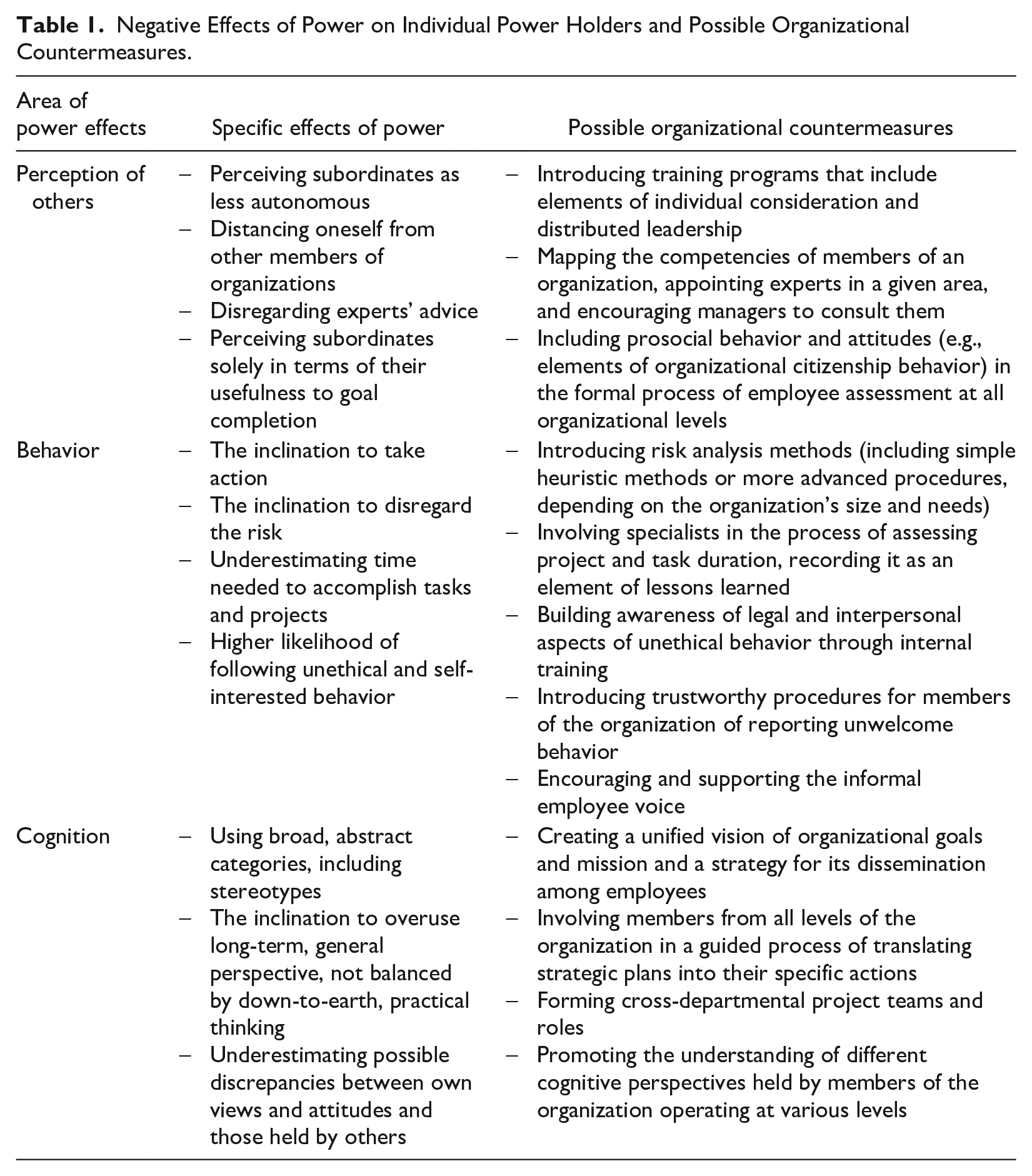
Social sciences, including sociology, organizational and social psychology, political studies, and ethics, have a tradition of examining power and its effects. For instance, any list of the most well-known experiments in psychology and sociology would include two, which revealed possible negative consequences of holding power (Hock 2009). The first one was Milgram’s authority experiment, which demonstrated that people might be capable of applying a potentially lethal electric shock because they are told to do so by an authority. The second one was the Stanford prison experiment. It proved that being randomly assigned to an experimental group with considerable power over other people (i.e., prison guards’ power over detainees) is sufficient to elicit behaviors that can be described as a misuse of power. These experiments are well-known and have been debated and used as a basis for analyzing various social phenomena, including organizational behavior (Haslam, Reicher, and Van Bavel 2019; Miller 2011; Pina e Cunha, Rego, and Clegg 2010). Their findings have been used to increase the understanding of different mental and social processes’ consequences among the general public and the policymakers. They contributed to the realization that the way in which external circumstances are shaped has a pervasive influence on people’s actions. Results of these and other scientific investigations indicate that power involves the emergence of mechanisms that can have negative consequences for the quality of decisions and results of actions performed by those who hold it. To a certain extent, it affects organizational power holders and influential departments. However, it predominantly can be more harmful to those who depend on them and, perhaps most importantly, to organizations’ ability to reach their goals. Organizations need to adopt a systematic approach to deal with this challenge. Possible countermeasures that can be introduced as a reply to the effects of power described in sections 2, 3, and 4 of the article are presented in Table 1. Please note that they are all based on using organizational solutions instead of relying on good intentions and self-awareness of power holders, which is unlikely to bring sustainable results.
Negative Effects of Power on Individual Power Holders and Possible Organizational Countermeasures.
In Table 2, the negative phenomena operating on the department level and those related to the structural aspect of power are listed together with proposed countermeasures.
Department-Level and Structural Phenomena Related to Power and Possible Organizational Countermeasures.

An interesting issue is whether power holders might be willing to limit their power. A seminal economist and Noble prize laureate, Oliver Williamson (1995), noted that certain inefficiencies in political bureaus’ and agencies’ functioning could be related to a farsighted approach and perceiving one’s authority as unstable and subject to changes introduced by successors. Successors may simply choose to use power against those who were in charge before them. Economics represented by Williamson emphasizes the system’s approach, farsightedness, and rationality and the role of power may be seen from this perspective as more limited. Indeed sometimes, it might be rational to limit one’s power, particularly in those political systems and organizations where checks and balances function well. On the contrary, it may be likewise rational to maximize one’s advantage and attempt to weaken the opponent so that it would not be possible for her—or—him to regain power. One may have an impression that in two and a half decades that have passed since Williamson wrote about bureaus’ inefficiencies, the latter approach has begun to prevail. The need to learn about the adverse effects of power and countermeasures might be thus even more pressing.
Conclusion
Social science has gradually increased the understanding of different mechanisms that can be associated with holding power. Disseminating this knowledge and developing practical suggestions for organizations seems to be a task of no lesser importance than their discovery. It is noticeable that media are full of stories about ways in which people holding power are affected by corruption in different areas, including politics (e.g., Mathiason 2007), business (e.g., Kim, Yoo, and Uddin 2018), or sports (e.g., Knight 2019). A robust, quite surprising, and pessimistic finding indicates that those who misuse power are often unaware that they act in an inappropriate or harmful way (Bargh and Alvarez 2001). Thus, it seems that we cannot just rely on the self-control and good intentions of those who are given power and hope for the best. Mechanisms described in this article may be too potent. The attempt to find a possible solution should be moved from the individual to the organizational level and from isolated reactive efforts to developing a planned approach.
One possible method is synthesizing perspectives of people from within and from the outside of the organization. Merton (1972) described insiders as members of particular groups or occupants of certain social statuses and outsiders as nonmembers. Quite often, both of these groups have their own perspectives that they believe to be true. As Merton (1972:11) put it: “There emerge claims to group-based truth: Insider truths that counter Outsider untruths and Outsider truths that counter Insider untruths.” In this article author’s experience, specific adverse mechanisms operating within an organization are easier to overcome when someone from the outside brings attention to them. However, sustainable changes require a thorough analysis and being respectful of the insiders’ point of view. The outsiders may easily say: “you are doing it in a wrong way,” and the insiders may reply: “but you just do not understand our perspective.” This article contains a set of propositions from the outside of organizations where they may be applied. However, the belief that the list of proposed questions and countermeasures, even though not exhaustive, can be used by organizations to verify the prevalence of power’s adverse effects seems to be justified. It can be incorporated into managers’ and organizations’ review processes, audits, or organizational climate surveys. As it is based on robust empirical evidence that pertains explicitly to the effects of power, it has the potential to grasp the prevalence of real-life phenomena.
Footnotes
Declaration of Conflicting Interests
The author(s) declared no potential conflicts of interest with respect to the research, authorship, and/or publication of this article.
Funding
The author(s) received no financial support for the research, authorship, and/or publication of this article.
