



Abstract
In the 2018 President Address provided by Gary David, he discusses the need for new approaches to how applied and clinical sociology is branded. He explores business approaches to how we can leverage our passion for sociology with the unique skills we have with clear messaging around what it is we do and why we do it.
When I was first asked to run for President of the Association for Applied and Clinical Sociology (AACS), I wondered what I could add to what has been done by past presidents. Much has been said about how applied and clinical sociology can be advanced to show its importance and relevance to the world. What else could I contribute which might be meaningful and helpful?
Behind much of what has been said about advancing applied and clinical sociology is a key irony. On one hand, most of us would agree that we have this marvelous profession which can answer so many questions, has the power to find things out in the world that before were unrecognized, and has the ability to help create solutions. At the same time, applied and clinical sociology is underrecognized for the work that is done under its name and by those who are in this room. Why is that? Why is it that despite all the contributions we can make, we still lack recognition for our work?
That led me to think about this idea of “What’s Phase 2: Crafting a Value Proposition for Applied and Clinical Sociology.” I’m not claiming that I have it worked out. I do think there are some recommendations and some ways that collectively we can come together to figure out how to get our message out to others so they can see the work that we do. In this talk, I’m going to go over some ideas, based on my work at a business school and working with businesses, which I think can help in this effort. Having a foot in each academic and applied worlds has allowed me to see things from different sides and perspectives, hopefully allowing me to bring the best of both together. To start that conversation, I want to explore my accidental career in sociology in programs that were fundamentally action oriented in nature versus the more well-known and research-oriented programs that are most often discussed within sociology.
My Accidental Career in Sociology
My career has been a series of fortunate accidents. I went to Central Michigan University in Mount Pleasant, Michigan, just because my brother went there. Kids today apply to numerous schools, do site visits. I did none of that. I took one test, got in, thank you very much, and showed up on campus in the fall. There was nothing special about the school except for being familiar, close enough for trips home when needed, and far enough away to discourage any surprise visits from parents.
Originally, I was planning on being a clinical psychologist because I wanted to help people. Then I took my first introduction to sociology course. It blew my mind, as is probably the case for most of us who went on to major in sociology. I don’t think that anyone goes to college planning on being a sociologist. I certainly didn’t. I didn’t even know what it was. I took the sociology class because a student advisor during orientation told me that I should sign up for a sociology class because he heard it was “cool.” He was right; it is cool. And that started me on a sociology journey, in what was not a well-known sociology program. Don’t get me wrong. It was a good program. I had great professors. But it is not a program that ranks among those you typically hear of. And I was lucky for that because it was focused on action-oriented sociology, what we can do with it to impact our worlds.
After completing my bachelor’s and master’s degrees, I ended up at Wayne State University in Detroit for my PhD. The reason I ended up there was because I couldn’t get any graduate student funding at any other places I applied to. With nowhere else to go and at the last second, one of my advisors called somebody he knew down at Wayne State to get me in. I hadn’t even applied there originally. But, out of options, I went back home to the Detroit area to start at Wayne State without knowing anyone who taught in the program or what I was going to do there for my work. With no plan, I just ended up there.
It turns out that this was one of the most fortuitous things that could have happened because I don’t know of a more applied and clinical program that you could find at a PhD level. Half or more of my cohort didn’t even care about academic careers. They wanted to get a degree that they could use in a professional field. I, in fact, might be one of the outliers who has a professor position. At Wayne State, I encountered Dr. Mary Cay Sengstock. She taught a graduate course called Clinical Sociology. Her course was the first time that I heard the term. Wayne State might have been one of the only programs in the United States with such a course and is where the journal Clinical Sociology Review is still archived. Surrounded by applied people, and taking clinical classes, I by accident ended up in the perfect location to become an applied and clinical sociologist.
After graduating from Wayne State, I ended up getting a job at Bentley University, which was Bentley College at the time. The reason I ended up at Bentley was that they offered me a job and nobody else did. I applied all over the place to many different schools, as a doctoral student does, and couldn’t even get an interview anywhere. With my advisor knowing a person on the search committee, I got a preliminary interview, a college visit, and ultimately a job offer. Again by accident, I ended up at another school that I didn’t plan on nor ever heard of.
Making it stranger is the fact that Bentley is a private business school. My immediate question was, “What am I going to do at a private business school?” As an undergraduate, I used to avoided the business school building because I refused to walk into it on principle. What am I going to do at a business school? I never felt like I had any use for business people, and I was sure that they had no use for me. In sociology, we are taught to be highly critical of businesses and corporations. Now I was going to a place that educated on their behalf.
It ended up being the greatest accident that I could imagine because I would argue there is no better place to be an applied and clinical sociologist than at Bentley University. Being a business school, they value applied work regardless of where it originates. The fact that you are using sociology to accomplish some goal or outcome was in fact very attractive during my job interview and site visit. This kind of work is valued across promotion and tenure, across performance reviews and evaluations, all of that.
Keep in mind that we don’t even have a sociology major, but yet we can have influence as sociologists. The school emphasizes the integration of Arts & Sciences and Business, or what I call the “Art and Science of Business.” Impact is not measured by how many students in your major, but by the impact you have in the classroom, through your work in scholarly research, and your contributions to applied settings.
I think one of the important threads in all of this, for me at least, is the fact that these are all small programs. I know that a lot of attention is given to big Research One programs. I get why they are important, and I’m not slighting those programs. But so many of you in the audience today are from these small and less well-known programs. Our AACS organizational members are from small programs. Those kinds of programs really get the idea that we need to be educating, training, mentoring, and instructing students on how to use sociology to do in meaningful ways. I also think that from these programs we can find begin to establish a greater path to relevance, especially when combined with an emphasis on why we got into sociology in the first place.
Sociology’s Self-Imposed Irrelevance and South Park
Let’s try this out. Using Poll Everywhere, I want you to take out your phones and respond to the question, “What words represent why you entered sociology?” (see Figure 1).

What words represent why you entered sociology?.
The words that are coming up include change, justice, making a difference, passion, interdisciplinary, empowerment, understanding, and curiosity. Nowhere here is anything about a big paycheck or the income. Of course, there are sociologists who make quite a bit of money, but that is typically not the motivation for entering the profession. We got into sociology to make a difference, but often we are not in positions (nor are we taught how to put ourselves in positions) to do precisely that.
The reasons that we got into sociology make me wrestle with what I call sociology’s self-imposed irrelevance. Ultimately, sociology did this to itself. How is it that we have the most interesting classes that anyone could take, but yet sociology is not seen as relevant when people are examining society and looking for explanations? How is it that we can be well suited to have an impact, but people rarely ask us for our input?
The self-imposed irrelevance refers to that for so much of sociological history, there has been this attempt to professionalize and gain “legitimacy” as academics. In trying to achieve legitimacy in the eyes of some academic institutional order, we have become so obtuse that no one can understand what we are saying.
This naturally leads me to start thinking about an episode from the cartoon series “South Park.” The particular episode in mind is the one with the underpants gnomes. If you have not seen this episode, there are these gnomes that go into people’s rooms and steal their underpants (see Figure 2).

Underpants gnomes.
The underpants gnomes have a business model associated with stealing underpants that goes like this:
Phase 1: Collect underpants;
Phase 2: ?
Phase 3: Profit.
The whole episode is about “What Is Phase 2?” Even when they ask each other, no one knows what Phase 2 is. The model is just collect underpants and then profit. No one knows what is that missing middle piece.
I then start thinking about how the underpants gnomes business model is like why we got into sociology (see Figure 3).
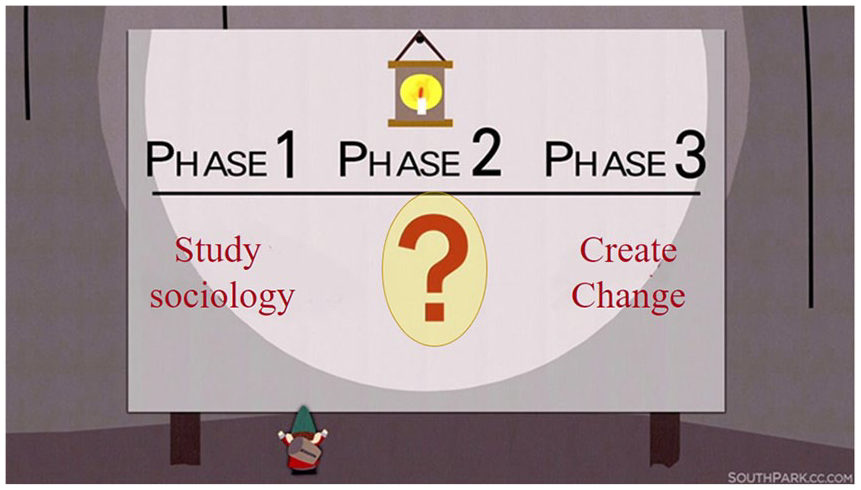
Sociological underpants gnomes model.
We go into sociology because we want to create change. We want to help people. We want to have some sense of justice. But what is Phase 2? How do we get from studying sociology to creating change? How do we make that jump?
What I would say is Phase 2 is applied and clinical sociology. It’s through that mechanism that we can find a way to makethat change. We can find that relevance. We can find that connection through our work with people’s lives in ways that have impact and meaning. And that’s what I want to talk about more today.
Let’s try to the Poll Everywhere program again and answer the question, “What word represents applied and/or clinical sociology to you? What does it mean to you?” (see Figure 4).
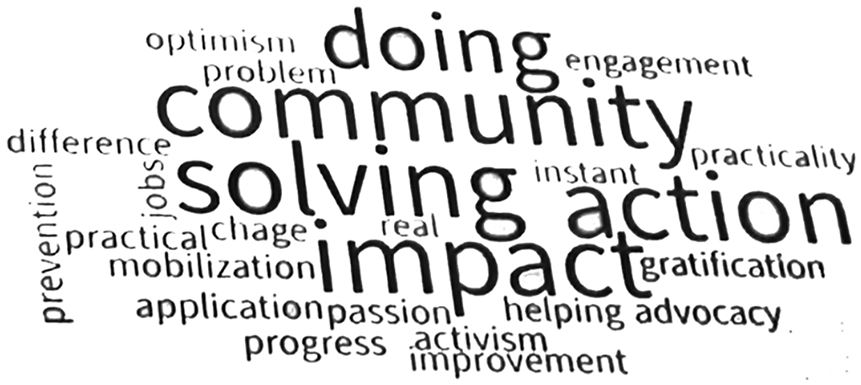
What word represents applied and/or clinical sociology to you?.
The words we see coming up include action, impact, progress, practicality, doing, and solving. And I think we could have guessed ahead of time what people would have said: community, action, improvement, and passion.
The question then becomes how do we get there? What is that Phase 2? And one of the things that I want to focus on is the branding of it.
Branding Applied and Clinical Sociology
Perhaps one of the most common questions we might get in AACS is what is meant by applied and clinical sociology. If you ask different people, you will probably get some different answers, which can cause further confusion. Also, those definitions might be hard to remember because, as sociologists, we often speak in ways that can be confusing. Let me provide the way in which I define applied and clinical sociology for those who are not sociologists. To do so, let me use a medical example.
Let’s think about what we might call “academic medicine.” To illustrate, let’s think about the scenario of two doctors talking to one another about a patient. One doctor says to the other: “The patient presents as an approximately 70yo female, with a fever of 104 degrees Fahrenheit, abdominal distress, moderate discomfort in her joints and generalized pain, and a positive throat culture.” The other doctor responds, “She seems to be suffering from streptococcal pharyngitis and influenzavirus B. Are you going to tell her?” The first doctor responds, “Nah. But I am going to publish this paper on it!”
That would be academic medicine. The audience for the analysis is not the patient, or other people outside of medicine. Rather, the focus is communicating with other physicians and academics through medical journals and the like. And there are people in medicine who do research and don’t talk to patients ever. This doesn’t diminish their contribution because research has an important role and function to play in medicine.
Let’s turn to what we might call “applied medicine.” In this scenario, we have a patient and doctor in an examination setting. The patient tells the doctor, “I have a fever, aches and pains, my throat is sore, and my stomach hurts.” The doctor responds, “You have strep throat and the flu. See you later.” The doctor then dismisses the patient without any other information.
Now, this is helpful information to have. If you were told you had strep throat and the flu, you could probably go out and find a solution given your better understanding of what’s going on. The doctor is translating medicine into lay language for the patient’s benefit. At the same time, it would be nice to have a solution as well.
Finally, let’s turn to “clinical medicine.” The patient says the same thing that was said in applied medicine. But this time, the doctor responds, “You have strep throat and the flu. Take this prescription for your throat, and rest with plenty of fluids for the flu.” It is the recommendation for treatment makes this clinical. The doctor is creating an intervention to help improve a situation, using knowledge and experience to formulate a plan of action for the patient.
Let’s see how we can use these scenarios to talk about applied and clinical sociology.
So here is my take on who we are as sociologists. First, we have “Foundational Sociology,” which involves “using theories, concepts, and methods of sociology to study topics, with the primary audience being academic outlets.” This is what most of us were trained in. Majoring in sociology involves some basic level of understanding in how to do this. The further you go in your sociological study, the more of this you learn.
Second, we have “Applied Sociology.” We can define this as “using theories, concepts, and methods of sociology to study topics and increase understanding, with the primary audience being non-academic outlets.” That could include things like community organizations, individuals who are in counseling, industry organizations, and policy groups. The goal is to translate what we have found to further the understanding of the topics about which they are curious and the situations they face.
Finally, we have “Clinical Sociology.” Before we get to this definition, I have to say that even though I am a Certified Clinical Sociologist, what clinical sociology meant really wasn’t made clear to me until Dr. Tina Uys told me when I was going for certification that I was a Clinical Sociologist. I had submitted my certification to be a Certified Sociological Practitioner. I had thought that being clinical meant I had to do medical work. She told me that this isn’t what it means and indicated that in fact I was a clinical sociologist based on the presentation of my work. Here I was as president-elect of the AACS, and I couldn’t clearly articulate what was clinical sociology. Her comments crystallized in my mind what clinical sociology means.
With Clinical Sociology, we are “using the theories, methods, and concepts of sociology to study topics and increase understanding in order to design solutions, with the primary audience being non-academic clients.” Here, we have the big difference being around creating interventions and effecting change. We are taking what we know from our study, we are translating it for a broader audience, and then we are creating solutions to help them effect change and outcome. You also can add measurement on the back of that to evaluate the effects of the interventions.
The framework I think is a concise way of branding who we are and what we do (see Figure 5). I can tell you that when I talk to business people about this, I even short cut it more and say that I’m a “design sociologist.” I design solutions to help clients solve problems that they are facing using a systems perspective and broad methodological framework. The goal is to simplify the pitch so they quickly can understand who it is I am, what value I bring, and how I can help.
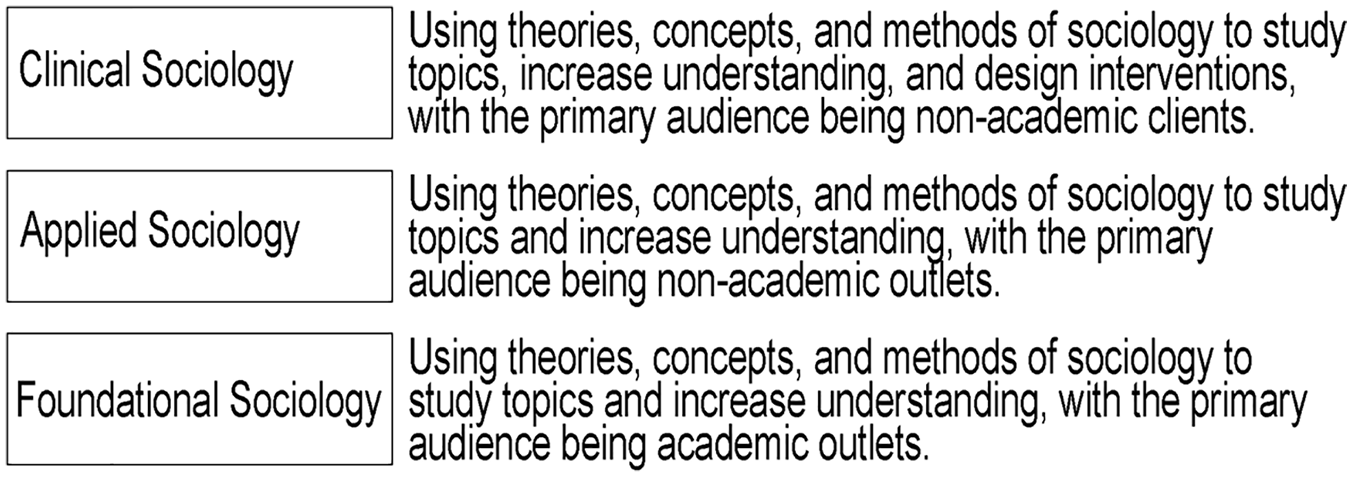
Framework for applied and clinical sociology.
While simplification is part of it, another element is to capture and communicate the passion that we have for sociology. As we will see, the “why” of sociology is even more important than what it is that we do.
#WhyApplied
Our hashtag for this conference was #whyapplied. This phrase was motivated from this book I was listening to called “Start with Why.” The author Simon Sinek talks about how the core or kernel in any organization’s mission is “why do you do what you do?” In other words, what is the purpose of your organization? The next step is to talk about “how do you do what you do?” Finally, you can discuss “what do you do?” They key is to start with why.
To see what this means in practice, we might look at the current 2018 AACS Web site, which has the slogan, “using sociological knowledge to promote beneficial social change.” It is a good slogan, and this is in no way a complaint about it. At the same time, the statement focuses on what we do. We “promote” to others the benefits of social change.
I would argue that we need to focus on “why.” For instance, we might think of a slogan, “Turning the sociological imagination into transformative change.” Our purpose is to use the potential of sociology (and the sociological imagination) for creating positive change for people, communities, organizations, and societies. We are trying to turn what we know how to do into an outcome that we want to so. That’s the Phase 2 of moving from knowing to doing.
Of course, there could be other “whys” to consider, and going through a conversation of why we are here can be very helpful in getting us to articulate it in clearer terms that others can understand. If we were all to individually think about our own“why,” or our own purpose(s) for doing sociology, we would come up with a list that can clearly articulate to outside audiences the passion behind our profession. Such an approach would open the door to then explaining how we do it, and finally, what we can do with it.
As an organization, it is the job of the AACS to help people get from their “why” to their “what.” The AACS can serve as that bridge in making that journey possible, to fill in that gap in Phase 2. A conference-based organization like AACS has the challenge of only being able to reach those who come to the conference. At the same time, there are people all over the world who are looking for these kinds of answers. Many of them don’t have the opportunity to come to the conference. Also, there are people who don’t even know that we exist who are looking for these kinds of answers.
We as an association need to do a better job, and those of us who are applied and clinical sociologists need to do a better job, of getting that message out. Toward that end, we are going to be launching a variety of different things that go beyond the conference. One of the new initiatives we are going to be doing is something called Applied U, which are programs to help you turn your sociological imagination into applied and clinical impact. The goal is to provide every month for next year a webinar that’s going to be free. We will be looking for people to give ideas for what they would like to see and do as part of the webinar series as well.
All these efforts go back to the central question of how we as an organization can help to unlock that potential in you to make it possible to achieve the change that you are looking to make.
Delivering the Message
Our success in gaining an audience is going to come down to how we are delivering the message. There is a radio personality that I listen to quite frequently on the SiriusXM channel Urban View by the name of Joe Madison. One of his favorite phrases is that “you have to put it where the goats can get it.” By the way, Joe Madison has a degree in sociology from Washington University. Putting it where the goats can get it means explaining it in a way that people can understand. This is where the value proposition of applied and clinical sociology starts to come in.
Simon Sinek tells us, “Value is about perception; not calculation.” One of the things I learned working at a business school is that people used to believe that value and price were driven by supply and demand. We now know with behavioral economics that value is constructed and created through influencing people’s perceptions. What something is worth is not necessarily derived from what it is worth in-and-of-itself, but to what extent people see it as valuable.
Being at a business school, I am confronted with what I call the Open House problem. Around 98 percent of the students who go to Bentley major in some form of business. During the open house for prospective students, I’m at the sociology table, and it is very lonely there. Usually the Number 1 question I answer is, “Where’s the bathroom?” Another question that I get asked is, “What does sociology have to do with business?” I used to just respond by saying “Everything.” But that really doesn’t answer the question in detail. Then I came across this quote again by Simon Sinek: 100% of customers are people 100% of employees are people If you don’t understand people, you don’t understand business.
Based on this statement and his image, I created a handout that added to the quote, “Study sociology. Understand people.” At this year’s open house when I was asked the question of what does sociology have to do with business, I would hand the person this sheet of paper, and they would immediately get it (see Figure 6).

Study sociology. Understand People.
Whether it be business-to-business or business-to-customer model, business fundamentally is people-to-people. In addition, this is a moment in business where people are back in. The emphasis on customer experience, employee experience, student experience, patient experience, and user experience is all about refocusing on delivering value to people. All of it also is applied and clinical sociology. In all the businesses I have spoken with in this space, none of them have ever said they don’t need sociology. Rather, they all have said they need more of it.
What they need from it is not just our methods, although they need that too. They also need our systems-based perspective. They need the ways in which we can see what is in an environment, and how we can make sense out of it, or we might say, translating complexity into action, which is the theme of this year’s conference.
I don’t know how many ethnographers are in the audience today. One of the skills of being an ethnographer is getting excited about walking into a situation that seems chaotic. We enjoy finding these complex environments and the challenge of making sense of them—for a lot of quantitative people, especially in analytics fields, when they walk into a situation like that and are not sure what to do or how to manage it. Ethnographers are more comfortable in complexity.
The same can be said to a certain extent to all sociologists. We are comfortable at jumping levels from micro to meso to macro. We can talk about things at a systems-based perspective. As a conversation analyst, I also can talk about what is happening in interactions. As sociologists, we have this amazing skill set that many other people and professions do not have. At the same time, having such a broader skill set and many tools in our toolbox can be problematic when people can’t identify anything in particular that we are good at. When we say, “You can do anything with sociology,” that doesn’t provide people with a pathway of what they can do in particular.
Sociology in general, and applied/clinical sociology in specific, needs to get better at our branding. A book I was recently listening to is called “Building a Story Brand: Clarifying Your Message So Customers Will Listen” by Donald Miller. Building a brand is something that we are never taught in graduate school. In the book, the author lays out three key ingredients to branding:
What do you offer?
How will it make one’s life better?
What do I need to do to get it?
I added a fourth point, which is “Communicate in terms that the client will understand.” Miller refers to this fourth point as “The Grunt Test,” or a message so clear that a caveman can understand it. We need to learn to communicate not as academics, but as cavemen (or cavepersons).
Again, I’ve been lucky to be at a business school where I have to break things down and translate content so that nonsociology students can understand it, or putting it where the goats can get it. If I was at a school where I was teaching sociology majors, I wouldn’t have to break things down in a way that nonmajors could understand. Talking to nonsociologists is a tremendous training ground to get better at messaging, figuring out whether the message is working.
Another part of messaging is “turning what you know into what you can do.” Very often people will talk about what it is that they know from whatever topics they have studied. Less frequently will they talk about the skills that they’ve used to do that work. Part of Phase 2 is emphasizing the skills that we know how to do, the practical things that we learned. We need to communicate our skills in ways that others can see as valuable.
For instance, if we look at a typical list of sociological skills, we might see the following:
Critical thinking
Communication
Analytical
Cross-cultural
Research
Interpersonal
These are all great skills, but we might ask in relation to these skills “So what?” By that I mean, this list indicates the skills that we might have, but not specifically articulate what you can do with them in ways that help others (such as clients). That one can think critically is great. Being able to articulate why that is important and what can be done with it in practical terms is better. What can be done with all these skills that adds value in terms of whatever people see as valuable.
Going back on more time to Simon Sinek, we can think about The Sociological Golden circle. When we think about our own “why,” we might articulate our passion for sociology and create positive change. Moving to our “how,” we can talk about how we are able to translate sociological theories, concepts, and methods for clients to better understand the situations and challenges they are facing. Finally, when thinking about “what,” we can articulate that we are trying to accomplish the translation of findings into action and their implementation for effecting positive change. In these, we can see our levels of sociology as well: Foundational sociology as the “why” Applied sociology as the “how” Clinical sociology as the “what” To me, this is the value branding of applied and clinical sociology.
Pulling It All Together
Branding and messaging is about understanding the audience that you are trying to reach. I have had to spend a lot of time talking to people in different industries, understanding how they spoke, what kinds of information mattered most to them, recognizing what kinds of information they need for the challenges they face. As an ethnographer who studies work and workplaces, this activity was an extension of what I do for research purposes. For those who are not ethnographers, I would suggest using an ethnographic mind-set as you join professional groups that you want to reach. Network in them to learn how people speak and communicate. We need to go to where they are, listen to what they need, and then figure out how to articulate to them in simple terms that they can understand.
A second strategy is to develop a social media brand. Social media can make you more discoverable, as well as point people in a direction where they can see what you do. Develop a social media presence that fits in with the groups that you are trying to reach, and builds your own brand of expertise. These are professional social media accounts that are meant to provide quick insights into the work you do. LinkedIn can be crucially important because people will use it to look you up. When making an account, don’t make it in academic terms unless you are trying to reach academics. Mirror the types of accounts that you would find among those you are trying to reach. You can bring your own sociological insights by commenting on events in the news, in the professional fields you are trying to explore, or any topics that you find important.
Third, you can think about content creation for broader audiences. We live in an age of content creation for online dissemination. You can try your hand at creating content for the audiences you are trying to reach through blogs, videos, social media posts, or any other type of content. It is important that you communicate in nonacademic terms so your target audience can better understand what you are saying and the value you are adding.
Fourth, we must fight against the impostor syndrome that we often suffer from. Academia is interesting in that you can spend years and years studying a topic, write a massive dissertation on it, and then graduate thinking that you don’t know much about it or how limited the work is. We need to be able to communicate with confidence the things we know and what we know how to do. We need to move beyond our advisors’ voices in our heads or the voice of Reviewer Number 2.
Fifth, we need to fill in the gaps in our knowledge. One way of doing this is by broadening out your reading (and listening) lists to help compensate for what we haven’t learned about the professions with which we are trying to engage. If we are only rooted in academic literature, that is going to be the language that we speak, and the skills that we have. Moving beyond that will allow us to better translate what it is that we are doing and improve our branding.
Finally, I would encourage you all to join and become involved in the AACS, as it is the only organization by and for applied and clinical sociologists. Join other like-minded sections and groups that are dedicating to using sociology and social science. It is a good opportunity to learn from others who are doing the kind of work that you are looking to do.
As the organization and the board are actively engaged in crafting these opportunities and programs, I invite you to be active participants in helping to shape that journey. It is by coming together to unite our common passions, our shared purpose, and our combined dedication to creating positive change, that together we can bring applied and clinical sociology out of irrelevance and into fulfilling its promise. Through this work, we might be able to start making the world look more like the image of it we’ve always had and hoped for.
Footnotes
Declaration of Conflicting Interests
The author(s) declared no potential conflicts of interest with respect to the research, authorship, and/or publication of this article.
Funding
The author(s) received no financial support for the research, authorship, and/or publication of this article.