




Abstract
Police officers are expected to serve and protect civilians. Yet cases of police officers harming, sometimes killing, people they are expected to serve and protect have received renewed attention in the United States. Notable cases have led to protests, calls for reforms, and disputes about roles of police officers. This study employs Applied Sociology approaches to questions around reforms of policing in the United States. This study examines reforms to legal protections police enjoy through use of force and qualified immunity laws. Analyzing data for the 50 U.S. states and Washington, DC, this study examines whether legal protections police officers possess are associated with excessive use of force against civilians. This study finds that civilian killings by police tend to be higher in states whose governments are characterized as beyond civilian control. Where Republicans control state government and police officers enjoy broad protections, police killings of civilians tend to be higher. This study finds that racial conflict may be a powerful factor related to police killings of civilians. Applied Sociology demonstrates that reforms should concentrate on not only legal protections police enjoy but also societal structures shaping their efforts to serve and protect civilians.
Introduction
Across the United States, police officers have been roundly criticized for excess use of force against civilians (Campaign Zero 2021; Mapping Police Violence N.d.). Police officers have not been charged for killings of civilians, including deaths of Breonna Taylor, Eric Garner, Tamir Rice, among many others. Notable attention was given to convictions of police officers who killed George Floyd (McLaughlin 2020). In response, experts, government leaders, and activists have called for reforms to policing. These reforms range from defunding police departments to changing laws that govern police officers and their work. Two areas of legal reform that have drawn attention are laws regulating use of force by police officers and qualified immunity police officers enjoy.
Differences in legal use of force are found across the 50 states and Washington, DC, with some police officers possessing nearly unchecked power to use force against civilians. At the same time, across these jurisdictions, police officers often enjoy legal protections, such as qualified immunity, while performing their duties. Powerful calls for reforms to these laws are being made (de Stefan 2017; Schwartz 2017). This article responds to calls Romero (2020; R. J. Durán and Shroulote-Durán 2021; Milne and Cumming 2021) had made to reclaim social justice traditions for Sociology and calls Burawoy (2005) had made for Sociology to contribute to civil society (Enriquez and Hernandez 2021). Employing an Applied Sociology approach, this study seeks to determine if these calls for reforms to police use of force and qualified immunity have merit.
This study applies sociological theoretical ideas and methodological approaches to a study of legislation and case law across the 50 U.S. states and Washington, DC. This Applied Sociological approach consists of a socio-legal content analysis of legislation and case law of use of force and qualified immunity provisions. From this analysis, an innovative typology of use of force and qualified immunity are developed, then applied to state legislation and case law to produce scores of latitude police enjoy when exercising force against civilians. This comparative approach then employs a fuzzy set Qualitative Comparative Analysis (fsQCA; Ragin 2008, 2009, 2017; Ragin and Fiss 2016) of factors previous research has identified as crucial to understanding excessive force police use against civilians. It is believed that this study is the first to employ fsQCA to study policing. Following discussion of the analyses and results, this study discusses its contributions to scholarship on law and policing. It then recommends policy reforms of police excessive use of force against civilians. The study concludes with a discussion of open questions, as well as appraisal of available data and what data are needed.
Why Employ an Applied Sociological Approach?
Applied Sociology offers crucial insights into social justice and contributes to debates about the future of society. Romero (2020) reminded us that Sociology has a history of providing tools to pursue social justice (see T. Smith et al. 2015). Burawoy (2005) called on sociologists to make contributions to civil society as well as make critiques of markets and states. This study seeks to respond to the calls made by Romero and Burawoy.
In his Sociological Imagination, C. Wright Mills (1959) articulated the sociological imagination as a means to comprehend an individual’s experiences through a deep understanding of social and historical processes that occur within a broad social context. One of the main ideas to come from Mills’ work is private troubles–public issues. A sociological imagination allows everyone to comprehend how our own, personal experiences are part of broad, public circumstances. Scholars and experts employ a sociological imagination to make and reform social policies that help an individual overcome private troubles.
Deutscher (2018:3) backed up Mills’ contention by reminding us that societal problems are social. He states, Social problems will ultimately be solved when we learn where to intervene in the on-going processes of society. They will not be solved by treating the individual whose behavior is merely symptomatic of difficulties which transcend him and which are outside of him.
Governing, including police, has long been a concern of Applied Sociology. In his ground-breaking piece, Geddes (1904) articulated that Applied Sociology is well suited to tackle issues of governance and laws (see Ward 1906). Applied Sociology can reveal challenges to governance, including trust in police (David, Rawls, and Trainum 2018).
This study contributes to debates over a major societal problem: police use of excess force against civilians. Taking an Applied Sociology approach, this study places this debate in context of where this social problem takes place (H. P. Smith 2006). It seeks to go beyond individual cases of police excess use of force to identify patterns in this social problem and potential policy solutions.
An Applied Sociology approach can point to policy reforms and how to achieve them (Street and Weinstein 1975; Thompson 2017). This study seeks to contribute to debates over reforms of police use of force against civilians. One call for reforms concentrates on ending qualified immunity protections of police. Qualified immunity laws prevent individuals from suing police officers while performing their jobs. In some states, qualified immunity laws protect police officers when they perform their job unless their acts were reckless. In other states, qualified immunity laws protect police officers when performing discretionary acts. Another call for reform focuses on laws that allow police officers to use force against civilians. These laws articulate legal latitudes by which police can use force against civilians. In some states, police officers are allowed to use deadly force. In other states, police officers face stronger limits, such as use of force necessary to arrest an individual. Taking an Applied Sociology approach, this study seeks to demonstrate differences across the 50 states and Washington, DC, when it comes to qualified immunity laws and legal latitudes police enjoy when using force against civilians. It introduces a new set of typologies to characterize these qualified immunity laws and legal latitudes. These typologies can contribute to debates over reforms of police use of force against civilians. It is hoped that this study will contribute to positive social change (Steele 2017) and liberation (Morris 2016).
What Are Legitimate Objectives and Powers of Police?
Policing in the United States was initially modeled on approaches taken in the United Kingdom. Until the 1830s, policing often was private and based in local communities. “Watches” were undertaken, but were ineffective. Eventually, communities supplemented watches with constables and officers who were paid via fees generated from warrants they served, as well as regulations they enforced, such as verifying weights and measures. In 1838, the city of Boston established the first police department in the United States. Over the coming four decades, police forces were established in New York, Albany, Chicago, New Orleans, Cincinnati, and other cities. According to Potter (2013), by the 1880s, all major U.S. cities had established police forces. Skolnick and Fyfe (1993) demonstrated that, when it comes to policing in the United States, police brutality is historically associated with lynchings and vigilantism.
While Weber ([1917] 1949) and others stated that one function of government is to protect its constituents, Weber meant protecting enemies from encroaching on national borders. Others, including Marx ([1867] 1993) and Foucault (1977), have taken critical perspectives of why societies employ police. While Marx viewed the state as necessary, he did not separate the state from the socio-economic system in which it was based. Marx was concerned that a state based in a capitalist system, for instance, would be used by owners of the means of production to maintain their control over property and economy, thereby preventing workers and lumpenproletariat from enjoying equity and security. According to Foucault (1977), the state is used to exert power over everyone, especially the vulnerable. Foucault expressed strong concerns that exertion of power may occur in seemingly innocuous ways that professionals come to possess due to their training and licenses. As we will see, ideas and concepts around the state, governance, and law continue to matter to contemporary societies and how people live together (Black 2010; Hegel 1992; Kraut 1984; Locke 1821; Woldring 1999).
While differences are found across the 50 U.S. states and Washington, DC, police officers undergo education and training to perform their duties (Bureau of Justice Statistics 2016). According to the Bureau of Justice Statistics, for 2013, on average, basic police training consists of 21 weeks of education and training. About 37 percent of the programs incorporated a mandatory field requirement after completing a basic education requirement. Most academies require 168 hours of training with weapons, defense tactics, and use of force. The Bureau of Justice Statistics reports that recruits spend about 21 hours on use of force, such as training about policies, “de-escalation tactics,” and strategies to intervene in crises.
Governments have passed laws that establish rules around what force police can use (Skolnick and Fyfe 1993; Thatcher 2020). Two kinds of laws that regulate policing are the amount of legal force police officers can use and qualified immunity protections police officers enjoy. Across the United States, state laws, reflected in legislation and case law, indicate the amount of force a police officer is allowed to use against civilians (Thatcher 2020; Schwartz 2020c). In some states, police officers are permitted to use whatever force is necessary that a reasonable police officer would employ. Other states are stricter with their police, providing explicit limits on force police can use. Qualified immunity laws, expressed in state legislation and case law, protect police officers from lawsuits (Schwartz 2014, 2017). Qualified immunity laws act as limits on what police officers are permitted to do.
Some scholars (Schwartz 2017; Nemeth 2019) call for overhauling reforms to qualified immunity laws. Nielson and Walker (2020) argued for legislatures, including state legislatures, to enact change. Schwartz (2020a, 2020b, 2020c), probably the leading U.S. expert of qualified immunity, contended that eliminating qualified immunity will be a step toward “greater accountability and deterrence.” This study seeks to assess impacts of qualified immunity and use of force laws on police use of force against civilians. It then proposes policy reforms based on sociological evidence.
Four Explanations of Police Use of Force against Civilians
This project approaches its study of police use of force through consideration of four models. The first model is the Social Disorganization model. Arising from the Broken Windows thesis Kelling and Wilson (1982; Harcourt and Ludwig 2006) offered, this model asserts that disorder breeds crime. According to this model, police react strongly to control crime and disorder, which may lead to civilian deaths by police (Barrick, Hickman, and Strom 2014; Fridell et al. 2009; Fryer 2019; Gladney 2009; Jacobs and Carmichael 2002; O. Johnson 2020; D. J. Johnson et al. 2019; Kaminski 2008; Kaminski, Jefferis, and Gu 2003; Kaminski and Stucky 2009; Klinger et al. 2016; B. W. Smith 2004; B. W. Smith and Holmes 2014; Sorensen, Marquart, and Brock 1993; Terrill and Reisig 2003). Because of the disorder and resulting crime, governments establish protections of police officers and ascribe powers to police officers. Governments also make available resources to police in the expectation that police will reduce crime and prevent disorder. This model suggests that in the face of great disorder, police officers will employ their protections, powers, and resources to reduce disorder. One step police officers may take to reduce disorder is to kill civilians.
The second is the Uncontrolled State model. This model asserts that some governments and their agencies are established in ways that prevent citizens from holding them accountable (Keefer and Knack 2007). Social circumstances may shape accountability; low population density can reduce social interactions and contact (Zuma 2014, referring to Allport 1954). When it comes to police departments, police officers may enjoy so much latitude in using their powers and force that civilians may perceive the officers as “above the law” (Skolnick and Fyfe 1993). Through laws and regulations, police officers may possess powers and immunity from lawsuits so that they appear to be beyond civilian control. Their training may imply that police officers are “above the law” (T. A. Johnson and Cox 2004:70). As a result, civilians may perceive police organization and actions as not responsive to civilians’ protections and needs. Consequently, civilians may respond to a government they cannot control by “taking matters into their own hands,” or preparing to do so by purchasing weapons and taking other steps (Hemenway et al. 2019; Swedler et al. 2014; Warner and Ratcliff 2021). Previous research contends that in communities where many civilians possess weapons, those civilians may resist arrest (Lester 1987) and foster fear among officers, creating an environment where police are more willing to respond to all civilians with force (Carlson 2020; Fridel, Sheppard, and Zimmerman 2020; Klinger 2012a, 2012b).
The third model is the Conflict model. This model asserts that states are subject to conflict over their organization, management, and use of resources (Mills 1956). According to this model, police perform their duties on behalf of the people who control material resources through the state (Sorensen et al. 1993). When median income is high, less deadly force is employed (Koslicki, Makin, and Willits 2020 citing Menifield, Shin, and Strother 2019; Ross 2015; cf. Klinger et al. 2016). Scholars have offered an amendment to this model that applies to the United States. This revised Conflict model takes into consideration another form of conflict, which is racial conflict (Bell 2017a, 2017b, 2018, 2020; James et al. 2019; D. J. Johnson, Cesario, and Pleskac 2018; Ray, Marsh, and Powelson 2017; Sewell 2020; Slatton and Feagin 2019). Rather than control of material resources, conflict concentrates on ensuring that members of some racial groups enjoy control over resources, including the state. Previous research suggests that civilians who live in states experiencing a combination of conflict over material resources and racial diversity may be more likely to be involved in crime as well as to resist police authority (Jacobs and O’Brien 1998; Liska and Yu 1992; McCluskey, Mastrofski, and Parks 1999; Miethe and Meier 1994; B. W. Smith 2004; Stewart and Morris 2009). Conflict over material resources and racial diversity may lead police to use force against civilians. This model suggests that police will kill civilians to ensure some groups maintain control over conflict, whether over material resources or race (Combs 2018; Fryer 2019; Melamed et al. 2019; Paoline, Gau, and Terrill 2018, but see Bursell and Olsson 2020 and cf. Melamed et al. 2020). Previous research suggests that in the United States, persons of color are overrepresented in fatal police–citizen encounters (Belvedere, Worrall, and Tibbetts 2005; Binder and Scharf 1980; Correll et al. 2007; Edwards, Lee, and Esposito 2019; Kahn et al. 2017; Menifield et al. 2019; Nix et al. 2017; Ross 2015; B. W. Smith 2004).
The fourth model is the Deference Exchange model (Alpert and Dunham 2004, citing Goffman 1959, 1961). This model contends that governments, including government actors such as police, are set up to maintain discipline over civilians and to punish those civilians who attempt to step away from or resist this power (Alpert and MacDonald 2001; Foucault 2007). The Deference Exchange model extends Deference Exchange theory (Sykes and Clark 1975) by contending that police will attempt to go beyond civilian deference to total control of civilians and their communities. The Deference Exchange model asserts that police officers possess powers and immunities that ensure they can impose power on civilians and discipline those civilians who attempt to resist this power (Bell 2017a; Bolton and Feagin 2004). Rather than deploy their power to protect people, this model suggests that police will kill civilians to maintain their power. Studies suggest that police departments that establish strict policies on policing, such as strict educational requirements, tend to reduce civilian deaths by police (Fridell et al. 2009; Kaminski 2002; cf. Alpert and MacDonald 2001). On the contrary, when the police employ an aggressive approach in combination with lower police-to-citizen ratios, higher proportions of civilian deaths by police tend to be found (Willits and Nowacki 2014; Wilson and Zhao 2008; but see Nix et al. 2017). Koslicki et al. (2020) contended that police militarization may be associated with civilian killings by police.
Typologies of Qualified Immunity and Use of Force
Social scientists have developed and applied frameworks of use of force to police–civilian interactions. Reiss’ (1968) approach was designed to allow researchers to classify police behaviors they observed in the field. Taking Reiss’ contribution further, Alpert and Dunham (1997) developed an indicator, called the “Force Factor,” that measures a police officer’s use of force compared with a civilian’s resistance to the police officer. Rojek, Alpert, and Smith (2012) extended the contributions of Reiss and Alpert and Dunham to account for perspectives of both police officer and civilian. Paying attention to the circumstances of the interaction, the work of Rojek et al. (2012) demonstrated that a civilian’s reaction can lead to escalation in a police officer’s use of force. By focusing on laws regulating use of force by police and their qualified immunity, this study seeks to advance the work of Reiss (1968), Alpert and Dunham (1997), and Rojek et al. (2012) that focuses on legal latitude police officers enjoy when using force against civilians.
This study seeks to assess what laws state governments have established as legitimate objectives and powers of police officers. It approaches these questions of legitimacy through examining latitude police officers enjoy when exercising discretion against civilians. This study has developed typologies useful to studying qualified immunity and legal use of force applicable to police officers in the United States. This study employs these typologies to help “see the forest for the trees” (Alper 2018; Esping-Andersen 1990). Typologies can help us think about policies and their reforms, objectives of the state, and powers government actors possess.
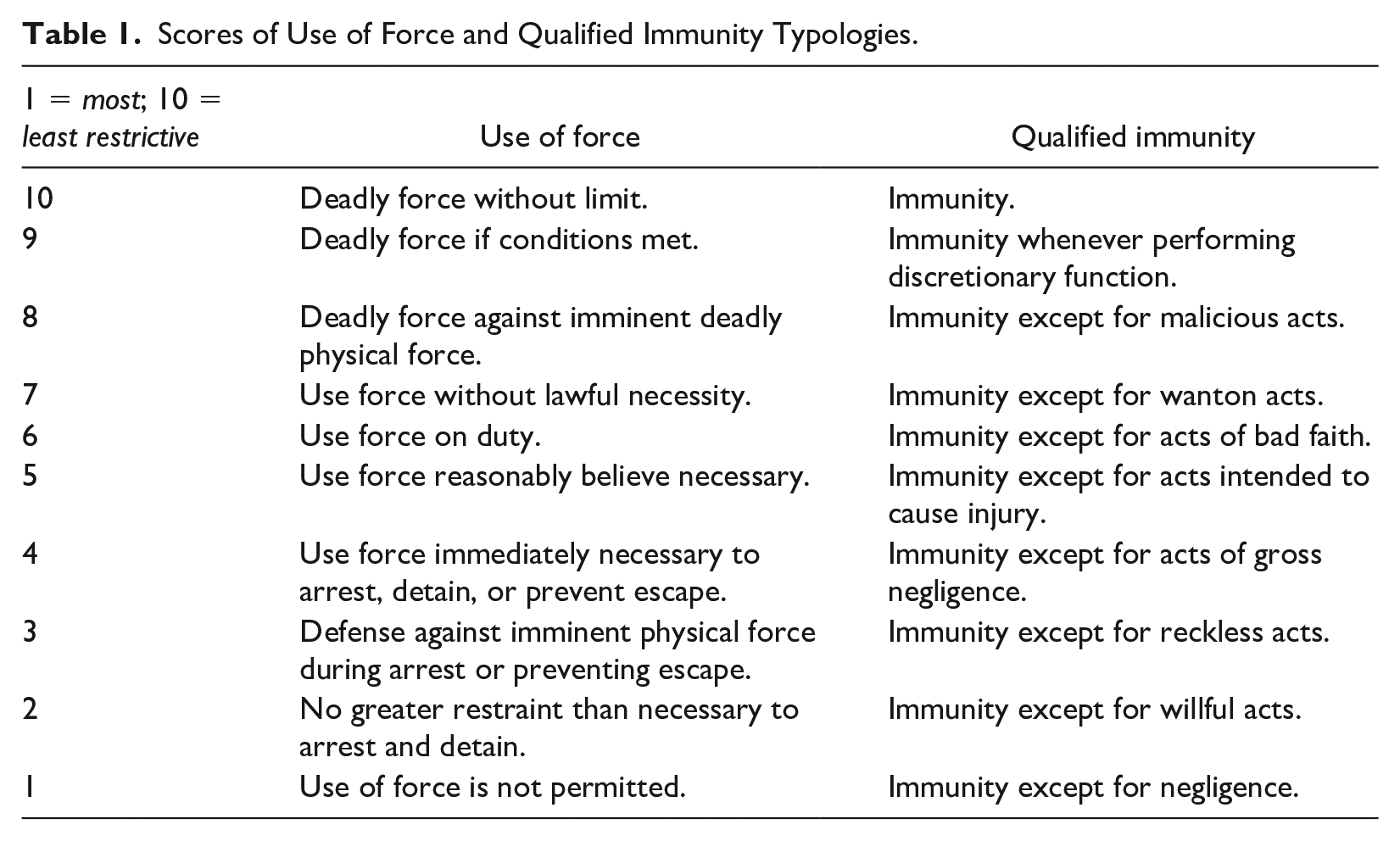
The first typology applies to qualified immunity. To assess qualified immunity, this study examines the range of qualified immunity available to police officers articulated in state law. In some jurisdictions, police enjoy qualified immunity when using discretion in exercising their duties. In some jurisdictions, policy enjoy qualified immunity unless their action or omission was intended to cause injury or was grossly negligent. Some jurisdictions offer even more latitude; police officers enjoy qualified immunity except for malicious acts or omissions. The second typology applies to legal use of force. To assess use of force, this study examines state law that articulates legal use of force police officers may exercise. In some jurisdictions, police officers enjoy wide latitude when it comes to exercising use of force against civilians. Legal statutes of some jurisdictions indicate more restrictions on use of force, ranging from bodily injuries that are forbidden to impacts of circumstances on use of force which is Table 1.
Scores of Use of Force and Qualified Immunity Typologies.
Data and Methodological Approach
Coding Qualified Immunity and Use of Force Statutes
This study employed Nexis Uni (N.d.), an electronic database formerly part of Lexis-Nexis, that makes available statutes and case law of U.S. states and Washington, DC. The author gathered content of statutes on qualified immunity and use of force for each U.S. state and Washington, DC. Through reading and studying each relevant statute, the author identified content, that is, language, found in each statute relevant to qualified immunity and use of force. He placed this content in a single document, which he shared with a separate reviewer. Separately, the author and the reviewer identified relevant content for each state and the District of Columbia, recording particular phrases and words tied to qualified immunity and use of force. For instance, for qualified immunity, the author observed the terms of “wanton” and “willful” in some statutes on police officers’ qualified immunity. When a statute was not available, the author and reviewer examined state case law.
The author and the reviewer independently assigned values to the pieces of language in the shared document. The values represented how much latitude each statute (or case law) piece of language offered police officers within the context of the qualified immunity statutes. After each person completed this step, the author developed an approach to coding qualified immunity statutes for each state (including the District of Columbia), which was applied by both the author and the reviewer. This approach is presented here:
For each state and the District of Columbia, the author and reviewer broke down that state’s qualified immunity and use of force laws into the phrases and words from above.
Based on the values of each piece of language, the author and reviewer separately assigned scores to the qualified immunity statutes. This scoring was performed primarily by applying propositional logic to the language that appeared within the statute. These scores represent the degree of latitude a police officer enjoys. The scores range from 1 to 10, where 10 would correspond to full immunity of the police officer. A state would receive a 1 if qualified immunity is offered but only in very specific circumstances.
After the author and reviewer independently applied this approach to the qualified immunity and use of force laws, they compared scores to achieve inter-rater reliability. They collaborated in reviewing their scores, identifying differences and reasons for those differences, and reached consensus for typology scores of the qualified immunity and use of force legislation.
Outcome and Control Variables
This study examines evidence of police use of excessive force against civilians through analysis of Fatal Encounters (N.d.) data, which has tracked people killed during interactions with police since 2000. In addition, this study includes control variables other studies have identified as possible factors shaping police use of excessive force against civilians. For example, this study examines state-level measures of poverty (American Community Survey 2017), unemployment (Bureau of Labor Statistics, U.S. Department of Labor 2019), household income (U.S. Census Bureau 2018), inequality (Population Reference Bureau N.d.), as well as violent crime rates (U.S. Department of Justice 2019) and illicit drug use (Substance Abuse and Mental Health Services Administration, U.S. Department of Health & Human Services 2020). It pays attention to population density (U.S. Census Bureau 2020), racial diversity (Kaiser Family Foundation 2019), and political party control of state governors and legislatures (Kaiser Family Foundation 2020). This study investigates impacts of gun ownership (Schell et al. 2020), spending on police forces, and receipt of military materials by police departments (Visual Capitalist 2020).
FsQCA Approach
It is believed that this study is the first to employ fsQCA to study police use of force. FsQCA differs from traditional regression analyses in that it is based on set theory and logic, not statistics. FsQCA is designed to evaluate social systems characterized by causal complexity. Ragin and Drass designed QCA, which is based on Boolean algebra and formal logic, to assess causal complexity among a modest number of cases. QCA’s cousin, fsQCA, employs fuzzy logic to assess causal complexity while assessing degrees by which a case belongs to a type. This study employs fsQCA to identify associations between causal conditions and police killings of civilians. One advantage of fsQCA is that it allows a researcher to identify combinations of causal conditions, which is called conjunctural causation, that lead to the outcome of interest (I. P. Durán and Menés 2017). Another advantage of fsQCA is that it allows a researcher to identify multiple causal conditions that can lead to the same outcome, which is called equifinal causation.
Three aspects of fsQCA are notable for the purposes of this study. The first is calibration. Calibration is similar to measurement of a phenomena (Ragin 2008). To calibrate, a researcher considers the metric she is using and its interpretation according to standards outside the immediate distribution (Kent 2008, citing Legewie 2017; Mendel and Korjani 2018; Ragin 2008). A key decision is to assign a crossover point to indicate when a phenomenon crosses from outside membership to inside membership. When calibrating the Qualified Immunity data, the author chose a crossover point that separated states where immunity is only offered for unintentional harm, up to and including gross negligence, from states where immunity is offered to officers who intentionally caused harm or acted maliciously. For the Use of Force data, the author chose a crossover point that separated states where deadly force was legal for police officers from states where only physical force was legal for police officers. For the Political data, the author chose a crossover point that separated states with a Republican majority from states with a Democratic majority. The author chose medians as crossover points for remaining variables. Table 2 presents calibration scores.
Calibration Scores.

FsQCA provides information about consistency and coverage. Consistency is the percentage of causal configurations that are similar that lead to the same outcome of interest (Ragin 2017; Roig-Tiernoa, Gonzalez-Cruz, and Llopis-Martinez 2017). Coverage refers to the number of cases for which a configuration is valid (Thygeson et al. 2012). Raw coverage measures the proportion of memberships in the outcome explained by each term of the solution. Unique coverage measures the proportion of memberships in the outcome explained solely by each individual solution term. A difference between coverage and consistency is even if coverage is low, a solution continues to be relevant.
FsQCA Analyses
This project undertook analyses of four theoretical models: the Social Disorganization model, the Uncontrolled State model, the Conflict model, and the Deference Exchange model. For each model, the study examines fsQCA output for the variables operationalizing each model. FsQCA produces two measures, which were discussed above, consistency and coverage. This study concentrates on the parsimonious solutions of each examined thesis (intermediate and complex solutions available upon request).
Social Disorganization Model
To analyze the Social Disorganization model, this project examines violent crimes, gun ownership, and unemployment on the number of civilians police kill.
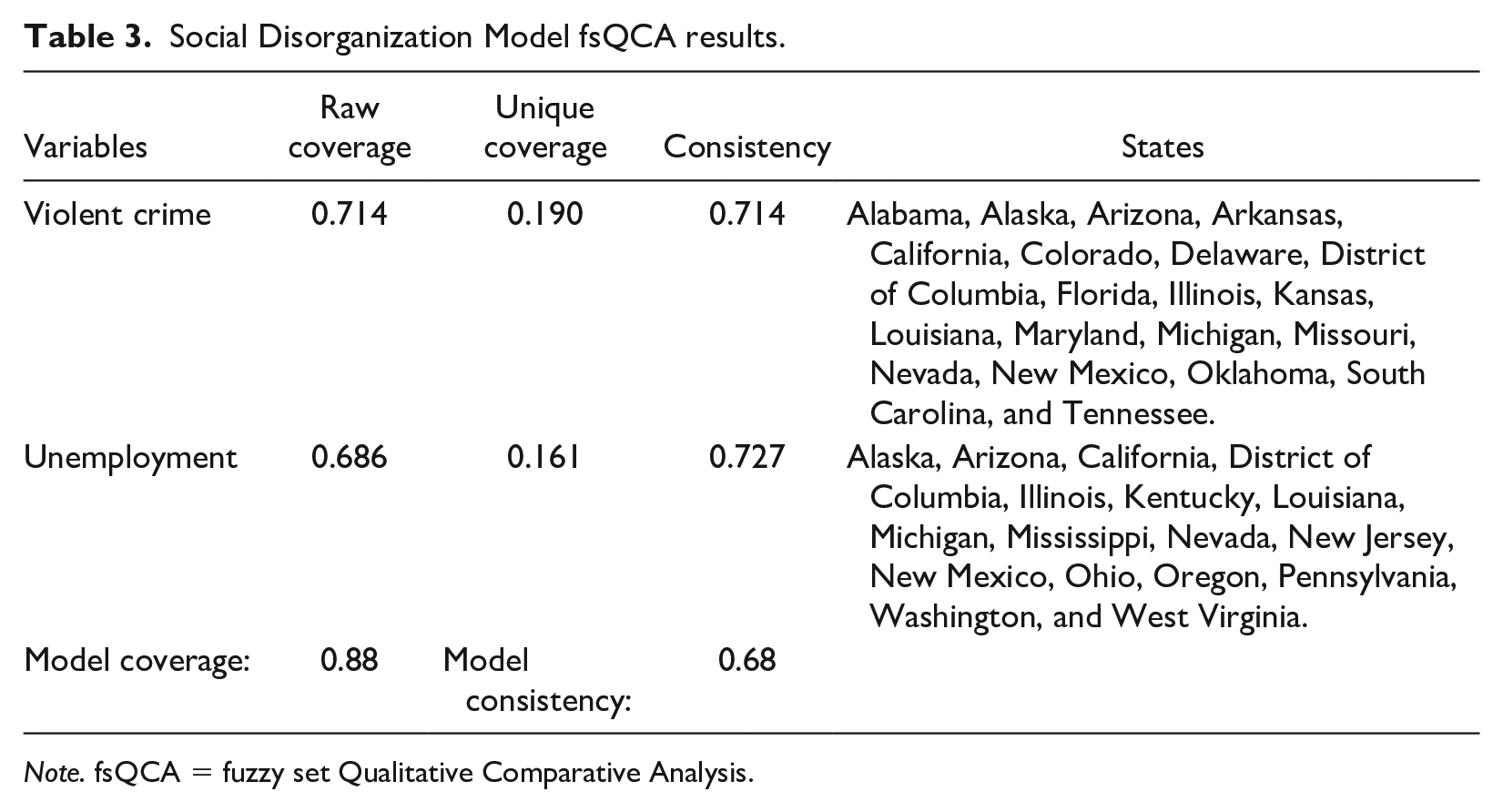
Tables 3 to 6 demonstrate that more than one explanation of police killings of civilians characterizes many states. Table 3 lists states for which the explanation of high levels of violent crimes or explanation of high levels of unemployment applies. High levels of violent crime or high levels of unemployment are associated with high levels of civilian killings by police for multiple states, which bivariate correlations also indicate. The fsQCA analyses indicate that for the Social Disorganization model, two causal routes lead to high proportions of police killings of civilians. The proportion of the population whose households own guns do not seem logically relevant. The solution consistency of the Social Disorganization model is .68; we will compare this consistency score across the other models. This consistency score indicates that 68 percent of the cases that share this combination of conditions are associated with high proportions of police killings of civilians. The solution coverage of the Social Disorganization model is .88, indicating this model accounts for outcomes of 88 percent of the examined cases.
Social Disorganization Model fsQCA results.
Note. fsQCA = fuzzy set Qualitative Comparative Analysis.
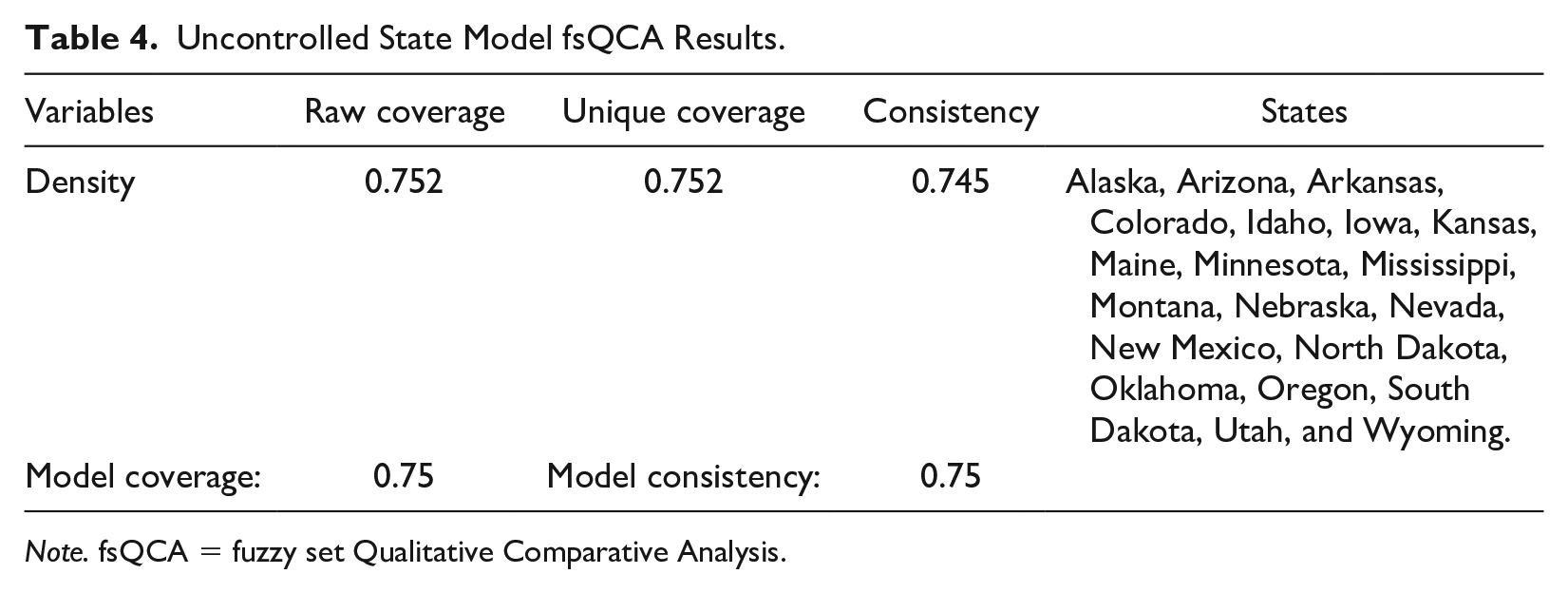
Uncontrolled State Model fsQCA Results.
Note. fsQCA = fuzzy set Qualitative Comparative Analysis.
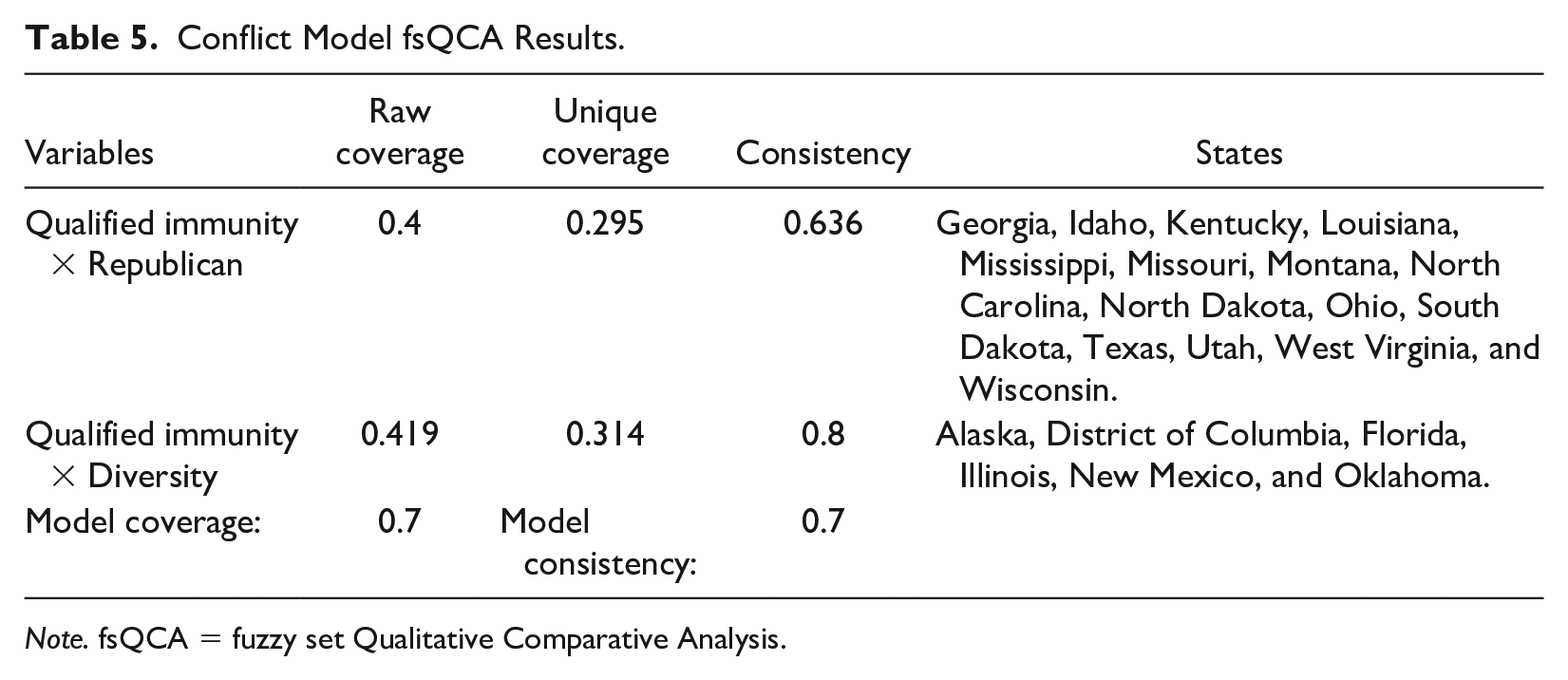
Conflict Model fsQCA Results.
Note. fsQCA = fuzzy set Qualitative Comparative Analysis.
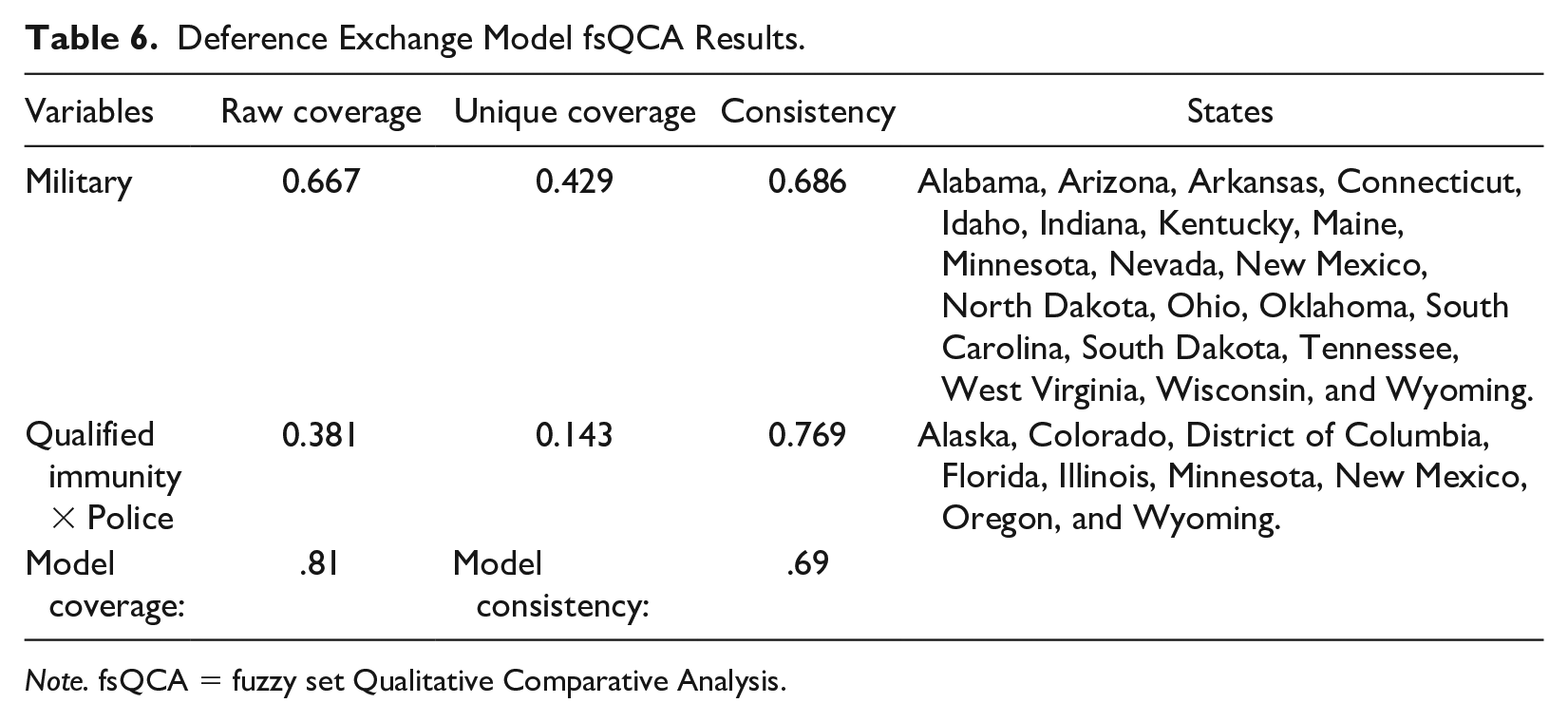
Deference Exchange Model fsQCA Results.
Note. fsQCA = fuzzy set Qualitative Comparative Analysis.
Uncontrolled State Model
To analyze the Uncontrolled State model, this project examines impacts of proportion of households who own guns, population density, and latitude in use of force police officers possess by law.
Table 4 indicates that low population densities are associated with high levels of police killings of civilians for multiple states, which bivariate correlation analyses also indicate. The solution consistency of the Uncontrolled State model is 0.75, higher than the Social Disorganization model. This consistency score indicates that 75 percent of the cases that share this condition of density are associated with high proportions of police killings of civilians. The solution coverage of the Uncontrolled State model is 0.75, suggesting that this model accounts for outcomes of 75 percent of the examined cases.
Conflict Model
To analyze the Conflict model, this project examines impacts of qualified immunity legislation, state political power, and racial diversity.
Table 5 presents results indicating two distinct explanations arising from the Conflict model are associated with high levels of police killings of civilians. One explanation is a combination of weak qualified immunity protections with strong Republican power. A second explanation is strong qualified immunity protections for police in combination with high diversity levels.
While bivariate correlation analyses did find a positive relationship between strong qualified immunity protections and large proportions of police killings of civilians, bivariate correlation analyses did not indicate a strong relationship between state political power or diversity. This finding highlights a strength of fsQCA, which is treating a causal combination of two factors as a unique explanation. The solution consistency of the Conflict model is .7, higher than the Social Disorganization model but lower than the Uncontrolled State model. This consistency score indicates that 70 percent of the cases that share this combination of conditions are associated with high proportions of police killings of civilians. The solution coverage of the Conflict model is .7, suggesting that the model accounts for outcomes of 70 percent of the examined cases.
Deference Exchange Model
To analyze the Deference Exchange model, this project examines impacts of qualified immunity legislation, military spending, and state spending on police per capita.
Table 6 provides information about two explanations of high levels of police killings of civilians through analysis of the Exchange model. One explanation is high levels of military equipment police forces possess in the individual state. A second explanation is the combination of strong qualified immunity protections police enjoy and high proportions of police officers. As mentioned, bivariate correlation analyses indicate high military spending is associated with strong use of force protections for police officers. FsQCA provides a second explanation, which is a combination of strong protections of police officers via qualified immunity legislation and high spending on police departments per capita, which characterizes Washington, DC. Bivariate correlation analyses indicate strong qualified immunity protections are associated with high proportions of civilians killed by police officers. Bivariate correlations do not indicate a strong relationship between the spending on police per capita and police killings of civilians. Similar to the Conflict model, fsQCA suggests that the combination of strong qualified immunity protections and high number of police per capita is associated with police killings of civilians. The solution consistency of the Deference Exchange model is .69, slightly higher than the Social Disorganization model’s consistency, but lower than the consistency scores of the Uncontrolled State and Conflict models. The consistency score indicates that 69 percent of the cases that share this combination of conditions are associated with high proportions of police killings of civilians. The Deference Exchange model’s coverage is .81, meaning that the model accounts for outcomes of 81 percent of the examined cases.
While FsQCA analyses provide support for the four models, qualified immunity protections are key factors to studying police killings of civilians. The Deference Exchange model indicates the combination of strong qualified immunity protections for police and high spending on police departments is associated with police killings of civilians. This causal combination suggests that police officers possess immunities and resources that enable them to impose power on civilians. The Conflict model indicates the combination of strong qualified immunity protections combined with the presence of racial diversity is associated with police killings of civilians. Another causal combination the Conflict model identifies is the absence of strong qualified immunity protections for police officers in combination with strong Republican control of state governments. These two causal combinations of the Conflict model point to context, racial diversity, and strong Republican political power, as important to understanding how qualified immunity protections influence police officers’ excessive use of force against civilians. The fsQCA analyses of the four models point to impacts of qualified immunity protections police enjoy on killings of civilians by police. The fsQCA analyses indicate, however, that influences of qualified immunity protections on police killings of civilians are mediated by other social influences, including political orientation and racial conflict.
Discussion and Conclusion
This study has employed an Applied Sociology approach to undertake fsQCA analyses of factors potentially shaping police killings of civilians. It has examined experiences across the 50 U.S. states and Washington, DC. This study has introduced new typologies of qualified immunity and use of force laws. It is believed that this study is the first to employ fsQCA when studying police use of force against civilians. A virtue of fsQCA is its ability to identify multiple pathways to an outcome of interest, which is called equifinality (Fitzgerald 2019). One objective of this study is to employ Applied Sociology to identify potential paths to policy reforms.
Analyses arising from fsQCA indicate that while multiple factors are associated with police killings of civilians, an Uncontrolled State model is a powerful explanation. Based on ideas important to the founding of contemporary states, the Uncontrolled State model suggests that if a government is organized in ways that hinder citizen control, police may be less responsive to civilians, including providing protection. The Conflict model points to states and their organizations that are designed and administered to manage conflict, with some experts contending that conflict revolves around control over material resources. This study finds that the Conflict model is an important explanation of police killings of civilians. Its results can be understood as the combination of strong Republican control of state governments with broad protections of police officers is associated with police killings of civilians. Rather than strictly material resources, the Conflict model also advances racial conflict as a powerful factor related to police killings of civilians.
The Deference Exchange model focuses on modern policing as designed to discipline civilians. FsQCA analyses suggest that when police officers possess resources and power, killings of civilians by police officers may result. The Social Disorganization model points to states experiencing societal disruption and social problems being associated with civilian killings by police. FsQCA analyses indicate that high levels of violent crimes or high levels of unemployment are associated with higher numbers of police officers killing more civilians.
While this study supports calls to modify qualified immunity protections police officers enjoy, it demonstrates that qualified immunity protections do not work in vacuums. Employing fsQCA, an Applied Sociology approach indicates reforms of qualified immunity protections should consider the communities in which police officers and civilians live together.
Availability of data and transparency around those data (Edwards et al. 2019) are crucial to reducing and preventing excess force police use against civilians. An important limitation of this study is the unavailability of national, historical data that would allow for analysis of changes in laws, including reforms, and societal structures. This study calls on the Federal Bureau of Investigation (FBI) and police departments across the United States to systematically gather the necessary data so that experts can assess how police can better serve and protect civilians. Applied sociological studies of protections police possess when using force against civilians can shed light on problems for modern states and governance, but data availability and transparency hinder these efforts.
National attention to killings of civilians by police officers has led to protests as well as calls for reforms of U.S. policing. An Applied Sociology approach demonstrates that social science research can provide powerful insights into contemporary social problems, including how wide latitude police officers enjoy may lead to harming civilians. Findings do support calls to reform legal protections police possess, in particular, qualified immunity laws and use of force regulations. Qualified immunity and use of force laws merit reforms so that police officers cannot harm civilians, the people police have sworn to serve and protect.
Thatcher (2020) reminded us that use of force laws are only one part of a complex picture shaping police behaviors and work. An Applied Sociology approach demonstrates that efforts to undertake these reforms must consider social structures in which police harm rather than serve and protect civilians. Reforms of policing necessitate changes not only to laws regulating police, but to changes to government and markets. Reforms that seek to overcome inequalities, societal conflict, and poor governance are essential to ensure civilians are protected, safe, and can enjoy their communities.
Footnotes
Acknowledgements
The author thanks Professor Mark Kukis, Dr. Preya Bhattacharya, and Professor Charles Ragin for their helpful comments and guidance. Mistakes are the author’s.
Declaration of Conflicting Interests
The author(s) declared no potential conflicts of interest with respect to the research, authorship, and/or publication of this article.
Funding
The author(s) received no financial support for the research, authorship, and/or publication of this article.