




Abstract
Existing research converges on the finding that females are attributed less agency than males, with one of the consequences being that they are allotted less challenging tasks than their male counterparts. We hypothesized that benevolent sexism accounts for this tendency. Hence, we predicted that parents advocate for the allotment of less challenging tasks to girls than to boys at school as a function of their endorsement of benevolent sexism. We tested for the effect using a sample of 153 Zimbabwean parents (103 female and 50 male; mean age of 34 years, SD = 3.23), whose female child was beginning form one. However, we also tested for other “control” variables—parents’ gender and their female child’s performance. Results indicated that benevolent sexism and the female child’s grade at grade 7 predicted the difference in scale of allotment of challenging tasks to boys versus girls. Taken together, these results suggest that benevolent sexism is the underlying sexist ideology that may limit girls’ exposure to challenging tasks and subjects at school, which may limit their chances of success and leadership later in their educational trajectories, and also in the occupations they would take in adulthood. Recommendations for changes in educational policy and related interventions are made in line with the present findings and existing literature.
Introduction
This research follows up on King et al.’s (2012) work, who showed that male decision makers who were high in benevolent sexism allotted fewer challenging tasks to female subordinates than to their male counterparts in the workplace. Such tendencies in the workplace perniciously disadvantage the development of women’s careers in the long term by confining their experiences to easier tasks that presumably fit well with their femininity. According to Glick and colleagues (Glick and Fiske 1996, 2001; Glick et al. 2000), benevolent sexism is an alluring form of sexism which reflects a chivalrous ideology about women. It characterizes women as aesthetically purer but weaker counterparts of men, hence deserving of cherishing and protection from men, but only as far as they endorse men’s power and stick to traditional gender roles (see Connor, Glick, and Fiske (2017) for a more recent review). In the current research, we try to determine if the tendencies witnessed by King et al.’s (2012) study also affect girls at school. In more precise terms, our main purpose was to test if parents of female children agree to the allocation of less challenging developmental tasks to girls than boys at school.
Among other characteristics of benevolent sexism, it acts as a tendency to cherish, protect and help women as parents do to children, which is specifically referred to as protective paternalism. It also encompasses a worshipful view of women which positions women as crucial for men’s happiness through provision of closeness and intimacy, a tendency referred to as heterosexual intimacy. Its third component is referred to as complementary gender differentiation, which restricts women to their traditional gender roles (e.g., mother and wife), valorising them in a way as necessary to men as they depend upon them to fulfill these roles. Hence, we were interested in determining whether parents who endorse such gender ideologies would in a way be seen to be preparing their daughters for their future conventional roles in society (e.g. as home makers and mothers), hence “protecting” them from the more challenging, presumably masculine tasks, which are not crucial for guaranteeing their future spouses happiness. The preceding statement encapsulates a benevolent sexist ideology.
Across the world, benevolent sexism works perniciously in tandem with what Glick and colleagues (Connor, Glick, and Fiske 2017; Glick and Fiske 1996, 2001; Glick et al. 2000) have termed hostile sexism as ambivalent sexism to suppress challenges to men’s traditional power and authority through direct or insidious threats to women who embrace unconventional gender roles (e.g., career women and feminists). Hostile sexism is defined as an antipathy reserved for women who are considered as attempting to surreptitiously appropriate men’s power through sexuality and/or abandoning their traditional feminine roles (e.g. professional women, feminists, and lesbians), and it equates to what had all along been considered as prejudice against women, and dovetails well with classical notions of prejudice (e.g. Allport 1954). Like benevolent sexism, hostile sexism is also considered to consist of three theoretical subfactors of hostile sexism, which are (1) dominative paternalism—a propensity to control and dominate women like parents do to children; (2) hostile heterosexuality—a view of women as being gatekeepers of sex, and an associated backlash when they are perceived to be toying with men through their sexuality; and (3) competitive gender differentiation—an exaggeration of gender differences in a way that favors men.
According to existing research, men endorse hostile sexism more than women do. However, both men and women find benevolent sexism appealing (see Berryman 2020; Chisango and Javangwe 2012; Cross and Overall 2018; Radke et al. 2018). This suggests that individuals do not ordinarily understand it as a type of sexism at all. People instead seem to interpret it as reflecting how men are ordinarily expected to be cherishing and protective of women, especially in intimate relationships. Recent research by Hopkins-Doyle et al. (2018) suggests that benevolent sexism is even perceived as indicating gender egalitarianism. The authors showed that although women recall experiencing benevolent (vs. hostile) sexism more often, they protest it less often, because they associate it with warmth. Importantly, the authors also showed that characterizing men as high in benevolent sexism caused them (through warmth) to be seen as lower in hostile sexism and more supportive of gender equality. Furthermore, the results indicated a misunderstanding of the relationships between benevolent sexism and a wide array of its correlates.
Despite the widespread social endorsement of benevolent sexism, existing research has demonstrated numerous ways in which it is associated with harmful outcomes for women. For instance, it is related to sexual harassment (Fiske and Glick 1995), to attitudes that validate domestic violence (Sakalli 2002), appears to form an impediment to women’s performance on cognitive tasks (Dardenne, Dumont, and Bollier 2007), and primes women into a belief that if they are promoted at work, their spouses may turn violent as a consequence of an ensuing threat to their egos (Expósito et al. 2010). More recently, Lamarche et al. (2020) found that women received fewer questions on a problem-solving task when the test administrator scored high on benevolent sexism, leading to impaired performance and self-doubt, and these negative consequences persisted in new situations and tasks. Overall, benevolent sexism serves as an insidious impediment that undermines women’s ascent toward gender equality (Glick and Raberg 2018).
At the core of benevolent sexism is its association of women with communal traits (e.g. warmth, nurturance, and considerateness). This plays a role in their restriction to domestic and low-status spheres of life, in contrast to men, who are ascribed agentic stereotypes (e.g. brave, confident, or courageous), which gives them a head start in seeking and maintaining high status (Good and Sanchez 2009; Meagher 2017). Hence, we suspect that parents’ endorsement of benevolent sexism may lead them to nurture communal traits more among girls in preparation for their future traditionally inclined gender roles, which in turn my lead them to “shield” them from developmental challenges that are stereotypically agentic.
Gender Practices in Zimbabwe
Chisango, Mafa, and Maunganidze (2022) observed that traditional patriarchal beliefs are endemic in most African societies, including Zimbabwe. According to Williams (2019), African traditional beliefs and practices dictate that women be limited largely to the role of being a homemaker, occupationally being restricted to domestic activities such as procreation, child rearing, and preparing children for collective existence. Chisango and Mayekiso (2013) make an apt observation that this tendency reflects a uniquely cultural ascription of communal traits encapsulated in a term known as Tsika. According to Samkange and Samkange (1980, p. 74), Tsika refers to “politeness, civility and circumlocution.” According to Pearce (1990), Tsika roughly equates to what is known as decorum in English, defined as “polite and socially acceptable behaviour” (Soanes 2005, p. 257). Whereas women can be rarefied for possessing and enshrining Tsika, they can be punished like children by their spouses and other male significant others if they seem to default from it. Hence Chisango and Mayekiso (2013) made unique predictions that a positive bias in ascription of Tsika to women is predicted by benevolent sexism and a negative appraisal of women would be predicted by hostile sexism, which were largely supported by their results. The trends occur elsewhere in Africa, as reported in Nigeria by Oloruntoba-Oju (2010), with girls and women being sidelined from agentic roles.
Sexism in Childhood
Research shows that the seeds of sexism are sown early in childhood, even before elementary school. Socialization agents such as the family, electronic and other media give children cues about what is appropriate or not for girls and for boys, which begins to entrench gender stereotypes early in their lives (Coyne et al. 2016; Kliman 1978). Family is a major contributor to the propagation of sexist stereotypes among children. For instance, Dueñas et al. (2020) showed that family socialization contributes significantly to the transmission of ambivalent sexism, especially benevolent sexism, among adolescents.
Evidence suggests that children show awareness of sexist stereotypes in early childhood, well before elementary school (Gutierrez et al. 2020; Halim and Ruble 2010) and as they get older, their knowledge of gender inequalities and discrimination becomes more pronounced (Leaper and Brown 2014). Important to note, a Childhood Ambivalent Sexism Measure developed by Richters (2019) showed that a sample of 7- to 10-year-old Portuguese children were already able to differentiate between hostile sexism and two factors of benevolent sexism, protective paternalism, and heterosexual intimacy. Besides, the findings indicated that the children showed high levels of stereotype knowledge and personal endorsement of benevolent sexism, just as adults do. Moreover, the researchers investigated the impact of ambivalent sexism on children’s future career aspirations. The findings indicated that girls who showed higher stereotype knowledge of protective paternalism also showed more interest in professions that require higher levels of warmth in comparison to competence. Paradoxically, although children and adolescents generally show remarkable levels of awareness of sexism and can perceive gender-based discrimination (cf. Gutierrez et al. 2020), they tend to mold their behaviors and choices of activities in a manner that falls in tandem with the allied sexist stereotypes (Cárcamo, Moreno, and Del Barrio 2021).
Sexism in Schools
Available evidence shows that various socialization agents are responsible for the perpetuation of gender stereotypes and the attendant discrimination among schoolchildren. These include teachers, peers, parents, and the media. Teachers and parents are of particular concern, given that as the closest model adults in children’s education, they can easily inculcate their beliefs into their impressionable minds. According to existing research (e.g., Jussim and Harber 2005; Kollmayer et al. 2020; Nürnberger et al. 2016), teachers may perpetuate gender stereotypes if they hold and express sexist attitudes about children’s aptitudes. For instance, some teachers may believe that boys are more logical, competitive, have a better affinity for math and science, and hence are more independent at such fields than girls. Thus, they may attribute boys’ success at math and science to ability, while they may attribute girls’ success to hard work and effort. These implicit and explicit gender biases may affect teachers’ expectancies about children’s performance, which in turn may affect the children’s actual performance in a self-fulling manner.
Research also indicates that children can identify gender discrimination in school by middle childhood (Bell and Juvonen 2020). In surveys conducted about school gender discrimination (Brown et al. 2011), girls typically reported that boys are treated preferentially in athletics and in contrast, boys reported that girls are treated preferentially within the classroom (e.g., “When a girl does something wrong, the teacher never gets her in trouble; a boy does the same thing, and he always gets in trouble”). In our perspective, the preferential treatment of girls in class and of boys in athletics actually betrays ambivalent sexism at play in school. In our perspective, the preferential treatment of boys at sports and of girls in class reflects sexist stereotypes of boys as the “stronger sex” who can brave challenges and of girls as the “weaker sex” who thus need to be “protected,” which are the stereotypes central to the notion of ambivalent sexism. Researchers have reported specific effects of gender discrimination on girls at school. For instance, Bell and Juvonen (2020) reported that girls who endure gender-based discrimination by an adult at school report higher levels of perceived school unfairness, which is in turn cascade into deep psychological problems such depression and insomnia-like symptoms.
We believe parents’ gender beliefs are likely to affect children in the same manner, hence also influencing the propagation of sexism in schools vicariously (Gunderson et al. 2012; Muntoni and Retelsdorf 2019). Like teachers, they may hold explicit and implicit gender biases about children’s abilities. Indeed, researchers have reported parents’ perceptions of boys as being more adept at logical-analytical subjects like maths and science, which are generally considered harder to comprehend. Consequently, they typically expect boys to perform better at such subjects than girls (Andre et al. 1999; Carlana and Corno 2021; Eccles et al. 2000). Furthermore, just like teachers, they may tend to attribute boys’ success at math and science to ability, and girls’ to effort (Espinoza et al. 2012; Yee and Eccles 1988). Again, this can affect the children’s real scores in a self-fulfilling manner (Gunderson et al. 2012; Jacobs, Chhin, and Shaver 2005).
Indeed, research suggests that such sexist beliefs and tendencies are severely hampering the progress of the science, technology, engineering, and math (STEM) sector in education. McGuire et al.’s (2020) research demonstrates that the marginalization of women from STEM-related subjects begins from a young age, due to enforcement of gender stereotypes. In a similar vein, many studies (e.g., Bozzato, Fabris, and Longobardi 2021; Miller et al. 2018; Steele and Ambady 2006) have repeatedly shown that when children are asked to draw a mathematician or a scientist, girls are twice as likely to draw a man over a woman, whereas boys usually draw a man. Stereotypes, along with the related lack of opportunity among other variables may explain why girls enter STEM fields at a disturbingly lower rate than boys (Corbett and Hill 2015). This trend stretches up to tertiary education and continues to trouble women as they enter the workplace. According to research, women in male-dominated occupations fall victim to a range of negative experiences, which include isolation, sexist comments, sexual harassment, stereotypes, being targeted for their gender, and unwanted sexual advances (Fry, Kennedy, and Funk 2021; Wright 2020; Ceci and Williams 2007).
The Present Study: The Link between Benevolent Sexism and the Distribution of Challenging Developmental Experiences at School
Children’s experiences described above suggest that sexism is an issue that has a substantial effect on their educational outcomes. From the above review of existing literature, it appears that there is a strong trend of alienating female children from any challenging academic and nonacademic activities at school, on the presumed basis that they are somehow weaker both intellectually and physically. A look at the literature suggests that they are not necessarily derogated—as children- for their presumed gender-based weaknesses. Rather, there appears to exist a strong motive among adults, whether parents or teachers, to want to protect them from the challenges. Whereas any such tendencies seem underlain somewhat by sexist ideologies, none of previous research has attempted to uncover them, which is a gap in the literature this study aims to fill.
As alluded to above, the present research was inspired by King et al.’s (2012) research, which showed that men who held paternalistic ideologies concerning women were less likely to recommend challenging developmental opportunities for female subordinates at work. We wonder as well whether parents’ (whether male or female) endorsement of benevolently sexist ideologies might affect daughters in a similar manner. Specifically, we test if parents who endorse benevolent sexist attitudes also try to “protect” their daughters from challenging developmental opportunities at school. We think such tendencies would be typical of both fathers and mothers, given that existing literature has shown that both genders of adults tend to be more protective of female children. We go a crucial step further, trying to connect the parents’ protective tendencies toward the female child from challenging developmental tasks at school to their endorsement of benevolent sexism. In our view, any such sex- or gender-based “protection” would equate to a component of benevolent sexism called protective paternalism which, although patriarchal in origin, is usually also internalized by women, with the result that they show similar tendencies to men.
Objectives and Hypotheses
In light of the above observations and arguments, the following objectives and hypotheses will guide this study. The first objective will be to test if parents of female children starting form one would agree to the allocation of less challenging tasks to girls than boys. Importantly, we test if hostile and/or benevolent sexism will predict the endorsement of allocation of less-demanding tasks to girls. However, in line with existing literature, we hypothesize that benevolent sexism (not hostile sexism) will predict the allocation of less demanding tasks to girls. We will also test if parent gender will moderate any of the above effects. Moreover, we control for the effect of the female child’s performance at the grade 7 final exams.
Methodology
Participants
The participants were parents who came seeking a form one place for their daughter at any one of eight secondary schools in two high-density suburbs of Harare, Zimbabwe. One hundred and fifty-three parents (103 female and 50 male) took part in this study. They reported a mean age of 34 years (SD = 3.23), with a range of 6 years. The sample was a convenient one, composed of parents who are mostly resident near the secondary schools chosen as the research sites. Hence, geographical proximity, availability at a given time, and willingness to participate in the research were the main criterion that delimited the sample. The suburb in which the schools were located was randomly chosen through the three steps of assigning numbers to the high-density suburbs in Harare, picking random numbers, and selecting the sample suburb. The gender composition of the sample was dominated by females, because in the majority of the cases witnessed by the researchers, they were the ones who accompanied the children seeking form one places. This is in line with the traditional gender roles still typical of Zimbabwean society, which still largely limit women to domestic duties that revolve around motherhood (see Chisango et al. 2022).
Materials
The main section of the questionnaire comprised the ambivalent sexism inventory (ASI) and a challenging-tasks at school scale adapted from King et al. (2012). The ASI is a 22-item scale developed and originally validated by Glick and Fiske (1996) and Glick et al. (2000). Half of the items tap into benevolent sexist attitudes (e.g., “women should be cherished and protected by men” and “a good woman should be set on a pedestal by her man”). The other half of the items measure hostile sexist attitudes (e.g., “women are too easily offended” and “feminists are seeking for women to have more power than men”). The hostile and benevolent sexism scales had Cronbach alphas of .78 and .81 respectively and were anchored on a 1 (strongly disagree) to 5 (strongly agree) scale.
The challenging tasks at school scale consisted of five items. Example items included (1) “An unusual task that requires the child to influence the peers, teachers, the school management, and other school staff over whom he/she does not have any authority over,” (2) “A novel task that requires the child to work with children and teachers from other schools” and (3) “A task that will require the child to learn significantly new or somewhat unfamiliar responsibilities.” This scale had a Cronbach’s α of .75.
Procedure
The researchers and/or their assistants approached the parents as they left the school premises with their child after securing him/her a form one place. They told them that the school had advanced plans to implement new activities that would coincide with their child joining the school, and as such, the school was soliciting parents’ views.
Upon agreeing to take part in the study, the participants were given the questionnaire, and given time to answer it while the researcher waited to answer or clarify any query that would possibly arise while they answered it. After answering the survey, the participants were debriefed, thanked for taking part in the study and if willing, they were given a packet of sweets or biscuits for their child.
Results
Preliminary Analysis
Table 1 provides on overview of focal zero-order correlations. Grade 7 Grade correlated positively with Challenging Tasks: Ascribed Gender Difference, indicating that the poorer the pupil’s Grade 7 results were, the more the parents considered the tasks to be more suitable for boys than girls. In turn, Grade 7 Grade correlated with benevolent sexism, somehow suggesting that the higher the parent’s benevolent sexism score was, the poorer the pupil’s grade 7 grade. Both benevolent and hostile sexism scores correlated positively with Challenging tasks: Ascribed Gender difference (i.e. mean differences in rated suitability of the tasks for boys vs. girls), with benevolent sexism showing a much higher correlation (.73**) than hostile sexism (.27**). As in most of the existing evidence, hostile sexism positively correlated with benevolent sexism. Hostile sexism also correlated with Parent Gender, indicating that men had higher scores of hostile sexism than women.
Bivariate Correlations between all Pairs of the Study Variables.
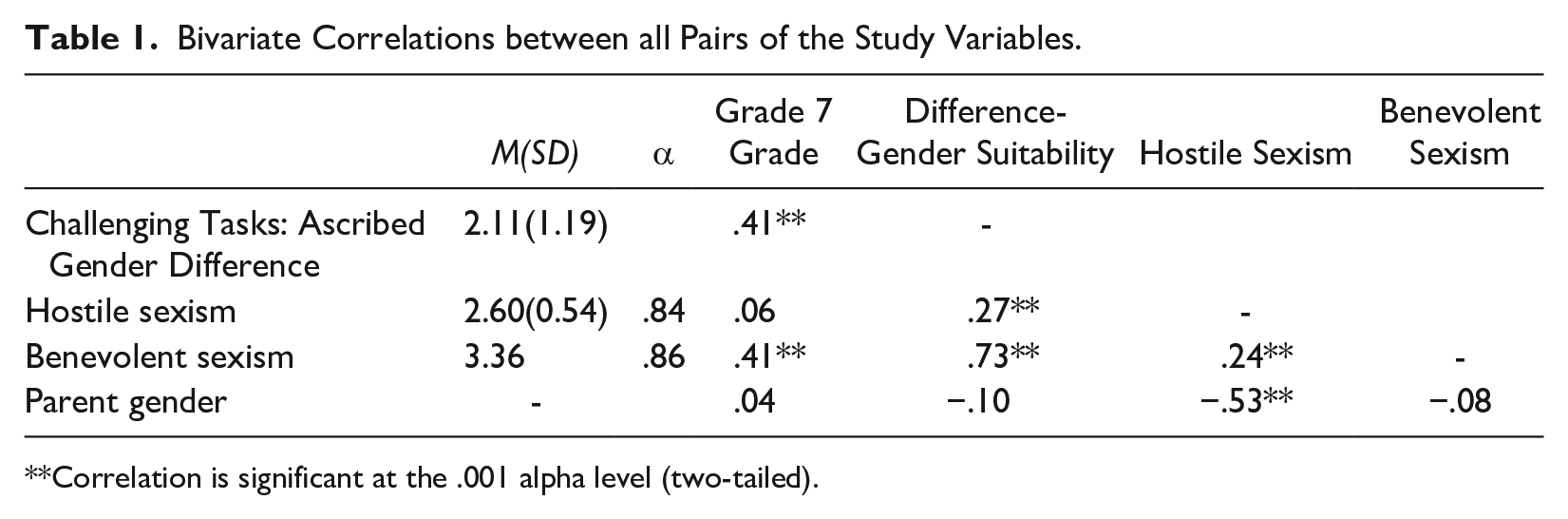
Correlation is significant at the .001 alpha level (two-tailed).
Main Analysis
Hierarchical regression analysis was used to assess which variables best predicted Challenging tasks: Ascribed Gender difference (see Table 2).
Summary of the Hierarchical Regression Predicting Challenging Tasks: Ascribed Gender Difference.
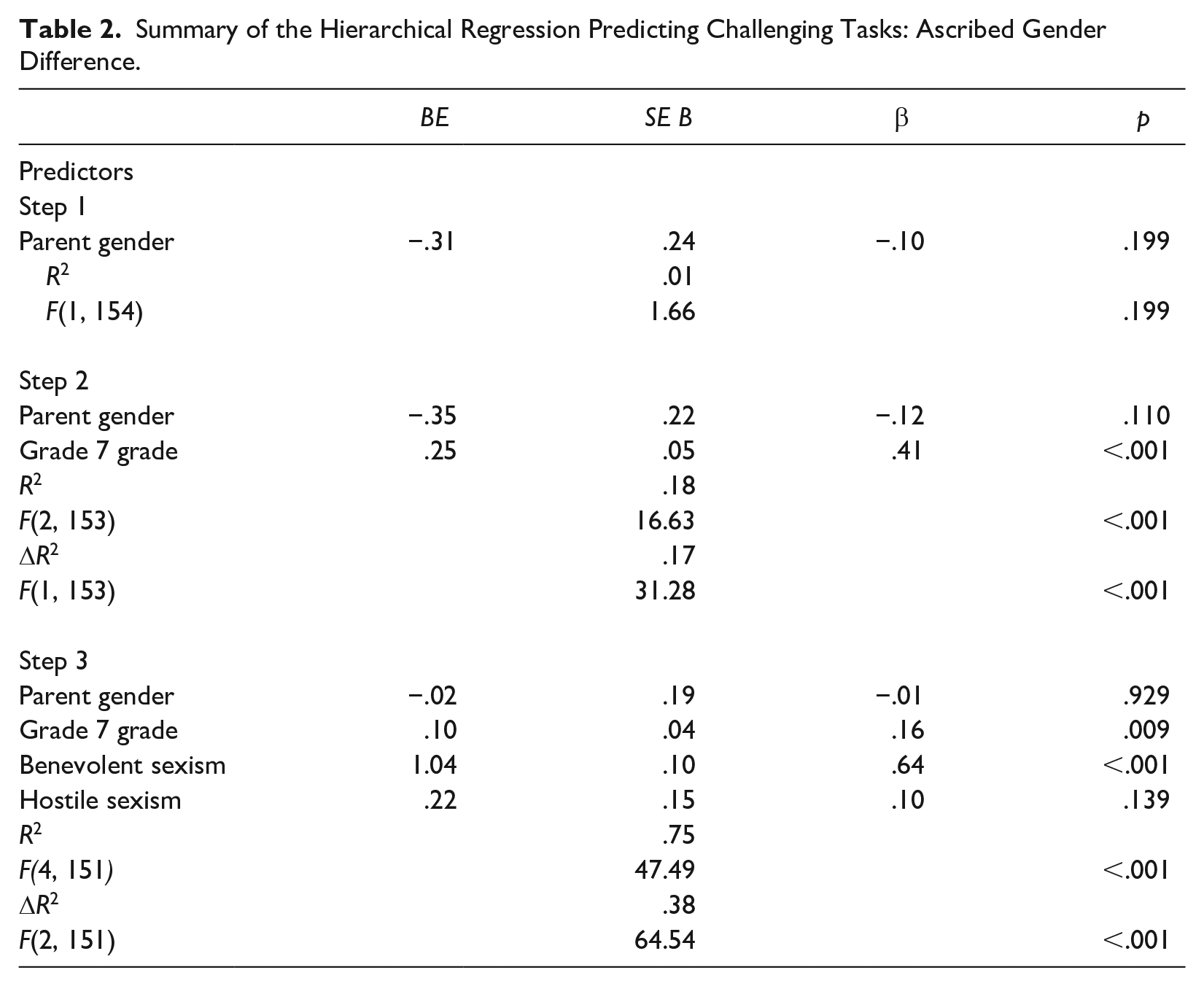
Parent gender was entered in Model 1, Grade 7 Grade in Model 2; benevolent and hostile sexism were entered in Model 3. Results for step 1 yielded a non-significant effect of Parent Gender, B = −.31(.24), β = −.10, p = .199, accounting for a paltry amount of variance of only 1%, R2 = .01, F(1, 154) =1.66, p = .199.
In step 2, results showed a significant effect of Grade 7 Grade, B = .25(.05), β = .41, p < .001. This increased explained variance by 17%, ΔR2 = .17, F(1, 153) = 31.28, p < .001.
In model 3, Grade 7 Grade remained statistically significant, B = .10(.04), β = –.16, p = .009. Of the added variables (hostile sexism and benevolent sexism), only benevolent sexism had a significant effect, B = 1.04(.10), β = .64, p < .001. This increased explained variance by 38%, ΔR2 = .38, F(2, 151) = 64.54, p < .001.
Discussion
Results of the study above largely supported the hypotheses, with benevolent sexism scores of both male and female parents predicting the difference in the scores of allocation of challenging tasks to boys over girls. The fact that this effect was not moderated by parent gander may suggest that although benevolent sexism is originally paternalistic in nature, women nevertheless internalize it as they find it alluring, characterizing as it does (at least some) women as wonderful, pure beings whose love is necessary to make a man complete. Hence, women who endorse benevolent sexism have been largely shown in past studies to show very similar tendencies to benevolent sexist men (e.g., Berryman 2020; Chisango and Javangwe 2012; Cross and Overall 2018; Radke et al. 2018). However, the female child’s grade 7 grade also predicted the difference in the allocation of the challenging tasks to boys versus girls. This suggested that the poorer the female child’s grade 7 performance, the less reluctant the parents were to endorse girls’ uptake of challenging tasks. On one hand, this is an encouraging finding, giving hope that good academic performance may to some degree shield female children from benevolent sexist tendencies. On the other hand, those not doing so well may be further shielded from challenging experiences that would otherwise cajole their performance upward.
The results reported in this article are somewhat disturbing, in the sense that they suggest that benevolent sexism among other forms of sexism may begin to gnaw at females’ chances of academic success and leadership at very early stages in their lives. We suppose that if such tendencies do actually materialize, they play a role in initiating and sustaining a chain process of depriving girls of the agentic and challenging experiences that turn boys into the more dominant gender in adulthood. Having started affecting children from their foundational years of academic progress and mastery, such practices are likely to lead to the entrenchment of real gaps in gender abilities in the long run that may seem immutable by early adulthood, due to limited opportunities granted to girls. Even if this may not actually happen, the related stereotypes may result in stereotype threats that might have real effects on females’ performance at tasks that are deemed typical of males (see Flore and Wicherts 2015).
Thus, the present findings also add to the understanding why the marginalization of women from the challenging facets of academic circles such as STEM begins from a young age. The subordination of the girls continues unabated in various forms and platforms into adulthood through the policies, procedures, attitudes, or laws that create and reinforce gender gaps in various fields and spheres of life. One such gender gap is the gender pay gap, which refers to a prevalent difference in the median earnings between women and men. For instance, in the United States, a woman earns 82 cents on average for every dollar that a man earns (Aragao 2023). Importantly, although benevolent sexist stereotypes of females are subjectively positive, we are quickly reminded by Glick and colleagues (Connor, Glick, and Fiske 2017; Glick and Fiske 1996, 2001; Glick et al. 2000) that they are socio-emotional, not agentic, thus casting women as socially competent, but not competent at a lot of important, challenging tasks which confer individuals high status (e.g. analytical thinking). In essence, any such benevolent sexist stereotyping of women casts them as the “weaker sex” who necessarily have to be “protected” by men through restricting them from challenging fields of study, occupations, and tasks, which has a double-pronged effect of undermining women’s progress and perpetuating men’s structural power (Glick et al. 1997). Important to note, girls seem also restricted from any other extra-curricular activities that are deemed too tough for them like sports, which further limits their horizons of success in life (e.g., Ullah and Ullah 2020). One only has to appreciate the success and prowess of numerous sportswomen like Serena and Venus Williams who were groomed from childhood by well-meaning significant others in highly supportive family setups to appreciate that much of lack of success by women is very likely due to socialization, not lack of ability per se. In the long run, the tendencies delineated above may be self-perpetuating, with girls and women unwittingly participating in their marginalization. This is supported by Richters (2019), whose findings indicated that girls who showed higher stereotype knowledge of protective paternalism also showed more interest in professions that require higher levels of warmth in comparison to competence.
With the majority of the girls excluded from challenging tasks and fields of study, individuals who are expected to take archetypal challenging roles later in adulthood are male (Steele and Ambady 2006). Hence the minority of girls who defy the gender stereotypes brunt of hostile sexism, which involves overtly derogating them for stepping into the spheres of life preserved for men (Ceci and Williams 2007; Fry, Kennedy, and Funk 2021; Wright 2020). Therefore, the gender barriers have to be broken early in early child, when they are seemingly benign, but with profound and accumulating effects later in life.
The present research carries a few limitations, nonetheless. For instance, the sample was skewed in favor of female participants. Future studies may attempt to use more balanced research designs. The researchers could also have measured other demographic variables of the participants and spouses, among other significant others, such as socio-economic status, level of education, and occupation.
Conclusion and Recommendations
The main goal of this study was to determine if benevolent sexism predicts their endorsement of less-challenging developmental opportunities at school to girls than boys. The findings leant support to the hypothesis, with benevolent sexism scores of parents predicting the difference in the scores of allocation of challenging tasks to boys over girls. Importantly, the grade 7 grade grades of the female child also predicted the allocation of the tasks to boys versus girls. This indicated that the worse the child’s grade was, the less reluctant the parents were to be prepared to have challenging tasks allocated to girls at school.
In light of the above findings, we have a few recommendations to make. First, at a broad level, we recommend that there be specific policies and interventions targeted at stemming stereotypes about children’s scholarly and other aptitudes from an early age. That way, the stereotypes would hopefully be nipped in the bud before they take root and have a big impact on children’s and young adults’ educational trajectories and outcomes. The family is the main socialization agent in the formative years of a child’s life. “Whatever contributions any other setting makes towards the all round development of the female child, social, emotional and intellectual, they were dependent on the foundation laid down by the parents” (Mapuranga and Chikumbu 2015, p. 62). The authors further aptly note that although stereotypes and prejudices pertaining to women’s attitudes are hindrances to girls’ academic performance, gender socialization is not conducted necessarily, or consciously with the aim of putting them down, but to let them grow and fit seamlessly into the “predestined” gender norms and roles, which has an impact of making them look forward to the prescribed roles with personal liking to the allotted tasks. Among other types of stereotypes, gender stereotypes are classified as shared stereotypes, meaning that both the ingroup and the outgroup endorse them, usually unaware of any of their harmful effects—they may function to manage common human dilemmas of co-survival across social and interpersonal settings (Fiske 2017). Hence, the worst that could be said of parents who propagate gender stereotypes is naivety, which can potentially be stemmed with some instillation of awareness. Existing research is encouraging in this regard—girls, who are more likely to be the victims of gender stereotyping, are more likely to show an inclination to combat them after undergoing lessons of historical gender discrimination (Pahlke, Bigler, and Green 2010?). Furthermore, catching children early and raising their awareness of gender stereotypes appears to alter their attitudes and behavior (Lucchini and Dodman 2015). In addition, concrete programs can be designed and actioned to enhance gender competence among teachers (see Kollmayer, Schober, and Spiel 2018).
Many such programs exist, but usually involve school and school-linked authorities such as teachers, principals, curriculum experts, and gender specialization. This is true of the National Gender Response Training program (GRT) Package developed in Rwanda by UNICEF as a guide for teachers and principals to facilitate teaching that is gender responsive (Uworwabayeho et al. 2018). Important to note, there was also parental and community engagement in the monitoring and evaluation process of the program. Although the parents were not the primary targets of this program, there is a possibility that the parents peripherally benefited by internalizing some of the gender sensitivity values the program was trying to inculcate among the teachers. The program also benefited the children through teaching them gender analysis, gender discrimination, gender stereotypes, and sexual harassment, among other related issues. From our perspective, it is possible to develop a similar program for the parents. It is also important to note that many organizations, including the British Council and CARE Zimbabwe recently launched similar programs in Zimbabwe, but as usual, were targeted toward teachers and school leaders. In our view, a more holistic approach that tackles both the home and school environment would work better.
Although not stemming from the results reported in this article, another possible way of stemming the sexist stereotypes may involve experts perusing school textbooks and related material, with the purpose of red-flagging and expunging material that fosters gender stereotypes. There is indeed evidence that shows that many textbooks used in the Zimbabwean educational system, from elementary school to high school, are not gender sensitive, with the male perspective being predominant (e.g. Dudu et al. 2008; Maruzani 2014; Mutekwe and Modiba 2012). Yet another way to achieve the goal would involve deliberately exposing the children to adults following careers that do not kowtow gender stereotypes, such as male nurses and female engineers. Hopefully, all this would contribute significantly toward promoting gender equality at school and beyond. Last, we advocate for future research that is action oriented, which will be directly focused on attempts to solve the problem of gender biases in education, and in a way that will directly impact teaching, learning, and related outcomes.
Footnotes
Declaration of Conflicting Interests
The author(s) declared no potential conflicts of interest with respect to the research, authorship, and/or publication of this article.
Funding
The author(s) received no financial support for the research, authorship, and/or publication of this article.
Compliance with Ethical Standards
All procedures performed in studies involving human participants were in accordance with the ethical standards of the School of Social Work Ethics Committee of the Midlands State University (MSU) and with the 1964 Helsinki Declaration and its later amendments or comparable ethical standards.
Informed Consent
Informed consent was obtained from all individual adult participants included in the study; no children were involved in the participation of the study.
