




Abstract
The aim of this paper is to examine how key actors implementing Rwanda’s National Gender Policy conceptualise gender equality within local contexts. Using purposive sampling, 38 participants from government, nongovernmental organisations and community-based organisations were interviewed across five districts in Rwanda. Thematic analysis indicates that within the Rwandan context, gender equality is conceptualised as a socially constructed concept, articulated through notions of legal parity, moral partnership, empowerment, and gender complementarity. While conceptual plurality represents both a strength and a constraint, it also creates inconsistencies in implementation. The study recommends clarifying definitional frameworks linking rights, empowerment, and complementarity, and aligning policy guidance with culturally grounded, power-sensitive approaches to foster equitable transformation.
Introduction
Gender equality has been part of international human rights law since the Universal Declaration of Human Rights (1948), which states that “all human beings are born free and equal in dignity and rights.” Subsequent developments including the Convention on the Elimination of All Forms of Discrimination against Women (CEDAW, 1979) and the Beijing Declaration and Platform for Action (1995) expanded this understanding by emphasising women’s rights as human rights and by calling for structural transformation to eliminate gender-based inequalities. The Sustainable Development Goals (SDG 5) reaffirm this by integrating gender equality into global development frameworks, viewing it as a cornerstone of human rights, peace, and sustainable development (UN 2023).
International scholars and institutions such as UN Women define gender equality as encompassing equal rights, responsibilities, and opportunities for all genders, coupled with transformation of power relations that perpetuate inequality (Carlson and Randell 2013; UNWomen 2023). The Maputo Protocol (2003) similarly calls for substantive equality in rights, participation, and economic opportunities (Geng 2019).
African scholarship situates gender as a socio-cultural construct rather than a biological determinant (Tamale 1999). Researchers who studied relations of men and women in different contexts (Amadiume 2015; Mama 2005; Oyĕwùmí 1997) emphasise context-sensitive approaches rooted in African epistemologies. Gender equality in this framework extends beyond legal rights to include the transformation of cultural and social hierarchies, highlighting collective well-being and social justice (Njogu and Orchardson-Mazrui 2013).
Effective implementation of gender-equality policy must translate political commitments into practices that engage both the actors enacting change and the cultural norms shaping their work. As Parpart (2014) noted, policymaking and implementation are inherently political, requiring the active involvement of key actors in transforming institutional biases and contextual practices. Gender equality, as Kabeer (2003a) argues, must serve not as an “add-on” but as a lens for redesigning policies, resources, and power relations. In Uganda, women legislators face deeply patriarchal institutions, and without strategies confronting these legacies, gains risk becoming merely symbolic (Tamale 1999).
Uvuza’s (2014) study of Rwandan female politicians shows that gender equality measures must also address care burdens and organisational cultures, while Kagaba (2016) demonstrates that success depends on locally negotiated implementation rooted in lived experiences. Together, these insights link political will to practical design: policies must empower key actors, engage cultural realities, and create feedback loops from local contexts to national reform. This dual focus on structural transformation and contextual sensitivity makes gender policy a genuine instrument of change rather than a symbolic gesture.
The implementation of gender equality in Rwanda involves a coordinated network of stakeholders led by government institutions and supported by local and community actors. The policy ensures gender equality by appointing gender focal persons in local government institutions and agencies to integrate gender principles across all sectors in Rwanda. Through the decentralisation agenda, at the district level, gender officers coordinate and oversee implementation within communities, collaborating with community-based organisations (CBOs) and nongovernmental organisations (NGOs).
The Rwandan government has prioritised gender equality through ratification of global and regional instruments and the creation of a comprehensive institutional framework (Debusscher and Ansoms 2013). This aligns with Rwanda’s post-genocide reconstruction agenda, where gender equality was recognised as vital for peacebuilding and socio-economic recovery (Bayisenge 2015; Kagaba 2016; Mukabera 2016; Uvuza 2014).
The Rwanda National Gender Policy defines gender equality as “the equal treatment of men and women by society, valuing their similarities and differences as well as the distinctive roles they play in society” (MIGEPROF 2021). Studies by Gutiérrez Villaverde (2023), Lorentzen (2017) and Niyonzima and Bayu (2023) reveal that while Rwanda’s gender policies have promoted women’s inclusion in politics, education, and employment, they largely serve developmental and legitimising state agendas rather than transformative equality. Empowerment is often instrumental, framed as contributing to economic productivity rather than redistributing power.
Lorentzen (2017) demonstrates how global gender equality norms have been appropriated to construct a national identity centred on post-genocide reconstruction, productivity, and modernisation. Thus, Alvesson and Sköldberg (2018) emphasise reflexivity or the ability of actors to recognise how the assumptions and positions of implementation actors are shaped by wider systems of power. Through reflexivity, empowerment is not only structural but also personal, involving the redefinition of one’s agency within institutional and cultural constraints. Cultural norms, however, as Njogu and Orchardson-Mazrui (2009) note, can both constrain and enable agency. The cultural embeddedness of key actors thus profoundly shapes how they interpret and enact gender equality within their communities (Njogu and Orchardson-Mazrui, 2009).
Thus, existing studies in Rwanda largely overlook how actors in implementation positions of gender equality define and understand the concept of gender equality. This lack of research creates a gap in understanding how these definitions and understandings influence the implementation of the gender policy in Rwanda. The motivation for the current study is thus, to fill this gap by examining how the key actors involved in implementing gender equality define and understand gender equality. This will add to the understanding of how policy implementers conceptualise and engage with gender equality, including how they reflect and define the concept and what dimensions of the concept they focus on.
Aim and Research Questions
The aim of this study is to examine how key actors responsible for the implementation of the Rwandan National Gender Policy and gender equality conceptualise and understand gender equality and to identify potential similarities and differences in these conceptualisations.
The research questions are twofold:
Theoretical Framework
This study is grounded in the understanding that policy implementation is not a mechanical or linear process but an interpretive and socially embedded one. Implementors or key actors, who execute policies on the ground, are central to conceptualising the meaning and practice, in this case of gender equality. Their understanding and conceptualisations determine how policy intentions are realised or transformed.
As Hill (2014) asserts, implementation is shaped by discretion, negotiation, and value-based reasoning. The implementation theory highlights the agency of key actors as intermediaries between policy design and social reality. Their interpretations of gender equality, whether framed as empowerment, protection, fairness, or parity, shape how policies are prioritised, resources allocated, and programmes executed. Key actors’ decisions are shaped by personal beliefs, professional roles, and socio-political contexts. Implementation thus becomes a process of meaning-making situated within institutional power relations, organisational norms, and cultural values.
As gender is an outcome of socio-cultural and historical processes, it is of interest to understand how those who shall implement a gender policy define and address gender equality and what perspectives they transfer to those who receive the policy. The processes are dynamic, constructed and reconstituted through human interaction, and thus open to change (Alvesson and Sköldberg 2018).
According to gender theories, gender is the social attributes and opportunities associated with being male and female, the interactions between women and men and girls and boys, the relations between women and men, and the institutions managing these interactions (Bonthuys 2002; Farré 2012; UNWomen 2023). These attributes, opportunities, and interactions are socially constructed and learned through socialisation processes.
The social constructivist theoretical framework conceptualises gender as a socially produced, historically situated, and culturally mediated system of meanings. Drawing on studies of (Kabeer 2003b; Lykke 2010; Njogu and Orchardson-Mazrui 2013; Oyĕwùmí 1997; Parpart 2014; Tamale 2020), gender is understood as a dynamic and relational construct shaped by discourse, power relations, and socio-cultural contexts.
Kabeer (2005) views gender as a system of socially produced rules and power relations that structure access to resources and agency. Similarly, Njogu and Orchardson-Mazrui (2013) argue that gender is learned and reproduced through cultural expectations, reinforcing the notion that gender roles are not biologically determined but shaped through socialisation processes.
Parpart (2014) advances a broad understanding of gender, emphasising its fluidity, intersectionality, and contextuality. She suggests that gender identities are constructed and negotiated within specific social, historical, and political contexts. This aligns closely with Lykke’s (2010) study, in which gender is conceptualised as multilayered, relational, and constituted through discursive practices.
African feminist scholars further deepen this constructivist understanding by foregrounding the role of coloniality in shaping gender systems. Tamale (2020) argues that contemporary African gender norms cannot be understood outside the historical imposition of Western patriarchal structures through colonialism. Oyĕwùmí (1997) similarly contends that gender as an organising principle is not universal. She demonstrates that precolonial Yoruba society did not structure social life around gender categories, which were later introduced through Western epistemologies. Their insights reinforce the culturally contingent and historically constructed nature of gender.
These perspectives coherently align with the broader tenets of social constructivism, which posit that conceptualising and meaning-making are created through social interaction, interpretation, and cultural context. Alvesson and Sköldberg’s (2018) reflexive methodology further supports this view by emphasising that social realities, including gender, are constructed through interpretive processes shaped by power and discourse. Creswell and Poth (2018) also affirm that within a constructivist paradigm, individuals create meaning through engagement with their world, and qualitative researchers aim to understand these subjective, socially negotiated meanings.
From a constructivist theoretical perspective, the understanding of how key actors define and understand gender equality is of particular interest for this study, as the concept is socially constructed. Accordingly, this study applies a constructivist lens that recognises gender equality as a culturally negotiated and evolving concept. Rather than imposing external definitions, it seeks to understand how key actors themselves conceptualise and implement gender equality, highlighting its diversity and dynamism in practice.
Methodology
Sampling
The study employed a purposive sampling strategy to select both the districts and the central actors involved in gender equality work. Purposive sampling is a nonprobabilistic approach that involves deliberately choosing participants and sites because they are expected to provide information-rich data that illuminates the research questions (Braun and Clarke 2013). In qualitative inquiry, this approach prioritises depth over breadth, focusing on participants’ experiences, meanings, and interpretations rather than representativeness (Braun and Clarke 2013).
Descriptions of the Study Sites
In this research, purposive sampling ensured that the selected districts reflected variation in social, cultural, and institutional contexts related to gender equality implementation. The inclusion of districts from different provinces and urban-rural settings as well as participants from different institutions was intended to capture diverse perspectives and locally specific understandings of gender equality among different actors. As Braun and Clarke (2013) emphasise, purposive sampling allows researchers to strategically construct a dataset that enables rich and nuanced analysis, rather than to generalise statistically. Gender officers helped identify and connect the researcher with relevant government officials, NGO staff, and CBO members who met the inclusion criteria.
Five of Rwanda’s 30 districts were purposively selected based on their distinct socio-economic and institutional characteristics and the ways in which gender policies and gender equality provisions are implemented by local actors. This purposive selection was intended to capture variation across contexts and to generate in-depth, information-rich insights into how key actors conceptualise and enact gender equality (Braun and Clarke 2013).
The selected sites represented the major socio-geographical divisions of the country. One district from the City of Kigali, an urban area and Rwanda’s capital was included due to its concentration of national ministries, government institutions, and development agencies, as well as its diverse population drawn from various regions of the country in search of employment and business opportunities. A rural district in the Eastern Province was selected for its community-based organisation (CBO) dedicated to gender and family promotion. This district is notable for initiatives recognised by authorities as potential national models, and for its strong cultural traditions that shape innovative community-led gender equality practices. An urban district in the Northern Province was included because it hosts several NGOs working on gender and family issues. Historically, this area had high rates of polygamous unions (Bayisenge 2015), and it has been a site of pilot interventions for promoting gender equality within families, several of which have yielded noticeable success. A district with both rural and urban features in the Western Province was selected for its cross-border trading activities with a neighbouring country, where women are particularly active in trade. Furthermore, a CBO running in one of its sectors focuses on family strengthening and gender relations. Finally, a district in the Southern Province; one of Rwanda’s three designated satellite cities was chosen because of its rapid population growth, urbanisation, and increasing commercial development involving both men and women.
Description and Recruitment of Participants
Following approval from the District Mayors, recruitment was facilitated through district gender officers who were provided with inclusion criteria for participants. The recruited participants included officials from local government and national institutions, professionals from NGOs engaged in gender equality and family promotion, and committee members of CBOs actively involved in gender-related initiatives. These Government-affiliated officials, NGO professionals, and CBO members are referred to as “key actors” as they play a key role in promoting, coordinating, and applying gender equality initiatives that are vital for Rwanda’s socio-economic development.
The gender officers shared the contact details of potential participants with the researcher, who introduced herself and explained the study objectives and participation expectations via telephone. Some participants provided verbal consent immediately, while others preferred to review the information sheet before deciding. The information sheets were sent electronically, via email or WhatsApp, depending on participants’ preferences. Once consent was obtained, interviews were scheduled at mutually convenient times. Recruitment occurred between June and August 2022.
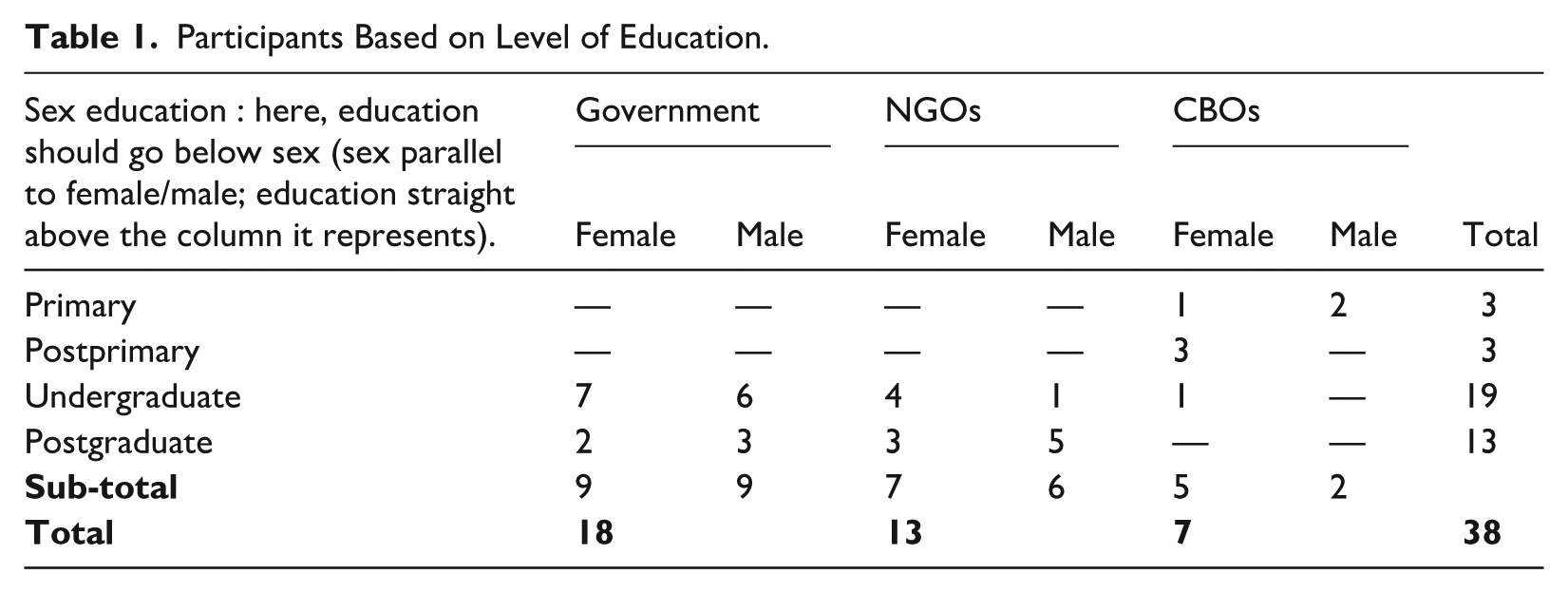
The study engaged 38 participants, including 34 individual interviewees and two pairs of participants who opted for joint interviews to complement each other’s insights based on their professional roles and experiences. Participants represented government officials, NGO practitioners, and CBO committee members, all of whom held positions related to gender and family promotion and have different educational backgrounds (see Tables 1 and 2). Table 3 presents participants by area (rural or urban).
Participants Based on Level of Education.
Participants Based on Education Specialisation.
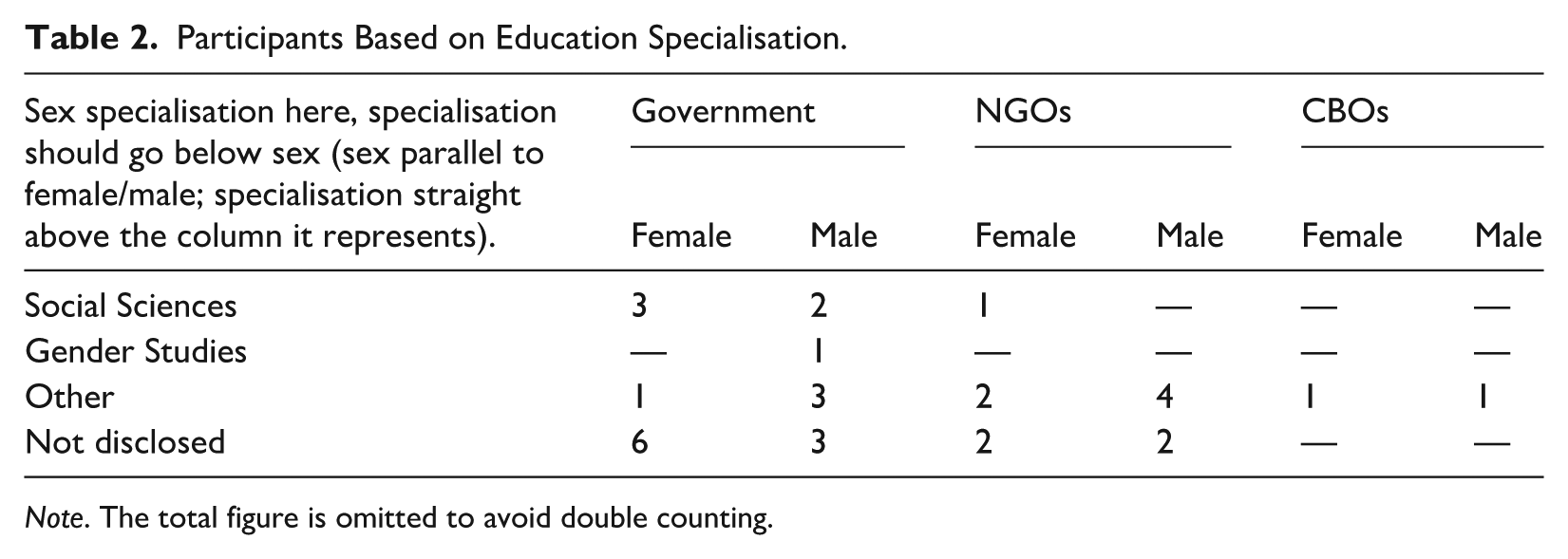
Note. The total figure is omitted to avoid double counting.
Rural-Urban Distribution of Participants.
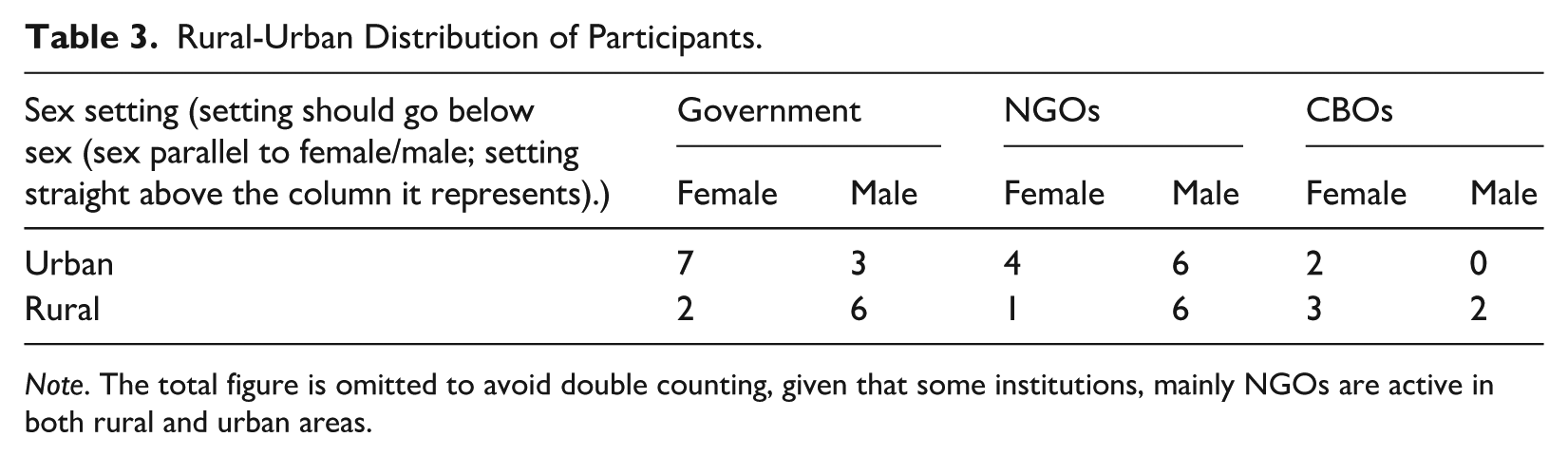
Note. The total figure is omitted to avoid double counting, given that some institutions, mainly NGOs are active in both rural and urban areas.
The summarised information about participants.
Data Collection
Although pilot testing is not always a formal requirement in qualitative research, Braun and Clarke (2013) note that piloting can be a valuable reflexive process to test and refine interview questions, assess their clarity, and evaluate whether they elicit rich and relevant data. In this study, the interview guide was iteratively developed and refined through consultation with the supervisor/co-author. While no formal pilot study was conducted, the early interviews served as a de facto pilot, allowing to make minor adjustments to the phrasing and sequencing of questions for subsequent interviews. This reflexive adaptation aligns with Braun and Clarke’s (2013) emphasis on flexibility and responsiveness in qualitative data collection.
Data were gathered primarily through semi-structured interviews, which allowed participants to articulate their understandings, knowledge, and perspectives in their own words (Braun and Clarke 2013). Semi-structured interviews were chosen for their flexibility, enabling the researcher to probe for elaboration and to follow emergent themes while maintaining focus on the research aim.
The interview guide, developed from the literature and prior empirical studies, addressed conceptual and practical understandings of gender equality, as well as challenges and contextual influences shaping its implementation (Jacob and Furgerson 2012). Each interview began with an introductory question inviting participants to describe their background and concluded with an open-ended question that encouraged reflections beyond the structured prompts. While all key topics were covered, the wording and order of questions were adapted to the flow of each conversation.
Interviews were conducted between August and September 2022, lasting between 40 and 90 minutes. Participants and the researcher selected interview locations to ensure comfort and privacy. The first author conducted all interviews personally, recording sessions (with consent) and supplementing recordings with detailed field notes. For participants who declined audio recording, responses were documented manually. The interviews were conducted primarily in Kinyarwanda, with one conducted in English. The researcher employed a flexible and reflexive interviewing approach, adding probes or follow-up questions as necessary to explore emerging insights (Braun and Clarke 2013). Sampling was guided by Creswell and Creswell’s (2023) principle of data saturation whereby data collection continued until no new significant insights emerged.
Data Analysis
All interviews were transcribed verbatim by the first author and subsequently imported into NVivo for data management and analysis. Relevant excerpts were translated into English for analytical purposes. Only a few quotes that best represent the main ideas of all the quotes are presented for analysis. Data were examined using thematic analysis (TA) following Braun and Clarke’s (2013) six-phase framework, which involves familiarisation, coding, theme development, review, definition, and reporting. TA was selected for its theoretical flexibility and capacity to identify patterns of meaning across qualitative data sets.
Themes were collaboratively identified by both authors, drawing on disciplinary expertise and the research aims. The analysis focused on uncovering underlying concepts, assumptions, and interpretations of gender equality among participants, as well as how these reflect broader social and institutional dynamics. TA enabled a critical and nuanced understanding of how varying conceptualisations and definitions of gender equality intersect and diverge across contexts and actor groups, shaping collective and individual understandings within the Rwandan context. To ensure the initial data analysis was grounded, a member check was conducted with a small group of informants (McKim 2023).
Ethical Considerations
Ethical approval was obtained from the University’s Directorate of Research and Innovation, which issued official authorisation and introduction letters. These were presented to the relevant district authorities, NGOs, and CBOs to secure research permission. Introduction letters were emailed to District Mayors, followed by in-person meetings to confirm participation and schedule interviews.
Participants were provided with information sheets detailing the study’s purpose, voluntary participation, confidentiality, anonymity, data usage, and the right to withdraw at any stage without consequence. Signed informed consent was obtained prior to each interview. For participants who declined recording, field notes were taken instead.
Minor challenges were encountered during data collection, including scheduling conflicts and occasional interruptions during interviews. In one instance, the presence of an uninvited third party during a group interview was deemed to potentially compromise the data quality. Following consultation with the research supervisor, that interview was repeated without the third party. It was also noted that some participants shared additional reflections after the recording devices were turned off. These insights were documented in the field notebook, a process that took longer than anticipated.
Findings
Thematic Overview of Conceptualisations
The TA identified substantial variation in how participants conceptualise gender equality. Their accounts clustered into two major themes: (i) Social, institutional, and contextual influences on conceptualisations. (ii) Understandings and conceptualisations of gender equality.
Note: The data are presented as numbered quotes (1, 2, 3, etc.). However, no social roles or tasks are inherently assigned exclusively to either men or women. The sources corresponding to each quote are provided in Appendix at the end of the manuscript.
Social, Institutional, and Contextual Influences on Conceptualisations
Within this theme, two subthemes are identified: (1) Historical rupture and policy reform, and (2) Legal and policy frameworks: equality as rights and opportunities.
Historical Rupture and Policy Reform
All participants highlighted the shift from past conceptions to contemporary understandings of equality and its mutual benefits for men and women. One Government-affiliated participant highlighted,
In the past, specific roles were assigned to men and others to women, despite their equal capacities. However, what a man can do, a woman can also do, and vice versa. There are no social tasks inherently designated for men or women alone.
1
The participants mark a break from traditional gender roles and support reforms promoting equality, challenging past stereotypes on men’s and women’s roles. Further it was noted that historical and traditional norms constrained women’s agency; thus, policy reforms seek to redress these legacies of inequality. An NGO-affiliated participant said, “Women are primarily targeted in these efforts to address the historical discrimination they have faced . . .” 2
Participants highlight reforms designed to redress the historical injustices faced by women towards a more equal and empowering society.
Furthermore, the significance of transforming the historically rooted conception of women’s dependency were emphasised as a crucial step towards achieving gender equality. One CBO- affiliated participant said, “. . . Wives must transcend the traditional mindset of dependency within marriage . . . Both spouses share the responsibility to contribute actively and equally for the family wellbeing . . .” 3
The participants that reflected on this underscored that reforms advance equality by encouraging the agency of women for the family’s benefit.
Participants anchored change in the post-1994 reconstruction, noting that state reforms promoted women’s rights and empowerment and reallocated responsibilities once regarded as male (Bayisenge 2015). These policies correspond with documented shifts in norms and practices concerning women’s roles (Uwineza, Pearson, and Powley 2009). The findings confirm that normative patterns are contestable and changeable (Tamale 1999; Uwineza et al. 2009).
Legal Policy Frameworks: Equality as Rights and Opportunities
Government-affiliated participants more often than the other participants defined gender equality through the laws and policies of the country and related frameworks. Typical formulations stressed equal rights, equal opportunities, and nondiscrimination such as “Gender equality means that persons from both sexes . . . have the same rights and opportunities before the Law and all other opportunities offered by the country.” 4
The participants reflected on the principle that gender equality is not merely social, but a legal right protected and upheld by national policies. Furthermore, they referred to the Rwandan Constitution as well as other legal provisions that guarantee the rights afforded to Rwandan citizens. As an example, one government-affiliated participant said, “Enjoying the same rights, ending discrimination in access to jobs . . . and in managing shared family property.” 5
The participants conceptualise gender equality as equal rights and opportunities for all citizens in resource generation and allocation. The link between gender equality and governmental priorities is also discussed as exemplified by one government-affiliated participant: “Gender equality is an outstanding Government programme . . . allowing all people to work together, complement each other, and avoid discrimination based on sex.” 6
The results reveal that the government-affiliated participants share an understanding of gender equality derived from political agency promoting equal rights and opportunities more often than participants from the NGOs and CBOs.
This legal, programmatic account treats equality as a codified entitlement and developmental imperative for family and nation. It is an abstract conception that government-affiliated participants seek to render concrete in practice through programme implementation and service delivery. That orientation is consistent with prior research showing state actors’ strong adherence to policy compliance and target attainment, sometimes with limited attention to the nuanced ways goals are locally realised (Debusscher and Ansoms 2013). Furthermore, donor-driven accountability can narrow interpretive space (Wendoh and Wallace 2005).
Building on the preceding presentation of the various factors influencing the conceptualisation of gender equality, the following section explores the diverse ways in which participants articulated and understood this concept.
Understandings and Conceptualisations of Gender Equality
Under this theme, different subthemes illustrate the diverse ways in which participants conceptualise gender equality: (1) Human and social values: equality as everyday ethical morals; (2) Power and empowerment: equality as redistribution and redress; and (3) Equality as shared roles, decisions, and responsibilities.
Human and Social Values: Equality as Everyday Ethical Morals
Government-affiliated and NGO participants more often defined and understood gender equality through relational morals and social norms. One government-affiliated participant said, “If husbands should love their wives as they love themselves . . . the husband cannot let his wife labour alone or refuse her opportunities.” 7
Government-affiliated described and viewed that gender equality represents a form of human values and moral reciprocity. This is also supported by NGO-affiliated participants, and as an example one of them said,
All family members feel involved . . . none are left behind, and everyone feels valued . . . When gender equality is practiced and internalized within the family, it becomes easier to extend and sustain it throughout the wider society.
8
The participants disclose that gender equality is understood in relation to concepts such as mutual respect, shared responsibilities, and equal participation in the family and that this will create a foundation for broader societal equality. Björnberg and Kollind (2002) support this view, showing that family gender equality extends beyond dividing tasks. It also involves mutual respect, boundary-setting, and valuing each partner’s independence.
Government-affiliated participants and NGO-affiliated ones further named negative norms that historically fuelled inequality, pointing to stereotypes that curtailed girls’ education and women’s leadership in the past, and the need to challenge those norms through socialisation and schooling. To illustrate this, one government-affiliated participant disclosed:
In the past, cultural stereotypes restricted girls from education, confining them to domestic roles while boys were encouraged to pursue schooling and leadership. This resulted in gender inequality and discrimination against women, So, nowadays, we should understand and train children that they have the same capacities, opportunities.
9
This understanding is consistent with earlier studies urging the contestation of socially constructed ideas that sustain inequality (Dillip et al. 2018) and with constructivist arguments about transformability of roles between the sexes (Alvesson and Sköldberg 2018).
Power and Empowerment: Equality as Redistribution and Redress
NGOs and government-affiliated ones also shared conceptualisations evolving on women’s empowerment and men’s inclusion.
Women’s Empowerment
Participants shared narratives framing equality as questioning and redistributing power and one NGO-affiliated participant said, “Gender equality refers to questioning power dynamics . . . acknowledging the unfairness of socially constructed norms . . . promoting an equal distribution of power.” 10
Gender equality was described and understood through the lens of power dynamics with a focus on equality rising from challenging historically constructed inequalities. This is in line with a quote from another NGO-affiliated participant from a different NGO: “In the past, women and girls had no power . . . now, gender equality empowered them . . . they have some degree of power in Rwandan society.” 11
The participants described that the implementation of gender equality allowed women to experience somewhat greater power in recent years, suggesting positive developments in empowerment efforts.
This perspective of empowering women is also revealed by a government-affiliated participant: “I understand gender equality as eliminating discrimination and empowering women through access to education, leadership, economic opportunities, and financial resources.” 12
The statement emphasises participants’ conceptualisation of gender equality as promoting the agency and inclusion of women and girls in all areas of life, ensuring their full empowerment and equitable participation.
This is in line with earlier research by Niyonzima and Bayu (2023) commending gender equality initiatives and empowerment strategies in Rwanda. The researchers disclosed that these strategies were associated with significant social advancements and women’s empowerment in decision making and improved women’s access to healthcare, education, and legal inheritance rights.
Men’s Inclusion
While some participants worried that empowering women seems like equating gender equality with women’s emancipation alone and excluding men, others explicitly advocated men’s engagement as partners in transformation of mind-set to achieve gender equality. As an example, a government-affiliated participant introduced a conceptualisation of gender equality that targets both men and women: “I understand gender equality as empowering both men and women to advance themselves, their families, and to contribute equally to the good of the nation.” 13
Some of the participants understand that gender equality enables both men and women to realise their potential and play equal roles in advancing the country. This view was also shared by another government-affiliated participant: “Gender equality involves engaging both men and women as equal participants in the development process.” 14
These participants emphasised that gender equality entails the agency and equitable treatment of men and women and the elimination of discrimination. This underscores the need for men and women to work collaboratively as equal contributors to sustainable development.
This approach of engaging men aligns with a previous study by Doyle et al. (2018), reinforcing evidence that culturally adapted, gender-transformative interventions involving men and couples can effectively address entrenched inequalities and improve household power dynamics.
Equality as Shared Roles, Decisions, and Responsibilities
All participants interviewed conceptualised gender equality based on how family life can be lived. They reflect that the basis for this should be shared income, joint decision-making, and division of household labour according to capacities. One government-affiliated participant disclosed,
Gender equality is essential for development, as it requires understanding equality as complementarity where both partners share responsibilities and support each other economically when needed . . .when one spouse cannot gain money, and the other supports the family . . .
15
Participants highlight that shared financial responsibilities and mutual support in running the household is an indicator that men and women have reached a more equal footing in terms of gender equality.
Other participants emphasised that harmonious relationships between spouses facilitate joint planning and decision-making. One NGO-affiliated participant used the concept complementarity to explain gender equality and said,
Complementarity is when as a man, you start to believe in shared decision-making and mutual contribution within the family . . . where both partners collaborate equally and the wife holds equal rights to family property.
16
Complementarity is described as a shift towards shared authority and responsibility within the family. It emphasises that gender equality requires equal collaboration and parity for women.
The above conceptualisations frame gender equality as an economic interdependence and shared decision-making. This is in line with an earlier study underscoring that women’s economic participation can increase their voice in household decisions, improve relationships, and reduce conflict (Stern, Heise, and McLean 2018).
According to participants, especially those from NGOs, gender equality within the family cannot be achieved without a fair and balanced sharing of caregiving responsibilities. One articulated this view as follows: “If a man is good at taking care of children . . . it is not a sin to show love and nurturing.” 17
Participants reflect on the need to challenge restrictive gender cultural stereotypes and promote the idea that both men and women can equally share and complement each other in emotional and caregiving responsibilities.
Another participant from a different NGO also uses the concept of complementarity to reflect on gender equality as follows: “Complementarity between spouses involves sharing responsibilities according to ability and contributing equally to family well-being, recognising the family as the foundation of Rwandan society.” 18
The participants emphasise that men and women can equally contribute to caregiving and family well-being, reinforcing the family as the cornerstone of a balanced and equitable society in Rwanda.
Some participants from CBOs and NGOs proposed a dual vocabulary: equality for legal rights and opportunities, complementarity for domestic praxis and the recognition of differences. One CBO-affiliated disclosed, “For me, gender equality means legal equality and complementarity within the household, where spouses share responsibilities and neither views themselves as superior.” 19
These participants define gender equality as partnership where both spouses contribute equally and value each other without hierarchy. Their conceptualisations highlight that gender equality is achieved when spouses share responsibilities as equal partners, without seeing one spouse as superior and the other as subordinate.
The above conceptualisations are in line with Burnet’s (2012) previous study revealing that true equality is achieved when spouses share responsibilities and regard each other as equal partners in rights and dignity, in sharing responsibilities and decision making.
Discussion
The aim of this paper was to examine how key actors responsible for the implementation of the National Gender Policy and gender equality programmes conceptualise and understand gender equality within the Rwandan context, and to identify potential similarities and differences in these conceptualisations. The analysis of data into two major themes: (i) Social, institutional, and contextual influences on conceptualisations. (ii) Understandings and conceptualisations of gender equality.
How Social and Institutional Structures Shape Conceptual Frameworks
Overall, the findings underscore the socially constructed nature of gender and reveal gaps between formal policy definitions and practical interpretations (Bayisenge 2015; Tamale 1999). These findings reinforce the argument that gender equality is not a universally fixed construct but a socially and institutionally situated one. Urban actors’ reliance on rights-based, formal definitions of equality echoes Debusscher and Ansoms’ (2013) observation that compliance-oriented policy frameworks tend to produce technocratic interpretations of equality.
The analysis of similarities and differences in the conceptualisation of gender equality across rural and urban districts reveals a complex interplay between institutional, cultural, and contextual influences. The rural-urban divide underscores how structural and cultural forces shape localised understandings of equality. Urban contexts, embedded within formal institutional and policy frameworks, tend to align gender equality discourse with national development and governance agendas. This is consistent with Kagaba’s (2016) argument that legal and political reforms often dominate gender mainstreaming in urban bureaucratic settings. Conversely, rural districts frame gender equality within community-based and relational terms, emphasising cultural continuity, social cohesion, and moral balance; an orientation that reflects deep-rooted cultural logics and the influence of CBOs.
Meanwhile, NGO and CBO actors operating closer to the social fabric of communities conceptualise equality through practice-based and value-oriented lenses, emphasising shared responsibility, cooperation, and everyday relational dynamics. From this perspective, earlier studies (Björnberg and Kollind 2002; Bonthuys 2002; Farré 2012) revealed that gender equality within the family goes beyond simply splitting tasks evenly; it also involves the nature of interactions, mutual respect and acknowledgement, the way boundaries are discussed and set, and the extent to which each partner’s independence is honoured.
Other studies (Uvuza 2014) highlight that formal equality, without corresponding cultural and social transformation, remains insufficient to produce substantive change. In the same perspective, as communicated by Njogu and Orchardson-Mazrui (2013), legal reforms alone are insufficient if they are not supported by shifts in cultural beliefs and everyday practices. When laws guarantee equality, but cultural norms continue to reinforce hierarchy or restrict women’s agency, the intended benefits of those laws remain largely symbolic.
Aligning legal rights with cultural realities therefore requires engaging communities, challenging discriminatory traditions, and promoting values that support shared responsibility and mutual respect. Only when cultural attitudes evolve alongside legal frameworks can gender equality be meaningfully realised in people’s daily lives.
Institutional affiliation further stratifies these understandings. Government-affiliated actors’ reliance on rights-based frameworks aligns with donor-driven and accountability-oriented imperatives whereas NGOs’ and CBOs’ conceptual flexibility and similarities stem from their participatory and capacity-building engagements (Wendoh and Wallace 2005). The result is a fragmented implementation landscape in which divergent conceptual logics such as formal legalism alongside moral-relational understandings coexist.
Sex differences among the participants were less influential than institutional context. The participating women emphasised empowerment and justice. The participating men emphasised unity and family cohesion. Education indicated no differences even though some CBO-affiliated participants with limited education expressed pragmatic, relational views of gender equality rooted in everyday life, mutual support and complementarity.
Gender Equality as a Contested Notion: Conceptualisations, Interpretations, and Implications
The wide range of definitions such as equal rights and opportunities, empowerment, complementarity, and equality before the law leads to diversity in terminology, which may make it more difficult to grasp a shared conceptualisation. As implementation science warns, imprecise concepts hinder the development and uptake of clear strategies and approaches often lack sufficient operational detail (Powell et al. 2015).
Such conceptual pluralism, while contextually rich, complicates coordination and evaluation of gender initiatives. As Powell et al. (2015) note, conceptual imprecision undermines implementation consistency, making it difficult to assess progress or replicate successful interventions.
Data expose that Rwandans crafted ubwuzuzanye (complementarity) to meet Rwandan realities. Their conceptualisations underscore that gender is shaped by specific cultural contexts and evolves through historical and contextual processes (Oyĕwùmí 1997; Tamale 2020).
The use of uburinganire (equality before the law) and ubwuzuzanye (complementarity in the home) shows how Rwandans translate global gender ideas into locally meaningful terms. In blending these concepts, participants adapt international gender-equality discourses to their own cultural frameworks, shaping change in ways that both enable and constrain deeper transformation (Uvuza 2014).
These participant perspectives can be situated within earlier scholarship on complementary gender systems, particularly the work of Ackerman (1995) and Schlegel (1977). According to them, equality can coexist with differentiation when roles are valued equally and grounded in reciprocity, denoting ‘complementary but equal’ systems. However, as Briggs (1974), Ortner (1972) and Uvuza (2014) caution, complementarity without power analysis risks perpetuating ‘complementary but not equal’ arrangements, where structural hierarchies remain intact despite apparent harmony. This tension between cultural legitimacy and power asymmetry reveals both the potential and limitation of culturally embedded equality discourses and the continued search for culturally and contextually conceptualisations.
The results can be understood as contextually co-produced discourse, whose realisation requires sustained engagement with both structural power relations and culturally resonant moral orders (Kabeer 2003b; Lykke 2010; Njogu and Orchardson-Mazrui 2013; Oyĕwùmí 1997; Parpart 2014; Tamale 2020).
Conclusion
In conclusion, the findings demonstrate that participants’ conceptualisations of gender equality converge around two overarching themes: (i) the social, institutional, and contextual forces shaping their conceptualisations, and (ii) the varied conceptualisations of gender equality itself. These results confirm that gender equality, as understood by key actors responsible for implementing the National Gender Policy in Rwanda is not a fixed construct. Rather, it is continually shaped by historical, socio-cultural, and political dynamics, consistent with constructivist perspectives that view gender and gender equality as socially produced and therefore subject to ongoing reinterpretation (Alvesson and Sköldberg 2018; Creswell and Poth 2018). In the Rwandan context, gender equality emerges as a social construction undergoing continuous renegotiation in response to state reforms and community practice (Bayisenge 2015; Uwineza et al. 2009).
The analysis identifies four principal conceptualisations articulated by participants: (1) gender equality as legal parity, (2) gender equality as ethical partnership, (3) gender equality as power redistribution, and (4) gender equality as complementarity in practice. From a constructivist standpoint, these frames are not mutually exclusive; rather, they coexist as interpretive repertoires that actors mobilise for different purposes and audiences (Alvesson and Sköldberg 2018).
The data also bring into focus a longstanding anthropological debate surrounding “complementary but equal” versus “complementary but not equal” gender systems. While complementarity may foster balance when distinct domains carry equivalent value and authority (Ackerman 1995; Schlegel 1977), it can equally obscure or reinforce hierarchical relations when underlying asymmetries persist (Briggs 1974; Lamphere 1977; Ortner 1972). This ambivalence is particularly salient in contexts where complementarity is invoked as a culturally resonant yet potentially ambiguous model of gender relations.
Overall, the plurality of conceptualisations observed in this study constitutes both an asset and a challenge: it enables alignment with diverse constituencies but risks generating inconsistency in policy interpretation and implementation. Developing a conceptual framework that explicitly links rights, empowerment, and culturally embedded forms of complementarity while remaining attentive to power dynamics may help ensure that appeals to complementarity signify equal value and authority rather than reinforce traditional hierarchies (Uvuza 2014). Such clarity is crucial for enhancing strategy design, implementation fidelity, and evaluative rigour in gender-equality initiatives (Powell et al. 2015).
Accordingly, this study recommends refining definitional models that integrate rights-based, empowerment-oriented, and culturally grounded understandings of gender equality. Future research should explore how definitional plurality shapes the practices of key actors to strengthen policy guidance and foster approaches that are culturally contextualised, power-sensitive, and conducive to equitable social transformation.
Footnotes
Appendix
The quotes are from the following participants:
Acknowledgements
The authors acknowledge the role of the participants who agreed to be part of the research and to the co-supervisor Hahirwa Gumira Joseph (PhD), who commented on some parts of the present paper.

Ethical Considerations
This study was approved by the Institutional Review Board (IRB)/Directorate of Research and Innovation, College of Arts and Social Sciences at the University of Rwanda (Ref. 08/CASS-DRI/2022) on 6 April 2022 and renewed on 24 October 2022 (Ref. 16/CASS-DRI/2022). Participants were recruited in June, July and August 2022.
Funding
The authors disclosed receipt of the following financial support for the research, authorship, and/or publication of this article: The authors disclosed receipt of financial support from University of Rwanda-Sweden Programme for Research, Higher Education and Institutional Advancement (SIDA), under the PhD training sub-programme in Social Work [FP1924_20].
Declaration of Conflicting Interests
The authors declared no potential conflicts of interest with respect to the research, authorship, and/or publication of this article.
Declaration on the Use of AI
The entire paper was written by our team, with copy-editing and wording help through Grammarly. Elicit was used to find relevant articles to use in the background and discussion, while ChatGPT Edu assisted with double-checking the references generated by Endnote.
Data Availability Statement
This manuscript is part of the PhD work and data will not be made public according to the ethical principles. Data are kept in a safe storage at the University of Gothenburg data repository, accessible to the research team only.