




Abstract
Objectives:
The aim of this study is to gain a deeper understanding of the experiences of visually impaired older people living independently at home.
Background:
As populations are aging globally, there is now an increase in the prevalence of visual impairment. That means for ongoing and future aging-in-place strategies that seek to enable older people to remain independent for longer, more attention needs to be given to the needs of those with visual impairment. As people develop visual impairment, they use adaptive strategies including modifying long-term homes or relocating to more suitable accommodation. In the United Kingdom, aging-in-place strategies include employing statutory lifetime home standards (LTHS) in the home or relocating to sheltered housing to live independently with support available if required.
Methods:
To get a better understanding of the needs of the visually impaired in the home, 12 interviews with six visually impaired occupants of LTHS homes and six from sheltered accommodation were analyzed separately using interpretative phenomenological analysis. Secondly, qualitative synthesis was used to further analyze themes generated from both samples before interview results were conceptualized in two superordinate concepts, namely, “negotiating priorities” and “understanding visual impairment.”
Results:
Participants from both groups had similar needs and were willing to compromise by living with some negative features. Those who coped well with moving utilized various resources.
Conclusions:
These findings will shed more understanding on providing good quality housing for those with visual impairment wanting to live either independently or within healthcare home environments.
As global populations age and develop health-related impairments, there is a greater incidence of sight loss among older people. This is challenging for designers to address. Older adults with visual impairments, wishing to continue to live independently, often adapt their homes or move to sheltered housing (SH) 1 from less suitable homes. Despite general design guidelines for aiding those with visual impairment, more research is required to analyze the experiences of visually impaired residents in age-related housing. This article therefore presents the experiences of 12 visually impaired people living independently in lifetime homes (LTHs) 2 and age-related housing in Northern Ireland (NI).
Background
Predictions suggest that global percentages of people aged over 60 years will grow from approximately 10% in 2000 to 13% by 2020 (United Nations Department of Economic and Social Affairs, 2005). Older people are predisposed to eye conditions such as glaucoma, macular degeneration, and cataract (Stuen & Faye, 2003). Additionally, the World Health Organization (2012) estimates that 65% of visually impaired people and 82% of blind people in the world are aged over 50. Consequently, it is necessary to understand experiences of older adults with impairments to ensure that their housing needs are met.
Many visually impaired older people choose to “age-in-place” which is the ability to live independently, safely, and comfortably at home regardless of age, finance, physical, or cognitive limitations (Rowles & Ravdal, 2004). The United Nations recognizes their right to live independently in the community with equal choices to others (United Nations, 2006). Thus, aging-in-place policy aims to develop communities that enable older people to remain in their homes and neighborhoods for as long as possible (Vasunilashorn, Steinman, Liebig, & Pynoos, 2012). Much research appraises independent living. Stones and Guilifer (2016) use interpretative phenomenological analysis (IPA) to examine experiences of people aged over 85 living at home. Johnson and Bibbo (2014) employ IPA to examine participants’ transitions into nursing homes. Studies also explore the experiences of people with glaucoma (Green, Siddall, & Murdoch, 2002; Wu, Guo, Xia, Lu, & Xi, 2011). This study specifically considers the housing needs of visually impaired adults living in age-related housing.
Housing policy should adapt to afford change as a result of aging and associated impairments (Mackenzie, Curryer, & Byles, 2015). Lawton’s productivity model indicates that homes can be adapted to enhance an individual’s competence and meet their changing needs (Wahl, Iwarsson, & Oswald, 2012). People with impairments use adaptive strategies such as care plans, adjusting their home, or moving to modified housing (Thomése & Broese, 2006). Deciding to relocate to SH is often to balance a user’s capabilities with the demands of the physical environment (Granbom, Löfqvist, Horstmann, Haak, & Iwarsson, 2014).
LTHS
Lifetime Home Standards (LTHS) seek to reduce the need to relocate or adapt homes when occupants develop impairments. LTHS consist of 16 standards with criteria that pertain to internal and external access alongside fixtures or fittings. LTHS demand inclusive external access with wide car parking and level illuminated access to the home. Internal features include wider doorways, turning spaces, entrance-level living space, provision for bed space at entrance level, entrance-level water closet (WC), provision of bathroom grab rails, space to install a through floor lift, potential for fitting hoists, and an accessible bathroom. Fixtures and fittings standards relate to window height and accessible services controls (Table 1).
Lifetime Home Standards.

Note. This table describes the 16 principles of lifetime home standards. WS = water closet.
The benefits of employing LTHS include the adaptability of housing at a minimum cost enabling older people to remain independent for longer (Hanson, 2001; Madigan & Milner, 1999). Despite this, many authors state that LTHS focus solely on physical impairment requirements rather than adequately addressing the needs of visually impaired people (Barlow & Venables, 2004; Holland & Peace, 2001; Imrie, 2006; Madigan & Milner, 1999; Milner & Madigan, 2004). Nonetheless, LTHS were incorporated into Part M 3 of the building regulations 4 as a higher optional standard (Department for Communities and Local Government, 2015). Hence, LTHS continue to play a major role in the design of UK homes.
SH
As older adults with disability spend lengthy periods in their homes, noninstitutional housing connected to services must be developed to enable people to age-in-place (Hamers, Spreeuwenberg, Bilsen, & Groot, 2008). Housing models such as the Eden Alternative, green house (GH) model, and assisted living were developed as alternatives to traditional nursing home facilities. In line with this, SH are independent homes, usually built near communal facilities and are monitored by wardens (Field, Walker, Hancock, & Orrell, 2005). SH is often viewed as transitional living between independence in the community and long-term care. Other terms for SH include extra-care and supported housing (Hadjri, 2010). UK studies examining SH identify the importance of designing flexible homes for older people with various care needs (Barnes et al., 2012). While Lewis and Torrington (2012) explore lighting and design of extra-care homes of visually impaired people in England, this article examines the experiences of visually impaired people living in LTHs and SH in NI. This study also questions: Does age-related housing met the needs of visually impaired residents?
Method
Participants and Interview Procedures
Purposive homogenous samples of home users were gained through gate keeper housing association (HA) lists and through charity organizations (Table 2). Two data sets were identified. These were (a) six visually impaired LTHs occupants with a mean age of 59 (L1–L6) and (b) Six visually impaired non-LTHS SH occupants with an average age of over 70 (S1–S6). After ethical approval was granted by Queen’s University Belfast, home visits and interviews were carried out with all 12 participants by one member of the research team. Questions were formulated by creating two interview guides, one with questions to be posed and the other with thematic research question (Kvale & Brinkmann, 2009). The schedule was tested using a pilot interview, and leading questions or jargon was avoided to reduce bias.
Participant Descriptions.
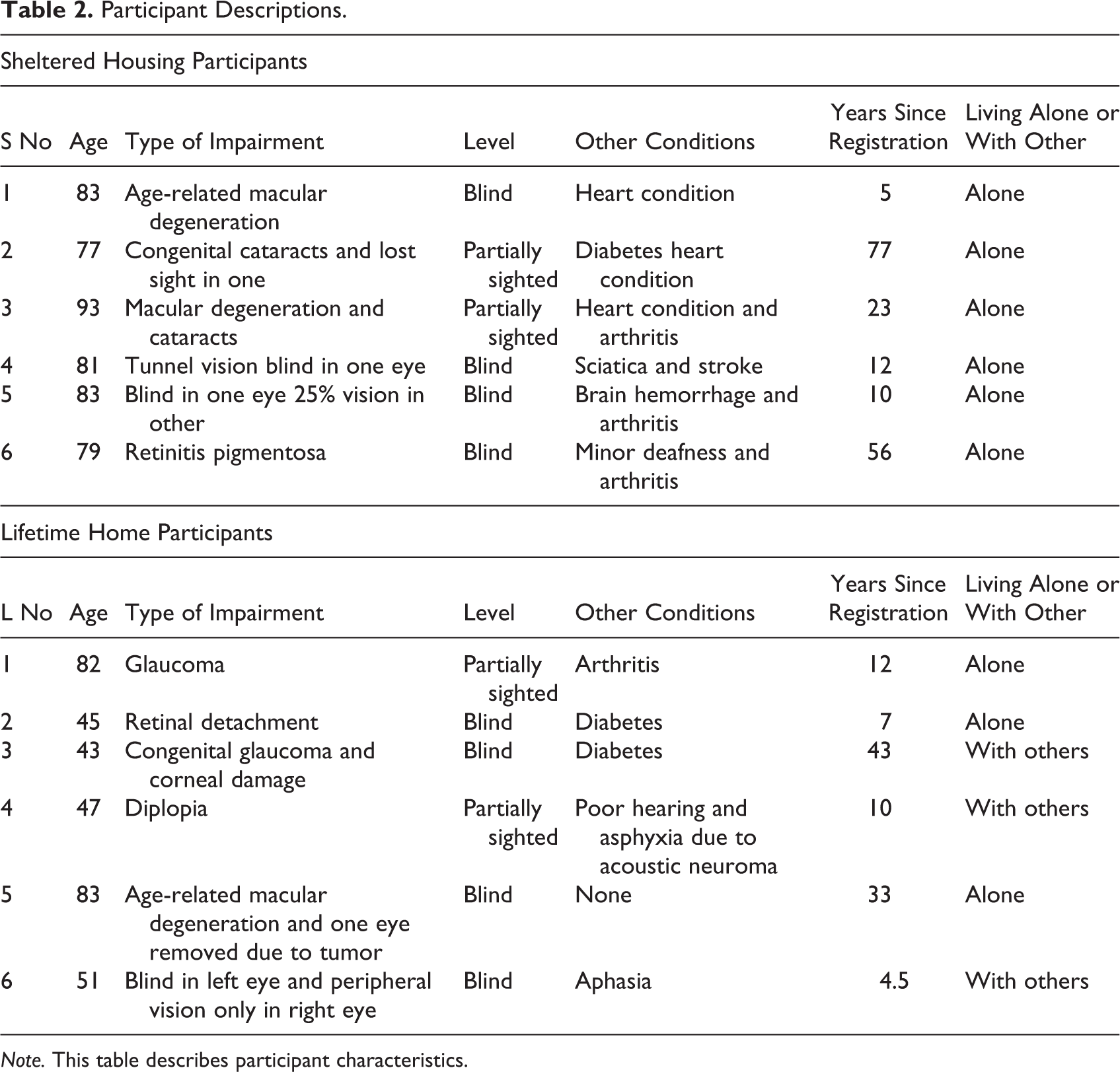
Note. This table describes participant characteristics.
Data Analysis
The analysis presented here stems from a larger IPA study that explored the phenomena of visually impaired people living in LTHs. Semistructured in-depth interviews exploring participants’ experiences of housing from the two data sets were analyzed as two separate groups using IPA, which is a systematic qualitative approach that examined the individual lived experiences of the participants (Osborn & Smith, 2006). IPA was a suitable method as it allowed for deep descriptions of participants’ thoughts and feelings regarding housing challenges they experienced, while acknowledging that researchers may bring certain concepts to the process of analysis (Reynolds, 2003; Smith, Flowers, & Larkin, 2009). Interviews were analyzed individually using the six steps of IPA analysis as devised by Smith et al. (2009) (Table 3). This involved initial reading, noting, developing emergent themes, searching for connections, moving to the next case, and seeking patterns across cases (Table 4).
Describing the Six Steps of IPA (Smith, Flowers, & Larkin, 2009).

Note. This table describes the analysis process for IPA. IPA = interpretative phenomenological analysis.
Example of Step Three of Interpretative Phenomenological Analysis, Developing Emergent Themes (Smith, Flowers, & Larkin, 2009).

Note. This table is an extract from a coded sheltered housing interview.
Final analysis brought two data sets together (L1–L6 and S1–S6), with the aim of further illuminating the experience of older adults with impairments living independently within community settings. Thus, generated data were further analyzed using qualitative synthesis which is a system used to amalgamate a body of research about a particular topic (Hannes & Lockwood, 2012; Ring, Ritchie, Mandava, & Jepson, 2010). A variation of meta-ethnography developed by Noblit and Hare (1988) was used to compare, analyze, and further interpret results. Overarching themes were used to identify differences that existed between data sets and to establish an overall picture of living at home with a visual impairment.
Noblit and Hare (1988) developed seven steps of meta-ethnography for studies (Table 5): The first four steps normally relate to deciding on the relevant studies and organizing them into groups; however, here the two data sets were preselected whereby key concepts had been developed in the form of themes in these studies using IPA. Step 5 was utilized to translate the studies into one another which was carried out by developing concepts from both sample groups. Step 6 then synthesized the translations by identifying concepts that can encompass those found between the two data sets. This was achieved by establishing how the concepts that were developed in Step 5 related to one another. This resulted in developing a map for each group to help describe the relationship between them. Finally, Step 7 involved expressing the synthesis in textual form.
Seven Steps of Meta-Ethnography (Noblit & Hare, 1988).

Results
Meta-analysis of the results from phenomenological analysis produced two superordinate concepts: “negotiating priorities” and “understanding visual impairment.” Table 6 provides a list of superordinate and subordinate concepts for discussion. Negotiating priorities was conceptualized in four subordinate concepts: enhancing our homes, housing priorities, compromises, and “home sweet home.”
Superordinate Concepts.
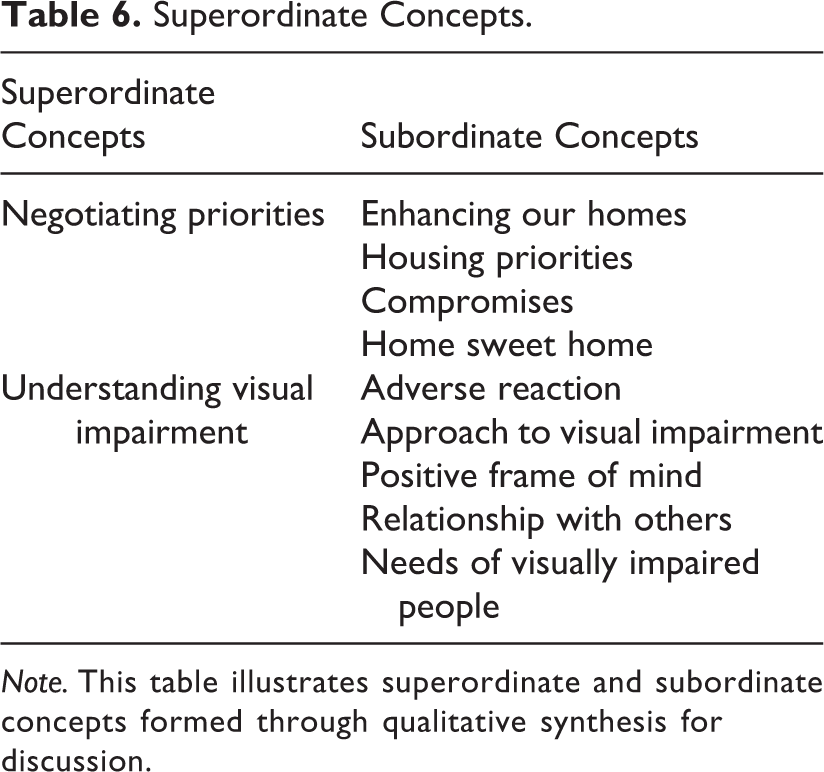
Note. This table illustrates superordinate and subordinate concepts formed through qualitative synthesis for discussion.
Negotiating Priorities
Enhancing our homes
Both sample groups (L1–L6 and S1–S6) discussed ways of enhancing their homes in the future. Participants (S1–S6) maximized the suitability of their SH by carrying out research when first selecting their residences, while participants in LTHs (L1–L6) considered ways of improving their current homes. Many SH participants had moved home for safety reasons. Safety was also important but not paramount for LTHs participants. Both groups favored homes with simple layouts and chose homes with level access throughout: “I think that really and truly you couldn’t get any better really because everything is on one level” (S6).
Many SH participants had moved home for safety reasons. Safety was also important but not paramount for LTHs participants.
Many moved to LTHs for further space and wider doorways. One SH participant noted how building and fire regulations had enabled her to feel safer in her home. Others favored living in familiar house types like their childhood homes. Relationship with others was also an important consideration for allocating homes. Additionally, neighborhood terrain was important as living on a hill was described as being isolating and dangerous in the winter. Close proximity to amenities and shops was seen as being beneficial by encouraging participants to maintain their independence.
Live-in wardens were keys for non-LTH sheltered accommodation interviewees: “And I mean let’s face it, you say live here alone but it’s not really alone, but I have my own life within here” (S6). Although support was valued by both groups, it was still important to prevent an institutional atmosphere in their homes. Participants wanted more consultation between designers and visually impaired people, especially at an early design stage. Participants from both groups used color contrast on steps and around light switches to aid use. Underfloor heating was also used specifically to lessen the likelihood of trips and falls.
Participants wanted more consultation between designers and visually impaired people, especially at an early design stage.
Housing priorities
Emotional value was placed on their home in both groups, and participants were attached to their new homes: “It’s a home because you make it a home” (S4). Home was described as a base and much time was spent there because it was familiar and satisfied their needs. Both groups felt confidence inside their homes compared to being outside in their neighborhoods or in the homes of others. All LTHs participants (L1–L6) had moved to a house or apartment that met their accessibility needs. This contrasted with SH participants. For instance, one interviewee had no space to allow two people to stand in her kitchen at the same time. Both groups were satisfied with storage space for equipment, hobbies, and bins in their homes.
“It’s a home because you make it a home”.
The extra shower room in LTHs was used by all household members, whereas walk-in showers were not installed initially in the sheltered accommodation. When installed, they were convenient and useful, particularly for older participants and those with physical impairments. Some participants used the shower space as extra storage space. Those living in sheltered accommodation (S1–S6) appreciated the lifts, handrails, and banisters on both sides of stairs and the use of braille in communal areas. LTHs participants (L1–L6) were satisfied with the high-level switches and sockets in their homes although one participant would have liked more switches and sockets. Car ports in LTHS housing not only helped keep people dry when approaching their front doors but gave a place for one participant to house her guide dog.
Compromise
SH participants (S1–S6) cited negative aspects in their homes alongside LTHs participants (L1–L6) who highlighted challenges that they faced at home and in their neighborhoods. Although downstairs bathrooms and walk-in showers were important, sometimes shower rooms were too small for wheelchair users alongside their carers. One LTHs participant also wanted an en suite shower room specifically for their bedroom. Many felt safe in their homes: “You lock your door at night and all that and you are safe” (S4), however two LTHs participants felt vulnerable to crime with no direct access to their back gardens. Although there were benefits associated with many LTHS features, one participant commented that LTHS focused principally on physical impairments and complained that features for visual impairment were very expensive to employ.
One LTHs participant wanted a more spacious kitchen, whereas another non-LTH SH participant’s cupboards were too high and her kitchen door opened inward restricting the amount of usable space. Both groups were dissatisfied with energy efficient light bulbs as they took too long to warm up and thought that natural lighting levels could be improved in internal bathrooms. Two LTHs had condensation issues due to inability to open windows fully for fire safety reasons. Most participants were satisfied with the atmosphere in their homes, however one SH participant described a negative atmosphere in her apartment block which may be a feature of SH with common rooms.
Home sweet home
Both groups experienced emotional attachment to their homes with many participants moving house to live closer to family: Being near them is just lovely, because the doorbell would go and one of my granddaughters hopped in…um…Friday evening. ‘you got the kettle on gran?’ (S6)
Understanding Visual Impairment
The superordinate concept of experience of being visually impaired was conceptualized into the subordinate concepts of adverse reaction, approach to visual impairment, positive frame of mind, relationship with others, and needs of visually impaired people.
Adverse reaction
Both groups discussed negative reactions toward their visual impairment and experienced adverse reactions, regardless of their home type. Having an ability to read, carry out certain tasks without support, and travel independently outside the home were missed by participants. Cooking independently became challenging. Therefore, participants often relied on family or used microwavable products instead. Those in SH accommodation described their diagnosis as disappointing, while LTHs participants felt a sense of grief and frustration.
Both groups lost independence before and after diagnosis. LTHs participants (L1–L6) had moved house to gain independence or more space and to receive more support. Similarly, non-LTH SH (S1–S6) participants had moved to homes built to Part R of the building regulations 7 to become more independent. Although LTHs are planned with universal design, 8 newly diagnosed physically and visually impaired people selected them for their accessibility features thus helping them to remain independent. Yet, it was important for some to remain in their own familiar home, as vision deteriorated. Non-LTH SH (S1-6) interviewees discussed tripping and falling concerns in the home. Participants cited more space and reduced risk of bumping into obstacles as reasons for moving to LTHS accommodation.
It was evident that both samples felt less comfortable and had less control of obstacles outside the home, regardless of standards that their homes were built to: “You see anybody else’s house, I am dead lost. I’m terrible, I can’t see” (S1). They became more cautious outdoors and often relied on others for support.
Approach to visual impairment
This encompassed the use of self-management skills, physical ways of coping, and achieving familiarity with their homes. Although both groups experienced negative reactions following diagnosis, they also learned to accept their visual impairment: “It never seemed to get me down. Do you know? It never got me down. I got on with it” (S6). They coped by focusing on their remaining sight and being mindful of those in more challenging situations. Participants learned to control the effects of impairment. On moving to new homes, they familiarized themselves with surroundings and learned to compensate for lack of sight through mind mapping their home. Both groups stated that moving house could be stressful and challenging, recognizing that this process was less challenging for people with partial vision. Both samples used sound and touch to compensate for their loss of vision. Tactile stickers enabled the use of dials on cookers washing machines. Tactile stickers were used with digital display to improve the accessibility of heating controls. Both groups removed trip hazards such as rugs. Physical changes suggested for use in homes included designing with clear layouts, installing nonslip flooring, eliminating door saddles, employing-level access, and avoiding awkward corners or obstructions.
Positive frame of mind
All participants discussed the benefits of having a positive emotional response to their sight loss. They also viewed the prospect of deciding to move home positively: “so it was decision time again, and that’s never bothered me, if there is a reason for doing something…I’ll get on with it” (S1). Participants went through a process of acceptance and focused on positive thoughts; they were grateful for their homes, their remaining vision, and the support of their families. Those who became visually impaired at a young age stated that they felt that visual impairment was easier to cope in this circumstance. However, some participants felt that they were too accepting of their accommodation: for example, accepting their inability to use the heating control system rather than applying solutions to the problem.
Relationship with others
Both groups discussed the level of support that they received from others; non-LTH SH users (S1–S6) discussed societal attitudes, whilst LTHs occupants (L1–L6) commented on the overall support that they received. On examining interview transcripts of both groups, it was evident that support received from family members, HAs, and sensory support teams was appreciated by participants. However, it was also felt important to be aware of when it was appropriate to seek help and to choose carefully how to utilize this assistance while maintaining independence. Members from both groups had care-line systems in their homes which could be used to seek help, and although many participants who lived alone found this useful, participants living with others found them obstructive, particularly when children visited their homes.
A vital consideration for HAs when allocating homes was that both groups valued their community and wished to live close to family and friends: “sometimes I would go up the stairs after dinner time and some of my neighbors would just sit and have a yarn” (S2). One LTHs participant (L2) had no room for visitors which contributed to negativity and loneliness. This contrasted with another SH participant who appreciated having facilities for guests within her SH complex. Some SH participants felt there was a lack of knowledge regarding their specific needs and were frustrated with poor understanding from members of the public: Like…because I am visually impaired I know what to do, but, there are some people who don’t. you would see people trying to lead a blind person holding onto them to push them…sort of…through the place. you don’t do that. (S2)
Needs of visually impaired people
Participants from both groups felt that the housing needs of visually impaired people varied. Many in non-LTHs sheltered accommodation changed aspects of their homes, for instance removing baths and installing showers. Others moved to LTHs to cope with secondary physical conditions. Some older participants spent more time at home, due to a fear of falling outside. The needs of occupants with deteriorating sight were different to those with congenital blindness or with sudden vision loss—for example, the quality and level of lighting necessary in their homes. Some participants from both groups favored dark spaces and used blinds to control levels of natural light entering a room: I don’t like the light. I don’t put the light on” (L1), others preferred an even spread of light and glare was an issue for many: “If it’s dark I can’t see. it helps me to see…. it’s just easier to see with it. (L5)
Discussion
This article has sought to provide a deeper understanding of the experiences of visually impaired people who live in age-related housing in a UK context by interviewing residents with visual impairment living in both LTHs and SH. Although most participants were satisfied with their homes, they were also willing to tolerate some negative features. It is clear that residents set their housing priorities and compromised between practicalities and their wishes within their homes. Both groups had similar housing expectations and highlighted the importance of feeling safe at home. This was achieved through design measures and changing their habits, with both groups expressing similar values with particular regard to inclusion within communities. This aligns with Wiles, Leibing, Guberman, Reeve, and Allen (2011) who observe that older people aging-in-place are most settled in safe communities enabling a feeling of security in their homes. However, there were also negative aspects with independent community living, whereby participants could be targeted by crime or where other people had lacked understanding toward them.
As with previous research, color contrasting features, extra storage space, and spare visitor rooms are important to participants (Johnson & Bibbo, 2014; Lenham, 2013; Sylvestre & Smith, 2009). Both groups found that design features developed for older people benefit them and stated that many impairment types are considered in the design of their homes. However, those who lived in homes with low social density had a greater need for technology such as care line systems, yet those with high social density dwellings found more obtrusive. Color contrast 9 is useful for those with partial visual loss (Foxlin, 2014), yet further consultation at an early design stage could be improved to enhance future homes.
Both groups found that design features developed for older people benefit them and stated that many impairment types are considered in the design of their homes.
In line with the social model of disability, residents were disabled by society, when their needs were not understood by members of the public and through an absence of key facilities (Bolt, 2005). Occupants noted a lack of control over decisions regarding internal changes to their homes. Preceding research identifies mobility or health decline reasons for older people moving home (Ermisch & Jenkins, 1999; Granbom et al., 2014; Seo & Mazumdar, 2011; Sylvestre & Smith, 2009). Here, all LTHS participants (L1–L6) moved to find more physically accessible accommodation, indicating a need for further accessibility in general housing stock. The SH examined was built to Part R of building regulations which is a visitability 10 access standard covering accessibility. Evidently, Part R and LTHS criteria are beneficial to both groups of participants, in particular with regard to level access design. However, building regulations and LTHS excluded features that participants favor including underfloor heating, color contrast, access to views from homes, location of homes, support available, and considering the emotional attachment to their homes. These could be considered by HAs and others when designing and allocating housing for visually impaired people. The design of care homes for visually impaired people can also benefit from these findings given the domestic features that these should afford.
The LTHS group complimented accessibility features such as carports, height of switches/sockets, extra space, additional shower room, walk-in shower, and wider doorways, whilst members of the SH group favored lifts and banisters in communal areas. Conversely, both groups cited negative features such as poor heating controls in awkward locations, small kitchen spaces, and poor lighting levels. Educating older people and housing providers to determine adequate levels of appropriate light for age-related visually impaired people is critical (Eilertsen, Horgen, Kvikstad, & Falkenberg, 2016). In both groups, a sense of community was important, and homes were enhanced by support and presence of others, affirming Rowle and Ravdal’s (2004) theory that social emersion enables development of affinity toward home or place. Accepting support of others to improve coping skills correlates with Antonovsky’s (1979) salutogenic theory of sense coherence that describes general resistance resources such as social support, coping strategies, and cultural stability inherent in people with strong abilities to deal with challenges (Eriksson & Lindstrom, 2005). A sense of coherence (SOC) is a capability to perceive that one can cope irrespective of challenges that they face (Lindstrom & Eriksson, 2006).
In order for the built environment to have positive effects on SOC for occupants, buildings must be easily understood, afford control, and have meaning (Golembiewski, 2010). Unsuitable non-LTHS features were inaccessible cupboards and awkward kitchen spaces. Poor features for LTHS occupants included heavy doors, lack of bathroom space for carers, and awkward window openings. Also negative features unrelated to design in both settings were poor atmospheres and trip hazards. Nonadapted use of space was also, evident when occupants relied on family members to cook meals. Brundle et al. (2015) identify clutter as a risk for falls in familiar home environments. Although gossip contributed to negative moods in study findings here, Percival (2000) suggests that it has necessary social purposes in sheltered homes. In line with this, Hadjri, Rooney, and Faith (2015) state that a good atmosphere is also an important element within care homes for people with dementia.
Overall, both groups had similarities in what home means to them, had pride in their houses, realizing that home provided them with shelter alongside a sense of community. Wiles (2008) notes that familiarity plays an important role in developing a sense of home. In line with this, living in familiar settings or house types was important to participants. This correlates with (Rowles & Ravdal, 2004; Swenson, 1998) findings where home acts as a base or shelter and a symbol of oneself. It is also in keeping with the principles of GH and assisted living principles, which suggest that residents should be able to age-in-place in a homelike environment designed to cater for their changing needs (Spitzer & Neuman, 2004). Furthermore, GH homes are built to blend with surrounding houses and neighborhoods.
Research states that people may react to diagnoses of visual impairment with shock and fear for the future (Green et al., 2002; Wu et al., 2011). In the present study, participants faced new challenges both inside and outside the home. Both groups discussed negative consequences of visual impairment and voiced a sense of loss, lack of control, and a sense of grief or frustration. Evidently all faced these challenges in a positive way and learned new ways to carry out tasks focusing on positive thoughts. Research into care home design shows that moving home can be uncertain and frustrating (Rowles & Ravdal, 2004). LTHS participants (L1–L6) who moved to more accessible homes then used touch and sound to become familiar with new spaces. Although adjustments to the home can counterbalance the negative effects that impairment can have on wellbeing, existing housing stock is not always adaptable and sometimes there is a need to move (Thomése & Broese, 2006). This corroborates previous findings that new memories, emotional attachments, and meanings can be built by deciding to move autonomously (Leith, 2006). This complies with Nahemow and Lawton’s (1973) ecological theory where the demands of the environment became too challenging. However, by moving to LTHS homes, participants are enabling themselves to age-in-place. On comparing the results of interviews, it is evident that both groups have similar experiences of housing and visual impairment.
Conclusion
This article provides an in-depth analysis of perceptions of visually impaired people in a range of homes. Our findings suggest that oftentimes people leave general housing and move to more accessible homes. As LTHs should reduce the need to move in future, it means that more thought and attention needs to be given to providing good quality aging-in-place housing for those with a wide range of disabilities, including visual impairment. The loss of capacity and increased likelihood of depression associated with any disability only increases the need to ensure that residents with a visual impairment do feel genuinely comfortable and at ease in their homes and wider surroundings. These findings are therefore also applicable to the design of healthcare facilities. Hence further research is now needed to evaluate the quality of our existing housing stock and how both it and new housing can provide a safe and secure home for many who face difficult physical challenges in their lives (Figure 1 and Table 7).

Implications for practice.
Evidence-Based Recommendations.

Note. This table takes themes generated by interviews and translates themes into evidence-based design recommendations. SH = sheltered housing.
Implications for Practice
There will be a need to upgrade mainstream housing stock to afford more choice and to enable people to age-in-place.
There is a need to educate residents and housing providers to determine adequate levels of appropriate lighting for age-related visual impairment.
Further research is needed to examine the inclusion of features such as underfloor heating and color contrast in current building regulations (Part R and lifetime home standards).
Any loss in physical capacity can have a negative effect on a person’s well-being, therefore feeling both comfortable and confident in one’s surroundings is important to counterbalance this.
Findings such as the need for access to views, improving heating controls, lighting levels, and creating buildings with meaning are also applicable to the design of care home environments.
Footnotes
Acknowledgments
The research team would like to thank the individuals and organizations who generously shared their time, experience, and materials for the purposes of this research.
Declaration of Conflicting Interests
The authors declared no potential conflicts of interest with respect to the research, authorship, and/or publication of this article.
Funding
The authors disclosed receipt of the following financial support for the research, authorship, and/or publication of this article: The Authors wish to state that this research was funded by Queen’s University Belfast.