



Abstract
The aim of this study was to examine the influence of visibility on teamwork, collaborative communication, and security issues in emergency departments (EDs). This research explored whether with high visibility in EDs, teamwork and collaborative communication can be improved while the security issues will be reduced. Visibility has been regarded as a critical design consideration and can be directly and considerably impacted by ED’s physical design. Teamwork is one of the major related operational outcomes of visibility and involves nurses, support staff, and physicians. The collaborative communication in an ED is another important factor in the process of care delivery and affects efficiency and safety. Furthermore, security is a behavioral factor in ED designs, which includes all types of safety including staff safety, patient safety, and the safety of visitors and family members. This qualitative study investigated the impact of visibility on teamwork, collaborative communication, and security issues in the ED. One-on-one interviews and on-site observation sessions were conducted in a community hospital. Corresponding data analysis was implemented by using computer plan analysis, observation and interview content, and theme analyses. The findings of this exploratory study provided a framework to identify visibility as an influential factor in ED design. High levels of visibility impact productivity and efficiency of teamwork and communication and improve the chance of lowering security issues. The findings of this study also contribute to the general body of knowledge about the effect of physical design on teamwork, collaborative communication, and security.
The emergency department (ED) is generally considered one of the most important departments of a hospital, where patients often present seriously ill, in pain, and in need of immediate and quick treatment (Considine, Kropman, Kelly, & Winter, 2008; Kilner & Sheppard, 2010; Welch, 2012). Considering the crucial role of the ED in providing quick care, designing physical environments to facilitate immediate, efficient, and effective patient care assumes significant importance (Calleja & Forrest, 2011; Lin & Lin, 2011; Welch, 2012).
One critical operational issue directly and considerably impacted by physical design is visibility (Apple, 2014; Bosch & Gharaveis, 2017; Calleja & Forrest, 2011; Gharaveis, Hamilton, & Pati, 2018; Harvey & Pati, 2012; Lu & Zimring, 2012; Pati, Harvey, & Pati, 2014; Welch, 2012). The importance of visibility in healthcare settings has also been emphasized by studies in other hospital departments, including inpatient and critical care units (Calleja & Forrest, 2011; Lu & Zimring, 2012; Welch, 2012). Visibility is a criterion for any ED’s effectiveness, since the care staff need to be aware of patients’ conditions and prevent unsafe actions. The visibility of a waiting area from the security desk, triage, and reception may improve security and safety (Harvey & Pati, 2012; Pati et al., 2014).
The quality of visibility affects the quality of teamwork, which is a critical operational factor in healthcare (Gharaveis et al., 2018; Lu & Zimring, 2012; Pati et al., 2014). Teamwork involves nurses, support staff, and physicians and affects efficiency and safety (Pati et al., 2014; Person, Spiva, & Hart, 2013). Person, Spiva, and Hart (2013) also note that appropriate teamwork helps staff manage their workload. The importance of communication and teamwork in the process of care in the ED is critical (Pati et al., 2014).
Nurse Communication in an ED Is Another Efficiency and Safety Factor, Which Can Be Affected by Design
Staff-to-staff communication, which can be called collaborative communication, is routine among all the hospital-based health practitioners, usually referred to as the patient’s medical team. Of all forms of communication, face-to-face is the most beneficial and effective form of collaboration (Corwin, Corbin, & Mittelmark, 2012; Slovis, 2008). The collaborative communication in an ED is very important in the process of care delivery (Slovis, 2008).
Security is a subset of safety and considered a great risk in EDs. Care delivery can be efficient only in a safe environment (Pati et al., 2014). Aggressive incidents can result in immediate disruption to the department and take staff’s attention away from clinical duties (Knowles, Mason, & Moriarty, 2013). Environmental factors and design considerations, as one of the security improvement factors, may lower the security risks in EDs (Angland, Dowling, & Casey, 2014; McPhaul et al., 2008; Poyner & Fawcett, 1995). Visual connection or visibility as a design consideration is critical in the context of security (Pati, Pati, & Harvey, 2016).
While the limited previous research in ED settings has separately explored visibility, teamwork, communication, and security, more exploration is needed about how all of these concepts interact with each other to enhance patient care. This study examined the influence of visibility on teamwork, collaborative communication, and security in EDs. The research question this proposes: What is the nature of the relationship between visibility and teamwork, collaborative communication, and security in emergency departments?
Methods
The foundation of this exploratory study was based on visibility as a physical design/architectural construct, while the ideas of teamwork, collaborative communication, and security in ED were borrowed from different disciplines including psychology, medicine, and nursing. The conceptual model sought to help explain how three types of visibility influence teamwork, collaborative communication, and security (see Figure 1). This study identified the importance and significance of visibility in EDs that can provide numerous positive results in care delivery.

Conceptual model—the relationships among variables and covariates.
The variables of interest in this research include: Independent variable: visibility: (a) between staff and (b) staff-to-patient. Dependent variables: (a) teamwork, (b) collaborative communication, and (c) security issues.
An exploratory approach was adopted for this study, involving qualitative technique as the base of inquiry. Visibility data collection included computer analyses and observations. The drawings were checked before conducting analyses and included touring the facility and marking all the changes or renovations, according to current situations. Digital copies of plans in AutoCAD 2016 format were inserted into the Depthmap software (UCL-Depthmap 10), and the analysis were done twice for consistency. Isovist (defined as the ratio of the visible area from a given point to the whole area) was drawn on schematic plans as manual visibility graphs to illustrate general visibility (Figure 2). The figure highlights the saturation of visibility around hallways and the main nurse station.

Isovist area (left) and Isovist perimeter (right).
Four hours of field observation (2 hr in the morning and 2 hr in the evening) were conducted as a qualitative assessment tool of the departments’ visibility based on the quantitative plan analysis in Depthmap software. The researchers observed around the locations where the probabilities of the staff presence were maximum including charting spaces, workstations and substations, corridors, and control areas based on the Isovist analysis results. The observations were conducted during busiest hours of the ED, according to the ED’s database regarding visits per hour, and the researchers took notes for further analysis. Data collection for this study was done in July 2016 in an ED after obtaining approval from institutional review board at the researchers’ institute. Also, the location of each of the saturated spaces was coded and the visibility of the spaces reviewed by field notes.
Five semistructured one-on-one interviews were conducted in this study (two physicians and three nurses). The volunteer subjects for interviews were selected purposefully after touring facilities and conducting observation sessions. The inclusion criteria were being ED nurse or physician for more than 3 years, serving the current facility for more than 1 year, and working at another EDs. Interview sessions were scheduled by the ED director, and each interview took approximately 30 min in the staff break area.
The exploratory questions in one-on-one semistructured interviews were asked from participants about the association of visibility and medical teamwork, collaborative communication, and security. The follow-up questions were asked to obtain in-depth information. The questions about the importance of visibility and the relationship of visibility and teamwork were asked first. The questions regarding collaborative communication were asked after teamwork questions and before security issues.
All the interview sessions were recorded by Olympus digital voice recorder WS-803/802/801 after checking the device. The interview recordings were transcribed by a professional transcriber under supervision of the researchers. The transcripts were checked with the original recordings for research validity. All field and interview notes were typed for analysis.
The related and similar ideas from observations were clustered together, and quotes were created. There were two rounds of coding. A brief narrative of each subject site was provided according to content analysis (Spradley, 1980). Several steps were followed sequentially to analyze and code the notes from observation sessions. The domains of the codes could be applicable to any sociocultural setting including different departments in a hospital. Hence, acts, activities, actors in the setting, the situation of the actors in the setting, objects, time, goals of behaviors, and emotions/feelings were the framework for the analysis and different comparisons.
Interview transcripts’ content and theme analysis were based on principles of naturalistic inquiry (Lincoln & Guba, 1985). After the data collection process, interview transcripts were prepared for analysis by having all the data units. All the transcripts were separated into data units. Data unit is defined as “a piece of information in an interview that can stand alone and make sense” (Y. Lincoln, personal communication, February 27, 2015). All the units were read through twice before coding. The statements were summarized to code the transcripts. The similar codes were clustered together (Emerson, Fretz, & Shaw, 2011). Nonsaturated themes and codes were deleted.
Results
Observation
According to observation sessions, communication in the ED was related to the patient load. When the ED was busy (more than 70% of the maximum occupancy), nurses tended to communicate more frequently in the rooms or in the hallways (rather than in the central work area) in order to remain closer to their assigned patients. In fact, during peak times, the nurses spent most of their time in patient rooms and hallways and went to central areas only for charting and communication with physicians. This dynamic changed somewhat when the ED was less busy, with nurses then choosing to spend more time in the central workstation.
Assessing nurse-to-nurse visibility was challenging during the busy hours of the ED, particularly since the places where nurses spent their time were not predictable. The layout of the pilot site was divided into two parts by a central medication room, and nurses were physically separated from physicians. Several members of the ED staff complained about this separation in our discussions, indicating it hampered nurse–physician interactions. With regard to nurse–patient interactions, the counter height between the nurse station and hallway was a significant concern, as it often interfered with visibility and even required the nurses to lean over the counter to have a better view of patient rooms. Concern about “who is going in and out of patient rooms” was a frequently expressed issue.
Trauma and psychiatric patients were particular targets of nurses’ supervision and were given a higher priority in terms of visibility. Gathered around trauma patients were nurses, physicians, and technicians with significant and extensive communication occurring inside the patient’s room. In a few cases, a police officer was involved and was also present in the room. Another important subject of observation was the chief nurse, who was involved in many of the team activities throughout the department. The physicians were less physically active than the nurses and spent most of their time assessing patients or making notes. They appeared to be a less important visibility target for immediate communication in comparison with the nurses and patients.
Interviews
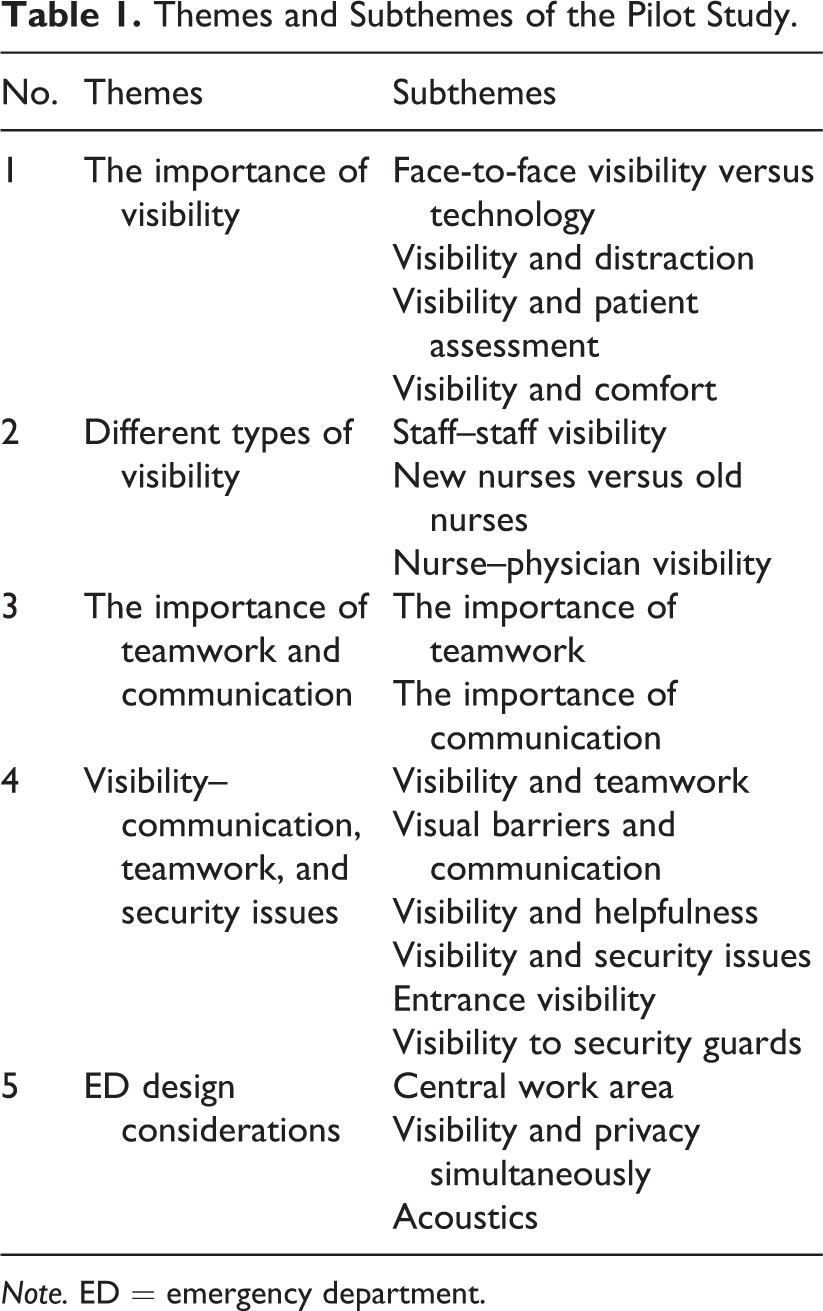
The importance of visibility in ED and the impacts of visibility on teamwork, communication, and security were investigated by exploratory questions. The data were coded in two different stages. Five major themes were found, and each theme included few subthemes (totally 18 subthemes; see Table 1).
Themes and Subthemes of the Pilot Study.
Note. ED = emergency department.
Based on the research questions, respondents believed that visibility should be one of the major considerations in the ED design, and it is correlated with better teamwork and collaborative communication and lower security issues. Also, higher visibility may lead to less distraction, more efficient patient assessment, and higher comfort based on the responses. Furthermore, it is considered that face-to-face communication, which can be related to visibility, is still the best method of communication even with the presence of technology.
Theme 1: The importance of visibility
This theme is divided into four subthemes including (a) face-to-face visibility versus technology, (b) visibility and distraction, (c) visibility and patient assessment, and (d) visibility and comfort. Expanded descriptions of different subthemes were provided in the following sections. The majority of the research participants emphasized visibility as the most critical environmental design element in ED.
Subtheme 1: Face-to-face visibility versus technology
Even though a large number of communication problems in EDs have been resolved by advances in technology, the research participants stated that they preferred face-to-face communication as the most efficient and effective means to exchange information. Face-to-face communication is the best way, and you can deliver more and communicate best. (P2) It is more important to see or have eye contact than having them calling you or texting you or something else. I think there is more engagement…. (N2)
Subtheme 2: Visibility and distraction
The feedback given by nurses and physicians during the interviews led to the conclusion that better visibility can enhance the concentration of the medical staff and decrease distractions during communication. So oftentimes one will be busy doing one thing, one will be distracted, one will be working with another patient, you can’t find each other if you are not working or having direct visibility with each other, so yes it does impact. (P1)
Subtheme 3: Visibility and patient assessment
Nurses and physicians indicated having eye contact with their colleagues, and visual connectivity with different locations of ED enhances the patient assessment process. Visibility has high importance to identify patients’ status and locating other staff. (N2)
Subtheme 4: Visibility and comfort
Nurses referred to walking distance, feelings, amount of work, level of comfort, and time saving as the factors that could be impacted by visibility. Also, visibility was thought to provide the opportunity to satisfy different tasks simultaneously. High visibility is so important and can reduce the amount of work and save time. (N1) Visibility and access in several different areas, I think it is good to review it from several vantage points such as walking distance, job satisfaction, and so…. (N3)
Theme 2: Different types of visibility
Similar to what has been discussed in the previous literature, the nurses and doctors who participated in the interviews referred to different types of visibility in the ED. These types included staff-to-staff, new nurses versus old nurses, and nurse–physician visibility.
Subtheme 1: Staff-to-staff visibility
Staff-to-staff visibility was asserted to have multiple impacts on care delivery. Asking for help from colleagues was the most frequently mentioned value of visibility by nurses. I think it affects it pretty greatly from all different aspects, visually blocking the design of the ED, you are no longer able to easily access the staff that you would like to speak with, to learn from and they learn from you. (N2) The working relationship from staff-to-staff…you want the staff to be working in approximately the same area. (P1)
Subtheme 2: New nurses versus old nurses
New nurses agreed on the higher importance of staff-to-staff visibility, while experienced nurses conversely contemplated that staff-to-patient visibility is their higher priority. …because with experience, comes experience in all aspects and likewise in a stressful situation in which you know you have experience of the people working with you…. (N2)
Subtheme 3: Nurse–physician visibility
Interviewees (nurses and physicians) stated mutual visibility between nurses and physicians would have a high significance in healthcare delivery because of its impact on communication and teamwork. Additionally, the ideas of nurses and physicians regarding the importance of staff–staff versus staff–patient visibility were different and depended on the individual’s job experience. Physicians notified that staff-to-staff visibility has higher importance for them. As a provider, as directing patient care, I think staff-to-staff is very important because you depend on your team and they depend on you and if they can’t find you they can’t tell you important information…. (P1) So you have that blocked off visibility where you don’t have that connectivity with the physicians as closely as you might in a layout that does not have that wall in the middle of everything. (N2)
Theme 3: The importance of teamwork and communication
The importance of teamwork and communication was emphasized by the participants in this study. Teamwork and communication were considered highly related to each other and were believed to be of a higher priority in healthcare delivery. Both nurses and physicians believed teamwork and communication could not be separated from healthcare delivery.
Subtheme 1: The importance of teamwork
The nurses and physicians emphasized teamwork is particularly important in the ED because of the nature of ED care delivery, which involves many different tasks and activities that are often undertaken with significant time pressures. It [teamwork] helps the unit care team become more efficient, much more precise, you are no longer relying on one person. You are able to complete tasks much more quickly, you have the advanced knowledge of a pool of sources now instead of the experience and forethought of just one person…. (N2)
Subtheme 2: The importance of communication
Communication among nurses and physicians was regarded as a necessary median in ED care delivery. In EDs, nurses and physicians have a large communication network. I think communication, especially collaborative communication is the base, is the most important thing. (P1) Collaborative communication is important for us because frequently the doctors will give a patient an update and then leave a room and I can come into the room behind the doctor and the patient still doesn’t know what is going on…. (N3)
Theme 4: Visibility on teamwork, communication, and security issues
Based on the interviews, visibility as an environmental factor can have an effect on teamwork and communication. This theme in the interview data can be broken down into six subcomponents, including visibility and teamwork, visual barriers and communication, visibility and helpfulness, visibility and security issues, entrance visibility, and visibility to security guards. The interviewees emphasized the impact of visibility on teamwork, collaborative communication, and security.
Subtheme 1: Visibility and teamwork
The respondents stated they would prefer to have the maximum possible visibility of their colleagues throughout the entire ED to achieve the most effective teamwork. Yes, it [visibility] bolsters the team and creates teamwork and ability to communicate on a regular basis things that aren’t necessarily important to the medical record but are important to the nuance of the case…. (P1)
Subtheme 2: Visual barriers and communication
Visibility in the ED was described as one of the most effective environmental elements impacting communication. In other words, visual barriers inside the department reduce effective communication. We have a huge visual barrier to communication, right in the middle of a department…we have nurses on one side and providers on the other. (N3)
Subtheme 3: Visibility–helpfulness
The respondents stated they would prefer to have the maximum possible visibility of their colleagues throughout the entire ED to ask for help. …I think that the more that you see, you can see your other staff, your coworkers, you can see what they are doing, how hard they are working, if they need help. (N1)
Subtheme 4: Visibility and security risks
The nurses and physicians who were interviewed believed promoting security in the ED through the use of environmental design should be a priority. Regarding visibility and security, respondents bolstered the idea that increasing visibility is an appropriate strategy to control and secure EDs. ERs are highly volatile, you can have assaults, you have people that come in that might be a victims of attempted murder, so controlling the flow of visitors is huge. (N1) I think visibility can definitely increase or decrease your security. (P1)
Subtheme 5: Entrance visibility
The ED entrance was regarded as a high-risk area and one that should be strongly supervised. Hence, greater visibility toward the entrance was seen as an important step in reducing security risks. High control on the main entrance of the ED was recommended by nurses and they believed that central workstation is a potential target for aggressive behaviors. …it is uncontrolled entrances, multiple entrances that people can come from without anyone standing by to keep an eye on them. They are locked but that changes as soon as someone goes out the door.…(P1)
Subtheme 6: Visibility to security guards
The presence of security guards making rounds within the ED or visible outside the ED in the waiting area was considered important to minimize aggression. Also, security guards are important parts of EDs, and higher visibility of staff to their location, if their station existed in ED, would be a robust improvement. It’s nice to have them around, you know, a little bit closer. And they do come into ED quite a bit to see if we have any issues or patients we are concerned about, or family members. (P2)
Theme 5: The ED design considerations
This theme includes the specific design considerations other than visibility that emerged during the interviews. Three subthemes were identified in the analysis, including central work area, how to obtain visibility and privacy simultaneously, and acoustics.
Subtheme 1: Central work area
Physicians and nurses hypothesized the importance of being in the middle of the department, so they have easy access to everywhere and everybody, thus leading to better levels of communication and teamwork. The best layout would be having everybody in one room, it would be wonderful for teamwork, but it is not possible, because of privacy issues…. (P2) I would have loved an open layout where the med room was not in the middle of the station, where it’s just one big square, everybody can see and talk, maybe have a station in the middle—but I hate the wall.…(N3)
Subtheme 2: Visibility and privacy simultaneously
The physicians and nurses who were interviewed stated they preferred high visibility to have appropriate care delivery, but they were concerned about Health Insurance Portability and Accountability Act violations. This idea was highly highlighted about the central workstation visibility, to/from the rooms and corridors. …If you are trying to talk to a consultant on the phone—a lot of these things are on the phone and privacy is lacking. That’s why I like the provider in back or in a closed room. (N2)
Subtheme 3: Acoustics and lighting
The nurses who were interviewed frequently mentioned the noise levels in EDs and considered this a major barrier to effective communication. Background noise reduction should be considered seriously. The nurses mentioned they need to have appropriate lighting, but their concerns of less background noise was more challenging. Noise is a barrier for communication and teamwork. We need to have doctors more accessible (N2)
Discussion
The qualitative data supported the importance of visibility as an environmental factor that can enhance teamwork, collaborative communication, and security in EDs. The positive findings were remarkable in the interviews with nurses and physicians, who believed that greater visibility improves their teamwork, communication, and security. This was supported by the researcher’s on-site observations. This study supports (a) visibility enhances teamwork, (b) high visibility promotes communication, and (c) visibility reduces security risks.
Also, these results were consistent with previous studies that have investigated the relationship between visibility and teamwork in workplace environments (Martin & Ciurzynski, 2015; Pati et al., 2014; Trzpuc & Martin. 2010). The nature of the relationship between visibility and communication was another focus of this research. The interview and observation results reflected visibility as an important factor in successful communication, again consistent with the findings of previous qualitative studies (Becker, 2007; Haq & Luo, 2012; Johanes & Atmodiwirjo, 2015; Pati, Harvey, & Cason, 2008; Rashid, Boyle, & Crosser, 2014; Ritchey & Pati, 2008; Trzpuc & Martin, 2010; Yi & Yijia, 2014). Finally, the findings of this study regarding the association of visibility with security support the existing literature. Poyner and Fawcett (1995) and Hadi and Zimring (2016) in addition to Pati, Harvey, and Pati (2014) and Pati, Pati, and Harvey (2016) notified the significance of visibility in reduction of aggression and security issues in ED. Regarding the potential covariates, Gharaveis, Shepley, and Gaines (2016) reported the impact of lighting on communication in rehabilitation units. However, this study’s participants were not concerned. This may be related to the differences of challenges in inpatient and outpatient healthcare facilities.
Moreover, the ideas that visibility promotes patient supervision, as discussed in the literature by Joseph and Rashid (2007), has been supported by this study. The ideas of Seo and coauthors regarding the positive impact of visibility on reduction in walking distance were emphasized by this study.
Furthermore, the benefits of visibility in EDs were analyzed extensively in this research, and to a large extent the data supported the value of visibility. Visibility has the potential to reduce nurses’ and physicians’ distraction levels, facilitate patient assessments, enhance staff comfort levels, and expedite the helping process. The comparison of this study’s findings regarding the impact of visibility with the findings of the literature review is summarized in Table 2.
Similarities Between This Study’s Findings About Visibility and Previous Studies.
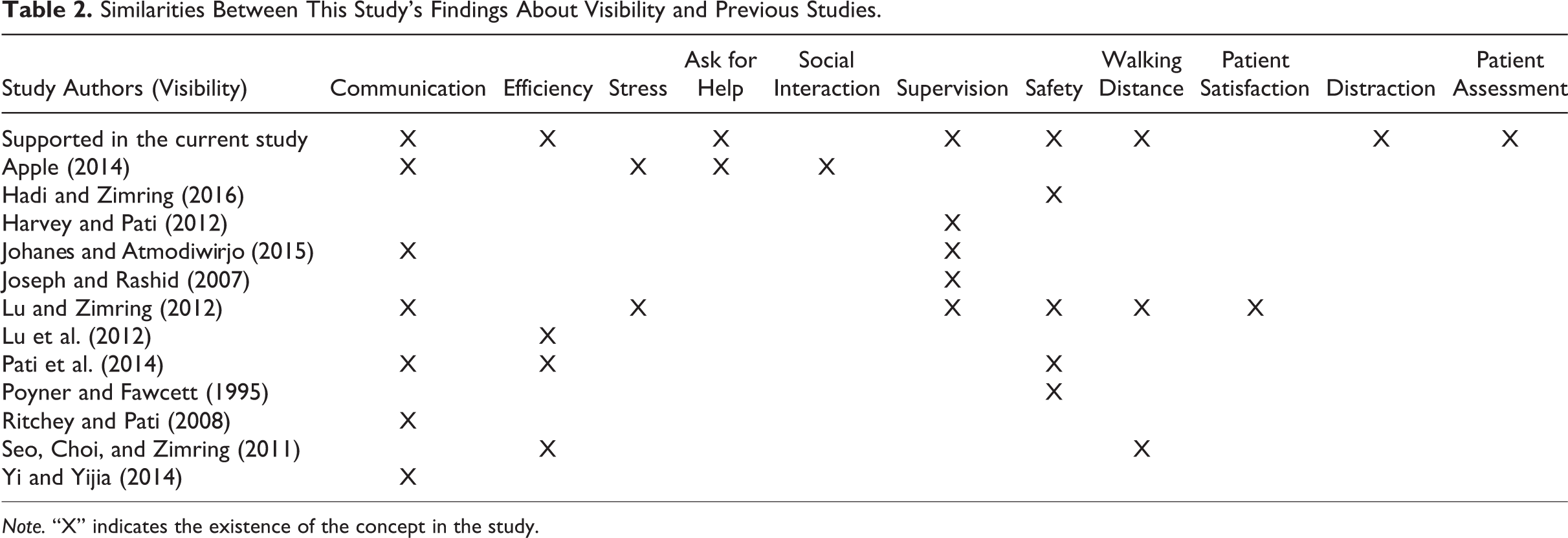
Note. “X” indicates the existence of the concept in the study.
Conclusion
This study was expected to provide subjective and predictive data on the impact of visibility on medical teamwork, collaborative communication of medical personnel, and security in EDs. Although the exploratory findings may not be generalizable to all hospitals, it will provide a foundation for subsequent quantitative and qualitative studies involving a broader and more representative sample. The findings may help to develop a preliminary set of guidelines or to modify current guidelines for future ED designs. In addition to contributing to the core body of knowledge about the impact of physical design on teamwork, investigating the importance of visibility for physicians and nurses in the ED constitutes another by-product of this study.
The findings of this study support the importance of visibility in promoting teamwork and collaborative communication and reduction in security risks in EDs. A higher level of security in EDs is another by-product of this research for nurses. Additionally, visibility enhances efficiency, asking for help, patient supervision, patient assessments, while reduces walking distance and distraction. Different teams’ communication may be facilitated by improvement of visibility in departments. So, layout design should be considered crucial for healthcare designers and planners.
This pilot study has some limitations related to the research design, sampling, and site selections. While it is not unreasonable to generalize the findings of this study to a wide array of community hospital ED environments, future studies can go further in replicating the results and overcoming some of the current limitations. First, the limited number of participants in this study was volunteers, their opinions may not be fully representative of their colleagues. Second, 4 hr of observation cannot be considered sufficient to explore the communication and teamwork efficiency and their relationships with visibility. Longer hours of observation should be conducted in future studies. Finally, the research model took into account a variety of covariates that have been identified in previous studies to affect teamwork and communication. However, this qualitative study was not able to explore the impact of potential confounding variables. Future multivariable quantitative studies are highly recommended.
Implications for Practice
This study explored an understanding of the current knowledge about the relationship between communication and the design of healthcare facilities by exploring the relevant literature.
The main implications for practice of this study are as follows:
High visibility in emergency department (ED) enhances care delivery.
Visibility impacts medical teamwork and improves efficiency.
Environmental design considerations, especially visibility and accessibility, promote communication extensively.
With high visibility in ED, the chance of aggression and security risks will be lower.
Footnotes
Declaration of Conflicting Interests
The authors declared no potential conflicts of interest with respect to the research, authorship, and/or publication of this article.
Funding
The authors received no financial support for the research, authorship, and/or publication of this article.