



Abstract


I have noticed recently in reviewing a few submitted manuscripts for Health Environments Research & Design Journal (HERD), some authors do not clearly define the terms, concepts, or variables they are using in their study. Likely, there is an assumption that the terms are so widely used, everyone has a shared understanding of the terms. Unfortunately, this is not always the case and particularly with an international and intraprofessional journal audience. Words have different meanings in different languages, professions, and geographical locations. Not everyone has the same understanding or assigns the same meaning to the generic term “evidence-based” as an example. To some, evidence-based refers to research findings that can be translated or applied to design practice, but to others, evidence-based may also include other forms of nonresearch-related evidence. Fortunately, the healthcare design field has actually developed a definition and process of evidence-based design (EBD) which should create a shared meaning among those who engage in EBD, but unfortunately some of the current definitions have created more confusion than clarity. As an example, a Google search of the term evidence-based design (EBD) yields a Wikipedia site (https://en.wikipedia.org/wiki/Evidence-based_design) defining EBD as “the process of basing decisions about the built environment on credible research to achieve the best possible outcomes” and cites the Evidence-based Design Accreditation Certification (EDAC) book used for preparation for certification as the source (retrieved March 14, 2018, http://www.healthdesign.org). This definition limits evidence to credible research. Fortunately, a more accurate second definition follows: “a process for the contentious, explicit, and judicious use of current best evidence from research and practice in making critical decisions, together with an informed client, about the design of each individual and unique project” (Hamilton & Watkins, 2009, p. 9).
Other similar terms include research-informed design, research design, and design research. All of these terms have slightly different meanings and applications and should not be used interchangeably with EBD or with each other. As an example, research-informed design is a design process based on applying credible research findings in integration with the project team to inform the design and achieve project goals (Peavy & Vander Wyst, 2017). The original definition of research-informed design comes from the education field and relates to research-informed curriculum design (Bentley et al., 2013) and expands the definition from only previously published or disseminated research (similar to the original definition of EBD) to include input from the project team coupled with overall project goals.
On the other hand, research design is a term used to describe the research methodology used in both qualitative and quantitative studies and may include exploratory, descriptive studies, case studies, correlational or comparative studies, quasi-experimental or experimental studies, retrospective or prospective methods, phenomenology, grounded theory, and a host of other research designs. The description of the research design is absolutely critical in describing the research in an article or presentation because the research design directly influences the research questions and/or hypothesis statements, data collection methods, analysis of the findings, reporting of the results, and description of the conclusions and applications for practice.
Design research uses the very same words in reverse as research design, but the term has an entirely different meaning. Design research is defined as studies about the effect of a particular design feature on patient, provider, or organizational outcomes. An architectural firm might use design research to evaluate the effectiveness of medication administration devices located in the patient’s room in reducing the number of medication errors (wrong patient, wrong medication, wrong dosage, wrong route of administration, and wrong entry into the medical record). Perhaps the design firm or the hospital client would like to evaluate the effectiveness of decentralized nursing stations on reducing the number of patient falls or steps nurses take during a shift of work. There are hundreds of different design research studies that could be conducted by firms and hospitals to measure the effect of the structure on care processes and patient, provider, and organizational outcomes.
Defining Terms Is Critical to Ensuring a Shared Understanding
It is important to define terms clearly and differentiate them from similar terms. As an example, people often confuse the terms of EBD with design research, thinking the two terms are synonymous. Peavey and Vander Wyst (2017) provided an excellent conceptual and comparative analysis of EBD and research-informed design creating a shared meaning for us using the terms in practice. I encourage all design and healthcare professionals to read the Peavey and Vander Wyst article, and hopefully, these definitions can be used not only in practice but also in future EDAC publications. To some designers not educated in formal research methods, design research may seem daunting, but EBD, using credible evidence (research, expert opinion, and past experiences) to guide the design, may seem more plausible. Of course, you still have to measure the results and hopefully disseminate your findings in journals like HERD or in presentations at national and international conferences.
In preparing the manuscripts for publication to disseminate findings from design research or EBD projects, it is important to define terms, concepts, or variables of interest early in the article. These three words—terms, concepts, or variables of interest—are also used interchangeably but have slightly different meanings. A term is simply a word you will use throughout your manuscript, and the term/word’s meaning may seem obvious to you, but the term’s meaning may differ slightly based on the context in which it is used or the language or profession of the reader. Therefore, it is suggested that you define important terms used in the article in the first few paragraphs. You might say, “in this article, the term ‘nurses’ performance efficiency’ is defined as nurses’ abilities to perform caretaking tasks with the least amount of steps and physical effort in the least amount of time to achieve optimal patient outcomes.” By the way, I just made up that definition. It is completely appropriate for you to define a term specific for your study or manuscript with your own definition, or you can use other previously published definitions of the term and cite other authors accordingly. You can also use a more formal dictionary or reference book definition if that is appropriate.
Concepts are very similar to terms but are often more abstract and not as easily defined as a term. Often authors will develop a conceptual definition giving a shared meaning to the concepts that are being discussed in the study or article. When there are multiple concepts in the discussion, it’s always wise to develop a conceptual model that assembles the concepts together and shows the relationships among the concepts in a figure or diagram. Architects and other professionals in the design field readily understand the need for a conceptual model, since they use this same methodology to communicate their thoughts about a design in a two- or three-dimensional model making it easier for their audience to understand their ideas.
Variables of interest are simply the terms and/or concepts of interest in a study, but they can be the terms of interest in a nonresearch article. Variables of interest should be introduced to and defined for the reader early in the article, and they become key words in the review of the literature, the research questions and/or hypotheses, and guide what will be measured in the research design. As an example, you might tell the reader, “the variables of interest in the study are nursing stress, work environment, and patient outcomes.” Once you’ve introduced the reader to these concepts, you might draw a picture (design a figure) showing how these concepts and variables of interest are interrelated (a conceptual model). Perhaps you are suggesting in your hypothesis that the physical work environment influences nurses’ stress and ultimately affects patient outcomes. These concepts and variables of interest become the key words in your literature search and the headings in your review of the literature. Perhaps physical work environment includes long hallways, lighting, noisy environments, visual access to outside environments, and other related design features. Nurse stress could be defined with a limited definition for your specific study to include physical stress (fatigue levels), cognitive abilities, visual acuity, alertness, or subjective stress. Patient outcomes could also be defined within the specific parameters of your research or your nonresearch paper to include patient satisfaction levels, medication error rates, patients’ readiness for discharge, or a host of other patient outcome options that might be appropriate for your study. You can readily see why definition of terms, concepts, and variables of interest are critical early in the article because they can have context-specific meanings, and the reader must be alerted to what you are specifically addressing and hoping to measure in your study. Research academics refer to measuring concepts or variables of interest as operationalizing the concept. The concept remains abstract until you can measure it or operationalize it.
The Need for Concept Analysis in Healthcare Design
Concept analysis is a structured process, a research method, and a critical part of building the science of a discipline (Nuopponen, 2010; Walker & Avant, 2011). The process of concept analysis or terminological analysis is familiar in business studies, nursing, healthcare, and other sciences, and the method/process may differ slightly depending on the discipline. The outcome is the same—a shared meaning of a concept. A concept analysis defines a concept through its use in the literature and synthesizes the concept’s characteristics and relationships to other concepts. The science of healthcare design is maturing, and we have more evidence, both experiential and research informed, to apply to practice and design decisions. With the maturing of the science comes the responsibility to analyze important concepts to create a shared meaning about their definition, defining what the concept is and is not (the attributes of the concept); the conditions that must be in place for the concept to be real (the antecedents); and the consequences of the concept. As an example, there is discussion about the need for collaboration between healthcare designers and the actual end users of the design (the care providers, healthcare administrators, and in some cases the patient and family). Before we can actually measure the effect of collaboration in this context, perhaps we would need to define the term, so that there is a shared meaning among all those who are reading and/or using the information in the article. Some designers might feel collaboration means including end users on the design team during one or more phases of the design process to create design concepts, whereas other designers might believe collaboration means presenting a completed and developed design concept to the end users to get their feedback, input, and reaction to the developed design concept. You can readily see these two processes are entirely different and would likely result in different outcomes if you asked if the end user was “involved” in the design process. Perhaps the lack of clarity about the concept of collaboration is the reason why we sometimes hear from nurses, physicians, and other professionals that they had no input into the design of their hospital or work environment – “no one asked me” or “I didn’t have an opportunity to give input or I would have told them that designing it this way would require more Full Time Equivalents (FTEs).” Reacting to a design or giving feedback to a seemingly completed design is different than being completely involved in generating the new design; thus, it is important to define the terms upfront in the design process lest expectations are confused.
Concept Analysis as a Formal Process
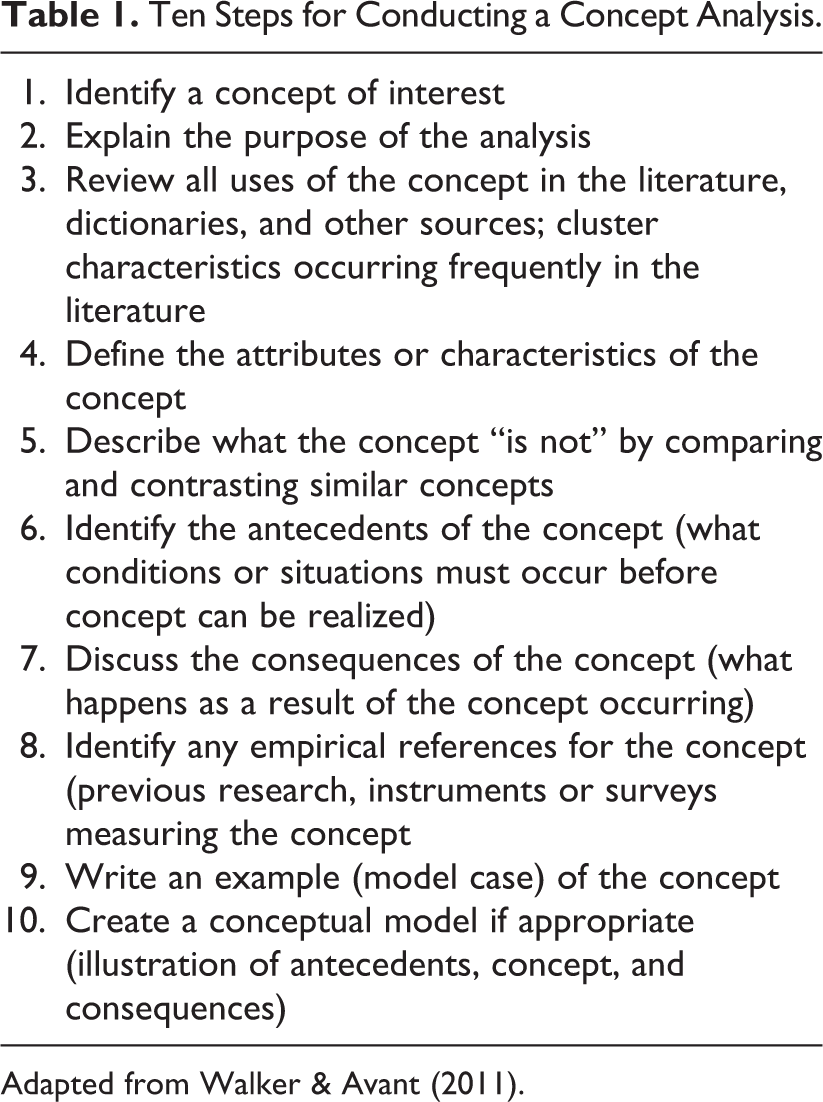
Should there be any interest in writing concept analysis papers, I have developed 10 steps of conducting a concept analysis as outlined in Table 1, which are adapted from the seven steps described by Walker and Avant (2011) and the various interdisciplinary methods described by Nuopponen (2010). The fourth step of identifying the attributes of the concept is the most important of all steps. Some authors refer to synonyms of the concept, while others list the characteristics of the concept. Most importantly, the synthesis of the attributes becomes your definition of the concept specific to your purpose, paper, or study. Your definition(s) of a term(s) or concept(s) stated up front and early in the paper clarifies the meaning for all who will read the paper regardless of their profession, language, or geographical location.
Ten Steps for Conducting a Concept Analysis.
Adapted from Walker & Avant (2011).
Concept analysis is not just an academic exercise, but rather it is an important step in ensuring shared meaning of concepts, terms, or variables of interest within a discipline. In its simplest form, it is the definition of terms early in a manuscript or in a presentation, and in the more formal sense, it is a critical step in clarifying what is meant by a term and in developing instruments or surveys to measure the concept or term. I hope we will see more concept analysis papers submitted to HERD and presented at national and international conferences. We need more clarity in some of the terms we use in healthcare design.