



Abstract

Architecture and the Modern Hospital: Nosokomeion to Hygeia, coauthored by Julie Willis, Philip Goad, and Cameron Logan, is an ambitious attempt to trace the transformation of the modern hospital—from a place of salubriousness and charitable care to a system of rationally organized health and welfare—as a “global phenomenon.” The architectural history of health and well-being is a rapidly growing field, and this book makes a thoughtful contribution with new content and an alternative framework for interpretation.
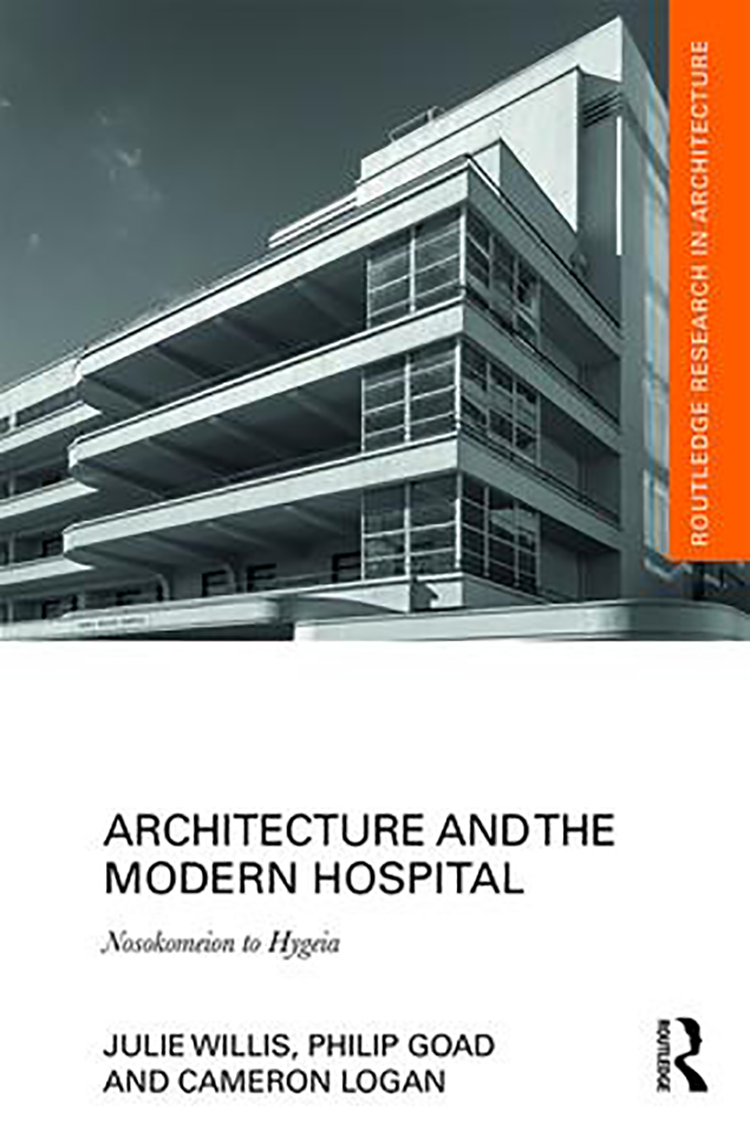
The authors’ claim of a “genuinely global architectural history of these hospitals” is raised early and is well-supported by a broad review of publications circulated internationally in the early 20th century, such as Nosokomeion, the official journal of the International Hospital Association, published in Stuttgart with articles in German, French, English, Italian, and Spanish; The Modern Hospital, a journal on hospital care and management published out of Chicago; and countless other volumes from hospital architects and specialists. These publications record a vibrant network of discourse, an idea that was first outlined by Logan and Willis in an article on the Australian connections, “International Travel as Medical Research” (2010) but has been expanded here to include its development across Australia, Europe, and North America, roughly between 1918 and 1968.
The global scope of this project places demands on the historian, regardless of their erudition. To relieve this pressure, and to focus the reader’s attention and memory, Willis, Goad, and Logan have framed their research topically. Aside from the introduction and conclusion, each chapter is dedicated to the exposition of one of the seven different topics, what they call “sites of design,” ranging from scale of the body (the hospital bed) to the scale of the city (the campus site plan). While not without drawbacks, adopting a topical approach to architectural history has the benefit of avoiding the limits of biographical and geographical schema for the sake of an interpretive framework more suitable to the object of inquiry. The authors should be celebrated for the ingenuity of their approach and their selection of revealing topics; they have delivered a promising example to future scholars in this field.
Each of the topical chapters is explored with a degree of independence from the others, an autonomy that is reinforced by the inclusion of an extensive yet very useful bibliography at the end of each chapter; nevertheless, many of the chapters fall into distinct types of argument. Several chapters share a precisionist view of material culture first made famous by Sigfried Giedion’s Mechanization Takes Command (1948). Chapter 2 is dedicated to the history of the hospital bed as a polyvalent unit or module of healing, serving, and controlling patients in and around hospitals. Likewise, Chapter 6 concerns the spatial implications of reticulated services and demonstrates how every operation, including laundry and kitchen services, was an opportunity for scientific management, à la Frederick Taylor. Here, we find several illuminating and well-written narratives about the movements and countermovements of commonplace artifacts within the modern hospital.
Other chapters embrace the historicist argument that innovations in medical technology beget transformations in architectural planning. Chapter 4 explains the changing location, illumination, and finish of the operating theater in the hospital, while Chapter 5 focuses on the architectural response to the development of noninvasive methods of diagnosis and therapy. In these, more than in the others, the selected topic is explored beyond the chronological brackets laid out in the introduction, which provides robustness to the explanation. Occasionally, however, these chapters seem haunted by a nervous rejection of the ancient yet perennial analogy between bodies and buildings.
Another approach is evident in Chapters 7 and 8, where the formal discipline of the architect is used to explain the search for appropriately modern compositions and site plans in hospital buildings and campuses. In these chapters, the structure of the approach recedes artfully behind the freshness and clarity of the interpretation. These two chapters seem uniquely suited to a readership of architects.
For more general readers, Chapter 3 may be the most engaging. It leans on the scholarship of Adrian Forty and Annmarie Adams to argue for the central importance of the nursing profession in the planning of the modern hospital. The chapter stands out all the more for the brief interjection of a critical position on the othering of genders in the nursing profession. This perspective is welcome in a book that otherwise holds critical theory at arm’s length. Indeed, on the occasion that Foucault’s seminal The Birth of the Clinic (1963) is mentioned, it is done so only in passing and through the quotation of Sven-Olov Wallenstein’s Biopolitics and the Emergence of Modern Architecture (2009).
One drawback of a topical approach composed of several voices is the likelihood of redundancy; some content of extraordinary importance and relevance—for instance, the modern discourse on light and heliotherapy—may be impossible to include meaningfully in one chapter and exclude artfully from another. In this book, for example, we find Paul Nelson’s unbuilt proposal for a Cité Hospitalière (Hospital City) at Lille, France (1932–1933), especially as it compares to Eberhard Zeidler’s Health Sciences Centre at McMaster University in Hamilton, Ontario (1967–1972), as an important case in Chapters 6, 7, and 8. On the other hand, the attention given to Nelson—a relatively unknown yet exceptionally talented architect who studied in Paris at Auguste Perret’s famous atelier at the Palais-du-bois, alongside Berthold Lubetkin, the architect of the Finsbury Health Centre (1938)—addresses a serious lacuna in the history of the avant-garde in the interwar period.
Architectural historians have struggled to address the impact and importance of internationalism and globalism in their respective fields for some time now. Architecture and the Modern Hospital is an important step in bringing the scholarship on the modern hospital into the fold. However, it should be noted critically that the discourse identified as global in this book coincides so closely with the geography of colonialism that the former renders the latter nearly invisible. It would seem, then, that this is a rather singular image of what it means to be a global phenomenon. Readers sensitive to this may wish for a greater range of differences in the selection of examples or more penetrating analyses into the meaning of those differences. For some, the book may even invite a postcolonial sequel.
Architecture and the Modern Hospital should be commended for several reasons, including its ambitious scope and topical framework, which readily demonstrates the expertise of its three authors. Different parts of this book will appeal to different readers, including scholars and students of the modern movement, architects interested in the history of hospitals prior to the rise of evidence-based design, and conservationists looking to articulate the significance of surviving historic structures in and around our cities.