



Abstract


Designers are increasingly encouraged to be “storytellers,” to make what they do more relevant and relatable. So, this is a story. Not a story about me, but I am a character in it. Over the Thanksgiving weekend I had the unfortunate opportunity to conduct some autoethnographic research (in which the researcher is the subject in a setting) at my local hospital in Washington, DC. It was an experience that jolted me out of my comfortable belief that design and research can solve much of what is wrong with the world.
Let me first say that I have been involved in healthcare design, primarily from a landscape architecture and access to nature perspective, for over 20 years. Most of my colleagues are healthcare architects and researchers. I have been a co-editor of HERD Journal since 2017, was its Editorial Assistant for 3 years before that, and have had a subscription since the first issue in 2008. I attend the Healthcare Design conference every year, read Healthcare Design Magazine regularly, and receive several other healthcare-related online newsletters each week. All of this to say I felt fairly confident about my knowledge of the healthcare system before my latest hospital experience. I was wrong.
There were two problems. First, I was far more ignorant than I thought I was, especially about large city hospitals that care for underserved people. Second, to know something intellectually is different from experiencing is first hand. My experience was mostly a series of annoying, non-life-threatening events. Nevertheless I had a glimpse of our broken healthcare system that I had not been aware of before. So on the off chance that some readers might benefit from my newfound and somewhat painfully earned knowledge, here is one story.
The Falls
The day after Thanksgiving, I fell, twice. The first time, on late Saturday morning, I was knocked flat on my back when two large, rambunctious dogs ran into me at the park. My ribs hurt a lot, but Google told me that if I wasn’t in excruciating pain, my ribs probably weren’t broken and there was little risk of internal bleeding from an organ puncture. And even if the ribs were broken (and assuming no organs were punctured), there wasn’t much treatment except painkillers, ice or heat, and time. The hospital closest to us had closed a year before and was now an Urgent Care, but was it worth going on a Saturday night, waiting with all of the other miserable people who probably had colds or the flu? Would the Urgent Care even have X-ray capabilities? I decided not to go. James (my spouse) and I had moved to DC only about 6 months earlier and, both being healthy, were not familiar with the medical institutions. We did not even have primary care providers yet.
I took a painkiller, went to bed early, and woke up a couple of hours later in more pain. In the bathroom, I looked in the mirror at my ribs. They were swollen. I felt slightly dizzy. About 10 min later, I woke up to an unfamiliar view, and slowly realized that I was on the bathroom floor, bleeding from my forehead. I had passed out and hit my head on the way down. In pain and panic, I called for James.
An Ambulance Ride
James wanted to take me to the Urgent Care (he has learned through me how dangerous hospitals are), but I couldn’t get up without passing out again. I insisted on an ambulance. The emergency medical technicians (EMTs) came quickly and were kind and reassuring. They suggested that James drive separately, behind the ambulance, so he could get back home again. One of the two EMTs did not know how to put the stretcher into the ambulance, so the loading was bumpy. I learned in the ambulance that EMTs have 24-hr shifts. This seemed absurd. How can anyone make a good decision after 24 hours? “Well, then we get 3 days off.” But still. I have since learned that doctors and nurses also sometimes have 24-hr shifts (I thought the shifts were 12 hours, which already seems far too long for someone who is working under stress nonstop, making life-or-death decisions). My physical therapist explained that this is so that there is more continuity with carers and patients. It still does not make sense.
Scenes From the Emergency Department (ED)
The closest hospital was not far, about a 15-min drive. Apparently, Washington, DC, has lost two of its major hospitals in the past few years, so the remaining hospitals with EDs are overloaded. On the Saturday after Thanksgiving, the place was packed and looked like a fluorescent-lit Hieronymus Bosch painting. As the EMTs wheeled me in, patients on stretchers and in chairs in various states of sickness and injury stared at us as we waited in the triage line. The man on the stretcher in front of me was hallucinating and alternately crying and laughing loudly. A middle-aged man in tattered clothes dozed in a chair and smelled so bad that even the wizened doctors, nurses, and EMTs made discreet faces of disgust. An officious person in scrubs told James curtly that he could not stay parked where he was, he had to park in the garage. Where in the garage? What if they take my wife back for X-rays or something, how will I find her?
After about a half hour, a kind triage nurse checked me in and the EMTs parked my stretcher along a wall near the bathroom before leaving for their next call. Three more stretchers with patients were lined up on the wall kitty-corner to me, and one more on the opposite wall. Patients well enough to not need a stretcher sat in chairs in two different waiting areas.
Two drunk or high or both young men were brought in together (a “two-fer”) and provided some comic relief as they talked to each other and anyone else who cared to listen, sometimes coherently, sometimes less so. Patients who are conscious are usually sat in chairs to sober up. One of the men fell asleep or unconscious and then fell out of his chair onto the floor and onto his head. He was taken for a computed tomography (CT) scan.
An elderly man on the stretcher kitty-corner to me was worried about his wheelchair. Where was it? Had someone stolen it? James eventually went to find out and told him that it was stored safely. He seemed somewhat, if not completely, reassured. A frail elderly woman needed to go to the bathroom but could not get up from her stretcher. A nurse helped her up and to the bathroom but then left. When the woman came out of the bathroom, James helped her back across the room to her stretcher.
After about 2 hours, I had a CT scan to check for cranial bleeding and concussion. The technician told me that the scan would cover my ribs as well as my head and spine. When the results came back an hour or two later, we were relieved by the negative results (nothing wrong) but disappointed that the ribs had not been included. I do not know why the technician had told me they were. I was then scheduled for an X-ray, for which we waited another hour or two. In the meantime, I was grateful for the two blankets I had been given in the cold CT scan room, which I was allowed to keep in the ED. No pillows, though. Too many pillows had been stolen over the years, so patients were given a folded-up sheet instead, if they asked for one.
For over an hour, we overhead a distraught young woman, probably in her 20s, as she talked on her phone with family members (“I’m in the ER, but they’re not helping me. They say I need psychiatric services but that doesn’t work, I’m in pain. No, I can’t go home, dad is there! Where were you when he RAPED me when I was only 2 years old!”) and a hospital help line (“No one is helping me! I am in pain and some people have beds and blankets but they won’t help me and I got my period and they won’t even give me a pad!”). The nurses, who knew the woman from previous visits, were visibly annoyed.
The police escorted a handcuffed man with blood on his face and hands to an area out of our view. As the night ebbed into morning, the police and EMTs brought in more drunk and high people, more sick, and injured people. All of us patients tried to be…patient.
Scenes From an ED Room
After about 5 hours (which, I have since learned, is fairly normal at this hospital), I was admitted to a two-patient room in the ED for heart monitoring; the doctor was concerned that my low heart rate had caused the syncope (technical term for passing out). Every time my heart rate went below 60 beats per minute (BPM), which was almost all the time, the monitor beeped loudly. No one seemed particularly bothered by this, no one except me who had been told that anything under 60 BPM was dangerous, and who couldn’t sleep because of the beeping.
I should have been grateful, though. Had I not needed to be hooked up to a machine, I might have been parked in the hallway/central area along with the six or seven other patients on stretchers. Perhaps the space was large on paper and at the hospital’s ribbon-cutting, but now with beds and chairs and machinery and computer carts, it was down to a single-lane pathway. Which is where a woman paced, for at least an hour, bent over, crying, moaning “My stomach hurts so baaaaad, oh my goooood, pleeeeease, somebody help me!” No one seemed particularly alarmed.
My roommate and I were separated by a curtain, with my bed closest to the door. She was an elderly woman whom I’d first seen and heard in the ED waiting room. I knew who it was from the hacking cough. I’m sure my beeping heart monitor didn’t help her. She was in constant pain and called out for aid every few minutes. When her cries sounded more urgent, I tried to flag down someone in the hall, but they usually ignored us. Whenever a care provider came to check in on me, my neighbor would also ask them for help. Her daughter visited and spoke with an impatient tone and harsh words. This overheard private life made me feel sad and helpless. At one point, the nurse tending to my neighbor sneezed (it did not sound muffled by an elbow) and then said cheerily, “everyone’s getting sick this time of year.” A day after my release from the hospital, I came down with a cold that took a month to recover from.
The greatest “amenity” during my stay was a sleep kit consisting of earplugs and an eyeshade. This gift enabled me to escape the human and machine hospital sounds and even catch a couple hours of sleep.
Scenes From the Upstairs
Twenty-four hours later, the doctor declared that he wanted to keep me under observation for one more night (24 more hours) to continue monitoring my low heart rate. Although I could have left at this point, I trusted the doctors and nurses that another night’s stay was probably wise. I was admitted to a room upstairs (a private room with its own bathroom, hurray!). Although the bed was far more comfortable (it was, after all, a real bed and not a stretcher), I was not shown or oriented to the remote, so I did not know how to move the bed up and down by myself, nor how to call a nurse if I was in pain or needed the bathroom or…anything, really. Although I was scolded for taking my own prescription medication (which I take every evening, and which James had brought in for me), they had not brought me any from their own pharmacy. Pain medication came erratically. The ointment for the stitches on my forehead was ordered from the hospital pharmacy but never arrived.
Access to Nature?
In my private observation room, I did have a window with a nominal view of nature beyond a parking lot full of cars, a park with a few large deciduous and evergreen trees. I appreciated being able to see the sky, knowing whether it was day or night and whether it was raining or not (Figure 1).
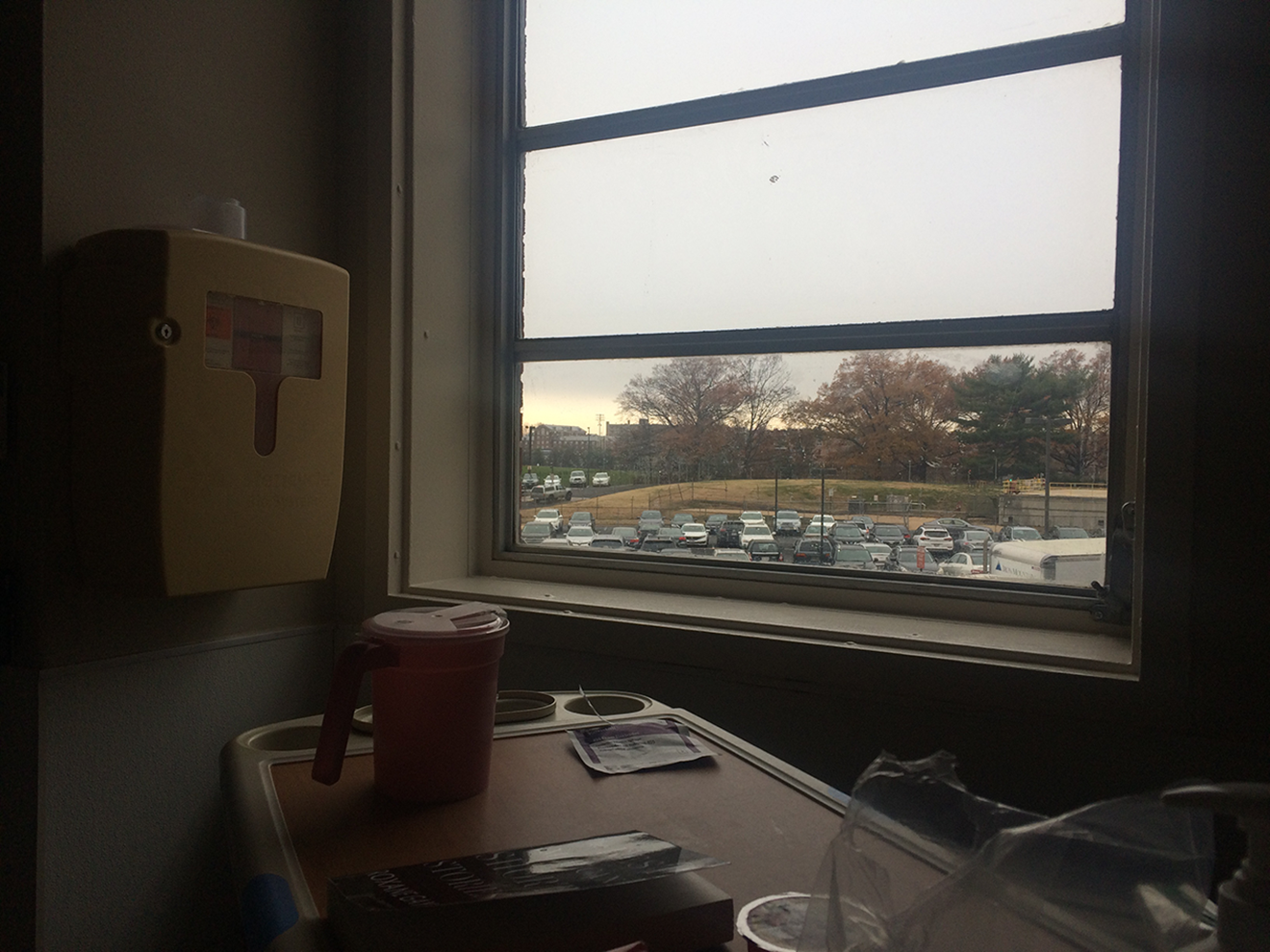
Private observation room.
In the ED, I had noticed that the privacy curtains had a sort of biophilic theme, leaves, or branches. That had been the extent of “access to nature.” Did it matter? Would a lovely mural, or a nature video, or a view out to a garden with night lighting, have helped? Maybe, I’m not sure. During my stay, I asked various caregivers whether the hospital had a garden (yes, recently renovated) and whether they used it (no, never enough time). I wondered: if the weather had been nicer, if the ED had been closer to the garden, would I or James have wanted to visit? Personally, I was in a lot of pain and too concerned about missing my place in line to want to risk going anywhere outside the ED. James would not even leave me for a cup of much needed coffee, much less a trip to a garden.
This knowledge is disheartening but also in line with published research about healthcare garden use. Visitors tend to be family members and care providers more than patients unless the stay is long such as with cancer care or hospice. People tend to use gardens more if they are visible and close to heavily used areas such as the lobby or restaurant. Care providers are more likely to use a garden if it is less than 5 minutes away and/or somewhere they will go anyway, like the break room on their unit or the cafeteria (Nejati et al., 2016).
All Healthcare Is Not Created Equal
My biggest surprise and disappointment (and embarrassment at my naivete) was how much healthcare facilities vary depending on where they are and who they serve, even within one city. I have visited many hospitals for treatment and research but had never experienced something like this ED, which treats a wide array and huge amount of people because two of the other main hospitals with EDs have closed. Public health research reveals that the greatest social determinant of health is zip code (Arias et al., 2018). Healthcare is tied in with this (American College of Emergency Physicians, 2017; Downing et al., 2018). James actually asked a colleague after, somewhat in jest, “Where do the rich people go?” “Oh,” the friend replied, not catching the ironic tone, “Suburban, or Sibley.” Okay, noted. Could James and I have requested that the EMS crew take us to Suburban or Sibley, and not just the closest? I’m still not sure. The answer, based on some post-hospital-visit internet searchers, is that “it’s complicated” and varies from state to state and even county to county. This is good homework to do before you need an ambulance.
Healthcare Costs Are Insane
After my discharge, I heard rumors about what I might get charged for and what might not be covered. One friend told me that insurance does not cover “observation.” This made me nervous since at least 24 hours of my hospital stay had been for “observation.” I was relieved to find, once I got the itemized bill, that my insurance did cover this aspect of care. A good thing since that charge was US$8,269.83. Those four chest X-rays? US$6,150.81. Routine blood work from the lab? US$999.26. The emergency room “experience” itself cost US$4,195.90. The complete hospital bill (well, almost complete) was US$19,918. I have never been so grateful for insurance, which covered all but US$150. The CT scan (a separate bill from the Radiology Department) was US$616.05, also covered. The ambulance bill was US$534, which I had to submit to my insurance after the fact. I have not yet gotten a bill for my 15 stitches from the oral surgeon. These prices, and not knowing what they are going to be ahead of time, are commonplace (Rosenberg, 2013; Rosenthal, 2013). Had I, like 27.5 million Americans, not had any health insurance (U.S. Census, 2019), would I still be required to pay something? Yes (Meier et al., 2013). For a funny yet maddening yet eye-opening if oversimplified exposé on healthcare in the United States, watch the Adam Ruins Everything episode, “Adam Ruins the Hospital.”
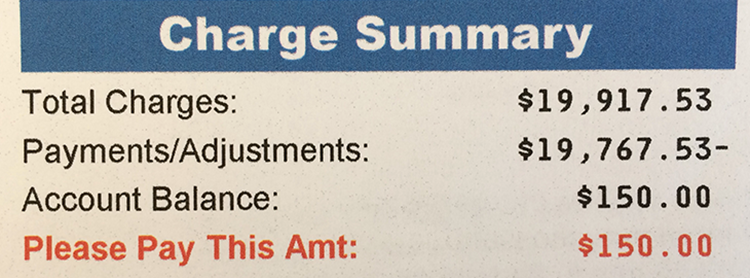
Total hospital charges, not including CT scans.
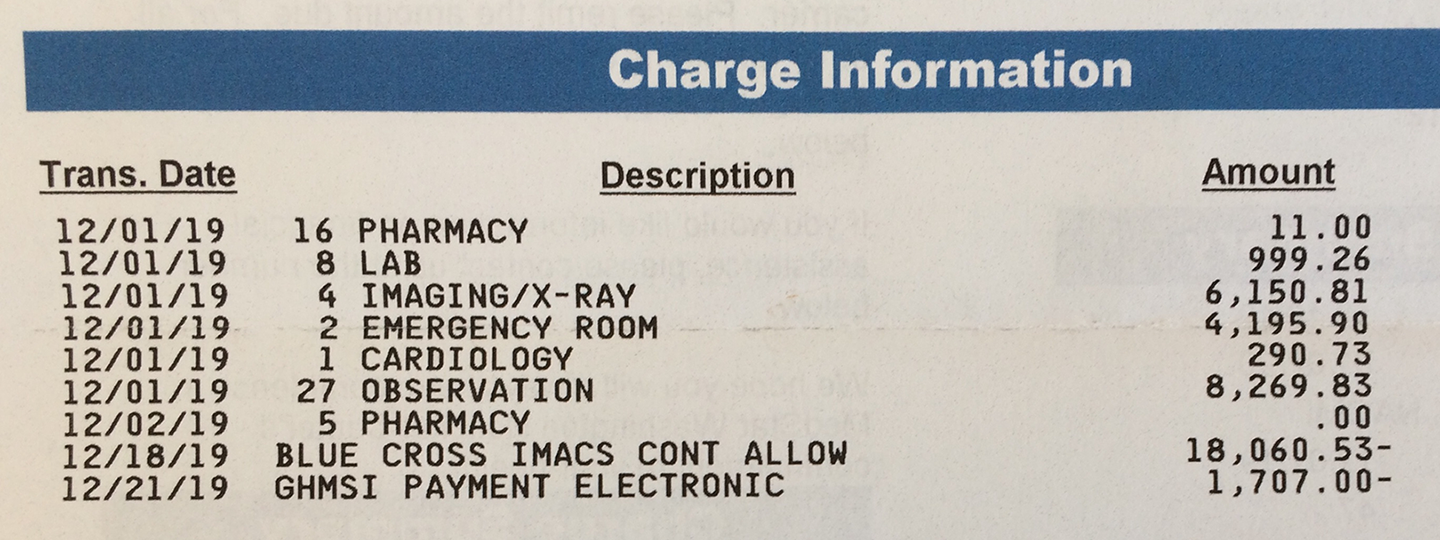
Itemized charges from a Washington, DC, hospital emergency department visit.
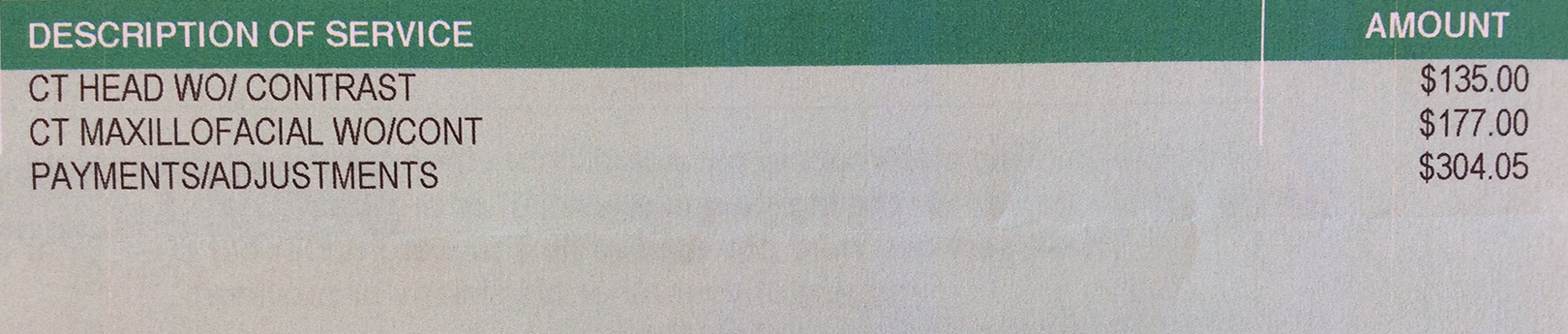
Computed tomography (CT) scan bill.
What Can Designers Do?
Even before this experience, I did not have the hubris to think that as a designer or researcher I could solve everything. However, I was not aware of the magnitude of my ignorance and how it might get in the way of meaningful problem-solving. I would like this editorial to be the beginning of a conversation on what to do better. I hope some readers will contact me with more ideas. Here is a start: Spend time in a hospital (without bothering the already overstretched staff). Better yet, spend time in several hospitals to get a sense of how they vary depending on their location and who is served. Educate yourself and your colleagues, employees, students, and so on, about the broader U.S. healthcare situation. What, in addition to design, influences healthcare quality? How do insurance, pharmaceutical companies, regulations, policies, and so on, intersect? And then figure out how design intersects with all of that to understand how one might make a difference. Have the humility to admit that design cannot solve everything. Neither can research. Neither can any one thing, actually. So find lots of different people, listen to their stories, and build bridges to make meaningful change.
Vote. In local, state, and national elections. Elect people—and work to get other people to elect those people—who want to make healthcare better for everyone.
Here are my “top 10” personal recommendations—some practical and realistic, some a bit more facetious. Have health insurance. Good health insurance. And know what is and isn’t covered before you get injured or sick. Don’t get injured or sick. Don’t ever need an ambulance. If you do, know ahead of time whether you can request where to be taken. And find out where that should be, based on your insurance (or lack thereof) and your hospitals’ (if you have more than one in your area) reported quality of care. Have someone with you at all times as an advocate. And bring your phone charger. Be (a) well educated and (b) compos mentis enough to advocate for your own care, understand and process the information coming at you from multiple rotating care providers, and catch mistakes. Be privileged enough to feel entitled to quality medical care. Speak and read English as your first language. Be a legal resident because you can not get good care if you’re terrified that Immigration and Customs Enforcement (ICE) will take you away. Note: ICE is not legally allowed to arrest people at so-called sensitive places such as schools, places of worship, or hospitals (National Immigration Law Center, 2017). But would you trust the government? If you stay overnight and have medicine that you take regularly, have your partner/spouse/friend smuggle it in because the pharmacy will probably get the order wrong and you will miss at least one dose. Have a strong enough immune system when you enter the hospital to ward off the bacteria and viruses that will attack you during your stay.
Meanwhile, I am healing well, with time and acupuncture and physical therapy and a lot of love from family and friends. Thanks for reading. Email me your thoughts, ideas, your own story, and so on. Let’s find even more ways to make healthcare better.