




Abstract
Purpose:
We propose a methodological framework to use immersive virtual environments (IVEs) in head-mounted displays for environmental design research.
Background:
IVEs offer researchers with experimental control and realistic representations of environments with high levels of ecological validity. IVEs are also increasingly being used to visualize proposed designs. Despite these tremendous benefits, IVEs are underutilized in environmental design research. We are unaware of preexisting frameworks that synthesize the methodological decisions related to the use of IVEs to conduct environmental design research.
Methods/Results:
We define the concepts necessary to conduct IVE research (virtual reality [VR], IVEs, ecological validity, visual realism, behavioral realism, and contextual realism). We also summarize the available study designs (correlational studies, experimental studies, and performance evaluations) and software systems used to create IVEs. We conclude with a conceptual framework that describes how research questions and study designs inform IVE selection and ecological validity. This framework is accompanied by a workflow that operationalizes the creation and use of IVEs in research.
Conclusions:
VR provides a robust and innovative research strategy for environmental design research because of its high degree of experimental control, rich data collection options, and opportunities for systematic evaluation of alternative design configurations.
Keywords
Virtual reality (VR) has been used as a tool to understand the relationship between the built environment and human behavior and outcomes for more than 40 years. Early studies employed pictures, videos, and monitors to simulate walk-throughs of environments. The consumer head-mounted displays (HMDs) that emerged in 2012 sparked an explosion of architectural and construction uses (Kuliga et al., 2015). Many researchers now use HMDs to project immersive virtual environments (IVEs).
IVEs consist of synthetic sensory information that surround the user with a continuous stream of stimuli. These stimuli create the illusion of being enclosed within and interacting with a real environment (Calogiuri et al., 2018). Recent studies using IVEs have shown that human psychological and physiological responses are similar between real environments and virtual environments (Browning et al., 2019; Chirico & Gaggioli, 2019; Heydarian et al., 2015; Kuliga et al., 2015). As such, IVEs provide opportunities to conduct many types of environmental design studies that are difficult to initiate in situ. This is especially true of research on healthcare environments, given the costs, barriers to entry, and difficulty in obtaining multiple experimental conditions in a real healthcare setting.
Recent studies using IVEs have explored a range of environmental design topics including navigation and spatial cognition research (Bruns & Chamberlain, 2019; Charalambous et al., 2017), perception of natural, urban, and architectural forms (Banaei et al., 2020; Echevarria Sanchez et al., 2017; Luigi e al., 2015; Mouratidis & Hassan, 2020; Pals et al., 2014), impact of nature and biophilic design on human health and behavior (Browning et al., 2019; Yin et al., 2019; Yin et al., 2020; Yin et al., 2018; Yu et al., 2018), and impacts of different built environment features on human performance (Heydarian et al., 2015). IVEs have also been used in preoccupancy evaluations comparing user satisfaction and/or performance in multiple proposed design configurations (Wingler et al., 2019; Zhang et al., 2019). At the time of writing of this article, however, there were relatively few environmental design studies conducted in healthcare environments using IVEs.
There are a range of different VR applications, each with its own strengths and weaknesses. These applications also vary in terms of the workflow involved in creating the virtual space, the level of visual and behavioral realism that can be achieved, and the capabilities for interaction and evaluation while in the IVE. As such, different types of IVEs may work best for answering different types of healthcare design research questions.
The purpose of this article is to provide a framework for understanding and selecting methodological applications of VR in environmental design research. Our focus is on research conducted using the technologies and applications that are widely used and available today—IVEs in HMDs.
VR and IVEs
The VR is a powerful tool to create digital realities. Digital realities provide researchers with experimental control and realistic representations of environments with high levels of ecological validity (Devlin, 2014). Visual simulations, augmented reality, mixed reality, VR, and other emerging technologies all fall under the digital reality umbrella. These techniques share the common goal of creating IVEs through computer generation (Yang, 2019).
The implementation of traditional visual simulations as IVEs relies on the stereoscopic projection of real photographs or computer-generated images/audiovisual stimuli on a large, flat, or cylindrical screen (Figure. 1). Only recently have fully IVEs become widely available to researchers. The first IVE research can be dated back to 1968 when Sutherland (1965) introduced the “ultimate display,” which could track the head of a user and adjust the graphics accordingly in a HMD. This early HMD, however, was untenable (Virtual Reality Society, 2017).
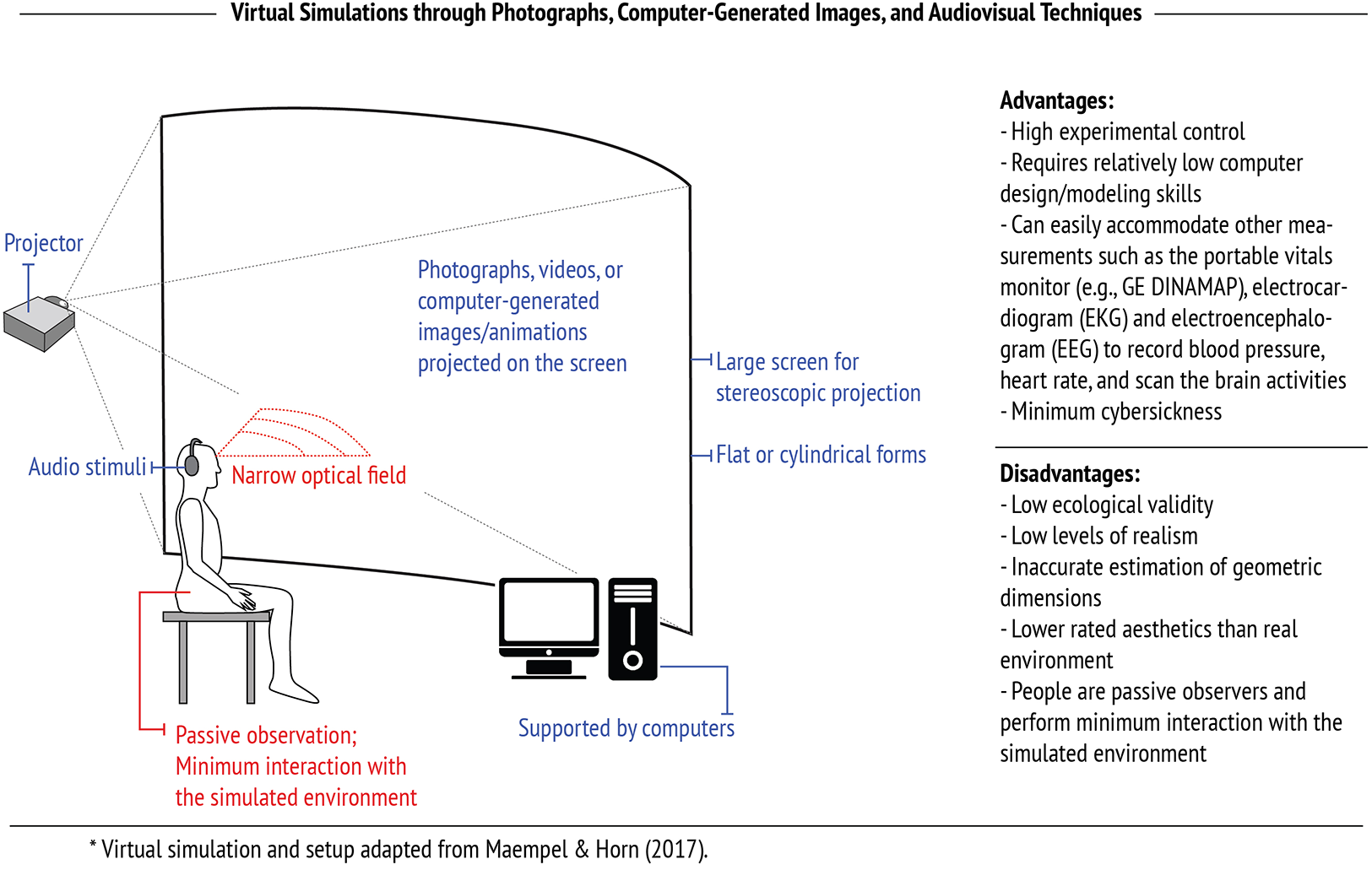
Virtual simulation and setup. Source: Adapted from Maempel & Horn (2017).
Research interest in IVEs rapidly grew in the 1980s and 1990s but head-mounted VR experiences remained uncompelling and uncomfortable during this time (LaValle, 2017). Instead, entire rooms—called cave automatic virtual environments—were built to surround users with projection screens. These systems provided better graphics and comfort than contemporaneous HMDs but cost millions of dollars (Figure. 2).

Cave automatic virtual environment cube setup referred to VisCube C4-T2 model. Source: VisCube™ C4-T2. (n.d.).
High-quality VR experiences became affordable with the introduction of the Oculus Rift in 2012. Rapid developments have since brought the cost, comfort, and quality of VR HMDs within reach of nearly any researcher. At the time of this writing, researchers can stream or play 4K 360 ° videos or computer-generated content in the Oculus Go for US$150. Upgrading to the US$399 Oculus Quest provides researchers with room-scale tracking, hand tracking, and augmented reality experiences. Neither of these devices nor those of several other manufacturers require dedicated rooms or additional computing hardware (Figure. 3).

Head-mounted display setup. Source: Adapted from HTC Vive System, HTC VIVE (n.d.).
Here, we limit our definition of “VR” to experiences in HMDs, which are readily available and easily used by most researchers. Thus, we define VR as an experience in an HMD “that combines sensorial displays (i.e., visual, auditory) with tracking devices that sense the movements of the individual and report the collected data to the visualization system, which updates the scene in real time”(p.3) (Chirico et al., 2016).
While myriad VR experiences are available in HMDs, exposure to IVEs are most relevant to environmental design research. IVEs surround the observer and create the perception they are enclosed within that environment through a stream of stimuli (Witmer & Singer, 1998). Nonvisual sensory inputs are typically limited to digital environmental noises being played back in HMD speakers or external headphones. Other sensory inputs such as scents, temperature, touch, and even taste are available using additional equipment (Birenboim et al., 2019). While multisensory virtual experiences provide greater ecological validity than visual or audiovisual experiences (Hedblom et al., 2019), environmental design research often focuses on spatial arrangements, visual perceptions, and soundscapes. Thus, audiovisual inputs are likely of greatest interest to the majority of scholars interested in using VR.
Ecological Validity of IVEs
Presenting ecological valid experiences is paramount for studies that employ environmental simulations, such as IVEs in VR. Ecological validity defines the extent to which a participant takes the simulation seriously and the extent to which their responses in VR resemble their responses in the real world (Dole & Ju, 2019). The ecological validity of virtual experiences is commonly measured with the user’s reported level of presence (Cummings et al., 2012). This concept describes the feeling of “being there” inside the virtual world (Witmer & Singer, 1998). Presence has been most commonly measured via self-report data on validated questionnaires with as few as 6 survey items (for review, see Rosakranse & Oh, 2014), yet objective measures have also been used, including behavioral (users displaying movements in expected ways) and physiological (emotional arousal and sympathetic nervous systems activation; Dole & Ju, 2019). Ultimately, while ecological validity is central to a “successful” IVE, multiple approaches to its operationalization and lack of minimum standards causes a situation when researchers may not know whether sufficient presence is achieved. It has been argued that the declaration of ecological validity is impossible (Dole & Ju, 2019). Achieving the ultrahigh levels of presence and ecological validity achieved at the expense of substantial computational and programming resources is unnecessary for some research questions. To understand such trade-offs in ecological validity, its useful to separate this concept into three, more nuanced factors. These include visual, behavioral, and contextual realism.
Visual Realism
Visual realism describes the extent to which graphics in simulated environments replicate real-world graphical expectations (Kuliga et al., 2015). Higher levels of visual realism are generally desirable but lower levels may also be acceptable. In this context, IVEs created from building data should aim to achieve an optimized frame rate in order to minimize latency and to reduce motion sickness among participants. This could be achieved by reducing to the extent possible the number of triangles, vertices, and texture sizes of three-dimensional assets used to create the IVE without sacrificing realism (Bruns & Chamberlain, 2019). IVEs consisting of 360 ° videos that are digitally edited should be created in such a way as to ensure the lowest risk of participants discerning which images or parts of images are artificially created/modified (Smith, 2015). Ultimately, the level of visual realism depends on the research question and environmental manipulations in a study.
Behavioral Realism
Behavioral realism explains the extent to which an observer responds to a virtual environment in the same way that they would respond to a physical environment (Freeman et al., 2000). These responses can encompass a wide array of physical and behavioral actions including the way the user holds or moves their body, their performance on kinesthetic tasks, their navigation through a space and wayfaring decisions, and more.
HMDs with hand/body tracking generally provide high levels of behavioral realism through interactivity. Similar to video games, virtual environments created with game engines allow users to navigate through and interact with IVEs as if users were in real environments. The anticipated behaviors and mobility of users determine how IVEs should be made for a study. Interactivity exists along a spectrum: from passive to mobile/not interactive to mobile/interactive. IVEs created using game engines enable both mobility and interactivity. The actual physical movements of the user can mirror the movements in small-scale IVEs. In large-scale IVEs, movement can be achieved with a controller. Here, the user is stationary or movement is limited.
IVEs created with a 360° video(s) generally provide passive experiences from fixed vantage points. Passive experiences can be valuable for environmental design research when a seated or supine position is assumed.
Contextual Realism
Contextual realism encompasses user and environmental characteristics that may modify the ecological validity of a simulated environment (Kuliga et al., 2015). A recent review article identified a long list of potential characteristics that may influence the ecological validity of environmental simulations (Browning et al., 2020). User characteristics included sociodemographic factors, cultural backgrounds, past experiences in nature or VR, psychological reactions to simulations (i.e., preferences, familiarity, connection with nature, and perceived safety), and health statuses. Environmental characteristics included presence/absence of built/natural features (i.e., trees, buildings, animals, and people), weather, lighting, and color. Empirical studies provide little clarity on the true impacts of these environmental and user factors on the ecological validity of IVEs (Browning et al., 2020). Because of the lack of data, we recommend that researchers be cognizant but not overly concerned with the potential influence of any single environmental and user factor on ecological validity.
Approaches to Using IVEs in Environmental Design Research
The key strength of using IVEs for environmental design research is the ability to manipulate specific features of the environment while holding others constant. This ability makes IVEs ideal for conducting experimental studies (Devlin, 2017). As such, many IVE studies use experimental study designs to compare user responses/behaviors in multiple environments or a single environment with multiple sets of manipulated features. However, it is possible to use IVEs and explore user behaviors and perceptions in a single, unaltered environment.
In this article, we outline key types of IVE study designs for environmental design research using examples from published studies. We focus on recent studies (published within the last 8 years) that used an HMD that was comparable to or newer than the 2012 Oculus Rift. Included is an outline of how the study design and research question impact key decisions regarding the type of IVE used, interactivity desired, mobility required, and visual/behavioral realism preferred.
Comparing Multiple Environments
Experimental approaches
Experimental studies with a between-subjects or within-subjects design are commonly used in environmental design studies that employ IVEs. For studies using a between-subjects design, participants are randomly assigned to different groups and exposed to one or more environments (Devlin, 2017). These environments can be solely IVEs or a combination of an IVE(s) and a real environment(s). Between-subjects design is usually adopted when at least one of two considerations are met. First, participant input/response to each environment is not deemed necessary to answer the research question(s). Second, to minimize carryover efforts of exposure to one condition (IVEs or IVE and real) impacting participant responses to another condition (Devlin, 2017).
For studies using a within-subjects design, participants experience all study environments (IVE and real) in a randomized sequence to minimize the order effects (Devlin, 2017). This design is usually adopted when participant input/response is required for all study environments or when the goal of the study is to obtain systematic input from stakeholders about alternative design configurations in order to support design decision making.
Several experimental studies have focused on comparing human responses and performance in real environments with IVEs of the same environments. For example, Heydarian et al. (2015) compared user performance, perception of color recognition, and object identification and sense of presence in a real and an IVE office under two different light conditions (dim and bright). Also, Browning et al. (2019) compared the mood effects of exposure to an outdoor forest, an IVE forest, and a bare indoor room. Both of these studies focused on evaluating the ecological validity of IVEs for measuring human responses. Thus, a high degree of visual and behavioral realism was necessary. For the office study, the user also needed to interact with objects in the environment. That IVE was created with three-dimensional modeling software to enable that interaction (Heydarian et al., 2015). For the forest study, the real and virtual forest must be as similar as possible. Therefore, the IVE was created with an 8K 360° camera rather than with a three-dimensional modeling software package. Interactivity was not provided to the user so that these two environments were as similar as possible. Thus, the stationary user experience involved sitting in a chair with an HMD and being asked to “try to relax.”
In contrast to the examples above, some experimental studies exploit the capability of IVEs to manipulate specific design features and hold others constant. Yin et al. (2020) evaluated stress recovery and anxiety levels before and after exposure to biophilic and nonbiophilic indoor spaces. Four three-dimensional virtual environments were created using Rhino Version 5 software and rendered in real time using Unity software (version 2017.1.0f3). All four IVEs shared the same room size and living wall location. For the nonbiophilic conditions, this wall was replaced by a window or a bookshelf. In total, user responses were compared across four similar but distinct experimental conditions: (1) nonbiophilic room, (2) biophilic room, (3) room with a window view of an outdoor biophilic landscape, and (4) combination of conditions 2 and 3.
Performance evaluation
The facility design process often involves choosing between multiple design alternatives. Virtual mock-ups provide a more cost-effective alternative to the commonly used physical mock-ups for visualizing, experiencing, and comparing multiple architectural design options preoccupancy (Wingler et al., 2019).
Scenario-based evaluation of mock-ups allows users to provide feedback in the context of their typical tasks and also allows evaluation of performance based on the observation of interactions during scenarios. Wingler et al. (2019) conducted a scenario-based evaluation of three different preoperative exam rooms in a surgery center using a within-subjects design in order to identify the design solutions and specific design features that supported nursing tasks. The IVEs were developed from Revit (Revit 2017.2.1) files and rendered with textures in Unity. Users viewed these IVEs with an HMD and used controllers to interact with specific IVE objects. A virtual patient and family member were included in the IVE to increase ecological validity. Several tasks were assigned that were clinically relevant and valid.
Single Environment Studies
It is less common in IVE-based environmental design research studies to evaluate a single IVE with no comparison group. One example is an exploratory wayfinding study in urban environments (Charalambous et al., 2017). Participants explored a single IVE 8 times, each time with a different starting location in the IVE. They were asked to “press” a digital button to indicate where they thought they were located on a map. Associations between these self-reported locations and specific environmental qualities of the location were evaluated. This particular study used an IVE that was created and developed in Unity three-dimensional software. The IVE represented a mock-up of a real urban center of a Southern European city. A low level of visual realism was provided in the IVE, because the heights and forms of buildings, streets and public spaces, rather than specific building details, were deemed most important for answering the research question.
Another example of a single environment study involved participants making seat selections in an outpatient surgery center waiting room (Jafarifiroozabadi et al., in press) in the same IVE during four typical scenarios they may encounter while waiting for a family member. After selecting a virtual seat during each scenario, the participant responded verbally to survey questions regarding the factors they considered important for seat selection while still in the IVE. Here, IVEs were created from Revit drawings of a proposed waiting room using Unity software. The IVEs included virtual staff members and waiting people to increase behavioral realism. The IVEs were created to be moderately visually realistic to reduce latency and minimize motion sickness among participants. The IVEs were experienced with an HMD with controllers for navigation.
Framework for IVE Study Design Selection
A framework for designing a research study using IVE is provided in Figure 4. This framework covers all the study designs above and summarizes one exemplary research article for each design. The exemplar articles’ focus, research question, study methodology, and IVE characteristics are described. These summaries are intended to highlight how study designs and research questions help determine the type of IVE used and the levels of user interactivity/mobility and IVE visual/behavioral realism desired. The purpose of the framework is to help researchers think through the IVE characteristics (interactivity, mobility within the VR, visual and behavioral realism) needed to answer their specific research questions, leading to the optimal VR workflow and setup for a particular project.

Framework for immersive virtual environment research.
Workflows to Using IVEs for Environmental Design Research
Figure 5 provides a practical workflow for the use of IVEs in healthcare design research studies. This was developed based on workflows created by Kumar and colleagues (2011) and further refined based on the authors’ experiences using different types of IVEs in environmental design research studies. The chart also illustrates how end users (participants) experience, interact with, and provide feedback in IVE-based research studies. Each step in the workflow is summarized below along with the major considerations that researchers must consider at each step.
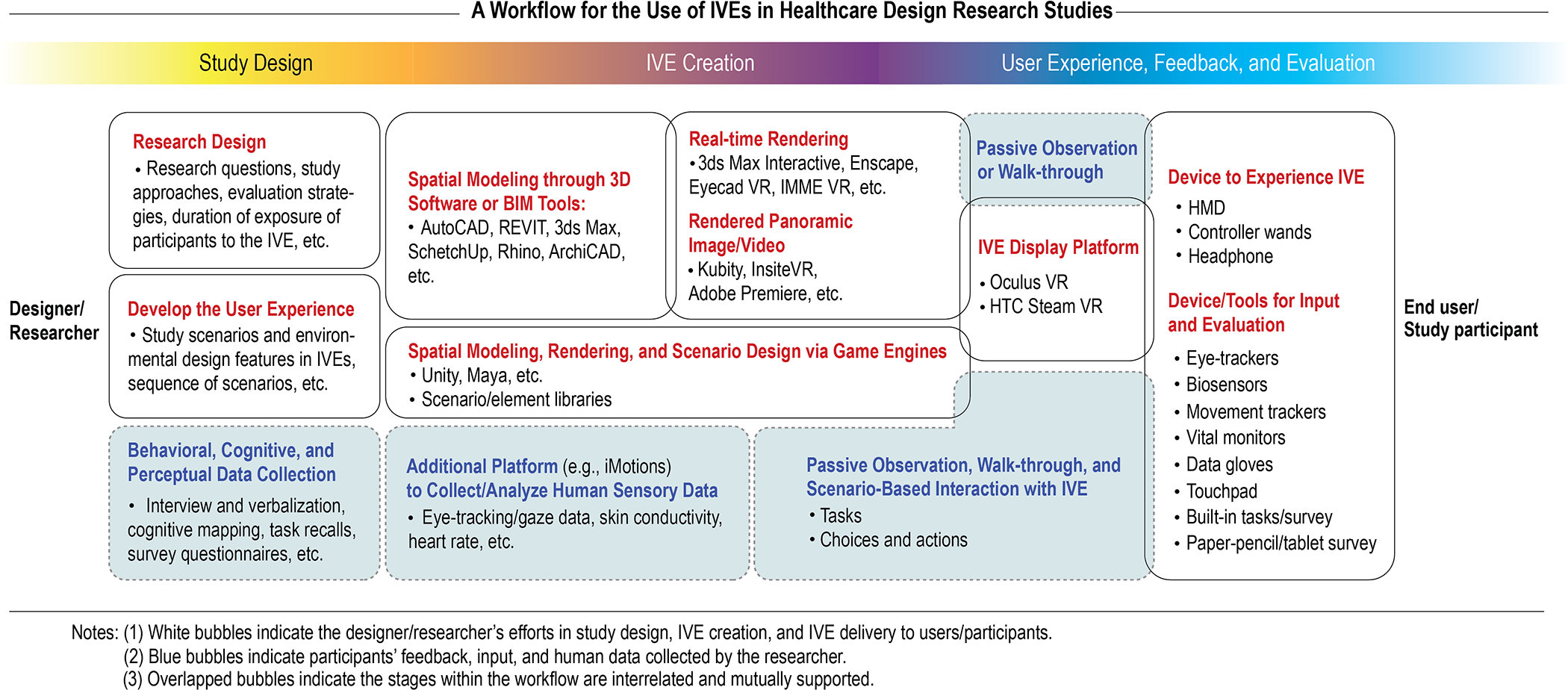
A workflow for the use of immersive virtual environments in healthcare design research studies.
Develop Research Question(s) and Study Design
All major decisions regarding the use of IVEs hinge on the study’s research question. Therefore, the first step is to select a clear research question(s). This research question then informs the study design—for instance, is a control group necessary, must users experience each environment that is created, and which behavior/responses data are required?
The sampling frame is also based on the research question. Are university students sufficient or must hospital nurses or patients be recruited? These questions have major implications for the generalizability of study findings. Bedridden hospital patients cannot physically walk through a three-dimensional IVE, for instance. Healthy undergraduate students can engage in this task, but their behaviors and reactions may differ from those of the clinical populations of interest.
The duration of IVE exposure is based on the length of time needed to measure the central dependent variable(s). In the studies reviewed, those focused on quick impressions of environments usually required exposures that were less than a minute (Banaei et al., 2020; Mouratidis & Hassan, 2020). Studies focused on understanding the impact of IVEs on psychological and physiological outcomes often used exposures between 4 and 10 min (Browning et al., 2019; Calogiuri et al., 2018; Tanja-Dijkstra et al., 2018), though no clear best practices were found for the duration of the IVE exposure.
Develop User Experience
Researchers must define the overall experience of IVE users. For instance, how many IVEs will each participant see, and how will they engage with these IVEs? Decisions leading up to the IVE experience must also be made. These decisions involve how to orient participants to the research study, to the HMD and its controllers, and to the movements and interactions users can undertake in the IVE. If the IVE experience involves multiple scenarios, the sequence of IVEs shown and activities in each must be defined and parlayed to the participant. Instructions can be integrated into the IVE and played through HMD speakers or spoken out loud by a researcher. Throughout the experience, particular attention should be put on randomization and blinding the participants and the researchers to each condition to avoid order effects and other biases.
Create IVEs
Three-dimensional IVEs can be created in two ways. Programs like Revit and Sketchup (Version 2020) can be used to design and model the spaces, and real-time rendering engines like Enscape (Enscape v. 2.7) or Eyecad VR (Eyecad VR 2020) can convert these digital models into IVEs. The output of this workflow is an IVE with limited mobility and interactivity. Participants can walk through the space and perform controls over only limited sets of environmental features such as toggling light switches. When more interactivity is desired, researchers can design, model, render, and convert three-dimensional spaces into IVEs using Unity, Autodesk Maya (Version 2020), or other advanced game engines. Such engines are computationally expensive and require coding skills to achieve high-quality rendering.
IVEs can be created through recording 360° videos of real environments and manipulating them in video editing software such as Adobe Premiere Pro (Version 14.1 Adobe After Effects 17.0) or After Effects. Study participants can experience the IVE from a single perspective or “explore” the IVE by teleporting from one location to another by pressing a button on the VR HMD controller. Here, each location represents a different location that the 360 ° video was recorded.
Conduct Study
The final steps of IVE studies involve recruiting participants and “running” them through the study protocol. Participant inclusion and exclusion criteria must be defined to limit confounding and likelihood of cybersickness in VR. Study location and recruitment strategies (incentives and recruitment distribution strategies) will dictate the ease of attracting eligible study participants to the study.
Once the researcher is with the study participant, they should follow standardized protocols to ensure the privacy and safety of the human subjects. Informed consent forms should be filled out by all participants according to the guidance of the researcher’s human subject board. HMDs should also be sanitized before and after every participant using manufacturer recommendations.
Users should be oriented to the VR HMD before the data collection begins. This can be done through placing users in a test environment that is similar to the study environment and asking users to perform simple tasks.
Once orientation is completed, participants enter the study IVE(s) and perform the actual study procedures. Data collection can include traditional research methods such as questionnaires administered directly in the HMD through pop-up questions or batteries of questions that are administered before and after the IVE exposure. Subjective evaluations of the environment and psychological indicators, such as anxiety and mood, using established scales are measured in this way. Objective data on user responses can be collected through consumer wearables or dedicated biofeedback devices. HMDs increasingly contain a wide array of built-in tracking sensors that can be mined for behavioral data. For instance, location tracking records the x-y-z coordinates and acceleration rates of the HMD in space over time. Data can also be collected with external trackers. Eye tracking and head rotation data report where users look and for how long.
Throughout the experiment, users’ behaviors and responses should be monitored to ensure safety. Nausea and dizziness indicate cybersickness, which is an uncommon but serious side effect of motion-intensive VR experiences. If these symptoms are observed, researchers should ask users to take off the HMD and rest while sitting until these symptoms abate.
The study should conclude with a debrief session. Participants can learn more about the research question(s) and study design at this point. Such data will no longer influence their experience in the IVE(s). Researchers can ask participants to register in a laboratory participant database for future VR study recruitment opportunities.
Last, the researcher seeks to understand the data that were collected during the IVE study through qualitative, quantitative, or mixed-method approaches. These results should always be shared with the broader research community through presentations and scientific articles to encourage use and heighten value of this underutilized research strategy in environmental design research.
Restrictions of IVEs for Healthcare Design Research
We argue IVEs can be used with a wide array of environmental design research studies but also acknowledge some restrictions. Most noticeably, VR systems that allow multiple participants to explore and interact simultaneously are not readily available at the time of writing this article, in spring 2020. Healthcare delivery is essentially a team-based activity that requires multiple people to be in a space and dynamically reacting to the space and each other. Therefore, research questions that must be answered within the context of team interactions may not be easily addressed with IVEs, though they might in the future. Also, it is difficult to replicate the physiological feelings associated with inpatient care, such as acute pain, although some researchers have attempted to overcome this issue with cold pressor tasks (participants placing hand in ice-cold water for extended time periods; Tanja-Dijkstra et al., 2018). Still, such laboratory tasks may not translate to the lived experiences living or working in actual healthcare settings.
Conclusions
VR provides an innovative but underutilized way to conduct environmental design research. Several recent studies have highlighted the robust experimental design strategies that can be employed with IVEs. Replications of these studies in the field or laboratory would be logistically difficult and prohibitively expensive. The interactive capabilities of many IVEs allow quick and convenient evaluations of virtual mock-ups as alternatives or complements to evaluations of physical mock-ups. By testing designs early in the design process, researchers can identify and address potential workflow and safety challenges in a cost-effective manner. The future of IVEs will certainly contain even more strategies for innovative environmental design research. For instance, the authors hypothesize that multiple participants will be able to interact simultaneously in a single IVE in consumer-grade HMDs. Such advancements will boost behavioral realism beyond the already high levels reported in IVE experiences.
To date, only a handful of studies have used IVEs in healthcare settings. These settings present unique but surmountable barriers to VR adoption. Most notably, it is intrinsically difficult to recruit patient and clinician populations for research studies. The authors’ experiences indicate that VR poses an exciting new intervention modality, which attracts both patients and clinicians. Environmental design research may be able to recruit sufficient numbers of patients/clinicians from healthcare settings if the study design is part of a larger inpatient/outpatient therapeutic strategy.
No matter how barriers to research in healthcare settings are negotiated, scholars interested in the use of IVEs should center their methodological decisions on the sections of the proposed framework. The low cost and high fidelity of consumer HMDs may engender feelings and thoughts such as “I should probably be using VR in my research, too,” or “I would like to start playing around with VR. I wonder how I can incorporate it into this new study/grant I am developing?” IVEs are tools that we—the authors—believe can be applied to environmental design research questions more than they are presently. However, IVE use should remain deliberate and thoughtful to ensure the research workflow always matches the research question(s) that are truly needed to be answered for the design question at hand.
Implications for Practice
– Immersive Virtual Environments (IVEs) allow quick and convenient evaluations of virtual mock-ups as alternatives or complements to evaluations of physical mock-ups.
– The proposed framework helps researchers and practitioners make key decisions about the type of IVE to select and its desired characteristics centered around key research questions and research design.
– The workflow described in this study provides practical steps for future research using IVEs - linking key aspects of study design and objectives with IVE creation and user experience, feedback and evaluation.
Footnotes
Acknowledgment
We would like to acknowledge Rutali Joshi and Seyedmohammad Ahmadshahi for their assistance with graphics development and literature review for this article.
Declaration of Conflicting Interests
The authors declared no potential conflicts of interest with respect to the research, authorship, and/or publication of this article.
Funding
The authors received no financial support for the research, authorship, and/or publication of this article.
