




Abstract
Background:
Over the past several years, a new problem affecting the elderly population has been increasingly reported in popular press—the elderly population is dying as a result of loneliness and related factors at a rate greater than that of lack of medical care. The problem is so pervasive that loneliness is being described as an epidemic.
Objective:
The objective of this inquiry was to examine whether the physical design of the lived environments could contribute to reducing loneliness in the elderly population.
Method:
A combination of scoping and conceptual review of published literature was adopted for the study. The process involved multiple phases of searching, and a review was conducted at each stage. Databases targeted include PsycINFO, Academic Search Complete, PsycArticles, Psychology and Behavioral Sciences Collection, and SocINDEX. In all, 44 articles and books were subjected to in-depth analyses of underlying concepts, constructs, relationships, and empirical findings.
Results:
Several theories including meaning in life theory, lifespan ego-development theory, symbolic interaction theory, proxemics, and affordance theory suggest that the design of the physical environment may have a role in addressing loneliness in the elderly. A potential explanatory model articulating the causal pathway is presented in this article.
Conclusions:
Between theoretical propositions and empirical literature, there exist grounds to assert that a plausible causal pathway exists between the physical environment and loneliness in the elderly population. The explanatory pathway suggests that the physical design could play both a direct and moderating role in influencing loneliness.
Could loneliness in the elderly population be influenced through physical design? Could the physical design play a meaningfully direct and/or moderating role in current social programs targeting loneliness? Over the past several years, a problem affecting the elderly population has been increasingly reported in the popular press—the elderly population is dying more from loneliness and related factors than from lack of medical care; the problem is so pervasive that it is being described as an epidemic (Gurnon, 2016; Khullar, 2016). Loneliness affects 17% of elderly Americans aged 65 and over and increases the risk of death by 26% (AARP Foundation as cited in Gurnon, 2016).
More specifically, loneliness has been linked to negative affective outcomes and psychological consequences in adults (Hawkley & Cacioppo, 2010). It has been found to increase the probability of a stroke by 32% and heart disease by 29% (Valtorta et al., 2016), chronic illnesses (Alpass & Neville, 2003), physical and mental disease (Gurnon, 2016), and cognitive decline and premature death (Khullar, 2016). The various current successful social programs used to target loneliness focus on social connections and interactions designed to reduce hopelessness, depression, and anxiety (Golden et al., 2009). However, loneliness, by itself, is a lesser examined construct.
A pertinent environmental design question is whether the physical environment, in conjunction with social programs, has any role in fostering social connections and interactions, thereby contributing to a reduction in loneliness in the elderly. Since most interventional programs produce correlational data and do not explain the possible underlying mechanisms or pathways between social connection/interaction and loneliness, it is difficult to situate physical design in a causal relationship in a logical and explanatory manner. Gaining an understanding may better equip design professionals to engineer physical design attributes for higher efficacy within the context of successful social programs. This article examines a broad range of theories in sociology, psychology, and allied disciplines to articulate a plausible explanatory pathway between social connection/interaction and loneliness in the elderly and uses the resulting explanatory structure to posit an argument in favor of the role of physical design. The key questions posed in this article are as follows: (1) Is there a plausible explanatory pathway between social connection/interaction and loneliness in the elderly? and (2) Can the physical design meaningfully fit into the proposed explanatory pathway?
Method
A combination of scoping and conceptual review of published literature was adopted for the study. Two unrelated events initially triggered interest in the topical area: (1) the current epidemic of loneliness among the elderly, especially those living in nursing homes and long-term care facilities and (2) a review of the book Man’s Search for Meaning by Frankl (1985). Frankl argues that meaning in life can make people survive even in very bad circumstances. He further argues that people find meaning from within and posits that the environment does not factor into it. Could there, then, be a possible association between meaningfulness and loneliness? If so, is there a role for the physical environment? Exploring these questions warranted a two-step process (1) a wide, cross-discipline, scoping review of published literature and (2) a conceptual review involving in-depth examination of concepts, constructs, and relationships underlying various theoretical propositions and empirical studies.
The process involved three phases of searching, with a review at each stage. Major databases on psychology, sociology, and environmental design literature were searched as part of scoping, using keywords including “Loneliness,” “Hopelessness,” “Catastrophizing,” “Hope,” “Emotional States,” “Physiological Aging,” “Gerontology,” “Aging,” “Intergenerational Relations,” “Generational Differences,” “Cross-Generational Interaction,” “Social Interaction,” “Elderly,” “Children,” “Environmental Planning,” “Interior Design,” “Architecture,” and “Environment.” The databases targeted include PsycINFO, Academic Search Complete, PsycArticles, Psychology and Behavioral Sciences Collection, and SocINDEX. The first phase focused on the relationship between hopelessness/loneliness and the elderly, with a harvest of 340 publications. The second phase focused on interaction and loneliness/hopelessness, with a harvest of 66 publications. Finally, the third phase focused on intergenerational relations and environmental design, with a harvest of 10 publications. An abstract review was conducted to filter out articles for subsequent in-depth conceptual review. Articles and books that did not include either (1) theoretical propositions articulating constructs and relationships of interest or (2) empirical findings on causation or correlation between key constructs of interest were filtered out. In all, 44 articles and books were subjected to in-depth analyses of concepts, constructs, relationships, and empirical findings.
Results
Several theories and empirical studies suggest that the physical environment’s design may have a meaningful role in addressing loneliness within the context of successful social programs. A potential explanatory model articulating the pathways is sequentially presented in this section.
Loneliness and Hopelessness
Several publications show hopelessness and loneliness among a wide range of psychological pathologies afflicting, especially the elderly who relocate to an institutional environment from home. Beck et al. (1974) defined hopelessness as a system of negative expectancies regarding an individual’s personhood and future quality of life. The more prominent elements of hopelessness are a sense of desperation, indifference (Snyder, 1994), giving up, helplessness, and self-blame (Greenberg & Paivio, 2003). Meis (1985) defined loneliness as a severe feeling of forlornness, emptiness, and abandonment.
Multiple studies underscore associations between hopelessness, depression, and suicidal desire/intent. Scholars consider hopelessness a serious risk factor for depression (Abramson et al., 1989). Worldwide, between 10% and 20% of the elderly population are estimated to have depressive disorders dependent on cultural situations (Barua et al., 2011). According to Blazer (2003), the number of elderly Americans diagnosed with depressive symptoms is estimated to be around 15% of the U.S. elderly population (as cited in Fiske et al., 2009). Correlations between hopelessness and multiple other undesirable outcomes including depression, sadness, anxiety, suicidal desire/intent, and loneliness have been shown in published studies (Beck et al., 1985; Cacioppo et al., 2006; Choi et al., 2008; Golden et al., 2009; Khullar, 2016; Rurup et al., 2011; van Wijngaarden et al., 2015).
One study demonstrated significant causation between hopelessness and loneliness. Gum et al. (2017) found that, across two 4-year periods, elderly individuals who were already feeling hopeless often became lonely—“The lagged effect of loneliness on hopelessness was non-significant whereas the lagged effect of hopelessness on loneliness was significant” (p. 1455). The authors postulated that hopelessness could contribute to loneliness by affecting social relationships. Hopeless individuals pull away from social relationships and do not seek to build connections with others. The aforementioned relational and causal studies suggest that addressing hopelessness might provide one potent avenue to mitigate loneliness’s negative outcomes (Figure 1).

A model representing a causal association between hopelessness and loneliness.
Hopelessness and Purpose
If understanding hopelessness is a conceivable path to addressing loneliness, what possible strategies could be used to address it? The Meaning in Life Theory suggests a potential effect of purpose on hopelessness. Psychologist Frankl (1985) developed the Meaning in Life Theory as a framework for his Logotherapy (1985). According to Xu (2010), Frankl posited that a lack of meaning in life would lead to a profound sense of emptiness, eventually manifesting in depression, hopelessness, boredom, and a lack of willingness to live. The theory postulates that the fundamental human motivation is to find meaning in one’s life. Xu quotes Moody’s (1995) arguments underscoring conceptual relationships between meaning and purpose and the resulting hopelessness from a loss of meaning and purpose.
Heisel et al.’s (2016) examination of significance for living—that is, a purpose that drives people’s motivation for life—proposed that a fundamental change is necessary in order to grasp suicide and methods for prevention in late life. Their unique contribution is the promotion of well-being and the pursuit of mental health instead of focusing on risk factors. They sought to enhance positive factors instead of merely avoiding risk factors and examined the role of “Meaning in Life” and “Reasons for Living” in enhancing mental health and well-being. They concluded that fundamental positive psychological factors, such as “Reasons for Living,” can protect against hopelessness more effectively than solely focusing on treating psychological risk factors. Contemporary psychologists are building upon this foundation by claiming that relating to other individuals is a fundamental need for human temperament and contributes to more positive psychological performance (Lambert et al., 2013). In this context, focusing on purpose has been shown to be linked to well-being and mental health and is more productive than centering on risk factors in promoting well-being (Heisel & Flett, 2004). These practices and theoretical propositions suggest a theory-based causal association between purpose and hopelessness (Figure 2).

A model representing a causal association between purpose, hopelessness, and loneliness.
Purpose and Generativity
Depression, hopelessness, boredom, and a lack of willingness to be alive are symptoms of neurosis (Frankl, 1985), aggravated in the elderly by a lack of structure or purpose in daily routines—periods during which they “do nothing” or remain in bed (Tak et al., 2015). Thus, could purposelessness possibly be addressed to motivate the elderly? One possible solution is creating opportunities for generativity, which is the psychological need to care and give back to the next generation. Generativity is usually related to parenthood (McAdams & de St. Aubin, 1992), where “parenting becomes a way of life in which parents are devoted to their children” (Slater, 2003, p. 62), thereby enhancing one’s purpose in life (Edin & Kefalas, 2005; Erikson, 1982). “Generativity, then is primarily the concern in establishing and guiding the next generation…” (Erikson, 1950, p. 267). Erikson’s Lifespan Ego-Development Task Theory captures the needs of adulthood, one of the most effective theories in the domain of human development (Dunkel & Sefcek, 2009). According to Erikson (1950), there are eight psychosocial crises or stages that emerge over the course of an individual’s life span, of which the seventh stage pertains to an adult’s task to help form the following generation. The advantage of this inclination is reciprocal: The adult wants to be needed, and the child wants to be cared for (Erikson, 1950). This theory-based causal association between generativity and purpose is illustrated in Figure 3.

A model representing a causal association among generativity, purpose, hopelessness, and loneliness.
Generativity and Intergenerational Interaction
One of the possible ways in which the elderly can engage in generativity is by participating in intergeneration interaction programs. The National Council on Aging defines intergenerational interaction in the United States as “activities or programs that increase cooperation, interaction or exchange between any two generations” (Thorp, 1985, p. 3). According to McAdams and Logan (2004), intergenerational interaction programs provide an opportunity for elderly individuals to share values and knowledge with children, allowing the elderly to engage in generativity. Gruenewald et al. (2016) examined the impact of participating in the intergenerational interaction program (The Baltimore Experience Corps Trial) and elderly’s self-perceptions of generativity. The study finding represents “the first-ever experimental demonstration that participation in an intergenerational civic engagement program can enhance perceptions of both generative desire and generative achievement in older adults” (Gruenewald et al., 2016, p. 667). This causal relationship between intergenerational interaction and generativity is illustrated in Figure 4.

A model representing a causal association among intergenerational interaction, generativity, purpose, hopelessness, and loneliness.
There are correlational studies that demonstrate a negative relationship between intergenerational interaction and loneliness, thereby lending supportive evidence to the causal model presented, sequentially, in the previous sections. When participation in intergenerational interaction increases, loneliness in the elderly decreases, with positive impacts on internal happiness (Gaggioli et al., 2014; Tian, 2016).
The previous sections articulate both a plausible explanatory pathway and a known correlational data between intergenerational interaction and loneliness (Figure 5). The contemporary focus on connections and interactions in various social programs appears to be conceptually well-founded. At this juncture, the key question of interest is whether the physical environment has a place in the theoretical arguments causally linking intergenerational interaction and loneliness. Given the right social program, if a stark, vacant space could host the same level/quality of intergenerational interaction as an intentionally engineered physical environment, then the answer is negative. Conversely, can the level, efficacy, and meaningfulness of intergenerational interaction possibly vary across different attributes of the ambient physical environment? At least three theoretical positions suggest so.

A model representing an explanatory and a correlational pathway between intergenerational interaction and loneliness.
Objects, Meanings, and Behavior
The Symbolic Interactionist Theory is a sociological perspective that examines society by understanding the personal meanings that individuals usually assign to behaviors, events, and objects. Personal meanings are given priority because it is believed that individuals behave according to their beliefs, not only according to objectively true facts. “Symbolic Interactionism is a micro-level theoretical framework and perspective in sociology” (p. 932) that considers the way society is formed and preserved through repetitive interactions between people (Carter & Fuller, 2016). The fundamental belief underlying the symbolic interactionist concept is that people use meaningful symbols and language to communicate and engage. The term Symbolic Interactionism was first coined in an article by Blumer (1986), in which two of the four fundamental principles states that (1) people’s behavior is grounded in the meanings they associate with objects and (2) interaction happens in a certain cultural and social environment in which physical and social objects (people), as well as conditions, should be classified and understood based on personal meanings.
Environment Attributes and Behavior
The Symbolic Interactionist perspective suggests that the environment assigned for intergenerational interaction is far from neutral; rather, it can contribute to such programs’ success. In turn, it raises an important follow-up question: What aspect of the infinite attributes of a physical space could be pertinent in the context of the key behavior of interest? Two theoretical positions in environmental psychology provide a starting foundation for examination—the theories of Proxemics and Affordance. In his book, The Hidden Dimension, Edward Hall (1990) introduced the concept of the language of space, especially for human beings, for whom space is considered an essential organizational system. He articulated individuals’ perception of social space and personal space, coining the term proxemics to describe the physical dimensions’ role in interpersonal interactions. Further extending Hall’s theory, Rapoport (1981) introduced nonverbal communications associated with Hall’s spatial classification of fixed (architectural details, basic structural elements, etc.), semifixed (furniture, furnishings, houseplants, etc.), and nonfixed features (behaviors, activities, etc.). According to Rapoport (1981), semifixed features affect interpersonal interactions, tend to embody significant personal meanings, and are more extensively used by people, including furniture arrangement, soft pieces such as curtains, decorative objects such as plants and lamps, and personal objects such as souvenirs, pictures, and framed photographs. For instance, in Hall’s (1990) experiment conducted in a Canadian hospital to identify factors fostering conversations in hospital waiting areas, the study discovered that semifixed features could have a substantial effect. Osmond (1957) introduced yet another set of concepts hypothesized to influence interpersonal interactions: sociofugality and sociopetality. Sociofugality is a design state that discourages or avoids the creation of steady individual relationships. Conversely, sociopetality is a spatial attribute that promotes interpersonal relationships.
Affordance and Behavior
People come in contact with a large number of novel objects, yet still interact meaningfully with the objects due to what Gibson deemed as affordance (Gibson, 1950). According to the Affordance Theory, people understand the world not just through spatial relationships and object shapes but through object-offered possibilities for actions (Gibson, 1950). Affordance is the link between an object and the abilities of an individual to identify possible ways of using the object. For example, “a chair affords (‘is for’) support and, therefore, affords sitting” (Gibson, 1950, p. 11).
Given a specific state of fixed and nonfixed features, the concepts propounded by Gibson (1950), Osmond (1957), Hall (1990), and Rapoport (1981), in combination with the Symbolic Interactionist Theory, point to an important role of semifixed and fixed features’ attributes and arrangements in influencing interpersonal interactions. Attributes and objects in the physical environment associated with the three aforementioned theories—Symbolic Interactionism, Proxemics, and Affordance—can also be viewed as three sets of interacting (moderating) variables in their influence on intergenerational interaction, in addition to having some degree of possible direct effect (Figure 6). For instance, given a successful social program, a sociopetal environmental configuration could enhance interactions; however, the degree of such interaction may vary based on the type of social meaning associated with objects in the environment and their affordances. Beyond theoretical propositions, the positive health influences of access to meaningful physical spaces that afford usage and interactions on the elderly are available in published literature, although not in the context of loneliness. Such positive outcome areas include pain management, pro re nata medication, falls, mood, and sleep quality (Detweiler et al., 2012; Rodiek et al., 2016). Affordance-based assessments focus on environmental features in terms of their specific purpose and the user’s ability to access and make use of that feature (Bardenhagen & Rodiek, 2016).
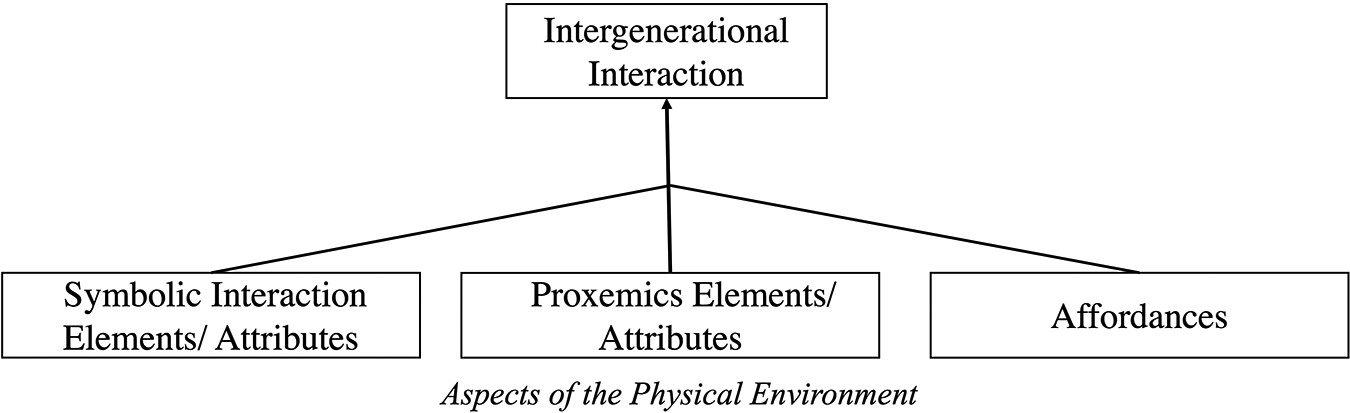
Direct and moderating effects of three sets of physical environment elements/attributes on the quality and level of intergenerational interaction.
Discussion
The current inquiry focuses exclusively on the theoretical exploration of the following research questions: (1) Is there a plausible explanatory pathway between social connection/interaction and loneliness in the elderly and (2) Can the physical design meaningfully fit into the proposed explanatory pathway? A literature review from sociology, psychology, and environmental design suggests an explanatory plausible causal association between physical design and loneliness. Some of the causal links are theory-based, whereas others have been empirically examined.
Theoretical propositions suggest that loneliness is associated with hopelessness and lack of purpose. Finding a meaning in life is fundamental to survival, and infusing purpose is argued to provide meaningfulness. For older adults, the Meaning in Life Theory, developed by Frankl (1985), posits that the fundamental human motivation is to find meaning; lack of meaning in life leads to a profound sense of emptiness symptomatized through depression, hopelessness, boredom, and a lack of willingness to be alive.
A solution for creating purpose can be found in Erikson’s (1950) Lifespan Ego-Development Task Theory. Erikson describes the phases of adulthood, one of which is generativity, in which older generations share knowledge with younger generations. Generativity is a need for giving; giving can provide purpose or meaning for living. Interventional studies have shown that to reduce loneliness, interaction is needed. Thus, through creating meaning via generativity, specifically intergenerational interaction, loneliness could be and is reduced.
This first set of theories address the phenomena of loneliness from a psychosociological perspective. The potential role of the physical environment emerges in the physical settings for intergenerational interaction. While social programs promoting intergenerational interaction is fundamental to reducing loneliness, theories suggest that the former’s level and quality could be improved by the environment in which it occurs (Figure 7).
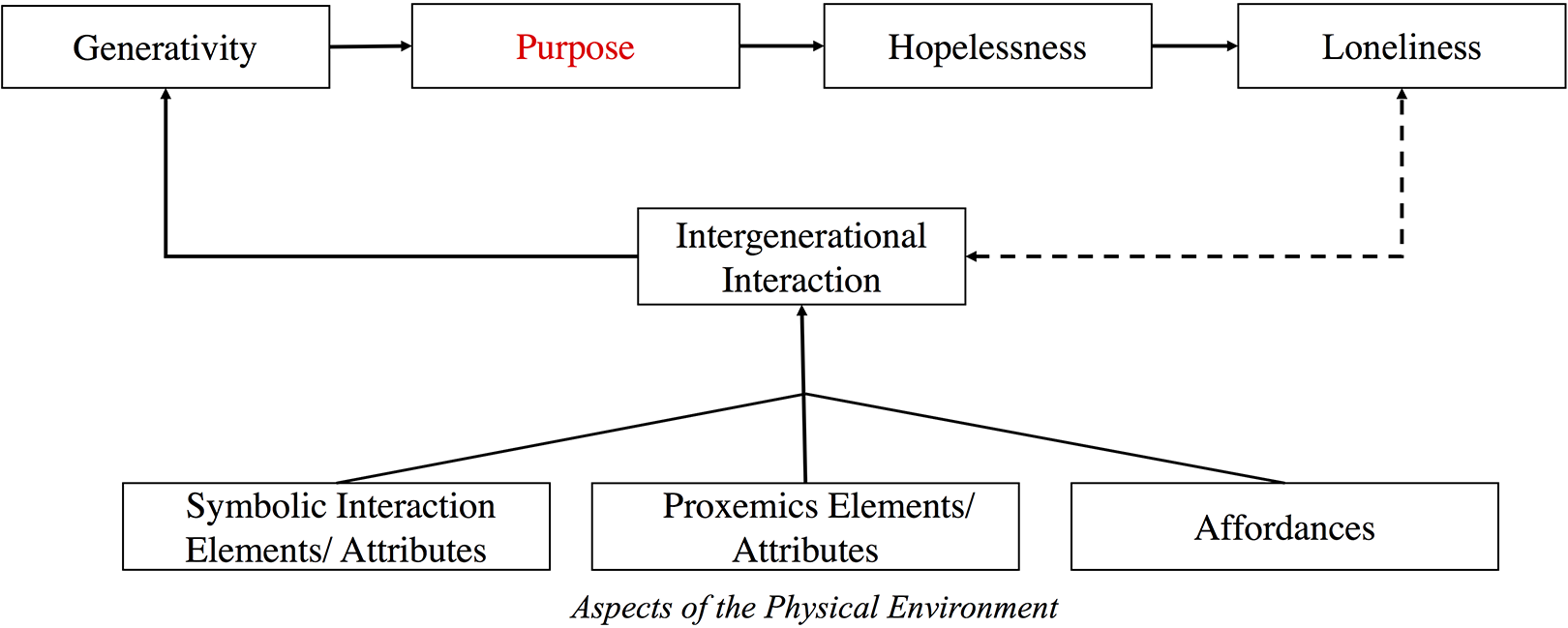
A causal model associating physical environment design with loneliness in the elderly.
Three theories provide a foundation to examine the matter, with particular consideration of the elderly users of a space. According to these theories, different sets of physical attributes in the environment can play a direct and moderating role in the association between the physical environment and intergenerational interactions. This position warrants empirical testing.
The causal pathway presented in this article posits that, given a successful social program, sets of physical environment attributes (associated with the theories of Symbolic Interactionism, Proxemics, and Affordance) moderate the association between physical design and intergenerational interaction, in addition to exerting direct effects. Since the objects, the objects’ affordances, and environmental attributes can have meanings for the elderly, both symbolic/nonverbal and practical, these can influence behavior, specifically intergenerational interaction. This type of interaction can foster generativity and care for others. In this chain of plausible causal pathways, purposelessness could be addressed through generativity to reduce hopelessness, which in turn reduces loneliness.
Three sources of environmental influences and interactions need to be examined to optimize the physical environment for intergenerational interaction. The first pertains to the Symbolic Interaction Theory. One of its fundamental principles is that interaction happens in a particular cultural and social milieu where physical and social objects (people) should be understood in the context of personal meanings (Blumer, 1986). Meanings associated with objects could directly affect the level/quality of interaction, which needs to be examined. It could also interact with spatial attributes (sociopetal/sociofugal, fixed/semifixed, physical proximity, etc.) and affordances in meaningful ways, that is, the association between object meaning and level/quality of interaction may vary based on the state of spatial attribute and/or affordance.
The theory of Proxemics (Hall, 1990) offers a second area of investigation. The state of spatial attributes (sociopetal/sociofugal, fixed/semifixed, physical proximity, etc.) could directly affect the level/quality of interaction. For instance, configuration, type of furniture, orientations, and proximities in a space could facilitate or impede interactions and activities. It could also interact with object meanings and affordances in meaningful ways, that is, the association between state of spatial attributes and level/quality of interactions may vary based on object meanings and affordances. The third area of examination is the Affordance Theory (Gibson, 1950), which directly affects how people use or interact with objects, hence the level/quality of interpersonal interactions. It could also interact with object meaning and the state of spatial attributes (sociopetal/sociofugal, fixed/semifixed, and physical proximity, etc.) in meaningful ways, that is, the association between environmental affordance and level/quality of interaction may vary based on object meaning and the state of spatial attributes.
In the specific context of intergenerational interactions, the causal pathway suggests that if spaces in which intergenerational interaction occurs were to be intentionally engineered to optimize interpersonal interactions, in combination with a successful social program, it could foster better quality and more interactions. Improved interaction could result in better mental health, which in turn could lead to reduced levels of loneliness. However, in the context of a successful social program, environmental typologies, and elements and attributes of an environment that might facilitate intergenerational interactions for the elderly are unexplored. Additionally, what is yet unknown from a physical design perspective is the combinations of objects, meanings, affordances, configurations, orientations, proximities, and so on, which could contribute to improvements in interactions. Information and communication technology and digital communications introduce yet another dimension to this emerging and critical question. These will be examined in a doctoral dissertation for which this theoretical examination constitutes the exploratory foundation.
Conclusions
Between theoretical propositions and empirical literature, there exist grounds to assert that a plausible causal pathway exists between the physical environment and loneliness in the elderly population. While the existence of a strong social program is minimum, necessary, and vital, the explanatory pathway suggests that the physical design could play both a direct and moderating role in influencing loneliness.
Implications for Practice
Pending empirical studies for more specific guidelines, designers, staff, and facility owners of settings for intergenerational programs may focus on three aspects of the physical environment to improve the quality and level of interactions. The physical design is rarely neutral—it either facilitates or impedes in the achievement of desired outcomes.
First: The symbolic meanings attached to objects in the setting of interaction. Review, when possible, the Symbolic Interactionism theory.
Second: Spatial entities and attributes that facilitate interpersonal interactions. Not all designs promote interactions, and some impede. Review, when possible, the theory.
Third: Design affordances in the environment and objects to support interpersonal interactions. Review, when possible, the theory of Affordance.
Footnotes
Declaration of Conflicting Interests
The author(s) declared no potential conflicts of interest with respect to the research, authorship, and/or publication of this article.
Funding
The author(s) received no financial support for the research, authorship, and/or publication of this article.
