




Abstract
While healthcare design research has primarily focused on patient outcomes, there is a growing recognition that environmental interventions could do more by promoting the overall quality of care, and this requires expanding the focus to the health and well-being of those who deliver care to patients. Healthcare professionals are under high levels of stress, leading to burnout, job dissatisfaction, and poor patient care. Among other tools, mindfulness is recommended as a way of decreasing stress and helping workers function at higher levels. This article aims to identify potential environmental strategies for reducing work-related stressors and facilitating mindfulness in healthcare settings. By examining existing evidence on workplace mindfulness and stress-reducing design strategies, we highlight the power of the physical environment in not only alleviating stressful conditions but intentionally encouraging a mindful perspective. Strategies like minimizing distractions or avoiding overstimulation in the healthcare environment can be more effective if implemented along with the provision of designated spaces for mindfulness-based programs. Future research may explore optimal methods and hospital workers’ preferences for environments that support mindfulness and stress management. The long-term goal of all these efforts is to enhance healthcare professionals’ well-being, reignite their professional enthusiasm, and help them be resilient in times of stress.
Keywords
Workplace Stress and Preventive Tools
Occupational or work-related stress is defined as the perception of a discrepancy between demands (stressors) and individual capacities to fulfill those demands, with significant implications for health and productivity (Varca, 1999). Workplace stress may stem from (1) organizational sources such as job assignments or work schedule, (2) social sources such as interactions with colleagues and visitors, (3) or environmental sources such as lighting, noise, or spatial properties. To reduce workplace stress, prevention strategies and interventions are developed and broadly implemented in different work settings. In 1979, Quick and Quick introduced the theory of preventive stress management as a set of principles that employs specific methods for promoting individual and organizational health by preventing individual and organizational stress. Hargrove et al. (2011) reviewed the advancement of this theory over 33 years since its conception and outlined the organizational practices associated with the application of the theory. Figure 1 shows an adapted version of their conceptual model that illustrates the flow of workplace stress, from stressors to outcomes. They introduced three stages of prevention. While primary interventions seek to reduce or eliminate the stressors, such as provision of social support to reduce social stressors, secondary interventions are aimed at moderating the stress response. These may include meditation techniques, mindfulness programs, or exercise and wellness programs. Finally, the aim of tertiary interventions is to moderate the outcomes associated with stress, like burnout or substance abuse. This may be achieved through medical or behavioral treatment by trained professionals. The purpose of this article is to initiate a conversation about environmental design strategies as (1) one of the primary prevention tools to aid with reducing organizational, social, and environmental stressors and (2) one of the facilitators of mindfulness—a secondary prevention tool. We aim to explore the paths to adopt these strategies into practice in healthcare settings as one of the most stressful work environments.
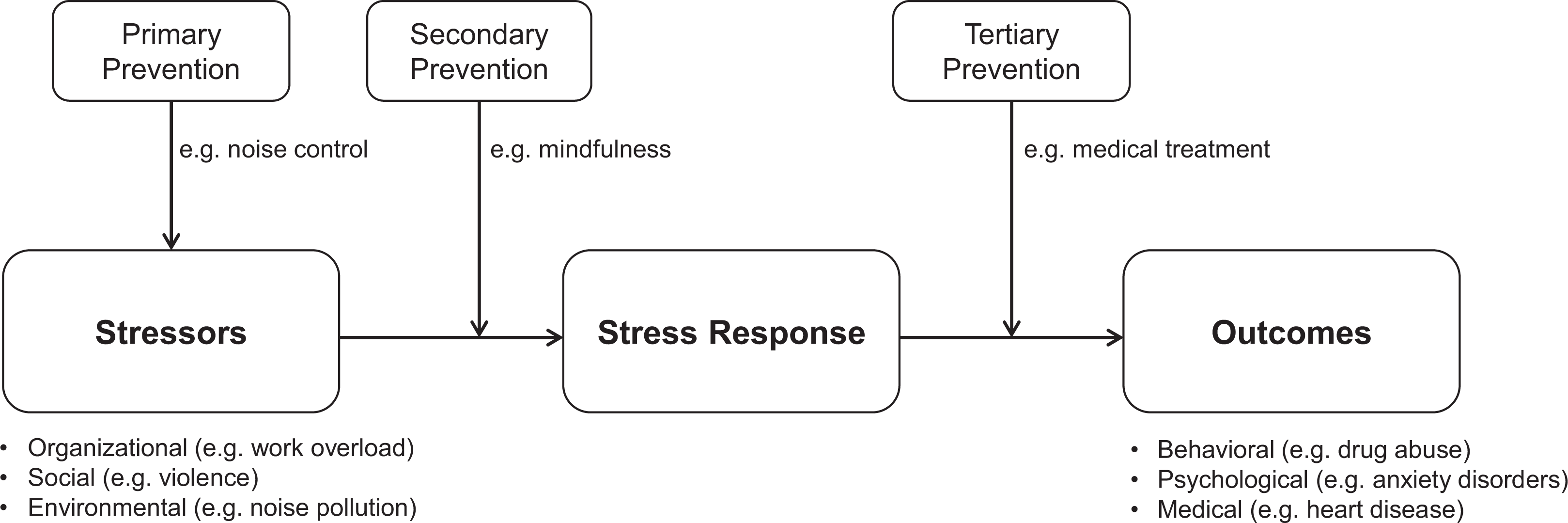
Preventive stress management model, adapted from Hargrove et al. (2011).
Stress Among Healthcare Professionals
The mental exhaustion associated with today’s work climate and its related stressors has led to a spike in burnout among U.S. workers (McGeary & McGeary, 2012), and this trend is even worse among healthcare professionals. They are under excessive pressure due to high patient volumes, limited resources and understaffing, long work schedules, repeated exposure to traumatic events, and workplace violence (McVicar, 2003; Schooley et al., 2016). In the modern technology-rich healthcare environment, they also have to deal with information overload, which requires even more cognitive processing, increasing the likelihood of emotional fatigue and burnout (Privitera et al., 2014).
Self-care tools and stress management strategies are shown to be effective in tackling burnout among healthcare professionals. These include mindfulness training (Kemper & Khirallah, 2015), coping skills (Howlett et al., 2015), mindful communication (Krasner et al., 2009), art activities (Huet & Holttum, 2016), and work condition interventions (Linzer et al., 2015). Stress management techniques, such as aromatherapy, massage, and music, have also been shown to be effective in healthcare settings (Cooke et al., 2007). Studies have demonstrated that being mindful and managing stress levels can enhance focus, mental clarity, creativity, emotional intelligence, empathy and compassion, resilience, happiness, and overall well-being (Kinser et al., 2016; Krasner et al., 2009; Lebuda et al., 2016)—the same capacities that we expect from caregivers and healthcare professionals. This article explores how we can provide supportive work environments so their minds can be focused, spontaneous, and responsive to patients’ needs.
Managing Organizational, Social, and Environmental Stressors Through Design
As shown in Figure 1, primary stress prevention interventions are techniques for directly managing the causes of stress. Hargrove et al. (2011) opined that organizations should attempt to eliminate extreme stressors such as violence or hazardous conditions. These proactive steps can also reduce the need for secondary (e.g., mindfulness trainings) and tertiary (e.g., medical treatment) interventions by focusing on sources of stress. Studies have shown that environmental design strategies have the potential to address both socio-organizational and environmental stressors, either directly or indirectly.
Organizational and Social Stressors
Design decisions that enable collaboration, effective conversations, and healthy channels of communications can reduce socio-organizational stress. When workers feel that they are a part of a team with shared goals, their stress will decrease (Kivimäki et al., 2007). Therefore, providing opportunities for information sharing and team-based problem-solving is important. For example, collaboration areas or team rooms within hospital units might enhance teamwork. Creating workplaces that encourage conversations among nurses, physicians, and residents might minimize the sense of hierarchy. This can be achieved by paying special attention to the location of workstations, their adjacency to others, access, and even their furniture arrangements.
Work-related violence is another social stressor in healthcare settings. Poor environmental design has been identified as a risk factor for violence against healthcare professionals (Pane et al., 1991; Pati, Pati et al., 2016). Some environmental considerations can help to reduce the incidence of violence in the healthcare workplace. Studies have shown that designing open layouts, avoiding blind spots, providing visibility of security personnel and clinical staff, and providing more than one entrance/exit door in high-risk areas, such as triage rooms in emergency departments, may reduce violence against healthcare staff (MohammadiGorji et al., 2020).
Environmental Stressors
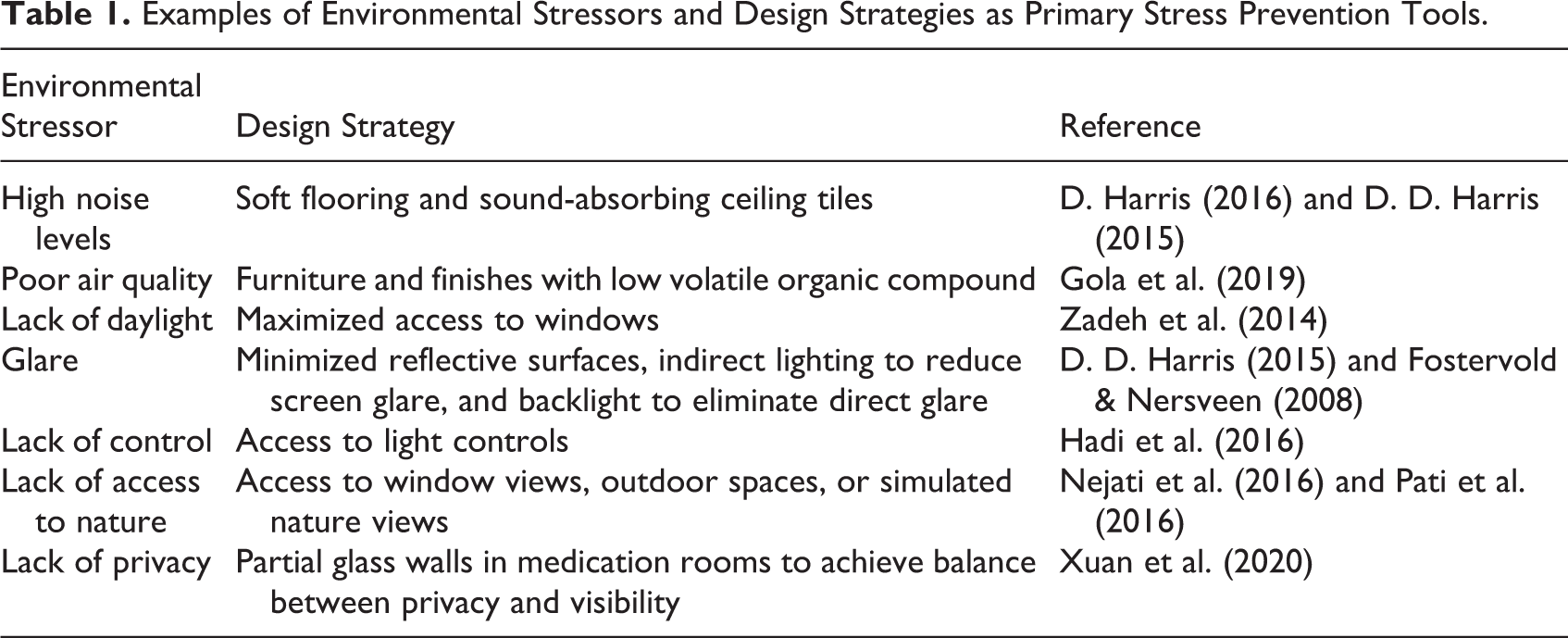
There are many environmental stressors associated with increased levels of anxiety, distress (stress response in Figure 1), and emotional exhaustion (stress outcome in Figure 1) in healthcare settings such as high noise levels (Applebaum et al., 2010); poor air quality (Hedge, 2000); constant exposure to artificial lights, especially fluorescent tube light (Kamali & Abbas, 2012); lack of daylight (Alimoglu & Donmez, 2005; Boyce et al., 2003; Zadeh et al., 2014); glare from reflective surfaces (Fostervold & Nersveen, 2008); lack of control over the surrounding environment (Diestel & Schmidt, 2009); lack of access to outside views (Nejati, Shepley, et al., 2016); and lack of privacy (Laurence et al., 2013). Table 1 shows examples of design strategies, as primary stress prevention tools, to address these environmental stressors. For example, a balance between natural and artificial lighting may not only provide sufficient lighting for tasks but also enhance circadian rhythms, visual comfort, and job satisfaction. Research also suggests that clutter and disorganization in the work environment are a source of stress and lost productivity. Roster and Ferrari (2019) demonstrated that clutter is an external manifestation of experienced stress created by heavy workloads, which further perpetrates workplace stress. Excessive clutter may also present physical hazards, such as trips and falls, which may serve not only as source of physical harm but also psychological stress.
Examples of Environmental Stressors and Design Strategies as Primary Stress Prevention Tools.
Mindfulness and Stress Reduction
Mindfulness is defined as maintaining a moment-by-moment awareness of our thoughts, feelings, sensations, and surrounding environment through purposeful attention (Kabat-Zinn, 2003). With roots in Buddhist meditation, the term “mindfulness” was popularized by Kabat-Zinn in 1979 for scientific inquiry. It is now considered to be an inherent quality of human consciousness. Being mindful means being in the present moment and paying complete attention to the immediate experience. Studies have shown that mindfulness practice has benefits including increased gray matter density in areas associated with attention, learning and memory, emotional regulation, empathy, and compassion (Hölzel et al., 2011; Jha et al., 2007; Luders et al., 2009).
Researchers studying the neurological foundations of attention have calculated that, on average, our mind wanders 46.9% of the time. This wandering comes at an emotional cost that includes unhappiness and a predisposition to chronic stress (Killingsworth & Gilbert, 2010). Attention wandering is a natural neurological tendency that has increased dramatically over the past few decades because of the modern way of working that requires workers to handle a constant and endless flow of information. Hougaard et al. (2016) refer to wandering and the consequent stress as the PAID reality: “Pressured, Always-on, Information Overloaded and Distracted.” Like many other authors, they suggest engaging in mindfulness as an antidote to stressful workplace conditions.
A mindfulness-based stress reduction program was initially developed by Kabat-Zinn in 1979 for stress management. It has since evolved to encompass the treatment of a variety of disorders including anxiety, depression, immune disorders, pain, and hypertension. Different forms of mindfulness-based stress reduction programs are offered by organizations such as Google, Aetna, Apple, and Ikea to increase concentration, enhance compassion, and reduce stress levels, with the aim of improving staff productivity. In a typical program, up to 30 participants engage in 8 weeks of intensive training in meditation techniques, using both in-class and at-home exercises.
Despite its various positive psychological effects, including improved perceptions of well-being, a review of empirical research raised concerns about insufficient inclusive evidence on the impact of mindfulness interventions, specifically due to the lack of controlled experiments and neglect of individual differences in earlier studies (Farias & Wikholm, 2016). Mindfulness and meditation techniques may not work for everyone, and some studies have even reported adverse effects associated with the practice of mindfulness, such as panic, depression, pain, and anxiety (Lomas et al., 2015; Shapiro, 1992). Regardless, ample evidence demonstrating the benefits of mindfulness, as a state of mind, warrants consideration as a possible aid in reducing stress among workers experiencing information overload.
With that aim in mind, bringing mindfulness to work, as a perspective and not just a therapeutic intervention, might result in decreased burnout and increased productivity, especially in stressful workplaces like healthcare settings. What we have learned from neuroscience is that mindfulness nourishes well-being by increasing concentration and enhancing compassion (Fletcher et al., 2010). As a secondary prevention intervention (see Figure 1), it can reduce the level of stress by slowing down the pace of work and sharpening focus. By promoting mindfulness, organizations can provide a buffer against organizational, social, and environmental stressors to improve productivity.
Mindfulness in the Healthcare Work Environment
As mentioned, environmental conditions in healthcare settings may serve as a source of stress (stressor), or they may function as a prevention technique by moderating the stress associated with providing healthcare services as well as the stress stemming from other environmental conditions. Examples include the stress-increasing impact of spatial disorientation and poor wayfinding in hospitals (Zimring, 1990) and the stress-reducing impact of being exposed to natural views and daylight (Pati et al., 2008). Environmental conditions may also facilitate other stress-reducing interventions like mindfulness. Regardless of whether mindfulness is practiced as a formal ritual or encouraged as a way of life, evidence suggests that the environments in which we work affect our ability to experience momentary awareness and continuous mindfulness.
Spaces for Practicing Mindfulness Techniques
Some healthcare organizations offer mindfulness-based stress reduction programs in their facilities; therefore, it is important to understand the individual activities and associated requirements. While most mindfulness practices require a quiet space similar to a meditation room, some activities involve mindful movements, such as walking or lying down on the floor; others need some sort of person-to-person interaction such as presentations or group discussions. Porter et al. (2017) have identified three types of spaces for mindfulness practices: (1) a place away from usual daily activities in the facility; (2) a regular meeting room or office that can be adapted to accommodate intended activities; and (3) a space that is custom-designed only for mindfulness. While the second type is the most common in healthcare facilities (Porter et al., 2017), LeVasseur and colleagues (2019) do not suggest repurposing spaces with different functions into mindfulness practice rooms. They found that yoga classes that were held in a quiet atrium of their large hospital after business hours were easily disrupted, so they suggested developing other venues such as healing gardens and meditation rooms. Quiet rooms are also suggested, allowing workers to pause after a traumatic incident on a ward that has affected multiple staff members (Cusack et al., 2016). These designated areas should be spacious enough to allow for movements and physical relaxation. Suitable furniture and accessories such as floor cushions or exercise mats can provide comfort for sitting or lying down on the floor. Soft flooring may be considered to provide under-feet support. Outdoor spaces (e.g., patios, balconies, porches) can provide not only opportunities for taking in fresh air but also enough open space for mindful walks. Helpful accessories are suggested, such as headphones, earplugs, and eye patches, to help employees meditate without being distracted (Hafenbrack, 2017). Performing mindfulness practices in existing spaces like meeting rooms would impose more limitations. If space allows, extra seating (e.g., sectional benches) may be provided on the perimeters of the meeting rooms for meditation practices. Group trainings can only be done on chairs in these rooms. Furnishing the room with wheeled furniture can help with rearranging the space for sitting on the floor.
In a study by Luberto et al. (2017), advocating for dedicated and protected space improved the delivery of their 4-week mindfulness-based cognitive therapy program. The study evaluated the feasibility and acceptability of their group program among hospital employees and noted implementation challenges. Environmental challenges noted in the study were as follows: (1) noise outside of the conference room where the program sessions were held, (2) interruptions (e.g., other employees entering the room, fire alarms going off), and (3) space conflicts (e.g., frequently changing rooms). Outside noise and constant disruption, as might be associated with proximity to patient rooms, have been reported as space-related challenges as well (Byron et al., 2015; Duggan & Julliard, 2018). Participants in one study noted not being able to lock the room as a disruptive factor, and they suggested that a dedicated space is necessary in order to have a successful initiative (Duggan & Julliard, 2018). Participants stated that it would not be appropriate to hold these events in a break room where all staff might expect to enjoy their lunch in quiet (Duggan & Julliard, 2018). A simple audit of potential work environments where mindfulness activities might occur can help locate the ideal space where distractions can be minimized. An environmental assessment tool may be developed to evaluate the existing spaces for their capabilities of being used as mindfulness practice rooms. By touring and observing the workplace, auditors can examine several factors, including the use pattern, noise level, clear floor, or types of furniture, and identify opportunities for quick modifications.
Environmental and survey audits may also be conducted to identify effective environmental qualities that are implemented in other workplaces like technology corporations. Google and Apple have designated mindfulness/meditation rooms for employees to calm down or perform preferred bodily practices (Parviainen & Kortelainen, 2019). These are usually quiet, peaceful, and comfortable spaces that employees may go to either practice mindfulness or readjust their mindsets during an intense working day. Similar rooms might support mindfulness among healthcare workers as well.
Environments That Support Mindful Work
As discussed, stress reduction may be achieved not only by performing mindfulness-based therapy within the workplace but also by creating an ambient environment that supports mindfulness by enhancing attentional processing and sustained focus, which are the core mechanistic components of many mindfulness-based practices (M. Wang et al., 2020). Creating a more mindfulness-supportive workplace can eventually enhance well-being and help healthcare professionals better cope with job-related stress. To enable mindfulness, the domains of distraction and overstimulation should be considered. We argue that healthcare workers who are excessively distracted or overstimulated by the environment may be compromising the cognitive ability that they need to sustain focus and engage in a mindful work.
Minimize distractions and interruptions
Modern healthcare workplaces are filled with informational distractions, both visual and auditory. In order for hospital staff to focus more effectively and stay present, it is essential to minimize distractions and interruptions that add to the complexity of care delivery and ultimately place patients at greater risk of harm. Potter et al. (2005) showed that acute care nurses were interrupted three to six times every hour by people, pagers, and telephones. The consequences of interruptions and distractions are higher levels of stress among health professionals, medical and medication errors, ineffective delivery of care, and poor patient outcomes (Potter et al., 2005). While interruptions from patients and team members are reported to be the main source of distraction (Hall et al., 2010; Ren et al., 2008), other sources include phone calls (Koong et al., 2015; McBride, 2015), side conversations among colleagues (Greenstein et al., 2013), and noises caused by technology and equipment. Several strategies have been suggested to help workers in the modern workplace be more mindful, such as answering emails during dedicated periods of time, pausing to take a deep breath, taking short breaks, or noticing one’s posture and improving it (Hougaard et al., 2016). The physical environment can provide opportunities for implementing some of these strategies. Break rooms in close proximity to work areas but separate from patients and family areas can make it possible for healthcare workers to step away from work demands even if it is just for a few minutes (Nejati et al., 2016; Steege & Dykstra, 2016). In the same way, hospital-integrated gardens that are in short distance with nursing units (Cordoza et al., 2018) can encourage workers to take restorative breaks for mindful moments. Posture improvements can be made by providing flexible work options like stand-up desks (Feiler & Stichler, 2011) or spaces for basic yoga stretches and corrective exercises (Hilcove et al., 2020).
Other suggested environmental strategies for healthcare settings include developing “no interruption” zones or quiet rooms (McGinley, 2010). These are designated areas in which interruptions are not allowed. This can be as simple as a red boundary on the floor around a medication dispensing system that implies “do not distract me.” Another solution is to expand medication rooms and locate medication dispensing machines in closed versus open areas, which can reduce medical errors by minimizing distractions (Chaudhury et al., 2009).
Incorporating private workspaces for quiet and focused work, as well as glass partitions to allow teammates to see each other while conserving privacy and minimizing noise, is also advocated in the literature (Gunn et al., 2015; Watkins et al., 2015). Different levels of privacy may be provided to enable a range of work, from direct contact with patients or family members in open reception desks to more hybrid works in partially sectioned-off workstations to completely heads-down work in enclosed rooms or cubicles. This range of privacy will give the workers options to move to a more private space once they need to have a more focused or sustained attention. Eliminating unnecessary spatial complexities, such as repetitive travels or inaccessible resources, was also found effective in minimizing distractions (Zadeh et al., 2012).
Avoid overstimulation
To counteract the negative impact of inevitable distractions in the complex environment of care, minimizing external stimuli, including auditory, olfactory, and visual stimuli, can be effective. Noise control strategies can be implemented to prevent auditory overstimulation. Noise is one of the main causes of distraction in healthcare settings. While some sounds are helpful, such as the communication of essential patient information (e.g., heart monitors), other sounds, such as moving equipment, objects falling to the floor, or footsteps, can be distracting and annoying. Although it is impossible to completely eliminate sound in the workplace, especially in healthcare settings, several strategies are being implemented to reduce ambient noise to improve concentration and decrease stress level. Other effective options for limiting unwanted noise include using soft and sound-absorbing finishes (e.g., acoustic ceiling tiles), eliminating the source of noise (e.g., noiseless paging systems), and creating private work rooms. Adding a dedicated service corridor to separate staff traffic from patient care traffic was also found to be significantly effective in noise control (Z. Wang et al., 2013).
In regard to olfactory stimulus, while research shows that smells can have a powerful impact on human behavior (Krusemark et al., 2013), less is known about their types and acceptable exposure levels to avoid overstimulation. For example, it is believed that aroma of coffee in the environment can lift moods (Gilbert, 2014). Many hospitals in the United States use coffee grounds to absorb unpleasant odors. However, a study on nurses in an emergency department found that the smell of coffee grounds may be tied to stress. Using biofeedback, heart rate monitoring, and surveys, the study demonstrated that in contrast with coffee, the introduction of true essential oils may reduce stress and improve job satisfaction (Clark, 2013). Introduction of lavender (a popular essential oil) among nurses in three different units of a hospital also resulted in a reduction in perceived work-related stress and an increase in job satisfaction (Johnson et al., 2017). To avoid overstimulation, it is important to consider that when the level of anxiety is high, people’s response to smells is stronger than when they are not anxious (Krusemark et al., 2013). In other words, there is an exaggerated emotion–olfaction interaction in negative mood states.
In relation to visual stimuli, Bar and Neta (2007) found significantly more activation in the amygdala—a part of the brain that triggers negative emotions such as fear—associated with everyday sharp objects (e.g., a sofa with sharp corners) compared with their curved contour counterparts. A study by Pati et al. (2016) found that sharp contours were associated with more activation of the amygdala when viewing images depicting healthcare objects and landscape, yet curved contours were associated with significantly higher activation of amygdala when viewing images of hospital interiors and exterior envelops. Color is another visual stimulus that is widely linked to psychological and physiological reactions. For example, warm-colored hues are believed to have higher stimulation qualities (Tofle et al., 2004). Despite the lack of evidence regarding a direct link between a particular hue and a given emotion, most people continue to associate warm colors with stimulating activities and cool colors with passivity and tranquility (Gong et al., 2017). Whether this connotation is due to individual experiences or cultural conventions or stereotypes, designers may choose to avoid using (or overusing) warm colors in healthcare facilities, especially on large surfaces, to avoid the possible perception of danger.
Another environmental feature that may result in overstimulation is high spatial density. Studies have demonstrated that spatially dense areas (i.e., those with little space available per person) have negative effects on employees’ level of stress (Oldham et al., 1995). May and colleagues (2005) found that medical receptionists in an outpatient clinic in dense work areas felt more crowded and dissatisfied with their work areas than those who worked in spacious areas. Ashkanasy et al. (2014) argued that decreasing interactional distance between employees in work settings may promote overstimulation and arousal, which will negatively impact employees’ performance.
Conclusion
Delivering excellent patient care demands physicians and nurses to function at their highest levels of health and well-being. However, healthcare professionals experience a broad range of workplace stressors that, in many cases, lead to job dissatisfaction and burnout. Mindfulness-based considerations have demonstrated a positive impact on helping healthcare professionals put stressful situations in perspective and promote positive reactions to stress. The physical environment can facilitate mindfulness, either through provision of designated spaces for mindfulness-based programs or by creating a mindful working environment that is attentive to workers’ needs during the course of the workday. The proper application of environmental design strategies discussed should be considered on a case-by-case basis. It might be challenging to implement some supportive design strategies simultaneously, especially in team rooms that need to support both collaborative and focused work. For example, a more open team care station provides a high level of visibility and may reduce the risk of violent events; however, it may also reduce focus and attention by decreasing environmental control and privacy. Future research should explore optimal methods and hospital workers’ preferences for environments that support mindfulness and stress management. Other studies may also benefit from caregivers’ retrospective experiences of the implemented design strategies (e.g., existing or simulated mindfulness rooms in hospitals). More work is needed to further uncover the relationship between the stressful environment of care, mindfulness, and the role of the physical environment in managing stressors, stress response, and stress outcomes among healthcare workers.
Implications for Practice
Mindfulness can be facilitated in the healthcare workplace either by providing dedicated spaces for practicing individual and group meditative techniques or by creating a comprehensive positive and mindful work experience.
To provide dedicated spaces, designers may identify locations where distractions can be minimized, and various mindfulness activities (e.g., walking, lying down on the floor) can be practiced in a quiet room or an outdoor space.
While offices and meeting rooms are commonly used for practicing mindfulness techniques in healthcare settings, permanent dedicated spaces will allow for implementing more successful programs.
A mindful work experience might be achieved in the healthcare environment by minimizing informational, visual, and auditory distractions; minimizing workflow interruptions; avoiding overstimulation; and using evidence-backed strategies to reduce high levels of stress stemming from organizational, social, or environmental sources.
Footnotes
Declaration of Conflicting Interests
The author(s) declared no potential conflicts of interest with respect to the research, authorship, and/or publication of this article.
Funding
The author(s) disclosed receipt of the following financial support for the research, authorship, and/or publication of this article: This work was supported by The American Society of Interior Designers (ASID) Foundation Research Grant Program.
