



Abstract
Objectives:
This study examined the associations between home and community environmental factors and self-rated health (SRH) among older Canadians and how these associations vary by gender and living arrangements. Background: In social gerontology research, the psychosocial determinants of SRH have been widely investigated. Based on the environmental gerontology framework, this study examined the home and community environmental correlates of SRH.
Method:
The sample (aged 60 or older) was drawn from the 2018 Canadian Housing Survey (4,086 men living alone; 6,471 men living with others; 9,170 women living alone; 4,876 women living with others). Multiple regression analyses were used to examine the relationships between SRH and potential environmental correlates in a hierarchical model.
Results:
Findings show that older men and women living alone reported lower levels of SRH than those living with others. Regression findings show common and unique home and community environmental predictors of SRH by group. Common predictors of higher SRH were private housing residence, larger living space, satisfaction with dwelling, volunteering, no perceived need for community services, and community safety. Home maintenance needs predicted lower SRH among older men and women living with others; uninhabitable conditions predicted poor SRH among older men living with others and older women living alone.
Conclusion:
Results support the important effects of place in terms of home and community environments for older adults’ SRH, and associations differed by gender and living arrangements.
The growth of the aging population and increased longevity is a global phenomenon. Canada is no exception. In 2014, approximately 6 million Canadians were aged 65 or older, and by 2030, the number is expected to reach 9.5 million, increasing from 15.6% to 23% of the population (Government of Canada, 2014). In addressing the needs of a growing aging population and longevity, multitudinous gerontological research has focused on understanding ways to maximize the physical, mental, and social health of this population. Ensuring healthy populations, particularly older groups, could potentially reduce disease burden, health care costs, long-term care expenditures, and informal caregiving stress.
In environmental gerontology, one emerging theme is to study the effect of living arrangements on older adults’ health and well-being. Social gerontologists have documented that living independently is a preferred option among healthy aging populations, especially for the baby boomer generation (Muhammad et al., 2021). In Canada, approximately 26% of the older adult population lived alone in 2016. Because of women’s longer life expectancy, the proportion of Canadian women aged 65 or older living alone exceeded men by about 20% (Statistics Canada, 2017; Tang et al., 2019). Regardless of living arrangements, most older adults prefer to age in place—to live in their familiar environments and communities. Housing design professionals have pointed out that the livability of dwelling places for the older adult population should be evaluated by the age-friendliness of home and community environmental conditions (American Association of Retired Persons Pennsylvania, 2020). Preliminary data suggest that favorable housing conditions are associated with better health and quality of life for all, especially older adults (Stephens et al., 2019). Thus, given the importance of place and environment to older adults’ health, we aimed to understand the relationship between home and community environments and older Canadians’ self-rated heath (SRH), including whether the associations differ by gender and living arrangements (living alone vs. with others).
SRH, Gender, and Living Arrangements
Psychometrically, SRH has been documented as a reliable and valid subjective measurement of the overall health status of older adults (Badri et al., 2021; Collins et al., 2009; Griffiths et al., 2005; Ocampo, 2010; Stronegger et al., 2010). SRH is highly correlated with a physician’s objective rating of an older adult’s health status (Bombak, 2013; Wu et al., 2013). Conceptually, the SRH score captures multidimensional information about the biological, mental, social, and functional aspects of a person’s present and future health trajectory. SRH reported by older adults provides a benchmark for evaluating overall health status at different points during the aging process (Mathis et al., 2015; Ocampo, 2010). Therefore, SRH has been used as a proxy measure of the general health of older adults in many gerontological studies. In this study, we adopted the SRH as a health outcome measure and examined environmental determinants of SRH among community-dwelling older Canadians.
Regarding gender disparities in aging health, research has documented gender differences in many physical and mental health outcomes. Compared to older men, older women reported more chronic illnesses (Alharbi et al., 2020), higher levels of depression (Girgus et al., 2017), and sense of loneliness (Takagi et al., 2020). In terms of SRH, research has consistently documented that older women reported lower SRH than older men (Af Sillén et al., 2005; Etherington, 2017; Josefsson et al., 2016). Gender disparities in health may be explained partially by genetic factors and longevity. Gender variations in SRH may also be attributed to differences in educational attainment, income, and health care access (Etherington, 2017). Sociologically, older women are more likely to be widowed, live alone, and shoulder family caregiving responsibilities due to gender role socialization. Research has suggested that late-life family caregiving role demands have a negative effect on women’s SRH (Mui, 1995).
Studies have also suggested an association between living arrangements (living alone vs. living with others) and levels of SRH among community-dwelling older adults, but the findings have not been conclusive. Some studies showed that older adults living alone were more likely to report higher levels of SRH than those living with others (Henning-Smith & Gonzales, 2020; Muhammad et al., 2021; Weissman & Russell, 2018; Xu et al., 2019). Perhaps this is a self-selection process because older adults who were not healthy could not live alone. Independent living demands higher levels of physical functionality and capacity in daily activities and self-care (Muhammad et al., 2021; Weissman & Russell, 2018). On the other hand, research also suggested that living alone was associated with lower levels of SRH relative to living with others due to risks associated with physical and social isolation (Barrenetxea et al., 2021; Chou et al., 2006; Kharicha et al., 2007).
Regarding the association between living with others and SRH among older populations, the findings also have been inclusive. For example, with a sample of 1,284 older Spanish adults, Zunzunegui and colleagues (2001) found that widowed older adults living with their children were likely to report higher levels of SRH. Living with others and family interdependence may be preferred during difficult transitions in an older adult’s life. Living with family may provide necessary social support, health maintenance, and access to medical services (Barrenetxea et al., 2021; Zhou et al., 2018). Conversely, research also suggested that older adults who live with extended family members reported lower levels of SRH (Muhammad et al., 2021). Living with others may be a necessary living arrangement for older adults who require assistance in their daily activities. Psychologically, SRH among older adults living with others may be negatively affected by stresses associated with the loss of personal space or rising family tension. The inconsistent associations between living arrangements and SRH may reflect differences in sample characteristics.
SRH and Home and Community Environments
Gerontological research has shown that aging in place and in familiar communities has been a preferred choice among older adult populations as compared to institutionalization in nursing homes. Since the advent of the age-friendly community movement by the World Health Organization (2021) in 2007, there has been growing interest in environmental gerontology in studying the effects of age-friendly environments on the health status of older adults. Research has largely supported that residents, including older adults, who reported satisfaction with housing quality were more likely to report higher levels of SRH than those who expressed dissatisfaction (Badri et al., 2021; Knöchelmann et al., 2020). Based on the person-in-environment perspective, studies have documented that individuals in low-income housing, including older tenants, are more likely to report lower levels of SRH than those in private housing (Tomioka et al., 2019). Researchers have argued that low-income housing may be associated with limited physical space, substandard housing conditions, and limited access to recreational facilities. Poor housing conditions may be proxy measures of environmental stressors that may be detrimental to the health and well-being of older residents.
In terms of community environmental factors, community environment is an important space and platform for the development of social capital, support networks, and access to health-promoting activities for older adults. For instance, communities that offer volunteering opportunities yield health benefits for their older residents (Li et al., 2013). Participating in meaningful volunteering activities can slow the deterioration of functional and cognitive abilities and chronic health conditions (Chang et al., 2021; Morrow-Howell et al., 2003).
Furthermore, satisfaction with the neighborhood has been found to be an important correlate of higher SRH among residents, including older adult populations (Oshio & Urakawa, 2012; Stronegger et al., 2010). A higher level of satisfaction with the quality of the community may mean availability of comfortable physical spaces, high-quality recreational facilities and community services, and high-quality social interaction and connectedness, which can serve as protective factors that promote better health (Stronegger et al., 2010). In addition, using a sample of 217 older Americans in a Midwestern city, Mathis and colleagues (2016) found community safety to be a protective factor related to better perceived health.
In this study, we adopted the socioecological and person-in-environment frameworks, which emphasize how interactions with environments such as home and community can shape the health and social behaviors of older adults, such as community social cohesion, sense of belonging, and civic engagement (Lu et al., 2021). The conceptual frameworks suggest accounting for multilevel factors (Bengston & Settersten, 2016), such as individual (age, gender, living arrangements), home (design, space), and community (cohesion, access to service, safety) factors, in understanding the relationships among person, place, environments, and assessment of health. In addition, the socioecological model emphasizes the intertwined association between a person’s health and the micro, meso, and macro environments. In this study, we addressed meso-system variables (e.g., home and community). Thus, our hypotheses were as follows: (1) Home and community environment variables, gender, and living arrangements are significantly associated with SRH, after accounting for control variables, and (2) home and community environment correlates of SRH vary by gender and living arrangements.
Method
This study used the 2018 public use microdata of the Canadian Housing Survey (CHS; Statistics Canada, 2020). The CHS is a biennial, stratified random-sampling survey of Canadians. CHS collects information on Canadian households’ socioeconomic status, SRH, perceptions of home and neighborhood environments, and social life (Statistics Canada, 2020). This study included 24,603 Canadians aged 60 or older residing across the country (4,086 men living alone, 6,471 men living with others, 9,170 women living alone, and 4,876 women living with others). Only older adults in noninstitutional settings were included in our sample, and living with others indicated that older adults lived with a spouse or extended family members. Due to structural missing data from respondents in the Northwest Territories (i.e., key variables not collected), we did not include sample data from that area.
Measurement of Variables
Outcome variable: SRH
SRH was rated by older respondents based on a survey question (“In general, how is your health?”) on a 5-point scale, from 1 = poor to 5 = excellent. This scale has been widely used in gerontology research, and its validity is well established (Kim et al., 2021; Sargent-Cox et al., 2008).
Key independent variables: Home and community environmental factors
Composite scores were created based on principal component analyses. All environmental variables were subjective assessments by the respondents. Respondents reported on home environmental factors via the following variables: (a) living in low-income housing (social or affordable housing; 1 = yes, 0 = no), (b) size of living space (number of bedrooms in the respondent’s residence; 1 = 1 or fewer rooms, 2 = 2 rooms, 3 = 3 or more rooms), (c) home maintenance need (0 = no, only regular maintenance is needed, 1 = minor or major repairs are needed), (d) satisfaction with dwelling design (a composite score that reflects respondents’ satisfaction with their dwelling conditions: safety, energy efficiency, accessibility, soundproofing, and temperatures during summer and winter; from 1 = very dissatisfied to 4 = very satisfied; α = .82), and (e) uninhabitable conditions (a composite score that included respondents’ report on whether certain conditions existed: poor indoor air quality, pests, undrinkable water, and mold or mildew; 0 = no, 1 = yes; α = .55).
Regarding the five community environmental factors, the measurements were as follows: (a) volunteering was used as a proxy for social capital, social engagement, and social network (any unpaid volunteer work for neighborhood organizations in the past year; 0 = no, 1 = yes); (b) satisfaction with the neighborhood (from 1 = very dissatisfied to 4 = very satisfied); (c) community service need (whether respondents needed community support services as part of their daily activities; 0 = no, 1 = yes); (d) perceived community safety (whether they feel safe about walking alone at night; 1 = very unsafe to 4 = very safe); and (e) sense of belonging (respondents’ attachment toward their community; 1 = very dissatisfied to 9 = very satisfied).
Control variables
Sociodemographic and psychological characteristics were included as control variables: (a) age (from 60 to 95); (b) education (1 = less than high school, 2 = high school diploma, 3 = professional certificate, 4 = bachelor’s degree and above); (c) self-rated mental health (1 = poor to 5 = excellent); and (d) life satisfaction (respondents’ satisfaction with their lives as a whole in the past 5 years; 1 = very dissatisfied to 9 = very satisfied).
Statistical Methods
Univariate and bivariate analyses were conducted to provide descriptive profiles of the sample by gender and living arrangements. Hierarchical regression analyses were undertaken to test the two hypotheses. To test the first hypothesis, Model 1 included only control variables. Home and community environment variables were added to Models 2 and 3, respectively. Then, gender and living arrangements were entered into Models 4 and 5, respectively. This hierarchical analytic approach allowed us to examine the incremental contributions of home and community environmental variables, living arrangements, and gender in explaining SRH. To test the second hypothesis, multiple linear regressions were conducted by gender (men vs. women) and living arrangements (living alone vs. living with others), separately. We used R square (R 2), Akaike information criterion, and Bayesian information criterion to provide information about the comparability between models.
Results
Descriptive Statistics of Sample by Gender and Living Arrangements
Table 1 shows the descriptive statistics of the sample. Our univariate analyses suggested significant differences by gender and living arrangements. Overall, older men living with others reported higher SRH than those living alone (3.38 vs. 3.20, respectively). Among older men, compared to those living with others, those living alone were older (70.43 vs. 69.84), had a lower level of education (bachelor’s degree or above: 18.71% vs. 34.46%), and reported lower levels of self-rated mental health (3.73 vs. 3.91) and life satisfaction (6.47 vs. 7.08). In terms of their home environment, older men living alone were more likely than those living with others to reside in low-income housing (27.50% vs. 2.68%), have smaller living spaces (2.16 vs. 2.99), have more home maintenance needs (25.82% vs. 22.78%), report lower levels of satisfaction with dwelling design (2.85 vs. 2.95), and have more uninhabitable conditions (0.288 vs. 0.190). Regarding the community environment, men who lived alone were less likely than those living with others to engage in volunteering (22.45% vs. 34.20%), reported lower satisfaction with neighborhoods (3.29 vs. 3.38), and had a lower level of sense of belonging to the community (6.19 vs. 6.63), yet they perceived higher levels of community safety (3.13 vs. 3.11).
Regarding the differences between older women living alone versus those living with others, similar patterns emerged. Among older women, those who lived with others also reported higher SRH than those living alone (3.37 vs. 3.27). Compared to women living with others, those living alone were older (70.31 vs. 69.52), received less education (bachelor’s degree or above: 13.07% vs. 25.83%), and reported lower levels of self-rated mental health (3.75 vs. 3.83) and life satisfaction (6.77 vs. 7.12). Older women living alone were more likely to reside in low-income housing (29.84% vs. 4.57%), had smaller living spaces (2.17 vs. 2.99), expressed fewer home maintenance needs (23.44% vs. 25.7%), and reported more uninhabitable conditions (0.268 vs. 0.211). In terms of the community environment, compared to those living with others, older women living alone volunteered less (31.08% vs. 33.85%) and expressed a greater need for community services (25.10% vs. 20.89%). Older women living alone also rated their communities as less safe and reported a lower sense of belonging than those living with others (6.48 vs. 6.60).
Descriptive Statistics of Sample by Gender and Living Arrangements.

Note. Ranges or variable measurements are shown in parentheses in left column. T-tests and χ2 tests were used to examine statistically significant differences between subgroups.
Hierarchal Regression Analyses for the Total Sample
Table 2 shows the results of the hierarchical linear regression analyses for the total sample. Model 1 suggested that younger age (b = −.008), higher education (b = .100), and higher levels of self-rated mental health (b = .422) and life satisfaction (b = .121) were associated with higher levels of SRH. We added the home environment variables to Model 2, and the following variables were significant in explaining SRH: living in private (not low-income) housing (b = −.179), the size of the living space (b = .040), home maintenance need (b = −.064), satisfaction with dwelling design (b = .035), and uninhabitable conditions (b = −.029). Community environmental variables were then entered into Model 3, and all variables were significantly associated with SRH: volunteering (b = .127), community service need (b = −.180), and perceived community safety (b = .041). In the final models, we added gender (Model 4) and living arrangements (Model 5). Analyses showed that both gender (b = .093) and living arrangements (b = −.080) made significant contributions to explaining SRH. Thus, the first hypothesis was supported.
Hierarchical Analysis of Self-Rated Health for the Total Sample.
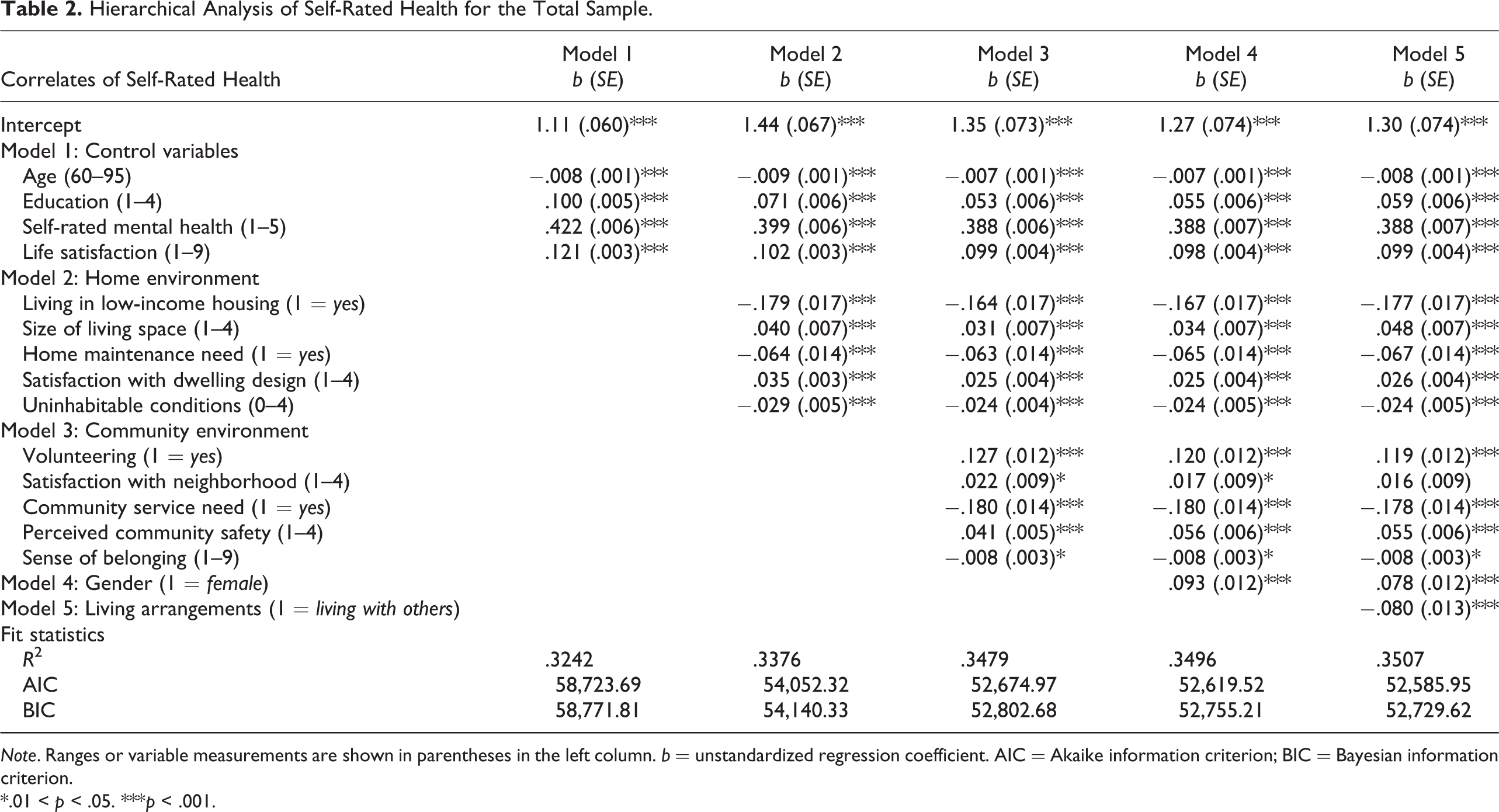
Note. Ranges or variable measurements are shown in parentheses in the left column. b = unstandardized regression coefficient. AIC = Akaike information criterion; BIC = Bayesian information criterion.
*.01 < p < .05. ***p < .001.
Multiple Linear Regression Analyses by Gender and Living Arrangements
In Table 3, data show that home and community environmental variables were associated with SRH across the four groups (gender and living arrangements), accounting for all control variables. Thus, the second hypothesis was supported. Common and unique environmental correlates of SRH existed across the four groups. In terms of home environmental factors, living in low-income housing and satisfaction with dwelling design were common correlates among all subgroups. In addition, the size of the living space was positively associated with SRH among women regardless of living arrangement. Home maintenance need and SRH were negatively correlated for older adults living with others (men: b = −.077; women: b = −.125). Unhabitable conditions were negatively associated with SRH for women living alone (b = −.034) and men living with others (b = −.032) only. In terms of significant community environmental variables, for all subgroups, volunteering and perceived community safety were positively associated with SRH, whereas community service need was negatively associated with SRH. Satisfaction with neighborhood (b = .052) uniquely predicted SRH for men who lived with others. The following section focuses on the significant home and community correlates of SRH across the four groups.
Regression Models for Self-Rated Health by Gender and Living Arrangements.
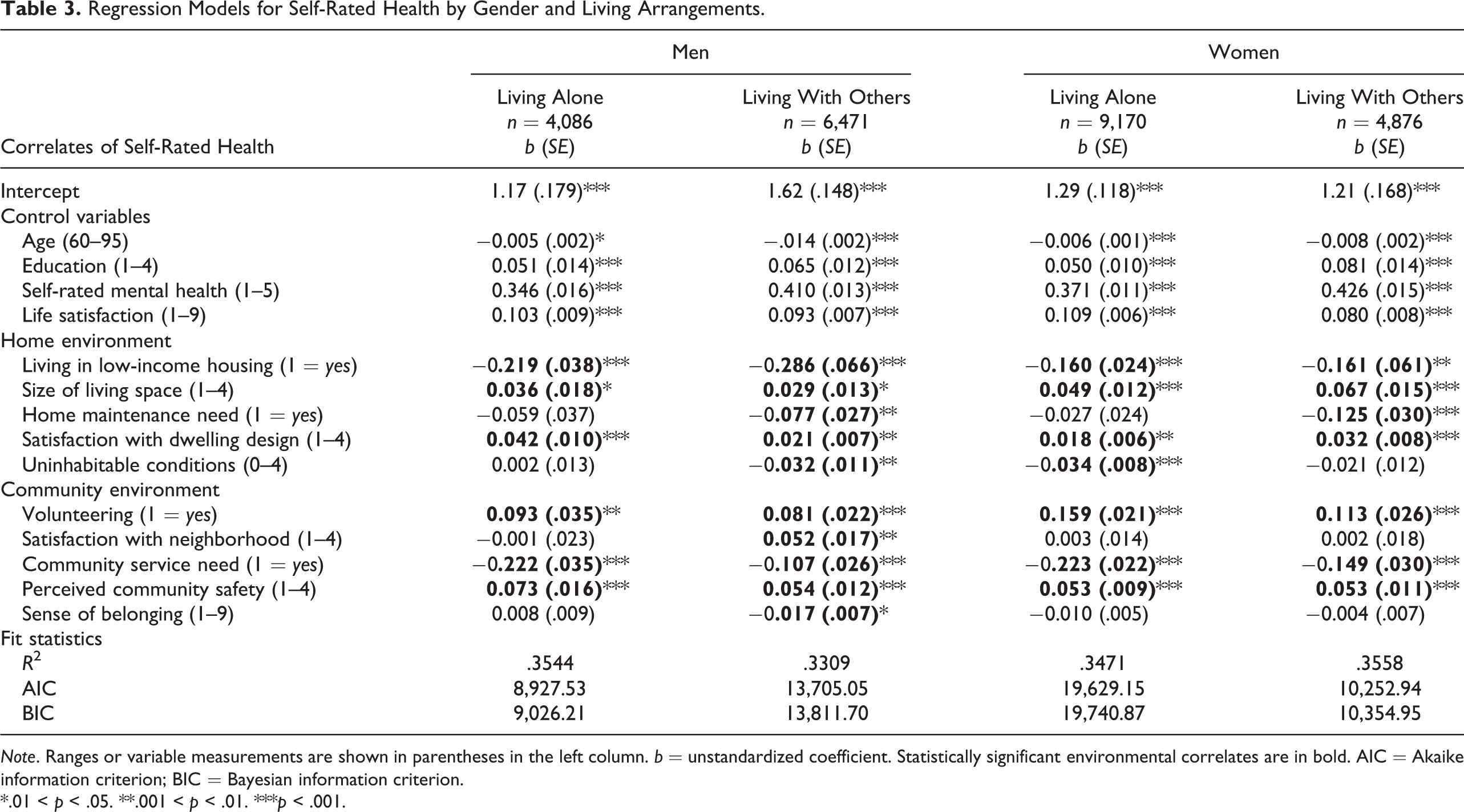
Note. Ranges or variable measurements are shown in parentheses in the left column. b = unstandardized coefficient. Statistically significant environmental correlates are in bold. AIC = Akaike information criterion; BIC = Bayesian information criterion.
*.01 < p < .05. **.001 < p < .01. ***p < .001.
Discussion
Findings indicate significant associations between home and community environmental factors, gender, and living arrangements and SRH after controlling for other differences. The association between home and community environmental correlates and SRH differed across gender and living arrangement groups. Our discussion focuses on findings of subgroup experiences. One of the most salient findings in this national Canadian study is that regardless of gender, older adults who lived alone reported significantly lower levels of SRH than those living with others. This finding is consistent with some of the previous literature on the adverse health effect of living alone on older populations (Barrenetxea et al., 2021; Chou et al., 2006; Kharicha et al., 2007). Data suggest that older adults living alone may be associated with a greater risk of poor health, probably due to social isolation and loneliness, or vice versa.
Regarding correlates of SRH by gender and living arrangement groups, findings show similarities and differences in home and community environmental factors associated with SRH. In terms of home environmental factors, living in low-income housing as compared to private housing was a common risk factor of lower SRH across all groups, which is consistent with previous research (Tomioka et al., 2019). Our data suggest that living in low-income housing may be a source of environmental stress associated with low-income or substandard housing conditions that affect the health of older residents. In addition, beyond physical space and housing quality, older residents may have poor health at first, making them eligible for such housing. Also, older adults in low-income housing may have more financial constraints and lower educational levels, which limit their access to quality health care and a healthier lifestyle.
In terms of between-group differences, the relationship of living in low-income housing and SRH was stronger for older men than for older women. Within-group differences also emerged, in that the relationship was more significant for older men living with others than for older men living alone. A possible explanation is that older men who lived with others may have more health issues than their solitary counterparts. This result suggests that older adults in low-income housing, especially older men living with others, are at greater risk of poor health and should be targeted for health promotion interventions.
With respect to other home environmental factors, expressing higher satisfaction with dwelling design was associated with better SRH across all groups. These findings suggest that older adults may gain health benefits from residing in favorable living place and having a sense of comfortable space. We speculate that the sense of home and place are important attributes related to the comfort of aging in place, such that engagement in an active and healthy lifestyle is possible. Living in a larger space was a significant correlate of women’s SRH, especially among those living with others. Our results provide clear directions for the age-friendly design and space consideration of home environments for older adult populations.
Furthermore, our findings provide evidence of group differences in the relationship between home environmental stressors and SRH. Home maintenance needs and uninhabitable conditions were risk factors of lower SRH for older men living with others only. For older men living with others and women living alone, uninhabitable conditions were linked with worse SRH. This finding is interesting, suggesting that these two groups of older residents may have low tolerance for these unmodifiable, uninhabitable conditions (poor indoor air quality, pests, undrinkable water, and mold or mildew). Housing and community government officials need to provide immediate interventions to tackle these hazardous conditions to protect older residents’ health. Interestingly, our data indicate that home maintenance needs were also a risk factor of lower SRH for older women or men living with others. Home maintenance needs that are not managed may be a daily stressor that puts their SRH at risk. On the other hand, individuals with poor SRH might not be able to maintain their living space.
In terms of community environmental factors, volunteering engagement was associated with higher SRH across the four groups. Volunteering opportunities may be a proxy of age-friendly community organizational networks in the neighborhood. The association was stronger for older women, especially those living alone, than for older men regardless of their living arrangements. The positive relationship between health and meaningful volunteering engagement has been well documented in the productive aging research (Chang et al., 2021; Schwingel et al., 2009). Older women living alone might benefit more than other groups because volunteering provides them with a much-needed sense of social connectedness, fulfillment, and purpose. There could also be a reverse relationship such that older adults may reduce their volunteering due to poor health.
Besides volunteering, it is also interesting that higher SRH was associated with satisfaction with the neighborhood among older men living with others only. The association between satisfaction with the neighborhood and higher SRH is consistent with prior research (Oshio & Urakawa, 2012; Stronegger et al., 2010). Furthermore, expressed need for community service and lack of community safety were common risk factors of lower SRH across all groups. Data also show that the association for community service need was stronger for older men and women living alone than those living with others. The health of older adults who live alone may be in jeopardy if community services and safety are in question. Meeting community service needs and maintaining community safety are meaningful environmental interventions to maximize the SRH of older adults living alone.
Three limitations of the study are worth noting. First, we could not establish the direction of relationships between variables because the 2018 CHS is a cross-sectional survey. Second, due to the lack of racial and ethnic diversity in the dataset, our findings should not be generalized to older adults in diverse groups. Last, variables such as social support, functional abilities, self-care behavior, age friendliness, and neighborliness of the community were not measured in the original dataset; our study could not estimate the correlations of these variables and SRH.
To conclude, findings from the 2018 CHS provide important directions for home and environmental interventions to promote aging health and the importance of accounting for the needs of diverse aging populations in terms of gender and living arrangements. Future studies should carefully evaluate how environmental correlates might mitigate health and mental health risk factors associated with the pandemic lockdown such as community disengagement, social isolation, loneliness, lack of physical activities, and loss of family and friends.
Implications for Practice
Older adults living alone are at greater risk of poor health. Community outreach health promotion programs by health care and social work practitioners should focus on these older residents to support their health.
Volunteering participation yielded beneficial effects on health for older men and women living alone and living with others. The positive effect was strongest for older women living alone. Urban planners could optimize local environments by improving geographical access to community services and meaningful volunteering participation. Social work practitioners could promote neighborhood-based volunteering opportunities, especially for older women living alone.
Home maintenance needs predicted poorer health among older men and women living with others. Policymakers could consider implementing regular home maintenance programs to address potential hazardous home environments and increase the comfort of aging in place, especially for those living with others.
Uninhabitable conditions (poor indoor air quality, pests, undrinkable water, and mold or mildew) predicted worse health among older men living with others and older women living alone. Home improvement and development of policy and programs to tackle uninhabitable conditions will promote health among older residents.
Footnotes
Authors’ Note
The opinions expressed in this article are those of the authors and should not be attributed to Statistics Canada.
Acknowledgment
The authors are grateful to Statistics Canada for making the data available.
Declaration of Conflicting Interests
The author(s) declared no potential conflicts of interest with respect to the research, authorship, and/or publication of this article.
Funding
The author(s) received no financial support for the research, authorship, and/or publication of this article.
