



Abstract
Objective
This study assessed the perception of people toward drive-through healthcare services, their willingness to use them, and the scope of services they would like to receive in a post-pandemic world.
Background
The abrupt spread of COVID-19 urged healthcare facilities to adopt new infection-control measures. Drive-through testing facilities were implemented as one of the measures to minimize physical contact between healthcare workers and test-takers. Many studies describe drive-through models’ merits, but people’s opinions about them as a permanent attachment to healthcare facilities are unclear.
Methods
An online survey was distributed through snowball sampling. The survey solicited feedback from adults who lived in the United States. The survey consisted of Likert-type and multiple-choice questions and was completed by176 eligible participants.
Results
The use of drive-through pharmacies increased after the spread of COVID-19. Most people agreed drive-through healthcare services could be more convenient and safer to use. People prefer to have their vitals checked, and vaccinations received in a drive-through because of the improved infection-control matters and increased comfort; however, they are neutral about the level of privacy they have and the hygiene of drive-through healthcare settings.
Conclusions
This study shows permanent drive-throughs offering medical services benefit people in times of crisis for the perceived infection control purposes and the improved convenience. A drive-through model can redefine the waiting experience and serve as a new safe triage system in urgent care centers. Drive-through urgent care centers can be adopted as a hybrid of telemedicine and in-person visits.
Keywords
Drive-throughs are models by which people can receive different services without leaving their cars. The first implementation of a drive-through model can be traced back to the 1930s in the United States, when it was used to deliver food in Los Angeles (Barksdale, 2021). Today, the models are commonly used for the delivery of goods and services.
The emergence of COVID-19, a highly contagious virus causing a pandemic (Hu et al., 2021), led healthcare facilities to look for novel means of providing healthcare services. Recent studies show implementing interventions in the physical environment can play a role in the spread of COVID-19 (Ahmadpour et al., 2021). Some medical services’ delivery models were transformed during the pandemic—examples include increased use of telehealth and drive-through testing. Drive-throughs primarily served as testing stations for COVID-19 as well as triage centers to determine the level of risk in patients regarding having contracted COVID-19 or not (Bradley et al., 2020; Kwon et al., 2020). Different models were designed and proposed for these drive-throughs to test people for COVID-19 efficiently and as quickly as possible (Dippel & Kelly, 2021; Kwon et al., 2020). Moreover, some of the proposed designs were suited to transform into vaccination stations once the COVID-19 vaccine was publicly available (Asgary et al., 2020; Kwon et al., 2020). Drive-through in healthcare is still a vague term. It could mean anything from receiving a self-assessment kit that a patient receives through a window and is instructed to perform a procedure (e.g., receiving a COVID-19 swab) to staying in a car in the parking lot and waiting for a healthcare professional to deliver a service to the person (e.g., taking blood pressure). In this article, drive-through healthcare services are referred to as the type that one drives through a car lane and receives medical attention primarily through the window of a car.
The COVID-19 drive-through testing showed numerous benefits, such as efficiency, shorter wait time, convenience, saving personal protective equipment (PPE), and reducing the spread of the virus. Long waiting time can be a barrier to patients’ intent of seeking healthcare (Tak et al., 2014). The drive-through models allowed people to stay in their cars, so the stations could rapidly test more people (Kwon et al., 2020), which would reduce bottlenecks and wait time and eventually increase surge capacity (Ledvina et al., 2020). The other advantage of the model was the reduced use of PPE. When there was a global shortage of PPE at the beginning of the pandemic, such as masks, gloves, and cleaning supplies (Cohen & Meulen Rodgers, 2020), the strategic use of the existing materials was paramount and respondents even reused them (Brammer et al., 2020). The drive-through test givers were merely required to change gloves after each exam as opposed to sanitizing a whole room (Tande et al., 2020). Last but not least, the model was aimed to help with infection control. Since all the visitors were in the incubated space of their vehicle and in open-air areas, it reduced the chances of cross-contamination.
As the world adjusts to the new norms of wearing masks and working remotely, many of the measures enforced due to COVID-19 may persist and that includes drive-through healthcare services. Given the use of urgent care services as an accessible, on-demand service for minor medical care needs, they have an excellent potential for a hybrid model of care that incorporates telehealth and drive-through care. Having alternate healthcare delivery methods is crucial to provide equitable care for those who are vulnerable, either medically or socioeconomically (Dominguez et al., 2020; Steinke, 2015). Typical drive-throughs are known to bring convenience to people; however, it is unclear how people feel about them being used for the provision of healthcare services.
While many articles point out the benefits of drive-through healthcare services, there has been close to no research to provide a comprehensive view of people’s outlook on using such models. This article aims to highlight the perspective of people on the use of drive-through healthcare services, especially as a complementary method of delivering healthcare in urgent care centers (UCCs), including but not limited to their willingness to use such a model and the services they are interested in receiving through it.
Method
The main research question was “are drive-throughs an acceptable option for providing patients with healthcare services in UCCs?” Given the novelty of the topic and lack of previous research, this study served as a pilot study to explore the concept of drive-through healthcare services for UCCs. The study used a survey method to examine people’s perceptions and attitudes on the use of drive-through healthcare services. The survey study was approved by the Institutional Review Board.
Sample Selection and Recruitment
The target population was the general public who sought healthcare services at some point in their life. The only eligibility criterion for inclusion was to have lived the majority of their adult lives in the United States since drive-throughs may not be a familiar concept or as commonly utilized in other countries. Convenience and snowball sampling methods were used to recruit participants on social media (Facebook and LinkedIn), as there were strict restrictions regarding any physical contact during the data collection phase of this study. The first few participants were recruited based on convenience sampling. The snowball sampling was used to expand the recruitment to people with diverse demographic backgrounds. The link to the survey was also shared in multiple Facebook groups for increased participation. The analysis excluded responses from those who did not meet the inclusion criterion.
Data Collection
The research team designed and developed a questionnaire, as the subject of the study was original. A narrative literature review was conducted to gather the latest information about the COVID-19 pandemic and the use of drive-through services. The survey questions were informed by the narrative literature review. In combination with the literature review, a pilot version of the survey was distributed among 11 people to assess its validity and reliability by ensuring the questions being asked are aligned with the goal of the study and they are clear and consistently understood by all participants. The questions were then modified to better communicate with the target population and better extract the desired information. Lastly, an expert evaluated the questions for validation purposes. The evaluation was to ensure the questions were aligned with the research objective, their language and phrasings were easy to understand, contained no offensive terms, were not double-barreled, offered as many choices as possible, and were not of presumptuous language which could introduce bias in the results.
The survey was anonymous, and participants agreed to the consent form before proceeding to the questions. The survey was conducted using Qualtrics, an online platform for conducting surveys. The survey had collectively 18 questions; nine were multiple-choice questions, four of which had open fields in which participants could write their custom responses. Five of the questions were Likert-type questions asking people to rate the degree to which they agreed or disagreed with a given statement on a scale of 1 to 5 (1 = agree, 5 = disagree). The last four questions were regarding the demographic information.
Data Analysis
The survey data were analyzed using Qualtrics. Descriptive summaries of the Likert-type scale questions and multiple-choice questions were extracted. The descriptive statistics included percentages and frequencies for multiple-choice questions; and means, standard deviations, and percentages for Likert-type scale questions. Some of the multiple-choice questions provided an opportunity for participants to specify their answers if they chose “other” as one of their answers. The responses to these open-ended questions included one-word answers and as such were analyzed by accounting for their frequency along with the other response choices. Upon the screening of the data, no outliers were detected.
Results
The survey received 180 responses, 174 of which were included in the study, as six did not meet the inclusion criterion of having lived the majority of their adult life in the United States. The average age of respondents was 54 years, with a standard deviation of 15. Of the 174 respondents, 15.7% used assistive devices and equipment (e.g., a wheelchair or a cane) for walking, 32.18% noted they had benefited from drive-through healthcare services prior to taking the survey, and 1.15% had a drive-through appointment scheduled.
Respondents were asked about their access to the three forms of healthcare, them being UCCs, primary care, and emergency departments (EDs). Most participants had access to all three in the vicinity of their residence. They were then asked about the frequency by which they visit UCCs per year. The majority of participants (61.49%) visited UCCs once a year, followed by those who visited them one to three times (20.69%), and the remaining respondents said they do not visit UCCs at all or visit more than three times a year (17.81%).
For the next question asking the reason for their visit to the UCCs, they could select as many as the six available choices and add any additional response in a text box named “other.” Flu symptoms (29.31%) and common cold (23.56%) were the most common reasons, followed by having a broken bone (14.37%) and getting stitches (13.22%). The rest of the responses belonged to the “other” category. Some of the repeated custom responses included urinary traction infection, animal bite, bronchitis, sinus infection, and pink eye.
Participants then answered questions about their most frequently used way of acquiring medicine both before and after the spread of COVID-19 (Figure 1). Before the spread of COVID-19, getting their medication in person at the pharmacies was the most common way (59.77%, n = 104), followed by drive-through pharmacies (30.46%, n = 53); however, after COVID-19, drive-through pharmacies became the most frequently used way of acquiring medications (47.78%, n = 86), followed by getting medications in person at the pharmacies (39.44%, n = 71).

Comparison of people’s way of acquiring their medicine before and after COVID-19.
Regarding the participants’ preferences on the area in which they would rather wait for their turn (Figure 2), 68.39% (n = 119) chose they would prefer to remain in their cars. The exam room and the lobby were the next two common preferred places to wait, which received 15.52% and 8.62% of the responses, respectively. The rest of the participants provided custom responses in the “other” response option. Most of the participants (92.53%, n = 161) believed that waiting in the car is the safest option in protecting them against cross-contamination of diseases.
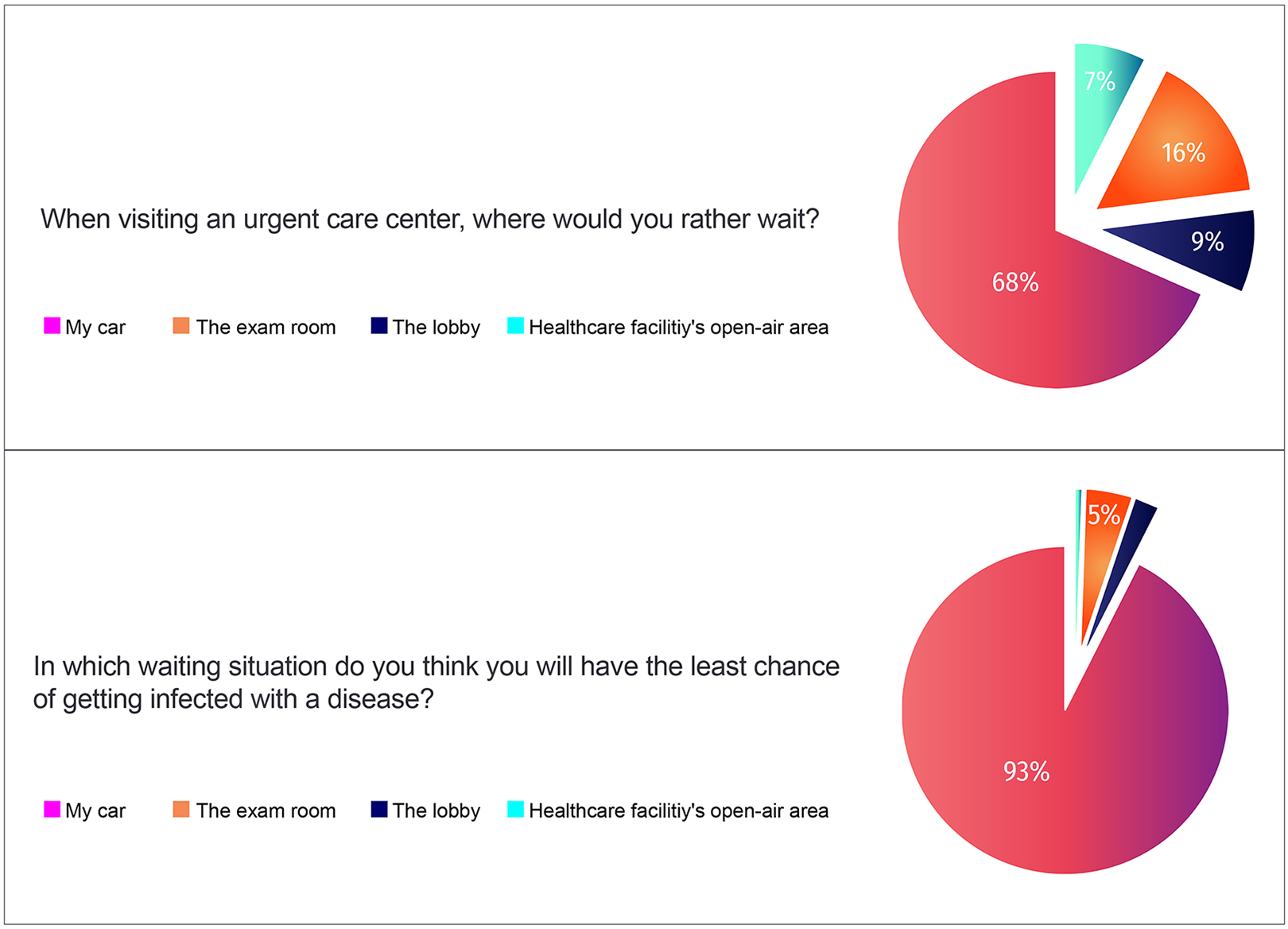
People’s waiting preferences and their reasons upon visiting urgent care centers.
In terms of the types of drive-through healthcare services, participants indicated they would most prefer to receive checking vitals (n = 116, 28.43%), followed by vaccinations (n = 115, 28.19%), drawing blood for a lab test (n = 88, 21.57%), and triage (n = 60, 14.71%) (Figure 3). A total of 29 participants (7.11%) chose the “others” option to add additional responses and articulate their desired service in which 10 participants wrote they would not like to receive any healthcare services at all. The rest of the custom responses included receiving COVID-19 tests, getting stitches, x-ray, and nebulizers.
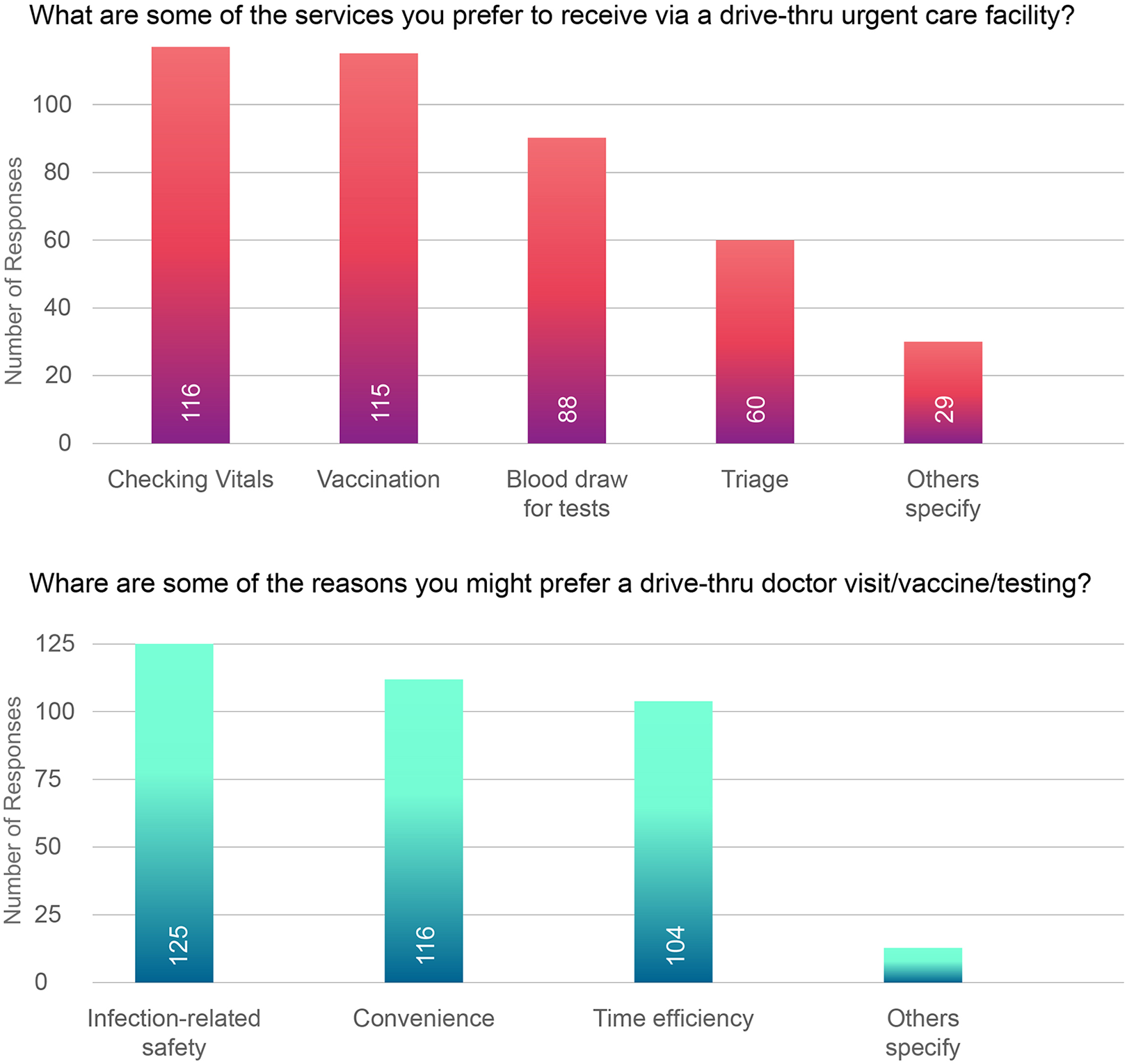
Services people would like to receive in a drive-through setting and their reason.
Participants were asked to explain the reasons as to why they may prefer drive-through healthcare services over an in-person visit (Figure 3). Infection-related safety and convenience were the most selected choices with 34.82% (n = 125) and 32.31% (n = 116), respectively. Time efficiency was the third popular choice (28.97%, n = 104). The “Others” choice with an open-ended section was selected by 14 people, among which eight wrote they would not like the system for anything. Three people wrote they would like it because it could be a supposedly less costly option. Privacy and the company of family members were the other responses.
The next five questions asked participants to rate their preferences and attitudes toward using drive-through services on a scale of 1 (totally agree) to 5 (totally disagree) (Table 1). Participants were asked whether they concur with the improved convenience of receiving medical services in their car; the response was almost neutral, with an average score of 2.37. They were then asked if receiving medical services in their car would make them question the integrity of the care they receive and feel less confident about it, which received an average score of 2.99. The next question asked whether they think they have more privacy in a drive-through setting than an exam room; the result was leaning more toward disagreement with a score of 3.18. They were then asked if they perceived receiving care in a drive-through would be more sanitary compared to an exam room which got a mean score of 3.23. Lastly, they were asked if they would like to receive as many healthcare-related services as possible in a drive-through setting once the pandemic of COVID-19 is over. The result was once again leaning toward disagreement with an average score of 3.22.
Likert-Type Questions and Results.
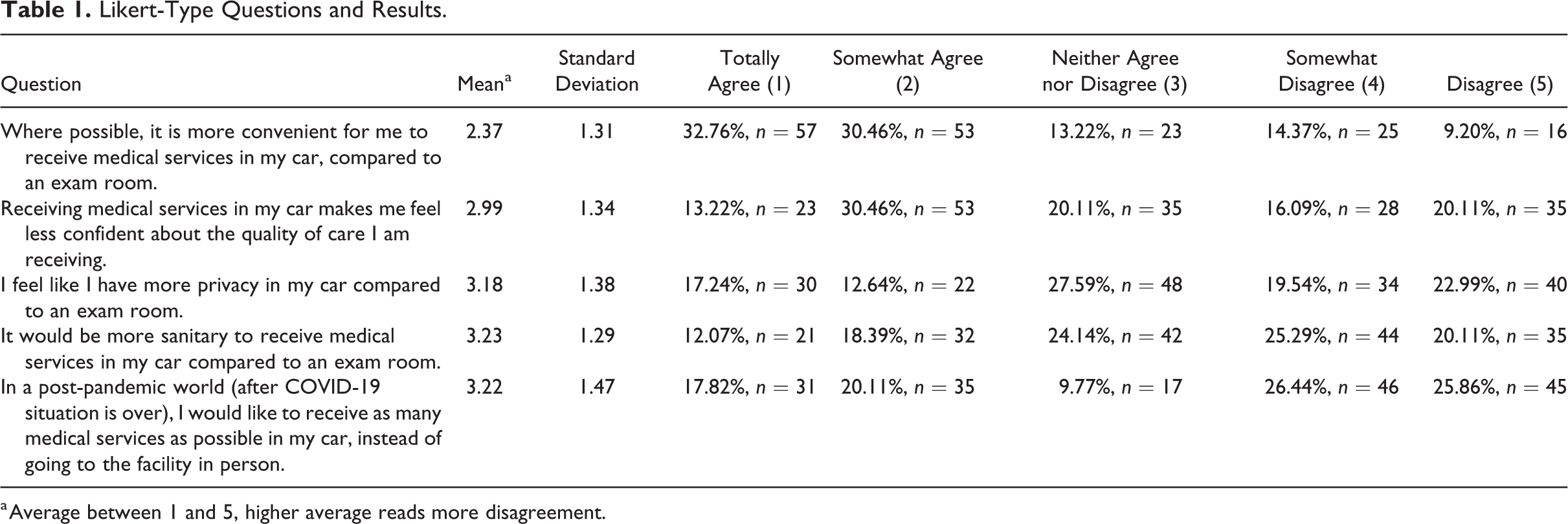
a Average between 1 and 5, higher average reads more disagreement.
Discussion
The benefits of using drive-throughs as medical facilities were recognized upon the spread of COVID-19 as testing stations (Asgary et al., 2020; Dippel & Kelly, 2021; Kwon et al., 2020). As healthcare facilities are rethinking this model’s use in a post-pandemic world, the perception of people toward their use is unclear. This article aimed to determine how likely people are to use drive-throughs as a supplement to UCCs and for what purposes.
This study included only those who had lived the majority of their adult life in the United States since the use of drive-throughs is common in the United States and uncommon in some other countries. Participants who lived their lives elsewhere might not have been familiar with the concept, culture, and the way drive-throughs work, let alone open to a novel use for them; Thus, several responses were excluded to avoid biased answers.
The permanent attachment of drive-throughs, in which drive-through stations are a part of the healthcare facility as opposed to a temporary extension, could play two significant roles in healthcare facilities, triage, and care (Asgary et al., 2020; Dippel & Kelly, 2021; Kwon et al., 2020). All participants in this study showed to have relatively equal access to UCCs, EDs, and primary care. While primary care visits are commonly scheduled and not in need of triage, EDs and UCCs typically require some degree of triage. In the UCCs and EDs, additional procedures related to triage could be offered in drive-through sections to assess the patients’ state. Whether used for registration, triage, or both, the drive-through stations can be the gateway to change in the waiting experience. This study revealed participants are incredibly eager to spend their wait time in their own cars instead of the traditional experience of waiting in the lobby or the exam room. The results showed that a major motive for that is likely the lower chance of cross-contaminations. In a drive-through setup, after the registration or triage is done, the patients can be given directions to a waiting area where they would be called to step inside once it is their turn to do so.
As a point of care, a drive-through system could be a part of both UCCs and EDs. For triage, however, UCCs might be a better candidate. People who are gravely concerned about their well-being and think they need immediate medical attention usually choose EDs as a point of care (Uscher-Pines et al., 2013), not UCCs. This can potentially make the reasons for visits in UCCs less complicated, and more visitors might decide to use the drive-through care as they anticipate they will not require major treatments. The cost of care also plays a role in patients’ decision to choose a UCC to seek care (Coster et al., 2017). The average cost per an ED visit is roughly six times more than a visit to a UCC (Weinick et al., 2009). While there has been no comprehensive cost-analysis done about medical drive-throughs, given that they have shown to be more time-effective (Weiss et al., 2010; Zerwekh et al., 2007), the decreased amount of time needed per patient could eventually lead to less costly visits as well. The study by Dippel and Kelly in 2021 compared the costs of COVID-19 testing in traditional clinics and drive-throughs and demonstrated that the reduced amount of PPE use and labor cost result in them being significantly cheaper to run (Dippel & Kelly, 2021), which can reflect the operational cost of drive-throughs and thus future UCCs. However, it is important to keep in mind that a sizable margin of people visit UCCs less than three times per year. Thus, the drive-through model is most likely a better model for high-populated urban areas where issues of overcrowding might be more prominent and not rural areas.
People commonly choose an inappropriate type of healthcare facility for their needs due to a multitude of reasons. A 2017 literature review revealed many people associate primary care with long wait times and lack of available appointments, or they assume their situation might get worse over time which leads them to use EDs and UCCs instead (Coster et al., 2017; Fieldston et al., 2012; Sieck et al., 2016). Examples of situations for which people use UCCs include but are not limited to common cold symptoms, flu symptoms, pink eye, and vaccinations. The drive-through setting, whether as a triage or a point of care, can be used as a “fast track” to treat these low-acuity patients quickly and allocate the resources of facilities to patients with more dire need for them. That way, resources such as rooms, nurses, and physicians can be dedicated to higher acuity patients who will be sent inside the UCC. This study demonstrated that most patients have no problem with vital checks, vaccinations, and blood draws to be done in a drive-through setting.
This study showed people use drive-through pharmacies more than in-person ones after the spread of COVID-19. While drive-through pharmacies are thriving, ED visits declined by 42% upon the initial stages of COVID-19 (Hartnett et al., 2020). Many diseases are spread in the environment of a healthcare facility, such as the waiting room (Shaw, 2019). This study showed the reason people might prefer drive-through medical services is rooted in the perceived better infection control and convenience. Should the drive-through medical services become widely available, those who stopped seeking care might be willing to return to their usual use of healthcare facilities as they did upon feeling ill before. The drive-throughs make people feel safer against the contraction of contagious diseases.
Upon the spread of COVID-19, the Center for Disease Control (CDC) advised patients to use telemedicine as a means to minimize physical contact with other patients and healthcare staff in order to protect themselves and their family members (CDC, 2020). As of late March of 2020, the use of telemedicine increased by 154% (Koonin et al., 2020), and the number of telephone visits per week more than doubled in 13 weeks (Reddy et al., 2020). Drive-through healthcare services can be a hybrid of traditional delivery of healthcare and telemedicine. They can serve the patients whose situations are not dire enough to feel the need to go to an exam room, but they do need to have basic assessments by a healthcare professional. They can also serve the population who are not invested enough in technology to use their phone for a virtual visit.
The perception of people is not entirely positive toward drive-through healthcare. The climate and seasonality factors related to participants’ location or personal preferences may have played a role in answers being negative. Privacy is one of the results of this study that people were neutral about. More than half of the respondents believed they have more privacy in an exam room. The results showed more than half of the people are neutral or believe their car is not as sanitary as an exam room. Cleanliness of the car environment is incredibly subjective based on the car owner’s cleaning upkeep. If the care environment, in this case the car, is not sterile, many people might feel uncomfortable about receiving care. Thus, it is difficult to say whether drive-through healthcare services would be entirely welcomed by patients.
Limitations
The survey was distributed between October 2020 and November 2020. During the said time frame, COVID-19 was considered an unresolved threat to people’s health and lives with rapid and unknown ways of transmission. In this period, masks were mandated to be worn in all closed public spaces in most parts of the United States. This could have created biased opinions, as some people associated the use of drive-throughs with yet another inconvenience forced on them because of COVID-19.
Another limitation of the study was the sampling. The majority of participants were from the states of Ohio and Georgia, which might have introduced bias in participants’ responses based on the circumstances of these states. Given that the drive-through setting does not work for people who rely on public transportation or walking to get to a UCC, the results could be differently biased should the participants were from locations with lower rates of vehicle per capita, such as New York City. Another geographic factor not accounted for was different climates in various regions.
Given the originality of the topic, the study questions relied on forward-thinking speculations by participants. This might have imposed bias in the findings if a participant was unable to fully envision such a delivery model. Also, a dramatic transformation in the delivery of healthcare service can face “resistance to change,” which might have been another source of bias in responses.
Drive-through healthcare services are a new concept and thus vastly understudied. Future research can address the extent of services that are feasible to deliver in medical drive-throughs as well as a comprehensive cost and benefit analysis. The seasonality of drive-through care delivery should also be explored. The findings for the seasonality factor may play a role in the financial justification of building drive-through UCCs that may not run all year round. It may also be explored what types of medical services can be offered in a safer manner, inspired by telehealth and drive-throughs. It can also be assessed whether drive-throughs improve the quality of care or limit the healthcare professionals’ ability to treat patients to find out about the clinical outcomes.
Conclusions
In a post-pandemic world, drive-through healthcare models can be used to deliver many healthcare services that do not require the patient to be seen in person. Many diseases are spread in the environment of a healthcare facility such as the waiting room (Shaw, 2019); elimination of the in-person visits to the hospital could potentially help decrease the transmission of diseases. People will be highly enthused to sit in their car, as they are waiting, and this can change the waiting experience of healthcare facilities indefinitely. Drive-throughs are relatively fast models and can increase the number of visited patients who decide to benefit from the available medical services. The increased throughput of offering healthcare services could especially be benefited from in dense urban areas where people use personal cars as means of transportation. Many services, including but not limited to vital checks, vaccination, and blood draw, could be done outside the healthcare facilities in drive-through stations. Moreover, drive-throughs would be highly welcomed by people for the purposes related to previsit tasks such as registration and triage. While not all people feel as confident about the healthcare services in a drive-through as they do in an exam room, most people believe it would be convenient for them. The use of drive-throughs has already increased in the United States due to the pandemic, and there is great potential in them for the future.
Implications for Practice
Drive-throughs can be adopted as a hybrid method of delivering healthcare services to make the visit to UCCs more convenient.
Waiting in the car is patients’ preferred choice compared to staying in the UCC’s lobby or exam room due to the perceived lower risk of infection transmission.
Receiving drive-through healthcare services could reach community acceptance because of the lower risk of infection, convenience, and time efficiency.
Drive-through healthcare services can transform healthcare delivery and become a complement to telehealth and traditional office visits.
Footnotes
Declaration of Conflicting Interests
The author(s) declared no potential conflicts of interest with respect to the research, authorship, and/or publication of this article.
Funding
The author(s) received no financial support for the research, authorship, and/or publication of this article.
