




Abstract


Nursing is currently at an important crossroads in our profession’s history. With the recent events of the pandemic, the critical nature of workforce burnout, and the diminishing number of nurses available for patients’ acuity and capacity, we as nurses find ourselves with a great opportunity to rethink and reimagine nursing and the environments in which we work.
The construct of work environment in healthcare is multifocal and includes several characteristics or attributes. Work environment includes leader–employee relationships, employee recognition, workloads, employee engagement, and organizational culture. When these attributes are positive, the work environment is perceived to be healthy resulting in reduced levels of burnout, organizational commitment, retention, professional commitment, and even optimal outcomes for patients (Brunetto et al., 2013). One critical attribute is often missed when speaking about work environments in healthcare—the physical environment. The design of the physical work environment can either enhance workflow, operational efficiency, and nurses’ and other providers’ well-being or create obstacles for getting the work done and impede the health and well-being of care professionals, patients, and families. The workplace shapes well-being every day.
Healthcare leaders are challenged to create work environments that promote well-being and quality outcomes; however, the issues of caregiver wellness have been exacerbated due to the stress and burnout brought on by the pandemic. The impact of the emotional and physical characteristics of the healthcare professional’s work environment has been elevated for critical examination and intervention. The National Academy of Medicine and the National Academies Health and Medicine Division’s (2021) report entitled, The Future of Nursing 2020–2030, supports nurse well-being as essential for the health and safety of patients, the functioning of health systems, and the financial health of health care organizations. The impact of nurse turnover and costs of hiring and training new nurses cost the hospital US$3.6–US$6.5 million per year (Colosi, 2022). Nurse well-being is a critical driver to support better, more equitable health care for all.
Defining Nurse Well-Being
According to the American Psychological Association’s, Dictionary of Psychology, well-being is defined as “a state of happiness and contentment, with low levels of distress, overall good physical and mental health and outlook, or good quality of life (para. 3).” More specific detail regarding the components of well-being or wellness (the terms are often used interchangeably) is offered by the Substance Abuse and Mental Health Services Administration (SAMHSA, 2016) at the U.S. Department of Health and Human Services. In the SAMHSA framework, well-being (or wellness) is made up of eight dimensions: emotional, environmental, financial, intellectual, occupational, physical, social, and spiritual. A key concept in this framework is recognition of the importance of addressing and balancing all the various dimensions or components in a holistic manner.
Similarly, in a concept analysis of well-being, authors (Patrician et al., 2022) defined individual attributes of well-being to include happiness, satisfaction, optimism, compassion, gratitude, forgiveness, and sound integration of body/mind/spirit. These same authors indicated that well-being extends beyond the individual to the organization with attributes described as teamwork, a sense of mission, social integration, and workplace pride. Both individual and organizational well-being result in critical outcomes desired by all professional groups and organizations—worker resilience, lifelong professional learning, worker empowerment, collegial relationships leading to high-performance teams, a sense of purposeful work, and positive mental and physical health (Patrician et al., 2022). As described in the concept analysis of nurse well-being, the individual, organizational, and community attributes create the foundational concepts of in the construct of well-being. Individual nurse well-being requires basic human needs and self-actualization, as well as organizational and community support. Another layered component integrated into this construct is the physical environment or environmental domain representing the physical (external) attributes of the environment, which is often omitted from well-being discussions. The healthcare setting, whether inpatient, specialty care, outpatient, or community, creates unique characteristics to consider when discussing nurse’s well-being.
Due to the rising concern over nurses’ well-being, the 2023 Magnet® Application Manual (American Nurses Credentialing Center, 2023) will include well-being as part of the application requirements for Magnet® status. Inclusion of evidence to enhance nurses’ well-being will now be imperative for health systems to achieve Magnet® designation. The Commission on Magnet® Recognition defines well-being as a function of being satisfied with one’s job, finding meaning in one’s work, feeling engaged while at work, having a high-quality working life, and finding professional fulfillment in one’s work. Sigur and Walters-Threat (2023) report that nurse leaders must advocate and acquire resources to support nurses’ well-being through strategic planning, nursing leadership participation, and involvement of nurses who practice and influence practice across the organization. Multiple examples or sources of evidence must be provided to confirm the examples of implementation and transformation.
The concept of well-being is often defined in terms describing the opposite of the concept. Ill-being has been defined as stress, anxiety, distress, depression, fatigue, clouded thinking, and in worst cases, actual physical or mental illness (Jarden et al., 2020). Prior to the pandemic, nurse suicide was found to be a phenomenon needing to be adequately measured and studied (Davidson, Zisook, et al., 2018; Davidson, Mendis, et al., 2018). It has been suggested when work stressors are combined with stress from home, suicide risk may increase in nurses. Suicide is highest in nurses (38.1%) as compared to other healthcare providers, and female nurses are 70% more likely to commit suicide than physicians (Davis et al., 2021; Lee & Friese, 2021). Nurse suicide is higher among nurses who feel a sense of moral distress in their work, which can be exacerbated by feelings that they are not performing well in their roles because of work overload, work stress, or fatigue (Davidson, Mendis, et al., 2018; Davidson, Zisook, et al., 2018; Kelsey et al., 2021). The physical environment can contribute to these feelings of moral distress with long windowless hallways, lack of spaces to enhance work efficiency, poor lines of sight to the patients and/or other providers, and other environmental burdens. The balance of personal and professional values often is neglected in clinical practice. According to a survey by the American Nurses Association (2021), one of the 18 nurse respondents experienced suicidal ideation, emphasizing the risk factor for healthcare professionals compared to other workers. These statistics demonstrate the urgency and focus needed to improve the nurse well-being and their work environment. To add to this crisis, more than 7,000 nurses in two of New York City’s largest hospitals walked off the job for 3 days according to ABC news in January of this year (Kekatos, 2023, January 12). Nurses demanded better pay, safer staffing, and better working conditions.
Integrating the Environment Domain Into Nursing Well-Being Model
The environmental dimension of well-being is not often included as a domain in healthcare or nursing. While there are current efforts to evaluate well-being and its effect on nurse satisfaction (Romppanen & Häggman-Laitila, 2017) and Jardin et al., (2020), we need to create tools to measure well-being and identify interventions to promote well-being. Healthcare leaders have not taken a lead role in advocating for the built environment as a dimension for workplace wellness. The impact of the environmental domain on healthcare professional’s well-being should be included well-being discussions. Florence Nightingale’s Environmental Theory reveals the attributes of the environment and the critical role the environment plays in contributing to a person’s holistic well-being.
Nightingale Environmental Theory
Through environmental alteration, one can put the patient in the best possible condition for nature to act, thereby facilitating the laws of nature (Selander, 1998). The environment has both internal and external components. Nightingale was as concerned about elements that entered the body, food, water, and medications, as those that directly affected the external being, such as ventilation, light, noise control, stimulation, and room temperature (McDonald, 2020). Nightingale’s holistic approach and constructs of interest also affected the healthcare professional. McDonald (2020) reminded us Nightingale advocated for nursing students to have access to a convenient “scullery” (kitchenette), where they could take a break, make tea, and go back to work refreshed. She also noted that nurses and students should each have a room of her own, private, with walls to the ceiling, and a window that opens to the outside.
From the literature and personal experience in nursing and the design industry, the authors have developed a conceptual model tying together all aspects of well-being including physical environmental attributes (Figure 1). Using this framework as a foundation, designers and healthcare professionals can address design components that promote care providers’ well-being.
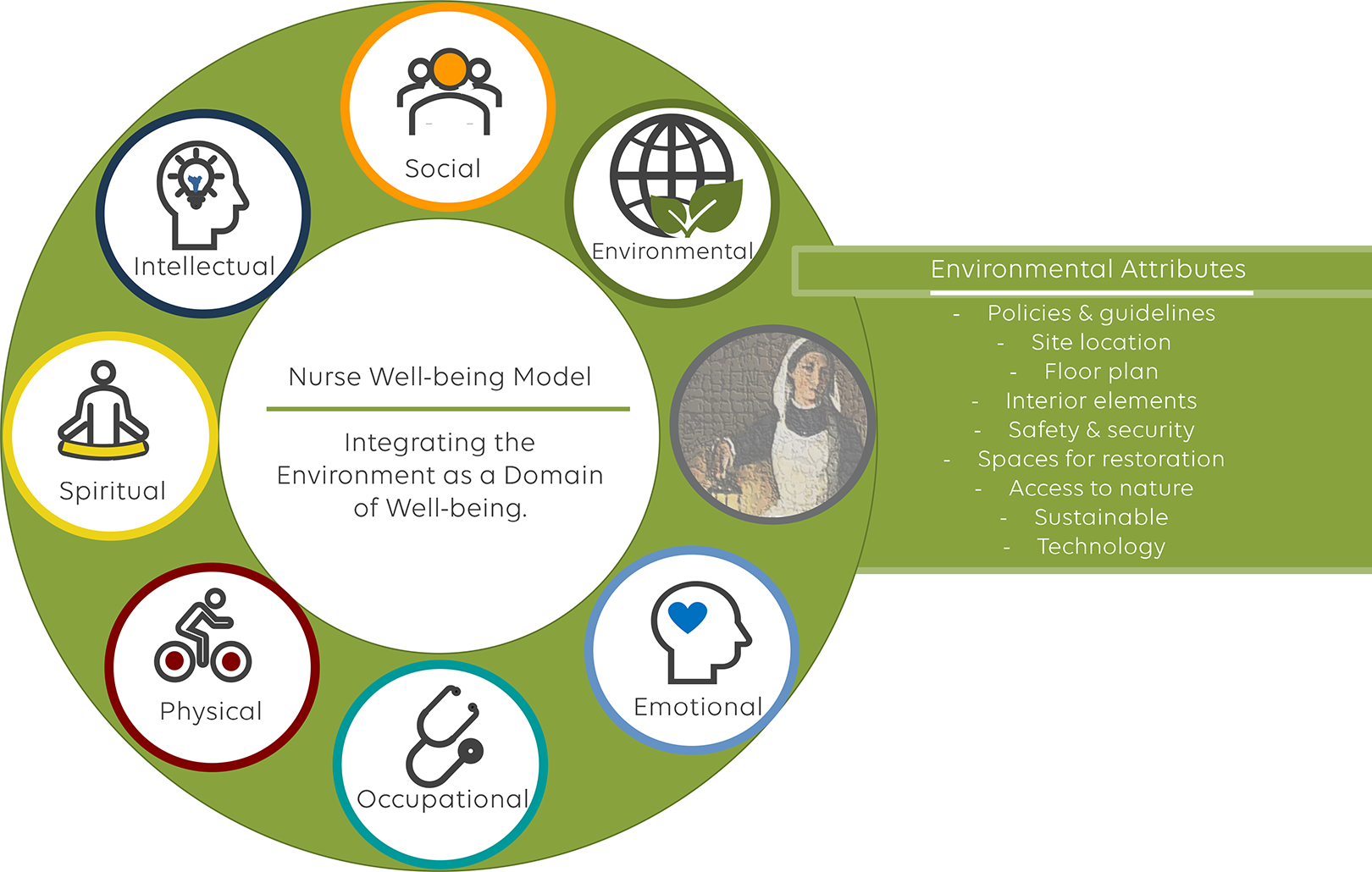
Physical attributes of a healthy work environment.
Design Components for Well-Being
Well-being is multifocal, requiring a variety of environment attributes to meet various needs. The next section enhances the description and definition to three selected attributes that include healthcare provider safety and security, healthcare provider restoration (respite and breakrooms), and healthcare provider views of nature.
Healthcare Provider Safety and Security
Healthcare environments are increasingly dangerous places with rising violence in emergency departments (EDs), critical care areas, and other patient care environments, such as post-traumatic brain injury units and behavioral health units (Press Ganey, 2022). Because of the increase in violence in healthcare settings, facility designers must consider design solutions that increase the safety and security of healthcare providers. It is impossible to achieve healthy work environments or provider well-being when nurses and other providers are working in fear of personal injury from violence or exposure to highly contagious diseases, such as COVID-19, SARS, and Ebola.
Not only is safety and security critical for provider/nurse well-being, but emergency room designs that influenced security, wayfinding, efficiency, and visibility also influenced healthcare job satisfaction (Zamani, 2019). The perception of ED safety accounted for 34% of the variance in the perception of work satisfaction. Similarly, other authors have reported the positive effects of facility improvements that emphasized patient and healthcare provider safety on reducing job stress and improving provider satisfaction scores (Berry & Parish, 2008). In a study exploring direct and indirect relationships between the physical work environment and job satisfaction among early career nurses, Djukic et al. (2014) found that safety and security are the most basic of human needs and we simply must do more to design healthcare facilities that address the safety of the healthcare providers. More research must focus on the effect physical environmental factors have on nurse and other provider well-being beyond job satisfaction. We must identify design features that promote stress reduction and enhance job performance to reduce moral distress among providers who simply want to do the best job possible in caring for others, often at the expense of their own health and well-being.
Healthcare Provider Restoration (Respite and Breakrooms)
Hospital facility guidelines (Facility Guidelines Institute, 2022) require a nurse breakroom or lounge, but any nurse or provider can attest to the fact that breakrooms are not restful. Typically, nurse breakrooms or lounges are shared by many providers who eat, converse, and/or watch television in the room. In some patient care units, shift report is given in the breakroom, and in others, students use it for gatherings. Many times, the breakrooms are the entry areas for provider changing areas as well. Clearly, these spaces are not conducive to rest, relaxation, or quietness. There is emerging evidence of the importance of a different type of space that can enhance rest, restoration, recovery, and recreation of balance in the mind, body, and spirit of healthcare workers.
Berry & Parish (2008) were early researchers identifying the effect of provider breakrooms on reducing provider stress and resulting in higher levels of provider satisfaction (Berry & Parish, 2008). Newer thinking introduces the importance of the respite, restoration, or rejuvenation room/space, where providers can retreat for quiet healing, reflection, and even meditation. Restorative design factors such as access to break areas, aesthetics of break areas, and access to private areas enabling between-shift recovery and providing personal privacy were identified as environmental factors that affect provider fatigue (Wingler & Keys, 2019). Other researchers have found a significant decrease in burnout among provider members who took their breaks outside in the hospital garden when compared to those who took their breaks inside (Cordoza et al., 2018; Tips & Signs, 2018) or who had visual access to nature (Mihandoust et al., 2021). Nejati et al. (2016) reported that having access to private outdoor spaces, such as porches or balconies, was associated with significantly greater restoration perception compared to window views or artwork. Similarly, Gola et al. (2021) found that a short break in green spaces was associated with improved mental and psychophysical well-being (mood), including fatigue. There is a growing body of evidence on the positive effects of nature, landscaping, greenery, and views to the outside on healthcare providers, patients, families, and even the reputation of the hospital itself (Allahyar & Kazemi, 2021; Elantary et al., 2021; Iqbal & Abubakar, 2022; Kim, 2021; Martin et al., 2021; Naomi, 2020; Tekin et al., 2022).
We cannot overstate the importance of respite, restoration, rejuvenation, relaxation, recharge, refuge, or relaxation spaces on hospital units for provider recovery from high stress care. These descriptive terms and responses have been used in the literature to describe the intended effect of the space/room on provider well-being. The literature is replete with evidence of the positive effect of respite rooms on reducing stress (Rubio et al., 2022) and improving resilience among nurses (Wood, 2022). To find out whether a hospital recharge room was truly making an impact, researchers have found that time in the respite rooms does not need to be long for benefits to be realized. Recent studies surveying of 496 healthcare providers in one study (Putrino et al., 2020) and 240 providers in the second study (Byun et al., 2022) and found that just 15 min in the recharge room resulted in an average 60% reduction in stress.
The idea of hospital recharge rooms is not necessarily new; many hospitals implemented similar spaces prior to the pandemic. Some were known as OASIS rooms—which stands for Opportunity to Achieve Provider Inspiration and Strength—such as the one at Christiana Hospital in Newark, DE. A year after the launch of the initiative, there is a 12% decrease in total unit turnover; and mean monthly unplanned paid time off is down 18% (Mousley, 2015; Van Horne et al., 2020).
Some respite spaces have been labeled as lavender rooms since lavender essential oils have demonstrated efficacy in reducing stress and soothing feelings of anxiety. Others have created a multisensory experience (visual, olfactory, and auditory) using essential oils to support different nature scenes, such as ocean views, forest scenes, babbling brooks, or other relaxing scenes and white noise or sounds. Hue lighting has also been used to synchronize with the nature scenes (Oakland, 2021; Putrino et al., 2020; Rubio et al., 2022).
A literature review of 27 empirical articles has clearly identified a strong relationship between the physical work environment and spaces supporting safety, exterior views, rest, and aesthetic appeal can support healthcare professionals’ mental health (Jin et al., 2023).
Healthcare Provider Views of Nature
Studies have found relationships between nurse alertness and fatigue with views to the outdoors. Mihandoust et al. (2021) found that less exposure to exterior nature views was associated with higher burnout, especially emotional exhaustion (defined as “the depletion of emotional resources and workers’ inability to focus on their patients at a psychological level”) and depersonalization (referring to “negative feelings toward patients”; Mihandoust et al., 2021, p. 259). Gharaveis et al. (2020) describe the perceptions of nursing staff regarding the effects of daylighting on behavioral factors including mood, stress, satisfaction, medical error, and efficiency. The findings of the study provide evidence that daylighting and a view to the outside enhance healthcare professionals’ satisfaction, mood, and alertness and result in less stress, fewer medical errors, and reduction in fatigue. Another study conducted in a hospital moving to a new wing included larger patient rooms with more natural light. This study found significant improvement in provider satisfaction, as well as a significant reduction in provider stress levels (Berry & Parish, 2008). A final study using focus groups with 63 provider members of one hospital (Raj et al., 2022) found that access to a garden, break rooms, and decentralized workstations fostered social, emotional/spiritual, intellectual, and physical wellness in the workplace. These are but a few studies offering clear evidence that physical environmental attributes, such as views of nature, respite rooms, and other design elements, can improve nurse’s well-being.
Conclusions and Recommendations
The correlates of well-being as it relates to elements of the environment and the creation of a healthy work environment for all healthcare workers have not been studied sufficiently. Design features and interventions to enhance the physical work environment to improve nurses’ and other healthcare professionals’ well-being remain significant opportunities for future research. We would like to recommend design and healthcare practitioners along with academics further the research in the effect of the healthcare facility design on the well-being of healthcare providers. Practitioners are in a key position to see opportunities for on-site research, while academics are at the ready to engage students in practice-based research. It is a perfect opportunity for all involved.
Secondly, we would like to recommend design and health practitioners as well as academics to see the opportunity for innovation in this area. Work closely with healthcare providers to engage in a design process that encourages the creative process, take calculated risks, build prototypes, and then systematically evaluate the results. As the saying goes, “Nothing ventured, nothing gained.” Thirdly, we would like to recommend everyone to advocate for changes in the next Facilities Guidelines Institute edition of the healthcare guidelines to amplify wellness and well-being for healthcare providers with the inclusion of respite rooms, better designs for breakrooms, and provider access to views to the outside and access to nature. The Health Guidelines Revision Committee encourage the public to review the 2022 Guidelines documents and submit proposals for any desired change to the language. Current public proposal review period is from February 1 through June 30, 2023.
Finally, we are all responsible to educate nurses and the other healthcare professionals about the important role the physical environment plays in supporting all healthcare providers’ well-being.
Footnotes
Declaration of Conflicting Interests
The author(s) declared no potential conflicts of interest with respect to the research, authorship, and/or publication of this article.
Funding
The author(s) received no financial support for the research, authorship, and/or publication of this article.