



Abstract

Is empathy important for designers? If so, can or should empathy be taught and fostered in design students? If yes, what are the best pedagogical approaches? I presented these questions recently at the Environmental Design Research Association conference in Portland, OR at a “deep dive” session organized by Dr. Sharmin Kader, “Education Philosophy, Program, and Pedagogy for Designing Health and Healing Environments.” I began by defining empathy and design empathy.

Is empathy important for designers? If so, can or should empathy be taught and fostered in design students? If yes, what are the best pedagogical approaches?
Empathy and Design Empathy Defined
Empathy is understanding another person's feelings, thoughts, and perspective (APA, 2023). Empathy is usually discussed as a multidimensional phenomenon with at least two components: cognitive and affective (or emotional). Affective empathy is being able to respond appropriately, even viscerally, to someone else's experience and feelings. For example, smiling and feeling happy when someone gets good news. Cognitive empathy, often called “perspective-taking,” is the more intellectual or thought-based mode of understanding someone's experience (Lima & Osório, 2021). Scholars sometimes use a third term, somatic empathy, to describe the ability to feel, and even mirror, what someone else is feeling (thus, it is a deeper, more physical form of affective empathy). Some people well up or even cry when they see or hear another person crying. “Contagious yawning,” or yawning when someone else yawns, is thought to be a marker of somatic empathy and prosocial behavior (Franzen et al., 2018).
I define “design empathy” as the use of empathy to design objects, environments, and experiences. The term is currently used most by user experience (UX) designers. Jakob Nielson and Don Norman (yes, THE Don Norman behind Norman Doors (99% Invisible, 2016) and the book The Design of Everyday Things) of the Nielson Norman Group, define UX as design that “encompasses all aspects of the end-user's interaction with the company, its services, and its products” (NN/g, 2024). One can google “design empathy” and find dozens of examples of UX. Google Images provides empathy mapping templates and guides to help designers “get inside a user's head” (see Figure 1).
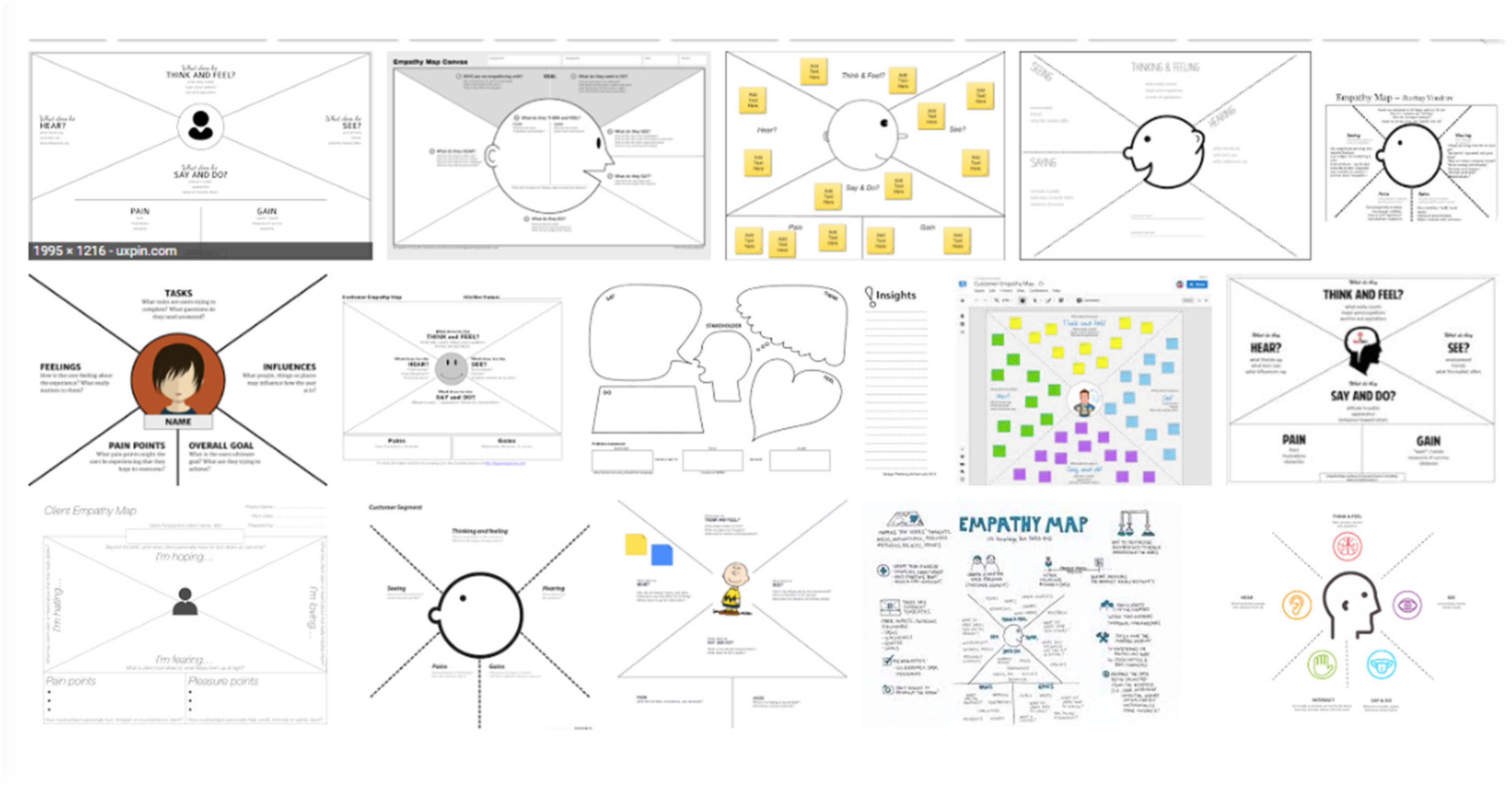
Screenshot of “empathy map template” from Google Images, https://uxbooth.com/articles/empathy-mapping-a-guide-to-getting-inside-a-users-head/ (Brown, 2018).
I am not sure why empathy is so widely discussed and accepted for UX and not for other design disciplines. Perhaps other types of designers are less concerned with their client's experience? Or do they assume that they understand the experience sufficiently to arrive at the best design? In healthcare design, all students learn about evidence-based design (EBD) and research-informed design. Many firms utilize, or at least claim to utilize, EBD for healthcare as well as education, offices, and more. Why do we not teach our students empathy as well? I think we should. We can have all the evidence in the world, but if we cannot understand our clients on a deep level, our work is not as impactful or meaningful.
In healthcare design, all students learn about evidence-based design (EBD) and research-informed design. Many firms utilize, or at least claim to utilize, EBD for healthcare as well as education, offices, and more. Why do we not teach our students empathy as well?
Why Teach and Foster Empathy in Designers?
We are at a point in history when disparity is growing and our very life on earth is threatened. Designers (architects, landscape architects, interior designers, industrial designers, and engineers) design for everyone. And “everyone” is individuals and communities far more diverse than our profession currently represents. Teaching and fostering empathy in design students can help them become better designers at the beginning of their careers by inculcating a deeper cognitive, affective, and somatic understanding of people and their environment. Research also suggests that teaching empathy increases students’ mental health (Mental Health First Aid, 2021) and creativity (Demetriou & Nicholl, 2022). Empathy is now taught in many K-12 schools as part of Social-Emotional Learning curricula (Committee for Children, 2023). In higher education, empathy is often taught as part of the medical and allied curriculum. The use of “design empathy equipment,” which I discuss below, is commonplace in occupational and physical therapy curricula.
Teaching and fostering empathy in design students can help them become better designers at the beginning of their careers by inculcating a deeper cognitive, affective, and somatic understanding of people and their environment.
My Pedagogical Exploration Into Design Empathy
My first experience using a wheelchair occurred over two decades ago at a healthcare garden design symposium in Portland, Oregon. One of the exercises involved navigating an outdoor courtyard with wheelchairs and IV poles. I had just earned my Master of Landscape Architecture (MLA) and was shocked by how difficult even a 2% slope was; how bumpy pavement felt, even without major gaps or cracks; how easy it was to graze my knuckles on three-foot Americans with Disability Act (ADA)-compliant door frames. That exercise stayed with me and, I believe, made me a better designer, researcher, and educator. At least a handful of other architectural and landscape architectural design educators use similar techniques. As a faculty member at the University of Maryland, I wanted to give my students the same powerful experience.
For the past three years, I used what I call “design empathy equipment” in my Bachelor of Landscape Architecture (BLA) and MLA design studios. In 2021, I received departmental funding for pairs of wheelchairs, walkers, IV poles, and GERT Suits—suits that simulate muscle weakness and diminished eyesight, hearing, and mobility that often accompany aging (see Figure 2). The GERT suits, especially, are based on tools developed by Lee Pastalan, an Environmental Gerontologist at the University of Michigan College of Architecture and Planning (Pastalan, 1982). In the 1970s, Pastalan developed the Empathic Model as a bridge between research and design, to help researchers better understand, through simulation, the people they were designing for (Pastalan, 1977). Note: If you are familiar with “disability simulation” and have begun to feel uncomfortable, I understand. Bear with me for a couple more paragraphs.
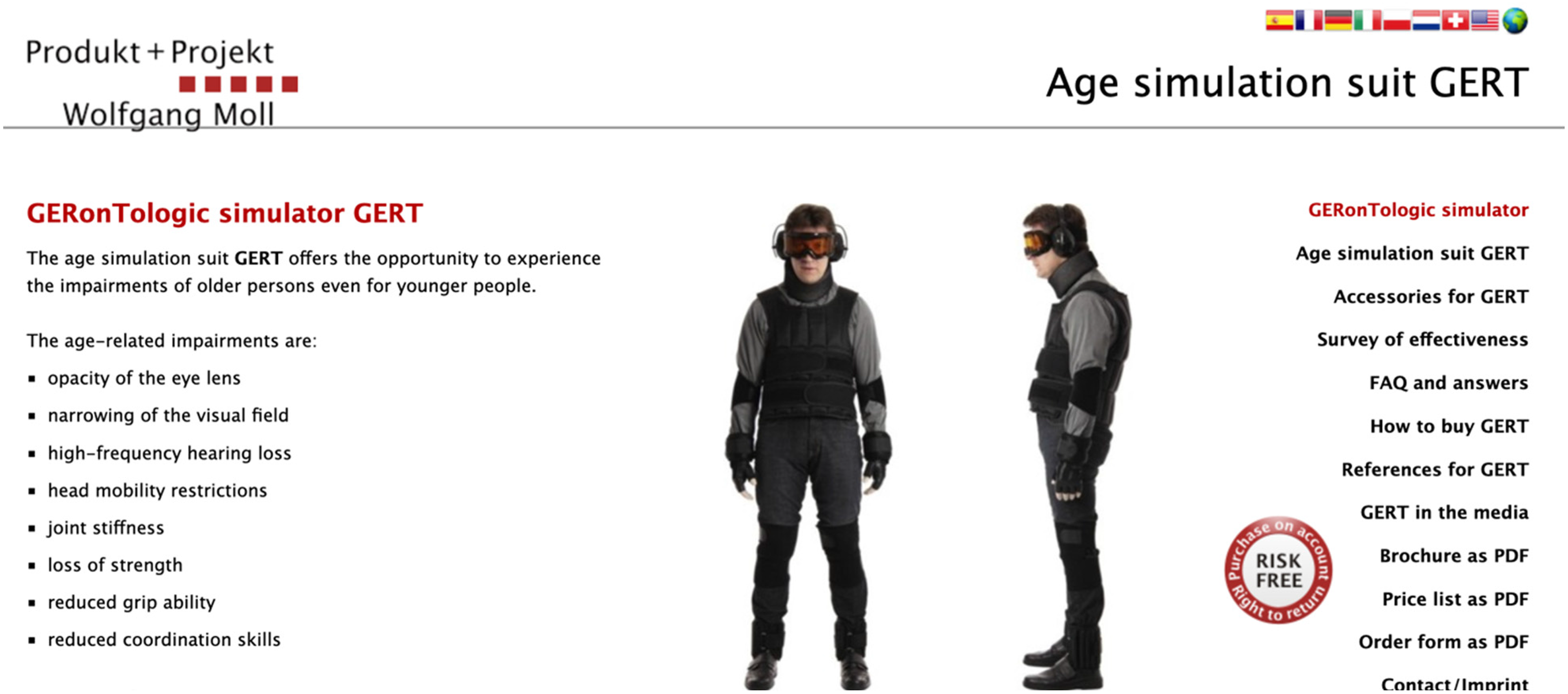
The GERT suit (screenshot of website, https://www.age-simulation-suit.com/).
In my “design empathy exercises,” students use one or more pieces of equipment to travel from our studio in the Plant Science building to another campus building, usually the Stamp Student Union, which is uphill and across a large outdoor plaza. Students must navigate various hallways, doorways, pavement types, and slopes. I bring a digital slope measurement tool, and students are often surprised at how steep a 3% slope feels, how bumpy minute changes in grade or gaps in the pavement are, and how tired and self-conscious they become with these encumbrances. We discuss the design empathy exercise before and after, and students write reflections about their experiences (Binder, 2023). Last year I added a series of readings and videos by University of Maryland students with disabilities, including a student with the “visible disability” of using a wheelchair, and a student with the “invisible disability” of attention deficit hyperactivity disorder (ADHD). In both studios, I also bring the design empathy equipment to our sites so students can experience the site-specific challenges that might better inform their designs (see Figure 3). For example, the extreme difficulty of using a wheelchair or walker on lawn or pea gravel, and the unnerving sensation of rolling in a wheelchair down an ADA-compliant 5% slope.
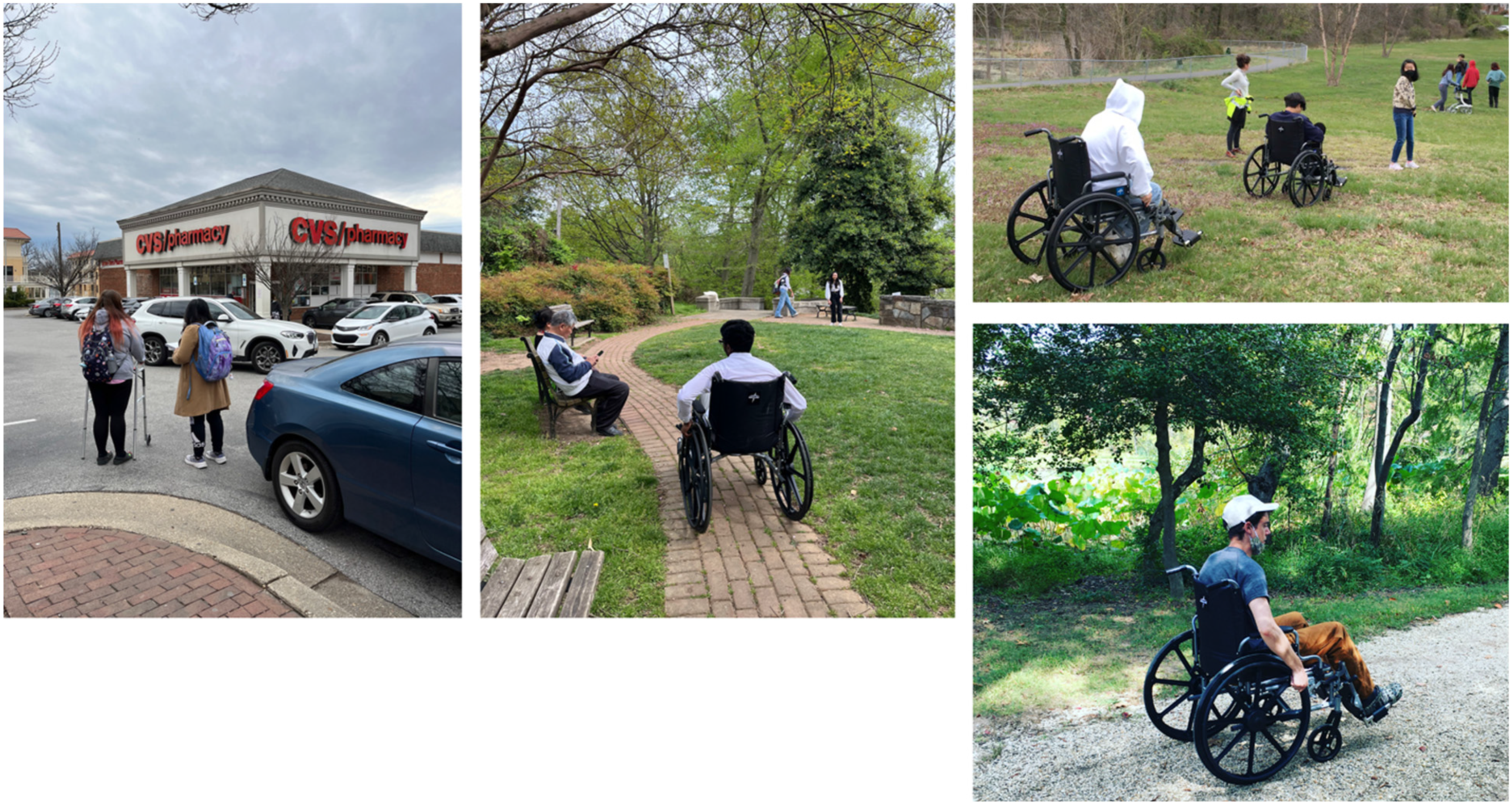
University of Maryland students using wheelchairs and walkers at their design sites.
My reasons for facilitating these exercises have been twofold. First, I believe design empathy equipment can help students understand on a physical or somatic, rather than merely a cognitive level, what the physical world feels like and how it serves or fails certain users. Second, I hope that the “aha” moments students describe during and after these exercises might ripple out to empathy for all kinds of people in all kinds of situations. Because many experiences and states of being cannot, or should not, be simulated: What is it like to navigate the world as someone of a different race, gender, ethnicity, citizenship status, or sexual orientation? What is it like to want to stay in your family home even when it repeatedly floods or is endangered by forest fires? To be unhoused and not want to live in a shelter? To want a nicer, safer neighborhood park while simultaneously worrying about gentrification?
Design Empathy Exercises as Disability Simulation: A Disability-Centered Point of View
Fortunately, last year amidst my pedagogical exploration of design empathy equipment, someone pointed out that “disability simulation,” the term for the design empathy exercises I was conducting, was not looked upon well by many members of the disability and disability rights communities. I googled the term and saw things from a different perspective that made me question the practice.
Huffpost contributor and disability rights activist Emily Ladau, who uses a wheelchair, articulates the sentiment shared by many in her activist community in the article, “I won’t pretend that disability simulation works” (2017). Disability simulation, she argues, does not go far enough to help users understand the experiences of people with disabilities:
Activities meant to simulate the experience of disability are so often lauded as moving, powerful, eye-opening experiences. With just a few hours in a wheelchair, wearing earplugs, or wearing a blindfold, people supposedly gain a deeper understanding of what life with a disability truly entails. I, for one, don't buy it.
Indeed, some studies have found that disability simulations can backfire, creating a more negative effect on the people going through the exercise, and the disabled people the simulation is supposed to be building empathy for.
Research on the Drawbacks of Disability Simulation
In “Crip for a day: The unintended negative consequences of disability simulation,” the authors describe their research on disability simulations on a college campus (Nario-Redmond, Gospodinov & Cobb, 2017). Undergraduates with and without disabilities underwent two different disability-awareness simulations for dyslexia, hearing, or mobility impairment. Both used pretest–posttest measures of mood, self-ascribed disability stereotypes, and measures of attitudes. In both experiments, disability simulations
Made participants feel more confused, embarrassed, helpless, and more vulnerable to becoming disabled themselves compared to baseline. Following the simulations, empathetic concern (warmth) toward disabled people increased in both studies, but attitudes about interacting did not improve. In Experiment 1, postsimulation anxiety, embarrassment, and helplessness were highest for those who used wheelchairs or simulated dyslexia. In Experiment 2, participants judged themselves less competent, expressed more pity, expressed more interaction discomfort, and were not more willing to interview disabled students for an accessibility project following the simulations compared to baseline. (Nario-Redmond et al., 2017)
After learning about the drawbacks of disability simulation, I rationalized my use of design empathy equipment for design empathy exercises: I am not asking my students to imagine what it is like to be disabled. Instead, we focus on how the physical environment does or does not meet the needs of different types of users. This environment-focused perspective is part of the social model of disability, wherein the social and physical world is the problem to be addressed. In contrast, the medical model of disability frames the disabled person as the problem, and they must adjust to their surroundings (Hogan, 2019). One of my students’ post-exercise writing does reflect this thinking:
This exercise was extremely eye opening for me, thank you so much for giving all of us this opportunity to experience what it is like to be in an inaccessible place. I think this exercise is 100% critical to landscape architecture and architecture as we want to design a world everyone can access and feel not only safe but confident in. Getting from one place to another was hard and I had help whenever I needed it. To be totally honest I was angry at the world when I was in the [wheel]chair because everything was so hard and inaccessible. I learned a lot being in the [wheel]chair and could go on about it for a few paragraphs, but I will just end by saying that now whenever I am designing, I will think about accessibility and go out of my way to incorporate tools that can aid people who are disabled. Most of the world is not accessible and I feel like it is simple aspects of design that can make a huge impact on the life of someone else.
I have always been careful to bring up other examples of mobility challenges, such as a student who breaks a leg and might temporarily need crutches or a wheelchair; or someone pushing a stroller with a sleeping infant. Yet, even if I am 100% clear that we are focused on the environment, what if there are still negative outcomes? What if someone sees my students with their wheelchairs, walkers, GERT suits, and IV poles and feels offended or disrespected? Hurting the very person (or any person) I am trying to build empathy for would be counterproductive and wrong. I still believe empathy should be part of design students’ education, but I am in search of alternative teaching strategies.
Teaching and Fostering Design Empathy Without Disability Simulation
What might some alternative teaching strategies be? Ladau (2017) asserts, “We must embrace differences as a fact of human existence without first needing to imitate them.” One of my students, in her reflection after the design empathy exercise, provided a critique similar to Ladau's above, and two excellent alternate ideas:
I used both types of equipment on Thursday when it was sunny but warm. They do give you a glimpse of the challenges many disabled and elderly people face navigating a space, but a part of me is uncomfortable with relying on props to build empathy for others’ experiences—especially for populations that are so marginalized and disregarded. I think it would be better in the future to include in the readings ahead of using the DEE [design empathy equipment] articles by disabled and/or elderly writers educating about the kinds of navigation barriers and experience they face. I also think hearing someone talk about their own personal experiences is a great way to build empathy.
At the 2023 American Society of Landscape Architects (ASLA) Conference, I attended a tour of several sites around Minneapolis, MN that were touted as “disability-friendly.” This tour would have been educational regardless, but what made it special were the tour guides: A deaf woman, a blind man, a woman and a man in wheelchairs with different disabilities, a young man with autism accompanied by his father, and two women who consult with municipalities on ADA compliance. At each site and all along our route, the tour guides spoke about the challenges they experienced in real-time. I did not need a wheelchair or earplugs or a blindfold or anything else; I and others walked alongside, listened, and learned a great deal.
There is a saying in the disability rights community, “Nothing about us without us.” My future pedagogical and research explorations around empathy, particularly regarding disability, will include members of the disability community. It is humbling to realize how much I still have to learn, and exciting to pass the knowledge and experience, in whatever the best way is, on to the next generation of designers.