




Abstract
One of the continuing challenges in the hotel industry is developing effective compensation policies that motivate frontline employees. Unfortunately, the areas of compensation and pay fairness are underresearched, and what research does exist often provides methodological and theoretical precision without necessarily lending itself to practical insight. The study presented here uses a longitudinal design to examine the effects of pay fairness on employees’ work effort and performance. Data for this study were collected from 270 employees and their supervisors in seven hotels in China. In practical terms, the results indicate that a fairly straightforward model connects perceptions of pay fairness with work effort and job performance. In theoretical terms, this study further validates the second-order factor structure of pay fairness dimensions (distributive, procedural, interpersonal, and informational). Stated more technically, despite the construct validity associated with a multidimensional structure of fairness, a more parsimonious model using an overall fairness representation predicts work effort and job performance better than the more detailed model that involves four distinct but interrelated fairness measurements. The chief implication is that although actual pay levels are important to perceptions of compensation fairness, hotel employees also take into account the compensation procedures, the nature of their interactions with management, and the extent to which managers and the company are forthcoming about compensation practices. Thus, money alone is not the only motivating factor for hotel employees but management treatment is also a large element of employees’ view of fairness.
Despite the clear need to manage the high cost of hospitality industry compensation effectively, there is a surprising lack of research on the effect of compensation fairness on employee performance (Deadrick and Gibson 2007). Furthermore, as research becomes increasingly sophisticated, in some ways it becomes even harder to find clear, prescriptive guidelines from this research. We sometimes seem to be learning more and more about less and less (cf. Meehl 1967). Without an evidence-based approach to management (e.g., Rousseau and McCarthy 2007; Rynes, Giluk, and Brown 2007), practitioners often rely on anecdotal prescriptions that often prove to be untrue (e.g., Bowling 2007; Way, Sturman, and Raab 2010). We think it is critical to provide clear research that is at the same time empirically valid and also can help companies more effectively to manage employee compensation. In short, research must help answer: “How should managers maximize the return from their single largest expense?” Although a complete answer to this question is beyond the scope of any single study, our goal here is to examine one essential aspect of this issue, namely, how employees’ perceptions of pay fairness influence their motivation and performance levels. By doing so, we hope to provide research-based guidance as to what aspects of pay fairness require managerial attention to obtain better returns on the compensation investment.
A key finding of much compensation research is that it is not only what you pay employees that matters but also how you pay them (Heneman et al. 1997; Isaac 2001; Sturman 2006; Tekleab, Bartol, and Liu 2005). Yet, although research has demonstrated that structural characteristics of pay decisions influence future job performance, the related psychological mechanisms are not yet understood. Researchers have often maintained that pay fairness is a vital determinant of employees’ utility, and thus a key ingredient of a successful compensation system (Dijke et al. 2009; Hundley and Kim 1997).
With employee compensation being the single largest cost for hotels (PKF Consulting 2012), and with employee performance being central to the successful delivery of the hospitality industry’s service product (Ford, Sturman, and Heaton 2012), it is not surprising that even without clear prescriptive research addressing the link between compensation and employee performance, companies are moving ahead with policies based on the inferred link between the two. For example, companies like Marriott and Southwest Airlines emphasize fairness in their relationships with the employees, and try to promote fairness in their compensation, rules, and interactions (Bettencourt and Brown 1997). It is thus critical for research to consider the link between perceptions of pay fairness and job performance to help fill both the theoretical and practical gaps that currently exist. In this study, we explore how hotel employees’ perceptions of pay fairness affect their work effort and performance. Our goal is to inform theoretical research that proposes a relationship between the two and to provide applied results that offer a more precise estimate of the role of fairness so as to better explain its importance in applied settings (cf. Edwards and Berry 2010).
Background and Hypotheses
Although there is a lack of longitudinal research investigating how fairness perceptions influence performance levels, there is fortunately a solid body of research on pay fairness in general on which we can build. 1 Like the construct of organizational justice (Colquitt 2001; Colquitt et al. 2001; Greenberg 1993; Hausknecht, Sturman, and Robinson 2011), fairness of pay systems can be conceptualized based on the following four dimensions: distributive fairness (DF) refers to the perceived fairness of distribution outcomes (Adams 1965), procedural fairness (PF) refers to the perceived fairness of the procedures leading to distribution outcomes (Folger and Konovsky 1989; Thibaut and Walker 1975), interactional fairness (ITF) refers to the fairness of the treatment that people receive from decision makers (Bies and Moag 1986), and informational fairness (IFF) focuses on the explanations provided to people that convey information about why procedures were used in a certain way or why outcomes were distributed in a certain fashion (Colquitt et al. 2001). Although this multidimensional approach to understanding fairness provides for a deeper understanding of the processes and factors that influence different types of fairness perceptions, it comes at the expense of simplicity and parsimony, and its prescriptive value is sometimes questionable (Wong, Law, and Huang 2008).
Complications arise in predicting work performance, where a multitude of explanations exist regarding which relationships to expect for these four fairness dimensions. For example, based on equity theory (Adams 1965), DF assesses fairness based on comparing one’s outcomes with relevant referents, usually other employees. According to this theory, feelings of inequity might induce people to withhold effort to balance the calculus of economic exchanges (e.g., reduce performance, be absent, quit). So, perceived DF might have a direct influence on employees’ performance.
PF is also seen as relating to job performance, on the argument that people not only care about the outcomes of pay systems but also the related allocation procedures. Frequently mentioned attributes of fair procedures include consistency, ethics, bias suppression, accuracy, representativeness, and correctability (Leventhal 1980). Formal procedures—such as compensation plan structure, benefit programs, and bonus incentive systems—could help employees reduce concerns about unexpected results and react more positively to the decisions, decision makers, and organizations (Brockner et al. 2007; Dijke et al. 2009).
Given that a performance assessment often involves the relationship between an employee and his or her supervisor, ITF may also play an important role for affecting future performance levels (Colquitt et al. 2001). Interpersonal treatment indicates one’s social belonging within the group and the organization. ITF is different from DF in that ITF fairness focuses much more on noninstrumental values than DF, which might induce a reciprocity effect between the authority and the employees through social exchange relationships. When employees are treated with sensitivity, politeness, and respect by their supervisors, those employees are more likely to be satisfied with their job and have higher trust in their supervisors (Judge, Scott, and Illies 2006; Loi, Yang, and Diefendorff 2009).
Finally, in the arguments purporting a relationship between IFF and work performance, the accuracy and timing of disclosures regarding compensation information are crucial. According to the fairness heuristic theory (Lind 2001a; Lind et al. 1993; van den Bos et al. 1997), people rely heavily on fairness information to make judgments and to interpret their relationships with the organization. Fairness information can be taken into account as a kind of heuristic that guides people’s attitudes and behaviors at work (Colquitt, Greenberg, and Scott 2005; Hausknecht, Sturman, and Robinson 2011).
While our review shows theoretical reasons for expecting that these fairness dimensions may influence performance, empirical studies have returned mixed results regarding the effects of specific fairness types on performance. Two meta-analytic reviews indicated that work performance was mainly related to perceived PF (Cohen-Charash and Spector 2001; Colquitt et al. 2001) but the literature considering this issue has been cross-sectional. Some researchers indicated that the impact of fairness varies depending on which particular fairness dimensions are examined (Holtz and Harold 2009). For example, Ramaswami and Singh (2003) found that of DF, PF, and ITF, only DF had a significant positive impact on employees’ work performance. Looking at PF and ITF, Zapata-Phelan et al. (2009) found that only PF had both direct and indirect effects on task performance. In sum, the relative importance of the fairness dimensions on performance is poorly understood, and there are reasons to expect that each dimension may play a role for influencing employees’ job performance.
A multidimensional view of the fairness construct should provide greater insight into the facets associated with perceptions of fairness, especially because a number of researchers have suggested that the exclusive focus on specific types of fairness may not capture the depth and richness of individuals’ justice experience (Ambrose and Arnaud 2005; Ambrose and Schminke 2009; Hauenstein, McGonigle, and Flinder 2001; Lind 2001b; Törnblom and Vermunt 1999). These researchers suggested a shift in focus to a consideration of overall fairness judgments, which represent global evaluations of an organization’s fairness based on personal experiences (Ambrose and Schminke 2009). Compared with specific fairness dimensions, overall fairness can provide more accurate, parsimonious, and consistent results regarding how fairness influences organizational phenomena. Because the various forms of fairness judgments are usually tightly linked, moreover, one’s fairness judgments might depend on an overall perception (Lind 2001b). Similarly, overall fairness may actually be a formative measure of its individual dimensional components. As such, overall fairness might offer greater predictive power than specific fairness dimensions when the outcome variables are relatively global in nature, such as organizational commitment or overall job performance (Ambrose and Schminke 2009; Colquitt and Shaw 2005; Holtz and Harold 2009).
Two studies provide some insight regarding overall fairness. Ambrose and Schminke (2009) suggested that specific fairness experiences are the foundation for overall fairness judgments. They proposed a bandwidth–fidelity theory to describe the explanatory power of overall fairness and specific fairness in different situations. That is, when the breadth or generality of the predictor matches the variable being presented, there might emerge stronger relationships and explanatory power. As the key outcome variable in this study, employee job performance can be seen as a result of a general evaluation of individual work outcomes, and there is a clear possibility that a global measure of fairness would be the most appropriate approach for assessing overall work performance. Ambrose and Schminke’s (2009) results showed that overall fairness judgments mediated the relationship between specific fairness judgments and employee attitudes and behaviors. Confirming this view, Holtz and Harold (2009) found that overall organizational fairness and overall supervisory fairness perceptions are well predicted by their respective specific fairness dimensions.
There is also reason to question whether a multidimensional conceptualization of a construct is always necessary. Individuals have different cognitive abilities and different personal motivations, which may affect whether they perceive one or more dimensions (Carraher and Buckley 1996; Sturman and Carraher 2007). The result is that the multidimensional construct may not be applicable for a significant portion of a given sample, even though a methodological test of the construct’s factor structure will still show a multidimensional structure if some of the samples do still perceive it that way (Sturman and Carraher 2007). Even if confirmatory factor analyses (CFAs) validate a multidimensional structure for a given sample, a notable portion of the sample may still be perceiving justice as an overall, single-dimensional construct.
Multicollinearity is another consideration for using the parsimonious model. Studies indicate that highly significant correlations exist among fairness dimensions (for a review, see Colquitt et al. 2001). Because coefficient estimates obtained from the direct structural model of independent variables on the dependent variable might only reflect marginal or partial effects, higher order modeling is more parsimonious, and a better empirical fit for hierarchical constructs, providing an alternative method of resolving this empirical management problem (Tanriverdi and Venkatraman 2005).
Although we do not deny that a multidimensional conceptualization of fairness is empirically valid and has value in many regards, for the purposes of providing applied results with prescriptive value, we argue that an overall model of fairness provides a simpler, clearer, and better fitting explanation of fairness effects. In this study, consequently, we modeled overall pay fairness as a reflective second-order construct to capture complementarities arising from the four types of fairness (Edwards 2001). We therefore hypothesize the following:
Hypothesis 1: Modeling fairness with a second-order factor provides a better fitting model of how fairness affects work effort and performance than a purely multidimensional representation.
Fairness and Work Effort
The fundamental idea behind the beneficial role of employees’ fairness perceptions is that increasing fairness can lead to higher motivation, and thus higher work performance. Although employee ability is clearly a critical component for successful performance, motivation and effort are essential (Byrne et al. 2005; Tracey, Sturman, and Tews 2007). In this vein, fairness theories have offered some insight into the reason why fairness perceptions might affect employees’ attitudes and behaviors toward work.
The way fairness theories describe how perceptions relate to work effort and performance can be divided into two categories: instrumental and value expressive (Jones, Scarpello, and Bergmann 1999). The instrumental category focuses on the individuals’ interests in the resource allocation outcomes, such as equity theory (Adams 1965) and discrepancy theory (Lawler 1971). The value-expressive category associates perceived value of self-fulfillment with social interactions in the allocation process, such as group value theory (Lind and Tyler 1988), emotional intelligence theory (W. C. Kim and Mauborgne 1998), and moral justice theory (Folger 1994; Montada 1998).
Research has shown that fairness perceptions predict job attitudes and behaviors. For instance, extensive research has demonstrated that a high level of fairness perceptions may lead to higher job satisfaction and organizational commitment (Folger and Konovsky 1989; Greenberg 1994; Hausknecht, Sturman, and Robinson 2011), improve organizational citizenship behavior (Colquitt et al. 2001) and supervisor trust (Ramaswami and Singh 2003), and reduce turnover intentions (Hausknecht, Sturman, and Robinson 2011; Nadiri and Tanova 2009).
Colquitt and Chertkoff (2002) have suggested that scholars should measure motivation in the same fairness model, to assess a mechanism linking fairness to performance. In our study, we incorporate work effort in the fairness model. The expectancy theory of motivation states that motivation is influenced by the belief that effort will lead to higher performance (expectancy) and belief that higher performance will lead to better rewards (instrumentality) that are valued by the employees (Robbins 2001). In addition, several studies have demonstrated strong support for the work effort–performance relationship (e.g., Blau 1993; Byrne et al. 2005; Yeo and Neal 2004).
Consequently, there is reason to expect a positive relationship between the various dimensions of fairness and future work performance because of the effects of fairness on motivation. As expressed in Hypothesis 1, however, the multidimensional form may not explain the overall effect as well as a more parsimonious model. We therefore predict the following:
Hypothesis 2: Overall fairness has a positive effect on future work effort.
Hypothesis 3: There is a positive relationship between overall fairness and work performance.
Hypothesis 4: The effect of overall fairness on work performance is mediated by its effect on work effort.
Method
Sample and Procedure
The data for this study were collected in two waves from seven star-level hotels in Guangdong Province, China. As the nation’s largest provincial economy, Guangdong has been the pioneer in introducing modern management ideas to the hospitality industry since China’s economic reform began. For instance, the first joint-venture deluxe hotel, White Swan, was developed in Guangzhou, the capital of Guangdong. Guangdong is ranked second in China’s National Tourism Administration’s list of top destinations and among the top three tourism-generating regions (China Tourism Academy 2011). Given the importance of Guangdong’s hotel sector to China’s tourism industry, we studied hotels in that province. We began with a sample of ten hotels selected because of the availability of management contacts who could assist with the data collection. However, three hotels dropped out in the midst of the study, leaving two 4-star hotels, three 3-star hotels, and two 4-star resort properties.
The hotels’ human resource (HR) managers coordinated the survey administration, and before the second-wave survey, we also confirmed that the hotels had not made significant changes in compensation policies and procedures. The questionnaire was constructed after site visits and extensive discussions with focus groups of employees and HR managers. We pretested the questionnaire using a convenience sample of 245 frontline employees in three Guangdong hotels and eighty-seven middle and senior hotel managers who attended a university-based industrial training class. The results of the pretest provided preliminary evidence of the construct validity of all measures. In the first research wave, we collected measures of the four types of perceived fairness, demographic variables, and supervisor-evaluated work performance. Four months later, in the second wave, we collected employees’ work effort and their supervisor-evaluated work performance. At all times, we guaranteed employees’ data confidentiality, and completed questionnaires were returned in sealed envelopes to a designated box in the HR department. On each survey, employees were asked to provide their employee identification number as the means to permit collection of further data. Similarly, supervisor surveys contained the identification number for both the supervisor and the subordinate.
The first wave of surveys regarding 1,180 employees among the ten hotels drew a response from 832 employees along with supervisors’ evaluations for 748 employees. After deleting responses with excessive missing data and those that could not be matched to supervisors, the sample size was 682 usable questionnaires. After the three hotels dropped out, the remaining potential sample was 350 employees. In the second wave, 280 employee surveys and 302 supervisor evaluations were returned, leading to a final employee–supervisor matched sample of 270 usable questionnaires across both time periods.
Our t-tests for demographic and fairness variables (i.e., DF, PF, ITF, and IFF) between participants who completed the both survey waves and those who did not found no significant differences in demographic variables, except that more local workers finished the second wave of survey than did workers who came from other parts of China. Of the 270 participants, 65 percent were females, 86 percent were in the age range 18 to 35, 91.3 percent worked for the hotel for less than five years, 20.5 percent had a university education, and 80.5 percent were from elsewhere in the country. In terms of average monthly wage, 65 percent earned less than 1,200 renminbi (¥). 2
Measures
Pay Fairness
We assessed DF, PF, and ITF using the 7-point scales developed by Moorman (1991), and IFF using the scales developed by Colquitt (2001; see Exhibit 1 for sample items). Scale anchors were strongly disagree and strongly agree for all four fairness measures.
Measurement Model for Second-Order Model

Note: All factor loadings are significant at p < .001.
Overall, pay fairness was modeled as a reflective second-order construct to capture complementarities arising from the four types of fairness, in a process well documented in existing studies as accounting for interactions and covariances among the first-order constructs (e.g., Koufteros, Babbar, and Kaighobadi 2009; Mishra and Shah 2009; Sivadas and Dwyer 2000; Tanriverdi 2006; Tanriverdi and Venkatraman 2005).
Work Effort
Employee (self-rated) work effort was measured with nine items, using measures developed by Warr, Cook, and Wall (1979) and Brotheridge (2003). The response scale again ranged from 1 (strongly disagree) to 7 (strongly agree).
Work Performance
Employees’ immediate supervisors were asked to complete the survey that included nine items adapted from Becker et al. (1996), Ramaswami and Singh (2003), and Williams and Anderson (1991). The work performance scale includes the quality of work, quantity of work, speed of work, ability, task fulfillment, job requirements fulfillment, attendance rate, cooperation with the supervisors, and overall performance. The 7-point response scale ranged from inadequate to superior.
Analyses
The hypothesized model was evaluated using the two-stage process recommended by Anderson and Gerbing (1988). In Stage 1, CFA was conducted to examine the factor structures of perceived fairness that included various alternative measurement models at the first-order and second-order levels. In Stage 2, structural equation modeling (SEM) was used to test the hypothesized model. During this stage, we first examined the direct effect of specific fairness dimensions on work effort and performance, then examined whether the overall fairness arising from four fairness dimensions affected work effort and performance. Due to the small sample size, a partial disaggregation approach was used to reduce random error and retain the multiple measure approach to structural modeling (Bagozzi and Heatherton 1994), and the items representing a construct were selected at random to form two indicators for the construct. Both the CFA and SEM were conducted using AMOS 18 software.
For our analyses of work performance, we controlled for the effect of work performance ratings from Time 1 on the effect of performance at Time 2. Including the lagged dependent variable, initial work performance partials out the stable effects associated with the dependent variable that may also be associated with the independent variables of interest (Sturman 2007). Thus, any effects we observe due to work effort or fairness are attributable to effects beyond that which affected work performance in the prior time period. Such a test gives us a better opportunity (although certainly not conclusive) to assess the causal effect of fairness on our outcome of interest.
Results
Means, standard deviations, Cronbach’s alpha, and correlations are reported in Exhibit 2. Cronbach’s alpha for each measure exceeded .90, which indicated that the reliabilities were appropriate for research on a construct as well established as fairness (Nunnally and Bernstein 1994). Consistent with our expectation, all four types of pay fairness had significant correlations with work effort and performance, and previous performance had a significant correlation with later performance.
Means, Standard Deviations, Reliabilities (Cronbach’s α), and Pearson Correlation Coefficient
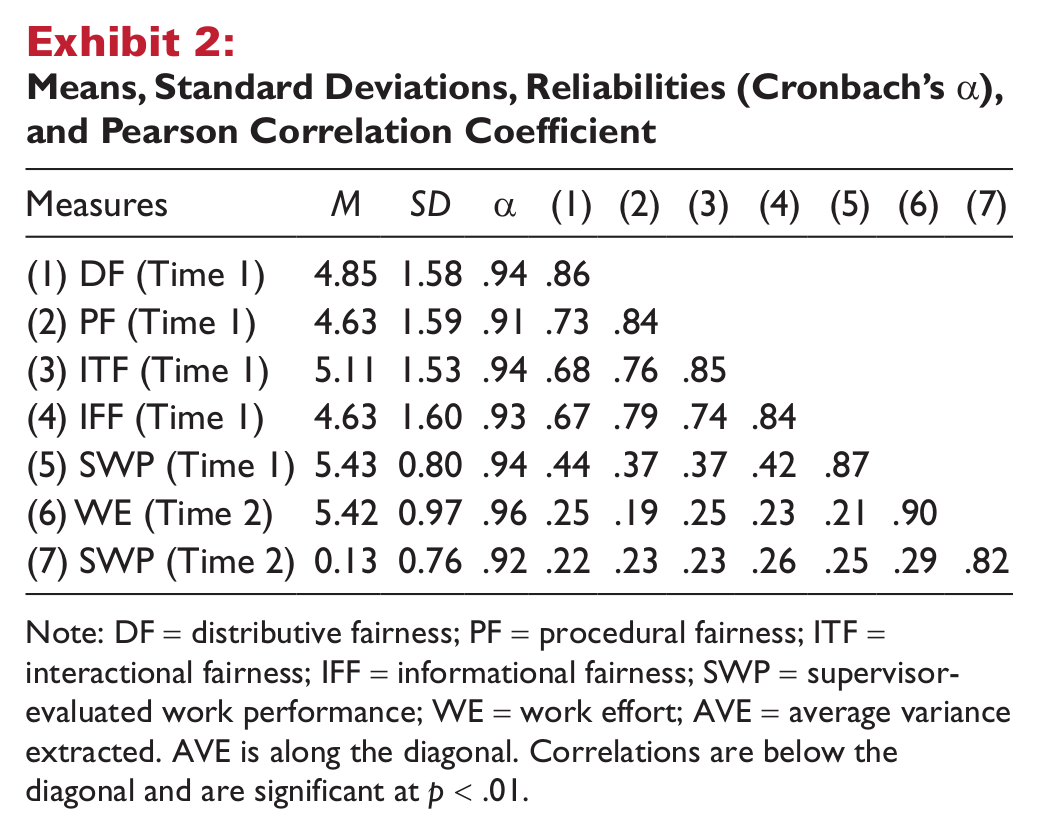
Note: DF = distributive fairness; PF = procedural fairness; ITF = interactional fairness; IFF = informational fairness; SWP = supervisor-evaluated work performance; WE = work effort; AVE = average variance extracted. AVE is along the diagonal. Correlations are below the diagonal and are significant at p < .01.
Testing of the Fairness Measurement Model
We tested the second-order model of pay fairness and compared it with four alternative measurement models to establish the dimensional structure of perceived pay fairness, with the results shown in Exhibit 3. These models are a (1) single-factor model consisting of all fairness items; (2) correlated two-factor model, in which PF, ITF, and IFF were collapsed to load onto one factor; (3) correlated three-factor model, in which ITF and IFF were collapsed to load onto one factor; (4) correlated four-factor model with four fairness types; and (5) second-order factor that accounts for the relationships among the four first-order factors.
Goodness of Indicators for the Different Measurement Models
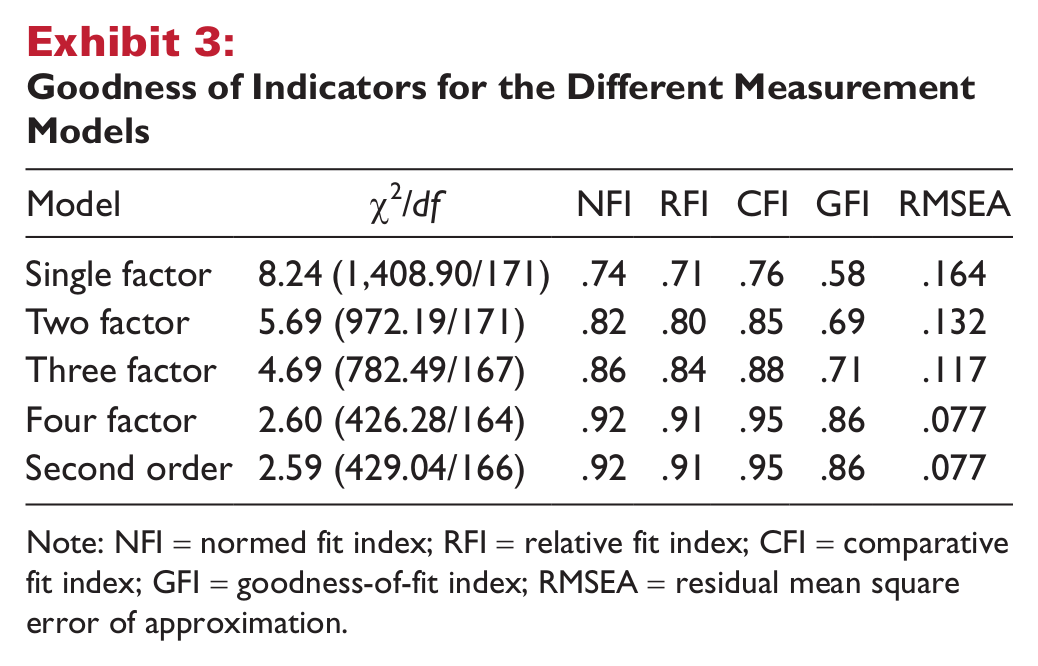
Note: NFI = normed fit index; RFI = relative fit index; CFI = comparative fit index; GFI = goodness-of-fit index; RMSEA = residual mean square error of approximation.
Dimensionality of First-Order Models
Compared with the other three measurement models, the four-factor model represented the significantly best fit to the data: χ2/df = 2.60, normed fit index (NFI) = .92, relative fit index (RFI) = .91, comparative fit index (CFI) = .95, goodness-of-fit index (GFI) = .86, and residual mean square error of approximation (RMSEA) = .077. The results of four-factor model showed that all the factor loadings from the items to their latent factors were greater than 0.60 and all were significant at p < .001, thus providing evidence for the convergent validity of our scales. To further explore the discriminant validity, the values of average variance extracted (AVE) were calculated. As shown in Exhibit 2, all the AVE values exceed the corresponding latent variable correlations in the same row and column, providing evidence of discriminant validity for our scales (cf. Fornell and Larcker 1981). In sum, these results support the multidimensional construct of pay fairness with four related dimensions.
First-Order versus Second-Order Factor Models
The second-order factor explains how the first-order factors coexist and covary with each other (Rindskopf and Rose 1988). We modeled overall pay fairness as the second-order factor to capture patterns of interactions and covariance that clearly exist among the four first-order factors. As Tanriverdi (2006) suggested, there are four criteria for comparing first-order and second-order models: goodness-of-fit statistics for the two models, significance of the second-order factor loadings, target coefficient statistics, 3 and significance of the structure links between the measurement models and the latent variable.
As shown in Exhibit 3, the fit statistics for the four-factor model and second-order factor model are almost identical. Analysis has shown that when two nested models have exactly the same chi-square and fit measures, the second-order factor model should be accepted because it is a more parsimonious model with fewer parameters to be estimated and more degrees of freedom (Tanriverdi 2006; Venkatraman 1990). All the factor loadings from the items to their latent factors were above 0.76, as seen in Exhibit 1. In addition, all the gamma coefficients of the first-order factors to the second-order factor are highly significant (p < .001) and all exceed 0.81, providing support for the acceptance of the second-order factor model. The value of the target coefficient reaches 0.99, indicating that the second-order factor accounts for 99 percent of the relations among the first-order factors. This also suggests the acceptance of the second-order factor model. Finally, as shown in Exhibits 4 and 5, the overall pay fairness construct has a significant impact on the latent variables. Collectively, these results confirm pay fairness as a second-order construct. Hence, we concluded that the four first-order factors could be integrated into a higher order construct of pay fairness, and thus our results provide fundamental support for Hypothesis 1.
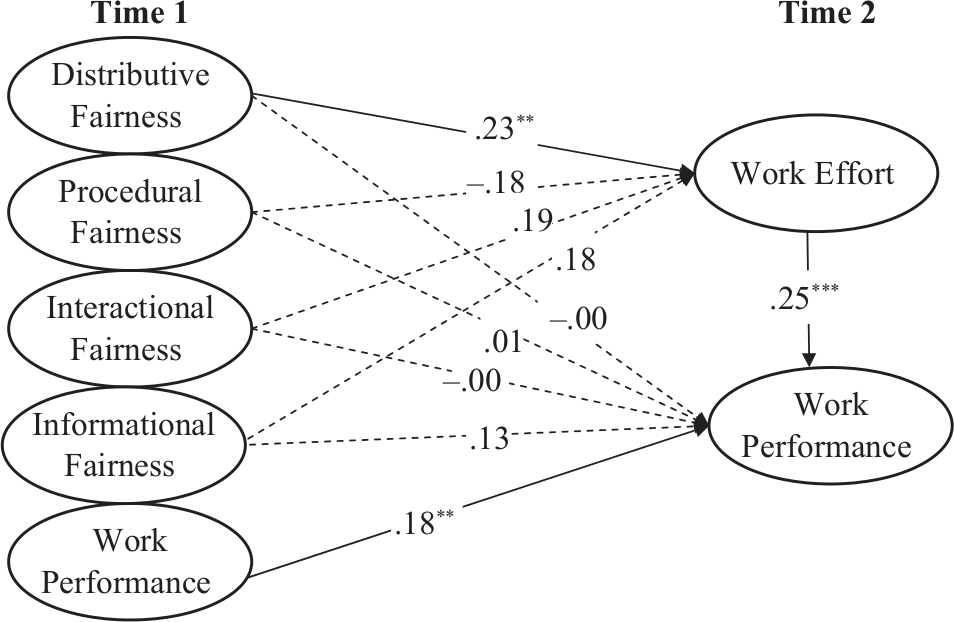
Hypothesized Direct Effects Model and Its Results

Hypothesized Parsimonious Model and Its Results
Testing of the Structural Model
We created two sets of structural equation models to test the proposed model. This involved contrasting a test model with the direct effects but no second-order factor against models that included the second-order factor. Each model set included the (a) submodel linking fairness with work effort, (b) submodel linking fairness with work performance, and (c) overall model linking fairness with both work effort and performance, after controlling for prior work performance. The submodels from (a) and (b) are used to evaluate Hypotheses 2 and 3. The overall models from (c) allowed us to test our final three hypotheses while providing a secondary test of our first hypothesis. The two competing overall models are depicted in Exhibits 4 and 5. In Exhibit 4, the direct effects model includes the direct relationships between the four forms of fairness dimensions and the work effort and performance measures. In Exhibit 5, the parsimonious model includes a second-order factor of the overall pay fairness construct, and two structural links representing the relationships from this construct to work effort and performance measures.
Exhibit 6 presents the fit statistics for the two sets of models. We also examined measures of model parsimony (Mulaik et al. 1989) to provide comparisons of these models. Results showed that the fit statistics for the parsimonious models are almost identical to or marginally better than those of corresponding direct effects models. Results showed that the parsimonious models are more effective in representing the data than the direct effects models. For a general evaluation, the two competing overall models are used to test Hypothesis 1. 4 As indicated in Exhibit 4, only one of the eight direct links from the four forms of fairness to work effort and performance is significant, indicating poor model specification. In contrast, as indicated in Exhibit 5, the links from overall pay fairness to both work effort and performance are positive and significant (β = .29, p < .01 for work effort and β = .13, p < .1 for performance). As we are primarily interested in testing parsimony, we therefore compared indices specifically representing this information of these two models: the parsimony goodness-of-fit index (PGFI) and the parsimony normed fit index (PNFI). In Exhibit 6, the PGFI was 0.51 and the PNFI was 0.61 for the overall direct model, and they were 0.61 and 0.72 for the overall parsimonious model, indicating a better fit. Note also that the levels of these parsimony indices are above proposed thresholds (i.e., 0.50; Mulaik et al. 1989). In addition, the Akaike information criterion (AIC) of the parsimonious and direct models was 186.12 and 189.84, indicating that the former model is more parsimonious due to its smaller AIC. Thus, the prediction model with a second-order factor is supported, and the above results demonstrate the superiority of the parsimonious model over the direct effects model in explaining the prediction effects of fairness, providing further support for Hypothesis 1.
Goodness of Indicators for the SEM Models
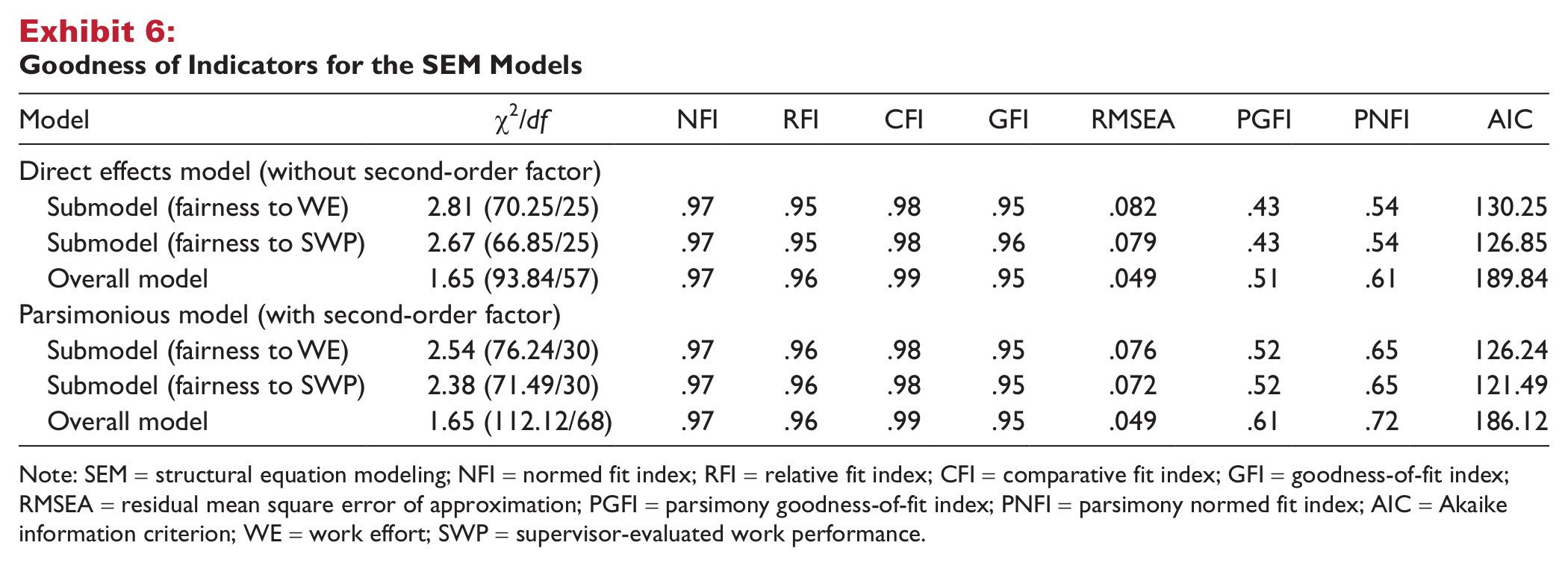
Note: SEM = structural equation modeling; NFI = normed fit index; RFI = relative fit index; CFI = comparative fit index; GFI = goodness-of-fit index; RMSEA = residual mean square error of approximation; PGFI = parsimony goodness-of-fit index; PNFI = parsimony normed fit index; AIC = Akaike information criterion; WE = work effort; SWP = supervisor-evaluated work performance.
Hypotheses 2 and 3 predicted that overall fairness would have a positive effect on future work effort and performance. The results of the two parsimonious submodels, Models (a) and (b), indicate support for these hypotheses, as they separately show a significant relationship between overall fairness and work effort (β = .26, p < .01), and for the relationship between overall fairness and work performance (β = .27, p < .01).
Hypothesis 4 predicted that work effort would mediate the relationship between overall fairness and work performance. With respect to testing mediation, the “causal steps” approach (Baron and Kenny 1986) suffers from low statistical power (MacKinnon et al. 2002). Instead, according to MacKinnon et al.’s suggestion, we used the unstandardized coefficients of the direct and indirect effects to test the intervening variable effect. The effect decomposition of SEM revealed that, in addition to its significant total effect (0.14) and direct effect (0.09), overall fairness had a significant indirect effect (0.05) on work performance through the mechanism of work effort. This significant indirect effect supports the mediation relationship, providing support for Hypothesis 4. To explore whether full or partial mediation occurred, we compared the partially mediated model (Exhibit 5) with a fully mediated model. Results indicated that the partial mediation model provides a slightly better fit to the data (Δχ2 = 2.77 and Δdf = 1 at p < .1). Above all, the results suggest that after controlling for prior work performance, work effort partially mediates the relationship between overall fairness and work performance. 5
Discussion and Implications
This study indicates that overall fairness provides a simpler and clearer explanation for the prediction of global reactions than does a multidimensional approach to conceptualizing fairness, because the specific fairness dimensions are associated and connected. Consequences of justice dimensions are thus similarly intertwined. Employees judge procedures as more fair when they receive fair or favorable outcomes (Colquitt et al. 2001; Lind and Tyler 1988; Thibaut and Walker 1975). So, for instance, if the employees are treated well by their supervisors (PF) and provided with adequate and sincere explanations (IFF) as well as information about accuracy of distribution (ITF), they most likely will also accept the resulting distributive (DF) outcomes (Dijke et al. 2009; W. Kim, Ok, and Lee 2009; Scandura 1999). Even though the fairness dimensions are empirically distinct, they also are inherently connected, and our study demonstrates that employees’ specific fairness experiences do not occur in isolation but rather as a system of complementary events. In fact, examining specific types of pay fairness as independent practices (even if allowed to covary) and their performance effects separately may lead to confusing results, as we demonstrate in Exhibit 4. If each form of pay fairness was treated independently, the results would incorrectly suggest that only DF has significant impact on work effort, and subsequently work performance. In that case, it also would be hard to explain why three highly related fairness links have no apparent effect on work effort or performance.
We note that although specific fairness dimensions might exert particular effects, our study of overall fairness is valuable because it summarizes the influence of the fairness dimensions and highlights the total impact of fairness perceptions (Holtz and Harold 2009). This result is consistent with that of Ambrose and Schminke (2009) and Colquitt and Shaw (2005), who suggested a global measure of fairness would be more appropriate for assessing global reactions such as job performance.
Managerial Implications
Above all, our findings offer practical insight to hotel managers for enhancing employees’ work effort and performance. Although attractive pay is often emphasized in encouraging service employees’ efforts, perceived fairness is vital as well. Thus, managers can work to increase employees’ perceptions of pay fairness to encourage their work performance.
Although hotel employees can distinguish between various types of fairness, their behavior is most driven by a general sense of fairness. When the employees think they are paid fairly, they will make efforts to do a good job. Consequently, employees’ perceptions of the fairness of the pay system strengthen the return from a compensation system. Even after controlling for prior work performance, those who perceive pay to be more fair exhibit greater motivation and performance over time.
Support for the use of a general measure of fairness, rather than effects associated with specific dimensions, provides support for a total compensation approach (Bremen and McMullen 2010a, 2010b; Kantor 2011). Organizations need to take a broader approach to compensation management and consider employee compensation and attitudes more holistically (Bremen and McMullen 2010a, 2010b). The importance of overall perceptions of fairness highlights the need for companies to consider how all aspects of compensation decisions and distributions—procedures, amounts, information sharing, and interactions with supervisors—yield global attitudes that ultimately influence employee performance levels.
Our results also provide managers with valuable information on the relative importance of fairness perceptions. A one standard deviation increase in pay fairness yields a 0.20 increase in work performance (through its direct and indirect effects, as calculated from Exhibit 5, [(0.13) + (0.29) × (0.24)]), which according to our model is as large a predictor of work performance as is prior work performance. An understanding of the relative magnitude of these effects (cf. Edwards and Berry 2010) provides a practical insight into the potential gains practitioners can obtain from different HR systems. Our results suggest that a low performer who perceives the pay system to be fair is predicted to perform as well in the future as a high performer who perceives the pay system as unfair. One implication of this result is that, without a fair compensation system, even a great selection system will ultimately fail. At the same time, managing overall perceptions of pay fairness may be helpful for overcoming prior performance issues.
Although we are suggesting an overall approach to pay system fairness, we of course do not advocate that managers should ignore specific fairness dimensions. On the contrary, it is critical for managers to implement all four dimensions of pay fairness simultaneously, because work effort and performance rely heavily on their coexistence and complementarity. The point is that treating fairness as a single dimension—say, specific pay levels—is overly simplistic, and may result in poor implementation. Managers need to simultaneously think about the procedures through which awards are decided, the size of those awards, how managers interact with subordinates with respect to the processes leading to the rewards decision, and the information shared with employees regarding the reward system. Compensation is a complex HR system, and sufficient attention must be devoted to its complexities, the better to maximize its return on investment.
In many ways, our suggestions are consistent with HR managers’ common understanding of the need to be fair in the workplace. We acknowledge that the realities of lodging operation make compensation fairness challenging to achieve. Perhaps to ensure PF, organizations tend to establish overarching decision making and compensation procedures (Olkkonen and Lipponen 2006), and local employees seem to have relatively few opportunities for control or participation in compensation management than in other HR practices (e.g., performance management, training, and career development). Although a limit may exist in terms of hotel employees participating in the decision-making process for compensation management, managers and HR people can make extensive efforts to explain the basis of compensation decisions. For example, employees might be shown why a supposed pay gap is appropriate, through job analysis, and how performance appraisals drive rewards. In addition, even the frontline employees need the right to voice their opinions, and for those comments to be considered with great care. Such consideration establishes that the management highly cares for their well-being.
Our results may also suggest that it could be beneficial for organizations to lift some of the shroud of secrecy that typically exists in compensation management. Researchers have already proposed that such practices as timely and sufficient information sharing and two-way communication are effective ways to cultivate perceptions of compensation fairness (Ramaswami and Singh 2003). Managers need to take the initiative to communicate their organization’s compensation policies, such as their compensation structure, merit pay plan, benefit programs, and bonus incentive systems. Not only will employees get to know the hotel’s compensation procedures and policies but this is also a chance for management to promote interaction in a respectful and dignified way. This invites a relatively new form of training in which managers and supervisors learn to be more procedurally, interpersonally, and informationally fair (for a review, see Greenberg 2007; Skarlicki and Latham 2005). In short, specific types of fairness cannot to be pursued in isolation from the others, and managers need to maximize the effects of overall fairness.
Contributions, Limitations, and Future Research
The first contribution of this study is that it enhances our understanding of the positive effects of perceived fairness, focusing on the mechanisms linking fairness with motivation and performance that have heretofore been underresearched (Colquitt and Chertkoff 2002; Zapata-Phelan et al. 2009). Rather than focus on avoiding injustice in the workplace (Greenberg 2007), we focus on the positive orientation of organizational fairness that encourages employees to thrive and flourish. Thus, our study contributes to the burgeoning field of positive organizational behavior (e.g., Luthans 2002), especially expanding our knowledge of organizational fairness from the negative to the positive.
More important, our study advances knowledge of the predictive mechanism of overall fairness. As Lind (2001b) suggested, it is more important to explore how fairness judgment processes can help the organization than to focus on the specific forms of fairness. While we do indeed confirm the multidimensional factor structure of pay fairness, our results indicate that overall perceptions of pay fairness are what drive employee motivation and ultimately employee job performance. Our study benefits from the increased complexity of prior fairness theories and associated methodological procedures; but at the same time, we add to the literature (Ambrose and Schminke 2009; Colquitt and Shaw 2005; Holtz and Harold 2009) by showing that overall fairness is more useful for predicting global reactions and guiding managerial action. This study should therefore be useful for informing both research and practice.
This study also has the methodological strength of modeling global pay fairness as a reflective second-order construct to capture complementarities arising from the four first-order constructs to overcome the shortcoming of multicollinearity resulted from highly correlated independent constructs. Our procedure also remedies a common issue by recording reactions to pay fairness longitudinally and controlling the lagged impact of previous performance, which allowed us to draw stronger conclusions about compensation causality. To address common-method issues, we drew ratings from employees at different points in time, along with performance ratings from supervisors.
The chief limitation of this study is its small, geographically limited sample. We only investigated seven hotels in China’s Guangdong Province. While research is emerging that shows that findings do generalize over cultures, the magnitude of a particular effect often varies (Ramesh and Gelfand 2010; Salamin and Hom 2005; Sturman, Shao, and Katz 2012). Further studies should validate our findings in different cultural and organizational settings.
Second, although our data are strengthened by their longitudinal nature, we nevertheless collected the data in only two waves. Further examination of causality across various time periods should be pursued. We also have to consider potential sample differences between the hotels that dropped out and those that did not, even though t-tests showed no significant differences on all the substantive variables and most demographic variables between those two groups.
Third, we did not measure overall pay fairness directly but modeled it as a reflective second-order construct. Further research directly examining the relationship among overall fairness, specific fairness dimensions, and outcome variables would be valuable.
Finally, further studies should incorporate other variables to more fully understand the relationship between fairness and performance outcomes. Some potential mediators (e.g., pay satisfaction and job satisfaction) and moderator variables (e.g., organizational fairness climate and individual financial need) need to be considered in fairness models of future research.
Conclusion
As companies seek to balance monetary incentives and labor costs, fairness in its several forms becomes especially important for the management of compensation systems. Fairness extends beyond simple distributive rewards to embrace processes and interactions. As Greenberg (2007) suggested, organizational fairness actions can lead to positive individual psychological states (e.g., joy, happiness, and trust), which in turn lead to perceptions of a positive organizational fairness culture—in a positive, regenerating spiral. Based on the results of our survey, the formation of pay fairness conceptualizations in Chinese hotels may best be described as being at the initial stage. To facilitate this process, managers can devote their attention to procedural, informational, and interpersonal aspects of the compensation system, treating employees fairly in terms of respect and dignity, and using accurate information on a consistent basis. We anticipate that employees will respond by continuing to improve their work effort and achievements.
Footnotes
Declaration of Conflicting Interests
The author(s) declared no potential conflicts of interest with respect to the research, authorship, and/or publication of this article.
Funding
The author(s) declared receipt of the following financial support for the research, authorship, and/or publication of this article: The National Natural Science Foundation of China (#71102062, 71202081) and the Fundamental Research Funds for the Central Universities (#0610-zk1010) supported this research.