



Abstract
This paper develops and tests a model of the impact of employees’ awareness of corporate social responsibility (CSR) initiatives on perceived task significance and important attitudinal and behavioral work outcomes of service employees in the hospitality industry. Data from 211 employees of a United Kingdom–based hotel chain provide support for the concept that employees should be made aware of CSR actions. Results suggest that employees’ awareness of CSR activities is positively related to job satisfaction, engagement in helping and voice behavior, and personal initiative, and CSR awareness is negatively related to emotional exhaustion. These relationships are partly or fully mediated by perceived task significance. We discuss implications of this research for theory and practice, and provide several recommendations for how managers in the hospitality industry can increase employees’ awareness for corporate engagement in CSR initiatives.
Corporate social responsibility (CSR) has received considerable attention in the hospitality industry (e.g., Lane 1982; Rowe 1986; Stuckey and Jones 1996; Woods and Berger 1989), and guests’ attention to this phenomenon continues to grow. CSR researchers have suggested that to gain a balanced view of organizational effectiveness, service firms should consider both the financial and the CSR-related performance of their business (Jackson and Parsa 2009), and have urged them to integrate CSR into their business strategies (Bohdanowicz and Zientara 2008; Manson 2006; Mullen 2006; Pérez and Rodriguez del Bosque 2012). Moreover, there is increasing evidence that large, multinational hospitality organizations not only implement CSR activities but also report on these activities on their websites and in their annual reports (Holcomb, Upchurch, and Okumus 2007). Similar evidence is available for small, independent hotels (Njite, Hancer, and Slevitch 2011), as well as for the restaurant industry (Jones, Comfort, and Hillier 2006).
The increasing business relevance of the topic has been accompanied by a steady surge in research on the impact of corporate CSR activities (Kechiche and Soparnot 2012; Scherer and Palazzo 2011). To date, this research has been predominantly focused on three distinct groups of stakeholders: shareholders and investors, customers, and prospective employees. With regard to shareholders and potential investors, the launch of the Dow Jones Sustainability Index (DJSI) in 1999 highlights the relevance of CSR initiatives. The DJSI rates companies according to fixed categories and compares them within their industry. The success of this index over the last eleven years shows that sustainability initiatives are of significant interest for shareholders and potential investors. Moreover, research suggests that CSR performance is related to the financial success of organizations (Cochran and Wood 1984; Johnson and Greening 1994; McGuire, Sundgren, and Schneeweis 1988). Such a positive effect of engagement in CSR on organizational effectiveness (Kraft 1991), volume of business (Boluk 2013), and financial performance (Park and Lee 2009) has also been suggested for service industries in general and the hospitality industry in particular.
In a similar vein, the consequences of CSR activities for customers have been investigated, and evidence for a relationship between CSR performance and consumer decisions has accumulated (Romm 1994; Solomon and Hanson 1985; Vandermerwe and Oliff 1990). Service industry research also suggests that corporate engagement in CSR is positively associated with customer assessments of service quality, customer loyalty, brand identification, and brand equity (Calabrese and Lancioni 2008; de los Salmones, Crespon, and del Bosque 2005; He and Li 2011; Poolthong and Mandhachitara 2009), and similar findings are reported in research specifically focused on the restaurant industry (Choi 2011; Hsin-Hui, Parsa, and Self 2010).
As far as prospective employees are concerned, research has suggested that firms that engage in CSR activities may develop more positive images and that, as a result, CSR may contribute to creating a competitive advantage in the labor market (Davis 1973; Fombrun and Shanley 1990). Drawing on social identity theory and signaling theory, Turban and Greening (1996) showed that firms’ corporate social performance (CSP) is positively related to reputation and increases their attractiveness as employers. Along the same lines, other researchers have argued that prospective employees could be more strongly attracted to organizations that engage in CSR activities (e.g., Brammer, Millington, and Rayton 2007; Greening and Turban 2000; Peterson 2004; Rupp, Ganapathi, Aguilera, and Williams 2006; Turban and Greening 1996). CSR also becomes more relevant from the employers’ perspective. For instance, recent hospitality research suggests that recruiters in the hospitality industry are increasingly sensitive to CSR-related values in job candidates and use these value orientations as an additional selection criterion (Day et al. 2013).
Given the depth of research on the impact of corporate CSR activities on shareholders and investors, customers, and prospective employees, there is a surprising lack of research on its impact on another important set of stakeholders: the organization’s current employees. In this research, we attempt to fill this gap and investigate the relationship between corporate CSR activities and important outcomes at the employee level.
CSR and Job Design: The Importance of Meaningful Work
Research on job design has a long tradition in the organizational behavior field, dating back to Frederick Taylor’s work on scientific management at the turn of the twentieth century (see, for example, Taylor 1911) and to the human relations movement (Roethlisberger and Dickson 1939). A dominant place in research on work design is occupied by Hackman and Oldham’s (1975; 1976) path-breaking work on job characteristics theory. Hackman and Oldham identified five “core job characteristics,” which predict important outcomes such as job satisfaction, motivation, performance, and turnover. These core job characteristics include skill variety (the variety of different activities that need to be carried out in a job), task identity (the degree to which the job allows for the completion of a “whole” identifiable piece of work), autonomy (the extent to which the job provides for independence and discretion), and feedback (the extent to which the job or other people provide feedback on the effectiveness with which the job is carried out). For our purposes, a fifth core job characteristic is most essential: task significance.
Task significance is defined as “the degree to which the job has a substantial impact on the lives or work of other people—whether in the immediate organization or in the external environment” (Hackman and Oldham 1975, 161). The task significance construct has triggered a substantial amount of research on how individual perceptions of being able to make a difference for others are related to individual job attitudes and work performance (Grant 2007; 2008). Job design researchers have argued that job characteristics are not simply an objective given, but that jobholders actively participate in shaping the characteristics of their jobs and develop their own perceptions of these characteristics (Wrzesniewski and Dutton 2001). One of the driving forces in this process is the search for meaning in work. In short, meaningful work requires that employees understand the significance of what they do (Wrzesniewski, Dutton, and Debebe 2003).
We suggest that organizational engagement in CSR is one mechanism by which the perceived meaning in work can be increased. When organizations engage in CSR activities, they actively contribute to the economic, ecological, or social environment around them. Such activities enhance the image of the organization and allow employees to construct a positive identity for themselves and the organization in which they work as a place that cares for and contributes to the well-being of others. This perception should increase task significance, which involves the perception of making a positive difference in the lives of others.
For organizational CSR activities to have positive consequences for individual perceptions of task significance, personal involvement or engagement in such initiatives would certainly be beneficial. But this does not constitute a necessary condition. Rather, what is critical is that employees are aware of the organization’s engagement in CSR initiatives. Hence, we propose the following:
Task significance is one of the job characteristics that, according to Hackman and Oldham (1975; 1976), contribute to positive individual work outcomes. They suggest that when work is experienced as being meaningful, individual job satisfaction should increase. As a baseline to our investigation, and in replication of the findings of previous work design research, we suggest the following:
Beyond its attitudinal impact, however, task significance should also have behavioral consequences. Since high task significance is associated with strong internal work motivation (Hackman and Oldham 1975; 1976), employees who experience high task significance should be more likely to engage in discretionary types of work behavior, such as organizational citizenship behavior (Organ 1988), for which intrinsic motivation is an important antecedent.
Discretionary work behaviors are of particular importance in the service industry, as they are strongly related to customer satisfaction (Raub and Liao 2010). Two types of organizational citizenship behavior that are frequently studied in the hospitality industry are helping behavior and voice behavior (Stamper and Van Dyne 2001). Helping behavior involves supporting or assisting colleagues who are faced with difficult tasks or suffer from work overload. Voice behavior involves making constructive suggestions for improvements in work processes or procedures. More recently, research on discretionary work behaviors has been extended to include “proactive” types of work behavior, including personal initiative (Frese et al. 1997; Griffin, Neal, and Parker 2007). Personal initiative at work involves a long-term oriented, proactive, change-oriented, and persistent approach to work. The positive relationship between individual initiative in service work and desirable individual and organizational outcomes has been established (Rank et al. 2007; Raub and Liao 2012). Given that the internal motivation generated by high task significance should be translated into more engagement in discretionary work behaviors, we suggest the following:
Service work is often emotionally challenging (Grandey, Dickter, and Sin 2004; Hochschild 1983). The diversity and range of customer demands, the need for frequent emotional labor, and encounters with demanding or even aggressive customers take a toll on service employees’ emotional resources. Coping with the emotional demands of service work should be facilitated when service employees perceive their work as meaningful. As a result, with high experienced task significance, the potential negative impact of emotionally challenging service work should be at least partly buffered, and task significance should be negatively related to emotional exhaustion. We therefore suggest the following:
In the preceding hypotheses, we suggested that the awareness of organizational involvement in CSR activities contributes to perceived task significance, which, in turn, should be beneficially related to a range of attitudinal and behavioral outcomes. The combination of these hypotheses suggests a mediated model in which the beneficial effect of employees’ awareness of corporate CSR activities is fully or partly mediated by task significance. Therefore,
Exhibit 1 provides an overview of our hypothesized model.

Theoretical Model.
Method
Sample and Procedures
We collected data with the support of a hotel chain based in the United Kingdom, which comprises two sister brands. The data came from four hotel properties, which belonged to the two different brands and were located in two primary cities in the United Kingdom. Due to the fact that a substantial proportion of the employees in our sample had limited access to a computer, we used paper-based questionnaires. The data collection process was officially announced by the human resources managers of the participating properties, and employees were allowed to fill out questionnaires during their remunerated working hours. Data collection was personally overseen by a member of the investigating team to guarantee full confidentiality for the participating employees.
The sample was limited to the four hotel properties with a total of 330 eligible employees. Overall, 211 employees completed questionnaires, corresponding to a 64 percent response rate. The mean age of respondents was 28.25 years (SD = 8.51), their mean tenure was 2.46 years (SD = 2.51), and 52 percent of the respondents were female.
Measures
The questionnaire consisted of three sections. The first part assessed employees’ awareness of CSR initiatives. The second part focused on their perception of several work design variables, including perceived task significance. The third part included work outcome dimensions. We used established measures to assess the central variables of the theoretical model, as described below. The survey instrument was pre-tested on a medium-size sample of hospitality students and hospitality managers. This pilot test did not reveal any issues with regard to the face validity of the items in the instrument. Scale reliabilities proved to be acceptable and similar in range to those observed in the main study.
Awareness of sustainability initiatives
The four items addressing awareness of sustainability initiatives were adapted from Raub (2008). Sample items include, “I am very aware of HOTEL’s CSR initiatives” and “I have a great deal of knowledge about HOTEL’s CSR initiatives” (α = .86).
Task significance
Task significance was assessed with three items from Morgeson and Humphrey’s (2006) Work Design Questionnaire (WDQ). Sample items include, “The results of my work are likely to significantly affect the lives of other people” and “My job itself is very significant and important in a broader scheme of things” (α = .85).
Job satisfaction
We used the four-item scale developed by Quinn and Shepard (1974) to measure job satisfaction. Sample items include, “If a good friend told me she or he was interested in working in a job like mine we would strongly recommend it” and “All in all, I am very satisfied with my current job” (α = .83).
Emotional exhaustion
The eight-item scale from Maslach and Jackson (1981) was used to measure emotional exhaustion. Sample items include, “I feel emotionally drained from my work” and “I feel frustrated by my job” (α = .90).
Helping behavior
Helping behavior was measured with five items from Podsakoff et al.’s (1990) Altruism scale. Sample items for helping include, “I help others who have been absent” and “I help orient new people even though it is not required” (α = .91).
Voice behavior
Voice behavior was measured with five items adapted from Van Dyne and LePine (1998). Sample items for voice include, “I speak up in this department with ideas for new projects or changes in procedures” and “I communicate my opinions about work issues to others in this department even when my opinion is different and others in the department disagree with me” (α = .92).
Personal initiative
We used the seven-item scale developed by Frese et al. (1997) to measure personal initiative. Sample items include, “I actively attack problems” and “I am particularly good at realizing ideas” (α = .93).
The response format for all items was a five-point Likert-type scale ranging from 1 = strongly disagree to 5 = strongly agree. The control variables included gender, age, and tenure.
Findings
Descriptive statistics, scale reliabilities, and correlations are shown in Exhibit 2. Cronbach’s alphas range from .83 to .93, demonstrating good scale reliabilities for all the measurement scales used in this research.
Descriptive Statistics, Reliabilities, and Zero-Order Correlations.
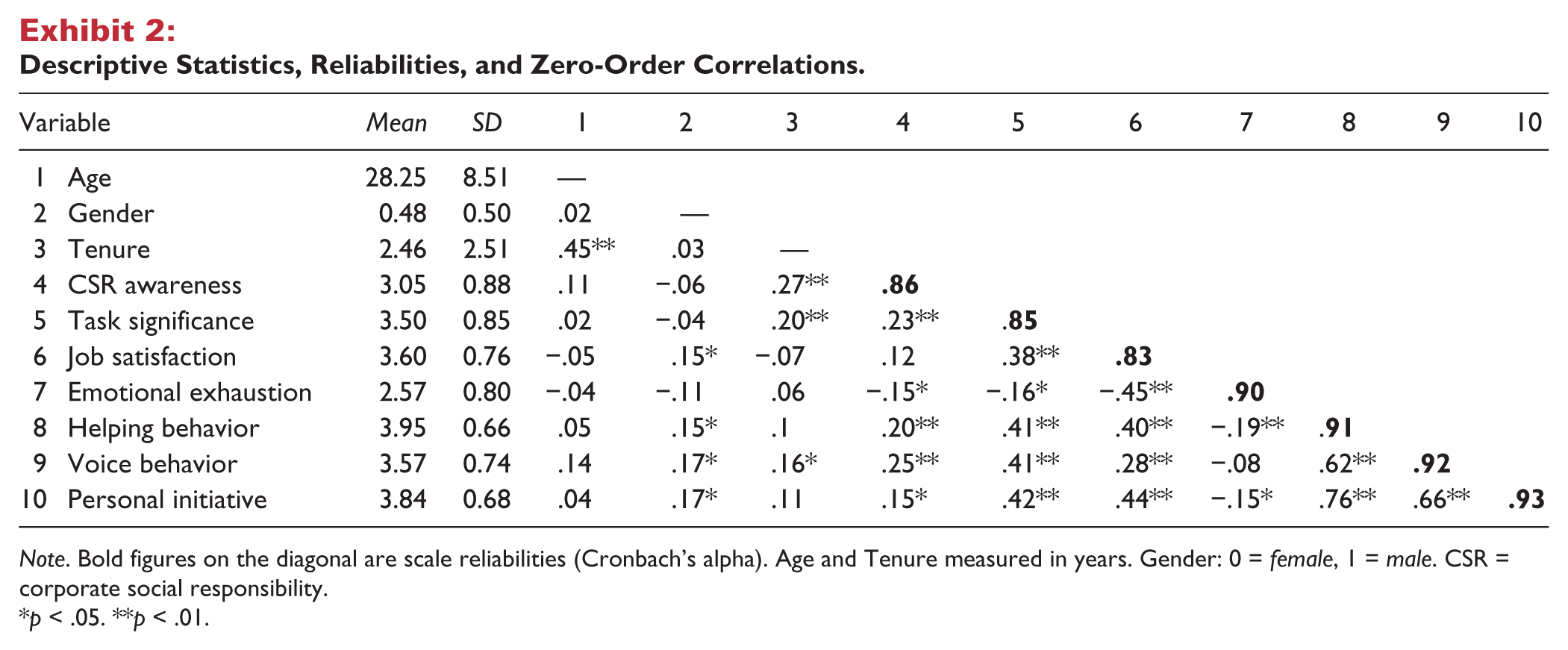
Note. Bold figures on the diagonal are scale reliabilities (Cronbach’s alpha). Age and Tenure measured in years. Gender: 0 = female, 1 = male. CSR = corporate social responsibility.
p < .05. **p < .01.
In an effort to assess the discriminant validity of our key constructs, we conducted a series of confirmatory factor analyses. Results of these confirmatory factor analyses (CFAs) are reported in Exhibit 3. We compared the proposed seven-factor model with three theoretically plausible alternative models, including a one-factor model, a two-factor model separating predictor and outcome variables, and a five-factor model in which the behavioral outcome measures were collapsed into a single factor. The results reveal that the seven-factor model shows acceptable fit to the data (normed fit index [NFI] = .85, comparative fit index [CFI] = .88, incremental fit index [IFI] = .88, root mean square error of approximation [RMSEA] = .11) and, more importantly, also fits the data significantly better than the alternative models.
Results of Confirmatory Factor Analysis.
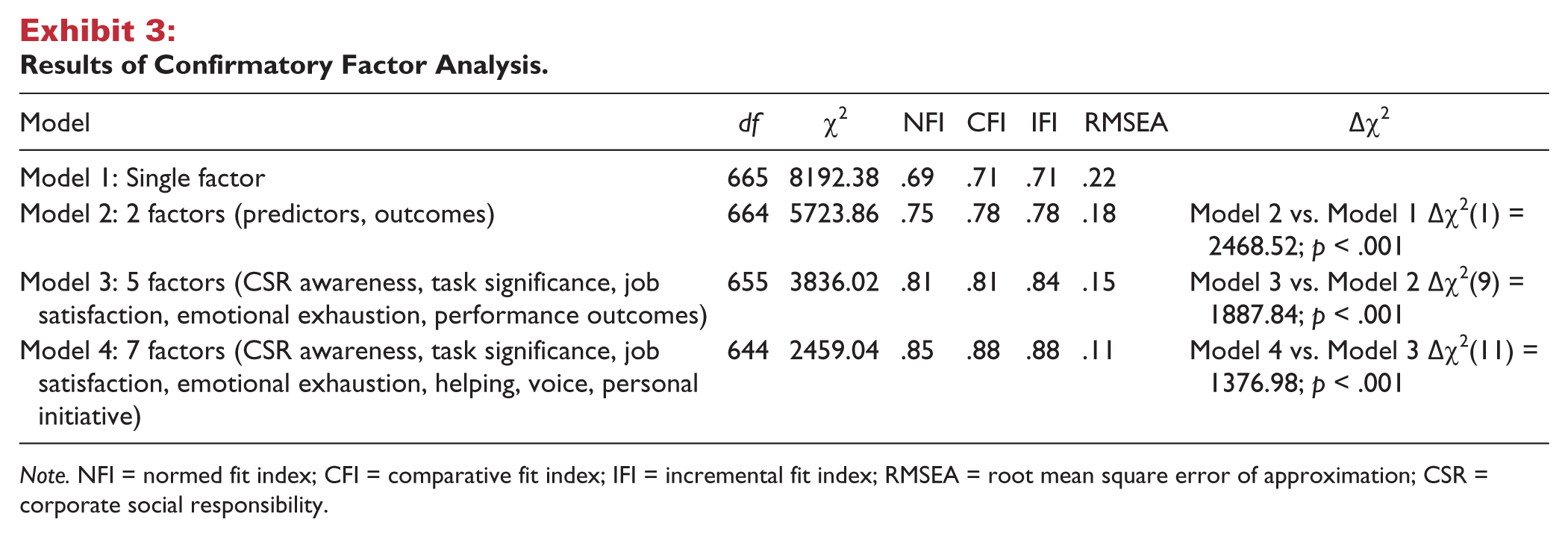
Note. NFI = normed fit index; CFI = comparative fit index; IFI = incremental fit index; RMSEA = root mean square error of approximation; CSR = corporate social responsibility.
To assess the hypothesized mediated model, we applied the widely used Baron and Kenny (1986) procedure. As a first step, we assessed whether CSR awareness was positively related to task significance (our presumed mediator). As shown in Exhibit 4, when controlling for age, gender, and tenure, CSR awareness predicts task significance (β = .18, p < .05). This result provides support for hypothesis 1 and indicates that the first condition of the Baron and Kenny procedure is fulfilled.
Mediation Analysis—Step 1.
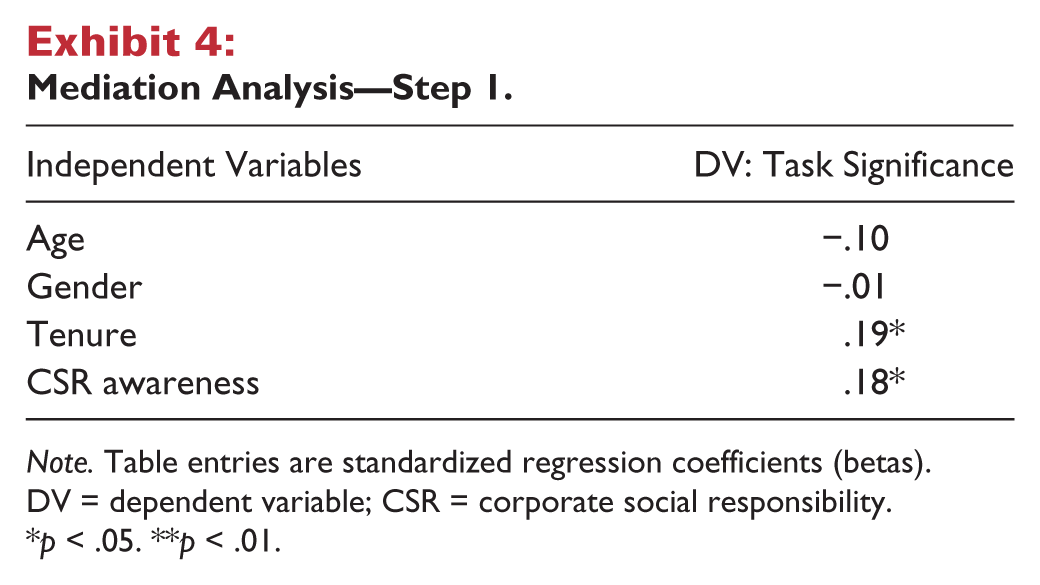
Note. Table entries are standardized regression coefficients (betas). DV = dependent variable; CSR = corporate social responsibility.
p < .05. **p < .01.
As a second step, we tested whether CSR awareness predicted the outcome variables (while controlling for age, gender, and tenure), with the results shown in Exhibits 5 and 6 under “Model 1.” As predicted, CSR awareness was positively related to job satisfaction (β = .15, p < .05), helping behavior (β = .21, p < .01), voice behavior (β = .22, p < .01), and personal initiative (β = .16, p < .05), and was negatively related to emotional exhaustion (β = −.19, p < .05).
Mediation Analysis—Steps 2 and 3 for Job Attitudes.
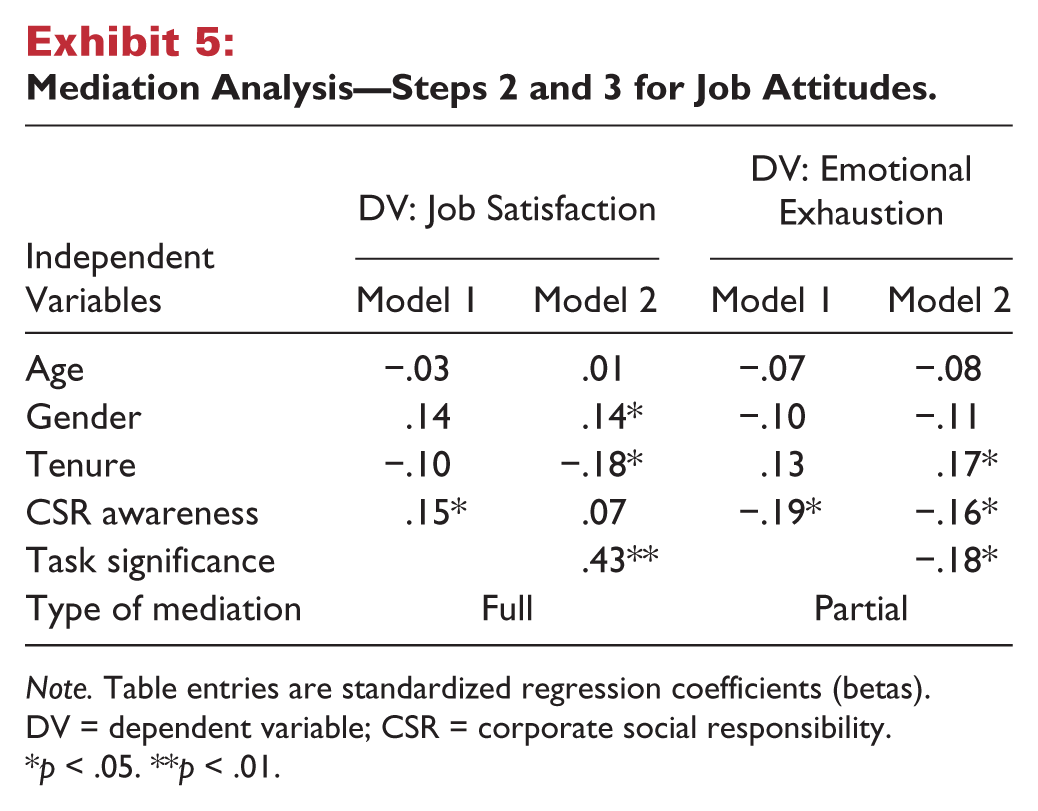
Note. Table entries are standardized regression coefficients (betas). DV = dependent variable; CSR = corporate social responsibility.
p < .05. **p < .01.
Mediation Analysis—Steps 2 and 3 for Behavioral Outcomes.

Note. Table entries are standardized regression coefficients (betas). DV = dependent variable; CSR = corporate social responsibility.
p < .05. **p < .01.
The third step in the Baron and Kenny (1986) procedure consists of examining a model in which the independent variable (CSR awareness) and the mediator (task significance) are jointly introduced as predictors of an outcome variable. These models are designated as “Model 2” in Exhibits 5 and 6. For mediation to occur, the effect of the independent variable should be reduced in the last step of the analysis. Full mediation occurs if this effect becomes nonsignificant. A reduced but still significant regression coefficient for the independent variable provides evidence for partial mediation.
As shown in Exhibits 5 and 6, the introduction of task significance in Model 2 leads to a reduction in the effect of CSR awareness for every outcome variable.
In the case of job satisfaction (β = .15, p < .05 → β = .07, ns) and personal initiative (β = .16, p < .05 → β = .09, ns), the nonsignificant regression coefficients for CSR awareness provide evidence for full mediation. For emotional exhaustion (β = −.19, p < .05 → β = −.16, p < .05), helping behavior (β = .21, p < .01 → β = .15, p < .05), and voice behavior (β = .22, p < .01 → β = .16, p < .05), the results provide evidence for partial mediation. Taken together, these results provide support for hypotheses 2 through 5.
Discussion
Implications for Theory
From a theoretical perspective, the findings of this research provide support for the notion that corporate engagement in CSR initiatives can have beneficial effects for an important stakeholder group, namely, current employees. Whereas previous research provides evidence for the impact of engagement in CSR on an organization’s financial performance (e.g., Cochran and Wood 1984; Johnson and Greening 1994; McGuire, Sundgren, and Schneeweis 1988), as well as on its reputation and attractiveness in the labor market (e.g., Greening and Turban 2000; Turban and Greening 1996), its impact on the workforce has not been studied to a similar extent. The fact that awareness of CSR initiatives is positively related to discretionary work behaviors (including OCB and personal initiative) and negatively related to emotional exhaustion is of particular relevance to the service industries in general, and the hospitality industry in particular, given the importance of these work behaviors in a service context and the frequent strain put on employees’ emotional resources that are characteristic for the industry.
These results also underscore the importance of task significance as a mediating mechanism in this relationship. When employees are aware of corporate engagement in CSR, they perceive that together with their organization, they can make a positive difference for other people and for the environment. This perception of “meaningful work” plays an important role in transmitting the effect of CSR awareness on the outcomes we studied. These results also underscore the importance of task significance as an important work design variable that has long been neglected by research and has recently benefited from a surge of interest among organizational researchers (Grant 2008).
Limitations
As with all research, this study has a number of limitations. The use of measures obtained from employees may suggest possible concerns about common method bias. Also, the cross-sectional design of our study does not allow for drawing conclusions about causal relationships. Finally, the fact that our sample of employees was drawn from a limited number of establishments of a single organization operating in a single country and a specific segment of the hospitality industry limits the generalizability of our results. Future replications and extensions of this study should attempt to investigate these relationships with multiple measures obtained from different cultural and industry contexts, and, if possible, use a longitudinal design.
Implications for Practice
From the viewpoint of hospitality industry practice, the most important implication of our findings is that when hospitality organizations engage in CSR activities and make their employees aware of these activities, they can reap substantial benefits in terms of improved job attitudes and greater engagement in discretionary work behaviors. This is an important finding because research suggests that engagement in CSR may be driven by the objective of projecting a better image to financial investors, potential customers, or potential employees, or may simply reflect a trend to follow the latest management fashion (Abrahamson and Fairchild 1999), rather than being explicitly focused on promoting outcomes at the level of the organization’s employees. When engagement in CSR is not motivated by an explicit concern for the attitudes and performance of current employees, it is more likely that organizations miss out on multiple opportunities of making their employees aware of ongoing CSR initiatives. However, this study suggests that it is the employees’ awareness of these initiatives that drives results. Observation of CSR practices in the organization under investigation in our study and discussion with managers revealed multiple starting points for thinking about how hospitality businesses can foster greater awareness of corporate CSR initiatives in their employees.
An important facilitating factor for fostering such an awareness seems to be the extent to which CSR initiatives are closely linked to and integrated with the organization’s core business. Employees are more likely to be aware of CSR initiatives that demonstrate a visible impact in their immediate work environment. For instance, a hospitality firm’s engagement in promoting sustainable development through the local sourcing of food products or its pledge to contribute to energy conservation through the systematic use of energy-saving technologies in its properties is more likely to contribute to the employees’ awareness of CSR initiatives than is a development project in a country that is thousands of miles away or a sponsorship of a lofty cultural event. In essence, employees will more readily perceive the organization’s core business as meaningful when they have the opportunity to observe how the organization is doing good in their daily work environment.
A second facilitating factor for greater awareness of CSR initiatives is their degree of “localization.” Engagement in CSR is frequently guided by overarching corporate policies. Greater awareness at the level of the organization’s employees can be achieved when sizable portions of the planning and execution of concrete CSR-related activities are left to lower levels of the hierarchy (i.e., to decision makers in individual hotel properties). For instance, appointing a “local CSR champion” in each property puts a face on the organization’s engagement, facilitates rapid decision-making, fosters widespread participation, and allows recognition and rewarding of special efforts of individual team members.
A related factor is the effective communication of CSR initiatives. It is not sufficient to inform employees by newsletter that the organization is supporting a particular charity. To identify with and derive meaning from CSR initiatives, employees need to be able to understand why a company is engaging in the chosen initiative and how this initiative is contributing to the welfare of others. This requires not only continuity and coherence in the company’s engagement in CSR but also well-orchestrated communication efforts to help employees understand on a continuous basis what drives the organization’s CSR philosophy, what concrete positive impact can be generated through engagement in CSR, and possibly also how employees themselves can contribute to the ongoing success of these initiatives.
Last but not least, awareness of organizational engagement in CSR can be facilitated when CSR initiatives are implemented in such a way that they allow for active participation of employees. Personal involvement fosters a better understanding of what the company is trying to achieve. If the participation in CSR initiatives brings the possibility of direct contact with beneficiaries of these efforts, task significance can be enhanced, direct connection to the daily work can be ensured, and positive effect of the participation can be sustained.
Footnotes
Declaration of Conflicting Interests
The author(s) declared no potential conflicts of interest with respect to the research, authorship, and/or publication of this article.
Funding
The author(s) received no financial support for the research, authorship, and/or publication of this article.