




Abstract
This research draws on regulatory focus theory to explore how to effectively advertise technology-based hospitality services. In an experiment, we compare four types of service ads: narrative-comparative, narrative-noncomparative, list-comparative, and list-noncomparative. Results reveal that narrative-comparative ads, portraying a superior service experience with the advertised brand against its competitors, can elicit gain perceptions, and therefore, they are more effective among promotion-focused individuals than their more prevention-focused counterparts. Conversely, list-comparative ads, presenting attributes of the advertised brand and its competitors side-by-side, can induce either gain or loss perceptions, thus being effective among both promotion-focused and prevention-focused individuals. With no mention of a reference brand, noncomparative ads fail to generate regulatory fit thereby being less persuasive. Managerial implications for hospitality marketers are discussed.
The boom of information technology (IT) creates new opportunities for the hospitality industry to delight its sophisticated customers (Law, Leung, & Au, 2013). More and more hospitality operators have recognized the critical role of IT in value creation and service differentiation. For example, Starwood recently introduced a keyless check-in app that enables guests to bypass the front office. Clearly, hospitality firms strive to incorporate the latest IT into their services to establish a sustained competitive advantage (Piccoli, 2008). A burning question for marketers is, how can we effectively advertise these IT-enabled competitive advantages?
Hospitality researchers are increasingly utilizing message-framing strategies to maximize communication effectiveness (S. A. Lee & Oh, 2014). In the lodging sector, previous research has explored the persuasiveness of substantive versus associative claims (Hu, 2012), emotional versus rational appeals (Mattila, 2001), positive versus negative message frames (Kim & Kim, 2014), and gain versus loss frames and high versus low proximity frames (Blose, Mack, & Pitts, 2015). While message framing has become an important research topic, the hospitality field has not considered the effects of comparative framing (Grewal, Kavanoor, Fern, Costley, & Barnes, 1997; Jackson, Brown, & Harmon, 1979; Wilkie & Farris, 1975), where the focal company is compared with another company in an advertisement.
Drawing on the regulatory focus theory (Crowe & Higgins, 1997; Higgins, 1998), this study examines the effectiveness of comparative advertising in promoting new technologies. Utilizing an experimental design, the current study strives to answer the following questions: Are comparative ads more persuasive than noncomparative ads in promoting technology-based hospitality services? What role does regulatory focus play in influencing consumers’ responses to comparative ads and noncomparative ads? Do consumers process narrative and list ads differently? The study findings will help hospitality marketers gain a better understanding of comparative advertising.
Background Literature
IT in the Hospitality Industry
Since the adoption of computer hardware and software by hospitality operators in the 1980s, IT has become a powerful force driving the hospitality industry (Law et al., 2013; Piccoli, 2008). While there is extensive literature examining IT from the operations and revenue management perspective (Law et al., 2013; O’Connor & Murphy, 2004; Siguaw, Enz, & Namasivayam, 2000), research viewing hospitality technology as a marketing tool is scant. This neglect is surprising as attracting guests with novel technology-based services (e.g., mobile check-in, wireless charging stations) is gaining popularity. Indeed, service differentiation and value creation are critical in strengthening brand competitiveness (Barney, 1991; Porter, 2008). Novel hospitality technologies such as robotic butlers are likely to provide a more memorable experience, thus creating extra value for the customer. Therefore, hospitality operators should strategically communicate their unique technology-based service offerings to consumers. We argue that comparative advertising might be particularly effective in the hospitality context as consumers have a natural tendency to compare existing options and they value unique and special experiences (Bettman, Luce, & Payne, 1998; Keinan & Kivetz, 2011; Zauberman, Ratner, & Kim, 2009).
Regulatory Focus
Regulatory focus theory distinguishes between two motivational orientations in goal pursuit: a promotion focus, which is concerned with achievement and growth, and a prevention focus, which is concerned with responsibilities and safety (Higgins, 1997, 1998). As a result, promotion-focused individuals are motivated to maximize the occurrence of positive outcomes and are driven toward gains. In contrast, prevention-focused individuals strive to minimize the occurrence of negative outcomes; therefore, they tend to exhibit heightened vigilance against losses (Crowe & Higgins, 1997; Higgins, 1998, 2002).
Previous research on regulatory fit suggests that when people pursue goals in a strategic manner that sustains their regulatory orientations, they “feel right” about what they are doing. Such fit feelings, in turn, influence their subsequent judgments and evaluations (Aaker & Lee, 2006; Avnet & Higgins, 2006; Cesario, Grant, & Higgins, 2004; Higgins, 2000; Higgins, Idson, Freitas, Spiegel, & Molden, 2003). For instance, A. Y. Lee and Aaker (2004) demonstrate that advertising appeals presented in a gain frame are more persuasive for health-promoting products, whereas loss-framed appeals are more persuasive for disease-preventing products. Regulatory fit also has a powerful impact on consumers’ perceived value. Avnet and Higgins (2003) show that people are willing to pay 40% more for the same book-light when there is (vs. is not) a fit between the strategy used in choosing the book-light and the consumer’s regulatory orientation.
Regulatory Fit in Comparative Advertising
Two prior studies have explored regulatory fit in the context of comparative advertising (Jain, Agrawal, & Maheswaran, 2006; Jain, Lindsey, Agrawal, & Maheswaran, 2007). Findings of these two studies suggest that an ad message emphasizing a brand’s superiority over its competitors is more effective among promotion-focused individuals due to their focus on gains, whereas stressing competitors’ inferiority is more effective among prevention-focused individuals whose focus is on avoiding losses. The current study extends their findings by contrasting the persuasiveness of comparative advertising against noncomparative advertising. We speculate that people with a promotion (prevention) goal are eagerly seeking gains (vigilantly avoiding losses); therefore, they tend to interpret comparative ads in a manner that fits their regulatory goals. This regulatory fit, in turn, will transfer into higher levels of purchase intention toward the advertised brand (Aaker & Lee, 2006; Avnet & Higgins, 2003, 2006). In contrast, with no mention of a reference brand, noncomparative ads fail to trigger gain or loss perceptions, thus they will not boost purchase intention.
We examine narrative ads and list ads separately as presentation format influences consumers’ information processing strategies (Adaval & Wyer, 1998; Boller, 1988; Mattila, 2000; Padgett & Allen, 1997). Narratives portray the audience as a character in the story (Padgett & Allen, 1997) and they tend to lead to a greater transportation into an experience and reduced cognitive counterarguing (Escalas, 2004; Green & Brock, 2000). Narrative-comparative ads depict a superior service experience with the advertised brand against its competitors. Consequently, narrative-comparative ads should be particularly persuasive among promotion-focused individuals (Jain et al., 2006, Jain et al., 2007). On the contrary, such ads might not be as effective among prevention-focused individuals because there is no explicit information about loss avoidance or inferiority. Taken together, narrative-comparative ads are expected to be effective among promotion-focused individuals. Formally,
In contrast, the list format facilitates the audience to actively compare the advertised brand and its competitor on an attribute-by-attribute basis (Swinyard, 1981), and such a process is characterized with increased cognitive elaboration and analytical processing (Muehling, Stoltman, & Grossbart, 1990; Thompson & Hamilton, 2006). Due to people’s motivational states of goal pursuit, the same list-comparative ad can lead to different perceptions: People with a promotion focus tend to interpret the ad as “attaining advantages by choosing the advertised brand,” while those with a prevention focus are likely to perceive the same message as “avoiding disadvantages by preferring the advertised brand.” This experience of regulatory fit is expected to boost purchase intention (Aaker & Lee, 2006; Avnet & Higgins, 2003, 2006). In sum, we propose that comparative ads in a list format are persuasive among both promotion-focused and prevention-focused individuals. Accordingly, we put forth the following hypotheses:
Method
Participants
Amazon Mechanical Turk was used to recruit U.S. adult participants online. 1 Mechanical Turk features a diverse nationwide pool of consumers and provides high-quality data (Buhrmester, Kwang, & Gosling, 2011; Paolacci, Chandler, & Ipeirotis, 2010). Prior hospitality research has utilized Amazon Mechanical Turk to collect data (Mattila & Choi, 2014; Wu, Mattila, & Han, 2014). Each participant received 50 cents for completing the study. A total of 254 usable responses were received. As shown in Table 1, the sample was 69% male and between the ages of 18 and 72 years (M = 30 years). Although the sample had more male participants, the proportion of male participants did not differ across experimental conditions, and gender was not statistically significant in the data analyses. The median income was US$40,000 to US$59,999, and median education was a 4-year college degree. For usage frequency, participants reported an average of seven hotel nights per year and 77% of them stayed three nights or more.
Characteristics of the Participants (N = 254).

Study Design and Stimuli
A “keyless check-in” service, which has gained growing attention in the lodging industry (Karmin, 2014; Trejos, 2014), was used as a context to test our proposed interaction effect of regulatory focus and comparison framing under different ad presentation formats. Although a keyless check-in service might not be the most important factor in hotel booking decisions, we aim to show that such a feature can significantly boost consumers’ purchase intention when properly advertised.
The study employed a 2 (regulatory focus: promotion vs. prevention) × 2 (comparison framing: comparative vs. noncomparative) × 2 (presentation format: narrative vs. list) between-subjects design. Regulatory focus was primed via an ostensibly unrelated task, whereas presentation format and comparison framing were manipulated using four different advertisements. A summary of the experimental conditions is presented in Figure 1.
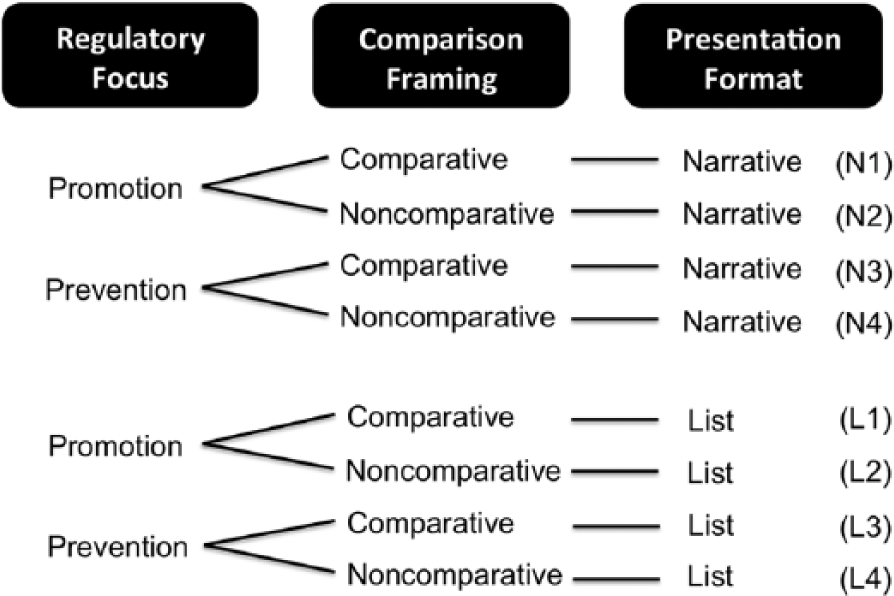
Experimental conditions.
First, participants were randomly assigned to the two regulatory focus conditions. Regulatory focus was primed using a well-established procedure (Higgins, Roney, Crowe, & Hymes, 1994; Liberman, Molden, Idson, & Higgins, 2001; Scholer, Ozaki, & Higgins, 2014). Participants in the promotion focus condition were asked to write down their current “hopes and aspirations” and explain how the current “hopes and aspirations” differ from those they had when growing up. Conversely, participants in the prevention focus condition were instructed to write down their current “duties and obligations,” the differences between their current “duties and obligations,” and those they had when growing up.
Next, participants were randomly assigned to view an advertisement featuring a “keyless check-in” service at a fictitious hotel (Royal Crown). They were told the following prior to their exposure to the ad: “Imagine that Royal Crown Hotel is located in a city you are traveling to. Please examine the following hotel advertisement.” There were four versions of the ad: narrative-comparative, narrative-noncomparative, list-comparative, and list-noncomparative. The narrative-comparative ad used a story-telling style to actively convey how the check-in experience at Royal Crown is superior to its major competitors, whereas the narrative-noncomparative ad did not contain any comparison information (see Appendix A). The list-comparative ad presented attributes of the check-in process at Royal Crown versus its major competitors and let the consumer decide which attribute was superior or inferior, whereas the list-noncomparative ad excluded the competitor information (see Appendix B). Finally, participants indicated their purchase intention and loss–gain perceptions, and responded to manipulation check questions and demographic questions.
Measures
Purchase intention was measured via a three-item scale: unlikely = 1/likely = 7, impossible = 1/possible = 7, and improbable = 1/probable = 7 (Cronbach’s α = .92), adapted from Mattila (2000) and Yi (1993). To gain insight into whether the ads induced loss–gain perceptions, we asked participants the extent to which the ad suggested that choosing the Royal Crown would enable them to avoid disadvantages = 1/have advantages = 7, avoid a loss = 1/achieve a gain = 7, and avoid the inferior experience = 1/have the superior experience = 7 (Cronbach’s α = .77). For the regulatory focus manipulation, we asked participants to indicate the extent to which the information they provided about themselves was focused on “responsibilities = 1/hopes = 7” and “obligations = 1/aspirations = 7” (r = .89, p < .001).
Results
Manipulation Checks
There was a significant difference in the manipulation check between the prevention focus (M = 2.35) and promotion focus condition (M = 5.70), t(252) = 16.56, p < .001. There was also a significant difference in the manipulation check between the narrative format (M = 2.11) and list format conditions (M = 6.28), t(252) = 23.76, p < .001. In addition, there was a significant difference in the manipulation check between the noncomparative (M = 2.57) and comparative conditions (M = 5.62), t(252) = 14.01, p < .001. Finally, the mean rating on stimuli realism was 5.60, indicating that participants in this study perceived the stimuli to reflect real-life hotel ads. In conclusion, our experimental manipulations were effective.
Results of the Narrative Format
We first examine ads in a narrative presentation format. A Regulatory Focus × Comparison Framing two-way ANOVA was performed on loss–gain perceptions (see Figure 2). Results revealed a main effect of regulatory focus, F(1, 127) = 6.52, p < .05, and a Comparison Framing × Regulatory Focus interaction, F(1, 127) = 6.61, p < .05. A series of planned contrasts with one-tailed tests (Aaker & Lee, 2001) showed that promotion-focused individuals experienced greater gain perceptions when the ad was comparative (M = 6.34) rather than noncomparative (M = 5.46), t(127) = 2.83, p < .01. As expected, such a difference was not detected among prevention-focused individuals, t(127) = 0.78, ns. These findings are congruent with Hypothesis 1.
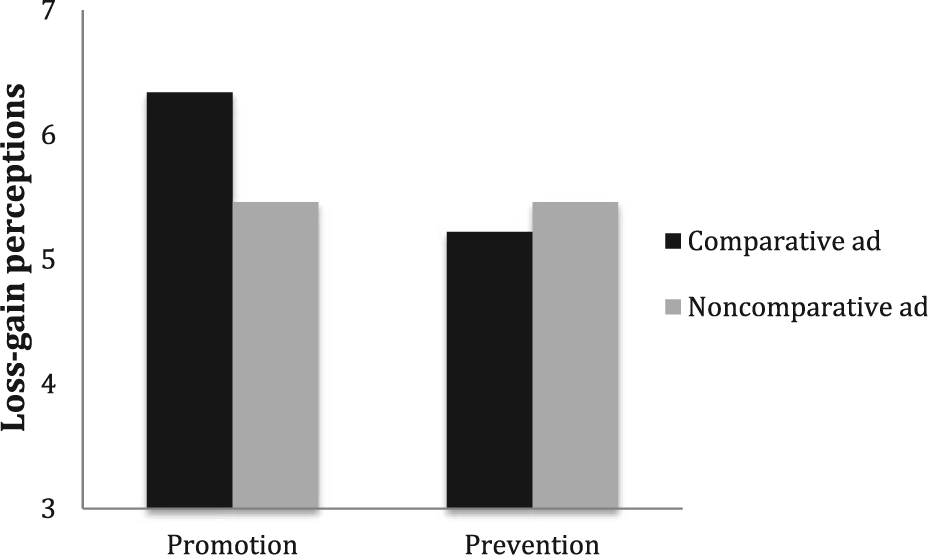
Effects of regulatory focus and comparison framing on loss–gain perceptions (narrative format).
To test Hypothesis 2, we ran a two-way ANOVA on purchase intention (see Figure 3). There were main effects of comparison framing, F(1, 127) = 4.65, p < .05, and regulatory focus, F(1, 127) = 4.88, p < .05, but these two main effects were qualified by a significant Comparison Framing × Regulatory Focus interaction, F(1, 127) = 3.94, p < .05. The patterns were similar to those of loss–gain perceptions. Results suggested that promotion-focused individuals exhibited higher levels of purchase intention when the ad was comparative (M = 5.64) as opposed to noncomparative (M = 4.71), t(127) = 2.89, p < .01; in contrast, comparison framing had no effect among prevention-focused individuals, t(127) = 0.39, ns. Thus, Hypothesis 2 is supported.
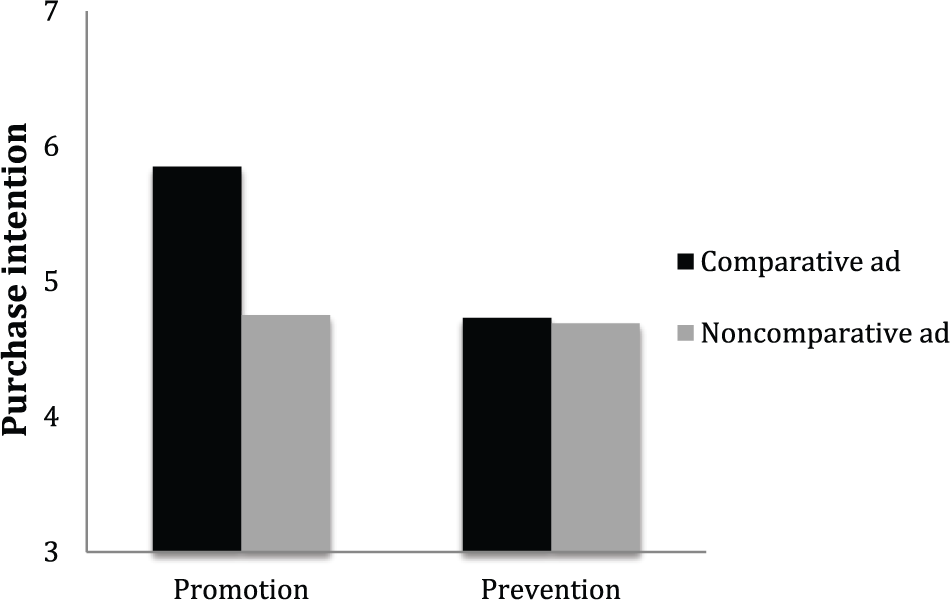
Effects of regulatory focus and comparison framing on purchase intention (narrative format).
Results of the List Format
We then examine ads in a list presentation format. A two-way ANOVA on loss–gain perceptions (see Figure 4) revealed a main effect of regulatory focus, F(1, 119) = 5.16, p < .05, and a Comparison Framing × Regulatory Focus interaction, F(1, 119) = 7.35, p < .01. Consumers’ regulatory focus drove their loss–gain perceptions: promotion-focused individuals experienced higher gain-approach perceptions with the comparative (vs. noncomparative) ad (M = 6.34 vs. M = 5.46), t(119) = 1.85, p < .05; prevention-focused individuals, conversely, indicated greater loss-avoidance perceptions with the comparative (vs. noncomparative) ad (M = 4.83 vs. M = 5.52), t(119) = 1.97, p < .05. Thus, Hypotheses 3a and 3b are also supported.
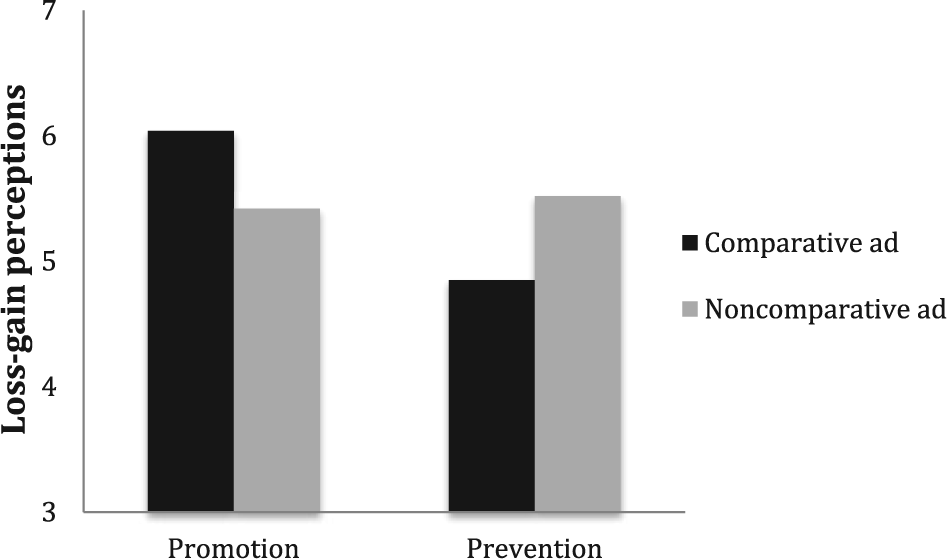
Effects of regulatory focus and comparison framing on loss–gain perceptions (list format).
To test Hypothesis 4, we conducted a two-way ANOVA on purchase intention (see Figure 5). Results revealed a main effect of comparison framing, F(1, 119) = 10.23, p < .01. As expected, promotion-focused individuals exhibited higher levels of purchase intention when the ad was comparative (M = 5.42) as opposed to noncomparative (M = 4.47), t(119) = 2.65, p < .01. Similarly, prevention-focused individuals also exhibited higher levels of purchase intention when the ad was comparative (M = 5.48) rather than noncomparative (M = 4.80), t(119) = 1.87, p < .05. These findings are congruent with Hypothesis 4.

Effects of regulatory focus and comparison framing on purchase intention (list format).
Please note that results from 2 × 2 × 2 ANOVAs showed that the three-way interactions did not reach significance (see Table 2). Hence, the two different patterns of 2 × 2 interactions for narrative and list formats, respectively, though consistent with expectations, were not significantly different due to insufficient power. A summary of cell means is provided in Table 3.
2 × 2 × 2 ANOVA Table for Loss–Gain Perceptions and Purchase Intention (N = 254).
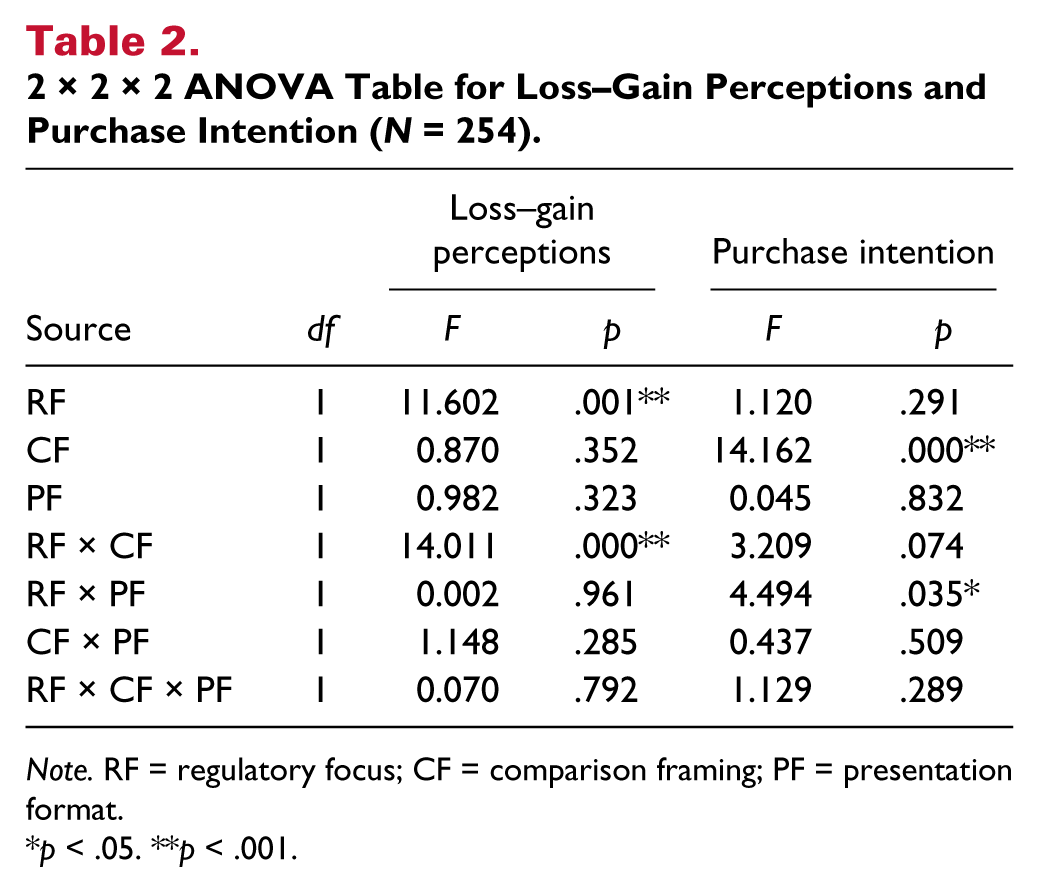
Note. RF = regulatory focus; CF = comparison framing; PF = presentation format.
p < .05. **p < .001.
Cell Means (Standard Errors) for Loss–Gain Perceptions and Purchase Intention.

Discussion
Our findings contribute to the hospitality literature in several ways. First, our findings demonstrate that comparative advertising enhances persuasion by taking advantage of consumers’ motivation to attain gain (promotion goals) or avoid losses (prevention goals). Moreover, the study findings provide insight into how gain- or loss-related perceptions influence consumers’ purchase intention. These findings are consistent with previous regulatory fit research showing that the experience of regulatory fit can transfer into consumers’ evaluation of an advertised product (Cesario et al., 2004; Crowe & Higgins, 1997; Higgins, 1998). Using noncomparative ads as a control condition, we show that noncomparative ads fail to trigger consumers’ loss or gain perceptions, and consequently, they do not benefit from a boost of regulatory fit. In sum, our findings suggest that regulatory focus is an important factor in understanding consumers’ reactions to hospitality/service advertising.
Second, this study identifies presentation format as a critical boundary condition in comparative advertising. To the best of our knowledge, previous research has failed to contrast the narrative and list formats in a single study. More importantly, the current study examines how regulatory focus affects consumer responses to comparative ads across different presentation formats. The findings of this study suggest that the interpretation of gains and losses is more flexible with comparative ads in a list (vs. narrative) format. Specifically, the list format enables consumers to actively adopt a viewpoint (i.e., attaining advantages or avoiding disadvantages) that matches their regulatory focus, and such a “fit” experience elevates consumers’ purchase intention. Therefore, the present study also adds to the hospitality/service advertising literature by demonstrating an interactive effect between regulatory focus and ad presentation format on persuasion.
Finally, previous research on regulatory focus and comparative advertising has mainly focused on material goods rather than experiential services. This neglect is surprising as recent research shows that consumers may engage in different decision-making processes when evaluating services versus goods (Bolton & Alba, 2006; Carter & Gilovich, 2010, 2012; Rosenzweig & Gilovich, 2012). The current study addresses this gap by examining regulatory focus theory and comparative advertising in a service context.
Managerial Implications
Despite the increasing importance of innovative technologies, only a few hospitality companies have considered using comparative messages to highlight their superiority. The findings of this study indicate that it is important to understand that consumers have different regulatory goals and these goals make them more susceptible to certain types of messages. For example, consumers with a promotion goal seek for opportunities to attain gains or advantages, whereas consumers with a prevention goal focus on avoiding losses or disadvantages. Consequently, hospitality marketers can highlight their unique technology-based offerings by creating comparisons with other companies who are less innovative. Such comparative advertisements imply that consumers can attain advantages or avoid disadvantages by choosing the focal brand, thus enhancing consumers’ purchase intention.
Many hospitality companies are striving to attract consumers with new service technologies. For example, Marriott and JetBlue have become the first major hotel chain and airline to accept Apple Pay. Starbucks has introduced free wireless charging for smartphone in select stores and McDonald’s is planning to make wireless charging spots available in 2,000 restaurants by 2016. The findings of this study suggest that these hospitality companies should use comparative advertising to highlight their superior IT offerings. Hospitality marketers can create comparative advertisements based on ad examples in our study (see Appendices A and B). Thus, the current study offers hospitality managers a novel means to enhance their advertising effectiveness.
Moreover, hospitality marketers should consider the role of presentation format when creating comparative advertisements. While the narrative format elicits gain perceptions and as such is particularly effective among promotion-focused consumers (e.g., U.S. consumers), the list format can generate either gain or loss perceptions, depending on the viewer’s regulatory focus. Consequently, the list format appeals to both promotion-focused and prevention-focused consumers. When it is difficult to assess the target market’s regulatory focus or when the target market has mixed regulatory orientations (e.g., Hong Kong, Singapore), the list format might be more effective.
Limitations and Future Research
As any experiment, this study has several limitations. First, we used ad stimuli for a hypothetical hotel brand. It is possible that other factors, such as familiarity or prior experience with the brand, might affect consumers’ evaluations. Second, we measured participants’ purchase intention rather than actual purchase behaviors. To overcome these limitations, empirical investigations in a field setting are needed. Third, because this research was limited to a single study, replications and extensions to other types of experiential services are needed for enhanced generalizability. Finally, the sample was U.S. consumers. Future research should examine potential cross-cultural differences.
This study is an initial examination of comparative advertising in the hospitality industry. Future research is needed to gain a better understanding of how consumers process comparative messages and what other factors influence advertising effectiveness. One direction is to look into the role of power in influencing information processing (Choi & Mattila, 2014). Another potential direction is to explore comparative advertising in the context of pricing and sales promotions.
Footnotes
Appendix
Declaration of Conflicting Interests
The author(s) declared no potential conflicts of interest with respect to the research, authorship, or publication of this article.
Funding
The author(s) disclosed receipt of the following financial support for the research, authorship, or publication of this article: The authors thank the Marriott Foundation for the funding of this research.