



Abstract
The purpose of this study was to examine the effects of restaurant employees’ social perceptions of their supervisors on employees’ work engagement and extra-role customer service behavior. We also assessed restaurant employees’ social perceptions of their coworkers as a moderator. Utilizing an online survey design, data were collected from frontline restaurant employees via an online commercial subject pool (N = 477). Results showed that the more employees perceive their supervisors as warm, competent, and moral, the more employees were willing to engage in extra-role customer service behavior via the indirect effect of increased work engagement. The effect of work engagement on extra-role customer service was also found to be more pronounced when employees developed positive social perceptions of their coworkers. These results offer implications for work engagement, as they suggest a new antecedent in the form of social perceptions, as well as a boundary condition to the positive outcomes of engagement through the interactive effect of social perceptions of coworkers and extra-role customer service behavior. In doing so, these results also shed light on the relevance of social perceptions in hospitality operations.
Keywords
Introduction
Work engagement has become a strategic goal for businesses around the world. Engaged employees are important for organizational effectiveness; they perform better and are more productive (Young et al., 2018). Yet while the percentage of engaged workers in the United States rose slightly in 2018, only 34% were actually engaged while 53% of employees were not engaged. Even more concerning was that 13% of American employees were actively disengaged (Harter, 2018). Nonengaged employees are generally satisfied but not attached to their work or workplace, meaning they show up to work and do the minimum required but they aren’t connected; these employees will leave their company as soon as they obtain a better job offer elsewhere. In comparison, actively disengaged employees are those who have miserable work experiences, often complaining to coworkers, lowering morale, and participating in nonproductive inappropriate behaviors while on the job, including watching Netflix, shopping online, playing pranks on coworkers, or napping (Harter, 2018; Wilkie, 2017). This lost productivity can cost U.S. businesses up to US$550 billion annually (Ray et al., 2017). Conversely, extant research shows that work engagement is linked to positive outcomes such as job satisfaction, organizational commitment, employee performance, and lower absenteeism and turnover (Salanova et al., 2003; Schaufeli & Bakker, 2004; Schaufeli, Martínez, et al., 2002; Schaufeli, Salanova, et al., 2002).
Furthermore, extensive research focused on the quality of work relationships has demonstrated how such relationships can positively impact work engagement and subsequent behaviors. These studies have largely organized work relationships into one of two broad categories of antecedents to employee engagement: leadership, especially leader–member exchange (Breevaart et al., 2015; Christian et al., 2011; Kim & Koo, 2017) and perceived social support (Lee & Ok, 2015; Li et al., 2012; Saks, 2006; Schaufeli et al., 2009; Xanthopoulou et al., 2009). Critically, within these categories of work relationships, both supervisors and coworkers represent important stakeholders who can influence employees’ work engagement and, of particular relevance to the hospitality sector, their service performance.
However, as noted by Lee and Ok (2015), hospitality researchers still need to find additional predictors of work engagement. This is important not only from a theoretical perspective but also from a practical one given that the accommodation and food services sector suffers from much higher turnover rates than the rest of the private sector. According to the U.S. Bureau of Labor Statistics (2019), the accommodation and food services sector had an average turnover rate of 74.9% in 2018 while the overall private sector had an average turnover rate of 49.0%. High turnover is a corollary for high levels of disengagement (Harter, 2018), and companies with disengaged employees tend to be less productive and possess lower customer loyalty than firms with a high-engagement culture (Harter, 2018; Sims, 2015).
This study advances the research on work engagement and hospitality research in three ways. First, we suggest a new antecedent of work engagement: social perceptions. Social perceptions or evaluations are universal dimensions of social cognition, as they help people to quickly evaluate or judge others based on social and professional interactions (Fiske et al., 2007). Social perceptions are comprised of three fundamental dimensions: warmth, competence, and morality. Warmth encompasses traits related to perceived sociability, competence reflects traits associated with perceived ability, and morality portrays traits connected to perceived honesty (Leach et al., 2007). Although social perceptions started to gain researchers’ attention back in the 1940s, a small number of studies have measured their effects in a corporate setting (Cuddy et al., 2011). Indeed, the few organizational behavior studies to measure the effects of social perceptions in hospitality literature focused on four main outcomes: job satisfaction, organizational commitment, turnover intentions, and firm performance (Bufquin, DiPietro, Orlowski, et al., 2017, 2018; Bufquin, DiPietro, Park, et al., 2017; Bufquin, DiPietro, Partlow, et al., 2018). However, social perceptions are so significant that they contribute to as much as 95% of people’s overall evaluations of others (Wojciszke et al., 1998; Wojciszke & Klusek, 1996), and thus in the workplace, they contribute to how employees perceive or judge both their supervisors and their coworkers. Accordingly, given the importance of work relationships in predicting behavior, testing whether social perceptions of supervisors can be an antecedent to work engagement is a clear contribution to the literature.
Second, we consider extra-role customer service behavior as a positive outcome of both social perceptions of supervisors and work engagement. Drawing on attitude theory, we examine work engagement as the linking mechanism between social perceptions of supervisors and extra-role customer service behavior.
Third, we consider the interactional effect of work engagement and social perceptions of coworkers. By introducing social perceptions of coworkers as a boundary condition in the relationship between work engagement and extra-role customer service behavior, this study extends our understanding of how such judgments may enhance or detract from the effect of engagement on workplace outcomes.
In sum, the current study investigates how social perceptions can influence work engagement and subsequent behavior in this specific sector. The specific objectives of this study are threefold: (a) to examine the relationship between social perceptions of supervisors and front-line employee extra-role customer service behaviors; (b) to examine the mediating effect of work engagement on this relationship; and (c) to assess social perceptions of coworkers as a moderator of the mediating effect of work engagement. Due to the importance of supervisors and coworkers in the workplace, the goal is to help restaurateurs improve the ways supervisors and frontline employees are judged or evaluated by their respective subordinates and coworkers to have more engaged employees, so that the latter can adopt service-oriented behaviors. This in turn should improve restaurants’ organizational and financial outcomes (Bates, 2004; Baumruk, 2004; Richman, 2006; Saks, 2006).
Literature Review
Social Perceptions
One of the first authors to study social perceptions was Asch (1946), who described the prominence of two social attributes often used by people when they evaluate others, namely their perceived warmth and competence. Warmth encompasses traits connected to perceived intent, such as friendliness and helpfulness, whereas competence reflects traits associated with perceived ability, including skill, intelligence, creativity, and efficacy (Fiske et al., 2007). In recent years, researchers have demonstrated that warmth and competence are two universal dimensions of human social cognition, both from an individual perspective and a group perspective (Fiske et al., 2007). Although most contemporary research has focused on the warmth and competence constructs, Leach et al. (2007) reported that morality is more important for in-group evaluations than warmth and competence perceptions. Morality, which includes traits such as honesty and trustworthiness, has long been considered by traditional Western psychology as the most important human virtue (MacIntyre, 1984). Interestingly, these three traits are associated with humanness perceptions (Gray et al., 2007; Harris & Fiske, 2009; Haslam, 2006).
Although other studies have used similar constructs, such as impression formation (e.g., Fiske & Neuberg, 1990; Wyer & Srull, 2014) and person perception (e.g., Forgas & Bower, 1987; Swann, 1984), social perceptions represent traits which people use to evaluate others in both social and professional settings (Fiske et al., 2007). Moreover, as mentioned earlier, these traits can be used to evaluate single individuals as well as larger groups (Allport, 1954; Bettelheim & Janowitz, 1950). Furthermore, studies have shown that warmth, competence, and morality perceptions contribute to as much as 95% of people’s overall evaluations of others (Wojciszke et al., 1998; Wojciszke & Klusek, 1996); much more than any other related construct previously developed in social psychology.
Although previous studies have demonstrated that warmth, competence, and morality are distinct in-group characteristics (Leach et al., 2007), a recent study by Bufquin, DiPietro, Orlowski, et al. (2018) showed that warmth and competence perceptions represent a single dimension, thus contradicting a variety of sociological and social psychology studies (e.g., Cuddy et al., 2008; Wojciszke et al., 1998). Similarly, in another study by Bufquin, DiPietro, Orlowski, et al. (2017), a high correlation was found between warmth and competence evaluations (r = .86). A third study also supported the unidimensionality of the social perceptions construct, as Bufquin, DiPietro, Partlow, et al. (2018) revealed through a cluster analysis that restaurant employees tend to evaluate their managers and coworkers in opposing ways: as either warm and competent or as cold and incompetent. Hence, given that social perceptions seem to represent a unique dimension instead of distinct characteristics, the present study will consider warmth, competence, and morality perceptions as a single “social perceptions” dimension, to empirically assess its effects on frontline restaurant employees’ work engagement and extra-role customer service behavior.
Extra-Role Customer Service Behavior
Performance that extends beyond an employee’s “in-role” job requirements has been defined in a number of conceptually comparable ways in organizational literature, including contextual performance, organizational citizenship behavior (OCB), prosocial behavior, and extra-role behavior (Moliner et al., 2008). As the present study is focused on frontline restaurant employees, we concentrate specifically on extra-role customer service behaviors, which are one facet or dimension of Bettencourt and Brown’s (1997) model of prosocial service behaviors. Extra-role customer service behavior refers to the “discretionary behaviors of contact employees in serving customers that extend beyond formal role requirements” (Bettencourt & Brown, 1997, p. 41). These are the behaviors that, in the jargon of the hospitality industry, reflect front-line employees going above and beyond, providing memorable service experiences, and exceeding guest expectations, which in turn influence customer perceptions of service quality and customer satisfaction (Kang et al., 2020). Such behaviors are also critical for effective service recovery (Karatepe, 2015).
Based on evidence from both organizational and hospitality literature, leaders can have an impact on their employees’ service-related behaviors. For example, in a recent study by Tang and Tsaur (2016), a supervisory support climate was found to have a positive effect on the service-oriented OCBs of front-line hotel employees. A supervisory support climate implies that supervisors are concerned about employees’ needs (Eisenberger et al., 2002), while service-oriented OCB is defined as the citizenship behavior (i.e., extra-role behavior) of service employees toward customers (Bettencourt et al., 2001).
In another study of travel agents from Hong Kong, findings indicated that leader–member exchange (LMX) is positively associated with travel agents’ organizational citizenship behavior (Chow et al., 2015). LMX describes the quality of a relationship between an employee and his or her immediate supervisor (Dansereau et al., 1975). Because the quality of such relationships can vary between high and low (Graen & Uhl-Bien, 1995), the social exchange theory (SET) posits that employees generally perceive an obligation to reciprocate high-quality work relationships with their leaders over time (Blau, 1964). Furthermore, SET implies that the fair and ethical treatment displayed by a party is likely to engender the feeling of indebtedness or obligation to reciprocate by engaging in behaviors needed in the work environment (Garba et al., 2018). This was demonstrated by Garba et al. (2018), who found that ethical leadership positively influenced customer-driven OCBs in their study of hotel workers.
Based on this theoretical framework, it is reasonable to suggest that frontline restaurant employees who evaluate their direct supervisors as warm, competent, and moral will want to reciprocate such positive social traits and, as a result, will tend to develop customer-centric behaviors that go beyond their role requirements. As such, we suggest that:
The Mediating Effect of Work Engagement
Work engagement is defined as a positive affective-motivational state of work-related well-being that generally comprises the following three constructs: vigor, dedication, and absorption (Bakker et al., 2008). As Bakker et al. (2008) explain, vigor is characterized by high levels of energy and mental resilience while working. . . . Dedication refers to being strongly involved in one’s work, and experiencing a sense of significance, enthusiasm, inspiration, pride, and challenge. Absorption is characterized by being fully concentrated and happily engrossed in one’s work, whereby time passes quickly and one has difficulties with detaching oneself from work. (p. 188)
Although work engagement can be examined via a three-factor model, literature has shown that a one-factor model is also acceptable and widely used (e.g., Babakus et al., 2017; Cheng & Chen, 2017; Karatepe & Olugbade, 2016; Schaufeli et al., 2006; Zhang et al., 2017).
As a motivational construct, work engagement has been found to play a mediating role, serving as the critical linking mechanism between a number of antecedents and positive work outcomes (Karatepe, 2015; Saks & Gruman, 2014). Saks (2006) found that job and organization engagement mediated the relationships between several antecedents, such as job characteristics, and work outcomes, such as organizational citizenship behaviors. Christian et al.’s (2011) meta-analysis demonstrated that work engagement mediated the relationship between transformational leadership (along with other distal predictors) and both task and contextual job performance.
There is also empirical evidence of work engagement as a mediator in hospitality literature. In a sample of Spanish hotel employees, Molinar et al. (2008) found that procedural and interactional justice indirectly increased extra-role customer service behavior through work engagement. In a series of studies conducted with frontline hotel employees across multiple countries, Karatepe (2011, 2013a, 2013b, 2015) also found support for the mediating effect of work engagement. Although the antecedents varied (e.g., procedural justice, perceptions of organizational politics, high-performance work practices, family support), extra-role customer service behavior was a significant outcome in each study.
Moreover, research has also offered evidence of the relationship between work engagement, leadership, and employee service performance. For instance, a study by Lyu et al. (2016) demonstrated that abusive supervision negatively influenced service employees’ customer-oriented OCB by undermining work engagement. On the contrary, empowering leadership was found to positively influence work engagement, which in turn positively influenced employee service innovation behaviors (Wihuda et al., 2017). Similarly, studies by Li et al. (2012) and by Kim and Koo (2017) both indicated that LMX is positively related to employee job performance, and that work engagement mediates this relationship, thus suggesting the critical role leaders play in fostering work engagement and subsequent performance behaviors. Hence, when employees have good relationships with their immediate supervisors, the former tend to develop increased levels of work engagement, which then ends up improving their service behaviors and performance.
Thus, we suggest that when frontline restaurant employees perceive their immediate supervisors as warm, competent and moral, their work engagement should increase as a result of such positive social perceptions. Furthermore, this heightened work engagement should culminate in the adoption of additional customer service-oriented behaviors by said frontline restaurant employees, as prior literature has shown that engaged employees tend to work hard, remain focused, and put in extra efforts (Kahn, 2010). The proposed influence of social perceptions on extra-role customer service, mediated by work engagement, is supported by the tripartite view of Bagozzi’s (1992) Attitude Theory. This theory suggests that the cognitive evaluations of events, outcomes, and situations precede affective reactions, which in turn influence individuals’ behaviors. As such, frontline restaurant employees who perceive that they work for warm, competent and moral supervisors should have increased work engagement, which would induce them to adopt extra-role customer service behaviors. Based on the aforesaid literature and theory, it is suggested that:
The Moderating Effect of Coworkers’ Warmth, Competence, and Morality
Limited research has examined the influence coworkers may have on an employee’s work engagement and/or work behaviors, including service-related behaviors. Generally, the research that does explore these relationships considers coworkers within the context of some form of support, such as emotional support (Xanthopoulou et al., 2009; Xu et al., 2018), instrumental support (Xu et al., 2018), or a more broadly defined construct of social support (Chen & Kao, 2014; Guchait et al., 2014; Karatepe, 2012; Zhu et al., 2019). Perhaps most directly relevant to the current study are the findings of Guchait et al. (2014), who examined the influence of perceived supervisor and coworker support for error management on hospitality employees’ engagement in service recovery performance. Their results indicated that (a) perceived supervisor and coworker support have direct effects on employee engagement in service recovery performance; (b) perceived supervisor and coworker support have a positive interaction effect on perceived psychological safety; and (c) perceived psychological safety has a significant mediating effect between perceived support and employee engagement. In other words, employees believe that they can freely share their service errors when they perceive having the support of both their supervisors and coworkers, and from such belief, they are then able to engage in service recovery.
However, the findings of other studies also suggest that coworkers can play a critical role with respect to influencing workplace outcomes, and that this role is different than that of supervisors. Susskind et al. (2003) argued that an employee’s relationship with their supervisor and their coworkers is different due to the hierarchical nature of the supervisor–employee dyad; thus interactions between an employee and their coworkers may be more open, warm, and friendly (Zhu et al., 2019). Employees may obtain useful information from their coworkers, which can help them solve job-related problems and address challenging customers (Karatepe, 2012). As noted by Guchait et al. (2014), supportive coworkers tend to share their experiences and how they resolve work-related issues, especially when solutions are not easily at hand. Coworker support also positively influences employee attitudes, including overall morale (Susskind et al., 2003) and work engagement (Xanthopoulou et al., 2009), thus also indirectly leading to improved service performance. Conversely, Xu et al. (2018) found that when employees perceive their coworkers to be emotionally supportive, it attenuates the negative effects of abusive supervision.
Accordingly, we suggest it is likely that an employee’s social perceptions of their coworkers (e.g., warmth, competence, and morality) will impact that employee’s extra-role customer service behavior. More specifically, we suggest that social perceptions of coworkers act as a boundary condition on the relationship between work engagement and extra-role customer service behavior. This implies that the more an employee develops positive social perceptions regarding their fellow coworkers, the more significant the influence of work engagement will be on their respective extra-role service behaviors. Since frontline restaurant employees tend to work more closely with their coworkers than with their immediate supervisors, we suggest that positive social perceptions of their coworkers will enhance the effect of employees’ work engagement on extra-role customer service behaviors in a restaurant setting, because warm, competent and moral coworkers will entice frontline employees to engage in superior service performance.
This suggestion is supported by two theoretical frameworks. The first is Tuckman’s (1965) Teamwork Theory, which posits that for teams to reach the “performing” stage, in which team members focus both on tasks and on team relationships, they must first go through three different stages: forming, storming, and norming. In the “forming” stage, individuals have not yet come together and are finding their place within a team. In the “storming” stage, conflict and confrontation often occur as employees become part of a team. In the “norming” stage, employees start to come together and establish processes, ground rules, and clarify who does what. If employees perceive that they work with warm, competent, and moral coworkers, this implies that they are likely in the “performing” stage, in which the team has a high degree of autonomy and focuses on overachieving goals, while also attending to relationships. In this stage, team members look after each other and focus on the tasks that need to be performed. Moreover, in this stage the team is able to stand on its own with no interference or participation from the leader (Tuckman & Jensen, 1977).
The second theoretical framework is the phenomenon of role models, which is based on the theory of role identification (Gibson, 2003, 2004). A role model refers to an individual who sets examples to be emulated by others, and who may stimulate or inspire other individuals to make certain decisions and achieve certain goals (Basow & Howe, 1980; Shapiro et al., 1978; Wright et al., 1997). Role identification is best described as a cognitive response to an individual’s belief that the characteristics of another person (i.e., the role model) are close to his or her own motivations and character (Kagan, 1958), and that this model plays a desirable role (Bell, 1970). Role identification may result in imitative behaviors and provide someone with the motivation and inspiration to choose a particular direction or activity (Krumboltz et al., 1976). Hence, if frontline restaurant employees perceive that they work with warm, competent, and moral coworkers, their work engagement should lead them to significantly improve their service performance and overdeliver, as employees will be motivated to imitate the attitudes and behaviors of their “model” coworkers. As a result, the following hypothesis is suggested:
The influence mechanisms hypothesized above are delineated by a second-stage moderated mediation model, as portrayed by Figure 1.

Conceptual Model.
Method
Design and Sample
We used an online survey design for this study. All participants were recruited from a Qualtrics commercial subject pool over a 2-week period at a cost of US$10 per useable survey, which targeted U.S.-based frontline restaurant employees. As part of the design, we included a screening question at the beginning of the survey to ensure respondents were employed in a nonmanagerial role in the restaurant industry. A total of 920 responses were collected, and 394 were deleted based on the response to the screening question. An additional 49 responses were deleted for failure to pass embedded attention check questions, leaving a useable sample of 477 (106 males, Mage = 33.1 years ± 12.2 SD). Among the respondents, the mean tenure in the restaurant industry was 3.7 years, 54.5% were full-time employees, and 64.4% were front-of-house employees. Additional demographics of the sample are provided in Table 1.
Demographic Profile.
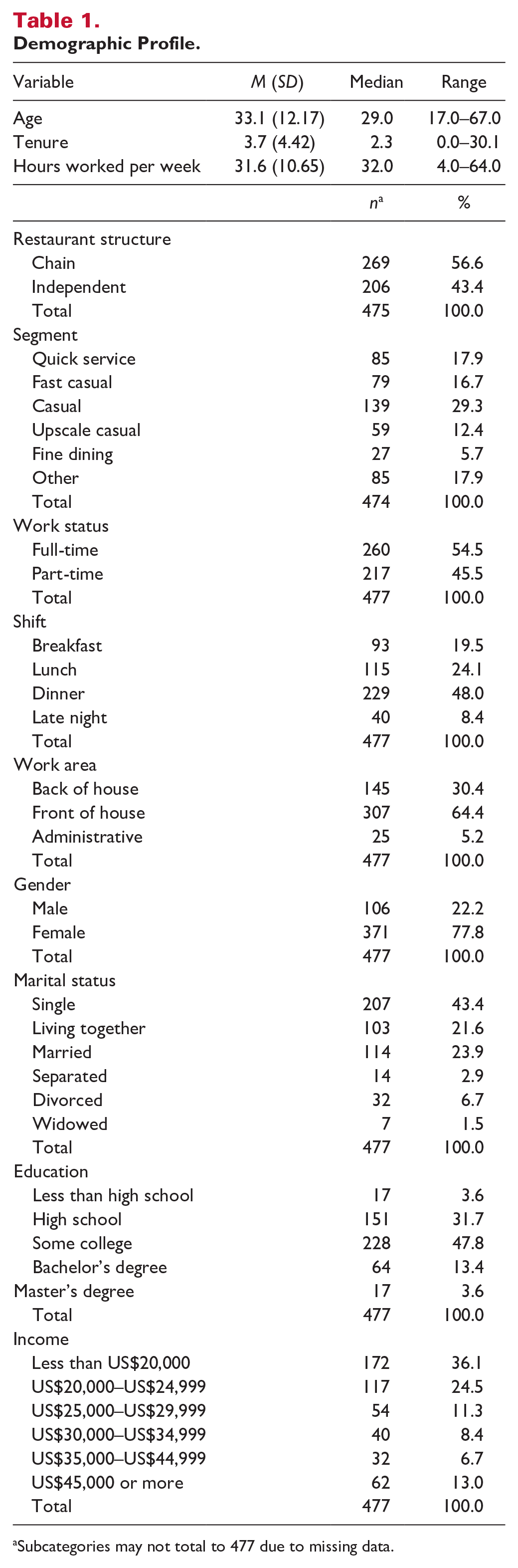
Subcategories may not total to 477 due to missing data.
Measures
Social perceptions
Social perceptions were measured twice with the same nine items, or traits, from Leach et al. (2007), with the wording adjusted accordingly to reflect either managers or coworkers. Sample statements included “I consider my immediate supervisor/coworkers at my restaurant to be likable,” “I consider my immediate supervisor/coworkers at my restaurant to be competent,” and “I consider my immediate supervisor/coworkers at my restaurant to be honest.” Respondents rated the items from 1 = strongly disagree to 7 = strongly agree for both sets of social perceptions items.
Work engagement
Work engagement was measured with nine items from Schaufeli et al. (2006). Sample items included “At my work, I feel bursting with energy” and “I feel proud of the work that I do.” Respondents rated the items from 1 = never to 7 = always.
Extra-role customer service behavior
Extra-role customer service behavior was measured with four items from Bettencourt and Brown (1997) and Karatepe (2015) and included items such as “I voluntarily assist customers even if it means going beyond job requirements” and “I help customers with problems beyond what is expected or required.” Respondents rated the items from 1 = strongly disagree to 7 = strongly agree.
Social desirability
Social desirability bias is a type of response bias that is the tendency of survey respondents to answer questions in a manner that will be viewed favorably by others, and can be a common problem with self-report survey designs (Zikmund et al., 2013). As this study included measures with the potential for biased responding (e.g., extra-role customer service behavior), a 4-item social desirability scale was also included, with responses coded 0 = No and 1 = Yes (sample item: “Would you ever lie to people?”). Scores for the social desirability items were summed, with higher scores indicating a higher tendency toward socially desirable responses (Haghighat, 2007).
Demographic profile
A total of 11 work-related and sociodemographic variables were included in the survey such as restaurant segment, hours worked per week, shift, work area, age, and income (see Table 1).
Results
Preliminary Analysis
Table 2 reports the mean values, standard deviations, and correlations for the study variables. Prior to hypothesis testing, we conducted preliminary analysis to determine if there was any effect of social desirability on the measures used in this study. Significant correlations were found between social desirability and social perceptions of coworkers (r = .13, p < .01), employee work engagement (r = .23, p < .001), and extra-role customer service (r =.17, p < .001). However, these relationships only explained minor amounts of variation (1.6%, 5.5%, and 2.7%, respectively), and thus were not deemed critical enough to exclude any participants or to include social desirability as a control variable in the model. The correlation between social desirability and social perceptions of supervisors was not significant (r =.08, p = .096).
Descriptive Statistics and Correlations.

Note. Cronbach’s alpha values for measurement scales are reported on the diagonal.
p < .05; **p < .01; ***p < .001.
Then, both exploratory and confirmatory factor analyses were conducted prior to hypothesis testing. Although all scales used in this study were established and validated through prior literature, we opted to first perform exploratory factory analysis (EFA) due to the varying results from prior literature regarding the dimensionality of both social perceptions and work engagement. Using a randomly drawn subsample of approximately 40% of the data (N = 221), the 31 items that addressed social perceptions of managers, social perceptions of coworkers, work engagement, and extra-role customer service behavior were entered into an EFA with maximum likelihood factoring and Promax rotation. The Kaiser–Mayer–Olkin (KMO) measure of sampling adequacy was 0.903 and the Bartlett’s test of sphericity was statistically significant (χ2 = 4,866.423 [df = 465, p < .001]); thus, the sample was considered appropriate for EFA. The rotated solution returned four dimensions and, notably, all nine items for social perceptions of supervisors loaded onto a single factor, as did all nine items for social perceptions of coworkers. This result aligned with the more recent work suggesting that “social perceptions” is a unidimensional construct (Bufquin, DiPietro, Orlowski, et al., 2018). Work engagement was also unidimensional, which has been supported by prior studies (Babakus et al., 2017; Cheng & Chen, 2017; Karatepe & Olugbade, 2016; Schaufeli et al., 2006; Zhang et al., 2017), although two items had significant but low factor loadings. As expected, extra-role customer service behavior was unidimensional as well. Together, the four factors accounted for 64.0% of the variance. The Cronbach’s alpha for each factor exceeded .70, indicating a high level of reliability: social perceptions of managers = .94; social perceptions of coworkers = .93; work engagement = .87; and extra-role customer service behavior = .88.
Then, confirmatory factor analysis (CFA) using the maximum likelihood estimator was conducted on the entire sample based on the results of the EFA. MPlus v8.0 was used for this analysis (Muthén & Muthén, 1998–2017). Although initial model fit was acceptable (χ2 = 1,362.153 [df = 428, p < .001], root mean square error of approximation [RMSEA] = 0.068, standardized root mean square residual [SRMR] = 0.043, comparative fit index [CFI] = 0.907), the two work engagement items with the low factor loadings in the EFA were removed from the measurement model due to nonsignificant loadings. Fit of the adjusted measurement model was improved (χ2 = 1,147.194 [df = 370, p < .001], RMSEA = 0.066, SRMR = 0.041, CFI = 0.921) and all factor loadings were significant with loadings above 0.60. The subsequent average variance extracted (AVE) values were all above 0.50, ranging from 0.57 to 0.66, while the construct reliabilities were all above .90 (see Table 3). The interconstruct squared correlations ranged from .01 to .23 and thus were all lower than their corresponding AVE values. Collectively, these results provided evidence for both convergent and discriminant validity of the constructs (Hair et al., 2010).
Convergent Validity Estimates.

AVE: average variance extracted.
We also compared the fit of the adjusted measurement model to a series of alternative models which addressed the dimensionality variations of social perceptions and work engagement. These models are summarized in Table 4 and collectively supported retaining social perceptions and work engagement as unidimensional constructs. For social perceptions, the fit indices suggested the first-order three-factor model was actually a better fit than the unidimensional model (Δχ2 = 394.34, Δdf = 22, p < .001); however, further examination revealed that when warmth, competence, and morality were modeled separately, these factors were so highly correlated they failed to achieve discriminant validity for both perceptions of supervisors and perceptions of coworkers. Given this result, it was deemed unnecessary to test a second-order model of social perceptions. For work engagement, the fit of our adjusted measurement model was significantly better than either alternative model (first-order three-factor model Δχ2 = 80.79, Δdf = 48, p < .01; second-order model Δχ2 = 91.08, Δdf = 55, p < .01).
Measurement Model Comparisons.

Note. All alternative models compared against Model 2. RMSEA = root mean square error of approximation; SRMR = standardized root mean squared residual; CFI = comparative fit index.
Failed discriminant validity test for both supervisors and coworkers. bAll items loaded onto single latent factor.
To complete our preliminary analyses, we assessed common method variance (CMV) with a final CFA. Fitting a single common latent factor to all items used in our study did not fit the data well, returning extremely poor indices (χ2 = 5,642.04 [df = 377, p < .001], RMSEA = 0.171, SRMR = 0.153, CFI = 0.468). This indicated that the potential for CMV to influence the results due to the use of a self-report questionnaire and single-source data collection method was minimal (Podsakoff et al., 2012).
Hypothesis Testing
As this study conceptualized a second-stage moderated mediation model, hypothesis testing was conducted in SPSS v24.0 using PROCESS Model 14 (Hayes, 2013). This allowed us to test all three hypotheses simultaneously, as PROCESS calculates moderated mediation, or conditional indirect effects (the effect of an independent variable on a dependent variable through a mediating variable for different levels of, or conditioned on, a moderating variable), while also taking into account any direct effects in the model. For this analysis 10,000 bootstrap samples were used, and conditional indirect effects were considered statistically significant if the bootstrapped confidence interval did not contain zero.
As depicted in Figure 2, the direct effect of social perceptions of restaurant supervisors on employee extra-role customer service behavior was nonsignificant (b = −0.027, β = −.034, p = .48); thus, H1 was not supported. However, the index of moderated mediation was significant (index = 0.031, SE = 0.013, 95% confidence interval [CI] = [0.005, 0.058]), which supports both the presence of an indirect effect of social perceptions of restaurant supervisors on employee extra-role customer service behavior through work engagement, and indicates that this indirect effect is a function of social perceptions of coworkers. Therefore, H2 and H3 were both supported.

Statistical Model Results.
Given the support for H3, we further explored the moderating effect of the social perceptions of coworkers. Using a spotlight analysis technique, we probed the interaction by looking at conditional effects of social perceptions of restaurant supervisors (the focal predictor) at different values of social perceptions of coworkers (the moderator); specifically, the mean, one standard deviation above the mean, and one standard deviation below the mean of the moderator. The indirect effect of social perceptions of restaurant managers on extra-role customer service through employee work engagement was significant for all values, as the boot-strapped confidence intervals all excluded zero, but the indirect effect was increasingly positive as social perceptions of coworkers increased (see Figure 3). The point estimate for employees with moderate social perceptions of their coworkers was 0.123 (95% CI = [0.080, 0.173]), as compared with 0.090 (95% CI = [0.046, 0.142]) for employees with low social perceptions of their coworkers and 0.156 (95% CI = [0.102, 0.221]) for employees with high social perceptions of their coworkers. In short, higher perceptions of supervisors leads to increased work engagement among restaurant employees, and this in turn leads to increased extra-role customer service behavior. The effect is enhanced when an employee’s social perception of their coworkers is higher; on the contrary, this effect is depressed when employees have low perceptions of their coworkers’ warmth, competence, and morality.

The Moderating Effect of Social Perceptions of Coworkers.
Discussion
The present study examined the influence of frontline restaurant employees’ social judgments or perceptions, as related to their supervisors and coworkers, on employees’ work engagement and extra-role customer service behavior. A moderated mediation process was revealed to be the mechanism through which restaurant employees’ social perceptions of these two stakeholder groups (i.e., supervisors and coworkers) ultimately influence their extra-role customer service behavior. Notably, the lack of a direct influence of employees’ social perceptions of their supervisors on employees’ extra-role customer service behavior was also revealed. Our results demonstrated that when an employee has a positive social perception of their supervisor, their extra-role customer service behavior increased; however, this influence operated indirectly through increased work engagement. Independent of this mechanism, there was no evidence of an effect of supervisors on employee extra-role customer service behavior. Moreover, an employee’s social perception of their coworkers played a critical role, as it provided a boundary condition for the mediation mechanism.
Theoretical Implications
The current study provides several theoretical contributions to the current literature on work engagement, social perceptions, and extra-role customer service behavior. First, our study contributes to the literature on work engagement by demonstrating that employees’ social perceptions of supervisors can be an antecedent. This study is among the first to propose and provide empirical evidence for this relationship. Although prior research has studied the influence of supervisors on employee work engagement, it has largely been conceptualized as leader–member exchange and/or transformational leadership (Christian et al., 2011; Saks & Gruman, 2014). Our findings were consistent with the literature linking high-quality leader–employee relationships with positive job attitudes, as they suggest that when an employee maintains a positive social judgment of their supervisors, they are more willing to be actively engaged in their work.
Second, our study adds to the current understanding of work engagement as the underlying process connecting job resources to workplace outcomes. Drawing on attitude theory (Bagozzi, 1992), we found that employees’ positive social perceptions of their supervisor leads to increased extra-role customer service behavior; however, there was not a direct relationship. Critically, the impact of social perceptions of supervisors on extra-role customer service behavior only operated indirectly through work engagement. The lack of a direct effect, although a nonsignificant result within the context of this study, aligns with the work of Karatepe (2011), Karatepe (2013b), Karatepe et al. (2013), Li et al. (2012), and Moline et al. (2008). In each of the aforementioned studies, work engagement fully mediated the relationships between hypothesized antecedents and workplace outcomes. This finding is also consistent with attitude theory in that it delineates the process by which cognitive evaluations (e.g., social perceptions) influence affective reactions (e.g., work engagement), which subsequently influence intentions and behavior (e.g., extra-role customer service behavior).
Third, the findings of this study extend our knowledge about the relationship between work engagement and extra-role customer service behavior by showing that an employee’s social perceptions of their coworkers can have a moderating effect. Previous research has focused on coworker social or emotional support, rather than cognitive evaluations (Chen & Kao, 2014; Guchait et al., 2014; Karatepe, 2012; Xanthopoulou et al., 2009; Xu et al., 2018; Zhu et al., 2019). In addition, findings related to the moderating effects of coworker social support have been inconsistent (Zhu et al., 2019). Our results highlight the importance of coworkers as a stakeholder group, as they demonstrate that an employee’s social perception of their coworkers can enhance or diminish the indirect relationship between that employee’s social perception of their supervisor and their extra-role customer service behavior.
Practical Implications
This study also provides several implications for restaurant managers. First, both supervisors and employees need to be aware of how they are perceived at work. Through social perceptions or judgments, both stakeholder groups can significantly impact employee work engagement and extra-role customer service behavior. This suggests that both supervisors and employees must display warmth, competence, and morality in an authentic fashion. These qualities should be incorporated into the overall culture of the organization and supported through ongoing training, coaching, counseling and rewards programs.
Building a team of supervisors and employees with high levels of warmth, competence, and morality begins at the recruitment and hiring process. Although knowledge and skills do reflect the competence component of social perceptions, our findings indicate that warmth and morality should not be disregarded. Prehire assessments can be used to screen potential candidates and provide scientifically valid and reliable predictive accuracy and rigor to hiring decisions. About 82% of companies use some form of preemployment assessment screening, and the emergence of new technologies offers more advanced methods that move beyond traditional pencil-and-paper multiple-choice formats (Zielinski, 2018). These assessments allow for a hiring manager to screen for “soft” skills, such as the social traits of warmth and morality, that are important in the service environment, as well as to select employees who may be predisposed to experiencing work engagement (Young et al., 2018).
All employees in the restaurant, whether in a supervisory role or a frontline position, should participate in training that emphasizes the “social” aspects and expectations of the job. For example, warmth, competence, and morality can be translated into “soft” (behavioral) and “hard” (technical) core competencies (Woodruffe, 1993) and incorporated into the overall training curriculum. In addition, ongoing coaching and training efforts should focus on providing guidance and resources for employees to utilize during opportunities for extra-role customer service.
Continuing focus, communication and education should also be provided to supervisors and management staff on the importance of teamwork for increased work engagement and coworker support to achieve the desired extra-role customer service behaviors. Teamwork is important in most organizations; however, in the hospitality industry an exceptional level of teamwork is required to meet and exceed guest expectations (Pizam & Shani, 2009). Coordination of a restaurant’s front-of-the-house and back-of-the-house teams is critical for delivering consistent customer service and a quality product. Collaboration among employees to create a product that is more than the sum of the individual parts (guest experience) is certainly the benefit of this effort (Guchait, 2016).
Finally, as discussed in the research by Testa (2001), hospitality leaders need to be mindful of gaps that may exist between their awareness of their leadership effectiveness and the perception of that leadership by their employees. The consequences of such incongruent perceptions could lead to detrimental impacts on the leader’s effectiveness, as well as on employees’ attitudes, work engagement, and performance. There are a wide range of work engagement tools and services available, all focused on gaining insight on employee priorities, satisfaction and organizational commitment (Markos & Sridevi, 2010). Although these tools and services may come with a financial investment, the result and payoff can be substantial when utilized by supervisors displaying authentic warmth, competence, and morality.
Limitations and Future Research
Prior studies in this line of research noted limitations that we, while still using a survey design, attempted to overcome. Specifically, the previous work indicated the use of a self-administered survey and data collection from a single restaurant chain as limitations to be addressed in future work (Bufquin, DiPietro, Park, et al., 2017; Bufquin, DiPietro, Orlowski, et al., 2018; Bufquin, DiPietro, Partlow, et al., 2018). Although in this study we also used a self-administered survey, which can inherently by their design result in self-report bias, we included a measure of social desirability to assess the extent to which responses may have been inflated due to a participant’s desire to “look good” and control for it if needed (Haghighat, 2007). We also made use of a commercial subject pool (i.e., an online market research panel composed of people preregistered to complete surveys) for data collection rather than partnering with a single restaurant company or brand. Although recognizing that the subject pool may not be representative of the entire population of restaurant employees in the United States, and thus generalizability is still a limitation of this study, it did allow for respondents from different restaurant segments and brands rather than a limited, restrictive sample from a single restaurant segment and/or organization.
An additional limitation of this study is that we focused primarily on employee social perceptions of supervisors and coworkers, and how these perceptions ultimately influence extra-role customer service behavior. However, there are other work-related variables that may be relevant which were not considered in the model conceptualized in this study. For example, the findings in the current study may differ based on meal period, restaurant type/segment, or even restaurant organizational structure (chain vs. independent). Each of these offers an opportunity for future research. Given our results and the critical influence of an employee’s social perception of their coworkers, we also suggest that future research examine differences in employee tenure and work status.
Footnotes
Declaration of Conflicting Interests
The author(s) declared no potential conflicts of interest with respect to the research, authorship, or publication of this article.
Funding
The author(s) received no financial support for the research, authorship, or publication of this article.
