




Abstract
There has been exponential growth in the power exercised by social media in hospitality and tourism. The power of social media platforms as stakeholders has been widely accepted by both academics and industry practitioners. However, to the best of the current authors’ knowledge, there has been no conceptualization of the power attributable to social media. On this basis, it is both timely and necessary to establish theoretical grounds that explain the concept of social media power and its application in hospitality and tourism. A hierarchical model that characterizes social media power is constructed in the present article by bringing together fundamental power discourses, media effect theories, and technology determinism. The authors identify definitions and sources of social media power at different levels of the power pyramid and present various technological mechanisms that trigger such sources. This conceptual study proposes theoretical foundations for future research and theory-building.
Introduction
The rise of social media has transformed the dynamics of social power both between and among service providers and tourists (Akehurst, 2009). More than a decade has passed since “you” was declared the person of the year in 2006 by Time magazine, thereby highlighting the power of individual social media users. The editor of Time postulated that “[i]t’s about the many wresting power from the few and helping one another for nothing and how that will not only change the world, but also change the way the world changes” (Grossman, 2006, p. 1). Apart from empowering tourists, social media have also empowered service providers by facilitating customer targeting, thereby allowing them to reach out to their markets (Fotis et al., 2012). Social media have been deployed by various hospitality and tourism businesses for purposes of communications, research, promotions, service recovery, service performance, product distribution, marketing, brand management, and other management activities (Duan et al., 2016; Leung et al., 2013; Lund et al., 2018; Rose & Blodgett, 2016; So et al., 2018). Various potential social media performance metrics have also been proposed for the hotel industry (Michopoulou & Moisa, 2019; Minazzi, 2015).
The empowerment of hospitality and tourism customers and businesses has had the effect of transforming social media platforms into powerful stakeholders. The substantial influence of social media on tourists’ destination perceptions, attitudes (Camprubi et al., 2013; H. Kim & Stepchenkova, 2015), decision-making (Hernandez-Mendez et al., 2015), and purchase intention (Bui et al., 2015) have been highlighted. Recent studies have informed hospitality practitioners by placing a focus on hotel occupancy (Bigne et al., 2019) and on revenue management (W. H. Kim & Chae, 2018).
In its capacity as a form of authority and control over the behaviors and non-behaviors of social beings (Lukes, 1974; Wrong, 1979), the concept of power may help to explain the role of social media in social relations between and among service providers and tourists. As power plays an essential role in the tourism industry (Hall, 1994; Nyaupane & Timothy, 2010), the concept has been applied in relevant discourses of planning and development (Bramwell, 2006; Xiao, 2006; S. Zhao & Timothy, 2015), policy making (Nyaupane & Timothy, 2010; Velasco, 2016), and stakeholder relations (Beritelli & Laesser, 2011; Lenao, 2017). Despite the recent growth of tourism research outputs about social media, such channels have not been considered as a potential stakeholder that holds and exercises power.
There are many examples of social media acquiring and exercising power. The number of social media visitors has reached 3.2 billion in 2018 (Chaffey, 2018). The implications of this transformational phenomenon are important for the hospitality and tourism sector. A recent Statista survey has shown that 65% of young U.S.-based leisure travelers (18–29 years) consider online guest reviews very important when deciding on a hotel (Lock, 2018). Similarly, 58% of middle-aged (30–59 years) and 55% of senior (60 years and above) leisure travelers have agreed that online guest reviews are very important when selecting their accommodation (Lock, 2018). Recent studies have demonstrated how social media play a decisive role in diverse travel-related choices (Liu et al., 2020). Ahead of the advent of social media research, the power of various social groups to influence hospitality and tourism decisions through word-of-mouth communication and advice from opinion leaders was already well understood (Bruwer & Reilly, 2006; Haywood, 1989; Longart, 2010). However, the sudden ubiquity of social media has exposed the diversity and magnitude of the range of social groups that can influence travel decision-making. Such developments suggest that it is both timely and important to conceptualize the power of social media in hospitality and tourism as an emergent technology.
One radical perspective on the power of media is technological determinism. This view advocates that the entire structure of society at all levels is determined by technological change (Chandler, 1995). Along such lines, it has been suggested that the power of social media originates from the technological mechanisms that empower the applicable platforms. Advocates of media effect theories have suggested that media determine what and how society should think by setting and framing agendas, whether positive or negative. The relevant theories are agenda-setting (McCombs & Shaw, 1972) and framing (Entman, 1993). However, numerous sociologists have regarded power as a fundamental concept that shapes social relations, and attributable to social beings (Russell, 1938) rather than to technologies. These seemingly conflicting perspectives prompt several questions. First, do social media possess power over travel providers and tourists? Second, if this is the case, what is the source of social media power? Third, what technologies generate social media power?
Studies of the exercise of power in tourism are long established. Inspired by Foucault (1982), Cheong and Miller (2000) have stated that “there is power everywhere in tourism” (p. 372). Morgan and Pritchard (1998) have predicted that power structures in hospitality and tourism will be shaped by new media channels. Social media have undeniably become one of the most important global communication channels between and among service providers and tourists in the contemporary era. Numerous hospitality and tourism scholars (e.g., Browning et al., 2013; Zhang et al., 2016; X. Zhao et al., 2015) have explored the power of social media, yet have rarely referred to the theoretical foundations of power. Given the centrality of power for understanding stakeholder relations in hospitality and tourism (Ford et al., 2012; Hall, 1994; Nyaupane & Timothy, 2010) and noting the ubiquity of social media in research and practice (Leung et al., 2013; Mehraliyev et al., 2019), the aforementioned research questions can be addressed through a conceptualization of social media power. The present study will extend previous discourses on the power of social beings and media effect theories with a view to (a) defining and explaining social media power, (b) proposing a theoretical framework that explains the levels and sources of social media power, and (c) identifying and describing technological mechanisms that enable the exercise of social media power.
The current authors note the extensive categories of social media platforms in hospitality and tourism (Fotis et al., 2012) and associated technological mechanisms. To enhance the prospects of consistent measurement, the present study defines social media as “a group of Internet-based applications that build on the ideological and technological foundations of Web 2.0, and that allow the creation and exchange of User Generated Content” (Kaplan & Haenlein, 2010, p. 61). The authors view social media as including all types of website or platform (e.g., social networking and online review sites) that mediate interactions between and among service providers and tourists, and proceed to discuss the power that they exercise.
The chosen methodology follows the guidelines that are commonly applicable to undertaking conceptual studies. Literature on social media in hospitality and tourism and their power in various disciplines and discourses are critically reviewed. To build theoretical foundations that underpin the application of social media power in hospitality and tourism, the current study reaches beyond a systematic review and synthesis by presenting carefully selected research that is consistent with the conceptual premise of the article (Callahan, 2010).
Power in Social Relations
Power is a key concept in explaining how social media influence the choices of tourists and service providers. To understand social media power, a necessary first step is to explain the meaning(s), source(s), and structure of power.
Definitions of Power
Social science perspectives on power are diverse and seemingly conflicting. A group of theorists (e.g., Barnes, 1988; Parsons, 1964) regard power as a prerequisite of agency in the form of food, job, money, cars, skills, knowledge, or health, which enable one to act in certain ways. For these adherents, power refers to “the ability or capacity to do something or act in a particular way” (Power, n.d.). This explanation is constrained in that power is viewed exclusively as agent-centric and does not seek to capture relationships with other social beings. However, in most social processes, power is relational and cannot be considered in isolation mainly because of its emergence from interactions with others (Tseng & Seidman, 2007). In this regard, many theorists view power as a concept that shapes social relationships. Hobbes (1968) has posited that an individual takes his or her power from society. Machiavelli’s (1981) The Prince has argued that power is synonymous with violence and coercion, leading inexorably to the domination of the weak by the strong. To Weber (1978), power can be authority and/or a form of coercion that one exerts over others legitimately and/or through threats and violence. In social relations, power means “the capacity or ability to direct or influence the behavior of others or the course of events” (Power, n.d.).
Pitkin (1972) has distinguished two types of power, namely power-over and power-to: One may have power over another or others, and that sort of power is indeed relational. . . But he may have power to do or accomplish something all by himself, and that power is not relational at all. (p. 277)
Dowding (1996) has named power-over as social power and power-to as outcome power. As a relational phenomenon, power-over has gained attention in the social sciences and in tourism studies (Church & Coles, 2007). Pettigrew and McNulty (1995) have stated that “[p]ower is not an attribute possessed by someone in isolation. It is a relational phenomenon. Power is generated, maintained, and lost in the context of relationships with others” (p. 851). Power can also be socialized as articulated by Arendt (1970): [w]hen we say of somebody that he is “in power” we actually refer to his being empowered by a certain number of people to act in their name. The moment the group, from which the power originated . . . disappears, “his power” also vanishes. (p. 44)
Social scientists have proposed two dimensions, namely potential and actual use of power. Bierstedt (1950) has postulated that power is the potential to apply sanctions and should be differentiated from the actual use of force. Conceptualizing power as cause and effect, Dahl (1957) has argued that unused potential fails to cause an effect and is therefore not power. By contrast, Wrong (1968) has pointed out that potential power might be sufficient to alter behaviors because people perceive that the power-holder can use this potential wherever and when necessary. Similarly, Lukes (1974) has argued that the non-exercise of power could be more effective than its exercise.
Two main schools of thought have given consideration to the possession of power, namely the elitists and the pluralists. Elitists, such as Mills (1956), have advocated that power in societies is concentrated in the hands of a few individuals who constitute the elite. Pluralists such as Dahl (1957) have posited that power is distributed widely within a community, albeit unevenly.
Sources of Power
The concept of power is complex because social relations are dynamic. Social beings may use power consciously and/or unconsciously to influence the behaviors of others. One’s power can be generated and/or exercised through different mechanisms. Social power theory (French & Raven, 1959) provides a theoretical framework to explain how power works in social relations between an influencer and an influenced. To date, however, few studies (Jang et al., 2007; Liang, 2013) have applied social power theory in hospitality and tourism. Social power theory posits that power comes from five sources: reward, coercive, legitimate, referent, and expert (French & Raven, 1959). A sixth source, information power, has been added by Raven and colleagues in their later conceptualizations (Raven, 1965; Raven & Kruglanski, 1970; Raven, 1965). The following section provides a brief explanation of the six sources of power with A representing the influencer and B representing the influenced.
Reward power is the perception of B that A has an ability to mediate rewards for him or her (French & Raven, 1959). B seeks a reward as a result of following A’s recommendation, and thus B’s behavior is influenced by A. By contrast, coercive power refers to the perception of B that A has the ability to mediate punishment (French & Raven, 1959). Therefore, B’s behavior is influenced by A so as not to receive punishment for failing to comply with A’s recommendation. A simple example is the parent–child relation, wherein children behave as is desired by their parents because they are either hoping to be rewarded or afraid of being punished. Numerous hospitality and tourism studies have supported the view that service providers and hotels use discounts, membership, and loyalty programs as a reward to influence customer behaviors (Tanford et al., 2011).
Legitimate power is based on established cultural or organizational norms and standards (Bickman, 1974). B believes that A has the legitimacy to influence his or her behavior. Legitimacy can be interpreted in different ways. Hospitality and tourism studies have also confirmed the effect of social norms on behaviors (Font et al., 2016). As noted by Yukl (2009), in the context of organizational behavior, legitimate power is authority derived from position. For example, managers could legitimately influence the behaviors of their subordinates in work environments. Similarly, Hunt and Nevin (1974) defined legitimate power as “internalized values . . . which dictate that i [i.e., influencer] has a legitimate right to influence and that j [i.e., influenced] is obligated to accept this influence” (p. 187). Given that not all internalized values originate from position, including those that apply in work settings, it may be observed that Yukl focused on a single aspect of legitimate power. In their seminal work, French and Raven (1959) also noted the challenge and complexity of defining and understanding legitimate power as follows: “Legitimate power is probably the most complex of those treated here, embodying notions from the structural sociologist, the group-norm and role oriented social psychologist, and the clinical psychologist” (p. 264). They describe the “feeling of oughtness” as the core “force field” of legitimate power and proceed to explain that this feeling may originate from position (e.g., in manager–subordinate, and parent–child relations there is a feeling of oughtness). However, they also observe that legitimate power may be universal and apply equally to all community members (e.g., religious or cultural norms which “ought to be followed” by all members). If the observation is extended to work environments, everybody “ought to” follow the company culture. This may constitute a form of legitimate power which is not derived from position. Among similar lines, French and Raven (1959) proposed a wider, and arguably more abstract description of the psychological mechanism of legitimate power as follows: “He [the influenced] will speak of such behaviors with expressions like ‘should’, ‘ought to’, or ‘has a right to’. In many cases, the original source of the requirement is not recalled” (p. 264). Although these descriptions of legitimate power are disparate, they should not be viewed as contradictory. French and Raven have adopted a broader definition of legitimate power, whereas others such as Yukl have narrowed the concept through its application to a specific environment or setting.
Referent power may be referred to as attraction or attachment and can be explained as the desire of B to identify himself or herself with A (French & Raven, 1959). B attempts to follow A’s recommendation because B likes A. For instance, fans may follow or imitate celebrities when they seek association. Unsurprisingly, tourism and hospitality marketers use celebrities in their marketing strategies (McCartney & Pinto, 2014) because attachment to a community or to an individual may influence behaviors (Gursoy & Rutherford, 2004).
Expert power refers to the perception of B that A has knowledge and expertise (French & Raven, 1959). Those who perceive the expertise of A regarding a subject are influenced by his or her recommendation. For example, recommendations by expert reviewers (e.g., high-level contributors in TripAdvisor) are considerably more influential when choosing a travel product (X. Zhao et al., 2015).
Numerous attempts have been made to conceptualize information power. Raven et al. (1998) have suggested that information power (or “informational power” in the term adopted by the authors) is based on “presentation of persuasive material or logic” (p. 308). Raven et al.’s (1998) information power has been further explained as follows: “The absent-minded parent who turns on the headlights in his car after his child points out that it has become quite dark outside has been influenced by the child’s informational power” (p. 308). Notably, this power is based on the rationale behind the given information. Yukl (2009) has proposed a different conceptualization of information power, or based on his adopted label “control over information,” which refers to the dissemination of information. Yukl (2009) has argued that such power is vested in an agent’s strategic location in an organization’s communication network. Control over information enables a power agent to delay the dissemination of certain information (that does not favor his or her view) and to feed certain information (that favors his or her view) to coworkers, subordinates, and/or managers, in an attempt to influence them.
Social power theory has been subject to various critiques and extensions. Yukl (1989, 2006, 2009) critiqued the French and Raven (1959) taxonomy as being excessively abstract and insufficient with limited categories. Along similar lines, Bacharach and Lalwer (1980) viewed the aforementioned taxonomy as overly generic and as being susceptible to too many potential interpretations. Bacharach and Lalwer (1980) have extended the theory to differentiate between power bases (what a power agent controls to influence others) and power sources (how a power agent comes to control power bases). Yukl and colleagues (Yukl, 1989; Yukl et al., 1996; Yukl & Falbe, 1991) have proposed several re-categorizations of French and Raven’s (1959) taxonomy, concluding with general categories that apply onto work environments: position power (legitimate authority, reward power, coercive power, and information power) and personal power (referent power and expert power). Yukl (2009) has further argued that managers rely more on personal sources of power rather than position.
Although the various studies mentioned in the preceding section have made unique contributions to applying and extending social power theory in different settings, the present study has opted to use the original French and Raven (1959) taxonomy for several reasons. First, this taxonomy of power has been most widely used (Green, 1999; Nesler et al., 1993). Over the years, numerous studies (e.g., Flurry & Burns, 2005; Goodrich & Mangleburg, 2010; Hinkin & Schriesheim, 1989; John, 1984) have empirically developed, tested, and refined multi-item scales for the five factors in social power theory. Recent studies have also provided empirical evidence to confirm the aforementioned constructs as antecedents (Flurry & Burns, 2005), mediators (Goodrich & Mangleburg, 2010), and/or moderators (Mallin & Ragland, 2017) of influence. Second, recognition of the general or abstract nature of social power theory supports the purposes of the present study. Interpretations have the capacity to be more flexible, thereby facilitating potential extensions of the theory into new settings. This abstractness has enabled Bacharach and Lalwer (1980) and Yukl (2006, 2009) to modify and extend the original taxonomy to organizational behavior settings. It is acknowledged that there have been conflicting views and animated debate within the literature about the use and misuse of the French and Raven taxonomy (e.g., see Blois & Hopkinson, 2013, 2015; Hunt, 2015). The view of the current authors is in line with the recent critiques (e.g., Blois & Hopkinson, 2015), namely that the five-factor model should be adapted and refined to different settings rather than seen as a “done deal.” Given that the present study is extending social power into a new setting, it is reasonable to employ and adapt the original taxonomy for the conceptualization of social media power in hospitality and tourism.
Hierarchical Structure of Power
Power is exercised when one’s power is stronger than another’s and thus seems to work in a hierarchical structure in which behaviors are determined in multiple ways. Recognizing these conditions, Bachrach and Baratz (1962) have proposed two “faces” of power. Power holders not only exercise the visual face of power (seemingly related to individuals’ decision-making), but also the unseen face of power (policy and authority): Of course, power is exercised when A participates in the making of decisions that affect B. But power is also exercised when A devotes his energies to creating or reinforcing social and political values and institutional practices that limit the scope of the political process to public consideration of only those issues which are comparatively innocuous to A. To the extent that A succeeds in doing this, B is prevented, for all practical purposes, from bringing to the fore any issues that might in their resolution be seriously detrimental to A’s set of preferences. (p. 948)
The unseen face of power (controlling social, political, or legislative environments) can be stronger and/or higher than its explicit visual face (influencing individuals’ decision-making). The source of power in this context is authority and control, similar to Yukl’s (2009) view that legitimate authority is derived from position. However, for Yukl and Falbe (1991), such authority equates with the ability to influence behaviors, whereas for Bachrach and Baratz (1962), authority involves control over both behaviors and non-behaviors. In the context of a market economy, controlling non-behavior may involve a monopoly that limits consumer purchases to products that are provided by a certain enterprise(s). Buying from other enterprises is not an option because they do not exist in the market.
The present study uses the term choice to represent the widest scope of decision-making behaviors. This is based on the assertion that “choice is behavior and behavior is choice” (Baum, 2004, 2010; Kőszegi & Rabin, 2007; Noll, 1995). Humans have several choice options at any particular time. Each initiative becomes their behavior or each behavior becomes their choice. The current study proposes three levels of power in the form of a choice based hierarchical structure: (a) ability to choose, (b) ability to influence choices, and (c) ability to provide choices.
Ability to choose
An individual’s ability to choose (Luthra et al., 2017) is the basic level of power. This is a non-relational, agent-centric power (i.e., power-to). At this basic level, all prerequisites for an individual to perform a certain behavioral choice are potential sources of power. In a market economy, for example, money is one of the most important sources of power to purchase (Shambaugh, 2004). Money provides an individual with the ability to choose among alternative products in the market, whereas one with financial limitations may need to choose between paying rent or buying food (Luthra et al., 2017). In the case of hospitality and tourism, the consumer choice of travel-related services and products is the main question of interest (e.g., hotels, restaurants, destinations, activities, museums, cultural heritages sites, and travel packages). In this context, power is vested in the capacity of consumers to choose between various hospitality and tourism products. This level of power is the lowest because it requires the resources of only a single actor (i.e., power agent).
Ability to influence choices
The ability to influence choices (one’s behaviors or decisions) is the second level of power. This power is relational and includes exercising one’s power over others. At this level, social power theory (French & Raven, 1959) can be used to articulate power sources. At least one of the social power sources is necessary to influence the behavioral choices of others. Hospitality and tourism researchers have suggested that social power domains can influence tourists’ behavioral choices, notably in the form of discounts (Wong & Yeh, 2009), coercion (Caruana & Crane, 2011), social norms (Oh & Hsu, 2001), celebrity involvement (Lee et al., 2008), and perceived expertise (Lo & McKercher, 2015). However, social power theory has rarely been used to explain these powers in hospitality and tourism settings.
Ability to provide choices
The ability to provide choices is the highest level of power. Bachrach and Baratz (1962) have proposed the unseen face of power involving control over decision-making and non-decision-making, such as market environments. Luthra et al. (2017) have mentioned that although individuals have the capacity to choose, their degree of freedom in choosing is limited and is shaped by powers beyond their control. For example, one cannot choose something that does not exist. People have the power to choose to sit down, stand, walk, or run, but not to fly. In hospitality and tourism, the greatest power is vested in those with authority and control over what services and products are provided. For instance, governments can be very powerful as providers of gambling choices. Many countries do not allow gambling and casino business permissions, whereas some countries restrict where residents are able to travel and who is allowed to enter. Israel is out of the question as a tourist destination for citizens of Iran, and vice versa. Most studies of power have focused on either the first or second level, but this highest level has been rarely discussed. The ability to provide choices has the highest power because it predefines the choices that can be made or influenced.
The Role of Media in Social Power Dynamics
The present study synthesizes social scientists’ fundamental approaches to power, focusing on its hierarchical structure. Power is mainly attributed to social beings and emerges from their interactions (Tseng & Seidman, 2007). Understanding the role of media in this interaction process is necessary to conceptualize the power attributable to social media. The following section explains how media shape social power dynamics among social beings, with a specific emphasis on hospitality and tourism stakeholders.
Referring to “the means of communication” (Media, n.d.), media play a central role in facilitating and mediating communications between hospitality and tourism stakeholders. As technology introduces new forms of media and transfers the weight of influential power from traditional mass media to social media, the power relations of stakeholders in communication process are also altered (Richmond & McCroskey, 1992). The following sections discuss the role of traditional mass media and social media as power agents in hospitality and tourism.
Power of Traditional Mass Media
From the perspective of traditional mass media (e.g., television [TV], radio, and newspaper), the roles of three main players have been articulated in the communication process: message sender, medium, and message receiver (DiMuzio & Sundar, 2012). In hospitality marketing, the message sender can be a service provider (e.g., hotel or restaurant) who pushes a message (e.g., promotional materials). TV or radio can be the medium, conveying the message to receivers (e.g., hospitality and tourism consumers; Hu et al., 2014). The power of message senders (i.e., service providers) over message receivers has been emphasized (i.e., hospitality and tourism consumers), but the power of the medium and message receiver in these relations has often been overlooked.
Media effect studies have emphasized the role of media and consumers as power holders. McLuhan’s (1964) groundbreaking argument has proposed that “the medium is the message,” postulating that each medium conveys its own message. When dispatched through two different channels, the same message may be perceived differently by receivers (DiMuzio & Sundar, 2012). This perspective of media determinism imposes an exclusive power on media and provides a theoretical groundwork to explain how media technologies affect the economy, society, institutions, groups, individuals, and consumer–supplier relations.
The power of mass media has also been explained by agenda-setting (McCombs & Shaw, 1972) and framing theories (Goffman, 1974). The former states that the press “may not be successful much of the time in telling people what to think, but it is stunningly successful in telling its readers what to think about” (Cohen, 1963, p. 13). Agenda-setting theory explains how mass media convey its power to provide choices (i.e., on what to watch/read/listen to or think about).
In considering the framing power of media, Entman (1993) has contended that the way in which messages are framed (e.g., highlighting and/or minimizing certain details) influences the audience’s understanding. Moreover, a story’s frame directs the audience by providing more or less attention toward certain details of the message. Wall (2017) has emphasized the interpreting power of media is “to set the context, to frame the issue, to interpret the facts, and potentially to provide legitimacy for people, issues, or groups” (p. 1). The same fact can be (mis)interpreted and framed in multiple ways, thereby leading the audience to particular thoughts or feelings. This perspective suggests that media influence an audience by directing their thinking to a certain way. Framing theory thus provides an example of media’s ability to influence choices.
This leads to the question of who has media power? Various answers have been proposed from the perspectives of consumers, service providers, and media technology. Originally proposed by Edmund Burke, the concept of media as a “watchdog” focuses on the power of the public. Given that power elites are never in a position to represent the interests and opinions of all classes (Olien et al., 1989), media serve as an independent and necessary channel and function as a watchdog over power elites for the interests of the broadly defined public (e.g., consumers and social media users). By contrast, the “guard dog media” emphasizes the power of government, businesses, and the institutions of media itself (Donohue et al., 1995). This perspective contends that the media guard the interests of their owners rather than promote the public good. However, media determinists propose that power is vested in media technology and not through a specific social unit. From this perspective, social power dynamics can be influenced and determined by the development of specific media technologies. In particular, the recent development of social media and Web 2.0 technologies determines power structures of various groups, including consumer–supplier relations in hospitality and tourism.
Emergence of Social Media and Their Power
Unlike the established practices of traditional mass media, social media equipped with Web 2.0 technologies can enable spontaneous and multilateral communications (Choi et al., 2018). Given that social media have had a substantial and transformative effect on the communication among stakeholders (Zeng & Gerritsen, 2014), numerous online communication studies have focused on consumer–supplier relationships (Leung et al., 2013). Figure 1 represents the communication process between service providers and consumers through social media platforms. The diverse, complex, and advanced technical features of social media support the proposition that all three stakeholders (service providers, consumers, and social media platforms) function as both senders and receivers and exercise power over one another.
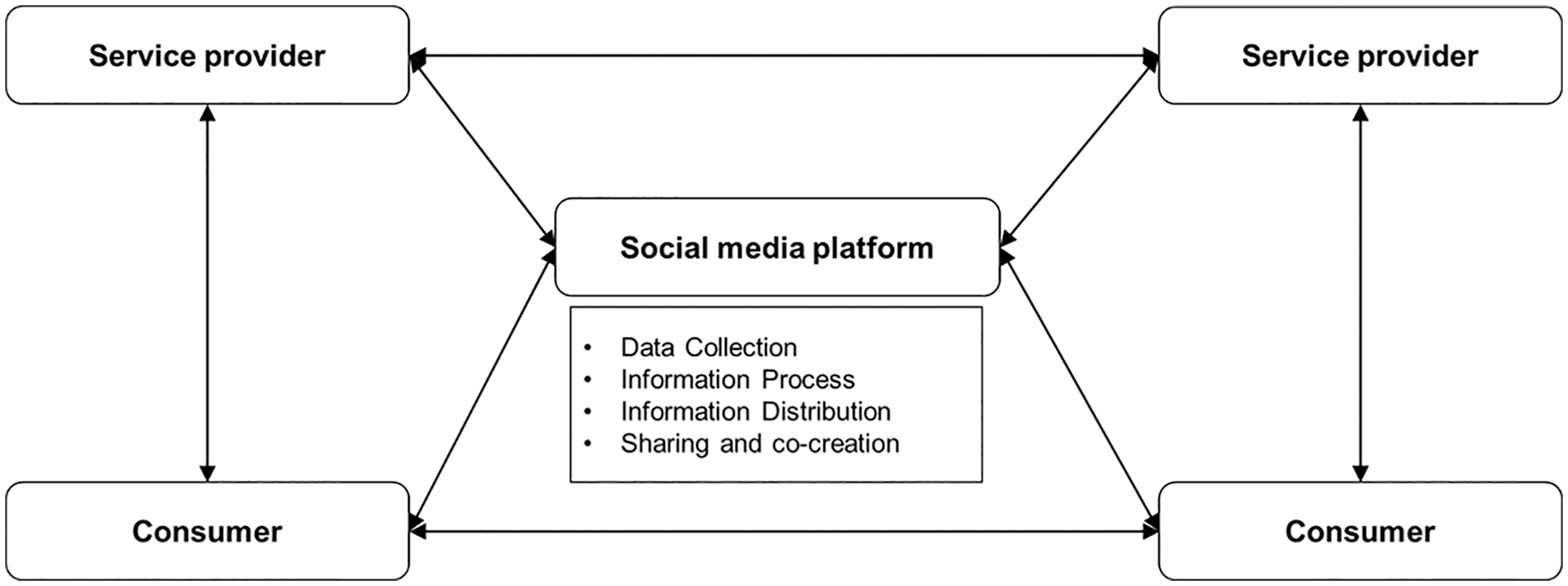
Social Media Platforms in the Flow of Online Travel Information.
Information exchange between service providers and consumers
Hospitality and tourism consumers are no longer passive receivers of information (Hanna et al., 2011). Communicating using social media platforms is dynamic in a way that information flows from service providers to consumers/other service providers and vice versa. Consumers are empowered to provide feedback to service providers and potential consumers, thereby influence their behaviors (Xie et al., 2016). An evolution moving from the traditional role of businesses only as information senders is likewise observed. Businesses now seek and receive information from consumers in the form of private messages and public posts. For instance, communications are rendered increasingly dynamic by the “reply” feature. The potential effects of negative and positive posts on service providers can be mitigated by responding directly to each specific message (Zehrer et al., 2011). In such scenarios, the communication becomes dynamic and personalized. Service providers and consumers are equally empowered to reach out to their specific targets and provide personalized and influential messages (Jansson, 2018). Social media do not necessarily diminish the power of businesses but change the “rules of the game” by providing various and novel types of power resources to consumers and service providers.
Social media platforms as sender/receiver
Social media platforms as message receivers and senders are increasingly becoming important players in smart tourism ecosystems (Chung et al., 2015). As message receivers, social media collects information from consumers and service providers. The collected data are then processed through mechanical algorithms that enable the platforms to select and dispatch the most relevant messages to consumers and service providers. The Internet of Things and various forms of smart technologies have reinforced the functions of social media as a control center to manage and operate the flow of information (Gretzel et al., 2015). As message senders, social media technologies can be viewed as separate stakeholders that exercise their power over tourists and service providers. From the perspective of media determinism, technological features that contribute to the message-sending role of platforms are considered working mechanisms of power.
Developing a Hierarchical Model of Social Media Power
The preceding analysis of the relevant literature has synthesized the theoretical perspectives on social power relations to explain the sources and working mechanisms of social media power and apply them to hospitality and tourism. Building upon our discussion about the hierarchical nature of power in the section “Hierarchical Structure of Power,” the current researchers propose a comprehensive framework that explains how each source of social media power influences the decision-making and non-decision-making of hospitality and tourism consumers. Figure 2 shows a power pyramid consisting of three levels: the ability to choose between travel choices, the ability to influence travel choices, and the ability to provide travel choices.
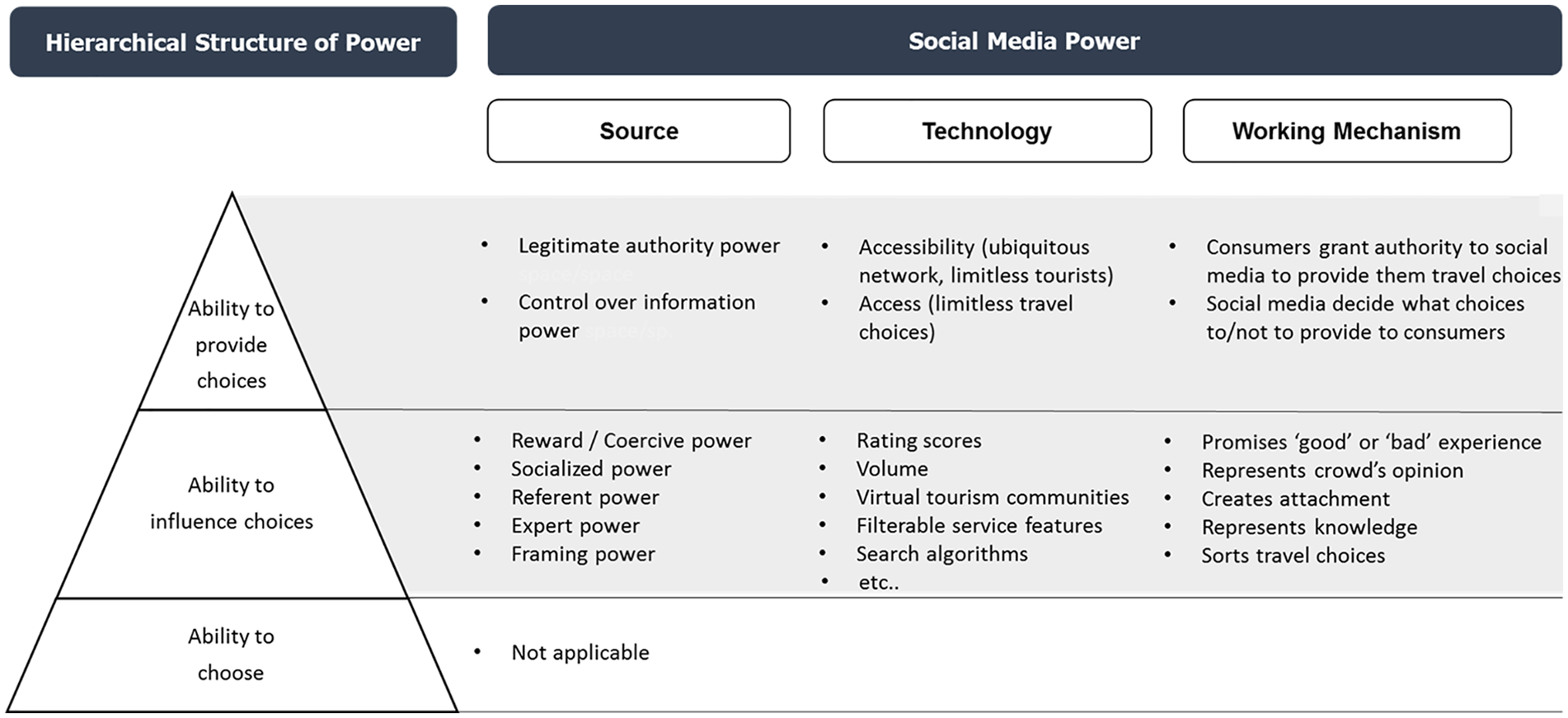
Hierarchical Model of Social Media Power.
Ability to Choose Between Travel Choices
The ability to choose constitutes the first level of the pyramid. From the perspective of hospitality and tourism consumers, this level includes the ability to choose between travel choices. Travel choices may apply to specific services/products (e.g., food, rooms, activities, and package), providers (e.g., hotels, restaurants, transportation companies, travel agencies), and destinations. At this level, power is not relational (power-over) but consumer-centric (power-to). Time and money are the main sources of consumer-centric power. Hospitality and tourism consumers choose among various products, suppliers, and destinations on the basis of their available time and money. Consumer choices will also be influenced by their health, travel experience, and knowledge. Other factors (e.g., technological literacy and ability to use the internet to learn about or purchase travel choices) may also contribute to or limit travel choices in online environments. Given that social media power is relational in nature, this level of power cannot be applied to social media.
Ability to Influence Travel Choices
The second level of power is relational and may be defined as the ability to influence choices. Specifically, this power is defined here as the ability of social media to influence travel choices. At this level, social power theory provides a theoretical lens to understand how certain technological features trigger the sources of social media power by influencing consumer behaviors.
Expert power
Experts are perceived as possessing knowledge in a specific area, leading to a widely held acceptance within a particular domain of their opinions and recommendations. Choi et al. (2018) have shown that platforms specializing in tourism have a stronger influence on travel behaviors than generalist websites. The same principle may be applied to online review sites. Mehraliyev et al. (2020) have confirmed that online review sites specializing in hospitality and tourism have greater expertise than their counterparts that have no specialization. Unsurprisingly, most of the social media platforms that tourists use specialize in hospitality and/or tourism possess a mass of information that is perceived as “knowledge” about a specific sector (Fuchs et al., 2014). Imagine an individual with in-depth knowledge about restaurants in a given locality, including precise locations, cuisine types, dietary restrictions (e.g., halal, kosher, vegetarian, and gluten-free), suitability for various occasions (e.g., business meeting, romantic event, and family gathering), price range, operating hours, and various service features. Such comprehensive knowledge makes this person an ideal expert for individuals seeking a restaurant recommendation. All of the aforementioned information is conveniently available through social media platforms (e.g., Yelp, TripAdvisor, and OpenRice) in a form of “filterable service features.” For instance, consumers can simply activate the “nearby” function in an app and filter certain restaurant options according to their desired service features. In terms of technological mechanisms, each “filterable service feature” serves as a piece of knowledge about service providers, and collectively, they formulate the expert power of social media.
Reward and coercive power
Rating/voting is an important technological feature related to reward and coercive power. By aggregating a number of consumer ratings, platforms provide hospitality and tourism consumers with an assembly of information about certain travel choices. Several studies have provided empirical evidence supporting the effect of ratings on travel choices (e.g., Melian-Gonzalez et al., 2013; Tsao et al., 2015). A high average rating of a service or product symbolizes “a good choice,” whereas a low rating implies “a bad choice,” thereby promising consumers good or bad experiences, respectively. Interestingly, Li et al. (2016) have found that the effect of ratings is substantially low for sales of experiential products relative to utilitarian products. The influential power of a single average rating is low because experiential products may require more information than utilitarian products, which can be assessed with objective measures (e.g., battery longevity, hard drive capacity, and screen size for laptops). As hospitality and tourism products/services are information-intensive, uncertain, and high-risk (Sheldon, 1997; Tan & Chen, 2012; Werthner & Klein, 1999), consumers rely upon diverse informational cues to evaluate various aspects of their prospective experience. Therefore, using only an average rating score is insufficient to convey detailed information about hospitality and tourism experiences. In the case of hotel choices, ratings that focus on certain features are being increasingly developed and adopted to illustrate diverse aspects of experiences, such as cleanliness, service, room, location, and ambience. Social power theory indicates that behaviors may be influenced through the promise of rewards or coercion. By promising hospitality and tourism consumers good or bad experiences, the average rating scores and specific ratings on various experiential aspects provide encouragement or restraint for travel choices. Technologically, rating/voting features can grant reward and coercive power to social media by producing such psychological effects on consumers.
Socialized power
Rating features are commonly accompanied by volume—a display of the number of people who provided ratings. Volume has been observed as a key influential factor in hospitality and tourism. Torres et al. (2015) have illustrated that online bookings are influenced by indications of the number of reviews in TripAdvisor. The quantity of reviews has likewise influenced hotels’ offline reputation (Xie et al., 2016). This is also the case for restaurant reputations online (Zhang et al., 2010). The number of reviews are particularly influential for choices of lower-tier hotels (Blal & Sturman, 2014). The impact of volume features may be understood in the context of Arendt’s (1970) socialization of power. Socialization implies that the power agent acts in the name of a certain social group and represents their opinions. Similarly, technological features that aggregate volume are an example of how platforms position themselves as social agents that possess socialized power. Introduced by TripAdvisor, the Travelers’ Choice Award quickly became an important indicator of quality for hospitality and tourism companies. Ratings with high volumes represent the collective opinion of a community of consumers. Although collective opinion may resemble expert power (as a form of knowledge) or legitimate power (as a form of accepted social norm), in essence, it is a form of socialized power, because the base of such power is a crowd or social group (i.e., consumer community). Perceived expertise or legitimacy may stem from socialized power. The volume function of socialized power also grants a watchdog type function to social media when acting in the best interests of consumer communities. The popularity of volume features extends beyond hospitality or tourism to a diverse range of industries (K. Kim, Yoon, & Choi, 2019).
Referent power
Social power theory states that individuals who identify themselves with a certain social group are likely to be influenced by that group. There are many technological features equipped with Web 2.0 (e.g., create, join, and like) that support the formation of virtual tourism communities. In their seminal work on virtual tourism communities, Wang et al. (2002) have explained that not all online groups or pages are considered as a virtual community. A “personal investment, intimacy, and commitment” is necessary for a virtual community to exist, and members have to identify themselves with a given virtual social group (Wang et al., 2002, p. 411). Referent power refers to such type of self-identification with a power agent or a social group. Participating in virtual tourism communities also produces a major influence on members’ travel choices (Wang et al., 2002; Zeng & Gerritsen, 2014). On this basis, the formation of virtual tourism communities through Facebook or Instagram groups or pages explains the mechanism of referent power. Virtual communities are particularly important in hospitality and tourism, which are information-intensive and experience-based industries (Wang et al., 2002). Contrary to average rating scores, virtual communities provide rich experiential information to consumers who share information with group members. Such shared experiences serve as a reference point and play a decisive role in influencing travel decisions.
Framing power
In addition to the sources of social power theory, framing can also serve as a source of social media power at this second level of the pyramid. Sparks and Browning (2011) have found that travel choices are affected by the order in which positive and negative reviews on products are presented. Thus, the algorithm that frames review can be articulated as the technology mechanism behind this influence. Similarly, the presentation order of search engine results has been found as an important influencer of tourist destination choices (Pan, 2015). The same logic applies to search results that are obtained from social media platforms. For example, when searching travel choices on TripAdvisor (2018), the results are sorted according to three main factors: quality, recency, and quantity of reviews. Therefore, the algorithm that frames search results is an important technology mechanism that represents the framing power of social media.
Ability to Provide Travel Choices
The ability to provide choices is the highest level of power. In the present study, this level is defined as the ability of social media to provide travel choices to hospitality and tourism consumers. By providing certain or defined travel choices, social media exclude certain alternatives and thereby influence tourist non-decision-making. For example, a restaurant that does not appear in the search results of OpenRice is “out of choice” for its users.
Legitimate authority and control over information are the two sources of power that constitute the theoretical foundations of social media power at this highest level of the pyramid. First, a social media platform needs the authority granted by consumers. Authority is defined as “the right to act in a specified way, delegated from one person or organization to another” (Authority, n.d.). When using a specific platform to search for information, hospitality and tourism consumers authorize or legitimize that platform to provide them with travel choices.
Scholars have raised concerns about the applicability of legitimate authority power to supplier–consumer relations. Clauss and Bouncken (2019) have contended that “several previous studies found it difficult to capture general legitimate power in buyer-supplier alliances empirically” (p. 87). Consequently, they suggested and proceeded with excluding legitimate power in a supplier–consumer setting. The issue with conceptualizing legitimate power in such settings is that it is naturally changing, depending on the agreement agents sign. Specifically, the content of an agreement determines the extent, scope, and designation of legitimate power. Each agreement gives specific legal responsibilities to the agreeing parties. It should not be surprising that empirical studies that have adopted traditional measurement scales (e.g., J. Kim, Kang, & Lee, 2018; X. Zhao et al., 2008) have failed to support their hypotheses and gained unexpected results. In Yukl’s studies of organizational behavior, the manager has legitimate authority to tell his or her subordinates how to behave. Such authority is bound by legal agreement, and failing to comply with the managerial request may mean the discontinuation of the agreement (i.e., leaving the organization). Applying such a perspective to supplier–consumer relations is likely to be inaccurate because most agreements (there are some exceptions) do not provide legal authority to suppliers to dictate to buyers about what to purchase prior to the occurrence of the purchase. Put in quantitative language, measurement items such as “supplier A/company A has the (legal) right to tell me what to buy” simply cannot work (why would any consumer select “I strongly agree”?!). Similarly, items such as “a consumer has the (legal) right to tell me what to sell” will mislead managers when responding to a survey.
No social media platform has the legitimate authority to tell consumers what to choose. However, they have the legitimate authority and in fact responsibility to tell consumers what to choose from. Consumer responsibility in this context is to choose from the choices provided in the digital environment. Notably, the adoption of such a conceptualization opens a new venue for developing relevant measurement items for legitimate power of social and other media in supplier–consumer relations. The use of a specific platform works as a digital agreement between consumers and platforms, granting authorization from the former to the latter. Similar to what occurs in organizational behavior, discontinuation of this agreement is possible by the act of leaving, and in this case, opting out of the platform.
Legitimate authority power is not the only building block of social media’s ability to provide travel choices. Information power is the second source. This is not based on Raven’s “informational power” (i.e., rationale behind the information) but rather on Yukl’s control over information dissemination. A range of travel choices is available in online and offline environments, but many do not appear in search results. If they are to be accessible to customers, service providers must fulfill certain social media platform requirements. These typically include proof that the company actually exists, its relevance to the platform’s scope (especially for specialist platforms), and certain remuneration in the form of a monthly fee (e.g., TripAdvisor) or a commission (e.g., hotels.com). Platforms commonly retain a right to exclude service providers from their listings for various reasons.
In line with Yukl’s (2009) conceptualization, social media derive their legitimate authority and control over information power from their position, which refers to the roles and responsibilities of a power agent in work environments. The unique role of social media as a medium between consumers and service providers requires both power sources to work interdependently; without authorization, nobody can receive information, and without information, there is nothing to provide to consumers. Two key factors contribute to these power sources, namely (a) accessibility to users (contributes to authority) and (b) access to travel choices (contributes to information power).
The accessibility of traditional media (e.g., newspapers) is limited, compared with the equivalent for social media. Often referred to as ubiquitous computing, emergent technologies enable hospitality and tourism to use social media anytime and anywhere: before, during, and after travel. Technologies that improve the accessibility of social media contribute to consumer usage, and thereby convey authority power. Many traditional media agencies have responded to the changing landscape by making their services more accessible via the internet. However, in addition to accessibility, a powerful medium should connect hospitality and tourism consumers with service providers by providing access to travel choices. Social media have overtaken traditional media channels by decentralizing the generation of information on travel choices. Meanwhile, an unlimited number of consumers have become information producers. Compared with media agents, hospitality and tourism consumers produce more information about a greater diversity of travel choices and on any specific travel choice. Traditional media are confined to travel service providers who can afford relatively high costs that are associated with advertising. In the case of social media, the choice spectrum extends to smallest businesses or companies (e.g., local restaurants). Traditional media have never provided access to such vast information on travel choices.
Relationship Among the Three Levels of Power
The sources of power that are identified in Figure 2 are integrated and can mutually interact. In work environments, managers constantly use expert power to increase their legitimate authority (Yukl, 1989). Parallels may be drawn for all levels and sources of social media power. When browsing social media platforms for recommendations, consumers are likely to rely on those with more knowledge about the respective sector. As such, the expert power of social media influence social media use and legitimate authority. Expressed differently, the second-level source of the power pyramid (i.e., expert power) can influence the third level source (i.e., legitimate authority). Interactions also occur between sources within the second level of the pyramid. A relevant example is the interaction between the review volume and valence (i.e., positive vs. negative), which denote socialized power and reward/coercive power, respectively. Tsao et al. (2015) have found that volume has magnified the effect of the review valence on booking intentions. Future researchers may opt to investigate the potential interaction effects between various power sources of social media.
Conclusion
Theoretical Contributions
This study has sought to present a conceptualization of social media power in hospitality and tourism. A hierarchical structure has been proposed for social media power, drawing upon various theoretical discourses on power. At the first level of the proposed pyramid, power is not relational and thus cannot be applied to social media. At the second and third levels of the pyramid, social media power has been defined as the ability of social media to influence and provide travel choices, respectively. At the second level, social power theory, socialized power, and framing theory have provided theoretical foundations for the sources of power. The pluralist approach to power is applicable because of the substantial number of social agents that could influence travel choices (e.g., friends, relatives, tourists, service providers, and governments). At the third level, the source of power is legitimate authority and control over information, which are derived from the position of social media as a medium. Agenda-setting power is one type of control over (information) choices. Unlike in the second level, the elitist approach is relevant because the agents that possess the power to provide travel choices are limited.
This conceptual study has provided meaningful and timely theoretical contributions. To date, the literature on social media in hospitality and tourism has focused primarily on discussions about influential power (e.g., Filieri, 2016; Hudson et al., 2015; Tsao et al., 2015). However, to the best of the authors’ knowledge, this study is the first to connect power theories and social media and to provide a theoretical basis that defines the phenomenon of social media power and explains its workings. The power of social media is not confined to influence and involves the ability to provide behavioral choices. By integrating the role and power of social media in shaping the choice behaviors of hospitality and tourism consumers, the proposed hierarchical model of social media power offers future researchers the theoretical guidelines on the power dynamics that are prevalent within hospitality and tourism.
The proposed three-level approach to social media power contributes to existing power theories. Within the literature, the main distinction has been between power-to and power-over. The hierarchical structure of relational power as a differentiator between influencers and providers of behavioral choices has been largely ignored. Noting the multitude of influencers within hospitality and tourism and the smaller number of providers of behavioral choices, the hierarchical model offers a single framework that integrates the pluralist and elitist views.
This study contributes to the hospitality and tourism literature by synthesizing the technology determinist view and fundamental power theories. The power sources of technologies are explained in the social dynamics of hospitality and tourism consumers and service providers. The study has elevated McLuhan’s (1964) technology determinism perspective with the argument that “the medium is the power.” In particular, the highest level of social media power (i.e., legitimate authority and control over information) is derived from its position as a medium that connects service providers and consumers. The conceptualization of a medium as a power agent has provided a fruitful foundation for the potential development of new media theories for hospitality and tourism literature. Reconceptualization of legitimate power in consumer–supplier relations has also been emphasized. This study sets the foundation by articulating the main issues covered in previous conceptualizations, and by providing a new understanding for the legitimate power of a medium.
Managerial Implications
The managerial implications of this study can be separately conceived as short-term and long-term strategies. For short-term plans, managers may consider capitalizing on the ability of social media platforms to influence the hospitality and tourism consumers’ choices using power sources at the second level in the pyramid. The expert power of social media has been equated with knowledge and with “filterable service features.” It is of crucial importance for service providers to provide extensive, accurate, and detailed information accessible on social media platforms. Information about unique services (e.g., halal food may be essential for the Muslim travelers’ decision-making) and offerings (e.g., an iron and/or hairdryer in an Airbnb accommodation may be essential for the business travelers’ decision-making) may appeal to specific customer needs. Social media platforms need to increase the scope of filterable features because each feature provides a piece of knowledge that can play a decisive role in targeting and influencing specific market segments.
In terms of the reward and coercive power of social media platforms, hotel practitioners should be aware of the risk of overestimating the persuasive power of average ratings. Instead, fine-grained ratings on various aspects of guest experience should be considered. Although luxury and upscale hotels need to maintain high ratings for each experiential aspect, budget and mid-scale hotels may prioritize certain service attributes for the purposes of resource allocation. For example, a low rating of cleanliness is likely to be coercive for most or all consumers, whereas poor-quality breakfast or amenities may be less important for certain consumer segments.
A high volume is influential in social media, because it represents the acceptance of a business by consumer society. Considering positivity-bias in online reviews (i.e., consumers tend to write more positive reviews than negative ones; Bridges & Vásquez, 2018; Cheng & Jin, 2019), a reminder strategy to ask for feedback would be beneficial by increasing the volume of ratings and of comments. Although the formation of virtual communities may provide another effective strategy to influence consumers, simply hosting a company page is not synonymous with exercising referent power. Effective strategies should be developed to encourage the commitment of members to the virtual group. Practitioners may also consider initiating or sponsoring local and/or thematic virtual communities (e.g., luxury eating in a destination), where relevant market segments gather online (Schmallegger & Carson, 2008). With regard to framing power, social media platforms can deploy a range of factors into search algorithms for sorting choices. A close examination of customer profiles and preferences using big data analytics could support practitioner efforts to influence search results.
Practitioners should not overlook the long-term fundamental power of social media, namely legitimate authority and control over information. The elevated dependency of hotels on a limited number of online review sites has enabled the latter to impose high commission rates. For instance, TripAdvisor, originally developed as a review site, has added a price comparison function and has subsequently offered direct bookings, thereby allowing it to become a major hospitality player (Delgado, 2016). Given the reliance of millennials on social media for their travel decisions (Bilgihan et al., 2014; Leask et al., 2014), the power of such platforms as choice providers is likely to be accelerated. As a long-term strategy, it is crucial for hotel practitioners to decrease their dependency on social media platforms over the long term, especially as a distribution channel. This is of utmost importance for small- and medium-sized hospitality enterprises that ironically pay higher commissions. One suggestion would be to launch a new platform that is jointly ventured and controlled by a group or a crowd of businesses, with sophisticated social media features and a booking function. However, such a platform would need to serve as a watchdog medium that acts in the best interests of hospitality and tourism consumers and at the same time challenges the overweening power of online travel agencies. A guard dog medium that undermines the power of consumers by manipulating their evaluations is unlikely to be successful.
Future Research Directions
This study has raised a range of questions and issues that are worth considering by future researchers. One important question is, “how social is the power of social media?” since “you” were recognized as the person of the year in 2006 (Grossman, 2006), the empowerment of each hospitality and tourism customer has boosted expectations about the capacity of social media to decentralize power. However, this study has pinpointed that technological changes increasingly facilitate the concentration of power into certain platforms. In this regard, it will be important to examine the extent to which social media power is vested in society and/or those in charge of popular platforms (e.g., owners and chief executive officers).
Recent concerns about data privacy and security (e.g., Facebook and Cambridge Analytica scandal) have led numerous governments to critique the granting of access for third parties to consumer data by social media companies. This is prompting the development of legislation to regulate user rights with potentially profound implications for the power dynamics between hospitality and tourism stakeholders. It is as yet unclear who benefits from the ban on third parties’ usage of open social media data for analytical purposes. Ironically, the assumption is that the ban can further empower popular platforms by providing them with exclusive rights to big data analytics. Emerging legislation is also likely to affect academia because big data analytics is a rapidly emerging research domain. Although future power dynamics are uncertain, studies on power in hospitality and tourism must consider the role of social media power in shaping stakeholder relations.
The current study has limitations, some of which are expected to lead to future research opportunities. It has not been possible in the present study to consider all approaches to power in the proposed conceptualization. Future researchers should consider various perspectives of different power theorists. In a similar fashion, though most relevant and typical examples have been presented, not all social media technologies and platforms have been discussed. Technologies behind social media platforms can vary and change over time. The sources are, however, more theoretically fundamental and stable and can be triggered through the application of relevant and new technologies. Further empirical studies are needed to support each source of power, which can build upon the presented theoretical framework.
Footnotes
Acknowledgements
We would also like to thank the editor-in-chief, handling editor, and anonymous reviewers for their valuable constructive comments to improve an early version of this article.
Declaration of Conflicting Interests
The author(s) declared no potential conflicts of interest with respect to the research, authorship, or publication of this article.
Funding
The author(s) disclosed receipt of the following financial support for the research, authorship, or publication of this article: This work was supported by the Institute of International Business and Governance, with the substantial support of a grant from the Research Grants Council of the Hong Kong Special Administrative Region, China (UGC/IDS 16/17).
