




Abstract
Advancements in technology enable hospitality organizations to rely on digital recruitment efforts such as websites to attract applicants. Reflecting this industry trend, a small, but growing body of literature from the hospitality industry examines how applicants react to online recruiting using fictitious websites of hypothetical companies in experiments. The purpose of this article is to validate the use of fictitious websites as an experimental data collection method. Two quasi-experiments were guided by theories and model of applicant perceptions of fit and organizational attraction. Fit was manipulated by matching the career preference of active job seekers (e.g., a job seeker in the hotel sector) with a fictitious website (e.g., a hotel’s careers page) or not (control group). The results from the two quasi-experiments showed person–organization fit (Study 1) and person–job fit (Study 2) led to more organizational attraction under conditions of matches (e.g., a job seeker in the hotel sector evaluating a hotel’s careers page) than in the control groups. The findings of the two studies not only support the use of fictitious websites as a viable data collection method but also open a new line of research for hospitality research and human resources. Future hospitality scholars can use this technique to manipulate organization’s human resource practices (e.g., recruitment, selection, training, performance evaluation, compensation, and benefits) and examine attitudes of individuals (e.g., applicants, employees, and managers). The current data collection method also allows for researchers to not only manipulate information but also maximize the realism of the experimental stimuli.
Introduction
Organizational attraction through recruitment efforts is the first step in creating a human capital competitive advantage (Chapman et al., 2005). Recruitment efforts have evolved with technological advancements such that online recruiting—defined as the use of company websites and other online communication to attract prospective job applicants—is now the main source of information for job seekers (Acikgoz, 2019). Understanding applicant attitudes to online recruitment efforts found on company websites is particularly important for the hospitality industry because all major hospitality companies require applicants to apply online, where companies post information about their values, mission, goals, and benefits (Ladkin & Buhalis, 2016). In fact, organizations commonly have “about us” or “careers” sections for prospective applicants to review. For example, on their corporate website, Hilton Worldwide has a careers page highlighting their culture, brands, and opportunities for new employees. Hyatt’s corporate website also has a page dedicated to showcasing their career opportunities. Finally, Darden Restaurant’s corporate website includes information about their various career opportunities, stories from current employees, and why applicants should join their organization.
Reflecting this trend in the industry, a small, but growing body of literature from the hospitality industry examines how applicants react to online recruiting (Tracey, 2014). To examine how online recruiting information on websites can lead to applicant attitudes, researchers using experimental methods create and use fictitious websites of hypothetical companies to reflect the online recruiting that real organizations use (e.g., Banerjee & Gupta, 2019; Dineen et al., 2002, 2007; Hu et al., 2007; Ihme & Sturmer, 2018; Roulin & Krings, 2019). By allowing participants to browse or show “screenshots” of fictitious websites, researchers can conduct experiments in which information or messages are manipulated to examine how they can influence applicant attitudes, such as organizational attraction. For example, from the hospitality management literature, researchers have examined how diversity management information (Madera, 2018), training information (Bernardes et al., 2019), selection procedure information (Madera, 2012), and job information (Walker et al., 2008) can influence applicant attitudes, such as organizational attraction, intentions to apply, or perceived fit.
Despite the use of fictitious websites as a method to collect data, little research has examined the validity of this data collection methodology. This is an important gap to address for several reasons. Examining applicant attitudes to online recruiting is a research trend in the hospitality literature (Tracey, 2014) that reflects organizations’ use of online recruiting (Acikgoz, 2019). Research employing fictitious websites (e.g., Bernardes et al., 2019; Madera, 2018; Walker et al., 2008) has not been validated. Experimental methods—through the use of fictitious websites—allows for researchers to isolate and generalize the causal effect of recruitment information on outcome variables, like perceived fit and organizational attraction (Highhouse, 2009). In other words, the use of fictitious websites as an experimental method is not only useful for generalizing about the theoretical effects of independent variables on dependent variables but also for testing implications from theories. Validating the use of fictitious websites as a viable data collection method would provide a new line of research for hospitality research examining applicant attitudes. Thus, the purpose of this article is to validate the use of fictitious websites as an experimental data collection method to study applicant attitudes. Specifically, the current article examines how person–organization (P–O) fit (Study 1) and person–job (P–J) fit (Study 2) predicts organizational attraction to fictitious organizations.
This article makes several contributions to understanding this method of collecting data. First, little research in hospitality focuses on methodological issues of using fictitious stimuli (i.e., fictitious websites) in human resources studies, specifically recruitment research in the hospitality industry. This is an unfortunate gap in the literature considering that fictitious websites are also used to study consumers’ attitudes in the hospitality literature (e.g., Chark et al., 2019; Smith et al., 2016; Tian & Wang, 2017; Xu et al., 2019).
Second, little research in hospitality focuses on applicant attitudes. For example, in a review of the human resource literature from the hospitality industry, Tracey (2014) cited eight published articles from hospitality-focused journals. Since the publication of Tracey’s (2014) paper, there have been 10 papers published in hospitality management journals that specifically examined applicant attitudes (Bellou et al., 2018; Bernardes et al., 2019; Guchait et al., 2014; Huang et al., 2016; Jolly et al., 2020; Kang et al., 2019; Ladkin & Buhalis, 2016; Madera et al., 2018; McGinley et al., 2015; Yen, 2017). In contrast, the last meta-analytic review of applicant attitudes from the general human resource management literature included 232 published papers (Uggerslev et al., 2012). This stark contrast suggests that research on understanding applicant attitudes to recruitment efforts from the hospitality literature is lagging behind. In addition, considering the high rates of turnover and vulnerability of the industry to change, examining the factors affecting applicant attitudes and subsequent behaviors is crucial in maintaining and recruiting a viable workforce in the present and into the future of hospitality (Walmsley et al., 2020).
Third, this study will examine the validity of fictitious websites through the lens of P–O fit and P–J fit (Kristof-Brown, 2000) and signaling theory (Spence, 1973). Carless’ (2005) model of fit and organizational attraction provides a framework to validate the use of fictitious websites to study applicant attitudes. In short, this model suggests that prospective applicants will use recruitment information, which serve as signals for the organization sector (Spence, 1973), to assess their fit (P–O and P–J) with the organization and job, which then leads to organizational attraction. If using fictitious websites to examine applicant attitudes is a valid research method, then manipulating fit information should affect perceived fit (P–O and P–J) and organizational attraction. For example, prospective applicants’ career preference (e.g., hotel/lodging sector) should lead to higher fit perceptions and subsequently organizational attraction, when presented with a fictitious website that matches their career preference (e.g., a hotel website for a job seeker in the hotel sector) than when presented with a fictitious website that does not match their career preference (e.g., a restaurant website).
Literature Review
Perceived Fit
Person–environment (P–E) fit theories suggest that prospective applicants will have positive attitudes to recruitment information found on company websites when applicants perceive a fit or match with the company (Ostroff, 2012). When evaluating a prospective organization for employment, job seekers will use available information, such as that found on websites, to evaluate whether or not company characteristics or the characteristics of a job are compatible with their own characteristics. Research has found two common forms of fit assessment: P–O fit and P–J fit.
P–O fit is the match between applicant characteristics and organizational characteristics (Kristof-Brown, 2000). Specifically, P–O fit examines the match between job seekers’ personality and values to an organization’s characteristics, such as their values and what they have to offer. Perceived fit occurs when job seekers assess they share comparable characteristics with an organization. P–O fit perceptions are predicted by job seekers’ values prior to and after becoming an employee (Cable & Judge, 1996). This proposition suggests two main aspects: first, job seekers should trust their own values as means to evaluate organizations; second, P–O fit can be enhanced or diminished depending on the job experience that individuals will have. Research has found that P–O fit is related to a variety of important organizational attitudes (Verquer et al., 2003). More importantly for this study, Swider et al. (2015) showed that P–O fit is an important antecedent of job choice and organizational attraction. Specifically, they followed 169 applicants who made eight assessments of P–O fit with up to four different organizations and found that initial assessments of P–O fit and changes to these assessments predicted job choice across organizations. Stronger P–O fit assessments and changes that increased toward higher P–O fit led to more attraction and preferred job choice. In addition, job seekers who focus on P–O fit while evaluating job decisions, experience greater P–O fit after being hired (Cable & Judge, 1996).
P–J fit is the match between applicant characteristics and the characteristics of a job (Kristof-Brown, 2000). Specifically, P–J fit examines the match between knowledge, skills, and abilities (KSAs) of a job seeker with the demands of the job and what is provided by the job. Perceived fit occurs when job seekers assess their KSAs with a job and/or the job fulfills their needs. The higher the perceived fit, the more likely an applicant will be attracted to and choose a job that fits their skills. For example, a meta-analysis from 71 studies found that P–J fit was a strong predictor of job acceptance intentions (Chapman et al., 2005). Thus, job seekers analysis of both P–J and P–O fit is a critical component of job choice decisions (Saks & Ashforth, 1997).
Organizational Attraction: The Roles of Both P–O Fit and P–J Fit
Organizational attraction refers to “individual’s affective and attitudinal thoughts about particular companies as potential places for employment” (Highhouse et al., 2003, p. 989). In this regard, individuals are attracted to an organization as they view it as an appealing place to work. Attracting the attention of job seekers is the first stage in the recruitment process. It allows individuals to become aware of a job opening and to process the information presented (Breaugh, 2013). The likelihood of pursing a job in an organization increases if applicants are attracted to it (Gully et al., 2013).
Carless’ (2005) model of fit and organizational attraction states that both P–O fit and P–J fit influence organizational attraction. This model suggests that prospective applicants will use recruitment information, such as that found in organizational websites, to assess their fit (P–O and P–J) with the organization and/or job, which then leads to organizational attraction. To test this model, Carless (2005) surveyed applicants at four time points to assess fit perceptions prior to the selection process, during the process, after the process, and after the actual job offer. The results showed that perceived P–O fit and P–J fit predicted organizational attraction prior to and during the selection process. These results suggest that applicants use information they find from recruitment materials, such as information found on company websites, to assess their fit with the organization and job.
Finally, signaling theory (Spence, 1973) provides a framework to understand why P–O fit and P–J fit predict organizational attraction. Spence’s (1973) signaling theory states that organizations provide signals or information about their culture, values, and what type of place they are for employment and that job seekers look for these signals to make assessments. Signals are often observable or confirmable, and applicants often use information from an organization’s website as signals of what type of organization they are applying to and what the job requires in regard to KSAs (Celani & Singh, 2011). In addition, previous literature suggests human resource management signaling on company websites influences recruitment trends (Chang & Chin, 2018), attraction, and attitudes (Gregory et al., 2013) as well as diversity management (Madera et al., 2018). Therefore, signaling theory provides a theoretical rationale for how companies can leverage their websites to communicate their values and perceived fit to prospective applicants.
Testing the Validity of Fictitious Websites in Experimental Studies
For the purpose of this article, we define validity as construct validity: the degree to which data (e.g., empirical evidence) fits theoretical frameworks (e.g., theories and nomological networks). In other words, construct validity measures the relational distance between theory and empirical evidence. It is concerned with how accurately empirical data and theoretical hypotheses support the conclusions and findings of a study based on the realism of the test and measurement of attributes (Borsboom et al., 2004). Despite their use in examining applicant attitudes, the validity of using fictitious websites to measure applicant attitudes has not been tested. Carless’ (2005) model and signaling theory (Spence, 1973) provide models to test relationships for validating the use of fictitious hotel and restaurant websites. These models suggest that prospective applicants will use recruitment information to assess their fit (P–O and P–J), which then leads to organizational attraction. If fictitious websites are a valid method to examine applicant attitudes, then manipulating fit information should affect fit and organizational attraction.
The development of fictitious hotel and restaurant websites allows researchers to manipulate information about a fictitious organization to influence organizational attraction. For example, Bernardes et al. (2019) examined how training information from a fictitious hotel website can influence organizational attraction among millennial job seekers. In that study, they manipulated information about a hotel’s training program, which was described as completely online, completely on-the-job, or a combination of the two. Job seekers, hospitality management majors on the job market, were asked to evaluate a hotel based on a fictitious hotel website screenshot (unbeknownst to the job seekers that it was a fictitious hotel). The results showed that the manipulated training information did indeed influence their attraction to the hotel such that job seekers were least attracted to the hotel as a place for employment when the training was described as completely online. In a similar study, Jones et al. (2016) examined how corporate social responsibility (CSR) information on a fictitious website can influence job seekers’ organizational attraction. They manipulated CSR information using a fictitious website that job seekers read and found job seekers did use the manipulated CSR information to assess their organizational attraction.
Drawing from signaling theory (Spence, 1973), we hypothesized that job seekers will use information from fictitious websites as signals about the organization and job. Using Carless’ (2005) model of fit and organizational attraction, we specifically examine how prospective applicants will use recruitment information from fictitious hotel and restaurant websites to assess their fit (P–O and P–J) with the organization and job, which then leads to organizational attraction. Specifically, prospective applicants’ career preference (e.g., hotel/lodging sector) should lead to higher fit perceptions, and subsequently organizational attraction, when presented with a fictitious website that matches their career preference (e.g., a hotel website) than when presented with a fictitious website that does not match their career preference (e.g., a restaurant website). Therefore, it is proposed that if the fictitious website does match the career preference, the match should lead to higher fit perceptions and organizational attraction than in conditions where there is a mismatch. The following hypotheses are proposed:
Study 1 Methodology
Sample
Hospitality college students attending a hospitality industry career fair in the southern region of the United States were approached. This sample was ideal, given that they were actively seeking employment at a career fair, thereby providing an opportunity to examine prospective applicant attitudes. In addition, student samples have been found to be demographically diverse and yield similar results to those obtained from nonstudent samples (Wheeler et al., 2014). A total of 92 students (60% females and 40% males) participated in this study. Respondents’ age ranged from 18 to 49 years (M = 23 years, SD = 4.75), 69.2% worked part-time, 17.6% worked full-time, and 13.2% were not working. Approximately 42% identified as Caucasian American, 19% Asian American, 14% Latino (a) American, 11% African American, and 14% “Other.” From those employed, 39% worked in restaurants, 27% hotels, 9% event planning, 1% club management, and 24% in other segments.
Research Design and Procedure
A two-group quasi-experiment using a fictitious website of a hotel was used to test the hypotheses. A career preference match (matched or not matched) was created through two steps. First, adapting Kim et al.’s (2010) procedure, the students were asked to select one of four broad categories in regard to their career preference: hotel/lodging, food/restaurant, travel/meeting/convention, and other. Second, the participants selected the type of organizations they primarily searched for at the hospitality career fair. They were able to select from the same four sectors (hotel/lodging, food/ restaurant, travel/meeting/convention, and other). Students who selected “hotel/lodging” as their preference for future careers and who primarily searched for “hotel/lodging” jobs at the career fair were coded as “matched” and all others were coded as “not matched” (i.e., control group).
As a cover story for the quasi-experiment, the students were instructed to evaluate the career fair and then evaluate a hotel’s website on their recruitment efforts. A fictitious website of a hotel’s “careers” page was shown to them as a series of screenshots. The pages had a description of a hotel company, including the services offered by the hotel, career opportunities (i.e., type of jobs), and instructions for the application process. The students evaluated the career fair using filler items, viewed the fictitious website screenshots, and then completed the P–O fit items, organizational attraction items, and the demographics.
Measures
PO fit
P–O fit was measured using the three-item instrument developed by Cable and Judge (1996) using a 5-point Likert-type scale from strongly disagree to strongly agree. Example items include “I feel my values fit this hotel’s values” and “My values match those of this hotel.” The reliability for this measure was 0.95.
Organizational attraction
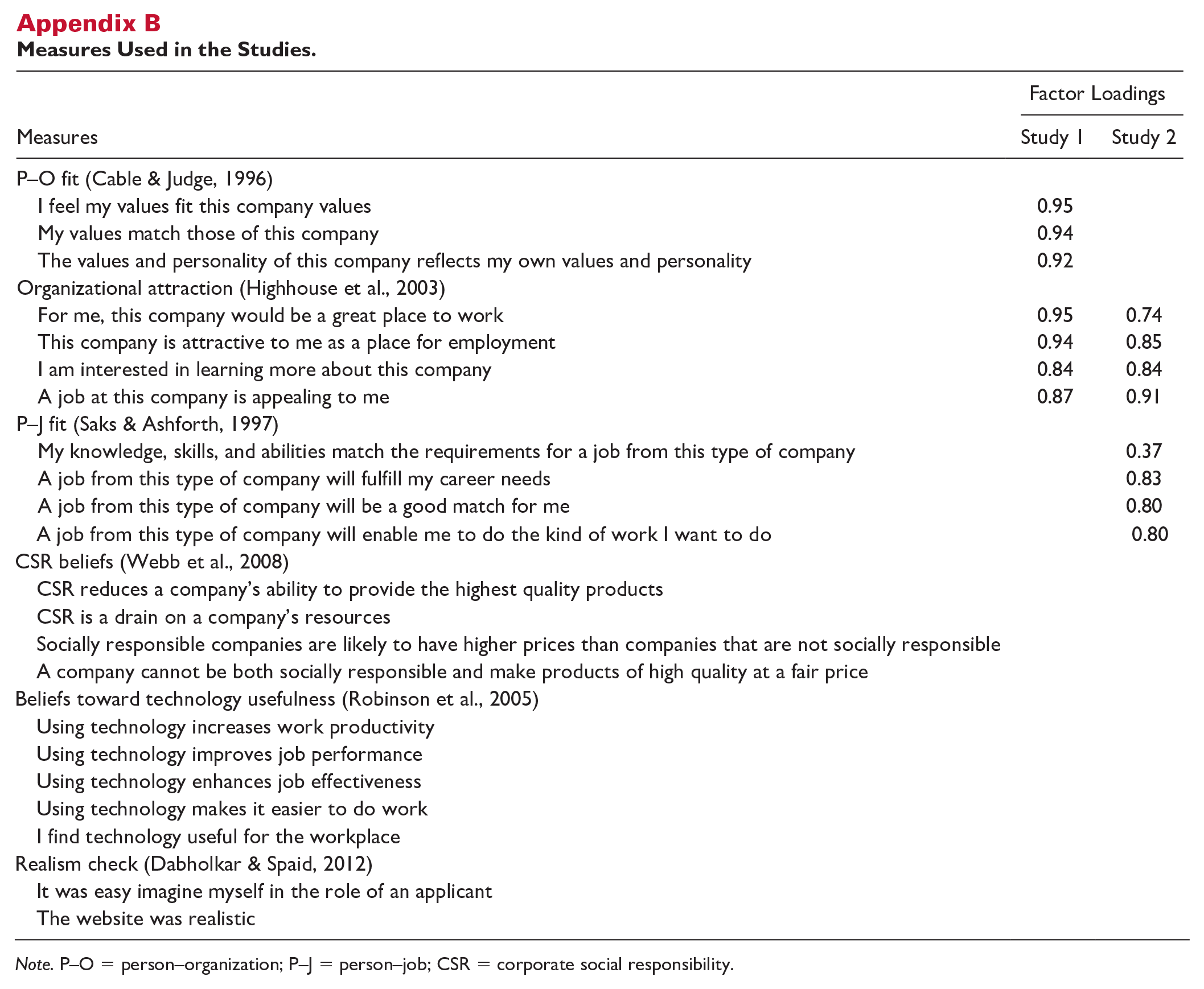
The organizational attraction measure by Highhouse et al. (2003) was adapted. The participants used a 5-point Likert-type scale from strongly disagree to strongly agree. Example items include “This company is attractive to me as a place for employment” and “For me, this company would be a great place to work.” The reliability for this measure was 0.95 (see Appendix B for all the items).
Study 1 Results
Preliminary Analysis
Before testing the hypotheses, the assumptions of multiple regression were tested. Measures of skewness and kurtosis, and normal probability plots showed that the shape of the distribution of organizational attraction approached that of a normal curve. As P–O fit presented skewness and kurtosis outside the threshold normal range (±1.96; Abu-Bader, 2011), percentile bootstrap confidence intervals (CIs) were used to test the conceptual mediation model.
Later, a confirmatory factor analysis (CFA) using AMOS version 26 was conducted. The measurement model indices were (χ² = 31.173, df = 12, p < .001, comparative fit index [CFI] = 0.98, Tucker–Lewis index (TLI) = 0.96, goodness-of-fit index [GFI] = 0.91, root mean square of error approximation [RMSEA] = 0.13). Considering that RMSEA produces a better estimation for large sample sizes (Cangur & Ercan, 2015) and that all other fit indices were above the commonly used thresholds (Kline, 2016), the conceptual model demonstrated satisfactory fit. All factor loadings were significant (p < .01) and ranged from 0.84 to 0.95. As shown in Table 1, the average variance extracted (AVE) for both variables were above the threshold of 0.50, confirming convergent validity (Hair et al., 2016). In addition, the square root of AVE was found to be higher than the intercorrelation between the constructs, providing support for discriminant validity (Fornell & Larcker, 1981). Both constructs also presented high composite reliability (CR) and reliability alphas.
Descriptive Statistics and Model Measures of Study 1.
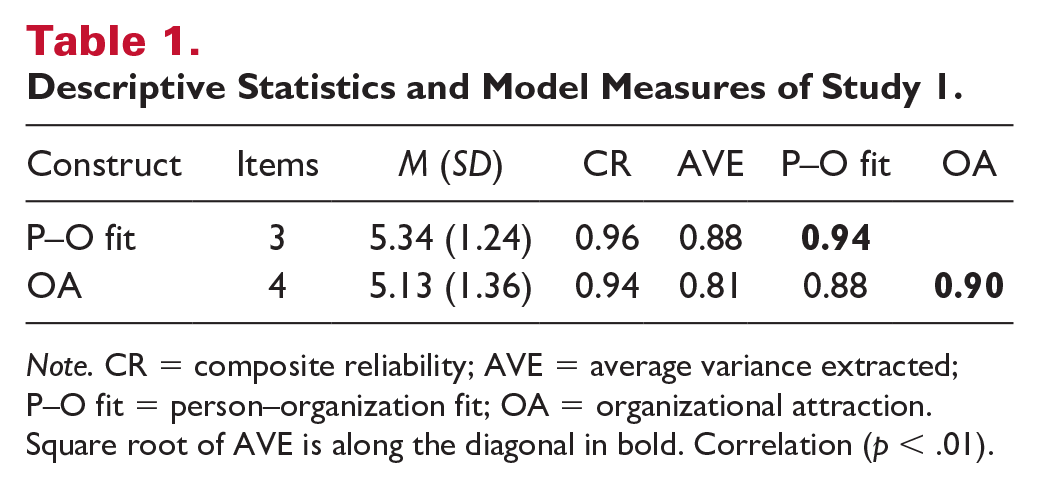
Note. CR = composite reliability; AVE = average variance extracted; P–O fit = person–organization fit; OA = organizational attraction. Square root of AVE is along the diagonal in bold. Correlation (p < .01).
Procedures recommended by Podsakoff et al. (2012) were used to mitigate the concern of common method bias: respondents’ confidentiality was ensured; they were informed that there were no “right” or “wrong” response; and order of items were counterbalanced. In addition, the single-factor model had a worse model fit than the two-factor model (χ2 = 85.919, df = 13, p < .001, CFI = 0.91, TLI = 0.86, GFI = 0.76, RMSEA = 0.25), providing support that common method bias is not an issue in this study.
Test of Hypotheses
Process on SPSS (95% bootstrapping CIs, extracting 5,000 samples) was used to test the conceptual model. Table 2 presents the direct and indirect effects results. As hypothesized (H1), when the career preference and fictitious website type are matched, prospective applicants had a significantly higher P–O fit (b = 0.51, 95% CI [0.01, 1.02]). Considering that the independent variable is binary, partially standardized mediated effects in terms of standard deviation of the dependent variable were analyzed. P–O fit (b = 0.33, 95% CI [0.02, 0.62]) mediated the relationship from the matched career preference/fictitious website to organizational attraction, providing support to the second hypothesis (H2). The R2 value indicates that 68% of the variance in organization attraction can be explained from the relationships with other constructs in the model.
Direct and Indirect Effects of Study 1.
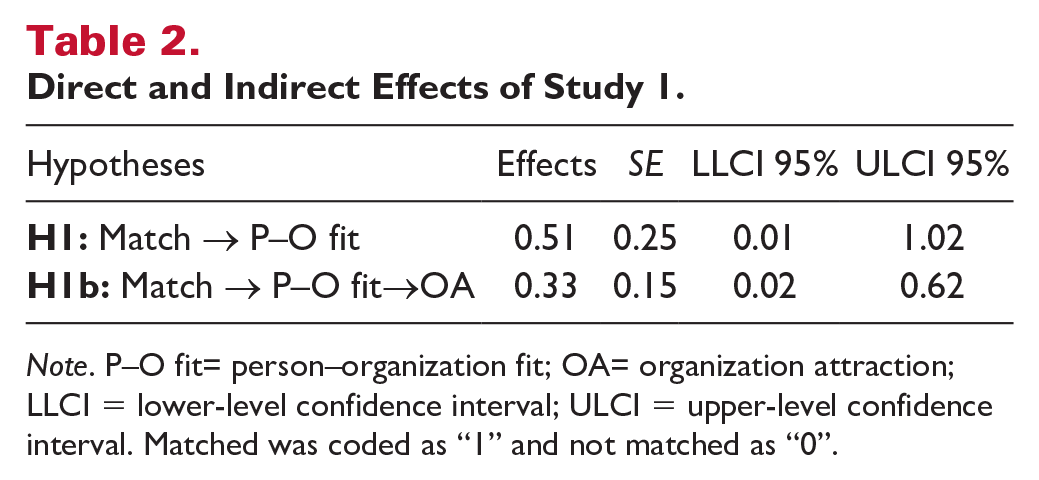
Note. P–O fit= person–organization fit; OA= organization attraction; LLCI = lower-level confidence interval; ULCI = upper-level confidence interval. Matched was coded as “1” and not matched as “0”.
Overview of Study 2
Study 1 showed that when the career preference and fictitious website type are matched, prospective applicants had a significantly higher P–O fit, which led to higher organizational attraction. The results suggest that using fictitious websites is a valid method to collect data concerning applicant attitudes because manipulating fit via a match between a fictitious website and their career preference (e.g., a hotel website for a job seeker in the hotel sector) led to more perceived fit and organizational attraction. Study 2 extended Study 1 by making several changes. First, Study 2 introduced a restaurant sector website for participants to evaluate. To increase the generalizability and extend the findings of Study 1, a fictitious restaurant website was included as a “match” manipulation for participants. Second, Study 2 examined how P–J fit predicts organizational attraction. In doing so, Study 2 tested a replication of the findings of Study 1 with another fit variable to further test the validity of using fictitious websites as a method to examine applicant attitudes to online recruitment. Study replication is crucial for validating the generalizability of phenomenon and validity of previous findings and theories (Amir & Sharon, 1990).
Third, a realism check was used in Study 2, which is necessary for experiment-based approaches. Fourth and last, CSR and technology attitude measures were added as another way to test the validity of using fictitious websites. Adding these two measures allowed us to test for divergent validity, which is “evidenced when different attributes of theoretical interest are not correlated to an extremely high degree.” (Holton et al., 2007, p. 387). In theory, a prospective applicants’ career preference (e.g., hotel/lodging sector or restaurant sector) should lead to higher fit perceptions, and subsequently organizational attraction, when presented with a fictitious website that matches their career preference (e.g., a hotel website for a job seeker in the hotel sector) than when presented with a fictitious website that does not match their career preference (e.g., a restaurant website). This manipulation, however, should not influence CSR and technology attitudes because the manipulated information in the fictitious websites did not include information about CSR and technology. In other words, the experimental manipulations (e.g., career preference and website type) should not influence their CSR and technology attitudes (Jones et al., 2016).
Study 2 Methodology
Sample
Hospitality college students attending another hospitality industry career fair in a southern region of the United States were approached. A total of 153 students participated in this study. After deleting multivariate outliers (detected through Mahalanobis distance test), the final sample was 150 students (67% females, 33% males). Respondents’ age ranged from 18 to 53 years (M = 23, SD = 5.24), 58.7% worked part-time, 25.3% worked full-time, and 16% were not working. Approximately 33% identified as Caucasian American, 23% Asian American, 22% Latino (a) American, 6% African American, and 16% “Other.”
Research Design and Procedure
A 2 (career preference: hotel or restaurant) × 2 (fictitious website type: hotel or restaurant) between-subjects experiment was used to examine P–J fit. A career preference match was created using similar steps as Study 1. Students who selected “hotel/lodging” as their preference for future careers and who viewed a “hotel/lodging” website were coded as “matched.” Students who selected “food and beverage” as their preference for future careers and who viewed a “restaurant” website were also coded as “matched.” All others were coded as the “not matched” (i.e., control group). The fictitious website type (hotel or restaurant) was manipulated by using the same steps from Study 1. The same hotel fictitious website from Study 1 was used for the Study 2 hotel fictitious website. It was also used to develop the restaurant fictitious website; the only difference was to change it to a restaurant context. The same cover story and procedure from Study 1 was used in Study 2.
Measures
P–J fit
P–J fit was measured using the four-item instrument developed by Saks and Ashforth (1997) with a 5-point Likert-type scale from strongly disagree to strongly agree. Example items include “My knowledge, skills, and abilities match the requirements for a job from this type of company” and “A job from this type of company will be a good match for me.” The reliability for this measure was 0.79.
Organizational attraction
The same measure from Study 1 was used. The reliability for this measure was 0.90.
CSR beliefs
We used the four-item measure by Webb et al. (2008) with a 5-point Likert-type scale from strongly disagree to strongly agree. Example items include “CSR reduces a company’s ability to provide the highest quality products” and “CSR behavior is a drain on a company’s resources.” The reliability for this measure was 0.75.
Beliefs toward technology usefulness
We used the five-item measure of beliefs toward organizations use of technology usefulness by Robinson et al. (2005) with a 5-point Likert-type scale from strongly disagree to strongly agree. Examples items include “Using technology increases work productivity” and “Using technology improves job performance.” The reliability for this measure was 0.88.
Realism check
A realism check was conducted using the two-item measure by Dabholkar and Spaid (2012) with a 5-point Likert-type scale. The items included “It was easy imagining myself in the role of an applicant” and “The website was realistic.” The reliability for this measure was 0.77 (see Appendix B for all the items).
Study 2 Results
Preliminary Analysis
To verify the manipulation’s effectiveness, the two realism items were examined. The respondents found it easy to imagine themselves in the role of an applicant (M = 4.04, SD = 0.78) and they also found the website to be realistic (M = 4.02, SD = 0.80). Before testing the hypotheses, the assumptions of multiple regression were also investigated in this study. Measures of skewness and kurtosis, and normal probability plots showed that the shape of the distribution of P–J fit approached that of a normal curve. As organizational attraction presented skewness and kurtosis outside the threshold normal range (±1.96; Abu-Bader, 2011), percentile bootstrap CIs were used to test the model.
After, a CFA using AMOS version 26 was conducted. The measurement model indices were (χ² = 35.547, df = 19, p = .12, CFI = 0.98, TLI = 0.96, GFI = 0.95, RMSEA = 0.76). Considering that this study also presented a relatively small sample size and that all other fit indices besides the RMSEA were above the commonly used thresholds (Kline, 2016), the conceptual model demonstrated satisfactory fit. All factor loadings were significant (p < .01) and ranged from 0.80 to 0.91. The only exception (loading = 0.37) was one item from P–J fit “My knowledge, skills, and abilities match the requirements for a job from this type of company.” Considering that the scale presented high alpha and CR and that no issues were found related to convergent validity (see Table 3), the item was kept in the construct in an effort to not modify the original scale. As shown in Table 3, the AVEs for both variables were above the threshold, confirming convergent validity (Hair et al., 2016). Moreover, the square root of AVE was found to be higher than the intercorrelation between the constructs, providing support for discriminant validity (Fornell & Larcker, 1981). Both constructs also presented high CR and reliability alphas.
Descriptive Statistics and Model Measures of Study 2.

Note. CR = composite reliability; AVE = average variance extracted; P–J fit = person–job fit; OA = organizational attraction. Square root of AVE is along the diagonal in bold. Correlation (p < .01).
As the reliability alphas for CSR and realism check were close to the threshold of 0.7, further analyses were conducted. First, the item-to-total correlation and the interitem correlation for both constructs exceeded 0.50 and 0.30, respectively (Hair et al., 2016). The lone exception was the intercorrelation between two items in the CSR construct (r = .27). As the deletion of one of the items would not significantly increase the construct reliability alpha, all items were kept in the scale. Considering the item-total and interitem correlations, that both scales were measured with few items (if the number of items on a scale increases, Cronbach alpha also increases; Field, 2013) and that both alpha reliabilities were above 0.70 (Hair et al., 2016), both constructs were found to be reliable.
The concern of common method bias was mitigated using the same procedures conducted on Study 1. In addition, the single factor model had a worse model fit than the two-factor model (χ² = 107.718, df = 20, p < .001, CFI = 0.871, TLI = 0.82, GFI = 0.82, RMSEA = 0.17), providing support that common method bias was not an issue in this study.
Test of Hypotheses
Process on SPSS (95% bootstrapping CIs, extracting 5,000 samples) was again used to test the hypotheses. Table 4 presents the direct and indirect effects results. As hypothesized (H1), when career preference and fictitious website were matched, prospective applicants had a significantly higher P–J fit (b = 0.56, 95% CI [0.34, 0.76]). P–J fit (b = 0.47, 95% CI [0.28, 0.67]) mediated the relationship between a matched career preference and fictitious website and organizational attraction, providing support to the second hypothesis (H2). The R2 value indicates that 68% of the variance in organizational attraction can be explained from the relationships with other constructs in the model. Finally, no significant effect of career preference (hotel or restaurant) on P–J fit and organizational attraction was found, suggesting that the “match” coding was valid.
Direct and Indirect Effects of Study 2.
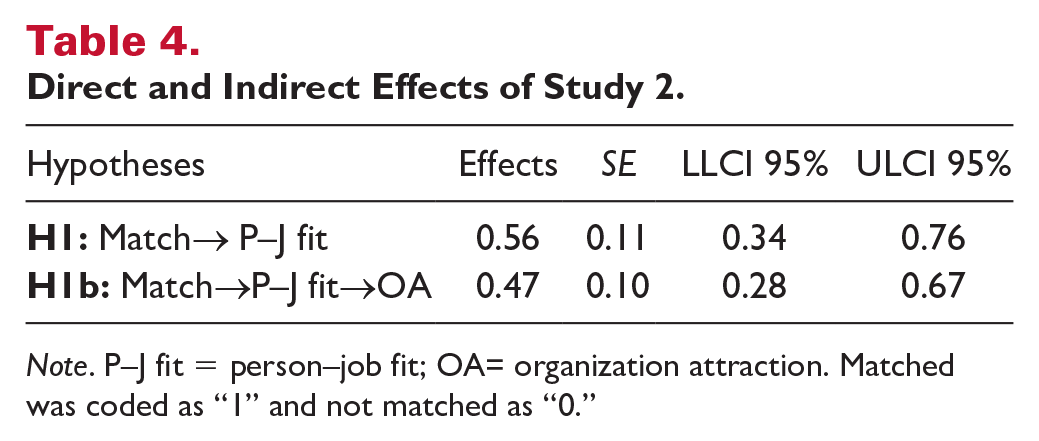
Note. P–J fit = person–job fit; OA= organization attraction. Matched was coded as “1” and not matched as “0.”
In addition, we further validated the use of fictitious websites as a method by including two measures that theoretically should not be influenced by the manipulated information. We used one-way multivariate analysis of variance (MANOVA) to test the effects of career preference and website type (matched variable) on CSR beliefs and beliefs toward technology usefulness. No significant results were found (F = 0.53, df = 2, Hotelling’s Trace = 0.001, p = .95). Specifically, participants’ beliefs about CSR (F = 0.02, df = 1, p = .89) and technology (F = 0.08, df = 1, p = .78) were not affected when there was a match between participants’ career preference and the website they were assigned in this experiment, thereby demonstrating divergent validity.
Discussion
The results demonstrated that a match between career preference and website type increased both P–O fit (Study 1) and P–J fit (Study 2). Both P–O fit and P–J fit mediated the relationship between the matched career preference and fictitious website to organizational attraction, providing support for these signaling mechanisms (Spence, 1973) and for Carless’ (2005) model of fit and organizational attraction. These results extend prior research by showing how manipulating objective fit can influence subjective fit. Specifically, the P–E fit literature points to the importance of distinguishing objective fit from subjective fit (Cerdin & Le Pargneux, 2014; Ostroff, 2012). Study 1 and 2 manipulated objective fit by matching career preference and website type. Past research has argued that subjective fit is a more accurate predictor of applicants’ attitudes and behaviors, such as organizational attraction (Carless, 2005). However, the current studies showed that it is possible to influence both by manipulating objective fit to influence subjective fit rather than choosing one type of fit.
Moreover, past research employing fictitious websites from the hospitality (e.g., Bernardes et al., 2019; Madera, 2018; Walker et al., 2008) and general management (e.g., Banerjee & Gupta, 2019; Dineen et al., 2002, 2007; Hu et al., 2007; Ihme & Sturmer, 2018; Roulin & Krings, 2019) literatures have mainly used either P–O fit or P–J fit. Thus, this article extends past research by showing that manipulating objective fit (e.g., matching career preference and website type) can influence both P–O fit (Study 1) and P–J fit (Study 2).
Implications for Researchers
This study focused on a unique experimental data collection method: use of fictitious websites. Experimental design allows for causal conclusions and is a popular research method allowing for understanding of psychological processes (Imai et al., 2013). By validating the use of fictitious websites for experimental design, this data collection method has great implications for researchers because experimental conditions can be made more realistic for respondents when researchers use this data collection method. First, very few experimental design studies are conducted in the area of human resources in hospitality research. Most HR research in hospitality use survey design. Few research attempts have been made to take on an experimental design that manipulates organizational HR practices to examine the causal impact on applicant/employee attitudes. In such studies, respondents are typically asked to read a scenario about the HR practices of a hypothetical company and answer the survey questions on individual attitudes and behaviors (Yao et al., 2019). Respondents are asked to imagine that they work for that imaginary company. A similar approach has been used in service marketing/delivery research, where customers are asked to read a scenario about a service delivery encounter where customers are asked to imagine themselves in the situation and answer survey questions on attitudes and behaviors (Guchait et al., 2019; Mattila, 1999). However, scholars have noted the limitations of using such hypothetical scenarios as respondents may find it hard imagining themselves in such situations based on a written scenario and may consider the situation to be unrealistic (Aguinis & Bradley, 2014; Mattila, 1999).
The current data collection method of using fictitious websites solves the issue of lack of realism in scenario-based studies. Respondents are informed that the website is real and are allowed to browse through the webpages or are given “screenshots” of websites, giving the impression of a real website (e.g., Dineen et al., 2007; Ihme & Sturmer, 2018; Roulin & Krings, 2019). Although the use of vignettes or scenarios in experiments are valid and widely used, using fictitious websites increases the mundane realism of an experiment, which is the extent to which the experiment reflects a real-world situation (Brewer, 2000). The current studies asked prospective applicants to see a website screenshot of recruitment information and answer questions on perceived fit and organizational attraction. This is the closest researchers can be to a real situation while maintaining control using experimental methods. As opposed to live company websites, fictitious websites can be manipulated to target the phenomena or theory in question. Therefore, prospective applicants reading information on recruitment efforts on fictitious websites are more likely to consider the experimental stimuli to be more realistic compared to simply reading a paragraph/scenario. This data collection method can help increase generalizability of experimental studies.
Some researchers have also considered the use of real websites for experimental manipulations (e.g., De Goede et al., 2011), to make experimental stimuli realistic; however, this method has its own limitations. It is difficult for researchers to control the information on real websites. It is crucial to keep everything the same in experimental and control conditions except the factor whose effect is being examined. Based on this requirement, experimental studies can claim that the outcome changed only because of the manipulated factor. While this requirement of controlling all information is challenging for real websites, the requirement can be achieved using fictitious websites. Therefore, the current data collection method is the best of both worlds; it allows researchers to control the information while maximizing the realism of the experimental stimuli.
Implications for Practitioners
Internet-based recruitment (i.e., e-recruitment) has become increasingly popular because of the advances in technology. However, there is limited hospitality research related to recruitment, specifically e-recruitment. On similar lines, hospitality researchers have mostly ignored research on applicant attitudes, particularly in the area of online recruitment, resulting in a research-practice gap. The unique data collection method of using fictitious websites in the current studies and their findings have several implications for hospitality practitioners/recruiters. First, recruitment messages should be aligned with core organizational values, mission, and culture, to ensure that job seekers can have a valid and reliable picture about the organization. Therefore, customized and relevant recruitment messages based on applicant preferences are more likely to attract applicants that are a better fit to the organization. Job seekers perceptions of fit with jobs and organizations are based on individual differences (based on their personal values and identities) (Madera et al., 2018); and these individual differences can be taken into consideration in an organization’s recruitment efforts. The findings of these studies highlight the importance and consideration of judgments of subjective fit paralleling judgments of objective fit among applications. In other words, e-recruitment efforts can signal objective fit with an organization (i.e., organizational culture and goals) as well as subjective fit (i.e., perceived value congruence). Previous literature suggests both objective and subjective fit predicts positive recruitment outcomes such as organizational attractiveness, pride, and job pursuit intentions (Travis, 2019). For example, recruitment messages targeting millennials can highlight factors this group values (e.g., work-family balance, work flexibility, location). Recruitment messages can highlight company’s CSR practices, charitable gift matching, or volunteer time off that are targeted toward applicants who value social impact. Customization of recruitment messages can help target diverse groups to get a talented and inclusive talent pool. Customization can be achieved through various channels or embedded links that can track application behavior. For example, when interested applicants want to visit the “careers” page on the corporate website, they can be asked some screening questions first (e.g., applicant preferences) and based on the applicant’s preference, they can be directed to relevant recruitment messages. This strategy would be similar to how advertisements on Facebook are created and delivered to the audience based on demographics, interests, and behaviors (Facebook, 2020).
Second, along similar lines, recruitment websites (i.e., webpages) can be customized based on applicant preferences. For instance, an applicant could be interested in working in the food and beverage department at a hotel, but a hotel website might present recruitment information for core areas, such as corporate (i.e., sales, services, marketing, rooms and group blocking) and frontline customer service (i.e., front desk, valet, bellmen), while neglecting the same level of information for food and beverage (i.e., restaurants, bars, coffee shop, and catering) or ancillary business (i.e., spa, gift shop, and golf course). By providing recruitment information that is catered more toward the applicant’s interest in food and beverage, the hotel could help increase perceptions of fit with both the organization and the job. As another example, when applicants visit the careers webpage on Hilton’s company website, there is no mention of career opportunities in foodservices on the main website. It is not until an individual clicks “jobs in hotels” and the next web-page shows all the job categories including foodservices/culinary. A similar issue is with the careers webpage of Marriott International. It may give an impression of low fit for applicants whose career preferences are in foodservices. This study informs hospitality companies about such issues which may result in the organization missing out on better applicant pools because information that informs fit (e.g., career preferences foodservice) should be provided early in the job search process. On the other hand, career websites of companies such as Southwest and Sysco includes every job category on their main page. Interestingly, Hilton’s career website has a statement “Let us help find the right career for you”; individuals are asked some questions on career preferences such as skills, previous experience, location, and based on that information, the individual is directed to those webpages which has relevant job openings based on their career preference selections. Thus, the current studies can help hospitality organizations understand which type of recruitment websites lead to greater organizational attraction for applicants.
An Agenda for Future Research
This study validates the use of fictitious websites as a data collection method by showing how manipulating fit via a match between a fictitious website and applicant career preferences (e.g., a hotel website for a job seeker in the hotel sector) leads to more perceived fit and organizational attraction. This data collection method opens a new line of research for hospitality human resources. Future hospitality scholars can use this technique to manipulate an organization’s human resource practices (recruitment, selection, training, performance evaluation, compensation, and benefits) and examine attitudes of individuals (applicants, employees, and managers).
For example, research in the hospitality literature shows that CSR activities have a positive influence on attracting and retaining employees (Guzzo et al., 2019). Future research in this area can manipulate company involvement in CSR activities using fictitious websites to influence perceived fit and organizational attraction among prospective applicants with varying attitudes of CSR. Future research might also include other outcome measures related to fit and organizational attraction, such as willingness to engage in an organization’s CSR activities.
In addition, since the findings of these studies showed that fictitious websites are a viable experimental data collection method by showing a causal relation of manipulated fit information to perceived fit and organizational attraction, future hospitality research can examine boundary conditions that influence these effects. For example, personality measures can be used to examine how certain personality constructs moderate or change the effect of the manipulated fit information to perceived fit and organizational attraction. Doing so will continue to advance the theories, knowledge, and understanding of hospitality and provide more implications for theory and practice.
Footnotes
Appendix
Measures Used in the Studies.
| Measures | Factor Loadings | |
|---|---|---|
| Study 1 | Study 2 | |
| P–O fit (Cable & Judge, 1996) | ||
| I feel my values fit this company values | 0.95 | |
| My values match those of this company | 0.94 | |
| The values and personality of this company reflects my own values and personality | 0.92 | |
| Organizational attraction (Highhouse et al., 2003) | ||
| For me, this company would be a great place to work | 0.95 | 0.74 |
| This company is attractive to me as a place for employment | 0.94 | 0.85 |
| I am interested in learning more about this company | 0.84 | 0.84 |
| A job at this company is appealing to me | 0.87 | 0.91 |
| P–J fit (Saks & Ashforth, 1997) | ||
| My knowledge, skills, and abilities match the requirements for a job from this type of company | 0.37 | |
| A job from this type of company will fulfill my career needs | 0.83 | |
| A job from this type of company will be a good match for me | 0.80 | |
| A job from this type of company will enable me to do the kind of work I want to do | 0.80 | |
| CSR beliefs (Webb et al., 2008) | ||
| CSR reduces a company’s ability to provide the highest quality products | ||
| CSR is a drain on a company’s resources | ||
| Socially responsible companies are likely to have higher prices than companies that are not socially responsible | ||
| A company cannot be both socially responsible and make products of high quality at a fair price | ||
| Beliefs toward technology usefulness (Robinson et al., 2005) | ||
| Using technology increases work productivity | ||
| Using technology improves job performance | ||
| Using technology enhances job effectiveness | ||
| Using technology makes it easier to do work | ||
| I find technology useful for the workplace | ||
| Realism check (Dabholkar & Spaid, 2012) | ||
| It was easy imagine myself in the role of an applicant | ||
| The website was realistic | ||
Note. P–O = person–organization; P–J = person–job; CSR = corporate social responsibility.
Declaration of Conflicting Interests
The author(s) declared no potential conflicts of interest with respect to the research, authorship, or publication of this article.
Funding
The author(s) received no financial support for the research, authorship, or publication of this article.
