




Abstract
The emancipatory approach in disability research takes the political position of promoting the voices of people with disabilities to make possible transformative changes to their lives. Based on auto-ethnographic research notes made while applying the emancipatory approach to qualitative research conducted with employees with disabilities in the Vietnamese hospitality industry, this article suggests guidelines that include four steps: preparing/planning, recruiting, conducting interviews, and confirming the data. Practical strategies for each stage in the process are also suggested, with the aim of better including the voices of employees with disabilities in qualitative hospitality research. The article will benefit future researchers conducting qualitative research on employees with disabilities by highlighting the value of the emancipatory approach, which has not been previously reported on in the hospitality literature.
Keywords
Introduction
Including the voices of marginalized people, such as employees with disabilities, in research makes a significant contribution to social justice and their human rights (Oliver & Barnes, 2010). In disability research, the emancipatory approach has a dual focus on methodological and political stance, which guides the research process and creates meaningful and transformative knowledge for those living with disabilities (Barnes, 2003; Barton, 2005). In this way, research participants with disabilities are empowered through making their voices heard. Although the hospitality industry experiences increasing levels of engagement of people with disabilities in different roles, Mooney and Baum (2019) argue that the interests of vulnerable workers (in this case, hospitability employees with disabilities) continue to be largely neglected, both in the paradigms used and limited scope of hospitality and tourism management studies. Therefore, the emancipatory research approach offers an excellent narrative framework to better inform understandings of hospitality disability-related phenomena. By applying and testing the application of the emancipatory approach in an empirical study of employees with disabilities in the Vietnamese hospitality industry, this article proposes methodological strategies and guidelines for conducting qualitative research that includes the voices of these employees.
Employees with disabilities experience underemployment and discrimination in the workplace due to the stigma that questions their ability to work (Gewurtz et al., 2016; Houtenville & Kalargyrou, 2012). A review of the literature indicates that previous studies have focused on exploring issues related to this group from the perspective of outsiders (e.g., employers, service workers, government officials, students, and customers) rather than from the perspective of the employees with disabilities themselves (Lysaght et al., 2016). The typical characteristics of hospitality services, such as the inseparability of production and consumption (P. B. Kim et al., 2015), suggest that employees with disabilities experience a more challenging working environment than employees without disabilities, due to the pressures of constantly interacting with customers, exclusionary stereotypes about their ability to provide customer service skills, and the atheistic preferences of managers (Madera et al., 2020). Thus, studies on the experiences and perceptions of hospitality employees with disabilities need to incorporate a more inclusive methodology that includes their voices alongside the existing disciplinary approaches (Gillovic et al., 2018; Macbeth, 2010). Although the emancipatory approach is widely accepted in the fields of disability, medicine and health, and education, it has been paid little attention by hospitality scholars. The lack of voice for people with disabilities in the literature may contribute to the misunderstandings that cause their exclusion from the mainstream workforce (Dwertmann, 2016).
The challenges of conducting research with participants with disabilities include a lack of literature about the social and cultural aspects of involving them in studies. For qualitative research, disability inquiry literature shows that ethics-related issues, including ethical requirements and participant recruitment methods, were the major challenges for researchers using participants with disabilities. These challenges have significantly affected the quality and quantity of studies related to disability and work (Lysaght et al., 2016). It should also be noted that previous disability-related studies in the hospitality industry were conducted in the context of developed countries (Feerasta, 2017; Gröschl, 2012), so the implications of the results for developing countries may vary due to social and cultural incompatibility. The distinctions between social settings in developed and developing countries also influenced how the research could be conducted with participants in those contexts (Scott et al., 2006). Such challenges in conducting qualitative research with employees with disabilities have not been previously discussed in hospitality and disability literature. In response, this article proposes an alternative inclusive methodology, the “emancipatory approach,” by addressing two research questions:
The overall aim of the article is to advocate for research projects that include the voices of this marginalized group in the hospitality workforce. The article, therefore, will address some methodological issues with previous hospitality and tourism studies, and provide hospitality researchers with practical guidance to enable them to successfully implement an emancipatory approach. The guidelines were developed using auto-ethnographic research notes based on fieldwork performed in the Vietnamese hospitality context. The guidelines are separated into four steps—preparing/planning, recruiting, conducting interviews, and confirming the data—with practical strategies for each stage in the process that aim to increase the number of voices of employees with disabilities being heard within qualitative hospitality research. The sections that follow will present a brief review of the emancipatory approach for disability-related research, describe how extant studies of employees with disability have been conducted in the hospitality and tourism literature, discuss the auto-ethnographic research notes of the fieldwork in Vietnam, and then offer guidelines for applying the emancipatory approach to research with employees with disabilities.
Emancipatory Approach for Disability-Related Research
The emancipatory approach can provide a broad framework for including the voices of employees with disabilities in academic works (Biggeri & Ciani, 2019). Applying the emancipatory methodology has been regarded as a transformative approach to disability-related research (Barnes, 2003). The key objective and ideology of emancipatory research are to foster positive social change for those living with disabilities (Danieli & Woodhams, 2005). In the literature, the emancipatory approach has become a central focus of critical social science and is associated with feminist researchers who take the political position of change agents (Barnes, 2003).
Emancipatory research allows employees with disabilities to have their voices heard; essentially, it allows them to be the central focus of studies and responds to the call for more disability-related research in the hospitality and tourism industry. Danieli and Woodhams (2005) explain how an emancipatory approach takes the political position that disability research should support positive change in the lives of people with disabilities, for example, through meaningful employment opportunities and promoting insights from direct living-with-disability experiences. Similarly, Pringle and Booysen (2018) recommend emancipatory researchers to adopt a critical/transformative paradigm with the mission of creating knowledge to drive positive change in organizations and society. This ontological and epistemological positioning prioritizes the diverse social realities of inequality that marginalized groups experience. Both researchers and research subjects must be actively involved to create transformative knowledge (Rose & Glass, 2008; Swartz & Nyamnjoh, 2018). Participants with disabilities are highlighted as insiders who are more than a source of information, but rather should be given ultimate control of the quality of the interaction and the sharing of information between them and the researcher (Barnes, 2003). The emancipatory approach ensures the participation and involvement of participants with disabilities through six key dimensions stated by Zarb (1992; see Table 1): research methods, roles of individuals with disabilities, the role of researchers, empowerment, the social model of disability, the control of the research process, and the research implications. The key dimensions of Zarb (1992) highlight the methodological and managerial approaches that can maximize the contribution of individuals with disabilities to the research process.
Key Aspects of Emancipatory Research.

Note. Please see the following studies: Pringle and Booysen (2018), Rose and Glass (2008), Swartz and Nyamnjoh (2018), and Zarb (1992).
In the literature, the debate about the benefits of participatory and emancipatory approaches to disability research has been ongoing, but more scientists agree that the participatory approach can be used en-route to the emancipatory approach (Kiernan, 1999; Rix et al., 2019). The key contribution of emancipatory research is to define how the participation of employees with disabilities should be undertaken and to ensure that the political position of researchers is toward empowering them. In the case of hospitality research, the previous approach taken by the researchers failed to include the voices of employees with disabilities. To address the deficit, an emancipatory approach should be embedded in any future hospitality research involving employees with disabilities to resolve the identified methodological challenges.
It remains a considerable challenge to determine who controls the research, whether the researcher plays the role of an impartial observer or becomes an advocate for the interests of employees with disabilities (Richards et al., 2010). The question is how participants with disabilities may be involved and encouraged to actively express their expert knowledge. The most appropriate person to lead such research is the employee with a disability; however, how should researchers proceed if they are not themselves disabled? Powis (2018) suggests the emancipatory approach could guide researchers as nondisabled individuals to optimize the experiences and expertise of participants with disabilities when conducting such research. In this way, if researchers self-identify as disability advocates, a platform is created whereby employees with disabilities can contribute their voices in the advancement of knowledge.
Pringle and Booysen (2018) argue that research is emancipatory when it opens an avenue for marginalized people to add their voices. Thus, diverse interpretative methods (e.g., interviews, focus groups, or auto-ethnography) enable employees with disabilities to actively engage in the research process and to address research questions. In addition, Swartz and Nyamnjoh (2018) advise researchers employing an emancipatory approach to engage participants with disabilities in research design from the onset, and plan studies that integrate carefully considered research questions with the appropriate methods to collect relevant data. For example, Richards et al. (2010) decided on focus groups as their data collection method based on their intention to co-create richer insights between participants in the group discussion as they shared their knowledge and experiences of qualified rehabilitation officers. The study on which the article is based followed a similar approach by using semi-structured interviews to obtain insights from Vietnamese hospitality employees on the dimensions of their job performance, throughout prioritizing the well-being and comfort of participants while respecting their agreement to voluntarily participate or withdraw from the study at any time. The detailed records of the interactions between researcher and participants during the research process assisted in developing the guidelines for carrying out emancipatory research. Further details on the auto-ethnographic process will be presented in the following section.
Employees With Disabilities in Hospitality Studies
Employees with disabilities are considered as an as yet untapped labor source for the hospitality industry (Kalargyrou et al., 2018). Employment of people with disabilities could provide multiple benefits in terms of human resources, marketing, organizational diversity culture, and creatives; however, employees with disabilities often face hiring barriers in the workplace (Kalargyrou & Volis, 2014; Lindsay et al., 2018). In hospitality, barriers such as stigma about inability, employers’ concerns about accommodation costs, and customer acceptance of service are the major reasons for either failure to hire or mistreatment in the workplace (Gröschl, 2012). However, the literature about employees with disabilities in the hospitality scholarship has focused on the involvement of employers and lacks the perspective of employees with disabilities. The voices of employees with disabilities have not been heard around the issues related to their workplace environment.
A systematic review of the hospitality literature was conducted to identify the methodological gaps. By consulting with a university library expert, two search-engine platforms were identified as sources of potential studies, including Google Scholar and Web of Science (Pickering & Byrne, 2014). The keywords were divided into two groups to perform an advanced search. The first group of keywords, “Hospitality,” “hotels,” and “foodservice,” was used to identify publications related to the hospitality and tourism industry. The second group of search terms comprised “employee,” “staff,” “worker,” “disability,” “disabled,” “handicapped,” and “impairment.” The study included articles that had research subjects across groups of different disabilities. The boundary of the search was defined within all articles and research notes published in English, in peer-reviewed hospitality and tourism journals (C. S. Kim et al., 2018). The study excluded conference papers, theses, and publications that not included in the Social Science Index listed journals.
From a total of 1,091 articles (Google Scholar 557 and Web of Science 534; see Figure 1) generated by the search engines, a process of synthesizing, removing duplicates, screening, and checking was conducted to identify whether the research being reported on included the participation of employees with disabilities (C. S. Kim et al., 2018). We found only three articles, out of 1,091, included employees with disabilities as research participants (Feerasta, 2017; Gröschl, 2012; Luu, 2019). It is noticeable that we found 49 articles about inquiries related to employment and workplace issues of employees with disabilities; however, only three of them had recruited employees with disabilities, whereas the other 46 concentrated on the perspectives of relevant stakeholders (employers, managers, supervisors, students, and service workers; Bengisu & Balta, 2011; Gröschl, 2005; Houtenville & Kalargyrou, 2012; Kalargyrou et al., 2018; Kalargyrou & Volis, 2014; Madera et al., 2020). These stakeholders were considered as gatekeepers or outsiders who could not present the voices of employees with disabilities; however, they were more convenient for researchers to approach for the process of data collection than participants with disabilities (Lysaght et al., 2016). As a consequence of this methodological failure, the voices of the key stakeholders, employees with disabilities, were not heard. The outcome, unintended by these researchers, is that the stigma of disability and those living with disabilities remained unchallenged.

Findings From a Search of the Hospitality Literature for Research Involving Employees With Disabilities (n = 49).
Auto-Ethnographic Research Note in the Vietnamese Hospitality Context
This article is based on the auto-ethnographic research notes of a project conducted in Vietnam. Auto-ethnography is a research approach that interprets and analyzes the personal experiences of a researcher recorded in notes written while he or she was in the field (Ellis et al., 2011). The project aimed to explore the perceptions of employees with disabilities about their job performance when interacting with customers. The concept of disability used here aligns with the social model of disability, which holds that people with disabilities are excluded from community activities due to social and environmental barriers and not by their biomedical impairment (Oliver & Barnes, 2010). In this project, employees with disabilities were invited to participate as co-researchers, following a similar approach by Richards et al. (2010). In this approach, employees with disabilities are involved in guiding and co-creating knowledge.
All six dimensions of emancipatory research suggested by Zarb (1992) were applied flexibly in the process of data collection to maximize the contribution of employees with disabilities to the research. As Barnes (2004) suggested about the role of researchers in emancipatory research, the lead researcher and research team involved in the study used their experience and expertise to facilitate and organize the process of data collection. One of the research team not only is an expert in disability studies but also experiences a lived disability in a wheelchair, leading many projects involving people with disabilities in Vietnam. Therefore, this project encapsulates a unique approach where decision-making processes were rigorously confirmed by all researchers and the research participants with disabilities.
The project of exploring the employees with disabilities perceptions of their job performance was conducted at 10 cafés and restaurants in four major cities in Vietnam, such as Ho Chi Minh City, Da Nang, Hoi An, and Ha Noi. Throughout the project in Vietnam, the lead researcher used autobiographical and ethnographic techniques to observe and to take notes about what happened during the process of research implementation. These research notes were important as they were used by the research team to revise the research plan and to complete the project in a way that met the objectives. This project differed from previous studies as it focused on providing a platform on which employees with disabilities could raise their voices and made them be heard. The project also rigorously followed the six dimensions of the emancipatory approach recommended by Zarb (1992) to ensure the role of participants with disabilities in the research process.
To address the methodological concerns highlighted previously with studies involving hospitality employees with disabilities, auto-ethnography was used as a method to unpack the experiences of the first author when attempting to apply the emancipatory approach in an empirical study while responding sensitively to the social-cultural context of Vietnam (Ellis et al., 2011). The auto-ethnographic notes offered the researcher critical insights on how to implement the “right” processes and procedures that would enable the full participation of employees with disabilities in the research. Using previous auto-ethnographical studies, for example, Liggin et al.’s (2013) public health research and Ryan and Mooney’s (2018) hospitality diversity study as examples, the researcher recorded their personal reflections on every stage of the field research process in handwritten notes in the “third person” voice to capture contextual details and to maintain objectivity by distancing the researcher as the method requires (Ellis et al., 2011). The fieldtrip notes were continuously updated during the research process, and on conclusion of field data collection, they were grouped and synthesized manually by the researcher using Braun and Clarke’s (2006) thematic analysis process, as the auto-ethnography approach may incorporate further compatible methods as necessary (Ryan & Mooney, 2018). Understandings were continuously checked and refined in a reflexive process. The first step of analysis was immersion in the notes to gain a deep understanding of different dimensions. The second step involved noting connections to discrete stages of the research process. In successive steps, emerging themes were linked and refined with fresh insights from the emancipatory approach. Finally, the main themes were structured and organized to form distinct stages and provide practical guidelines for future emancipatory researchers. Consultation between the lead researcher and the research team to confirm interpretations and, consequently, further refine themes took place at critical junctures during the analysis to ensure credibility, one of the four criteria used to denote “trustworthy” interpretive research (Pringle & Booysen, 2018).
In total, 18 employees with vision, hearing, and speaking, and mobility disabilities voluntarily participated in semi-structured interviews. However, to optimize the role of employees with disabilities in making decisions about how they wanted to be involved in this research, the lead researcher consulted with each participant to determine their preferences on how the interview would be organized. To complete an interview, there was thus more than one meeting between the researcher and each employee with a disability, and 40 meetings were had in total. Even when predefined interview questions had been agreed to by the research team and disability advisors beforehand, the employees with disabilities could still decide which issues or questions they wanted to emphasize in their conversation with the researcher. Therefore, in contrast to semi-structured interviews commonly used in qualitative research, the interviews with employees with disabilities occurred in more than one meeting to give time for the participants to consider their contribution to the project.
Challenges in Conducting Research With Employees With Disabilities
The reluctance of researchers to undertake disability studies can be directly attributed to its methodological challenges. According to Dwertmann (2016), there are three groups of unique factors underlying the methodological challenges to disability studies that are not encountered when researching other dimensions of diversity (e.g., gender, age, or race), including different understandings of the disability construct, the stigma from gatekeepers about individuals with disabilities, and associated health conditions. These factors create difficulties in defining research questions, research subjects, and processes of empirical data collection, especially in quantitative research. In particular, the challenges of recruiting research participants with disabilities at workplaces have led researchers to engage with other stakeholders as alternatives instead of individuals with disabilities. In addition, the study of Lysaght et al. (2016) found that disability researchers faced challenges from gatekeepers to having the participation of organizations in their research. By interviewing gatekeepers (employers, managers, and supervisors of employees with disabilities), Lysaght et al. (2016) identified the barriers for organizations to participate in research:
Gaps in acknowledging the concept of disability;
The lack of financial and resources support within the organization for research;
The risk to the organization of legal and reputational issues;
A lack of trust in the credibility of researchers and institutions; and
Other organizational policies regarding disability.
When organizations imposed these barriers, it becomes more difficult for researchers to approach their employees with disabilities. To deal with these barriers, a study by Lysaght et al. (2016) suggested recruitment strategies to increase the participation of employers. Acknowledgment of these methodological challenges and recruitment strategies to mitigate them is thus necessary for any researchers in disability-related studies.
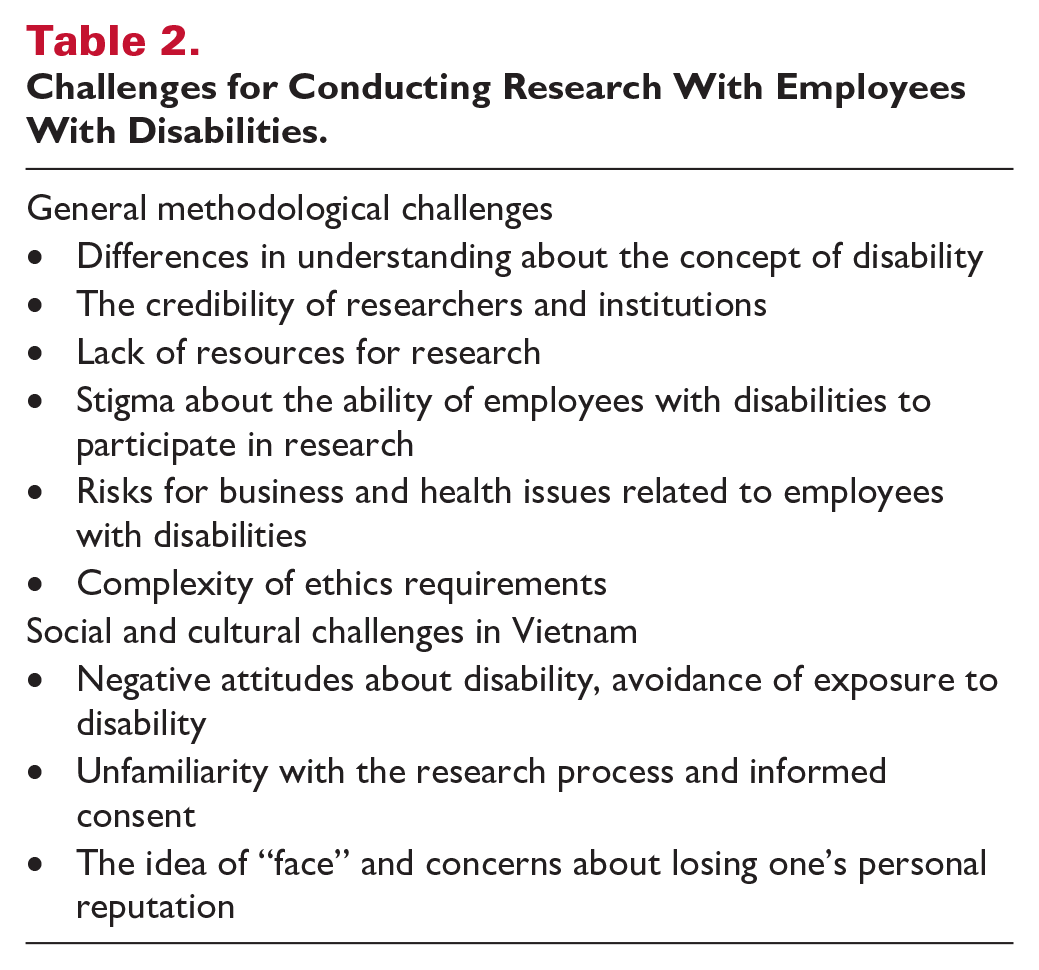
However, these methodological challenges to conducting research with employees with disabilities and the recommended solutions to them are more associated with the organizational level than at the individual level (Table 2). According to Nind (2008), the challenge is how to obtain the engagement of vulnerable groups like employees with disabilities and to give them a voice to help eliminate their exclusion from participation in social activities, including academic research. In the context of the hospitality industry workplace, the challenge for employees with disabilities to engage in research critically involves their employers, as employers hold concerns about the safety of their business image from the risk of information exposure (Gröschl, 2012; Sakdiyakorn & Wattanacharoensil, 2017). Employers, as gatekeepers, hindered researchers’ ability to invite employees with disabilities to participate in research. Thus, it is essential for hospitality researchers to address the challenges and adjust the methodological approach to cooperate with employees with disabilities.
Challenges for Conducting Research With Employees With Disabilities.
While research on employees with disabilities is seriously lacking (Kalargyrou & Coten, 2017), the existing studies on disability issues in the workplace focused on the perspectives of employers, managers, supervisors, customers, or carers rather than of the employees (Darcy et al., 2016; Lysaght et al., 2016). A review of hospitality and tourism studies revealed different research methods, yet only three studies offered employees with disabilities the opportunity to voice their experiences and opinions (Farley & Vorwald, 1993; Feerasta, 2017; Gröschl, 2012) (see Figure 2). Consequently, a new research approach is required to empower employees with disabilities by including employee voice to encourage engagement (Mooney & Baum, 2019). Empowering methodologies promote equity by recognizing the interests and human rights of diverse groups and honoring the subjective knowledge of multiple stakeholders (Gillovic et al., 2018; Lysaght et al., 2016). The integration of an emancipatory approach into hospitality research will deal with the urgent methodological problem of excluded voices of marginalized groups, such as employees with disabilities, in hospitality studies.

Research Methods in Previous Studies About Workplace Issues With Employees With Disabilities.
In the ideology of emancipatory research, employees with disabilities participate in research as co-researchers to co-create transformative knowledge (Zarb, 1992). Particularly, research using an interview method provides a platform for employees with disabilities to cooperatively contribute to knowledge by promoting the idea of conducting research with them rather than on them (Kiernan, 1999; Motha et al., 2019). The application of the emancipatory approach provides significant findings in terms of methodological acknowledgment. Although the lead researcher of this article spent more than 1 year preparing for the interviews, the research team encountered more challenges conducting research with people with disabilities than those that have been identified in the literature. The research team experienced a more complicated procedure to obtain ethics approval for this project in comparison with previous disability-related studies mentioned (Lysaght et al., 2016). The recruitment of research participants faced difficulties due to business owners and managers hesitating to give their approval, and the lack of statistical information about people with disabilities in Vietnam was also a barrier (Palmer et al., 2019). The most challenging issue was the social and cultural incompatibility of Vietnamese employees with disabilities to the research methods of a Western developed country. This challenge may not only be experienced in Vietnam but could also be an issue in other developing countries. Most importantly, this incompatibility has not been investigated in disability and hospitality literature. Therefore, the research team needed to test different strategies to find a way to conduct interviews with employees with disabilities in the Vietnamese hospitality industry in a more culturally compatible way.
When the lead researcher first contacted the managers of employees with disabilities, many were not familiar with the procedure of doing research. Some managers asked the researcher to do the research in a simpler way by handing over the survey questionnaire to them and then coming back later to pick it up. They said that they had previous experience of doing research in that way in Vietnam. Teachers are traditionally respected in Vietnamese society, but the business of doing research and other academic work is vague due to a lack of legal obligation (Mizunoya et al., 2016; Nguyen, 2015). The concept of an “interview” causes the worry of a formal occasion that their employees may not have the ability to deal with (Nguyen, 2015). Ethics documents and consent forms are Western concepts that are not common in Vietnamese research (Bonnin, 2010; Vo, 2018). For researchers with nondisabled subjects, the approach of sharing research information and a consent form was implemented casually in an informal way or often absent (Bonnin, 2010; Scott et al., 2006). However, for this emancipatory research project, the research team took the ethical requirements seriously to ensure the right of employees with disabilities to clearly understand the research procedure. From there, they could decide whether and how they would actively participate in the research. Therefore, it is important for the lead researcher to establish a proper strategy to communicate with managers and employees with disabilities to obtain their agreement for the implementation of the research.
In addition to the unfamiliarity with research procedures, business owners and managers were also really concerned about the credibility of the researchers and the potential risks for their business if they participated in the research. The research team included three members, but only the lead researcher, a Vietnamese doctorate student, went on the fieldtrip to Vietnam. Previous qualitative studies in Vietnam have mentioned that novice researchers might experience difficulties in gaining the trust of organizations so that they will allow research to be conducted on their premises (Nguyen, 2015; Pham, 2014). The managers showed a lack of interest in collaborating in research with unknown researchers, as it would cost time for them and their staff without foreseeable benefits (Lysaght et al., 2016). Some mentioned the lack of a financial return for research participation from a doctoral project, unlike the remunerated research they had experienced conducted by nongovernment organizations.
Furthermore, the managers also worried that the conversations between the researcher and employees with disabilities may publicly reveal information related to legal issues that could harm their business. The process of having to get approval from higher management persons could also have led to the hesitation to participate in the research (Lysaght et al., 2016). Consequently, the research team needs to plan solutions to have appropriate recruitment strategies to work with business owners and managers for their approval and willingness to support the project as referrals.
After obtaining agreement from managers, it was essential for the research team to engage in corporative interactions with the employees with disabilities, as this was their commitment to the managers and the philosophy of emancipatory research. There were three major issues for the employees, which arose from their low educational background, their concern about losing face, and their lack of trust in the researcher. As many employees with disabilities had never taken part in research before, they reported that the idea of being interviewed created the fear of being in a formal conversation with journalists or policemen. Therefore, they worried they would not be able to answer the questions or to meet the research requirements. Their excuse at the beginning was, “I have nothing to say.” Later, they also shared that they thought their low educational background would be not good for the study or themselves. This issue also related to the idea of losing face (personal reputation; Pham, 2014). If there are questions that the employees with disabilities could not answer, it would negatively influence how other people saw them.
Besides that, meeting and talking closely with a strange person about disability-related issues is not a common practice for employees with disabilities (Hunt, 2005). It is thus important for the researcher to establish rapport with employees through their acquaintances (Gammeltoft, 2008). In Vietnamese culture, the trust of someone is based on the relationship and believed commitment (Nguyen, 2015). Thus, the strategy for cooperating with employees should be developed flexibly in Vietnam, with a view to social and cultural compatibility, rather than applying emancipatory qualitative research processes rigidly.
Research Guideline—Applying the Emancipatory Approach in Conducting Qualitative Research on Employees With Disabilities
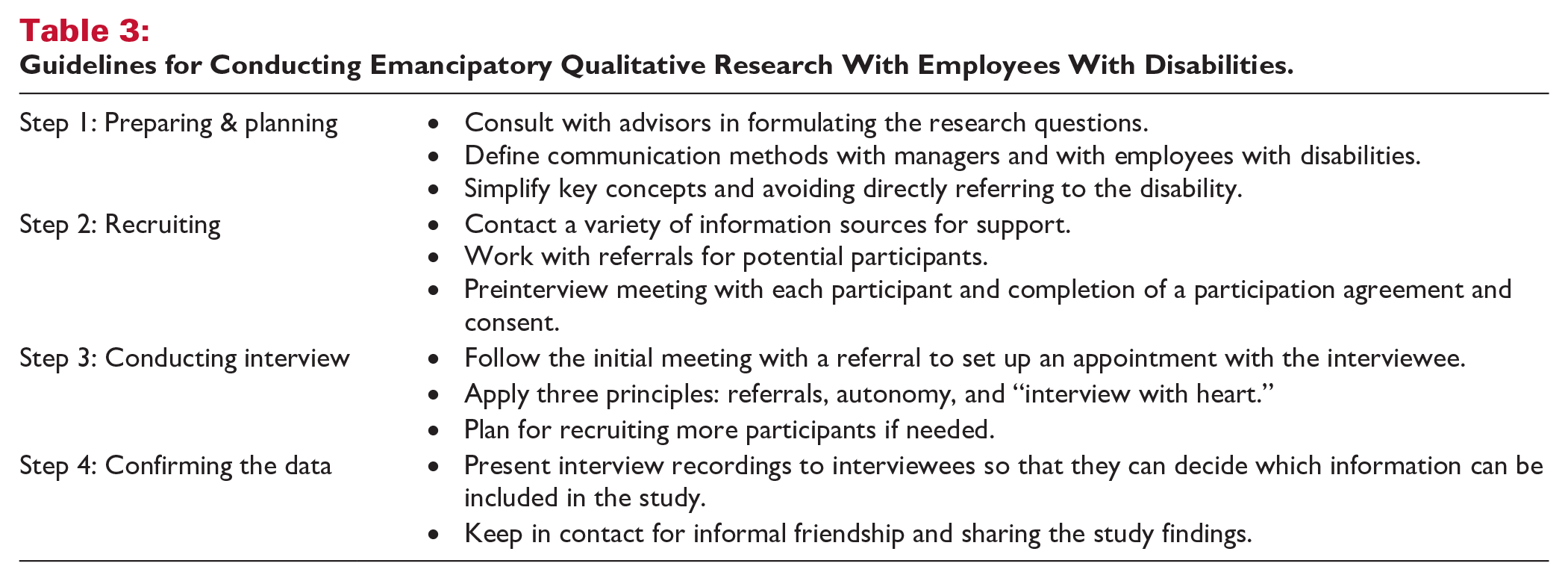
After the successful trial of different solutions to apply the emancipatory approach to this qualitative research with employees with disabilities in the Vietnamese hospitality industry, a four-step research guideline has been developed from auto-ethnographic research notes (Table 3). The first step is to develop the research questions and research design. Strategies for this step include consulting with disability advisors to decide research inquiries and make adjustments to communication methods and language expression to successfully invite businesses and employees with disabilities to cooperate with the research team. The second step of emancipatory qualitative research with employees with disabilities is to search for information and recruit participants. The final two steps are to conduct the interviews and confirm the interview data that will be used for analysis. The implementation of these research guidelines helped avoid any possible harm and discomfort for employees with disabilities and built their confidence and openness to sharing their deeper insights with the researcher during the interviews. Consequently, the interview data include rich insights from stories of the lived experience of employees with disabilities at their workplace.
Guidelines for Conducting Emancipatory Qualitative Research With Employees With Disabilities.
Step 1: Preparing and Planning for the Research
Following the emancipatory approach, the research team engaged with disability experts for their contribution to developing the strategies to communicate the aims and methods of the research with organizations and their employees with disabilities. The group of research advisors included a researcher at a disability research center, a café manager, and two of their employees who were living with a disability in Vietnam. Their advice about establishing the strategies for communication and language expression for conducting the research was critically important to overcoming the challenges, especially from gatekeepers.
To deal with social and cultural challenges when communicating with managers and employees with disabilities, the strategy to approach them should be different (Table 4). In this project, only four employees with disabilities could use email competently. The face-to-face meeting helped employees with disabilities to know the researcher in person, which enabled them to build trust in the researcher. In Vietnamese culture, sharing personal information is a common way for people to get to know each other (Napier et al., 2004). The face-to-face meeting would be a chance for employees with disabilities to gain some knowledge about the researcher rather than the research. For managers, more formal conservation with a consent form showed them the seriousness of the research and helped establish the credibility of the researcher (Vo, 2018). As mentioned previously, the key challenge from managers was their concern about the credibility of researchers and institutions (Lysaght et al., 2016). The communication with managers about the research was simpler if the researcher had established a good relationship with them in advance.
Communication Strategies With Managers and With Employees With Disabilities.
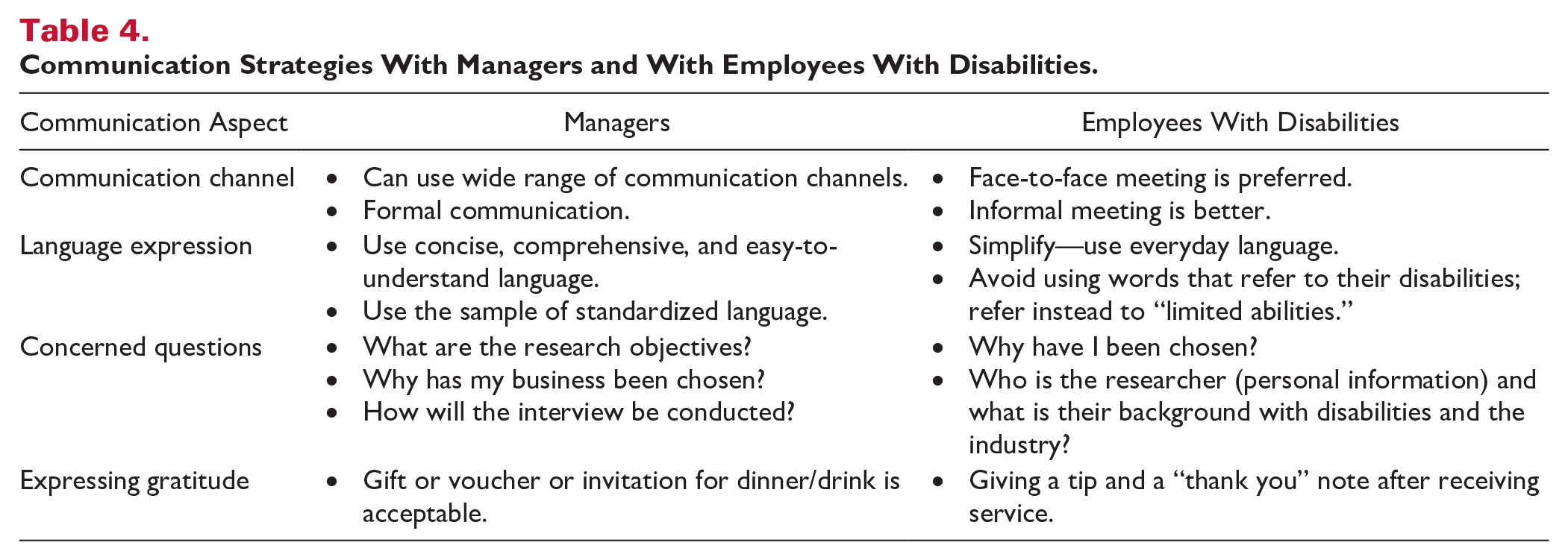
From the aspects of language expression and the content of communications, the ultimate purpose was to make employees with disabilities interested in contributing to the research. Although the formal language of communicating with managers could be learned from a sample available from an institution, local advisors were an important source of advice that helped the researcher understand the local context of disability issues. The feedback from pilot interviews with employees with disabilities contributed to a better version of predetermined interview questions and an interview code of conduct. Thus, the active involvement of individuals with disabilities benefited the development of the research from the beginning.
In terms of expressing gratitude for the contributions of participants and facilitators to the research, the researcher should remain sensitive and flexible. The lead researcher understood that managers and employees showed their willingness to help the researcher rather than the opposite way (Nguyen, 2015). Therefore, the token or present was to show the gratefulness and appreciation from the researcher to the managers. Mentioning compensation for their time or effort could lead to misunderstandings about how their kindness had been construed and their face (Pham, 2014). With employees with disabilities, the expression of gratitude could be easier, but the researcher must be aware of the disability of employees. An inappropriate present could lead to misunderstandings about their disabilities.
Step 2: Recruiting Employees With Disabilities as Co-Researchers
The disability literature shows that gaining access to employees with disabilities through their gatekeepers’ approval is a challenge for any researcher (Lysaght et al., 2016; Nind, 2008). Therefore, to obtain the diverse voices of employees with disabilities in different positions at various businesses, the research team used many sources of information about hospitality businesses with employees with disabilities in four cities in Vietnam. The first list of cafes and restaurants was established using an internet search engine. The next steps were to contact local authorities, disability associations, vocational training institutions, and disability research institutions. These places might not provide statistical information, but the people there can introduce the researcher to further sources of information. In contrast to previous studies performed in Western countries where researchers could approach a disability bureau in search of potential research subjects, the Vietnam context required the researchers to build a network with different partners to gain access to information (Hoang et al., 2015). The rule of referral was popular among government officials and business partners (Scott et al., 2006). Whenever the researcher obtained information about a business employing people with disabilities, it was always beneficial to ask for an introduction to the business manager.
After gaining approval from managers, direct contact with employees was processed in alignment with the ethics requirements for informed consent, safety, confidentiality, and voluntarism. As the emancipatory approach highlights the role of co-researchers, employees with disabilities should be facilitated to freely express their voluntary involvement and openly share their insights into the subject of the research (Barton, 2005). To avoid any pressure on employees with disabilities to become involved from their managers, the researcher shared the research information and recruitment request with employees with disabilities through notice boards at sites, joining staff briefings, and asking for help from managers and other staff (Coons & Watson, 2013). When disability was still viewed in Vietnam as a sign of punishment by bad spirits, employees with disabilities might feel uncomfortable talking with an unknown person because of their disabilities (Hunt, 2005). Therefore, sharing research information and recruitment should be through a third person or a handout that can be picked up.
To obtain informed consent, which was a challenge for research with employees with disabilities, the researcher needed to know how to explain the ethics procedure and consent form to them. As mentioned before, the procedure of ethics requirements and consent forms is foreign to Vietnamese behavioral culture (Nguyen, 2015). When Vietnamese people must sign a form, they assume it could be something relating to official legal papers, which causes fears about legal problems. When Vietnamese are willing to help, the requirement of asking them to sign papers might cause them concerns about whether the researcher respects their kindness (Nguyen, 2015). Therefore, the researcher must explain the purpose of informed consent to employees with disabilities and emphasize that this is the normal routine of the researcher when conducting research involving participants.
Step 3: Conducting Interviews With Employees With Disabilities
The process of conducting the interviews significantly influenced how the voices of employees with disabilities can contribute to the success of the research. As co-researchers, employees with disabilities could decide how their expert insights answer research questions and, in return, benefited themselves through the co-creation of meaningful knowledge. By applying the emancipatory approach, the research team facilitated and supported co-researchers to openly share their opinions during the interviews. Many previous studies conducted interviews with research participants immediately after obtaining consent (Kumar, 2014). This timing was convenient for the researcher if the employees with disabilities agreed to start the interview. However, in the context of the Vietnamese hospitality industry, which might be similar to hospitality industries in other countries, the interview with employees with disabilities happened only after a few meetings to build rapport and to arrange the appointment for the interview. From experience gained during this project, the research team has determined three principles for interviewing with an employee with a disability.
The first principle is to have a referral for the first meeting with the employee with a disability. The referral ensures the employee has an appropriate understanding of the research, which gives them the confidence to sign the consent form and the feeling of being safe when talking to the researcher (Lysaght et al., 2016). However, the disability literature concluded that the existence of gatekeepers (who play the role of guardians or supporters to individuals with disabilities) reduced the independence of individuals with disabilities when they were asked to express their opinions (Coons & Watson, 2013). The researcher must discuss this issue with the person making the referral (the gatekeeper) before the meeting starts, to clarify their role. The support from the referring person should end when the employees with disabilities have been informed and signed their consent forms.
The second principle is to respect the autonomy of employees with disabilities (National Disability Authority [NDA], 2009). During the process of ethics approval, the research team had to plan various solutions for how to conduct an interview with people with different types of disabilities. Although the preparation was necessary, the researcher could expect employees with disabilities to decide the most comfortable way for them to join the study. For example, one employee with a vision disability preferred to answer all interview questions and record it himself. He then sent the recording to the researcher for further questions if needed. In this case, the interview still happened but the employee decided in an active way how to make his contribution to the research. Some employees with hearing and speaking disabilities preferred to conduct the interview with only the researcher present, although they could ask for a sign language interpreter to help them. The researcher had to respect their right to make decisions on how they wanted to contribute to the study. It was also vital for researchers to give opportunities for employees with disabilities to maintain their independence. More meetings could be arranged with employees with disabilities by the co-researchers of this research if a further conversation was requested for the research.
The last principle is to conduct the “interview with care.” The “interview with care” refers to the concept of care as a moral attitude (Gastmans, 1999). The interviewer does define the caring attitude not only by completing a set of tasks and requirements but also by their commitment to the caring process with interviewees (NDA, 2009). In many books and instructions on conducting research and the ethics requirements for conducting a semi-structured interview with research subjects, interviewers are asked to remain focused on research issues (Kumar, 2014; NDA, 2009). However, this could cause discomfort for participants without any research experience, like employees with disabilities. As mentioned in the section about social and cultural challenges, the idea of being asked questions in a formal conversation raised the fear among employees with disabilities of the possibility of answering wrongly or the shame of I “cannot answer the question.” Therefore, it was essential for the researcher to facilitate a bond with employees with a disability, to make them feel free to share their stories with a sympathetic interviewer.
Step 4: Confirming Data and Postinterview Relationship With Participants
The step of confirming the data to be used in the research and remaining in an ongoing relationship with employees with disabilities was necessary for this research and also for future studies. This step highlights the advantage of qualitative research fitting the emancipatory approach, as research participants can still reconsider their decision to participate in the research (Nind, 2008). Therefore, the confirmation of consent and the interview data is important in ensuring the ethical principle and the participants’ role of co-researchers. The interviews with employees with disabilities could have occurred for more than one meeting and the stories could be longer. To protect the employees with disabilities from any possible discomfort and to respect their voluntary participation, it was beneficial for them to listen to recordings or read the interview transcriptions again to confirm the information to be included in the research. This was their right as a co-researcher (Richards et al., 2010).
It was also vital for the researcher to retain a postinterview relationship with participants as cultural behavioral practices in Vietnam (Napier et al., 2004; Nguyen, 2015). The researcher could share with participants the findings of data analysis if they requested. More importantly, an ongoing relationship enabled the researcher to help the participants in return if they asked for assistance. It was the ethical responsibility of the researcher to create a positive partnership for future research by maintaining a fruitful postinterview relationship with participants.
Implications and Limitations for Future Research
Participating in research is an inclusive platform for employees with disabilities to promote their rights of citizenship, well-being, and social justice (United Nations, 2012). The emancipatory research approach allows employees with disabilities to co-create knowledge with researchers that contributes to human integrity and social justice (Barnes, 2003). By testing the emancipatory qualitative research process in the Vietnamese hospitality industry, this article makes a unique contribution to the body of knowledge by developing guidelines for conducting research with employees with disabilities within considerations of the social and cultural compatibility of co-researchers. The emancipatory approach is employed to guide the process of planning and conducting interviews with them. The guidelines improve the quality and quantity of interviews with these participants to ensure the voice of employees with disabilities can be heard and contribute to transformative changes in their lives. The guidelines were developed from analyzing and synthesizing the auto-ethnographic notes taken when implementing the emancipatory approach during the process of data collection in Vietnam. The four steps introduced here for the first time extend current methodological understandings about operationalizing an emancipatory approach and will be of benefit beyond the immediate service sector research context of this study.
This article has endeavored to demonstrate the superiority of the emancipatory approach for hospitality researchers when designing disability-related studies. Incorporating an emancipatory perspective will enable theoretical advances and achieve the aim of significantly improving current inconsistent industry practices for employees with disabilities. Hospitality scholars who follow the recommended guidelines not only privilege the voices of employees with disabilities but also undoubtedly increase their studies’ methodological validity, reliability, and credibility, to add to their value for the hospitality industry. Likewise, the authors urge hospitality practitioners to adopt an emancipatory approach when exploring ways to engage employees with disabilities when embedding inclusive principles in their organizational processes. Hospitality institutions and governing bodies who commission research should mandate that funding applications and competitive grant processes incorporate the emancipatory research approach, to ensure that the voices of individuals with disabilities are prioritized, not excluded (Nasir & Hussain, 2019).
In terms of improving the efficiency of communication with business managers and employees with disabilities, both formal and informal forms of communication should be considered. While contact with managers should be in formal presentations in both direct and email-based or phone-based communication, employees with disabilities preferred face-to-face, informal communication. Informal meetings such as being a guest of their service, joining a staff briefing, or a coffee chat with their friends could be an effective way to encourage employees with disabilities to consider the researcher as an “insider.” The more open-minded the researcher was, the more employees with disabilities could trust in him. With managers of businesses, the professional appearance of the contacted researcher at the first meeting, the email with an official work email address (e.g.,
The cooperation with local experts at a prestigious institution helped to gain credibility for the researcher (Lysaght et al., 2016). Local experts shared different tips about how to express research information in simple, everyday language. The researcher was advised on how to refer to various disabilities and any difference in each type of disability. The advice was also given on how to use Vietnamese words to encourage closer relationships with employees with disabilities (Nguyen, 2015). For example, Vietnamese would call another person according to their age as “anh-em” (if you are male and older, call yourself “Anh” and others are “Em”), “con-chú” (if a person is male and not too older than you, call him “Chú” to you “Con”), and so on. If using the formal pronoun as “I-Tôi” by the researcher, it made the communication formal unnecessarily. Another example was the disparity of sign language used in different areas in Vietnam. The researcher needed to have a sign language interpreter in each city if he wanted to work with employees with hearing and speaking disabilities. The expression of gratitude could vary due to the relationship between the researcher and the manager. It could be a gift, a voucher, or an invitation for dinner if bestowed with genuine gratefulness. The lead researcher recognized that tipping was a common practice in the Vietnamese hospitality industry. If the researcher used the service provided by employees with disabilities, a tip accompanied by a “thank you” postcard was received well by employees with disabilities in this project.
Following the strategies for Step 2 in the guidelines could help future researchers recruit research participants. The use of referrals can save time and built a rapport with the business. Alternatively, the researcher played the role of a customer to approach the business. This showed the seriousness of the researcher to learn about their business from real experience. This approach should also be applied to employees with disabilities as they first meet the researcher as a customer. They could do their job without feeling uncomfortable when meeting an unknown person. Through this project, the lead researcher found this approach was the most efficient for building rapport with employees with disabilities. It was essential for the researcher to stay friendly and easy-going when at the site with employees with disabilities. Being a regular customer builds the trust of employees with disabilities and the researcher through service interaction. When the employees trusted the researcher, they would come to talk with the researcher about their interest in contributing to the project. If rapport was established, the explanation of the consent form could be presented in the form of employees helping the researcher to demonstrate the implementation of the study to the research institution. This explanation could minimize participants’ uncertainty about the ethics paperwork.
To conduct the interview effectively, the strategies in Step 3 were essential. The lead researcher of this project recognized that the interview was deeper and richer when employees with disabilities learned about the predetermined interview questions before the interview. The researcher should use both gestures and words during the conversation to express interactive attention so that employees with different disabilities could perceive them (Lysaght et al., 2016). In case of a long interview due to a speaking disability or employees having a long story to tell, the researcher needs to stay patient and attentive to integrate questions into their stories rather than interrupting their conversation. This was the time for the researcher to show his care for employees with disabilities through conversation. Few employees with disabilities told the researcher that they took the interview as an opportunity to express their feelings and their burdens in life. They wanted, rather, that not only this research but that more people would hear their stories and obtain a better understanding of what they were experiencing. This could drive the researcher away from the research focus; however, the willingness to share related stories by participants contributed deeper and richer data to the study.
Following Step 4, it was time for the researchers to demonstrate their advocacy for employees with disabilities. Researchers must discuss and confirm the participants’ consent and what interview information they feel should be included before starting the data analysis. It might be uncommon research practice to let interviewees listen to the interview recordings but employees with disabilities were happy and proud of themselves to listen to the recordings again. Some said that the excitement came from recognizing their ability to answer the questions of the researcher. This unique activity contributes to the joy of doing research, which future researchers should experience. During the conversation, participants might have asked for assistance with different issues. It is the responsibility of the researcher to confirm with them what he or she can do in return for the employee with disabilities. When the researcher knew what he could help with, his prompt action would confirm his commitment as a disability advocate at the beginning of the research. For example, employees with disabilities in a few cafes and restaurants asked the researcher to share with them materials for learning English. This was an opportunity for the researcher to build a good relationship with them and the businesses by offering help. The researcher may want to share with managers and employees with disabilities information about social service workers and nongovernment organizations that they can approach for support when they need it.
Despite the methodological and practical values of this article, some limitations should be noted for future researchers. First, as the guidelines proposed in this study stemmed from auto-ethnographic research notes in the hospitality work context in a developing country, Vietnam, the applicability of the guidelines may be limited for developed countries, in which the majority of past studies have been based. Furthermore, the auto-ethnographic notes were based on interviews with hospitality employees with physical disabilities, excluding those with mental and intellectual disabilities. Future research, therefore, is warranted to explore and apply the emancipatory approach with other types of disabilities.
According to Danieli and Woodhams (2005), “emancipatory research becomes more appropriate when researching the disempowered and therefore becomes only one of several approaches that might be used to research disability rather than the sole methodology” (p. 293). The guidelines on applying the emancipatory approach proposed in this article aim to improve the efficacity of research that includes hospitality employees with disabilities as it compliance with the key principles of emancipatory research. The research team needs to be reflexive and respectful when negotiating the ownership, engagement, and mutuality of each member of the study, especially the co-researcher with disabilities (Swartz & Nyamnjoh, 2018). The effects of empowerment should be considered at the beginning and during the research process instead of merely relying on the research outcome. However, to increase the trustworthiness of emancipatory research findings, researchers should consider combining with other approaches, for example, a feminist approach which is founded on the principle of furthering social justice by adopting a critical methodology to by critically exposing inequalities in societal and organizational systems of power.
Footnotes
Declaration of Conflicting Interests
The author(s) declared no potential conflicts of interest with respect to the research, authorship, or publication of this article.
Funding
The author(s) received no financial support for the research, authorship, or publication of this article.
