



Abstract
This systematic literature review aimed to investigate the use of case study method in hospitality and tourism research to increase the awareness about the use of case study as a research method. Data were collected (n = 871) from 10 leading hospitality and tourism journals published between 1974 and 2020. A thematic analysis of the data was conducted using Leximancer as a computer-aided analysis software. The study findings reveal an overall mislabel and misuse of the case study method. Suggestions are provided to improve case study method applications and increase case study research for more theory development in hospitality and tourism research.
Introduction
Case study method can be described as “a method that uses multiple data sources to develop a contextualized understanding of the phenomenon with the intention of confronting theory by comparing it with empirical data” (Hoorani et al., 2019, pp. 286–287). Case study is identified as a qualitative form of research design, also considered as a comparative study, a retrospective study, a snapshot (e.g., analysis of state and process at the time of the research), or a longitudinal study (Flick et al., 2004). Case study method is classified within qualitative research designs along with narrative research, phenomenology, grounded theory, and ethnographies (Creswell, 2014). Case study method usually includes a specific feature and well-structured narratives that naturally reflect the complexities and contradictions of real-life (Flyvbjerg, 2006).
Case studies are, therefore, useful, and their units of analysis can largely be comprised of a broad range of elements; persons, social communities, organizations, and institutions could become the subject of a case analysis (Flick, 2009; Yin, 2003). Case study research is preferred by researchers when (a) the main research questions are “how” or “why” questions; (b) the researcher has little or no control over behavioral events; and (c) the concentration of the research is a contemporary (as opposed to entirely historical) phenomenon (Yin, 2014). Case study research emphasizes detailed contextual analysis of a limited number of events or conditions and their relationships, and it has been used as a method for many years in a diverse range of disciplines (Dooley, 2002).
In line with the increasing trajectory of hospitality and tourism research in the last few decades (Mulet-Forteza et al., 2019), case study research has also increased over the years, even though researchers sensed a lesser use of qualitative methods such as case study compared to positivist research, mostly survey research (Strandberg et al., 2018). This lesser use and preference of qualitative research, especially case study method, may be attributed to the perceived challenges and weaknesses inherent in such research (Adeyinka-Ojo et al., 2014) as well as the maturing nature of hospitality and tourism research (Rivera & Pizam, 2015).
Researchers should use case studies for particularly unexplored or underexamined topics for which little or scarce empirical evidences exist. Case studies provide scholars and researchers with deep and hidden meaning of phenomena in studying places or sites (Hollinshead, 2004). As opposed to large-scale quantitative surveys, case studies require intense examination of an individual object or a small number of objects (Brunt et al., 2017). However, case study researchers are often criticized by positivists for the lack of objectivity and generalizability, where both reliability and validity are questioned (Decrop, 2004).
The data obtained by a case study cannot be generalized to the broader population (Brunt et al., 2017), often called with the term trustworthiness. The issue of trustworthiness encapsulates four main principles (e.g., credibility, transferability, dependability, and confirmability) through which the legitimacy of case studies can be established (McGehee, 2012).
To improve the case study research in hospitality and tourism, the current state of case study research needs to be analyzed. The existing body of case study research in hospitality and tourism was recently questioned by Tasci et al. (2019), who summarized the issues as mislabel and misuse of case study method by hospitality and tourism scholar. However, a more thorough analysis is needed to reflect the types of subjects, publication outlets, and regions producing case study research. This study conducted a quantitative and qualitative analysis of the existing case study research through a systematic and thematic analysis of past literature to identify areas of concern and voids for future attention.
Case Study as a Research Design
Case study method is used in a wide range of disciplines and fields in the social sciences to investigate several different, social, and political phenomena related to individuals, groups, and organizations (Yin, 2003). It can be designed through both inductive and deductive logics (Dooley, 2002), and they can be qualitative or quantitative (Eisenhardt, 1991). While inductive case studies aim to build theories, deductive case studies test theories (Eisenhardt & Graebner, 2007). The case study method is conducive to investigate complex and new phenomena in both building and testing theories (Eisenhardt, 1991; Tasci et al., 2019). In their purest form, case studies are limited by time and space, where researchers collect detailed information through a wide variety of data collection techniques for a certain period of time (Creswell, 2014).
Case studies can include a single case or multiple cases (Gustafsson, 2017). Yin (2014) further proposed four types of case study designs: single-case holistic designs, single-case embedded designs, multiple-case holistic designs, and multiple-case embedded designs. The single holistic design indicates the existence of only one case, while a single embedded design also has subcases which signal embedded units in the case of interest. The same situation applies to multiple holistic and multiple embedded designs, except that there is more than one case to be investigated (Hoorani et al., 2019). Both designs offer several advantages and disadvantages. The single case study is an appropriate design for critical, unusual, common, revelatory, or longitudinal cases (Yin, 2018). The arguments obtained from multiple case studies are usually treated as more compelling, and the overall research is thus accepted as being more robust (Yin, 2014).
According to Yin (2014), there are six types of data sources in case studies: documentation, archival records, interviews, direct observations, participant observation, and physical artifacts. Observation can be grouped into five categories: covert versus overt, participant versus nonparticipant, systematic versus unsystematic, observations of natural versus artificial situations, and self-observation versus the observation of others (Flick, 2009, p. 222). Observation is often used by researchers to collect data in cases when there is no attainable data from other methods (Noor, 2008). Interviews can be applied face-to-face, over the phone (Fontana & Frey, 2005), or even online. Documents and document analysis can be complementary to other sources, or they may even be the sole source (Flick, 2009). Notes, case reports, contracts, drafts, diaries, statistics, annual reports, letters, or expert opinions are regarded as some of the documents from which researchers or scholars can benefit (Wolff, 2004). Photography and films can be crucial parts of visual sociology as they deeply provide detailed recordings of facts while ensuring a more comprehensive and holistic perspective regarding lifestyles and circumstances (Flick, 2009). Overall, photographs, art objects, videotapes, website main pages, e-mails, text messages, social media text, or any forms of sound generate the forms of qualitative audio and visual materials (Creswell, 2014).
The Legitimacy of Case Study Method
The legitimacy of research (Miles & Huberman, 1994), including case study method, is described with different terms such as reliable, valid, dependable, reasonable, confirmable, credible, useful, compelling, significant, and empowering. Qualitative approaches in general are criticized for their lack of rigor and credibility, and thus they are usually blamed for missing the tenets of good science (Decrop, 1999). Similarly, along with the reliability (dependability) matter, the issue of transferability (external validity) is one of the major problems that may discourage journals’ editors and reviewers to embrace qualitative case studies as they may not be convinced that these studies add a great deal of theoretical or methodological contribution to the current knowledge (Nunkoo et al., 2013) and thus researchers and scholars are discouraged.
There are four criteria to judge the legitimacy of case studies: construct validity, internal validity, external validity, and reliability (Yin, 2009). Construct validity refers to triangulation, based on multiple sources of data used in research, while internal validity reflects pattern matching to compare findings with research objectives (Adeyinka-Ojo et al., 2014; Xiao & Smith, 2006). According to Stake (2005), case studies receive credibility by triangulating the descriptions and interpretations by benefiting from multiple sources of data. Triangulation can provide rigor in a case study while increasing validity (Hoorani et al., 2019).
In response to the issues presented above, there are several different methods to provide reliability of qualitative research, including case studies. Several quantitative techniques with statistical applications have been suggested to increase the trustworthiness of case study research such as Krippendorff Kappa or Cohen’s Cappa Analysis (Forman & Damschroder, 2007; Hayes & Krippendorff, 2007; Landis & Koch, 1977), using alpha (α) as a reliability co-efficient to measure agreement among observers or coders (Krippendorff, 2011), or employing data triangulation to make research more rigorous and credible to avoid measurement bias (Creswell, 1998; Creswell & Poth, 2018). Besides, researchers are suggested to apply several steps to establish legitimacy of case studies such as increasing sample size of the unit of analysis, employing more multiple case studies approach from comparative analysis perspective to gain deeper insights about the phenomenon under investigation and benefiting from data triangulation that involves different and independent sources to provide wider acceptance of qualitative tourism researches (Decrop, 1999).
Methods
Data Collection
Data were obtained from 10 top-ranked hospitality and tourism journals that are classified by Scimago Journal and Country Rank developed by Elsevier using the Scopus database. These journals publish the bulk of the research on case studies. The basic reason behind the choice of the Scimago Journal and Country Rank as a data source is twofold: (a) it is regarded as a size-independent indicator and (b) it classifies and ranks journals according to their average prestige for each article and can be used for journal comparisons in the scientific assessment process (Vuignier, 2016). The unit of analysis consists of the aforementioned journal articles published between 1974 and 2020. Sampling of articles was based on three main approaches (Veal, 2011, p. 295):
(a) Purposeful: The articles possess specific characteristics that allow an investigation of the phenomenon under study (i.e., case study articles published in 10 top-ranked hospitality and tourism journals);
(b) Criteria: The articles meet the research criteria as they are classified among the top 10 high-tier hospitality and tourism journals classified by Scimago Journal and Country Rank; and
(c) Convenience: The researcher has had a chance to access necessary documents concerning the selected journals from the well-known database in the Social Sciences (e.g., Social Sciences Citation Index (SSCI) Listed Journals by Scimago Journal and Country Rank).
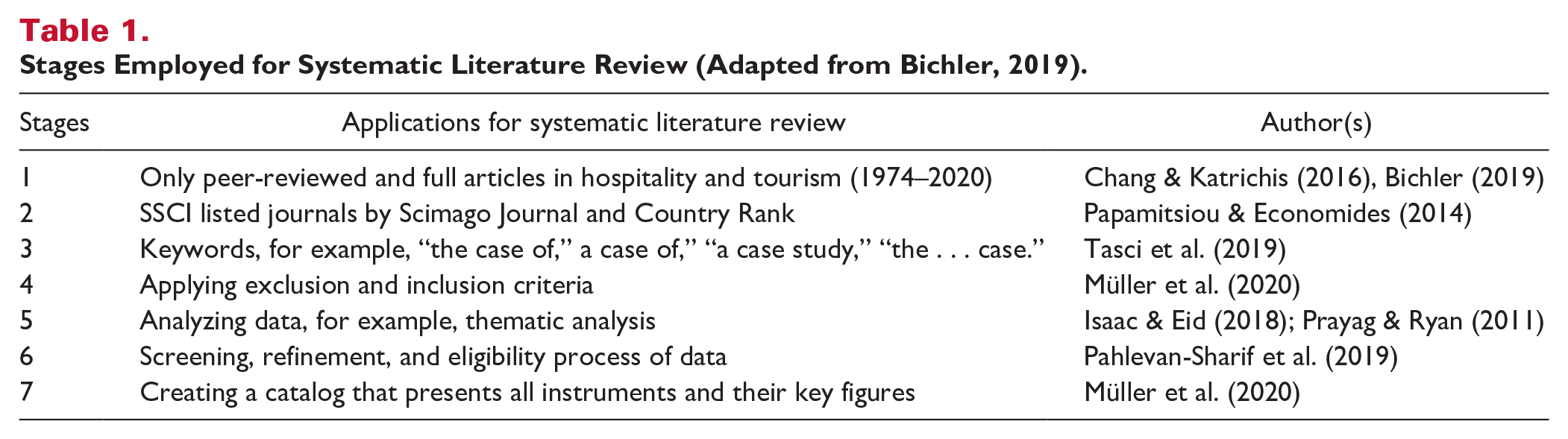
The major hospitality and tourism journals are thus the Annals of Tourism Research, Current Issues in Tourism, Journal of Hospitality Marketing & Management, Journal of Hospitality and Tourism Research, Journal of Sustainable Tourism, Journal of Travel Research, Journal of Travel & Tourism Marketing, International Journal of Contemporary Hospitality Management, International Journal of Hospitality Management, and Tourism Management. During the course of data collection, a keyword search approach was performed from predefined key terms that were selected as “the case of,” a case of,” “a case study, “the . . . case,” “a/an . . . case study,” “case study,” “the case . . . of,” “a . . . case of,” “the case for,” “a case for,” “case of . . .,” “a . . . case study of,” “the case study,” “the . . . case of,” “a case from . . .,” “a case study from,” “cases studies from,” “case study with,” “a case study on . . .,” “a . . . case study from,” and “a case on the . . .” by adapting the research approach of Tasci et al. (2019). As such, a keyword search was applied to the title of studies. Many inclusion and exclusion criteria were considered during the course of the database search (see Table 1). Book reviews, reports, research in brief, commentary papers, research letters, short communications, viewpoints, and discussion papers were excluded from review. Only full hospitality and tourism journal peer-reviewed articles in English were included in the analysis process.
Stages Employed for Systematic Literature Review (Adapted from Bichler, 2019).
Data Analysis
The study adopted a systematic literature review that has more recently received greater attention of scholars and reviewers in the field of tourism (Khoo-Lattimore et al., 2019). The thematic analysis was conducted to examine the data at several distinct stages (see Table 1).
The thematic analysis of keywords in article titles revealed categories of articles at the initial stage. Articles were classified independently by two authors and separated into four groups and themes within each group after the coding process was finalized. Next, the classifications were compared (e.g., Qualitative, Quantitative, Conceptual, and Mixed-Methods) and a high level of agreement was provided by two authors on the themes that emerged. Any inconsistency was resolved by discussion and a few modifications to accommodate inconsistencies. A disagreement about six articles resulted in their reclassification into a new category (i.e., papers such as Research Notes, Research Letters, Short Communications, Viewpoints, and Discussion Papers labeled as “Short Papers”).
Leximancer was used for data analysis. This software differs from other analysis programs as it uses quantitative methods to implement qualitative analysis (Tseng et al., 2015). Along with the frequency of the concepts that mostly occur, it also creates thematic clustering to map complex themes derived from the data (Cheng & Edwards, 2019).
The primary aim of employing a systematic literature review is usually to provide information to the researcher mapping and evaluating the existing intellectual field while building a research question to expand the current knowledge beyond the field (Tranfield et al., 2003). It is often used by researchers to elicit all empirical evidence that complies with the predefined inclusion criteria in response to answering a specific research question or hypothesis (Snyder, 2019).
Results
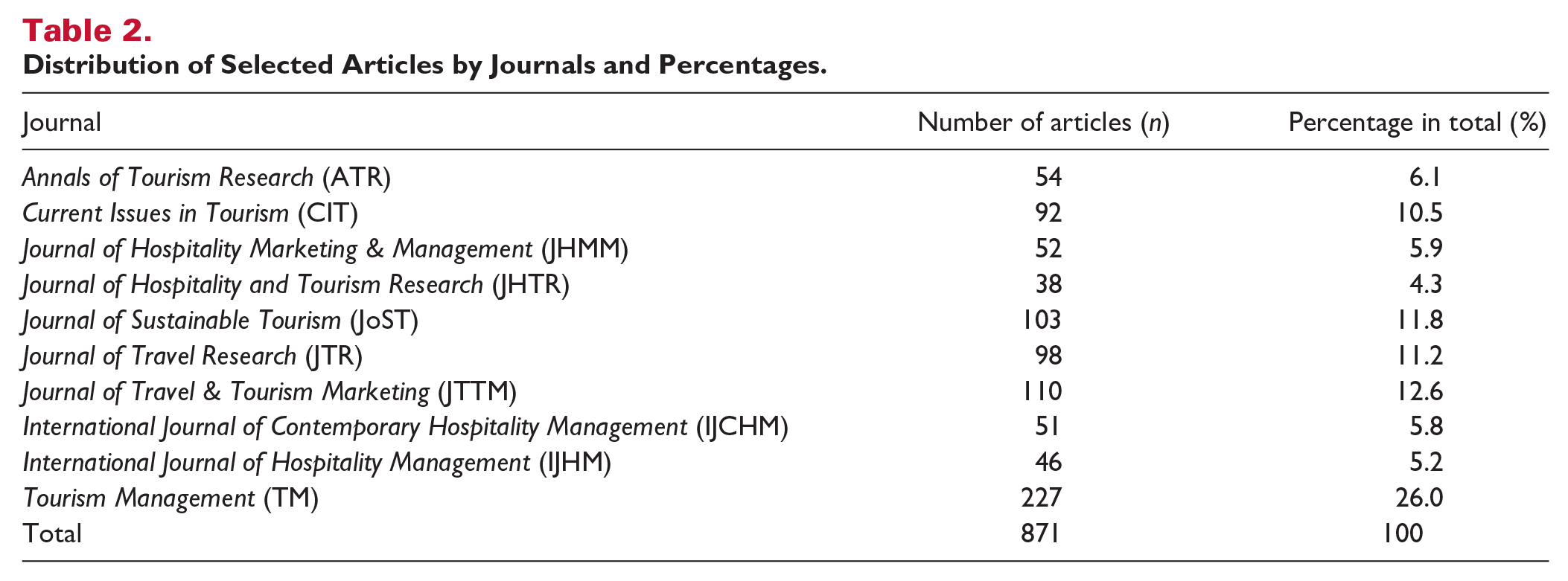
The search resulted in a total of 1,108 articles. The major hospitality and tourism journals are the Annals of Tourism Research (n = 73), Current Issues in Tourism (n = 126), Journal of Hospitality Marketing & Management (n = 58), Journal of Hospitality and Tourism Research (n = 43), Journal of Sustainable Tourism (n = 114), Journal of Travel Research (n = 198), Journal of Travel & Tourism Marketing (n = 111), International Journal of Contemporary Hospitality Management (n = 65), International Journal of Hospitality Management (n = 51) and Tourism Management (n = 269). After reviewing and applying inclusion and exclusion criteria, 237 articles were excluded and, as a result, 871 articles published in 10 peer-reviewed journals were subjected to thematic analysis (see Table 2).
Distribution of Selected Articles by Journals and Percentages.
Thematic Analysis of Articles
This section includes the key themes of the articles identified using Leximancer software that resulted from a qualitative, thematic analysis. It also aims to identify the related issues in the articles covered in this systematic review. The review of the articles was categorized into six main themes after systematic review process finalized. These major categories are as follows: (a) articles by method, (b) articles by year, (c) articles by method and journals, (d) articles by subjects and contexts, and (e) data collection method and statistical techniques used.
Articles by Method
Figure 1 shows that the majority of studies (52%) employed a quantitative method (e.g., Axelsen & Swan, 2010; Brida et al., 2015; Zátori et al., 2019), followed by a qualitative method (e.g., Matarrita-Cascante et al., 2010; Ottenbacher & Harrington, 2013; Smith et al., 2016), the mixed-method approach including both quantitative and qualitative methods (e.g., Biran et al., 2014; Page et al., 2017), and conceptual approach (e.g., Callahan, 1998; Mycoo, 2006). This implies the dominance of the positivist paradigm for the majority of journals. Another reason can be attributed to the attitudes of journals’ reviewers and editors who are prone to reject conceptual and/or qualitative case studies as they believe they cannot make a significant theoretical or methodological contribution to the literature (Nunkoo et al., 2013).

Percentages of articles by method.
Articles by Year
Figure 2 shows the number of published articles had a sharp increase between 2004 and 2008. Results also show a slight decrease in the number of articles published on the case studies between 2008 and 2010, which can be evaluated as a temporal or coincidental situation or it might be a periodic process where this method may have reached academic saturation.

Publication development of case studies in hospitality research.
Articles by Method and Journals
Figure 3 shows that Tourism Management (TM) published the most case study articles (25.8%) followed by Journal of Travel and Tourism Marketing (JTTM) (12.5%). Taking into consideration articles by method and journal, JoST and ATR differ from others as they published qualitative case studies more than quantitative ones.

Distribution of articles by method and journal.
Figure 4 reflects that a large number of case study articles were employed in Asia (n = 236), mostly published by TM, followed by Europe (n = 221). The least number of published articles that adopted a case study approach was in the Polar region.

Distribution of articles by location and journal.
Articles by Subjects and Contexts
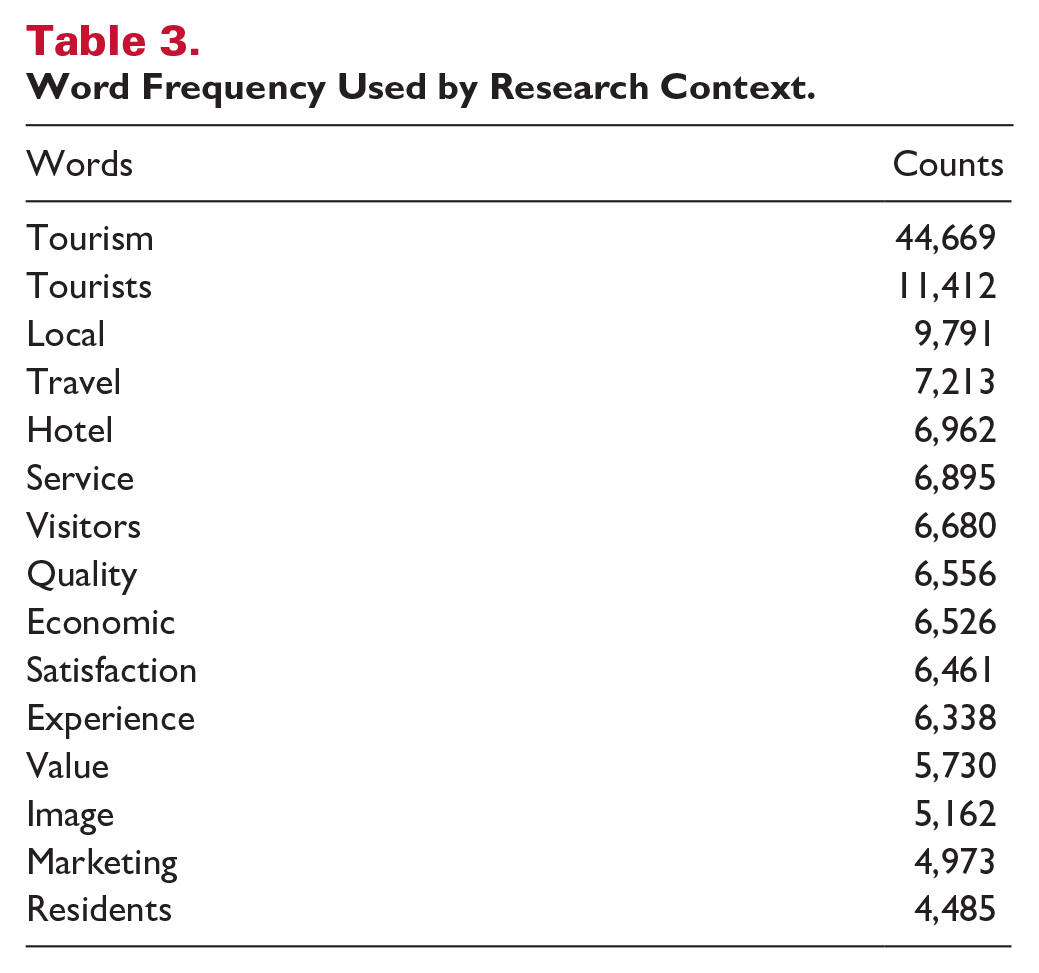
The major topic areas of case studies have consisted of a wide range of fields, such as destination marketing and management, economic development of destinations, dark tourism, structure and analysis of service and hotel industry, crisis management, motivation and experiences, cultural and heritage tourism, sustainable tourism, stakeholder management, tourism governance, tourism planning and policy, innovation, sharing economy and interrelated fields like peer-to-peer accommodation, Airbnb, satisfaction, service quality, authenticity, and tourism education (Table 3).
Word Frequency Used by Research Context.
Data Collection Method and Statistical Techniques Used
Most of the qualitative case studies relied on the data triangulation approach, which refers to multiple data sources, and thus tourism researchers and scholars have tended to use observation, documentation, and archival records or published materials as secondary data to ensure the trustworthiness of the research. It was also reported in the analysis that a number of more recent qualitative studies have used photographs and movies as visual sources of data (e.g., Im & Chon, 2008; Önder et al., 2016; Song & Kim, 2016). On the other hand, the number of qualitative studies that employed participant observation was limited, while the use of the interview as preliminary data was prominent.
Some of the qualitative research benefited from published materials and archival records along with notes of field observations as the primary empirical evidence, while some studies used secondary sources, such as printed and online documents, as primary data sources. Online websites of travel, tourism, and hospitality organizations and travel blogs used by tourists were also used by many scholars in their research as a source of data (Jeong, 2004; Law & Ngai, 2005; Marine-Roig, 2014; Xiang et al., 2010). While tourists were mostly the unit of analysis in quantitative studies, in qualitative studies, the main tourism stakeholders, consisting of both public and private sector representatives (e.g., local government authorities, tourism organizations, travel agencies, owners of travel agencies/tour operators, etc.), were the samples in qualitative case studies.
Results show that in both quantitative and qualitative case studies, the majority of research predominantly tended to use systematic literature as a review type since 2010. Also, a wide variety of quantitative methods and several different statistical methods and analysis techniques were employed including analysis of variance (ANOVA) (Oviedo-García et al., 2016), exploratory factor analysis (EFA) (Isaac & Çakmak, 2014), factor analysis (Fuchs & Reichel, 2006), data envelopment analysis (DEA) (Wöber & Fesenmaier, 2004), descriptive statistics (Mohsin, 2007), paired sample test (Suen & Law, 2001), generalized least squares (GLS) (Salazar & Zhang, 2013), multiple regression analysis (Sinclair-Maragh & Gursoy, 2015), linear regression analysis (George, 2010), and shift share analysis (SSA) (Zuo & Huang, 2020). In studies using mixed method, more than one statistical technique was used at the same time (e.g., Biran et al., 2014; Tang-Taye & Standing, 2016).
For qualitative case studies, use of content analysis as a data treatment technique was most prevalent (e.g., Paget et al., 2010; Peters & Kallmuenzer, 2018) which is followed by thematic analysis (e.g., Marschall, 2017) and discourse analysis, respectively (see Burns & Cowlishaw, 2014; Cui et al., 2020). More interestingly, an increasing number of innovative data analysis techniques were recently used in quantitative case studies such as affective mapping and emotinality of texts (Martini & Buda, 2019), along with computer-assisted data analysis software (see Chan & Hawkins, 2010; Lacey et al., 2012; Li & Ryan, 2018; Scott et al., 2008).
Conclusion and Implications
This study investigated the use of the case study method in hospitality and tourism research to identify the areas of need for attention in future research. A systematic review of 871 peer-reviewed articles published in top-tier hospitality and tourism journals use the “case” terminology in their titles. The majority of these articles used quantitative research methods. Overall, results suggest that most articles follow the positivist paradigm in case study research.
One of the most compelling finding is that there is an increasing number of qualitative case studies using data analysis software to improve credibility and reliability of their research. There are also a handful of qualitative studies that used statistical techniques to measure the reliability of data. Using statistical techniques to provide reliability of the data may increase the legitimacy of qualitative case studies.
Study findings have also suggested that researchers also used semistructured interviews published materials as a secondary data source in thematic or content analysis. Study findings also show that researchers typically use case study method while studying subjects with limited samples such as public and private representatives, policymakers, destination marketers, managers, nongovernmental organizations (NGOs), local residents, and so on, who are the main tourism stakeholders in the destination context. On the other hand, it has been found that researchers are more inclined to use quantitative methods when their study sample is comprised of mainly demand side (e.g., tourists or consumers).
A large number of studies adopt a single case study approach, while the use of a multiple case study approach is less (See Supplemental Material). Findings also show that qualitative approach is mostly used in studying tourist destination, tourism organization, owners of travel agency, tour operators, stakeholders, and employees. The findings also show the misuse or mislabel of case study terminology (Flyvbjerg, 2006; Tasci et al., 2019).
Second, there is a mismatch of using case study terminology (e.g., “the case of,” “a case of,” “a case study,” “the . . . case,” “a/an . . . case study,” “case study,” “the case . . . of,” “a . . . case of,” “the case for,” “a case for,” “case of . . .,” “a . . . case study of,” “the case study,” “the . . . case of,” “a case from . . .,” “a case study from,” “cases studies from,” “case study with,” “a case study on . . .,” “a . . . case study from,” and “a case on the . . .”) and thus there is no common use of case studies (Tasci et al., 2019).
There are many reasons for misuse or mislabel of case studies. First, the use of quantitative case studies was dominant in the early stages of published articles in the field, while there seems to be a more recent, increasing trend in using qualitative case studies in hospitality and tourism. There are multiple research sampling techniques (e.g., convenience, criterion, homogeneous, opportunistic, maximum variation, purposeful, and stratified purposeful) which make it easier for tourism researchers and scholars to use a case study approach as a most proper research design (see Veal, 2006, p. 295) while permitting them to collect data from multiple sources (e.g., primary and/or secondary sources). This approach is closely concerned with triangulation which strengthens qualitative findings related to ensuring trustworthiness that come true by multiple independent data sources.
Considering that the main issue of case study research is the legitimacy problem of qualitative case studies, several measures can be suggested to improve the trustworthiness (reliability, transferability, credibility, and confirmability) of qualitative case studies. In addition to employing purposeful sampling technique, qualitative researchers may also use some statistical techniques (e.g., Krippendorff Kappa or Cohen’s Cappa Analysis) for their case studies to ensure transferability (external validity) or more concretely generalizability while increasing the reliability of their research;
Based on triangulation, they can also use multiple sources of data to validate research derive from qualitative case studies;
Researchers should also be encouraged to use data triangulation to make research more rigorous and credible while avoiding measurement bias. Besides, given the objectivity (confirmability) criterion, two or more independent observers need to be involved in data analysis process, and a high level of agreement should be reached between coders;
Researchers should also give special attention to adopt multiple case studies from comparative insights to produce credible (internal validity) and more generalizable findings.
Limitations and Future Research
The data in this study are limited to 10 leading journals in the field. In addition, some studies were excluded from the analysis based on inclusion and exclusion criteria (e.g., book chapters, conference papers, dissertations, etc.) applied in the formation process of the data set. Also, data were retrieved only from SSCI-listed journals that were ranked by Scimago Journal and Country Rank. Future studies may carry out a critical review by expanding an inventory and corpus of articles published by hospitality and tourism journals to explore as to when and under which circumstances the case studies are used by tourism researchers and scholars.
Supplemental Material
sj-pdf-1-cqx-10.1177_1938965520971281 – Supplemental material for Case Study as a Research Method in Hospitality and Tourism Research: A Systematic Literature Review (1974–2020)
Supplemental material, sj-pdf-1-cqx-10.1177_1938965520971281 for Case Study as a Research Method in Hospitality and Tourism Research: A Systematic Literature Review (1974–2020) by Kadir Çakar and Şehmus Aykol in Cornell Hospitality Quarterly
Footnotes
Acknowledgements
We are grateful to Dr. Aslı Tasci who contributed to the study by providing valuable insights and comments that remarkably improved the research.
Declaration of Conflicting Interests
The author(s) declared no potential conflicts of interest with respect to the research, authorship, or publication of this article.
Funding
The author(s) received no financial support for the research, authorship, or publication of this article.

Supplemental Material
Supplemental material for this article is available online.
Author Biographies
References
Supplementary Material
Please find the following supplemental material available below.
For Open Access articles published under a Creative Commons License, all supplemental material carries the same license as the article it is associated with.
For non-Open Access articles published, all supplemental material carries a non-exclusive license, and permission requests for re-use of supplemental material or any part of supplemental material shall be sent directly to the copyright owner as specified in the copyright notice associated with the article.
