




Abstract
Owing to the impact of third-party commissions upon hotel profitability, many hotel brands have actively engaged in book direct campaigns, but to date, no large-scale longitudinal effort has been conducted to systematically evaluate direct booking behavior (i.e., direct versus online travel agency [OTA]). In this study, we use three years of transactional data from a large hotel brand to evaluate booking channel choices. To address the dynamic nature of the longitudinal individual-level data, we use a hidden Markov model (HMM), allowing us to evaluate both short- and long-term effects. Using the HMM, we evaluate the latent loyalty status of customers through their observed online booking channel behavior (i.e., direct versus OTA). As a result, we find that customer–manager engagement through guest satisfaction surveys (and managerial responses to those surveys) has a long-term effect on consumer propensities to book direct, gradually increasing customer loyalty to the brand. Specifically, we find that positive customer feedback signals a greater willingness to book direct in subsequent purchases. Moreover, managerial responses to the satisfied customer result in greater tendency to remain loyal and book direct. Second, the membership program tier of the customer has a significant short-term effect on the consumer’s propensity to book direct. Low-loyalty customers’ direct booking tendency increases as soon as they join the membership program. These findings not only illustrate the impact of membership status upon channel choice but also indicate the effect of the customer’s voice and the resulting managerial response upon booking behaviors over time.
Keywords
Introduction
The rapid growth of the internet, combined with the ease of information discovery—through search engines, hotel websites, online travel agencies (OTAs), and social sources like TripAdvisor—has increased the number of travelers who research and book hotels online. Consumers may book hotels online directly with hotels at their own (or brand, e.g., Hilton.com) websites as well as through numerous intermediaries (e.g., OTAs). While OTAs have been shown to play a critical role in the travel ecosystem (Anderson, 2011), as the OTAs gain prominence with customers, hotels are faced with increased acquisition costs owing to third-party commissions.
The increase in popularity of OTAs has the potential to detrimentally affect owner profitability owing to third-party commissions often in the range of 15% to 20%. Some hotels, especially those belonging to larger brands, have tried to reduce their reliance on OTAs by investing in direct booking channels. Although several studies have argued that OTAs provide little value to the hotels (McLeod et al., 2018), there are significant difficulties associated with hotels relying on direct booking channels (Ye et al., 2019). First, hotels are required to invest heavily in their direct booking channels along with marketing to support these channels. Although many hotels are improving their booking channels, it is hard to surpass the user experience and breadth of alternatives at OTAs. Second, there is a limited number of potential customers who are within reach of direct booking; while some customers may have a strong loyalty to a particular hotel/brand, or perceive benefits from loyalty program participation, and choose to shop and book direct, others may be attracted to the availability of alternatives at OTAs.
Owing to the extensive use of rate parity between hotels and OTAs, which tends maintain similar prices across direct and third-party channels, customers often cannot expect to gain any financial benefits from direct booking. Therefore, steering customers to their own sites without violating the rate parity stipulations with OTAs has been an active area of interest for the hotels (Toh et al., 2011).
In this study, we aim to provide insight on how hotel managers can increase direct booking tendencies of their customers. Furthermore, as firm/brand loyalty is one of the motivations driving direct booking behavior, we discuss the direct booking behavior as a unique opportunity to observe the dynamics of customer loyalty and investigate the long- and short-term effects that cause this purchase behavior.
Direct Booking Behavior as a Loyalty Metric
While behavioral loyalty metrics with longitudinal data have been used in other business settings, they have been used to a much lesser extent in travel and hospitality. The most typical behavioral loyalty metrics used in marketing literature are customer retention and share of wallet (Verhoef, 2003). Although these metrics are a powerful way to understand customer loyalty dynamics, both retention and share of wallet are hard to apply/evaluate in transactional hospitality settings owing to a lack of panel data. Since tracking purchase behavior across multiple service providers is difficult in most hospitality settings, retention is the behavioral loyalty metric that has been rarely used. Likewise, to calculate a customer’s share of wallet, it is necessary to compute the number of hotel bookings purchased during the same period across a set of service providers. Therefore, the services marketing literature (in which retention and share of wallet are hard to observe empirically) have relied on self-reported loyalty intention measures rather than behavioral loyalty metrics (DeWitt et al., 2008; Fullerton, 2003; Wirtz et al., 2007). To overcome this challenge and extend our knowledge about customer loyalty behavior, we make use of common customer behaviors in the hospitality industry that allow researchers to infer customers’ loyalty dynamics: namely, the selection of a reservation channel. Specifically, we identify how customer feedback and managerial responses, along with the participation within a brand’s membership program, can influence the future loyalty of a customer as partially reflected by channel choices.
Although popular state-dependent models (Heckman, 1981), in which a customer’s observed previous choice constitutes his or her future choice, can identify a causal relationship, such models have limitations. If the state-dependent model fails to include important variables, the estimation from the observed variables is likely to be biased. For instance, the customer–manager interaction may slowly develop a rapport that cannot be measured from traditional state-dependent models. To overcome the limitation of state-dependent models, we use a hidden Markov model (HMM), in which the observed dependent variable is the consequence of an unobserved state. The HMM allows customers to transition between these states and an estimation of the factors that impact customer transition from one (loyalty) state to the other. Therefore, this model allows us to capture the different latent loyalty states of customer behavior (i.e., high and low-loyalty states) as estimated through observed booking channel choices.
Long- and Short-Term Effects
In Figure 1, we present our HMM which illustrate the sequence of the observed purchase behaviors and its latent loyalty states. Although a customer may purchase a hotel room directly through the hotel’s website (i.e., OTA vs. Direct in Figure 1), this behavior does not necessarily mean that the customer is highly loyal to a firm. The transaction specific attributes (e.g., membership program, price, or display promotions) may influence the customer’s channel choice. Therefore, it is important to distinguish the attributes that have enduring effects and those with short-term effects on customers’ booking behavior.

Research Model.
Oliver (1976) enriched the loyalty framework by dividing loyalty into cognitive and affective loyalty. While cognitive loyalty is a rational element that results from the assessment of relationship benefits such as reward programs, affective loyalty arises from an emotional attachment to with the exchange partner (X. Han et al., 2008). Cognitive loyalty is characterized as being weak and short-term if no benefit is provided, as it comprises utilitarian evaluation. In contrast, affective loyalty tends to be strong and enduring, as it comprises hedonic evaluation where customers have an emotional attachment to the firm. Previous studies have consistently found that a strong customer–manager relationship develops a rapport that increases the affective loyalty of the customer. The goal of this article is to identify the interactive process between the customer and manager that induce long-term effects (i.e., affective loyalty) along with the marketing activities that have short-term effects (i.e., cognitive loyalty). Specifically, we investigate the long-term effects of customer feedback to the hotels (via satisfaction surveys) and the associated email responses (to those surveys) from hotel managers upon future consumer booking channel choices (i.e., direct versus OTA). For short-term effects, we explore one of the most popular marketing activities that hotel managers often use—the loyalty program membership.
The importance of maintaining long-term relationships with existing customers and driving customer loyalty has been extensively emphasized in the marketing literature (Kumar et al., 2010; van Doorn et al., 2010). To enhance customer long-term loyalty, firms endeavor to interact with their existing customers. A typical example of this interaction within lodging exists as hotels seek poststay feedback from recent customers (Bone et al., 2017). This feedback request is often sent to the customers as an email that includes a guest satisfaction survey (GSS), comprised of a mixture of open-ended and close-ended satisfaction-related questions. Once the firm encourages a customer’s participation in a survey through an email, said customer can either ignore or respond to the survey. If a manager receives guest feedback via the GSS, he or she decides whether to respond (via email) to the guest’s comments or not. A positive interaction between the manager and the customer develops rapport that leverages long-term loyalty of the customer. Although this is a prevalent managerial practice within hospitality, there does not exist any empirical research investigating the impact of this interaction upon customer loyalty.
Customer feedback
Offering feedback to a firm requires time and effort by the consumer; thus, doing so must have a reason. Therefore, customers’ feedback to the firm is likely to contain a signal of how willing they are to changing their loyalty level to a firm. Note that we are referring to private customer-firm feedback within a closed GSS, versus public feedback through online review platforms which may have secondary motivations driven by social sharing and interaction. Predicting customers’ loyalty status in advance allows managers to react proactively. Therefore, understanding which customer’s voice is the most likely to be a signal that predicts an increase in future loyalty is important for both marketing researchers and managers.
Prior relationship marketing studies have investigated the link between customer satisfaction and loyalty. A consistent finding in this scope of research is that higher customer satisfaction leads to higher loyalty to the brand. For example, numerous studies have found that satisfaction serves as a mediator for the service quality. Therefore, a direct relationship exists between satisfaction and attitudinal loyalty (H. Han et al., 2011).
Although these studies are insightful, it is interesting that no study has been done to look at how customer satisfaction influences the actual loyalty behavior (i.e., direct booking). In this study, as our use of longitudinal purchase data allows us to asses actual purchase behaviors, we investigate how customers’ survey participation and their reported satisfaction affect their future channel choice when booking the same hotel brand. As direct booking behavior is a reflection of loyalty to the hotel chain, we hypothesize the following:
Managerial responses
Under a typical interactive GSS system, managerial responses to customer feedback may also play an important role in how customers perceive their relationship with the service provider. Such managerial responses provide additional information to the customers when evaluating their relationship level with the hotel. While some customers offer feedback to express their emotions, others expect some type of follow-up from the managers. Several studies in services marketing have shown that managerial postpurchase engagement also drives brand loyalty. In these prior studies, surveys and experiments with purchase-intention measures have been predominantly used and have shown the positive relationship between the managerial postpurchase interactions and the survey participants’ self-reported repurchase intention (Andreassen, 1999; DeWitt et al., 2008; Van Vaerenbergh et al., 2012). As interesting as these findings are, they have not been extended to a study that looks into loyalty behavior in a real-world setting. Moreover, due to the cross-sectional survey design, these studies have primarily focused on static effects, ignoring dynamic effects of engagement (over time) upon customer loyalty. Considering the potential for customers to update their loyalty levels using the information and interactions they gather from past experiences, a dynamic analysis with longitudinal data is appropriate for capturing the evolution of loyalty because it is updated through a sequence of customer-firm engagements. Therefore, cross-sectional data are often criticized because they cannot establish causal relationships in loyalty research (Mittal & Kamakura, 2001; Verhoef, 2003). To the best of our knowledge, the dynamics of customer loyalty as a function of customer feedback and the managerial response has yet to be investigated.
However, managerial responses may not be equally effective to all customers. As the managers may not be able to respond to all customers due to their limited resources, they may take a strategy of selective responses, for example, only responding to satisfied (or unsatisfied) customers. Previous studies have found that future satisfaction of the customer changes depending on which customer feedback the manager responds to. For example, Gu and Ye (2014) found that the managerial response to the complainants increases the future satisfaction of the customer, whereas the same effect is not found when responding to the satisfied customers. However, to the best of our knowledge, no study has extended this research to measure response effects upon loyalty. Therefore, as part of this study, we investigate to whom the managerial response is most effective at increasing the direct booking tendency (i.e., impacts on satisfied vs unsatisfied customers). Managerial responses in essence provide an additional level of service from the manager with the potential to exceed the customer expectations. We thus propose the following:
Membership programs
While the interaction between the customer and the manager may gradually transition the customers’ loyalty state with the firm to a different level; there are transaction-specific attributes that may have short-term effects on customers’ purchase decisions. The impact of the membership program participation or tier status on consumer loyalty behavior has rarely been studied despite its prevalent usage in the hospitality industry. A membership program rewards customer with different levels of membership status. Operators and marketers expect that customers enrolled in their membership program are more likely to choose their hotel brand to receive more rewards. Although such loyalty behavior may not be aroused from the long-term affective commitment to the service provider, a short-term cognitive commitment drives these customers to choose the hotel brand and receive the exclusive benefits. Research has found that higher tier members had reported significantly higher intention to purchase from the focal brand than low-tier members (Fu et al., 2017; Tanford, 2013). However, none of these studies looked at how the membership tier affects actual loyalty behavior rather than their self-reported purchase intention. Furthermore, no study has tried to investigate how the membership tier program influences customers’ selection of distribution channel. Our unique, longitudinal data allow an investigation of direct booking behavior as a function of changes in membership tiers. Tanford (2013) indicates that customers may incur switching costs when changing brands, with these switching costs including a loss monetary benefit as well as increases in time and effort. In general, switching costs are expected to be higher for the upper tier members, as they have spent more time and effort building relationships with the brand and thus have to give up greater benefits. As tier-level increase switching costs, the tendency to consider other brands should decrease as a function of tier level, which leads to the following hypothesis:
Implications for Service Providers
A better understanding of customer loyalty dynamics is essential for both researchers and practitioners. This article contributes to the current loyalty literature in several important ways:
We explore both customer feedback and managerial response as drivers of customer loyalty,
Instead of relying on the loyalty intention data collected from customer survey answers, we investigate the transition of the latent loyalty states from behavioral outcomes using an HMM,
Unlike prior loyalty research that predominantly studies the brand selection, we focus on the distribution channel selection.
By providing specific guidelines on how managers can enhance customer loyalty, this study helps managers in the following ways:
We interpret the implication of customers’ feedback,
We provide specific recommendations to managers regarding the customers with whom they should interact by predicting the customers’ latent loyalty states based on their transaction history,
We provide an estimate of the cost reduction a firm can expect through a reduction in third-party commissions by engaging with their customers through email.
Using our model, we suggest that the direct booking tendency increases after high-loyalty state customers provide positive feedback to a firm. This finding implies that the complements of high-loyalty customers act as a signal that these customers are ready to further leverage their loyalty. We also find that managerial responses have a greater impact on future direct booking tendency when they are sent to customers who are currently at a high-loyalty state. This result suggests that to keep their loyal customers, firms need to direct their email to high-loyalty customers who are satisfied with the hotel experience.
Data
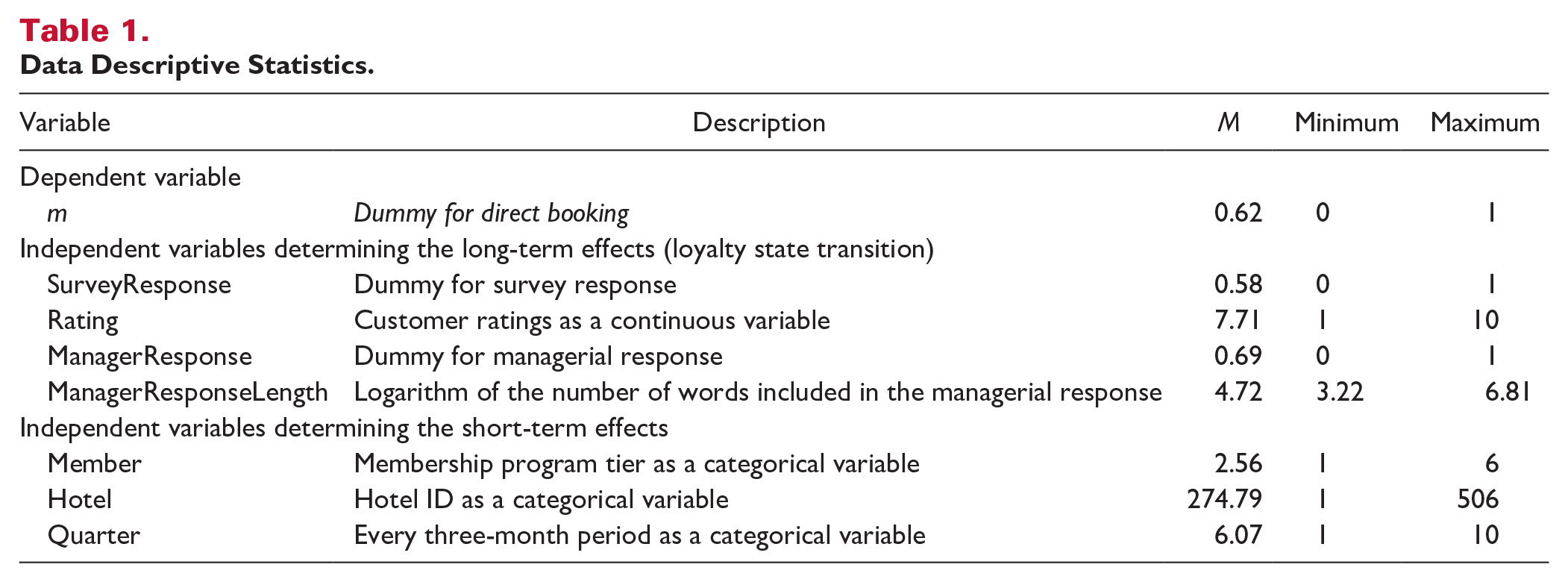
Our data are comprised of all online hotel reservations, over a 3-year period, for a sample of a little over 500 randomly selected hotels from a large global hotel chain. Guests who provide an email address, either during the booking or check-in process, automatically receive a poststay GSS via email. Surveys contain a maximum of 20 questions with the number of questions a function of the services/amenities each customer received (e.g., spa, restaurant, and etc.). A customer’s decision to open the email and complete the survey is purely based on their own self-motivation, as there are no financial incentives provided by the hotels for survey participation. The dummy variable SurveyResponse identifies whether the customer responded to the GSS or not at the time he or she visited the hotel.
While there are several different satisfaction questions in the questionnaire, we chose one that measures the general satisfaction—“How satisfied were you with the OVERALL experience?” The rationale behind our decision to select this variable as a satisfaction measure is: (a) this satisfaction question is the first satisfaction question that customers receive, an approach which averts the potential measurement bias caused by the question order effect (Bradburn & Mason, 1964), and (b) for the same reason, the survey drop-out rate is relatively low, which reduces the risk of item nonresponse bias. This satisfaction measure is a 10-point scale where 1 is extremely unsatisfied and 10 is extremely satisfied (i.e., Rating).
The data also include whether the manager responded to the customer survey or not, and other characteristics of this managerial response. Managerial response variables included in our model are the dummy for managerial response (ManagerResponse) which indicates whether the manager responded to the customer survey or not. However, since not all managerial responses have the same quality, we use a proxy that can account for the quality of the managerial response. We use ManagerResponseLength, which is the log of the word count for each managerial response, as a measure of how detailed the manager response is. To account for the exponential nature of the managerial text response, we log-transformed the number of words in each of the text responses of the managers and included in our model, which is a similar approach as Chen et al. (2019).
In addition to the customer–managerial interaction variables, we accounted for potential seasonal heterogeneity by including the quarter of check-in (Quarter) as a categorical variable. As the direct booking tendency may also vary across different properties, we include the hotel-level indicator variable (Hotel) in the model. Customer’s membership tier level at the time they visited the hotel (Member) was also included as a categorical variable (i.e., Member ∈ {No Membership, Membership Tier 1, Membership Tier 2, Membership Tier 3, Membership Tier 4, Membership Tier 5}).
One of unique features of our data is that it contains information about the distribution channel used by the customer during the reservation process. Since the widely used behavioral loyalty metrics, customer retention, and share of wallet are often not available in hospitality transaction settings, we use the channel selection as an alternative. Therefore, we use the booking channel as a binary dependent variable—1 if booking directly from the hotels’ website, 0 otherwise (i.e., OTA). The data cover a period of 30 months, from July 2015 to December 2018.
After the data cleaning, our sample contains 84,917 transactions from 515 hotels and 32,707 unique customers. Given that our focus is on channel dynamics, we excluded customers who only had less than four purchase incidences. As a result, the final data set that we use for our analysis contains 2,971 individuals. The descriptive statistics are reported in Table 1.
Data Descriptive Statistics.
Model
We use an HMM to investigate the effectiveness of managerial postpurchase interactions on customer channel selection in a dynamic manner. HMMs have been widely used in marketing to understand the transition process of finite sets of hidden states. Interestingly enough, despite its benefit as discussed by Netzer et al. (2008) and Bijmolt et al. (2010), HMM have rarely been used in services research. HMMs capture latent states that may have different probabilities of predicting the observable outcome variables. In our distribution channel selection context, customers belonging to latent loyalty states have a potential impact on a customer’s propensity to book direct. The transition process of these latent states is affected by a number of time-varying covariates, which include customer feedback information and managerial responses. Therefore, the probability of the customer deciding to book directly depends on which state the customer belongs to at the moment he or she books a hotel room and the customer-manager interaction that contribute to the state transition.
Long-term Loyalty State Evolution
The transition matrix, Q
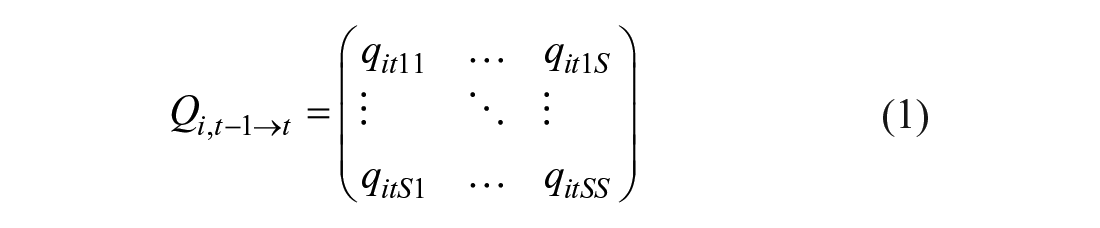
where
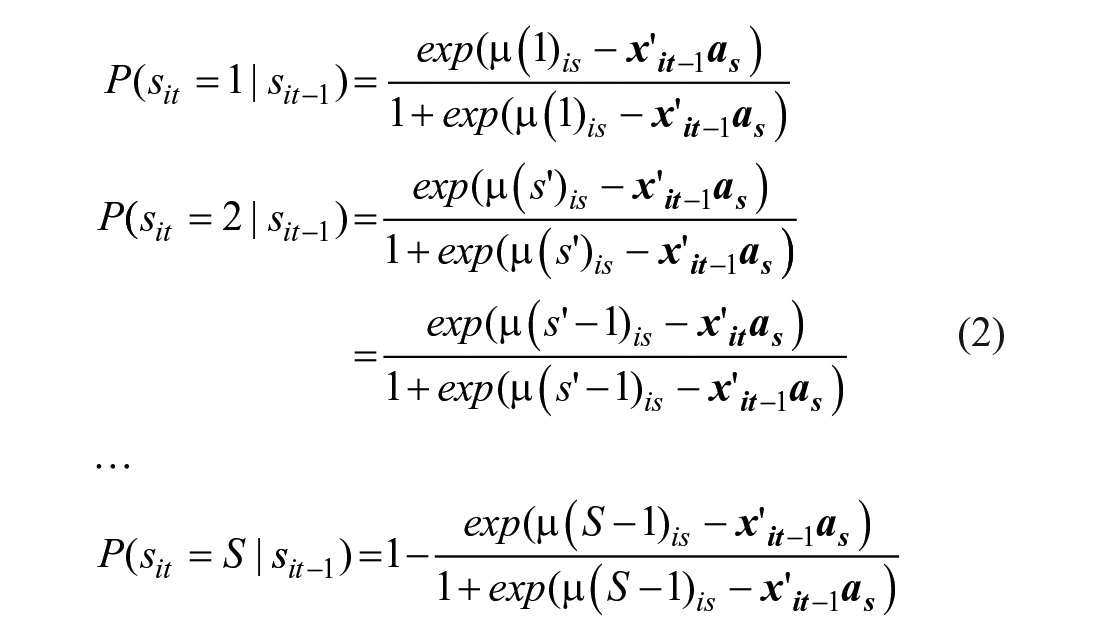
Customer feedback and managerial response–specific vector of parameters as are the coefficients that we are particularly interested in. These are the variables that predict the state transition probabilities which are supposed to have an enduring impact (as compared to an immediate impact). A customers’ memory of the relationship with the manager is long-lasting and forms the perception about the brand, which, in turn, gradually shifts the affective loyalty state of the customer that impacts subsequent transactions. Therefore, both the customer’s feedback and the managerial response are considered to induce a long-term effect on customer brand loyalty. The set of lagged variables in vector
For the initial state distribution π
Short-term Effect on Channel Selection
The probability of customer

where

We assume that while customer feedback and managerial responses have long-term effects, all other variables may have short-term effects that change the probability of direct booking, given their loyalty states at time t.
Empirical Results
We describe the results obtained by estimating the models described in the previous sections. We estimate parameters using a Markov chain Monte Carlo (MCMC) hierarchical Bayes procedure, as suggested by Netzer et al. (2008). We ran three parallel chains that each had 2,000 iterations. After discarding the first 1,000 iterations as a “burn-in” period, we used the last 1,000 iterations to estimate the conditional posterior distributions. We implemented the model using Stan (Carpenter et al., 2017), and we confirmed that the model converged using Gelman and Rubin (1992)’s potential scale reduction factor.
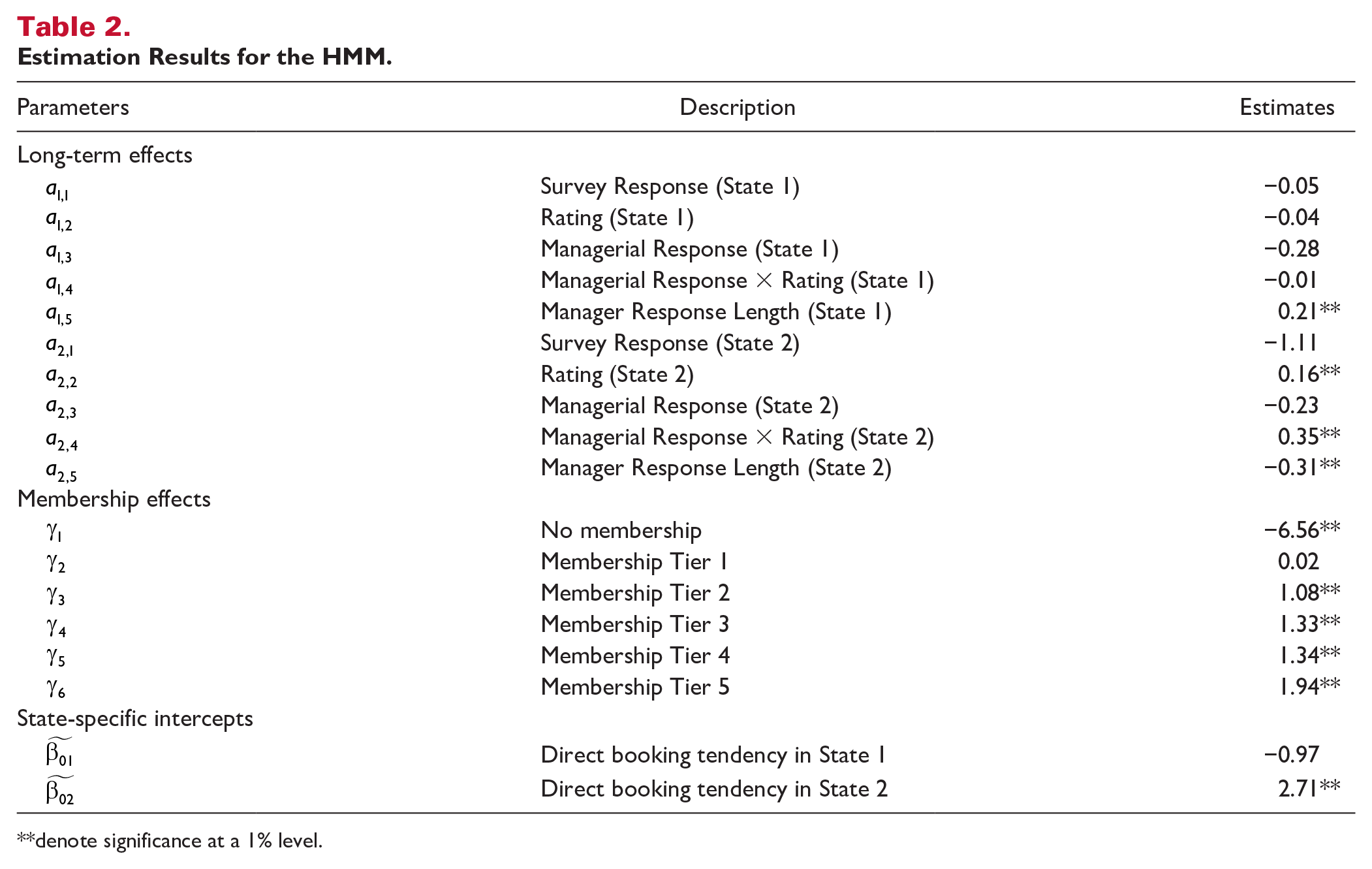
Table 2 reports the posterior means of the parameters in the proposed HMM. The interpretation of the two states was determined by the state-specific intrinsic propensity for direct booking (the parameters
Estimation Results for the HMM.
denote significance at a 1% level.
Customer Feedback and Managerial Response on Loyalty States
To get a better understanding of the magnitude of the parameter estimates, Tables 2 and 3 presents the marginal effects of different customer feedback and the managerial responses on the probability to shift to the high-loyalty state. The results indicate that when a customer in a high-loyalty state provides negative feedback, his or her likelihood to stay in the high-loyalty state increases by 2.3%. If a customer in a high-loyalty state provides positive feedback, the likelihood to stay in a high-loyalty state increases by 14.4%. As the likelihood to transition to the higher loyalty state is greater for the satisfied customer, these results support Hypothesis 1. When managers reply to this feedback, the transition probabilities change even further. If a complainant in a high-loyalty state receives a managerial response, the probability of staying in the high-loyalty state increases by 1.6%. If a satisfied customer in a high-loyalty state receives a managerial response, the likelihood to stay in the high-loyalty state increases by 4.1%, which supports Hypothesis 2. The length of the managerial response indicates an interesting result where its effect differs by loyalty state. That is, if a customer in a low-loyalty state receives longer managerial responses, his or her likelihood to transition to the high-loyalty state increases by 15.2%. In contrast, if a customer in a high-loyalty state receives the same length of managerial response, his or her probability of staying in the high-loyalty state drops by 30.4%. As a result, we find that high-loyalty state consumers exhibiting positive feedback are more likely to keep their high-loyalty state than those who provide negative feedback to the hotel.
Average Change of the Posterior Means of the Transition Probabilities by Customer Feedback and Managerial Response.
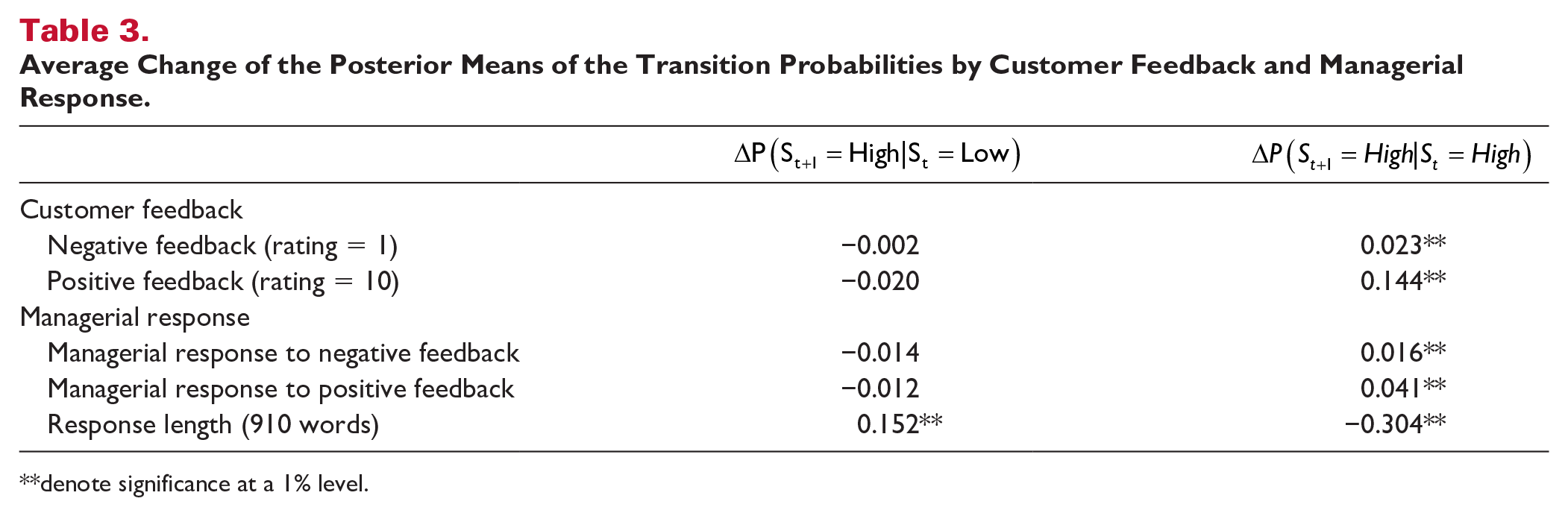
denote significance at a 1% level.
Membership Tier on Direct Booking
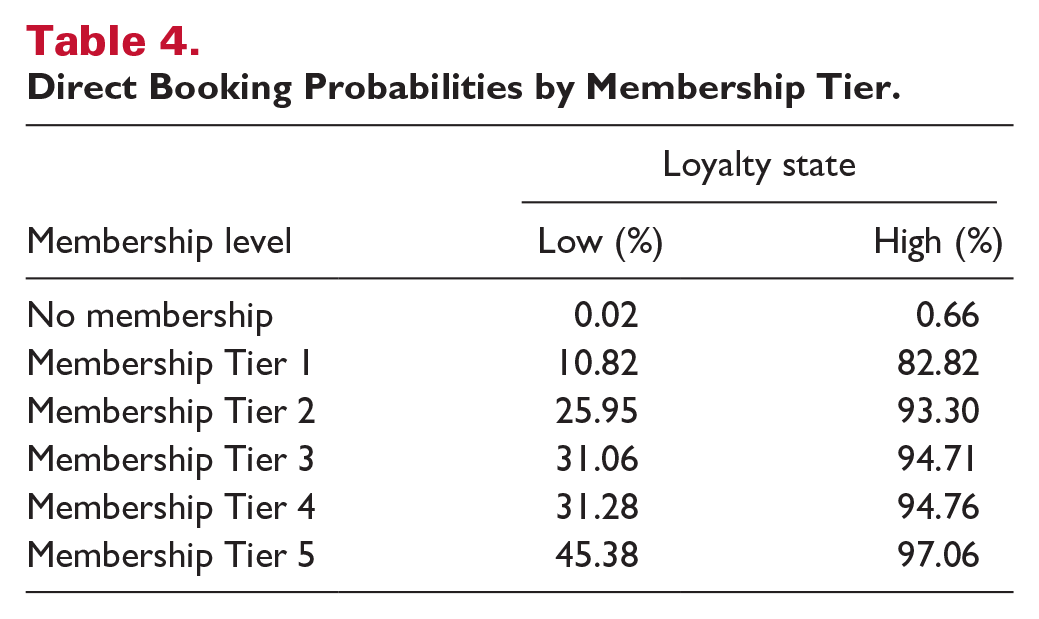
We can use the parameter estimates in Table 2 to illustrate the marginal effects of membership level upon direct booking behavior as a function of loyalty state—these are summarized in Table 4. This result suggests that a hotel’s membership program has a significant effect on direct booking tendencies, which supports Hypothesis 3. All other parameters in our model were estimated conditional on the unobserved heterogeneity caused by these different membership levels. What is obvious from Table 4 is that the dramatic shift in direct booking probabilities between Members and Nonmembers with probabilities moving from 0.02% to 10.82% for low-loyalty state customers (0.66% to 82.82% for high-loyalty state). For both loyalty states, the direct booking probability strictly increases with membership level.
Direct Booking Probabilities by Membership Tier.
Monetary Effects of Customer–Manager Interactions
We can use the parameter estimates in Table 2 to estimate financial impacts of managerial engagement as a function of commission savings owing to direct versus third-party reservations. To calculate the predicted marginal commission fee, we multiplied the commission savings (direct versus OTA—assumed to be 15%) by the incremental changes in booking behavior. The filtering probability that individual

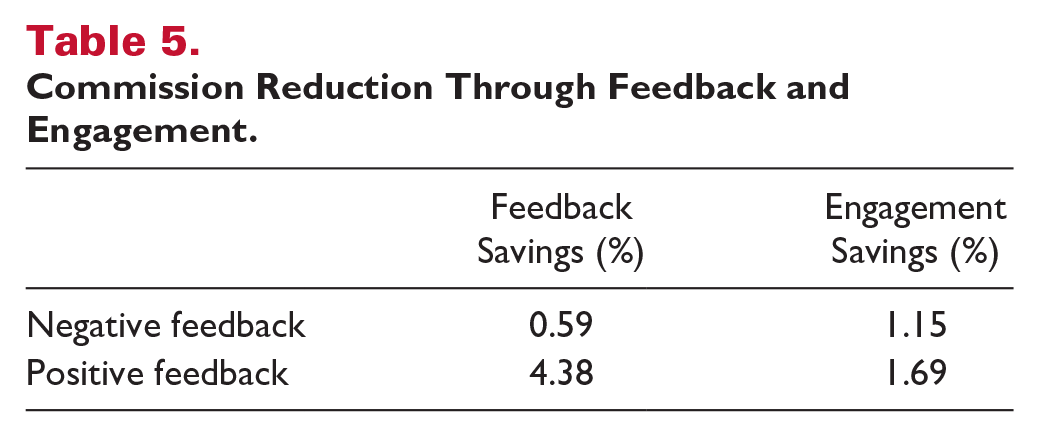
Then, we can estimate the financial impacts of customer feedback and managerial response through the change in loyalty states and the resulting change in direct booking probabilities. Table 5 summarizes commission reductions as a result of guests engaging and providing feedback to the service provider. The second column in the table shows the expected percentage of additional savings of the service provider by responding to this feedback. As stated earlier, customer feedback exhibits a willingness to persist in the high-loyalty state (and more likely to book direct) and as a result, when a customer provides feedback, the manager can expect a certain amount of commission savings. More specifically, feedback from satisfied customers predicts larger commission savings (4.38%) than complainants (0.59%). These savings continue with managerial responses. When managers respond to the complainants, 1.15% of additional commission savings can be expected, while 1.69% of additional savings can be expected if the manager responds to the satisfied customers.
Commission Reduction Through Feedback and Engagement.
Discussion
We examine the dynamic effects of customer-service provider poststay email interactions upon on brand loyalty. Specifically, we investigated how customer complaints and managerial apologies within postservice interactions affect future customer loyalty. As a loyalty behavior in our hospitality context, we use the booking channel that the customers chose as our dependent variable. However, to account for both enduring and short-term effects in the longitudinal model, we use an HMM. We use this model to examine how the customers’ postpurchase feedback and the managerial email responses dynamically transitioned individual loyalty states which in turn determine the direct booking tendency.
We demonstrated that the feedback of the satisfied customers has a greater impact on future brand loyalty. Therefore, once highly satisfied customers’ feedback is observed, this might be a strong signal they are likely to transition to a higher loyalty level. We also find that sending managerial email responses has a greater impact on future loyalty when they are sent to the satisfied customers. While the customer–manager postsurvey interaction changes the customers’ brand loyalty state, there are also transaction-specific attributes that have short-term effects on customers’ booking behavior. Specifically, we find that the reward membership program strongly affects customer book direct behavior.
Our research is particularly relevant for firms that allow customers to purchase either through their own channels or through an agency in which they have to pay a commission. As third-party agencies grow, many service providers have been looking for ways to convert customers (from expensive third-party channels) to low-cost supplier direct channels. We approached this problem by making a rational assumption that channel selection is impacted by customer loyalty. Specifically, our study provides strong evidence that postservice email communications increase customer loyalty.
The managerial implication for hospitality marketers who want to empirically understand their customers’ loyalty is also noteworthy. Prior loyalty studies have predominantly used behavioral metrics that are less applicable or hard to field measure in hospitality industries, such as retention and share of wallet. As an alternative, we suggest that the channel through which the customers choose to purchase services can be used as a behavioral loyalty metric. For managers, we suggest that this metric is superior to the other two behavioral loyalty metrics because it allows them to detect a loyalty decrease before a customer entirely churns.
This research has implications for firms that have interactive feedback systems in which managers can respond individually to customers following consumer feedback. As our proposed HMM model requires only the customers’ channel selection data from the booking records, managers can easily apply this model to evaluate how effectively they can communicate with the customers who provided feedback through the GSS.
Limitations should be acknowledged and addressed in future research. First, given the limitations of the data, we did not include the hotel price difference between the OTAs and the hotel’s website. Although inclusion of customer reward membership may account for price discounts provided through member-only prices, if there are price differences (i.e., direct prices < OTA prices) then these differences would also negatively affect book direct commission savings. Second, our model does not consider how the customers’ browsing behavior for a given visit might influence their final purchase decision on a given channel.
Footnotes
Declaration of Conflicting Interests
The author(s) declared no potential conflicts of interest with respect to the research, authorship, or publication of this article.
Funding
The author(s) disclosed receipt of the following financial support for the research, authorship, or publication of this article: This study was financially supported by Seoul National University of Science & Technology.
