



Abstract
This study proposes and examines the role server-friendly customers play in the customer-employee exchange stage of service encounters, and how customer-employee exchange relates to employee organizational citizenship behaviors toward customers, colleagues, and hotel organizations. To further explain how service employees could reenergize through the psychological resources gained from server-friendly customers at the point of customer-employee exchange, conservation of resources theory was applied. Hotel employees in the United States and China were sampled to jointly examine our proposed model. Findings of this study contribute valuable theoretical implications by emphasizing the role of customer-employee exchange in the formation of employee citizenship behaviors, as well as practical implications with regard to mentoring employees, thus strategically reenergizing psychological resources and obtaining tacit knowledge of citizenship behavior and its practice.
Keywords
Introduction
Organizational citizenship behavior (OCB), which refers to behavior beyond employees’ nominal job requirements that is unrecognized by formal reward systems (Organ, 1997; Van Dyne & LePine, 1998), has attracted considerable research attention over the past three decades in the management and organizational behavior research domains (e.g., Carpenter et al., 2014; Eatough et al., 2011). Voluminous research has been conducted with regard to the formation or motivational mechanism of OCBs, suggesting that employees’ perceptions and experiences gained at different levels of a work environment, including exchange with leaders, interaction with coworkers, and friendly organizational policy, are important motivational triggers for employees’ OCBs (Carpenter et al., 2014; Eatough et al., 2011; Organ & Ryan, 1995). Employees’ OCB has been studied from multiple theoretical perspectives, such as social exchange, social identity, impression management, psychological contract, altruistic and egoistic motivations, and leader and organizational support (Hackett & Lapierre, 2017; Rioux & Penner, 2001; Robinson & Morrison, 1995). For instance, social exchange is one of the most widely applied theories that explains the formation of OCB. Gong et al. (2010), building upon social exchange theory as applied to work organization, suggested that collective social exchange positively influenced employees’ collective OCB via affective commitment. Yet most studies have focused on social exchanges as they occur internally between organization members. Ma and Qu (2011) proposed that in service-intensive organizations, such as hotels, interactions between customers and service employees should also be considered an important type of social exchange. Focusing on service employees, this study pivots from the dominant narrative by proposing positive customer-employee exchange in the context of service encounters as a key space in which employees can reenergize and gain psychological resources for performing OCB. This study names customers who bring psychological resources to service employees as “server-friendly customers” and recognizes the value of service employees in gaining psychological resources via their interactions with said server-friendly customers.
OCB’s close connection with service experience and customer satisfaction has made it a popular topic in hospitality research (Ma et al., 2019). A recent report by Deloitte suggested that as hotels are facing intensified competition, getting the guest experience right is critical (Reichheld et al., 2018). A significant 75% of customers indicated that they returned to the same hotel due to great guest experiences, which are achieved by the efforts of employees who are willing to go above and beyond to exceed customers’ expectations (Reichheld et al., 2018). Yet the service-intensive and customer-oriented nature of the hospitality sector calls for special emphasis on OCBs directed toward customers (Bettencourt et al., 2001). Hospitality researchers have already begun addressing this knowledge gap (Ma et al., 2013). Building on previous researchers’ work (Bettencourt et al., 2001; Williams & Anderson, 1991), they have conceptualized OCB as a three-component construct categorized by targets, including OCBs toward coworkers (OCB-I), OCBs toward the organization and leaders (OCB-O), and OCBs toward customers (OCB-C). It is worth noting that Ma et al.’s (2013) framework can be further sorted into two domains: (a) an internal domain within the organization (OCB-I and OCB-O) and (b) an external domain involving external customers (OCB-C). Previous and recent meta-analyses (e.g., LePine et al., 2002; Ma et al., 2019; Miao et al., 2017) suggested that most studies on OCB motivations have focused on either organizational factors or individual traits, and that there seems to be a lack of research on external resources and external players’ influences on employees’ OCBs. Although this research gap is understandable in less service-intensive organizations, it should not be neglected in hospitality organizations. Therefore, we attempt to address this research gap by looking into server-friendly customers’ influence on employees’ OCB performance.
Applying conservation of resources (COR) theory and social exchange theory, this study proposes how positive customer-employee exchanges may support service employees to perform OCB-C. In addition, our study takes a further step by proposing OCB-C as the antecedent of both OCB-I and OCB-O, and justifies the gaining of psychological resources through server-friendly customers as an important antecedent of OCB-C. According to COR theory (Hobfoll, 1989), employees’ psychological resources may be gained through positive experiences and depleted through negative ones. Halbesleben et al. (2014) highlight social support from customers as a major source of employees’ psychological resources. Taking psychological resources gained through favorable customer interactions as a means of resource recovery, findings of Zimmermann et al. (2011) also showed that happy customers are more likely to exhibit emotional and instrumental behaviors in support of service employees, thus motivating employees to perform well. However, based on the perspective of social exchange theory, Fehr et al. (2017) conceptualized the effects of gratitude initiatives (e.g., beneficiary contact and appreciation programs) on improving employee OCB as well as long-term collective positive outcomes at the organizational level, revealing the feasibility of considering server-friendly customers as generating positive outcomes on diverse aspects of an organization. In addition, in line with Bolino et al. (2002), who argued that OCB helps employees build social capital within an organization, tacit knowledge and customer comments received in response to OCB-C could be utilized by employees to perform well in OCB-I and OCB-O.
Taken together, the purpose of this study is to propose and examine customer-employee exchange as the antecedent for the formation of a customer-driven OCB model. Specifically, we propose that customer-employee exchange allows employees to gain psychological resources (e.g., positive emotion and empathy) from server-friendly customers, supporting them to engage in OCB-C. Psychological resources gained through OCB-C further support employees to perform OCB-O and OCB-I in a customer-driven OCB model. We further highlight the support of social exchange theory and COR theory by introducing the affective/emotional component of social exchange processes (Lawler, 2001). In particular, positive emotion is an important psychological resource, which could be gained through customer-employee exchange.
Literature Review
Research Framework and Theoretical Foundations
Our research framework is presented in Figure 1. This study argues that positive customer-employee exchange in service encounters could help employees gain empathy and positive emotions. Empathy and positive emotions are key psychological resources for supporting employees’ direct engagement with OCB-C and, by extension, OCB-I and OCB-O. Both COR and social exchange theories are used to explain the framework at hand, after which the proposed hypotheses are addressed.

The Research Framework.
Hobfoll (1989) proposed COR theory for the purpose of explaining human psychological stress, stating that “people strive to retain, protect, and build resources and that what is threatening to them is the potential or actual loss of these valued resources” (p. 516). Psychological stress, following the definition of Hobfoll (1989), is “a reaction to the environment in which there is (a) the threat of a net loss of resources, (b) the net loss of resources, or (c) a lack of resource gain following the investment of resources” (p. 516). For Hobfoll (1989), “resources” refer to “those objects, personal characteristics, conditions, or energies that are valued by the individual or that serve as a means for attainment of these objects, personal characteristics, conditions, or energies” (p. 516). These include, but are not limited to, mastery, self-esteem, learned resourcefulness, socioeconomic status, and employment. Halbesleben et al. (2014) conducted a literature review of psychological resources through the lens of COR theory and listed various categories of resources, such as job security, social support, emotional intelligence and stability, and family-friendly workplace policies.
COR theory has been widely applied in service settings to explain service employee burnout, turnover, and work behaviors (Choi et al., 2014; Han et al., 2016; Karatepe & Olugbade, 2009; Lee & Ok, 2014), thus revealing service encounters as stressful work situations. In service encounters, employees face resource depletion through muscle pain and chronic fatigue (Arjona-Fuentes et al., 2019), abusive supervision (Park & Kim, 2019), customer incivility (H. Kim & Qu, 2019), workplace bullying (Hsu et al., 2019), sexual harassment (Zhu et al., 2019), and discrimination (Ineson et al., 2013). Service employees typically earn relatively low wage (Ahmat et al., 2019) and must sacrifice family time to meet the increased demands of service work during holidays (Zhao & Ghiselli, 2016).
In his review of COR literature, Halbesleben (2010) pointed out that employees who face frequent and significant amounts of resource loss have the tendency to either strategically invest their resources in behaviors or reduce their resource investments. Halbesleben et al. (2014) further added that the “strategic” investment of resources at the workplace could be divided into job-related (e.g., job motivation and involvement) and interpersonally related investments (e.g., trust and reciprocity). The arguments of Halbesleben (2010) and Halbesleben et al. (2014) support the importance of server-friendly customers in reenergizing the psychological resources of service employees. In a stressful work environment, service employees are willing to invest time in positive customer-employee exchange as a strategic means of resource acquisition (Halbesleben, 2010; Halbesleben et al., 2014). Using strategic resource investment to interact with server-friendly customers, service employees may gain psychological resources such as praise and recognition, social networks and support, relaxation through mutual sharing of life stories or jokes, constructive comments for making service more efficient or innovative, and consideration of their service work as valuable and meaningful (Brady et al., 2012; Butcher et al., 2002; Li & Hsu, 2016). Suitable resources could reenergize service employees to be capable of directly practicing OCB-C for reciprocity while engaging in OCB-O and OCB-I.
Social exchange theory has its roots in several disciplines, including economics, sociology, and social psychology (Emerson, 1981; Homans, 1974; Mauss, 1954). Said theory was initially developed to explain social behaviors in economic settings (Homans, 1958) and has gained increasing popularity in business-related fields. According to Cropanzano and Mitchell (2005), the theory of social exchange has become one of the most influential conceptual paradigms for understanding workplace behaviors. Social exchange theory is based on three core assumptions: (a) social behaviors are a series of exchanges, (b) individuals in social exchanges aim to maximize benefits and minimize costs, and (c) when individuals receive rewards from others, they feel obligated to reciprocate (Homans, 1958).
Reciprocity is a defining feature of social exchanges. According to Cropanzano and Mitchell (2005), reciprocity may be understood as (a) a transactional pattern of interdependent exchange, (b) a folk belief, and (c) a moral norm. The first of these perspectives sees reciprocity as contingent on interpersonal transactions, where actions by one party would lead to responses by another. When an individual provides a benefit, the receiver of that benefit responds in kind (Gergen, 1969), yet the reciprocal exchange should not involve bargaining and is often unspecified in nature (Molm, 2003). Social exchange does not occur on a quid pro quo basis, but is based on individuals’ trust that the other side of the exchange will fairly fulfill its obligations in the long run (Holmes, 1981). A folk belief of reciprocity says that those who are helpful and contribute more in social exchanges will receive help in return, whereas those who are not helpful will be punished. Ideally, exchanges between the parties in question even out over time. The effect of folk belief on organizational process is underexplored, although Bies and Tripp (1996) found that it may lessen the likelihood of revenge and other destructive behaviors. As a norm, reciprocity is subject to individual and cultural differences, suggesting that although reciprocity is generally considered universal (Wang et al., 2003), not every individual values it the same way (Parker, 1998).
The labor-intensive, team-based, and service-oriented characteristics of the hospitality industry foster social interactions between leaders and subordinates, among coworkers, and between customers and employees. A recent review paper found that social exchange theory is one of the most widely applied theories in the study of hospitality employees’ extra-role performance and OCBs (Ma et al., 2019). Settoon et al. (1996) found that employees’ perceived leader-member exchange is positively associated with their citizenship behavior. In their study of hospital employees, Konovsky and Pugh (1994) found that employees’ trust in their leaders mediated the relationship between their perceived procedural fairness and engagement with OCBs. In hotel contexts, Ma and Qu (2011) examined how three types of social exchanges—those between leaders and members, among coworkers, and between frontline employees and customers—would influence performance of OCBs toward three groups of people within and without the hotel.
Theoretically, the “above and beyond” nature of OCB links closely with the fundamental thesis that workplace exchange is more than economic. Despite the popularity of social exchange theory in hospitality contexts, notably less research attention has been paid to social exchanges between frontline employees and customers. Instead, the majority of existing research has focused on social exchanges within an organization (Estiri et al., 2018; S. Kim et al., 2010; Wu et al., 2013). Yet such attention is needed to nuance our understanding of the customer-oriented nature of the hospitality industry.
Psychological Resources Gained Through Social Exchange With Customers
Ma and Qu (2011) summarized three major types of social exchange in the formation of OCBs: leader-member exchange, coworker exchange, and customer-employee exchange. In line with follow-up empirical supports from Li and Hsu (2016) and Chen (2016) regarding the significance of customer-employee exchange in improving service employees’ attitudes (e.g., intention for internal service behavior) and behaviors (e.g., innovation), this study takes customer-employee exchange as the initial driver for the proposed mechanism of customer-driven employee citizenship behavior. Customer-employee exchange is a unique type of social exchange that takes place between customers and service employees in service-intensive organizations. Building on the definition of social exchanges as “the exchange of activity, tangible or intangible, and more or less rewarding or costly, between at least two parties” (Homans, 1958, p. 13), Ma and Qu (2011) defined customer-employee exchange as the mutually beneficial relationship between customers and employees in service interactions, whether in the form of emotional interaction or informational exchange (Ma & Qu, 2011). Customer-employee exchange is a two-way interaction process between customers and employees, and when evaluated from employees’ perspective, customer-employee exchange refers to service employees’ subjective perception of politeness, emotional response, and satisfaction gained when interacting with customers in a service encounter (Lawler, 2001; Ma & Qu, 2011; Sierra & McQuitty, 2005).
The affect theory of social exchange has suggested that social exchanges carry an emotional component (Lawler, 2001), as is particularly true of customer-employee exchange relationships (Ma & Qu, 2011; Sierra & McQuitty, 2005). Service employees who experience high-level customer-employee exchange not only perceive positive social exchange with their customers (Karatepe & Olugbade, 2009; Lerman, 2006; Ma & Qu, 2011) but also experience an emotional uplift, which could in turn deter psychological resource depletion resulting from service work (Walker et al., 2017). Because this study defines server-friendly customers as customers who bring psychological resources to service employees, customers who are capable of cocreating a positive social exchange with service employees are considered here to be server-friendly customers. Using COR, this study argues that a positive customer-employee social exchange could help service employees obtain two core psychological resources: positive emotion and empathy (Avey et al., 2009). Previous service research, especially that which is grounded in the service-profit chain (Hogreve et al., 2017; Loveman, 1998), has long emphasized positive emotion as a valuable psychological resource for employees to cope with work stress and authentically deliver happiness to their customers (Garlick, 2010; Spinelli & Canavos, 2000; Staw et al., 1994). Moreover, employees’ positive emotion has been shown to have strong connections with high retention rates and firm performance (Avey et al., 2009; Loveman, 1998; Ozcelik et al., 2008). Employees’ positive emotion is not only a natural outcome of favorable customer-employee exchange but also a valuable psychological resource in service organizations. Hence, we propose the following:
Employee empathy is proposed as another key psychological resource gained by service employees through customer-employee exchange. Empathy, as summarized by Bettencourt et al. (2001), encompasses both cognitive (e.g., accurate understanding of customers’ thoughts, actions, and feelings) and affective (e.g., sympathy and emotional reactions) dimensions. Empathy is a potential antecedent for OCBs because employees who have a sense of empathy are capable of sensing the needs of customers, coworkers, and service organizations (Bettencourt et al., 2001), so as to better understand the most needed and efficient OCBs. Distinct from employees’ positive emotion, which might be gained through happy customers via reciprocity in social exchange, the formation of employee empathy requires more in-depth social interactions with customers. Through relationships and experiences established in customer-employee exchanges, service employees could anticipate what customers are thinking (cognitive empathy) and how customers feel (affective empathy) in service encounters, supporting them to perform well on related tasks (Hughes et al., 2013). During favorable social interactions with service employees, friendship and mutual trust encourages server-friendly customers to share tacit knowledge (e.g., preferences of luxury customers, competitive advantages and innovative programs of other hotels and restaurants, or constructive feedback to improve products and services) with employees (Hau et al., 2013), thus improving employees’ sense of empathy in service encounters. Hence, this study proposes employee empathy as an important psychological resource gained through customer-employee exchange. Based on the above, we propose the following:
Hotel Employees’ OCBs
OCBs are desirable extra-role behaviors of employees, which vary in types and targets. According to Organ (1988), although OCBs are “discretionary, not directly or explicitly recognized by the formal reward system” (p. 4), they help promote “the effective functioning of the organization.” Because OCBs are voluntary, they are a matter of personal choice. Adequate performance of OCBs is therefore never compensated by monetary rewards. According to the theory of social exchange (Cropanzano & Mitchell, 2005), OCBs are contingent interpersonal transactions leading to responses by the receiving party. For example, performing OCBs may help build a positive impression, opening opportunities for career advancement. Despite being multidimensional constructs (Organ, 1988), OCBs fall into two general approaches, as dictated by 40 years of research. One approach sees OCBs as being based on nature, the other as being based on their targets (Ma & Qu, 2011). While Organ’s five-dimensional framework of OCBs is the most popular nature-based framework, variations in its subdimensions have been observed, particularly in cross-cultural studies (Amah, 2017; Kwantes et al., 2008). A later approach, proposed by Williams and Anderson (1991), which distinguishes OCBs by their targets, seems to have gained increasing popularity in hospitality-related OCB research. Ma et al. (2018) suggested that the target-specific approach makes an important contribution to the literature for two major reasons. First, organizational and positional differences may prevent employees from performing all five types of OCBs (Organ, 1988). Second, the target-specific approach opens opportunities to study unique antecedents and consequences for each type of OCB (Settoon & Mossholder, 2002). In hospitality contexts, following the second approach and considering features unique to the hospitality industry, Ma et al. (2013) suggested that OCBs in hotels should have three components based on their targets: OCB-O, OCB-I, and OCB-C. OCB-O and OCB-I have an internal focus, while OCB-C focuses on extra-role behaviors of employees toward customers and therefore has an external focus.
OCBs can be motivated by multiple factors and viewed through a variety of theoretical lenses. The reciprocal nature of social exchange makes service employees who receive positive exchanges from customers feel obligated to return the favors (Cropanzano & Mitchell, 2005). The affect theory of social exchange (Lawler, 2001) further suggested that positive social exchanges produce positive emotions, which can in turn motivate employees to go above and beyond their job duties, as demonstrated by the service-profit chain model (Heskett et al., 1994). Accordingly, when employees are happy, it implies they possess enough psychological resources to take care of customers. Therefore, we propose the following:
Lawler’s (2001) affect theory of social exchange suggests that positive or negative emotions generated from exchange processes can be rewarding or punishing, respectively, to individuals involved in a social exchange relationship. The affective impacts of social exchanges can be especially intensified when individuals in the exchange relationship perceive a shared responsibility for the success or failure of the exchange task. This is precisely the case of service delivery in hotel contexts, where service employees and customers play equally important roles in creating the service experience (Dadfar et al., 2013; Parasuraman et al., 1985). In the scenario of social exchange with server-friendly customers, when frontline employees have a pleasurable service experience and interaction with customers, the reciprocal nature of social exchange (e.g., Cropanzano & Mitchell, 2005) makes individuals feel obligated to pay back good deeds received from customers. This obligation can be amplified when the receiver of the good deeds is subordinate to the giver (e.g., service employees) in the social exchange relationship (Farh et al., 1990). Therefore, we propose the following:
We further argue that empathy generated by positive customer-employee exchanges would also contribute to employees’ willingness to direct OCBs to customers. Unlike positive emotion, which is self-oriented, empathy is other oriented (Yuan, 2006). Empathetic individuals are more likely to help those perceived to be in need (Eisenberg & Miller, 1987). Prior research on SERVQUAL further suggests that empathy could significantly influence customers’ perception of service quality (Parasuraman et al., 1985). In hotel contexts, customers need help from service providers, and the more employees can stand in the shoes of customers and think from their perspective, the more likely they are to go above and beyond service requirements to perform OCBs. Therefore, we propose the following:
In this study, we highlight a spillover effect among different types of OCBs. Performing OCBs toward a particular target can therefore positively influence the tendency of performing OCBs toward other targets. Spillover has been observed in proenvironmental behaviors (Dietz et al., 2009), workplace exchanges (Cardona et al., 2004), and perceived happiness (Erreygers et al., 2019). Emotion spillover refers to the tendency of a person’s emotion to affect the mood of others around them, while behavior spillover refers to the effects of an intervention on subsequent behaviors not directly targeted by it (Poortinga et al., 2013). Cardona et al. (2004), studying the positive spillover effects on workplace exchanges, found that presence of positive perceptions in one exchange relationship, such as economic exchange, can have a positive influence on other types of exchange relationships, such as social exchanges. Given that spillover effects can also influence behaviors, we propose that when employees direct OCB-C, spillover effects can positively influence employees’ OCBs when the latter are directed toward coworkers and organizations. Therefore, we propose the following:
Method
Sampling and Data Collection
For this cross-cultural study, we tested our hypothesized model using data collected from hotel employees in the United States and China. For data collection in the United States, an online survey was performed. A survey link created by Qualtrics was distributed via email to a U.S. hotel employee database. The database was purchased from an online survey company and contained addresses, states, zip codes, and phone numbers of hotels and the emails of employees working in those hotels. A total of 11,985 employees had valid email addresses, spanning all 50 states. The three states containing the largest number of hotel employees were Florida (N = 1,769), Illinois (N = 1,132), and California (N = 1,076), whereas the top states with the smallest number of employees were Delaware (N = 34), West Virginia (N = 117), and Wyoming (N = 138). To eliminate the issue of nonresponse bias, a number of measures were taken (Catania et al., 1990). The survey was carefully designed and pretested with a small student population to make sure participants understood each question. The cover letter clearly explained the purpose of the study and contact information of the researcher, as well as privacy statement and university ethical clearance contact information. To ensure the confidentiality of respondents, no personal identification information was asked. In addition, a reminder email containing the survey link was sent out 1 week after the first email, serving as a reminder/thank you letter. A total of 314 valid responses were obtained from the online survey, representing a valid response rate of 2.62%. Online surveys have a lower response rate compared with on-site surveys. Yet researchers have suggested that a low response rate could still constitute a good quality survey within a large enough population (e.g., Wright, 2005).
For data collection in China, the English version of the questionnaire was translated into Chinese using the back-translation method suggested by Brislin (1976). The wordings of some items were slightly adapted to evoke an idiomatic Chinese meaning closer to the original English (Brislin, 1976). A convenient sampling method was used based on an existing alumni network. An email was sent to 20 alumni, asking for their help to participate in the study. A total of eight hotels in Beijing, all of which were four- and five-star hotels, agreed to help distribute the survey. An invitation email with the link for the Chinese version of the questionnaire was then sent to the eight hotels, and directors of human resources management or hotel managers of those hotels shared the link with their employees. Similar measures were taken to eliminate the issue of nonresponse bias (Catania et al., 1990), such as a careful pretest, as well as inclusion of a cover letter clearly explaining the purpose of the study, contact information of the researcher, and a privacy statement. By these efforts, data collection in the eight hotels in Beijing, China, yielded 389 valid responses.
Measures
All constructs were measured by scales adapted from previous literature (Bettencourt et al., 2001; Havlena & Holbrook, 1986; Ma et al., 2013; Ma & Qu, 2011). Customer-employee exchange was measured by five service employee–oriented items from Ma and Qu (2011): politeness (two items), emotional response (one item), and satisfaction (two items). Employees’ positive emotion was measured using three items from Havlena and Holbrook (1986). Employee empathy was measured by three items from Bettencourt et al. (2001), encompassing both cognitive and affective empathy. Service employees’ OCB-C, OCB-I, and OCB-O were each measured by four items, for a total of 12 items, from Ma et al. (2013). Following the criteria to develop short-form multidimensional measurement scales from Bohlmeijer et al. (2011), this study extracted four items from each of the OCB types in Ma et al. (2013) by factor loadings. All scale items were rated using a seven-point Likert-type scale, ranging from 1 (strongly disagree) to 7 (strongly agree). Hotel employees’ demographic information such as age and gender, as well as work-related information such as position and tenure, was also collected via the questionnaire. All used English and Chinese scale items were listed in Appendix.
Common Method Variance (CMV) Bias Check
Due to the cross-sectional design nature of the study, potential CMV bias was checked using procedures suggested by Podsakoff (2017) and L. M. Anderson and Bateman (1997). Both a priori and post hoc remedies were performed. In terms of a priori remedies, the study used measurements of high quality to help eliminate measurements’ contribution to CMV bias. In terms of post hoc remedies, first, we performed Harman’s single-factor test by fixing all measurements in one factor, which explained 34.851% of variance—much lower than the 50% threshold—suggesting that CMV bias is not a major concern for the study. Second, we followed the recommendation of Lindell and Whitney (2001), using a marker technique to identify potential CMV problems. Employee tenure was used as a marker variable because it is less likely to be associated with our used constructs, had already been collected in our survey, and has been used as a marker variable in studies such as those conducted by Sun et al. (2009). In our structural equation modeling (SEM) analysis, employee tenure was significantly and negatively related to empathy, whereas significantly and positively related to OCB-O, and had no significant relationships with other used constructs. Although the marker variable was significantly related to only two used constructs, it is theoretically reasonable. Therefore, we again conclude that CMV bias is not a major concern for this study.
Data Analysis
SPSS 26 and Mplus 8 statistical software was applied for data analysis. SPSS 26 was used to run descriptive statistics, and Mplus 8 was executed following the two-step approach of J. C. Anderson and Gerbing (1988). The first step of J. C. Anderson and Gerbing (1988) involves confirmatory factor analysis (CFA) to ensure both validity and reliability of measures, while the second step involves SEM for the purpose of testing the proposed hypotheses. All used constructs in this study were examined as a one-factor construct in SEM.
Results
Profile of Participants
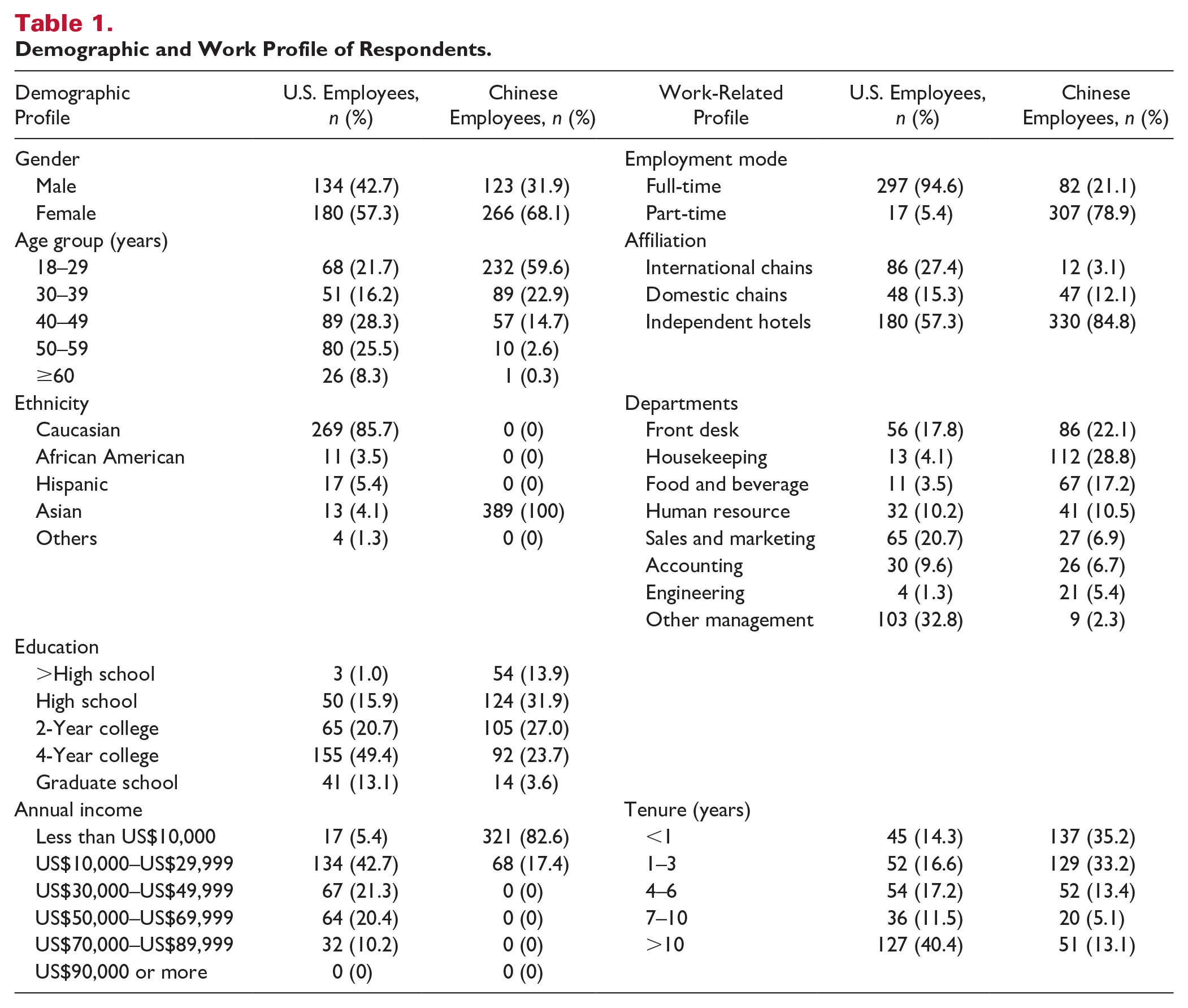
Table 1 shows the profiles of participants, including Chinese and American hotel employees. In terms of gender, 31.9% of the Chinese employees are male and 68.1% are female, while 42.7% of the American employees are male and 57.3% are female. In terms of age group distribution, more than 59.6% of the Chinese employees are younger than 30 years, compared with 21.7% of the American employees. Only 0.3% of the Chinese employees are 60 years or older, compared with 8.3% of the American employees. In terms of education, there seems to be a higher percentage of Chinese employees who have obtained a high school education or below (45.8%), compared with American employees (16.9%). A total of 50.5% of the Chinese employees have obtained 2- or 4-year college degrees, compared with 70.3% of the American employees. Only 3.6% of the Chinese employees have attended graduate school, compared with 13.1% of the American employees. In terms of hotel affiliation, 84.8% of the Chinese employees work in independent hotels, followed by domestic chain hotels (12.1%) and international chain hotels (3.1%), while 57.3% of the American employees work for independent hotels, followed by 27.4% at international chain hotels and 15.3% at domestic chain hotels. In terms of organizational tenure, 68.4% of Chinese employees have worked for less than 3 years for their current hotel, compared with 30.9% of the American employees. A total of 13.4% of the Chinese employees and 17.2% of the American employees have stayed at their current hotels between 4 and 6 years. A total of 5.1% of the Chinese employees and 11.5% of the American employees have worked between 7 and 10 years for their current hotels. Only 13.1% of the Chinese employees have worked for more than 10 years for their current hotels, compared with 40.4% of the American employees.
Demographic and Work Profile of Respondents.
CFA Results
Fit indices from the CFA results among the 703 total respondents were acceptable (Hair et al., 2006; Kline, 2011). The normed chi-square (NC), counted by NC = χ2M/dfM, was 3.66 (786.40/215; p ≤ .000). The comparative fit index (CFI) was .93, the Tucker-Lewis index (TLI) was .91, the root mean square error of approximation (RMSEA) was .06, and the standardized root mean square residual (SRMR) was .06.
Table 2 shows the correlation table. The Cronbach’s alpha of constructs ranged from .72 to .85. Besides, each construct’s correlations with other constructs were lower than the average variance extracted (AVE) square roots. Table 3 shows the measurement model. The AVE of all constructs ranged from .49 to .61. The composite reliability (CR) of all constructs ranged from .74 to .86. As reported in Table 3, all scale items were significantly (p ≤ .001) related to their construct. Based on the above, the measurement had adequate reliability and validity (Hair et al., 2006; Kline, 2011).
Correlation Table.

Note. Cronbach’s α of each construct is in the diagonal. AVE = average variance extracted; CEE = customer-employee exchange; PE = positive emotion; E = empathy; OCB = organizational citizenship behavior; OCB-I = OCB toward coworkers; OCB-O = OCB toward the organization and leaders; OCB-C = OCB toward customers.
p < .01.
The Measurement Model.

Note. CEE = customer-employee exchange, PE = positive emotion, E = empathy; OCB = organizational citizenship behavior; OCB-I = OCB toward coworkers; OCB-O = OCB toward the organization and leaders; OCB-C = OCB toward customers.
p < .001.
SEM Results
Figure 2 shows the SEM results of all respondents. Fit indices of the SEM model were acceptable (Hair et al., 2006; Kline, 2011). NC was 2.70 (4.22/222; p ≤ .000), CFI was .91, TLI was .90, RMSEA was .07, and SRMR was .07. Customer-employee exchange was significantly and positively related to positive emotion (β = .54, p < .001), empathy (β = .30, p < .001), and OCB-C (β = .23, p < .001), supporting H1, H2, and H5. Both positive emotion (β = .62, p < .001) and empathy (β = .12, p < .01) showed significant positive relationships with OCB-C, supporting H3 and H4. Finally, significant positive relationships were found between OCB-C and OCB-O (β = .77, p < .001) and OCB-I (β = .73, p < .001), proving H6 and H7. Thus, all proposed hypotheses were supported. In this SEM model, positive emotion was explained by 29%, empathy by 9%, OCB-C by 65%, OCB-O by 60%, and OCB-I by 54%. Moreover, for cross-cultural validation, this study further sorted the overall data into two sets—one including respondents from China and the other from the United States—to run analysis again with the same SEM model. All seven proposed hypotheses were supported in these two SEM models, demonstrating cross-cultural validation of the proposed mechanism of customer-driven employee citizenship behavior.

SEM Results.
However, this study also tested two alternative competing models under the setting of server-friendly customers’ influences on a customer-driven OCB model. In the first competing model, we took out H4 from our original model to highlight the bridging roles of positive emotion and empathy for the relationship between customer-employee exchange and OCB-C. Although all hypotheses were significantly supported, the model fit indices (NC = 4.34, p ≤ .000; CFI = .91; TLI = .89, RMSEA = .07, SRMR = .08) of the first competing model were worse than our proposed model. In the second competing model, we kept H1 to H5 of the original model, then linked OCB-C with OCB-I as H6, and OCB-I with OCB-O as H7, because a customer-driven OCB model in a service workplace may be anywhere from limited (OCB-I; coworkers within the same service team) to wide (OCB-O; the whole service organization) in scope. Whereas the SEM results showed that all hypotheses were significantly supported in the second competing model, the model fit indices (NC = 4.65, p ≤ .000; CFI = .90; TLI = .88, RMSEA = .07, SRMR = .09) were worse than our proposed model. Based on the above, in comparison with the two competing models, our proposed model is the best model.
Discussion
Exchanges and interactions with customers are important components of hotel frontline employee jobs. This distinguishes the management and operation process of hotels and their employees from less service-intensive organizations. In our study, OCB-C can facilitate positive social exchanges between service employees and customers, which helps create positive emotions for “citizens” (Fisher & Yuan, 1998) and therefore improves their experience of the organization (Randel & Ranft, 2007). Such an experience can serve as a reward or positive reinforcer, leading to spillover of employees’ self-reinforcing OCBs from external to internal customers. In service organizations, customers are not passive receivers of services; rather, they are cocreators of the service experience. Customers’ attitude, mood, knowledge, skills, and the way they treat their service providers can all influence the success and/or failure of service experiences. And so, by examining how customer-employee exchange influences service employees’ behaviors, this study fills a theoretical gap and has important practical implications.
Theoretical Implications
To the best of our knowledge, this study is one of the first attempts to propose the power of customers in shaping employees’ perception and performance in service encounters. Driven by the service-profit chain, most service literature focuses on how service employees’ attitudes and emotional displays could influence customers’ service experience and satisfaction (Hogreve et al., 2017; Loveman, 1998). In addition, previous research on emotional labor building conducted through the lens of COR theory often frames customer service encounters as a means of psychological resource depletion (Choi et al., 2014; Han et al., 2016; Lee & Ok, 2014). However, our study suggested that customers, particularly server-friendly customers, can bring positive customer-employee exchange, which explains the large variance in service employees’ positive emotion and empathy. This provides an important opportunity for service employees to reenergize themselves in stressful service jobs while gaining psychological resources. As explained by the reciprocal nature of social exchange (Ma & Qu, 2011), service employees are more likely to return the favor to customers (current or future; external or internal) with OCBs.
Second, our study explained the customer-driven mechanism of service employees’ OCBs from two theoretical perspectives: COR and social exchange. Building on the affective nature of the social exchange process (Lawler, 2001), we suggest that the two theories could be inherently connected. Positive social exchanges with server-friendly customers carry important emotional meanings for employees, thus serving as psychological resources for service employees to reenergize and engage in OCBs. The result of hypotheses testing also supports this proposition.
Third, the study further confirmed the spillover effect of OCB-C on OCB-O and OCB-I. Building upon the study of Ma et al. (2013) that also divided OCB into OCB-C, OCB-O, and OCB-I, this study goes a step further in proposing that performance of OCB-C can positively influence (or spillover) the performance of other types of OCB. The encouraging fact that customers can drive service employees’ OCB suggests a promising future investigation direction regarding how service organizations might utilize external resources (e.g., engaging and server-friendly customers) to encourage employees’ OCB. In addition, we have explained that service employees may absorb tacit knowledge (e.g., constructive feedback to improve products and services) from server-friendly customers during customer-employee exchanges, or OCB-C, which could help them do well with regard to OCB-O and OCB-I. Based on the researchers’ personal work experience in the hotel industry, some server-friendly customers are retired successful businessmen or officers who are willing to share the wisdom of their life experience with polite young servers. They sometimes not only kindly provide comments for service innovation and improvement (OCB-C) but also offer service employees suggestions to win social support and build their career in an organization (OCB-O and OCB-I).
Practical Implications
This study has important practical implications for the management and motivation of hospitality service employees. Marketing researchers and actioners have been using profitability as a key determinant to distinguish server-friendly customers from demon customers (Selden & Colvin, 2003). This study, however, recognizes that server-friendly customers are not only profitable, but can also provide psychological resources to employees and reenergize them to perform OCBs. Thus, engaging customers is important not only to the bottom line of business but also to employees’ well-being, emotional fulfillment, and service performance. Compared with other business sectors, service organizations have the advantage of meeting and serving customers face-to-face, thus building emotional connections: the suggested starting point of customer engagement (Rampton, 2015). Therefore, organizations should recognize the strategic importance of server-friendly customers in reenergizing psychological resources for employees and providing necessary support (including organizational culture, policies, facilities, equipment, and empowerment) to facilitative customer engagement activities and positive social exchanges between customers and employees. Doing this can benefit the service delivery process while strategically enhancing customers’ role in shaping a service organization’s climate and contributing to employees’ sense of belonging within an organization.
Second, this study has important implications for the recruitment and training of employees. As Mielle Batliwalla, one of Marriott’ s HR managers, puts it, “We hire for attitude and we train for skill . . . We would rather have people with the right attitude, the ones who are willing to work hard, to grow with the organization” (Moses, 2019). The findings of this study suggest that when selecting employees, certain personality traits may be more conducive than others to predicting good performance (e.g., a higher level of empathy, need for affiliation, good communication and social skills, etc.). In addition to technical skills, organizations should also provide training to enhance employees’ soft skills, such as social interaction and communication, to help facilitate positive interactions and build emotional connections with customers. Organizations should also involve server-friendly customers as part of their team (Rampton, 2015) to help create an engaging customer experience. For instance, sharing stories of these customers on hotels’ social media, including celebrations of business success with loyal customers or asking customers to cocreate new products and services, are effective ways of involving customers. All these can help build a culture of developing engaged and server-friendly customers.
Third, the spillover effects of OCBs suggest that directing OCBs at one target can foster a general tendency for employees to perform OCBs toward other targets. This not only affirms the propositions of the service-profit chain, which emphasize that happy employees are the starting point for happy customers (Heskett et al., 1994); it also has important implications for both internal and external marketing of service organizations. Hotel leaders should build a culture that encourages general helping behaviors and other types of good citizenship behaviors of employees, regardless of targets. Voluntary helping behaviors among coworkers, going the extra mile to satisfy customers’ needs, and taking extra time to reserve energies and resources for organizations should all be encouraged because these behaviors help build stronger work relationships and build a more positive workplace (Levin, 2020). In addition, it contributes to an organizational climate that values going above and beyond to facilitate employees’ OCBs toward both internal and external customers of the organization.
Limitations and Suggestions for Future Research
This study is not free of limitations and opens avenues for future research. First of all, this study used a cross-sectional noncausal research design, which limited the predictive power of the proposed model. Future research may take causal research designs (e.g., using data collected at multiple points in time) to further validate the proposed model. Second, practical research on the topic of server-friendly customers remains limited. Questions such as how to distinguish server-friendly customers from others and whether there are ways to develop regular customers into server-friendly customers have yet to be answered, leaving important research gaps that need to be addressed by researchers interested in this topic. Third, this study did not examine how positive customer-employee exchange improves employees’ mental health, such as emotional stability and stress release. This would be a valuable future research direction to enrich our understanding of the benefits that can be gained through server-friendly customers at service encounters. Fourth, we only used five items to measure customer-employee exchange, which limits the possibility of exploring the multidimensional structure of customer-employee exchange and examining how each aspect of customer-employee exchange may associate differently with employee OCBs. Therefore, we recommend that future research explore and enrich the content of customer-employee exchange. Fifth, future studies are also recommended to investigate effects of cultural values on changing the outcomes of server-friendly customers and on moderating the formation of a customer-driven OCB model. For example, face has been identified as an important cultural value in Chinese society to influence social networking, information exchange, and relationship building (Hwang, 1987).
Conclusion
Building on COR and social exchange theories, this study examined how positive customer-employee exchange in service encounters can be a key psychological resource for employees to reenergize themselves while performing OCBs toward both external and internal customers of service organizations. The results supported our hypothesis that positive customer-employee exchange is not only a direct trigger of hotel employees’ OCB-C but also indirectly contributes to employees’ OCBs performed to customers via positive emotions and emphatic feelings. This study affirmed that having server-friendly customers is not only important to organizations in terms of profitability, but can further shape the service delivery process by positively influencing employees’ emotions and performance. It also enriched literature on server-friendly customers and addressed and indicated important directions for future research. In service-intensive organizations, customers are not only actively engaging in service delivery process; their influence can expand from processes at the boundary of organizations to those at their very core.
Footnotes
Appendix
Measures Used in This Study.

| English Version | Chinese Version |
|---|---|
| Customer-employee exchange (Ma & Qu, 2011) 1. Most of our guests are polite. 2. I feel that my services are appreciated by our guests. 3. I rarely receive complaints from our guests. 4. I feel our guests are satisfied with the services provided by our hotel. 5. I feel our guests are happy to stay in our hotel. |
顾客员工社会交换 1. 我们的大部分顾客都很礼貌。 2. 我觉得我的服务是被顾客尊重的。 3. 我很少收到顾客投诉。 4. 我觉得顾客对我们酒店的服务是满意的。 5. 我觉得顾客对入住我们酒店感到很开心。 |
| Positive emotion (Havlena & Holbrook, 1986) 1. I feel happy to go above and beyond to serve customers. 2. I feel satisfied with myself if I satisfy my customers with exceptional services. 3. I enjoy the process of meeting customers’ needs. |
正向情绪 1. 努力服务顾客令我感到开心。 2. 如果我的优质服务令顾客满意的话我对自己也感到满意。 3. 我很享受服务顾客满足顾客需要的过程。 |
| Empathy (Bettencourt et al., 2001) 1. I try to understand my friends better from their perspective. 2. Seeing warm, emotional scenes makes me teary-eyed. 3. I am a very soft-hearted person. |
同理心 1. 我尽量站在朋友的角度来理解他们。 2. 温暖动情的场景常使我热泪盈眶。 3. 我是个有慈悲心肠的人。 |
| OCBs measures (Ma et al., 2013) OCB-C 1. I am always exceptionally courteous and respectful to customers. 2. I follow customer service guidelines with extreme care. 3. I respond to customer requests and problems in a timely manner. 4. I conscientiously promote products and services to customers. OCB-O 1. I take fewer breaks than I deserve. 2. I protect our hotels’ property. 3. I follow informal rules to maintain order. 4. I say good things about our hotel when talking with outsiders. OCB-I 1. I take time to listen to my coworkers’ problems and worries. 2. I go out of my way to help new coworkers. 3. I take personal interest in my coworkers. 4. I pass along notices and news to my coworkers. |
针对顾客的组织公民行为 1. 我总是非常认真恭敬地为顾客服务。 2. 我按照服务要求认真努力地为顾客服务。 3. 我非常及时地解决顾客的问题和满足顾客的需求。 4. 我以高度责任心向顾客推介酒店的产品和服务。 针对组织的组织公民行为 1. 在工作间歇我主动少休息。 2. 我珍惜和保护组织的财物。 3. 我遵守酒店里非正式的行为准则以维持酒店的良好秩序。 4. 与他人谈及我们酒店时,我会说好的方面。 针对同事的组织公民行为 1. 我愿意花时间倾听同事诉说他/她的问题和忧虑。 2. 为了帮助新来的同事我不介意暂停手头的工作。3. 我关心其他的同事。 4. 我会向同事传递通知和信息。 |
Note. OCB = organizational citizenship behavior; OCB-I = OCB toward coworkers; OCB-O = OCB toward the organization and leaders; OCB-C = OCB toward customers.
Declaration of Conflicting Interests
The author(s) declared no potential conflicts of interest with respect to the research, authorship, or publication of this article.
Funding
The author(s) received no financial support for the research, authorship, or publication of this article.
