



Abstract
This study examines consumers’ intentions to use contact-reducing technologies (CRT) in restaurants and their intentions to purchase from restaurants that use CRT. The study used a theoretical foundation based on the Unified Theory of Adoption and Use of Technology, extended with convenience orientation, media influences, shared goals, and health risks. Data were collected from 985 U.S. consumers who had purchased from a restaurant after March 2020. Social influences have the strongest impact on consumers’ intentions to use CRT in restaurants, and intentions to use CRT and shared goals have significant impacts on consumers’ intentions to purchase from restaurants that use CRT.
Keywords
Introduction
During the COVID-19 pandemic, restaurants that survived the unprecedented wave of closures were compelled to rapidly comply with safety guidelines and government restrictions. They shifted their focus toward takeout, curbside delivery, and reduced interactions (U.S. Bank, 2021). These new service models required the implementation of Contact-Reducing Technologies (CRT; Chick et al., 2023). As leading industry organizations, such as the National Restaurant Association, recognized the indispensable role of CRT in continuing operations (National Restaurant Association, 2020), restaurants have installed information technologies (ITs) such as QR codes and touchless payment systems to facilitate tasks (e.g., ordering, payment) without extensive physical contact (Lucas, 2020). Moreover, the pandemic exacerbated major consumer trends, such as a preference for electronic payments, highlighting substantial underlying demand for CRT (U.S. Bank, 2021). Given that many pandemic-era service models are likely to persist beyond it (Chick et al., 2023), CRT has become a fundamental component of postpandemic technology stacks.
The future of a restaurant may depend on the effective integration of CRT into operations and especially on consumers’ use of these systems. Understanding consumers’ use of IT has always been an academic priority (Pesonen & Neidhardt, 2020). Scholars agree that certain combinations of system perceptions and users’ personal characteristics influence IT adoption (Gunden et al., 2020). However, the literature remains inconclusive regarding the unequivocal set of factors that drive the adoption of specific IT (Kaur et al., 2021). Thus, scholars have continuously called for revisions to theoretical models predicting IT adoption in new task-technology environments (TTEs; Li et al., 2021).
Predicting IT adoption is inherently challenging in extraordinary contexts, due to shifting user motivations (Morosan & DeFranco, 2016). Research conducted during the pandemic illustrated the difficulty in generalizing prior results from prepandemic to the postpandemic contexts, because the use of technology, including CRT, could be motivated by different factors than prepandemic (Choe et al., 2021). Specifically, prepandemic factors driving adoption gravitated around optimizing tasks that were already efficient due to the omnipresence of staff (Ciftci et al., 2021). This resulted in additional calls from scholars to investigate the role of IT in services not only as a critical element of new service models but also as a tool for mitigating public health risks (Choe et al., 2021). Despite the findings of recent studies, to date, there is little systematic research that examines restaurant consumers’ use of CRT, marking a primary research gap.
As scholars continue to examine postpandemic industry practices (DeMicco et al., 2021), there is limited research that examines the role of IT in restaurants postpandemic, marking a second research gap. Both gaps are exacerbated by the divergent findings on IT adoption and the uniqueness of postpandemic TTE. Thus, understanding how restaurant consumers use CRT represents an essential step in advancing the theoretical–practical dyad, leading to several important outcomes for scholars, restaurants, and IT vendors. The goal of this study is to elucidate the role of CRT in shaping consumer behavior within the restaurant TTE postpandemic. This study is guided by two objectives: (a) understanding the impact of several system perceptions and personal factors that influence consumers’ intentions to use CRT in restaurants, and (b) understanding the role of consumers’ intentions to use CRT in restaurants in influencing their loyalty toward restaurants that use CRT.
Review of Literature
Theoretical Foundations
IT adoption is tied to specific TTE and examined through perception-based theories, such as the Unified Theory of Acceptance and Use of Technology (UTAUT2; Venkatesh et al., 2012). UTAUT2 posits that certain perceptions (e.g., performance, effort expectancies) and user characteristics (e.g., habits) influence users’ intentions to use IT (Venkatesh et al., 2012). UTAUT2 became well-established due to its conceptual robustness, parsimony, and extensive empirical validation, making it appropriate for studying IT adoption in new TTEs (Salehi-Esfahani & Kang, 2019). As TTEs evolve rapidly, UTAUT2 often requires the revalidation of its fundamental relationships. The TTE examined in this study is significantly different from those in prior research because (a) the task of completing transactions in restaurants is significantly different compared to prepandemic times and other hospitality retail contexts and (b) CRT’s main task is minimizing physical contact. Thus, the above differences in TTE require a revalidation of the fundamental relationships within UTAUT2.
IT adoption literature generally follows a two-step model development procedure (Benbasat & Barki, 2007). First, the primary model (e.g., UTAUT2) is revisited, and constructs like performance expectancy, effort expectancy, and social influences are commonly retained as the core model (Wallace & Sheetz, 2014). Second, the core model is extended with constructs (e.g., user perceptions and characteristics) that reflect a specific TTE without compromising parsimony (López-Nicolás et al., 2008).
In line with the first objective, this study’s conceptual model was built by revisiting the UTAUT2 (Venkatesh et al., 2012). UTAUT2 was chosen as the theoretical foundation because (a) it includes the core antecedents of behavioral intentions (Venkatesh et al., 2012), (b) it reflects a particular TTE (Morosan & DeFranco, 2016), and (c) it facilitates extension (Morosan & DeFranco, 2016). This study extended the core UTAUT2 by adding two constructs: media influences (López-Nicolás et al., 2008) and convenience orientation (Seiders et al., 2007) that reflect the current TTE. The media influences construct was added because the media are primary tools for conveying information about safeguarding health during the COVID-19 pandemic. Prior to the pandemic, CRT technologies were relatively uncommon in restaurants. However, where implemented, they aligned with the industry’s focus on convenience. To reflect this, consumers’ convenience orientation was incorporated into the core model.
Following the second objective, this study’s model conceptualized intentions to use CRT as an antecedent of loyalty toward restaurants that use CRT, along with two other antecedents of loyalty: shared goals (Chow & Chan, 2008) and health risks (Richter, 2003). This study uses loyalty toward restaurants using CRT as a concept that ultimately provides insight into consumers’ behavior toward restaurants. The conceptual model for this study is illustrated in Figure 1.
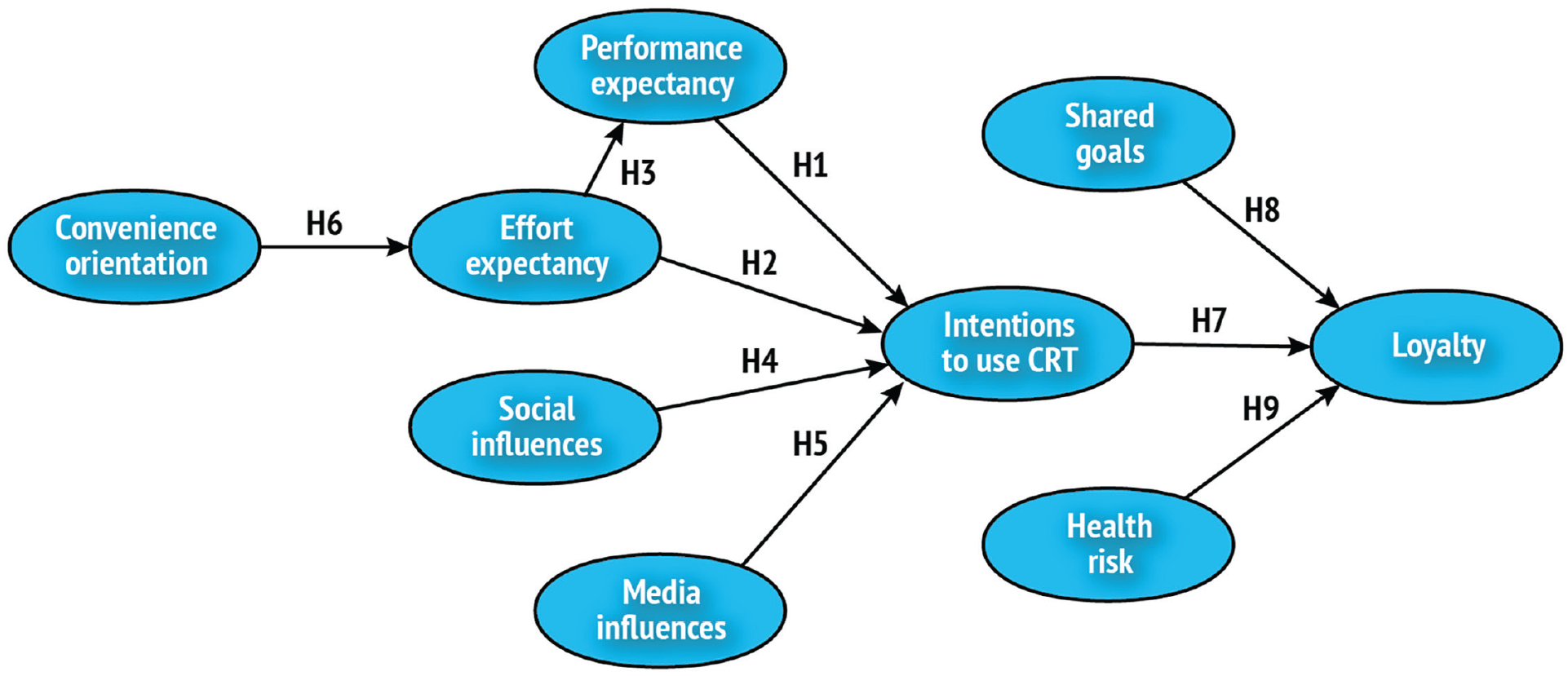
Conceptual Model.
Model Development and Hypotheses
The Core UTAUT Model
The IT adoption literature converges toward a core set of constructs that describe the motivational structure that determines users’ adoption (Venkatesh et al., 2012), such as performance expectancy, effort expectancy, and social influences (Morosan & DeFranco, 2016). Performance expectancy reflects users’ perception that a technology is suitable for task completion and effort expectancy illustrates that users develop perceptions of the effort necessary to complete the task (Venkatesh et al., 2012). Effort expectancy influences performance expectancy (Im & Hancer, 2014). Together, these two constructs reflect a user’s individual perceptions regarding the IT’s ability to facilitate task completion (Palau-Saumell et al., 2019). However, they do not recognize the social environment surrounding adoption. This aspect is addressed by the incorporation of social influences into the core UTAUT2 model (Venkatesh et al., 2012). Social influences recognize that social referents (e.g., family members and coworkers) influence consumers’ perceptions of IT and ultimately adoption (Gunden et al., 2020).
These constructs share theoretical commonalities attributable to their similar focus on understanding subjective perceptions within a social context. Therefore, they have been repeatedly validated together as the core UTAUT2 model. While the relationships between these constructs and users’ intentions are predictable, the literature showed that they still need revalidation, especially in TTEs that are unique in stimulating consumers' perceptions or those substantially different from previously validated TTEs (Morosan & DeFranco, 2016). This is why their validation is necessary in this study, alongside the following hypotheses:
Extending the Core Model
UTAUT2 extensions aimed to achieve a better understanding of various specific industrial and technological contexts. These practices considered the continuous development in IT and incorporated advancements in adjacent theoretical fields. They ultimately enhanced UTAUT2’s predictive power and practical relevance. A similar approach was taken in this study.
Media Influences
Media influences result from exposure to mass-media communications and have been validated as antecedents of purchasing intentions (Yu et al., 2017). Notably, media have been found to impact IT-related behaviors (López-Nicolás et al., 2008). Recent research has also validated the impact of COVID-19-related media coverage on consumer behaviors in restaurants (Sung & King, 2021). Specifically, exposure to COVID-19-related information can evoke fear, which may increase preventive behaviors (Sung & King, 2021). During the initial stages of the pandemic, the media had a critical role in disseminating COVID-19 information and facilitated consumers’ acquisition of sufficient information to make decisions about restaurant ordering via CRT. In this context, the following hypothesis was developed:
Convenience Orientation
Convenience reflects the time and effort required to use a specific product (Collier & Sherrell, 2010). In food service, where competition is high and differentiation is critical, offering convenient services has become important (Kotler et al., 2016). Therefore, an important related concept is convenience orientation, which reflects consumers’ perceptions regarding saving time and effort when purchasing or utilizing products (Olsen & Mai, 2013). During the pandemic, CRT served a dual role: (a) to facilitate convenient task completion and (b) to limit contamination. Therefore, consumers with a high convenience orientation are likely to understand how CRTs work and develop perceptions regarding the effort necessary to use them. As a result, consumers may find themselves in a situation where their convenience orientation determines the amount of effort necessary to complete a task, leading to the following hypothesis:
Intentions to Use CRT
Intentions to engage in behavior have been used extensively in hospitality as the final construct in models explicating consumer behavior (Amaro & Duarte, 2015). A similar approach was followed in IT research because it is difficult to examine actual behaviors related to technologies that are not widespread (Jeon et al., 2018). The literature documents a plethora of studies using intentions to use a specific system as a surrogate of actual behavior (Jeon et al., 2018).
Loyalty
Loyalty reflects consumers’ commitment to repurchase a product without considering marketing efforts (Oliver, 1999). The literature agrees that consumers who are loyal to a product are likely to engage in behavior that involves that product (Bowen & Chen, 2001). This finding has also been validated in the IT literature, where users’ intentions to use a system materialized in repeated behavior involving tasks that include that system (Renaud et al., 2019). Accordingly, as consumers develop intentions to use CRT in restaurants, their motivations to use such systems gravitate around their purchasing tasks, while considering the benefits of reducing contact with restaurants. They could view CRT as capable of mitigating risk while facilitating task completion, which could influence purchasing decisions. Thus, the following hypothesis was developed:
Shared Goals
Shared goals are defined as the degree to which members of a social group share a common understanding and knowledge of achieving certain results (Chow & Chan, 2008). Generally, while businesses and consumers have different goals, such goals may converge to create value (Saarijärvi et al., 2013). However, the pandemic made both restaurants and consumers realize that common goals adapt when public health is threatened. Thus, safeguarding public health became a new common goal. To facilitate goal alignment, organizational goals are made explicit and communicated to stakeholders (Haas et al., 1992). Restaurant measures like reducing contact, and consumer measures like using their own technologies converged toward the goal of safeguarding public health. As CRT were installed to address this common goal, consumers may view the use of CRT as indicative of the shared goal. Accordingly, the following hypothesis was developed:
Health Risk
Health risk represents the possibility of being infected with a pathogen (Foroudi et al., 2021). Recently, scholars began to note the importance of health risks for travelers and illustrated how several technologies and corporate initiatives could help mitigate such risks (Zemke et al., 2015). Outside hospitality, the concept of health risk has been increasingly examined in studies of technology adoption (Yoo et al., 2015). The literature converges toward two key notions: (a) technologies can help reduce health risk associated with consumer tasks (e.g., food purchasing; Yoo et al., 2015) and (b) reduced health risk can enhance consumers’ behavioral responses toward businesses using health risk-mitigating technology (Zemke et al., 2015). During the pandemic, reduced contact was believed to be a primary way to reduce health risks. Therefore, as in other settings where technology reduces health risk (Zemke et al., 2015), consumers for whom CRT use is viewed as low health risk may develop long-term behavioral responses toward restaurants that use CRT, alongside the following hypothesis:
Method
Data were collected online using a survey instrument with scales that have already been validated, refined, and proved effective in previous research. The scales (Table 3) were adapted to the current research context while ensuring the retention of their established psychometric properties (Heggestad et al., 2019). All measurement items were rated using Likert-type items, ranging from 1 = strongly disagree to 5 = strongly agree. The respondents were asked to read a scenario that included the definition and examples of CRT, subsequently asking them to imagine that they are purchasing from a restaurant that utilizes CRT. A sample of 985 respondents was collected using the services of a global consumer panel company in March 2021, by sending 31,000 invitations to the panelists.
Results
Preliminary Results
Multivariate normality was not established, therefore subsequent analyses used estimators robust to deviations from multivariate normality (Muthèn & Muthèn, 2017). To assess common method bias, a structural model was constructed by loading all items on a single latent factor. Given the poor fit, chi-square (χ2): 5908.22 (p < .001), degrees of freedom (d.f.): 560, normed-chi-square (X2/d.f.) = 10.55, Comparative Fit Index (CFI) = .68, Tucker–Lewis Index (TLI) = .66, and Root Mean Square Error of Approximation (RMSEA) = .1, common method bias was not considered a concern (Malhotra et al., 2006). The proposed model was also assessed against two alternative models and was considered appropriate, as there was no significant improvement of fit with the alternative models (Weston & Gore, 2006).
Most respondents were female (59.8%) with the largest group being 40 to 49 years old (21.1%). Approximately 41% reported annual household incomes of $50,000 or less (41%), while 37.4% had completed bachelor’s degrees (Table 1). Most respondents purchased between 3 and 10 times a month from restaurants (52.1%) and spent between $20 and $39 per person (40.7%). The most common type of purchasing has been pick-up only (39.9%), with fast-food restaurants being the most preferred choice (37.2%; Table 2).
Demographic Characteristics of Respondents.

Behavioral Characteristics of Respondents.

Structural Model Results
The measurement model’s reliability, and convergent and discriminant validity were assessed through Confirmatory Factor Analysis (CFA; Hair et al., 2009; Tables 3 and 4). The measurement model had the following fit indices: χ2: 1319.691 (p < .001), normed-chi-square: 2.5, CFI: .95, TLI: .92, and RMSEA: .04, indicating good fit (Hair et al., 2009). Composite Construct Reliabilities (CCRs) of each latent construct were found to be greater than .8, confirming reliability (Hair et al., 2009). Factor loadings exceeded .68, indicating acceptable convergent validity (Fornell & Larcker, 1981). With Average Variance Extracted (AVE) values exceeding .5, convergent validity has been confirmed (Fornell & Larcker, 1981). All AVE values were higher than the corresponding correlations, thus confirming discriminant validity (Hair et al., 2009).
Reliability and Validity Results.

Note. CCR = composite construct reliabilities.
Discriminant Validity Test Results.

Note. The values on the diagonal represent the average variance extracted from each latent construct. The bold values represent the squared interconstruct correlations. CRT = contact-reducing technologies.
As the psychometric properties of the instrument have been established, the analysis continued with a structural equation modeling analysis to assess model fit (Muthèn & Muthèn, 2017). The model had an appropriate fit (Hair et al., 2009) with the following indexes: χ2 (541) = 1732.76 (p < .001), χ2/d.f. = 3.2, CFI = .93, TLI = .92, and RMSEA = .048 (Figure 2).

Model Testing Results.
Discussion
All hypotheses were supported in their predicted directions, except for hypothesis H9. Performance expectancy was a significant antecedent of consumers’ intentions to use CRT (γ = .248, p < .001); therefore, H1 has been supported. That is, the design features that determine consumers’ perceptions of the performance of CRT for completing food-related tasks are critical to influencing consumers’ intentions to use CRT. The magnitude of this relationship is lower relative to similar findings (Gunden et al., 2020). Effort expectancy showed a positive relationship with intentions to use CRT (β = .214, p < .001), thereby supporting H2. Many restaurants have been motivated by the pandemic to install CRT, and they are likely to have incorporated the more recent technology, which includes intuitive design. In addition, effort expectancy was a strong antecedent of performance expectancy (β = .764, p < .001), which supports H3. That is, when consumers perceive CRT as easy to use, they are more likely to strengthen their perceptions regarding their performance.
Social influences were the strongest antecedent of intentions (γ = .471, p < .001), supporting H4. This finding highlights the social pressure that leads consumers to complete food-related tasks through CRT, indicating its ability to enhance consumers’ intentions to use IT. The result is somewhat surprising and stands out from the literature, where system perceptions are typically the strongest predictors of intentions to use IT (López-Nicolás et al., 2008). Although not strong, the relationship between media influences and intentions was significant (γ = .176, p < .001), supporting hypothesis H5. While the marketing literature supports the notion that the media may influence consumers’ decisions (Kotler et al., 2016), the role of the media in influencing consumers behavior relative to IT is rarely conceptualized in IT adoption studies. This study also validated a strong relationship between convenience orientation and effort expectancy (γ = .606, p < .001), supporting hypothesis H6. This could be attributable to the fact that many of today’s systems are designed based on the logic that any novel technology should be intuitive without training.
While most adoption studies use intentions to use as the final variable, this study presents several additional notable findings. Intentions to use CRT and shared goals have been significant predictors of consumers’ loyalty toward restaurants that use CRT. However, intentions to use CRT (β = .772, p < .001) are substantially stronger predictors than shared goals (γ = .162, p < .01), thereby supporting hypotheses H7 and H8. This could be because the use of technology, especially during the pandemic, must align with the restaurant’s goals, as well as the goals of consumers in their target segments. A somewhat surprising result is the not-significant relationship between health risk and loyalty. This result can be explained by the possibility that consumers may have already made their decisions to frequent restaurants regarding of the health risks.
Contributions
Theoretical Contributions
Despite the emerging research on the effects of the COVID-19 pandemic in hospitality, this study is the first to address the importance of CRT in the postpandemic restaurant business and its impact on consumer behavior. Positioned in a unique and separate context from the hospitality literature, which has focused on investigating the response of hospitality organizations to the pandemic from an overall macroeconomic perspective, this study addresses a less understood aspect of postpandemic hospitality—restaurant operations through IT. Relative to prepandemic research on restaurant IT adoption, this study emphasizes the role of social influences on consumers’ intentions to use CRT. In addition, this study goes a step further by investigating the role of intentions to use CRT in shaping loyalty. As restaurants have been severely impacted by the pandemic, the study provides much-needed insights into consumer behavior toward restaurants mediated by IT.
Most IT literature focuses on broader IT aspects, inevitably generating unbalanced literature with insufficient findings about the role of IT in restaurants. This study remedies this issue by focusing solely on restaurants. Moreover, this study aligns with the prepandemic literature in emphasizing the role of IT at the operational level in restaurants, especially for enhancing responsiveness. Thus, this study advances IT literature and provides the missing knowledge critical to a comprehensive understanding of IT in hospitality. Finally, this study validates the role of the social environment (i.e., social influences and media influences) in influencing consumers’ intentions to use CRT. This study also emphasizes that perceptions of system performance could be weaker antecedents than perceptions of approval by important social referents. Thus, this study provides new insights into the social environment’s role in IT adoption and thus advances the IT adoption literature.
Practical Contributions
A first critical practical contribution is grounded in the validation of social influences as the primary factor impacting consumers’ intentions to use CRT. To stimulate such intentions, restaurants should not only provide persuasive information but also reach beyond their core segments. The second important contribution is grounded in the validation of the relationship between intentions to use CRT and consumers’ loyalty toward the restaurant. This emphasizes the need for restaurants to install IT that facilitates purchasing in contexts as extreme as a global pandemic. While in theory, this sounds feasible, one must recognize that many restaurants are struggling to find the resources necessary to operate. Yet, this study demonstrates that IT infrastructure remains a critical aspect of restaurant operations, and without it, restaurants may have difficulty operating. A third practical contribution recognizes the media’s role in influencing CRT intentions, albeit weaker than social influences. Restaurants can engage in tailored communication campaigns to motivate IT use.
Taken together, these findings illustrate the state of consumers’ adoption of restaurant consumer-facing IT postpandemic. While the primary purpose of CRT is contact reduction, the use of such systems is grounded in factors likely to extend their utilization beyond the initial scope and into the postpandemic era. This is attributable to several reasons, including opportunities to complete secure transactions, sunk costs, strategic resource allocation, and difficulty in continuously upgrading their technology stacks. Thus, the combination of factors that drive consumers’ adoption of CRT illustrates that the current technology infrastructure is poised for resilience.
Limitations and Directions for Further Research
The study has several limitations. First, it investigated consumers’ intentions to use CRT in restaurants at a time when the economy was reopening. Second, the study investigated consumers‘ intentions to use IT in U.S. restaurants. Third, data were collected at a single point in time. Therefore, the findings of this study should be interpreted within the context of the research. Yet, these aspects of the study provide interesting avenues for further research, such as examining the potential impact of CRT use in various types of restaurants or among different economic segments of consumers.
Footnotes
Declaration of Conflicting Interests
The author(s) declared no potential conflicts of interest with respect to the research, authorship, or publication of this article.
Funding
The author(s) disclosed receipt of the following financial support for the research, authorship, and/or publication of this article: Funding for this study was provided by the University of Houston.
