




Abstract
For centuries, lead (Pb) pipes have been used to convey water for public consumption, resulting in widespread negative health impacts caused by lead-contaminated water. In 2022, after years of urging by environmental justice advocates, the U.S. federal government announced a plan to replace all lead service lines via the Biden-Harris Lead Pipe and Paint Action Plan (LPPAP) funded by the Bipartisan Infrastructure Law and American Rescue Plan. This announcement was celebrated as a massive victory for environmental justice advocates and the thousands of communities impacted by aging lead service lines. However, it also raises a critical question—what will become of the lead pipes after removal? In this article, we connect the lead service line removal initiative with the concept of “waste colonialism,” asking: How does critical environmental justice provide a lens to complicate our understanding of the LPPAP? Drawing on initial findings from research conducted in the city of Pittsburgh, PA, and insights from critical environmental justice scholarship, we critique the notion of environmental justice ending at national borders and argue that it is imperative that government programs adopt a comprehensive approach to environmental justice, one that considers global impacts—as well as equity—in the implementation of remediation efforts.
Keywords
INTRODUCTION
Environmental justice activists in the United States have long campaigned to address the widespread issue of aging lead service lines contaminating public water supplies. In 2014, testing in the town of Flint, Michigan, revealed that 17% of resident-collected water samples exceeded the federal lead “action level” of 15 parts per billion. 1 While Flint’s water crisis is sometimes portrayed as an isolated tragedy, that community is just one of thousands of U.S. cities grappling with mass lead poisoning. 2 The depth and breadth of the national lead crisis, like so many issues of environmental contamination, are also intimately linked to race and class. Research shows that low-income and minority children bear a disproportionate burden of exposure to lead-based paints and contaminated drinking water.3,4,5
In 2021, after years of pressure from environmental advocates, the Biden Administration introduced the Biden-Harris Lead Pipe and Paint Action Plan (LPPAP). Funded through the Bipartisan Infrastructure Law and American Rescue Plan, LPPAP pledged tens of billions of dollars over the next decade to fund the removal and replacement of lead service lines. After decades of federal inaction, LPPAP was touted as a major win for environmental justice advocates and the millions of U.S. households receiving new, lead-free water service lines. However, one question that bears consideration is: what will become of lead pipe material after removal? The answer, as we detail here, complicates the story of this environmental justice victory. In this article, we connect the lead service line removal initiative with the concept of “waste colonialism,” asking: How does critical environmental justice provide a lens to complicate our understanding of the LPPAP? Drawing on initial findings from research conducted in the city of Pittsburgh, PA, and insights from critical environmental justice scholarship, we critique the notion of environmental justice ending at national borders, arguing that it is imperative that government programs adopt a comprehensive approach to environmental justice, one that considers global impacts—as well as equity—in the implementation of remediation efforts.
BACKGROUND
Examining the afterlife of lead service lines highlights important broader issues pertaining to the international trade of toxic waste and other toxic commodities. Lead scrap, unlike other forms of toxic waste (e.g., plastics), is considered a valuable commodity because lead’s chemical and physical properties lend it for use in a wide range of consumer and industrial products. Moreover, its value as a commodity is also enhanced by its ability to be endlessly recycled.
In 2022, Mexican journalist Isabella Cota noted with alarm that the LPPAP was poised to increase the influx of lead scrap into the international secondary lead waste market, a market that supplies lead recycling facilities primarily concentrated in the Global South.6,7 Due to lower pollution control standards and a lack of strict environmental enforcement in these locales, lead scrap recycling frequently results in local environmental contamination and poisoning.8,9 To put it succinctly, the U.S. exports lead pipes and, in turn, recycling. Hence, the LPPAP is poised to dramatically increase the amount of lead scrap entering the global waste trade—effectively exporting environmental injustice abroad.
An abundance of critical scholarship addresses ongoing forms of eco-colonialism and global environmental injustice using concepts such as ecologically unequal exchange, 10 slow violence, 11 and waste colonialism. 12 Here, we focus primarily on this last concept, waste colonialism, which describes the pattern of countries of the Global North—including, but not limited to, the United States—exporting waste to nations of the Global South, which often have fewer regulations and/or mechanisms to enforce environmental protections. The term “toxic colonialism” was originally coined by waste activist Jim Puckett, who defined it as “dumping of the industrial wastes of the West on territories of the ‘Third World.’”13,14 We argue that in the case of the LPPAP (and other forms of domestic environmental policy), the United States engages in and contributes to the reproduction of global environmental injustice via the process of waste colonialism. Insights from critical environmental justice literature highlight the often-overlooked aspect of spatial and temporal scale when considering cases of environmental injustice. For example, David Pellow, whose work draws heavily from the 1991 social movement document known as the 17 Principles of Environmental Justice, identifies four pillars that make up what he calls “critical environmental justice.” 15 These pillars function as lenses through which scholars may analyze cases of environmental injustice, including the LPPAP. Each of the pillars is applicable, but here we focus primarily on pillar two, which emphasizes the “multiple spatial and temporal scales of environmental justice problems and solutions.” 16
METHODS AND DATA
This article draws on findings from our 2023 public-facing report, “Localizing Water Justice: Disposing Lead Pipes Responsibly.” 17 These data were derived from a combination of places. First, we contacted a random sample of local scrapyards in Pittsburgh, PA, to inquire whether the scrapyard had received lead waste in the form of removed water service lines. If the scrapyard indicated yes, we requested details regarding where the lead scrap was sold. Second, the authors participate in various local and global environmental justice efforts and drew on knowledge and previous collaborations with other activists and organizations, including Casa Cem, an NGO based in Mexico; the U.S.-based, globally focused, Occupational Knowledge International (OK International); the Basel Action Network (BAN); and the U.S.-focused Environmental Protection Network (EPN). Third, utilizing the United Nations’ Comtrade database 18 and third-party visualizations of Comtrade data, we were able to garner general information regarding patterns in the global trade in secondary lead scrap. 19 Lastly, we obtained information from a local water system—the Pittsburgh Water and Sewer Authority (PWSA) in Pittsburgh, PA, USA. 20 This included estimates of the number of lead service lines set to be removed in the city, general information about the local removal process, and also meeting minutes from the PWSA’s Community Lead Response Advisory Committee (CLRAC) (2019–2024).
FINDINGS: LOCAL ACTORS AND GLOBAL MOVEMENT OF LEAD WASTE
Local actors
The Pittsburgh Water and Sewer Authority is the largest water provider for the City of Pittsburgh and has been celebrated as an exemplar for its handling of the removal of lead service lines within its service area. In 2016, just 2 years after the Flint water crisis, Pittsburgh residents learned their own water had been contaminated with lead as the result of cost-saving measures enacted by a corporation (Veolia), which was briefly brought into a public-private partnership to manage the city’s water. In the wake of the disastrous fallout of this partnership, local activists pushed for the cleanup of the city’s water supply, fighting for safe, affordable, and public water. 21 After the discovery of high lead levels in city water, PWSA responded beyond their regulatory obligation, securing nearly $300 million in public funds and loans for lead service line replacements. PWSA has since coordinated the replacement of over 10,000 lead service lines in the city of Pittsburgh, 22 provided real-time data on progress via a user-friendly digital map, 23 convened the CLRAC that continues to meet several times a year, 24 and the water authority has also offered free water testing for any household in their service area. Notably, in response to activist pressure, PWSA prioritized equity as a central part of their lead service line replacement program. 25
At the local level, our research revealed that PWSA hires third-party entities (contractors and plumbers) to perform the work of removing and replacing lead service lines. These work contracts require lead service lines to be handled in one of two ways: (a) the contractors must pay to have the pipes processed at a hazardous waste facility (e.g., landfill), or (b) they are permitted to sell the pipes to metal scrapyards for recycling. Minutes from a June 2023 meeting of the CLRAC indicate that nearly all contractors opted for the latter choice, bringing the lead scrap generated to local scrapyards. However, after contacting local scrapyards, we were unable to verify the end destination of the lead service lines removed within PWSA’s service area. It is still unclear, for example, where and how much of the lead scrap originating in Pittsburgh flows to intermediaries, redistributors, and/or secondary smelters in the U.S. or abroad. Even still, there are clues about their likely route (we discuss this in the next section).
When conducting outreach to the local scrapyards to demystify the process, we were met with hesitancy to share information. Generally, scrapyard practices are not heavily surveilled by federal agencies. Even when scrapyards are in full compliance with the regulations set forth in the Resource Conservation and Recovery Act, which regulates hazardous waste streams, scrapyards often operate in ways that expose communities to pollutants. The fact that our inquiries may have introduced more scrutiny than these operations are accustomed to likely contributed to scrapyard operators’ disinterest in sharing information. Regardless, this lack of oversight, regulation, and enforcement creates variability among the hundreds of metal scrap yards in Pennsylvania (and across the greater U.S.) and therefore makes the collection of this kind of data challenging. More generally, the roadblocks we encountered in attempting to quantify and trace the local lead waste stream points to the enormous and even more challenging task of investigating the lead waste footprint of larger geographic areas, or even the entire U.S.—a task that would require resources and capacity that environmental justice advocates simply do not have.
Global movement of lead waste
In July 2023, the authors were part of organizing a webinar titled “Out of Sight, Out of Mind: Exporting U.S. Lead Water Pipes and Solutions to this Environmental Justice Problem” (henceforth referred to as “Webinar”). 26 Speakers included a variety of key actors in global lead poisoning prevention. In summary, the Webinar discussion corroborated the research challenges we faced in tracing lead waste generated by the local lead service line removal initiative. It also affirmed the notable lack of transparency regarding the global circulation of lead waste. As the speakers noted many times, U.S.-based local environmental justice initiatives have sought to remediate lead-contaminated water systems via the removal of lead service lines, but practically zero attention has been paid to what happens to the pipes once they are extracted from the ground. This observation is not a criticism of environmental justice advocates but a reminder of the necessity of considering the full lifecycle of waste in such efforts.
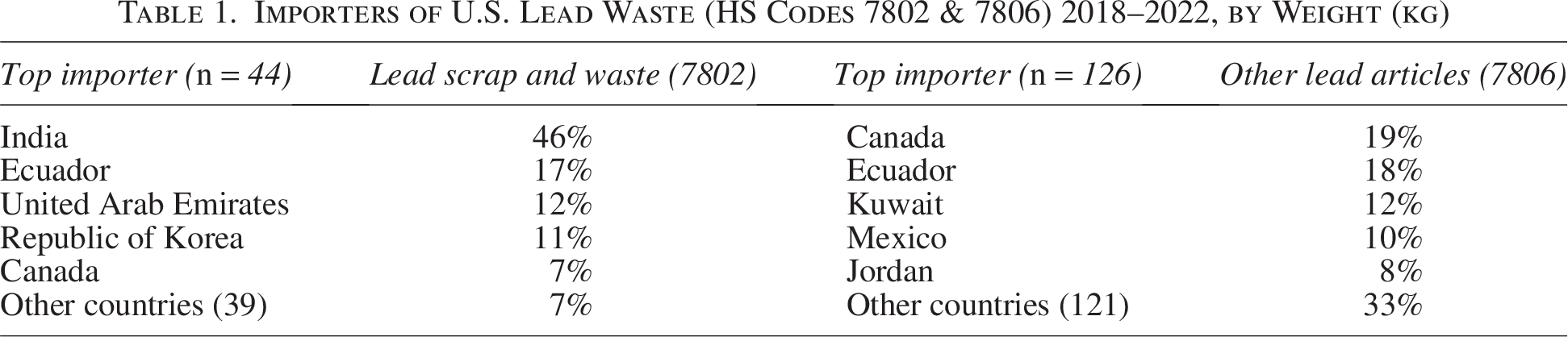
Though we were unsuccessful in pinpointing the exact final destination of PWSA’s lead service lines, it is possible to surmise the lead waste’s most likely path drawing on general information about the international secondary lead market. Upon entering the reclamation process at scrapyards, removed lead lines have—and will likely—travel with other lead scrap to distribution facilities and then on to international smelters. Because lead pipes are not considered “hazardous waste” in the traditional sense, when destined for international recycling, no federal or international regulations currently require a chain of command. 27 Despite the lack of granularity of available data, we identified broader trends in U.S. lead scrap exports indicating that the U.S. exports a significant portion of its lead scrap and that the top importers of lead scrap are located in the Global South. Thus, our current findings about the afterlife of these lead pipes support the claim made by journalist Isabella Cota: the United States has a longstanding pattern of shipping lead waste abroad to be recycled and repurposed, and the scrap generated by LPPAP is poised to continue in that pattern. As others have previously written about, this is related to: (1) lower costs associated with recycling due to this taking place in countries with less stringent environmental regulations (some have termed this the “pollution-haven effect”) 28 and (2) the lack of existing domestic or international mandates that require lead scrap to be recycled in the United States.
Currently, Comtrade data reveal that the majority of lead scrap generated in the United States is exported to India and other countries, leading us to infer that these countries are likely to be the eventual destinations for the lead scrap generated as part of the LPPAP. However, it is important to note that the Comtrade database does not provide granular detail about the specific intra-country origins of lead scrap. As lead pipes make their way through the waste chain, the stage with the most publicly available data is when lead pipes are classified before export. In the Comtrade data, specific commodities can be searched by key terms and/or their assigned code in the Harmonized System (HS). A keyword search for “lead” and a review of code descriptions revealed the following HS codes potentially assigned to exported U.S. lead pipes: “7802 Lead waste and scrap,” “7805 Lead tubes, pipes and tube or pipe fittings,” and “7806 Other Lead Articles.” In spite of the HS’s purported objective of making global queries and tracking easier, the system has a number of limitations that make tracing the final destination of lead service line scrap challenging. First, none of the HS categories refer exclusively to lead pipes, making it difficult to determine how much of the lead scrap exported consists of lead service lines versus another type of lead scrap. Second, it is unclear which—if any—of these codes are assigned to exported U.S. lead pipes. Results from Comtrade queries for all three codes between 2018 and 2022 for all reported United States exports revealed that only two of the codes—7802 (lead waste and scrap) and 7806 (other lead articles)—have associated data. 7805 (lead tubes, pipes, and pipe fittings), which would seem the most appropriate categorization for removed lead service lines, produced no results. See Table 1 for a summary of the results from the 5-year (HS 7802 and HS 7806) queries for U.S. exports.
Importers of U.S. Lead Waste (HS Codes 7802 & 7806) 2018–2022, by Weight (kg)
As we have shown through our investigation of lead service line replacement in Pittsburgh, PA, one of the major barriers for ethical cradle-to-grave environmental justice considerations is the fundamental lack of transparency regarding the global circulation of toxic waste/commodities. This lack of consistent information and transparency related to the handling of removed lead pipes presents significant hurdles when it comes to identifying and preventing waste colonialism.
CONCLUSION
These findings, based on our initial investigation into the lead service line disposal practices in Pittsburgh, Pennsylvania, confirm the need for a broader conception (and application) of critical environmental justice principles in order to prevent the perpetuation and reproduction of injustices in other parts of the globe. Because air, water, and other toxins do not conform to national boundaries, it is incumbent upon policymakers to embrace a global approach when creating and implementing environmental justice initiatives such as LPPAP. For many reasons, structural and otherwise, our observations reveal that U.S.-based non-profit groups, activists, and community organizations (not to mention local, state, and national policies) often struggle to view problems and solutions through a global lens.
One example highlighting this challenge is detailed in a report by a national environmental non-profit, which examines the Quemetco plant, a battery recycling and secondary lead smelting facility in Los Angeles County, California. Located within 600 feet of residential housing, Quetmetco has been cited and fined numerous times for violating air quality standards as well as for inadequate storage of hazardous waste materials. Meanwhile, local grassroots community groups link the pollution generated by the recycling facility to devastating health consequences for the surrounding community—a clear example of environmental injustice within U.S. borders. One solution proposed in the Earthjustice report includes reducing the demand for lead-based batteries by moving towards alternative materials (e.g., lithium and zinc). Yet, there is a growing body of research that raises significant global sustainability concerns—especially regarding the water table—related to lithium mining 29 and the various socioenvironmental effects of extractivism in general. 30
We highlight this as an example of how environmental advocates may inadvertently support so-called “solutions” that effectively export problem to other countries and/or replace certain materials with others that are equally extractive and unethical. Without considering global implications of advocacy, “solutions” can unintentionally become a shell game of shifting waste and exploitation around, jeopardizing the health and livelihood of workers and communities elsewhere in the world. Thus, true solutions must employ a global lens and, to the best of our present reality, must consider the environmental justice implications of any proposed alternative materials. Environmental justice communities in the United States should not be poisoned, and neither should communities elsewhere in the world.
At the same time, it is important to acknowledge the complex reality in which these activist/advocacy groups operate and how their interests may conflict with one another. Solutions to the waste colonialism practice linked to projects seeking to remediate environmental injustice must take into account the complexities that local advocates face, as they frequently lack resources, and time and often operate with minimal support. For their part, nationally based groups do not always have local priorities in mind. Nevertheless, we firmly believe that expanding the horizon of locally based environmental justice movements and organizations is crucial. The question of “where” toxic materials or industries will be relocated to and “what” materials will be substituted are issues that cannot be sidestepped. Answering these questions at the local level can build solidarity and collective capacity 31 among and between environmental justice communities across the globe impacted by the lead line life cycle.
Shortly after the 2023 Webinar we noted that multiple environmental organizations made comments to the EPA referring to the issue of exporting removed lead pipes to other countries as part of the comment period for the changes to the Lead and Copper Rule Improvements. 32 The issue of exporting removed lead lines abroad was also raised during the December 2023 EPA Children’s Health Protection Advisory Committee 33 which points to a budding awareness around this practice. As we have reiterated throughout this article, current trends indicate that the vast majority of lead lines removed from communities in the United States are destined to be sent abroad, where they will perpetuate a cycle of toxic exposure. Under this approach, the correction of a historical wrong for some communities comes at the expense of vulnerable communities abroad. 34 However, this is not inevitable. While the ultimate solution lies with overarching changes in U.S. trade policy that would require lead pipes and other lead waste to be reclaimed and recycled domestically under tighter environmental regulations, communities at the beginning or middle of the lead service line replacement process can act now.
In the mid-sized city of Pittsburgh, PA, our research revealed that once removed, lead pipes are sent to local metal scrapyards. Thus, water systems such as PWSA could include domestic processing requirements in their disposal contracts, and local scrap yards could commit to selling to U.S. recycling facilities. While coordinated global action is necessary to effectively address lead poisoning globally, local action is a critical stopgap measure that can stem the flow of toxic waste abroad. At the same time, ensuring worker justice, both domestically and internationally, is also essential to addressing the challenges associated with lead contamination. In eliminating a primary route of lead exposure, the removal of lead pipes from homes and schools represents a significant victory. However, it is equally important to consider the management and ultimate disposition of the lead waste once removed, and the sustained collaboration among local activist groups, both nationally and globally, 35 will be critical to achieving equitable outcomes and preventing the perpetuation of waste colonialism.
Indeed, the role of social movements in expanding government conceptions of environmental justice cannot be overstated. It was social movements that first brought the concept of environmental racism and environmental justice into national conversations, and it was social movement pressure that led to the signing of the 1994 Executive Order 12898 (Federal Actions to Address Environmental Justice in Minority Populations and Low-Income Populations). As previous scholarship demonstrates, social movements can be key actors in preventing or reversing privatization and promoting local voices and equity in environmental policies.36,37,38 Whereas government actors are often reluctant to challenge recommendations that they assume are tried and tested or that challenge the prevailing hegemonic order and corporate power,39,40,41 social movements, civil society, and advocacy organizations are often at the forefront of reimagining and shaping more equitable policy. Multiple sources highlight how activist pressure in Pittsburgh, PA, was instrumental in achieving several significant victories, including the victory of PWSA obtaining funding for the lead line replacement program.42,43
Just as activists have pushed to address the environmental injustice of lead poisoning in the United States, momentum must continue to ensure that people anywhere in the world are not being poisoned by our exports. The lead pollution in U.S. communities cannot be separated from the lead pollution in communities on the fence line of recycling operations. By embedding international solidarity in the local fight for environmental justice, we can resist the harm being done to communities around the world by corporations and ill-designed foreign policies. The importance of changing how we think about and implement environmental justice is not limited to government officials; it is also necessary to shift the vision of civil society groups and advocacy organizations that focus on lead risk prevention.
The uncertainty related to both the domestic process of preparing lead pipes for export and the inconsistency in codes for tracking lead pipe exports creates a murky context within which a broader, global environmental justice can be understood and developed. Ultimately, this represents a systemic lack of transparency that can stall action. Tracing exactly to which countries the U.S. is exporting removed lead pipes would be helpful in building global alliances, but it is not required to begin integrating global considerations into environmental justice movements and initiatives. As others have noted, tracing the physical flows of waste is not equal to, or as important as, tracing the social, political, and historical power dynamics that create unjust waste systems. 44 A way forward that simultaneously pushes for greater trade flow transparency and builds power to resist waste colonialism must be pursued. 45
AUTHORS’ CONTRIBUTIONS
Conceptualization: C.T., C.S., and M.G.R. Methodology: C.T., C.S., and M.G.R.; Formal analysis: C.T., C.S., M.G.R., and T.M. Investigation: C.T., C.S., M.G.R., and T.M. Data curation: C.T., C.S., M.G.R., and T.M. Writing original draft: C.T. and C.S. Writing—review and editing: C.T. and C.S. Supervision: C.T. and C.S. Project administration: C.T., C.S., and M.G.R. Funding acquisition: M.G.R. and C.S.
Footnotes
AUTHOR DISCLOSURE STATEMENT
No competing financial interests exist.