




Abstract
In recent years, in response to environmental justice (EJ) advocacy, some states have passed laws directing agencies to assess cumulative impacts (CIs) during environmental permit review and, in some cases, to deny permits that would increase CIs in disproportionately impacted areas. This type of regulatory reform is often characterized as the “gold standard” or “holy grail” of EJ policy implementation. Addressing CIs within regulatory decision making entails significant challenges, including technical uncertainties (data gaps, incommensurable data, and conflicting interpretations of existing data) and subjective points of decision making about how to proceed in the context of such technical uncertainties. How agencies address these challenges shapes how well these laws’ implementation supports EJ. However, government materials and media coverage about these CI laws and regulations have said little about these challenges and how agencies will address them, thereby shielding these issues from public debate. EJ advocates, in contrast, argue that agencies should use the precautionary principle to help navigate these technical uncertainties and subjective points of decision making. In this article, we build upon that work by identifying what it could mean to operationalize precaution within CI policy implementation. To do so, we draw on examples of the integration of CI assessment into environmental permit review—specifically, the new CI laws and regulations of New Jersey, New York, Massachusetts, and Minnesota. We identify how precaution is operationalized within these CI laws and regulations, and how this can be done more fully to better support EJ.
Keywords
INTRODUCTION
Many environmental justice (EJ) advocates push to reform U.S. state and federal environmental regulatory agencies to help redress the state’s long-standing and continuing complicity in environmental injustice. Notable among these efforts is reforming the environmental assessment processes agencies use to evaluate proposed facilities, new chemicals, and other potential hazards. EJ advocates challenge how these processes assess proposed projects or chemicals in isolation, without regard to most other environmental and social factors that cumulatively impact human health and well-being.1,2,3,4,5,6 To help rectify these issues, some states have recently responded to EJ advocacy by passing laws directing agencies to assess cumulative impacts (CIs) during environmental permit review.7,8,9,10,11,12 Of these, New Jersey, New York, Minnesota, and Massachusetts go a major step further in requiring state agencies to deny certain permits that would increase CIs in disproportionately impacted communities. This provision reflects EJ advocates’ insistence that “doing a cumulative impact assessment is a means, not an end,” as stated by one EJ advocate at an internal meeting of the National Environmental Justice Advisory Council (NEJAC) Cumulative Impacts workgroup in 2024. This type of regulatory reform is often called the “gold standard” or “holy grail” of EJ policy implementation.13,14,15
However, assessing CIs comprehensively entails significant challenges, including (a) technical uncertainties resulting from how agencies practice science and (b) political and subjective points of decision making about how to proceed in the context of such technical uncertainties. How agencies address these challenges shapes how well these laws’ implementation supports EJ. However, government materials and media coverage about these CI laws and regulations have said little about these challenges and how agencies will address them. This silence matters. Not acknowledging uncertainty and subjective elements of regulatory environmental assessment frames it as a strictly technical process and shields these issues from public debate. EJ advocates, in contrast, argue that agencies should use the precautionary principle (PP) to help navigate these technical uncertainties and subjective points of decision making.16,17,18 In this article, we build upon that work by identifying how CI laws and regulations apply the PP (albeit incompletely) and how they could do so more effectively.
In the next section, we review scholarship on environmental assessment, the PP, CIs, and EJ, identifying a need for further specification about how to operationalize precaution within CI policy implementation. In the Section “Cases and Methods,” we briefly describe our cases—the CI laws and regulations in New Jersey, New York, Massachusetts, and Minnesota—and methods. In the Section “Findings: Operationalizing Precaution Within States’ CI Laws and Regulations,” we identify how EJ advocates call for integrating the PP into CI policy implementation, elements of the CI laws and regulations that reflect the PP in ways that support EJ, further techniques for integrating precaution into these types of CI laws and regulations in ways that support EJ, and some constraints facing these efforts. We conclude by summarizing our findings and their policy relevance.
SCHOLARSHIP ON ENVIRONMENTAL ASSESSMENT, THE PRECAUTIONARY PRINCIPLE, CUMULATIVE IMPACTS, AND ENVIRONMENTAL JUSTICE
Environmental regulatory agencies are tasked with estimating the impacts of facilities, industrial processes, chemicals, and other projects; determining whether and how those could proceed within the context of a legal framework requiring the state to both respect private property interests and protect the public good; and issuing environmental permits that specify construction and operating conditions designed to meet regulatory risk thresholds and/or technology-based requirements. For agencies’ regulatory decisions to survive judicial review, they use environmental assessment to help make a case based on clear and persuasive scientific evidence.
That said, scholars show that regulatory agencies’ environmental assessment processes contribute to environmental problems in general and environmental inequality in particular.19,20,21,22,23,24,25,26,27,28,29,30,31,32,33,34,35,36,37,38,39,40 First, data gaps and analytical limitations make agencies’ environmental assessments routinely underestimate the magnitude of any given chemical or other hazard’s impacts on human health and well-being. For example, agencies’ environmental assessments tend to not account for all key exposure pathways, the effects of low-level and long-term exposures that humans experience, the cumulative effects of the many environmental hazards people are exposed to, how social stressors such as poverty and racism exacerbate the effects of exposure, and different exposure pathways for and cultural threats to Native communities. 41 Agencies’ environmental assessments might address some such complexities, but not all or most of them. Additionally, many permitted facilities are not adequately monitored for compliance with environmental regulations and permit conditions, which further undermines the accuracy of agencies’ environmental assessments. 42 Due to these data gaps and analytical limitations, agencies’ environmental assessments routinely underestimate risk.
Second, agencies’ environmental assessment processes shield from public debate many points in which assumptions, values, and other forms of politics enter regulatory agency environmental assessors’ work, including contributing to the technical limitations noted above. These political elements of conventional environmental assessment include “technoscientific epistemic habits” 43 dictating what experts regard as “quality data,” sufficient evidence, and “acceptable” impact; who bears the burden of proof; whether and how to account for data gaps and scientific disagreement; and which hazards and stressors get accounted for.
The legal and policy structures guiding regulatory decision making provide some guidance about how to address such issues, based in part on public deliberation in the policymaking process. However, policymakers leave many subjective decisions to policy implementation, including environmental assessment. Policy implementation confers regulatory agencies substantial discretion by design, as policymakers lack the expertise and bandwidth to specify the innumerable details of how laws should be implemented.44,45,46,47 Agency staff use that discretion in part to navigate many political decisions including in the process of environmental assessment (such as determining what risk threshold to use and which hazards/stressors to assess) while working under substantial pressure from regulated industry and engaging very little with residents who must live with the impacts of industrial activity.48,49,50,51,52,53 That is, policymakers task environmental scientists and other regulatory agency staff with not only objective fact-finding but also making policy decisions, and regulators negotiate this in ways that involve some democratic deliberation (i.e., soliciting public input) but are otherwise largely undemocratic.
Regulatory agencies’ lack of democratic process for negotiating these issues is problematic in part because communities affected by pollution tend to hold standards of proof and notions of “acceptable” impact that differ from those of regulatory and other expert scientists. Whereas environmental science and regulation cohere to the Western scientific norm of presuming that something has no effect until some effect can be proven in ways that meet certain statistical standards of proof (as evident in the preference for Type II over Type I errors, and the rejection of findings that do not meet a 95% confidence interval), community members most affected by environmental hazards tend to argue that agencies should restrict hazards that likely or even possibly harm human health and well-being.54,55,56,57 Max Liboiron’s recent intervention builds further on these critiques, arguing that threshold-based approaches to environmental assessment perpetuate colonialism by allowing some pollution to occur and presuming entitlement to Indigenous Land for assimilating that pollution. 58
To be clear, we are not categorically arguing against regulatory agencies’ use of environmental assessment and its reliance on thresholds of acceptable risk (though we do find Liboiron’s arguments important and in need of further consideration). Rather, we are highlighting that regulatory environmental assessment processes must be made more democratic, as should the legal and policy structures that guide regulatory decision making.
Scholars have attributed these technical limitations and political elements of regulatory environmental assessment to various factors. These include industry capture of the state; industry’s manufacture of ignorance and scientific disagreement; hegemonic scientific and regulatory epistemic norms pertaining to rationality, government responsibility, standards of proof, thresholds for action, expertise, and causes of disease; and the codification of these intellectual traditions into key documents and other artifacts by policy analysts, policymakers, and agency staff.59,60,61,62,63,64
In response to these concerns, and given proliferating pollution and pollution-related illness, many have advocated for agencies to use the PP to establish policies that guide agency staff in weighing evidence and otherwise navigate the uncertainties of regulatory environmental assessment in order to reach regulatory decisions.65,66,67,68,69,70,71,72,73 Although the PP is used in varying ways across contexts and time, the PP’s proponents share a conviction that chemicals or other projects that could pose serious harm should not be allowed until their safety can be proven, and that communities most directly affected by environmental regulatory decisions should have direct influence over the regulatory decisions affecting them. The PP underscores that regulatory practice is riddled with political decisions. Whiteside emphasizes that the PP is a position that regulatory environmental assessment and decision making should favor “prevention and the search for alternatives to environment-damaging practices rather than arguing for an ‘acceptable level’ of risk.” 74
While the PP was formalized perhaps most famously in the 1992 United Nations Rio Declaration on Environment and Development statement and later in U.S. environmental activists’ 1998 Wingspread Statement, precautionary thinking shaped debates about chemical regulation long before these statements.75,76 Moreover, although industry actors today frame the PP as an extreme and unrealistic position, scholars have shown that precautionary thinking has long manifested to different degrees in environmental science and regulation in and beyond the United States.77,78,79,80,81,82 Scientists today widely use quantitative uncertainty factors to account for particular data gaps (such as the lack of research on certain health endpoints) and ambiguities (such as extrapolating from animal laboratory-based toxicology studies to estimate a chemical’s effects on human bodies); this is often regarded as precautionary, albeit limited given the many other technical uncertainties, data gaps, and analytical limitations in environmental assessment. 83 Some scholars have argued that the essential foundations of the National Environmental Policy Act (NEPA)—the statutory mandate for environmental assessment in the United States—were precautionary, 84 although NEPA’s CI assessment requirements are vague, are unlinked to EJ concerns, and have no binding effect on permit decisions.
Within this literature, scholars have emphasized that the PP can be interpreted in different ways.85,86,87,88,89,90 Though a full review of such debates is beyond the scope of this article, typically the PP entails several key elements, as summarized by Steffen Hansen, Lars Carlsen, and Joel Tickner: “(1) taking preventive action in the face of uncertainty, (2) shifting the burden of proof or responsibility onto proponents of potentially harmful activities, (3) exploring a wide range of alternatives to possibly harmful actions, and (4) increasing public participation in decision-making.” 91 Here, we focus on how precaution, defined in terms of these core elements, could strengthen discussions about the use of CI assessment in regulatory decision making to help foster EJ. We are not suggesting that there is a binary between environmental assessment and the PP. Rather, the PP provides guidance about how regulatory agencies should proceed in the (common) context of scientific uncertainty, potential harm, and subjective decision making.
EJ scholars have made important contributions to these debates by emphasizing that dominant approaches to environmental regulation that underestimate environmental harm in general obscure and thus perpetuate disproportionate CIs in particular. Some have developed cumulative risk assessment and cumulative impact assessment methodologies to help address EJ limitations of conventional environmental assessment.92,93,94,95 A few have noted that precaution is central to EJ advocates’ calls for regulatory attention to disproportionate CIs.96,97 Rachel Morello-Frosch, Manuel Pastor, and James Sadd explain that, in part because the science of disproportionate CIs is so complex and uncertain, EJ advocates call for precaution-based approaches to CI assessment so that the regulatory process more fully accounts for actual harms without getting mired in analytical paralysis. 98 Additionally, Raoul S. Liévanos, Jonathan K. London, and Julie Sze note that EJ advocates pressured California regulatory agencies to integrate precaution into cumulative assessment of chemicals. 99
These EJ studies crucially underscore that precaution is central to EJ advocates’ efforts to integrate CI assessment into regulatory practice. However, these contributions leave unspecified what exactly precaution would entail to support EJ in this way. For instance, in their review of CI assessment initiatives in California, Liévanos et al. note in only general terms that the projects were “designed with specific environmental justice and precautionary principle-related policy outcomes in mind” and that regulatory agencies need to integrate “cumulative impact and precaution” into agency practice. 100 Morello-Frosch et al. describe some of the alignments between EJ and the PP but do not specify how precaution can be operationalized to support EJ within CI assessment in environmental decision making. 101
We build upon this work by providing such specification. We draw on examples of how CI assessment is being integrated into environmental regulation—specifically, into environmental permit review—to better support EJ. We identify how precaution is operationalized within these CI laws and regulations, and how this can be done more fully to support EJ.
CASES AND METHODS
To identify what it can mean to operationalize precaution within CI assessment in environmental permit review, we focus on CI laws and regulations from Massachusetts, Minnesota, New Jersey, and New York. These states share legislative mandates that agencies assess CIs and deny certain permits that would exacerbate CIs in disproportionately impacted communities. These laws rectify the lack of such mandate in federal law and thus help protect state agencies’ cumulative impact work from legal attack. Table 1 identifies key elements of each of these laws and their implementation.102,103 Notably, regulations have been promulgated for New Jersey and Massachusetts, while those for New York and Minnesota are still in development. We provide very few comments on the implementation of these regulations because no permits have yet been decided under these new laws, and very few are being reviewed under them; we will address this in ongoing research and future publications.
Cumulative Impact Laws, Regulations, and Their Implementation Status in New Jersey, Massachusetts, Minnesota, and New York
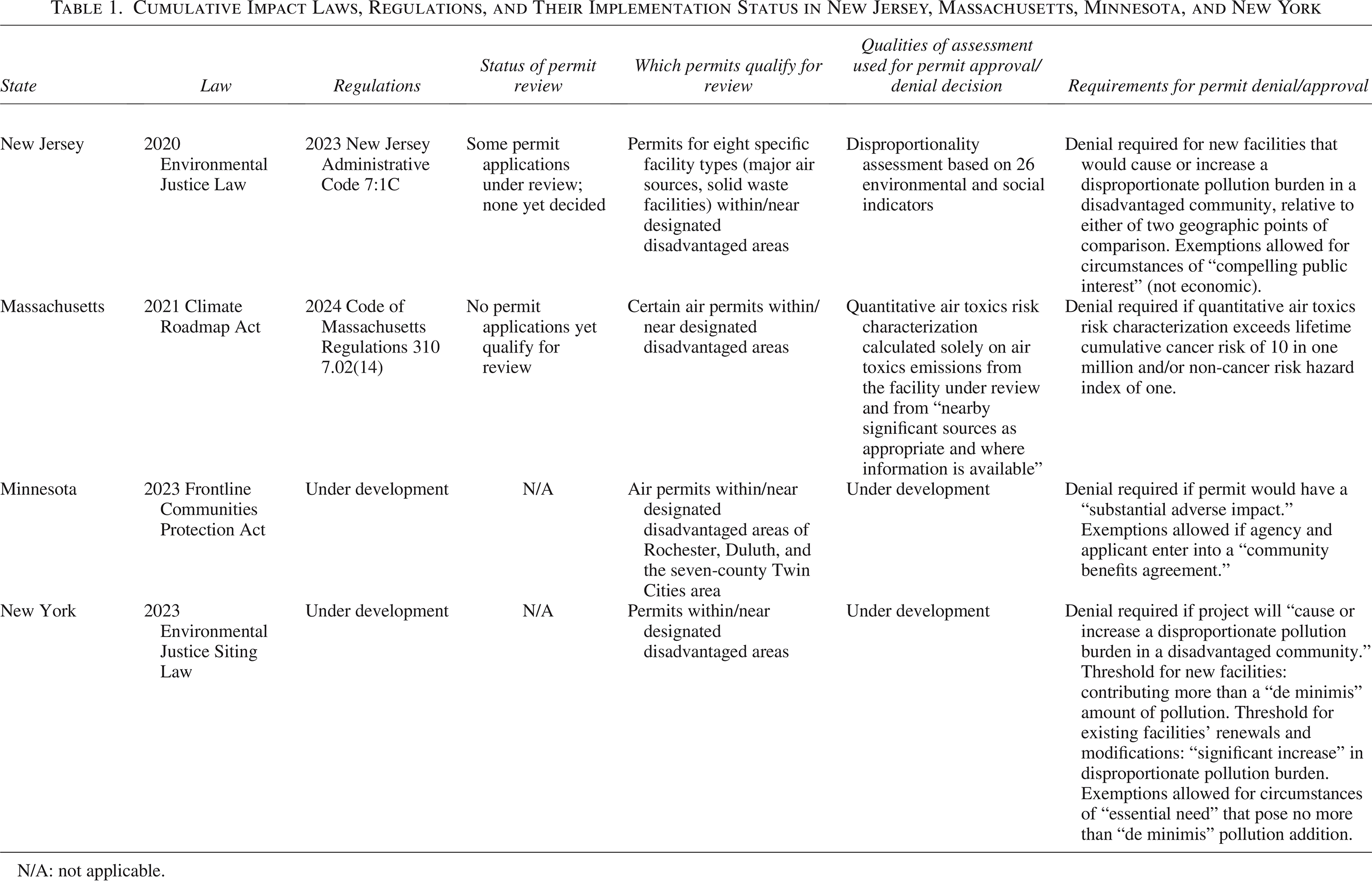
N/A: not applicable.
To identify how these four states’ CI laws and regulations operationalize the PP and how the PP could be further integrated into the regulations and their implementation, we analyzed various relevant sources, including the laws, their regulations, public comment submitted to the agencies and in news articles, EJ organizations’ websites and events, confidential interviews and informal conversations with 28 individuals involved in the development of the laws and regulations (current and former agency staff, grassroots community advocates, professional environmental organization staff, scholars, and one elected official; some occupied multiple such categories over time), agencies’ public engagement events, and dozens of meetings of the U.S. Environmental Protection Agency’s NEJAC and its Cumulative Impacts workgroup (of which the first author was a member from 2020 to 2023).
To analyze our data, we identified aspects of the four cases’ CI laws and regulations that align with, and deviate from, key elements of the PP delineated by Hansen et al. (specified in previous section). We then analyzed our interview notes and field notes to identify how EJ advocates argue that the laws and regulations could more fully operationalize elements of the PP.
FINDINGS: OPERATIONALIZING PRECAUTION WITHIN STATES’ CI LAWS AND REGULATIONS
In this section, we first briefly describe how EJ advocates call for precaution with regard to CI assessment in permit review; then identify how precaution is operationalized within the CI laws and regulations from Massachusetts, Minnesota, New Jersey, and New York; then specify how this can be done more fully to support EJ; and then identify some major challenges facing such objectives.
EJ advocates’ calls for precaution in CI assessment
Raising concerns about technical uncertainties and subjective points of decision making in conventional environmental assessment, EJ advocates argue that agencies must take precaution-based approaches to integrating CI assessment into permit review. Perhaps the most emblematic EJ approach to the PP in CI assessment can be seen in the following statement by Dr. Ben Pauli, EJ scholar-advocate and resident of Flint, Michigan:
A lot of people believe it to be nuts the way that we treat our environment, the way we put things out into the world without actually having good information on the front end about what the likely consequences are going to be.… A precautionary approach is different in the sense that we try to get ahead of these problems. It’s better not to bring the impacts into the world than it is to try to add them up later and rectify them…. One of the things that ultimately communities are striving for is, at the very least, the ability to say no to new projects that even have the potential of worsening impacts: … a precautionary approach …[which] is to say, “Look, we don’t want to take even the risk.… We should have some say over what we want to risk and what we don’t. It’s our quality of life after all that we’re talking about here.” …That’s the holy grail, in some ways, of the environmental justice movement.
Pauli made these comments as an invited speaker at a Minnesota Pollution Control Agency (MPCA) public webinar about developing regulations for Minnesota’s new CI law. Ana Baptista, EJ scholar-advocate and resident of Newark, New Jersey, also served as an invited speaker at another MPCA public webinar about Minnesota’s new CI law rulemaking process, and EJ advocates and regulatory agency staff alike informed us that they have consulted regularly with agency staff and EJ advocates in other states to learn from their CI policy implementation processes. These exchanges reflect the national impact of EJ organizing and research on the development of state EJ laws.
Similarly, the U.S. EPA’s NEJAC has long advocated for the integration of cumulative impact assessment into EPA’s environmental assessment processes, as evident in its 2004 report on the subject. 104 In a 2024 NEJAC report based on years of Council discussion about CIs, one of its key arguments emphasized in the first section is that agencies should “use cumulative impact assessments to reduce disproportionate exposures and impacts in overburdened communities” and, in so doing, should “Prioritize precaution over a high burden of proof of harm.” 105 In the wake of the Trump Administration’s 2025 attacks on federal agencies’ EJ efforts, EJ advocates turned that report into publicly accessible fact sheets, the first of which (titled “Overarching Recommendations for Cumulative Impact Assessments”) flags precaution as one of the four key recommendations. 106
The White House Environmental Justice Advisory Council, formed under the Biden Administration, pressed the broader federal government to address CIs in various ways that also reference precaution as a central recommendation. For instance, its Indigenous Peoples and Tribal Nations Workgroup’s charge was to “Provide recommendations for improving federal policy regarding environmental justice for Tribal communities and Indigenous Peoples as it relates to addressing disproportionately high and adverse human health, environmental, climate-related, and other cumulative impacts, as well as the accompanying economic challenges of such impacts, and underinvestment in housing, transportation, water and wastewater, infrastructure, and health care. The working group’s recommendations will adopt the precautionary principle to first do no harm.” 107
To be clear, while EJ advocacy widely operationalizes the PP, it does not always explicitly use the term “precautionary principle.” One EJ activist who helped advocate for one of the state CI laws in our study said that the PP characterizes everything that she and fellow EJ advocates fight for regarding CIs, which they have been doing for 25 years, although in her experience, the only people who use the PP by name are academics.
Precaution within existing CI laws and regulations
The PP is reflected in certain elements of the CI laws and regulations we examined, in ways strongly advocated for by residents and EJ organizations in public comment. One is that the PP recommends agencies marshal as much currently available relevant data as possible to assess CIs, even if these cannot be quantitatively commensurated. This aligns with PP advocates’ calls for preventing harm in the face of uncertainty. New Jersey’s CI process reflects this. New Jersey requires applicants to evaluate the proposed project’s geographic area in terms of 26 environmental and public health stressors and identify which of those are adverse relative to county and state averages and directs the agency to deny projects that would increase any of those “adverse stressors” in an area whose cumulative number of adverse stressors exceeds that of other areas or that would make the site area’s cumulative stressors exceed those of other areas. 108 This method enables the agency to assess permit applications in light of many types of impacts without trying to commensurate them and honors EJ community members’ concerns about the disproportionate nature of CIs. EJ advocates have been urging MPCA to adopt a similar process in its rulemaking for Minnesota’s CI law.
Minnesota’s CI law also operationalizes this to some extent in another way. Specifically, it allows residents to petition MPCA to require that a facility complete a CI assessment even if the permit application did not exceed MPCA’s impact benchmark (which is calculated with statewide-available data) by flagging other relevant information. Similarly, the law authorizes the MPCA commissioner to require a CI assessment even if the facility falls below the benchmark. These provisions could be a path to account for data gaps, locally specific data, scientific uncertainty, residents’ lived experiences, and other qualitative data. Because MPCA’s CI regulations are still in development, it remains to be seen whether such data will be considered within the CI assessment in ways that could shape permit decisions. New Jersey’s law similarly allows the New Jersey Department of Environmental Protection (NJDEP) to account for such data, as it directs NJDEP to consider not only the CI assessment but also testimony and written comments submitted through the public participation process to determine whether the proposed project would produce a disproportionate impact and thus be denied. 109 The laws also require more robust public engagement practices exceeding typical practice (e.g., holding public hearings in the host community and providing extended public comment periods), which are necessary steps to incorporating community experiences in their permitting processes.
Marshaling all relevant data would also entail using proxies to account for unknown but possible impacts. In other types of environmental assessment, this can include integrating uncertainty factors and regulating chemicals as a class (using evidence about one chemical to make regulatory decisions about others that share a common structure and mode of action). In CI assessments for permit review, this would include using readily available data where they constitute reasonable proxies for unavailable data, such as using residents’ proximity to a hazard (which can be readily estimated) as a proxy for exposure (for which little data exist). This is done for some of the 26 stressors within New Jersey’s process, which embodies precaution because it assumes exposure even in the absence of exposure data.
The PP would also recommend deferring to the most precautionary option in cases of conflicting or missing evidence. This aligns with PP advocates’ calls for preventing harm in the face of uncertainty and shifting the burden of proof onto those who seek to enact potentially harmful projects. New Jersey’s CI regulations reflect this by comparing the stressors impacting the area around the proposed project (existing stressors and stressors added by the proposed project) to multiple “geographic points of comparison”—the county average and the statewide average—and selecting the more health-protective point of comparison for each to determine whether a community is or would be disproportionately impacted by these stressors. During the CI law rulemaking process, NJDEP and stakeholders debated which would be the appropriate geographic point of comparison. In alignment with EJ advocates’ recommendations, NJDEP decided to assess both and defer to whichever is the most health protective. The New Jersey regulations also exemplify this principle by specifying that all stressors are assumed to be adverse unless proven otherwise.
Additionally, the PP would require that all permit applications be subjected to a meaningful alternatives assessment, as PP advocates have long called for,110,111,112,113 and that a permit be denied if safer alternatives exist. New Jersey’s CI regulations operationalize some form of alternatives assessment by requiring that applicants whose projects would pose adverse impact on disproportionately impacted communities demonstrate that the projects are “necessary to serve the essential environmental, health, or safety needs of the individuals in an overburdened community” and that “there are no reasonable alternatives that can be sited outside the overburdened community.” 114 This provision reflects the demands of EJ advocates, who repeatedly and emphatically made these points in public comment. As EJ scholar and advocate Nicky Sheats stated in a memo written based on conversations with many EJ advocates, New Jersey’s CI regulations should apply “the precautionary principle to their operations. In other words, they would have to demonstrate that they have minimized, or eliminated, the pollution they produce by considering all alternatives to the manner in which they operate.” 115
Recommendations for further incorporating precaution into CI policy implementation
Residents and EJ organizations identify additional ways the PP could be integrated into agencies’ CI laws and regulations. First, agencies could do more to marshal as much currently available relevant data as possible to assess CIs, even if these cannot be quantitatively commensurated. For example, although Massachusetts regulations require qualifying applicants to conduct a CI assessment involving 33 social and environmental stressors, that assessment’s influence on agency decisions is nonbinding and thus probably very limited, given that regulated actors consistently challenge any regulatory decision whose basis is not mandated by law. Instead, the regulations only direct the Massachusetts Department of Environmental Protection (MassDEP) to deny a project that would exceed a quantitative “cumulative risk limit,” calculated solely on air toxics emissions from the facility under review and from “nearby significant sources as appropriate and where information is available.” 116 This ignores all other sources and types of air pollution, all other types of hazards, all social stressors, and disproportionality between geographic areas. One community advocate lamented to us that MassDEP’s approach thus violates the PP: “We were advocating for something precautionary, rather than traditional risk assessment.”
This would also entail integrating residents’ observations, other lived experiences, and other qualitative data into permit decisions. 117 In public comment submitted to MPCA, community members argued that, when communities petition MPCA to request a CI assessment of permit applications that would not otherwise meet the requirement to complete one, information should be considered even if it does not appear “scientific”: “It must include an allowance for ‘evidence’ that may not, initially, appear to be relevant from a scientific/technical perspective, but must be taken seriously and looked at to thoroughly understand and ‘translate’ accounts/stories/experiences of residents in order to yield any evidence that could contribute to a cumulative impact of harm.” 118 This would require more robust public engagement to collect residents’ lived experiences relevant to these laws, regulations, and their implementation. Although these laws and regulations include important community engagement provisions, their implementation often falls short. For example, at a CI hearing for a proposed facility extension in New Jersey, several community members expressed frustration about not receiving notice and about the lack of translation to all relevant languages. 119
Second, agencies could do more to defer to the most precautionary option in cases of conflicting or missing evidence, such as by denying permits involving emissions of any pollutant that has no safe level of exposure. One Minnesota community advocate argued that any lead should constitute a “substantial adverse impact,” the basis for permit denial under the Minnesota CI law. This would operationalize precaution because it applies the most health-protective understanding of lead impacts.
Third, agencies could do more to subject all permit applications to a meaningful alternatives assessment. For instance, one public commenter argued that Massachusetts’ CI regulations should include an alternatives assessment for permit renewals so that MassDEP could phase out unnecessary and harmful existing facilities: “The Cumulative Impact Analysis requirements should include a strict analysis of alternatives to polluting activities so that the DEP can focus on phasing out existing polluting sources, not only preventing new ones. We recommend including ‘sunset clauses’ into permits, so that project proponents who are granted permits can plan to cease operations unless they receive a permit renewal. We have effective and clean technologies to power the Commonwealth, and this will help facilitate our shift into a renewable future.” 120
Fourth, PP advocates argue that communities most affected by permitting decisions should get to help decide whether to allow or reject projects with some adverse impacts. This reflects PP advocates’ calls for increasing public participation in decisions about harmful projects. Although all of these laws and regulations include certain community engagement requirements that exceed standard agency practice, none yet give community members formal power to reject permit applications. Democratizing permitting decisions is important partly because members of overburdened communities tend to hold different standards of proof than do regulatory agencies. As one EJ advocate we interviewed lamented about Massachusetts’ CI regulations, “I think we have tried to make an ethics problem a science problem. Communities should have a right to not consent [to harmful projects being sited in their neighborhoods]. Ultimately that is not an issue that science can solve.” In her invited presentation in a MPCA webinar, New Jersey EJ scholar-advocate Ana Baptista argued that MPCA’s determination of the “substantial adverse impact” threshold “is not simply a technical question. That is a political and moral question.… Environmental justice communities must be part of that determination of a threshold. That can’t just be left to technical experts.” Minnesota’s CI law specifies that any project that poses a “substantial adverse impact” in an EJ area could only be approved if the facility enters into an MPCA-approved community benefits agreement (CBA) with the community. As conveyed in many written public comments, verbal comments at agency-convened meetings, and interviews with us, community advocates strongly argue that communities should get to approve or reject any CBA—to determine whether its provisions sufficiently offset the project’s additions to CI—and even whether to engage in negotiation for a CBA. One community advocate we interviewed emphasized that, therefore, MPCA’s CI assessments must be accessible to a public audience—even if that requires sacrificing some analytical sophistication—so that community members can understand and participate in CBA negotiations.
Fifth, integrating the PP into CI laws and regulations would entail denying permit applications that pose any adverse impacts to disproportionately impacted communities. This is the heart of the New Jersey and New York CI laws, and it reflects PP advocates’ calls for preventing harm in the face of uncertainty by assuming that the existing CI in disproportionately impacted communities is already sufficiently harmful that it should not be increased. In contrast, the Minnesota law only requires permit denials for facilities that produce a “substantial adverse impact.” Several public comments argued that there is no acceptable threshold for impact. For instance, one wrote that “The acceptable amount of pollution for kids with asthma, the elderly, and those with lung conditions + heart disease—for all of us—is ZERO.” 121
Anti-regulatory resistance to the PP in CI laws and regulations
CI laws and regulations are being implemented in a context of significant anti-regulatory pressure from industry and political elites. Although input from regulated actors is important in regulatory decision making, scholars have shown that environmental regulatory decisions disproportionately reflect industry’s focus on generating profit over the needs of communities impacted by industrial projects, as industry uses its economic power to capture elected officials and regulatory agencies in many ways.122,123,124,125,126 Industry uses discursive pushback to narrow the scope of CI laws and regulations as they are being developed, as exemplified in public comments about MPCA’s CI draft bill and rulemaking. During bill negotiations, industry actors pressured policymakers to limit permit denial to cases of “substantial adverse impact,” whereas EJ advocates had called for following New Jersey’s language of (any) “adverse impact.” Claiming that conducting CI assessments and associated project delays would be prohibitively costly, the Minnesota Chamber of Commerce argued during the rulemaking process that MPCA needs to provide consistent (statewide-available) data to make the process as easy for industry as possible. 127 However, doing so would preclude locally specific data that are important for characterizing the CIs around proposed projects, and it also implicitly claims permission to pollute. 128 Industry actors also framed CI analysis as necessary only when the proposed project itself would have a substantial adverse impact—that is, irrespective of the already existing environmental hazards and stressors. As the Minnesota Building and Construction Trades Council argued, “We urge MPCA to draft the benchmarks narrowly, triggering a mandatory cumulative impacts analysis (CIA) only in discreet, well-defined situations where it is very likely the permit action at issue would have a substantial adverse impact.” 129
Anti-regulatory actors also use the courts and executive policy to formally undermine agencies’ abilities to address CIs. Some states’ CI laws and regulations are already subject to industry lawsuits.130,131 The June 2023 U.S. Supreme Court ruling banning affirmative action in higher education could limit agencies’ abilities to consider race as a proxy for racism within environmental assessments, thus undermining CI assessments’ accounting of social stressors affecting community health and well-being. 132
Following his January 2025 executive orders banning all “EJ” work in the federal government, in April 2025, President Trump issued an executive order directing the U.S. Attorney General to take action to stop the enforcement of all state-level laws addressing climate change, EJ, and more, an order that legal scholars decry as unconstitutional.133,134,135 Although the legal merit and consequences of these lawsuits, federal court rulings, and executive orders for states’ CI laws and regulations are contested and not yet determined, such attacks likely neuter states’ CI regulations by making agency staff implement laws and regulations narrowly to minimize retaliation from regulated industry and anti-regulatory elites, especially given that state agencies are tasked with enforcing many federal laws and regulations. 136
CONCLUSIONS
We have identified elements of these CI laws and regulations that put the PP into practice (albeit incompletely), and how they could do so more effectively. Some of these CI laws and regulations reflect precaution in ways that support EJ by marshalling as much currently available relevant data as possible to assess CIs, even if these cannot be quantitatively commensurated; deferring to the most precautionary option in cases of conflicting evidence; and subjecting permit applications to alternatives assessment. We also demonstrated how these laws and regulations could operationalize precaution more meaningfully by putting those principles into practice in additional ways, as well as by allowing communities most affected by permitting decisions to help decide whether to allow or reject projects with some adverse impacts and denying permit applications that pose any adverse impacts to disproportionately impacted communities. Finally, to help explain why these laws and regulations have fallen short of community advocates’ demands, we identified some of the techniques through which industry actors and anti-regulatory political elites have circumscribed agencies’ abilities to redress CIs in precautionary ways.
We hope this article will help prompt further conversation and specification about how such laws and regulations could be developed to more meaningfully operationalize precaution and support EJ. That said, EJ will ultimately require much more than the reforms we recommend here. Additionally, agencies’ implementation of these laws and regulations will require scrutiny for how well they support precaution and EJ.
AUTHORS’ CONTRIBUTIONS
J.L.H.: Conceptualization, formal analysis, funding acquisition, investigation, methodology, project administration, resources, supervision, writing—original draft, and writing—review and editing. A.H.: Conceptualization, formal analysis, investigation, methodology, writing—original draft, and writing—review and editing.
Footnotes
ACKNOWLEDGMENTS
The authors sincerely thank their research participants for sharing their experiences and insights. The article was further strengthened by the thoughtful comments of the anonymous reviewers; feedback at the 2025 American Association of Geographers annual meeting in Detroit, Michigan; and time for reflection provided by a writing retreat at the Sitka Center for Art and Ecology. All errors are the responsibility of the authors.
AUTHOR DISCLOSURE STATEMENT
The authors have no conflicts of interest to disclose.
FUNDING INFORMATION
This research was supported by the University of Colorado Boulder and the National Science Foundation (2240660).