




Abstract
INTRODUCTION
Global prison trends
On any given day, 11.5 million people are incarcerated worldwide. 1 Women make up 6.9% of the global prison population, with a 60% increase over the past 20 years compared with 22% for men. 2 Approximately one-third of all people in prison are in pretrial detention, disproportionately affecting women due to poverty. 3 Marginalized groups—Indigenous, religious, racial, and ethnic minorities—are consistently overrepresented. 4 Prison overcrowding remains a critical challenge worldwide, with some facilities operating at >400% capacity under inhumane conditions. 5 This exacerbates the already poor infrastructure, sanitation, staffing, health care, and emergency response systems. 6 Climate change amplifies the impacts of pre-existing inequalities already present in custodial settings, further increasing the risks to prison systems and populations. 7
Consequences of climate change worldwide
Human-caused climate change is increasing extreme weather events, resulting in widespread harm to ecosystems and communities, especially those who have contributed the least to global emissions. 8 There is a notable rise in climate-related food-, water-, and vector-borne diseases and mental health issues linked to environmental degradation. 9 These impacts intensify food and water insecurity, particularly in Africa, Asia, Latin America, the Arctic, and among Indigenous and low-income communities. Climate change undermines progress toward the United Nations (UN) 2030 Sustainable Development Goals (SDGs), especially SDG3, SDG6, and SDG13. 10 Despite international treaties such as the Kyoto Protocol and Paris Agreement, places of detention remain largely excluded from climate adaptation efforts. 11
Response to climate change and natural hazards: A human rights-based approach
Climate change threatens multiple internationally protected human rights. The UN Climate Change Implementation Plan (2022) calls for rights-based action on climate, food, and water security. 12 The Nelson Mandela Rules set global standards for humane prison treatment. 13 In July 2023, a UN meeting of >40 member states emphasized the need to address climate impacts on prisons. 14 Yet, most countries lack binding policies addressing prison-specific climate risks. 15 Adaptation remains reactive, leaving prisons exposed. The UN Office of the High Commissioner for Human Rights urges priority for vulnerable groups, including incarcerated individuals. 16 This necessitates coordinated action from prison authorities and civil society to implement sustainable, proactive responses. 17
Impact of climate change on prisons
Prisons in low- and middle-income countries face heightened risks from heatwaves, floods, and water scarcity. Incarcerated populations, who rely entirely on the State, face disproportionate threats to health and safety.18,19,20 Due to stigma, they are often deprioritized during emergencies. 21 Poor infrastructure and lack of investment in essential services exacerbate the spread of climate-sensitive diseases. 22 Prisons in high-incarceration, high-risk areas should be prioritized for public health interventions. 23 Further impacts relate to varying climate-related exposures, for example, the increasing threat of extreme heat in the United States, in particular in the absence of air-conditioning. 24 Heat exposure varies by demographics and facility. Elevated risk in unexpected regions, such as the Pacific Northeast and Northwest, has been reported for correctional facilities housing higher proportions of non-White and Hispanic individuals disproportionately affected. 25 These studies highlight the importance of quantitative analyses to contextualize prison vulnerability to climate-related exposures.
Despite growing awareness, prisons remain excluded from national climate strategies. 26 Funding gaps, weak political commitment, and societal marginalization limit emergency preparedness. 27 Findings from a scoping review on disaster risk reduction and emergency management in prisons highlight the deeply embedded perceptions and deprioritization of people in custody, “We don’t really want to look after prisoners, even though we could, as we only have a certain amount of staff.” 28
In 2025, UN Interregional Crime and Justice Research Institute and Penal Reform International released Green Prisons: A Guide to Creating Environmentally Sustainable Prisons, outlining the following five core strategies: policy commitment, sustainable infrastructure and energy, waste management, green rehabilitation programs, and water/food systems. 29 Our study builds on this by conducting a global e-Delphi consensus to define best practices for sustainable prison management amid climate risks. The goal is to foster international dialog, inform domestic responses, and promote proactive planning, risk reduction, and knowledge-sharing across correctional, health, and climate sectors.
METHODOLOGY
This study adopted the e-Delphi method, an approach that gathers input from international multidisciplinary substantive technical experts through several rounds of surveys. It is a structured consensus building process that incorporates a diverse range of perspectives across disciplines and geographic areas. This method works well for topics where empirical evidence is either limited or emerging, making it well-suited to this study’s objective to elicit expert opinions on best practices for promoting sustainability and mitigating climate change and natural hazard effects in custodial settings. 30
Design of the global e-Delphi
A global e-Delphi consensus study was conducted using an iterative online survey approach to gather expert opinions on best practices for promoting sustainability and mitigating climate change and natural hazard effects in custodial settings. 31 It is well-recognized that recruitment for Delphi studies can be challenging due to participant time commitment in completing each round of the Delphi study. 32 The size of Delphi panels can range widely. 33 The International Corrections and Prisons Association’s (ICPA) network of 4200 professionals received an invitation to submit an electronic expression of interest (EOI) via Qualtrics. Respondents signed a commitment to participate in two rounds. The diverse panel included prison officials, policy makers, health providers, academics, and people with lived experience, aligning with the Core Outcome Measures in Effectiveness Trials methodology. 34
Ethical approval for this study was granted in July 2024 by the University of Wollongong Human Research Ethics Committee (2024/114). Informed consent was obtained online, and participant data were securely stored and anonymized. Participation was voluntary, with the option to withdraw at any point.
Survey development and consensus criteria
The survey asked participants to rank 40 statements on a 9-point Likert scale (1 = low priority; 9 = high priority). The statements were developed based on evidence gathered from a rapid scoping review of peer-reviewed articles and grey literature. Rapid reviews are a form of information synthesis that aim to produce information in a timely manner by simplifying or omitting components of a systematic review. 35 Findings from the rapid review were used to inform key concepts, recurring themes, and gaps in research, policy, and practice.
The 40 statements were grouped under seven dimensions: climate principles; planning and infrastructure; partnerships and resources; disaster response; health impacts; sustainable development; and innovation. Additional suggestions could be submitted via free-text fields.
A consensus was predefined as ≥70% of participants rating a statement 7–9 and <15% rating it 1–3—consistent with established Delphi thresholds. 36 Data were analyzed using IBM SPSS Statistics (version 27). To limit attrition and bias, this study used two rounds, 37 a standard Delphi practice despite >70% of studies not relying on the consensus as a stopping rule 38
Panel participation and rounds
Of 142 confirmed EOIs, 102 participants completed Round 1. They rated the 40 statements, with 39 meeting the consensus threshold. Based on feedback from 26 participants, 10 new statements (7 original, 3 split from previous statements) were added for Round 2, resulting in 50 total statements (as shown in Fig. 1).
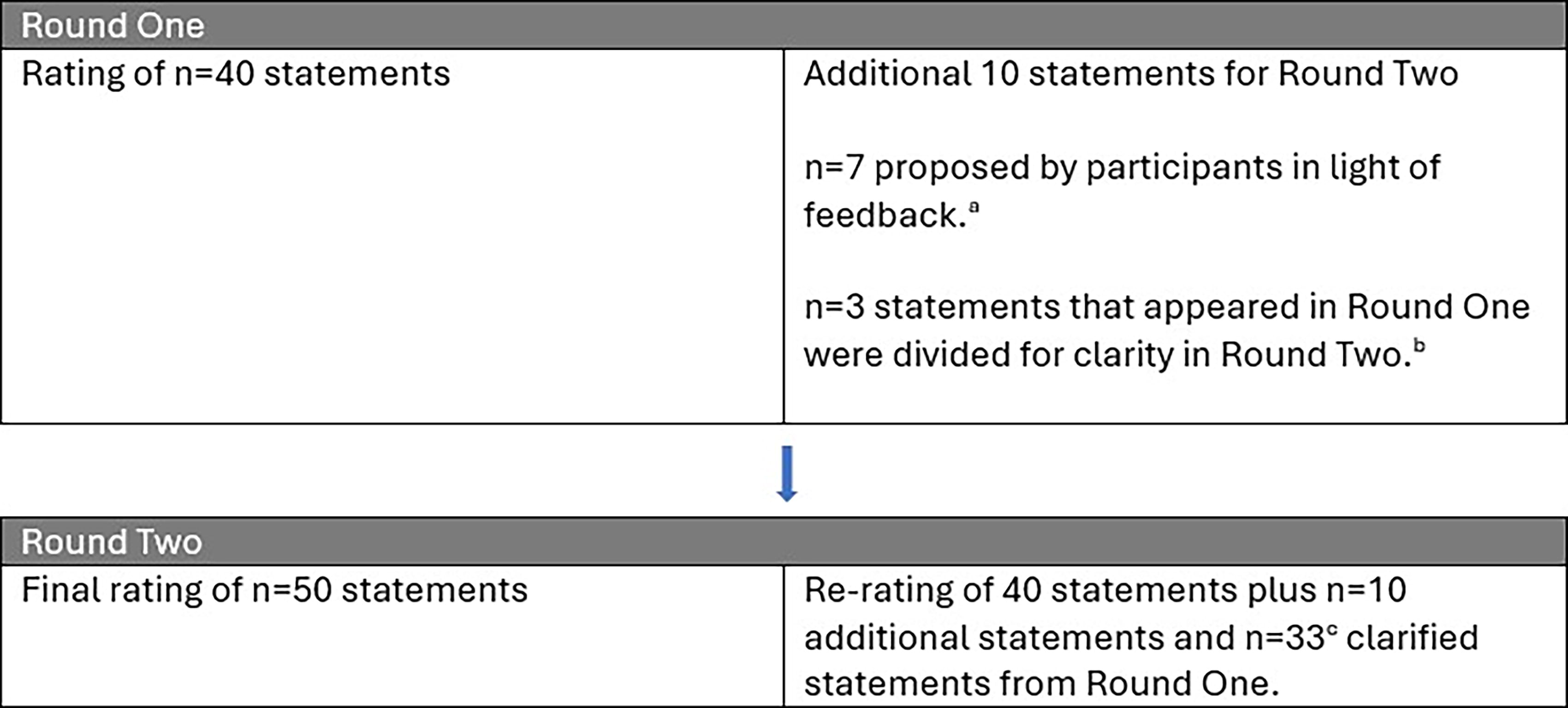
Flow diagram. aNew statements added in Round 2: 1, 5, 12, 14, 24, 38, 49; bRound 1 statements divided into two for Round 2: 13, 23, 39; cClarified statements in Round 2: 1–9, 11–13, 15–20, 22–29, 31–32, 34–35, 38–40. n = 8 statements remained unchanged between Rounds 1 and 2: 10, 14, 21, 30, 33, 36–37.
In Round 2, the 102 Round 1 participants received individualized results and were asked to reconsider their ratings. After 14 days and three reminders, 81 participants completed the round. Ultimately, 49 of the 50 statements reached the predefined consensus threshold (as shown in Table 1).
Round 1 and Round 2 Statements
S1 refers to the corresponding statement of Round 1, where the order may have changed between the rounds. S2 and S3 refer to where statements from Round 1 were combined for clarity. (new) refers to a new statement devised from Round 1 feedback.
Source: Created by authors.
This study is the first to consult stakeholders from internationally diverse backgrounds to consider best practices for sustainable prison management in the context of climate change and natural hazards.
Procedures
Specific decisions were made during data cleaning and analysis to ensure consistency. Age was rounded to the nearest whole year, and where participants provided a range, the mid-point was used. Age was reported as the mean and standard deviation. For years of practice, responses indicating values greater than a certain threshold (e.g., “>10”) were truncated to the minimum stated value. When both years and months were reported (e.g., “10 years 9 months”), values were rounded up to the nearest year. Country names were standardized; “United States of America” and “United States” were recorded as “U.S.,” while “United Kingdom” was changed to “U.K.” References to specific regions or facilities such as “Somalia Puntland state” and “Garowe city prison” were simplified to “Somalia.” Participants listing multiple countries or indicating international work were grouped under the label “global.”
RESULTS
Profile of participants
In Rounds 1 and 2, the majority of participants were male (62% and 50%, respectively). The mean age in Round 1 was 48 years and 50 years in Round 2. The most commonly represented regions were East and Asia Pacific, Europe and Central Asia, Sub-Saharan Africa, and North America, with the least representation in Latin America, the Middle East, and North Africa and South Asia. A proportion remained unspecified (7% in Round 1; 4% in Round 2). The most represented countries in Round 1 were Australia, the United States, and Namibia; yet, in Round 2, they were Australia and Namibia. High-income countries were the most represented (34% in Round 1; 36% in Round 2), followed by lower-income countries (24% in Round 1; 23% in Round 2) and lower-middle and upper-middle countries. Participants ranged from a diverse background of different roles in the prisons and corrections field, particularly advocacy and civil society, education and vocational training, and researchers, with the highest proportion working as policy makers (28% in Round 1 and 40% in Round 2). Participants with lived experience of imprisonment were among the smallest groups represented (8% in Round 1 and 7% in Round 2) (as shown in Table 2).
Patient Demographics
Source: Created by authors.
Delphi Round 1 results
One hundred and two participants completed Round 1, representing 72% of those who initially expressed interest (n = 142). Moreover, 39 of the 40 statements (97.5%) met the preset consensus threshold, with an average agreement level of 84%. All statements in Dimensions 1, 2, 3, 4, 6, and 7 reached the consensus (as shown in Table 3).
Likert Scale Scores for Round 1
Dimension 1: Climate change and natural hazards—principles
Four statements exceeded the 80% consensus, emphasizing international standards, human rights frameworks (87%), political and legal endorsement (83%), inclusion of incarcerated individuals (83%), and SDG alignment (82%). The remaining statements scored >70%.
Dimension 2: Disaster preparedness, planning, and infrastructure
Six statements scored >90%, two just <90% (i.e., 88% and 89%), and one at 82%, reflecting strong support for infrastructure resilience, planning, and preparedness.
Dimension 3: Partnerships, capacity building, and resources
All statements exceeded the 80% consensus, with two >90%, highlighting the need for collaboration, capacity development, and equitable resource allocation.
Dimension 4: Disaster response
Three statements scored ≥90%, with three others close behind (89%, 83%, 81%), supporting effective contingency planning and intersectoral coordination.
Dimension 5: Health-related impacts of climate change
Two statements surpassed the 90% consensus, while most others exceeded 80%. One statement on eco-anxiety scored only 55%, falling below the threshold. This may suggest that mental health concerns are not yet viewed as priority in this context.
Dimension 6: Sustainable development approaches
All three statements reached the >80% consensus, indicating broad support for sustainability and environmental stewardship in prison systems.
Dimension 7: Evaluation, research, and innovation
Four statements exceeded the 80% consensus, supporting the involvement of prison staff in planning and post-disaster review, the creation of monitoring tools, international knowledge-sharing, and global research collaboration.
Qualitative feedback
Participants provided 188 comments (avg. five per statement), with 26 participants contributing. A technical error in Statement 9 prevented free-text input. The feedback informed the refinement and development of 10 new statements (7 original, 3 split from previous statements) across Dimensions 1, 2, 3, 5, and 7.
Delphi Round 2 results
Eighty-one participants completed Round 2, yielding a 79% retention rate from Round 1 (n = 102). Of the 50 statements assessed, 49 (98%) reached the preset consensus threshold, averaging 90% agreement. All statements in Dimensions 1, 2, 3, 4, 6, and 7 met the consensus. Only one—Statement 41 (previously amended Statement 33 in Round 1) within Dimension 5—did not, receiving 64.2% agreement. Despite improved support from Round 1 (55.3%), views were polarized: 64% rated it the highest priority, and 4% rated it the lowest. This limited its inclusion in the final conclusions (as shown in Table 4).
Likert Scale Scores for Round 2
S1 refers to the corresponding statement of Round 1, where the order may have changed between the rounds. S2 and S3 refer to where statements from Round 1 were combined for clarity. (new) refers to a new statement devised from Round 1 feedback.
Source: Created by authors.
Dimension 1: Climate change and natural hazards—principles
All six statements met the consensus, with four >90%. The key themes included recognizing prisons as part of communities, context-specific policies rooted in human rights and SDGs, and leadership-led responses independent of political support. The highest-rated statement (95%) emphasized an equitable vision of well-being. A new, highly rated statement (93.8%) called for prisons to be viewed as integral parts of the community, not isolated entities, within the official strategic response to climate change.
Dimension 2: Disaster preparedness, planning, and infrastructure
All 12 statements exceeded the 90% consensus, reflecting strong agreement on infrastructure resilience, supply chains, architectural design, and water, sanitation, and hygiene. A new top-rated statement (97.5%) highlighted the role of assessments in driving mitigation. Other high-scoring areas included contingency planning (96.3%) and routine infrastructural reviews.
Dimension 3: Partnerships, capacity building, and resources
All six statements met the consensus. Three scored >90% (92%–93%), and three >80% (84%–86%), emphasizing the need for collaborative partnerships, adequate funding, and equitable resource allocation aligned with rights-based approaches.
Dimension 4: Disaster response
All seven statements met the consensus, five of which exceeded 90%. The highest-rated statement (95.1%) supported tailored, disaster-specific contingency plans. Slightly lower-scoring statements (88.9%) related to intersectoral coordination and regular stress testing.
Dimension 5: Health-related impacts of climate change
Nine out of ten statements met the consensus. The outlier, addressing eco-anxiety in prisons, remained below the threshold at 64.2%. Six statements surpassed 90%, with the highest (95.1%) emphasizing disease outbreak preparedness. Others highlighted continuity of care, immunization, regional adaptation of standards, and climate-sensitive health monitoring.
Dimension 6: Sustainable development approaches
All three statements reached >80% consensus. One (92.6%) strongly supported sustainable practices aligned with SDGs, including renewable energy for water, climate control, and cooking.
Dimension 7: Evaluation, research, and innovation
All six statements exceeded 80% consensus: four surpassed 90%, including the top-rated statements (97.5%) on developing adaptive policies informed by successful mitigation. Other high priorities included staff involvement in recovery, cross-jurisdictional learning, and research into climate-health impacts.
Qualitative feedback
Sixteen participants contributed 85 comments via open-text boxes, averaging two comments per statement, enriching interpretation and contextual insights.
DISCUSSION
This is the first global e-Delphi consensus study that identifies and defines core climate action components on the international best practice to promote resilience, sustainability, and safeguard prisons and prison communities against the consequences of climate change. Building the resilience of prisons to respond to crises is considered both a moral obligation and necessity. 39
Our results indicate that the ICPA experts participating in the e-Delphi method hold a strong consensus on what key components/outcomes and best practices should be implemented to achieve an effective response to climate change and natural hazards spanning strategies before, during, and after climate events (as shown in Fig. 2). Notably, throughout both rounds in the e-Delphi method, no substantive shift in the consensus was observed, as it related to the core Climate Change and Natural Hazard principles. The core principles centered on prisons as integral parts of the community and not isolated entities; an equitable vision including well-being, international human rights standards, and SDGs; broad political support; correctional leader-led responses independent of support; and imprisonment as a last resort. These are widely recognized in the literature as essential components of an effective response to climate change in closed settings, supporting a collaborative public health response, re-framing of prisons as part of society, promoting social and environmental justice, fostering political and institutional commitment, correctional leadership, and the urgent need for decarceration. 40 These principles align with broader climate action frameworks; yet, they require context-specific implementation strategies to navigate the unique challenges of closed settings, ensuring climate resilience beyond infrastructure to include systemic reform, equity, and sustainability.
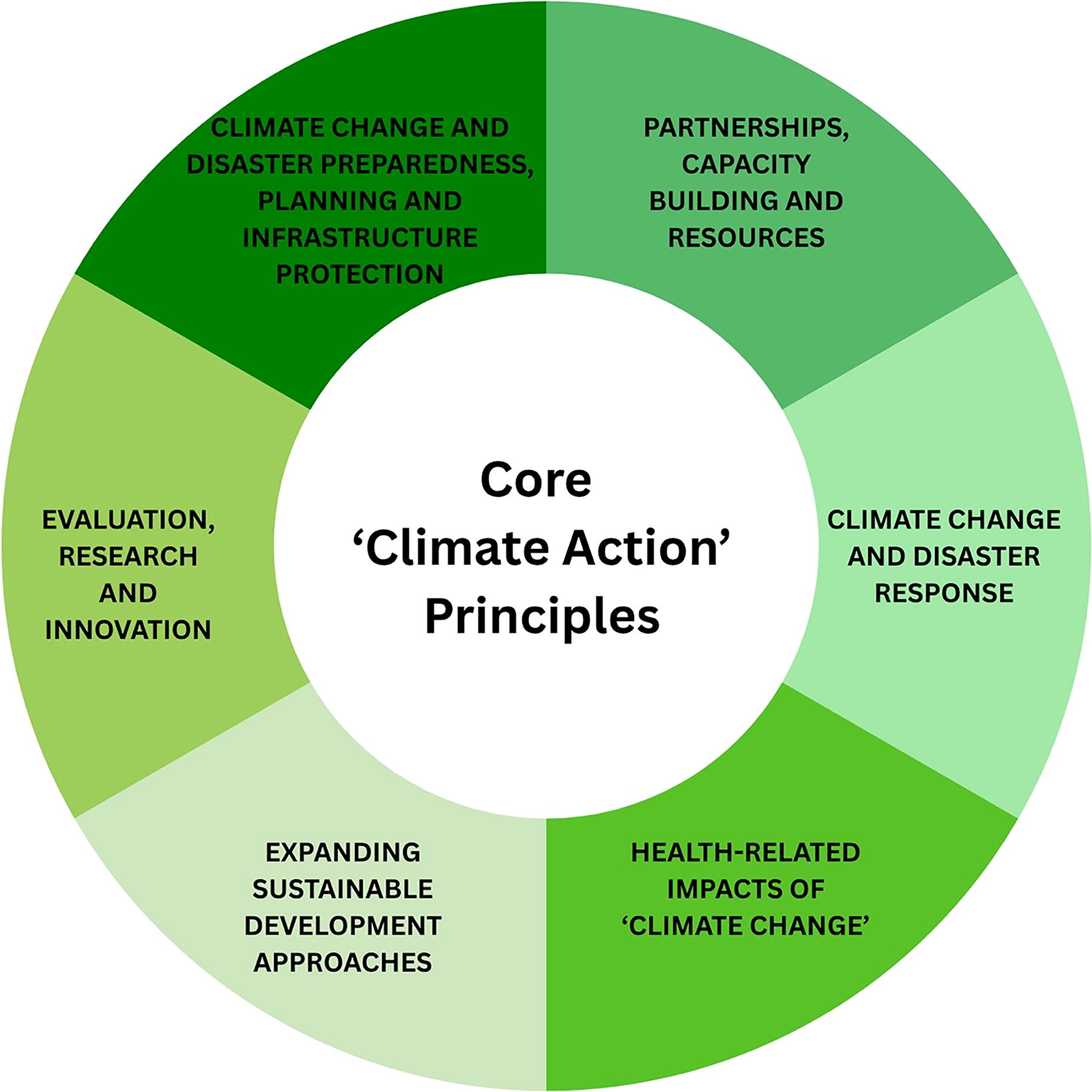
Effective climate action. Depicting the core climate action principles regarding prisons, spanning climate change and disaster preparedness, planning, and infrastructure protection; partnerships, capacity building, and resources; climate change and disaster responses; health-related impacts of climate change; expanding sustainable development approaches; and evaluation, research, and innovation.
There was a strong and consistent consensus in relation to the critical nature of collaborative approaches to disaster and climate impact preparedness, planning, and infrastructure protection and the importance of long-term sustainability. The meaningful involvement of lived experience in risk assessments in addition to communities and key experts is critical for effectiveness. 41 Consideration of the physical design of prisons is fundamental to identifying the vulnerability for people living and working in prisons, as is the inclusion of prisons in public health intelligence such as remote sensing climate mapping tools to inform decision making may incur better climate action outcomes. 42 Above all, it is suggested that the most sustainable prison is, in fact, the one that is never built. 43
A slight shift between the rounds toward the consensus was observed regarding partnerships and capacity building, particularly active participation from all members of the prison community from prison policy development to program implementation and other public sectors. 44 This aligns with the existing literature advocating that people in closed settings are routinely prevented from protecting themselves due to their reliance on institutional staff, structures, and practices that are mostly out of their control. 45 Further evidence suggests that the intrinsic capacities of people in closed settings may be underutilized, leading to exclusion from decision making or identifying and leading solutions during disasters. 46 While no substantive shift was noted between the rounds in relation to specialized education and training for all those living and working in prison, expert agreement was evident regarding an integrated approach including both agencies and people living and working in prisons, fostering unity and collective responsibility. 47 The existing evidence suggests that people in prison supported response efforts post an earthquake event, including food preparation for humanitarian works and volunteering, rebuilding homes, clearing debris, first-aid support, informal counseling to other people in prison, and fundraising. 48 However, consideration must be given to policies that include the force serving the public across the disaster life cycle, such as firefighting, ensuring the protection and well-being, appropriate compensation, and ongoing assessment of medical needs, as their involvement often places them at higher risk.49,50
Our findings, from a global perspective, complement existing research related to domestic and regional disaster preparedness in custodial settings. For example, one study examining U.S. correctional facilities identified significant gaps in planning, resource allocation, and staff training, which limited institutional resilience during climate-related disasters. 51 Participants in our sample of international multidisciplinary substantive technical experts supported the need for context-specific leadership and interagency collaboration opportunities and policy reform. This highlights the need for ongoing cross-jurisdictional research to identify best practices and lessons learned to inform contextually tailored interventions.
In relation to climate change and disaster response, the experts also agreed on the critical need to improve cross-sector coordination, with a notable shift toward the consensus between the rounds. This aligns with a body of literature that supports the critical need for enhanced emergency response planning, including practice drills. 52 A clear communication strategy to ensure regular, transparent updates for people in closed settings and their families was perceived by the experts as very important, with a strong shift toward the consensus noted between the rounds. The existing literature supports clear communication as critical in reducing anxiety and psychological trauma during periods of heightened vulnerability. 53
This e-Delphi study underscores the need for inclusive health care services to be prepared and carefully consider various aspects from disease outbreaks to immunization services in addition to identifying and supporting the diverse and specific needs of priority populations. This shared perspective among the experts aligns with the literature emphasizing the amplification of health risks and conditions among priority populations during disasters and the increased risk of climate-related harms given the disproportionate burden of mental ill-health, substance use, disability, women and children, older persons, and ethnic and Indigenous minorities who require tailored, culturally sensitive care and support. 54 A marked increase toward the consensus in relation to the monitoring and surveillance of climate control was observed among the experts between the rounds, underscoring the critical importance of responding to extreme, fluctuating temperatures. 55 Of note, there was a consistent failure across both the rounds to achieve a consensus regarding the critical nature of recognizing and responding to eco-anxiety to mitigate the psychological and mental health distress of climate change. 56 This likely reflects the lower prioritization of the psychological well-being of prison populations, particularly in comparison with other climate-related concerns.
The experts also agreed on promoting sustainable practices aligned with the SDGs, with a key focus on renewable energy for power, heating and cooling systems, sustainable cooking facilities, and clean water access. A consensus was evident regarding the collective support for the importance of educational and vocational training opportunities for the prison community on agricultural practices, food production waste disposal practices and promote, consistent with previous research. 57
The experts widely endorsed evaluation, research, and innovation, with a shift toward a greater consensus visible between the rounds regarding broader involvement in recovery and accountability processes, the development of indicator and performance tools, and lessons learned. 58 While the importance of further research was acknowledged, a strong shift toward the consensus between the rounds was observed in relation to sharing best practices, suggestive of the value of global, cross-sector learning. 59
LIMITATIONS AND STRENGTHS
Strengths of this e-Delphi study center on the composition of our e-Delphi panel of experts drawn from a global network of prison experts (advocates, persons with lived experience, staff, policy makers, researchers) from different regions of the world and from countries with differing and development/income levels. A similar approach has been taken in other e-Delphi studies in the prison and correctional space 60 and is aligned with the recommended best practices in conducting an e-Delphi study and in order to minimize recruitment bias. 61 There was also a relatively strong commitment to complete both rounds.
We identify several limitations; yet nonetheless, the e-Delphi method was still valuable for capturing a consensus of statements across disciplines and locations. A key limitation includes the low uptake from Latin America and the Caribbean, and the Middle East and North Africa. In addition, while the composition of the panel mostly included professionals with subject-matter expertise across both rounds, a significant limitation was recognized in that people with lived experience of incarceration were underrepresented despite being essential experts in this context. Given the limited participation of formerly or currently incarcerated individuals, this perspective was underrepresented in this study, reflecting broader systemic biases in whose knowledge is considered expertise. Furthermore, while our study cites the “empowerment of correctional leadership” as an essential component in advancing climate change responses, this contrasts with some existing studies that emphasize that leadership frequently acts as bottlenecks that constrain innovation and accountability, limiting the scope of measures that could protect those incarcerated. Due to the underrepresentation of those formerly incarcerated in our study, we acknowledge this point as a limitation and one that warrants centering future research on the voices and experiences of people with lived experience, who may frame correctional leadership differently.
Another limitation includes the potential introduction of bias via the inclusion of mostly positive statements. This may be perceived as limiting the expression of divergent or critical views; however, Delphi studies aim to generate a consensus around the best practice, in this case on the international best practice to promote resilience, sustainability, and safeguard prisons and prison communities against the consequences of climate change. Hence, why the statements are largely in the positive, as the aim was to establish standards rather than to conduct a survey to unpack challenges. Furthermore, it was beyond the scope of this study to weight expert perspectives by national incarceration rates or climate vulnerability given that Delphi studies do not weight, rather they generate a consensus at the global level. This may underrepresent perspectives from the countries most impacted. Lastly, the existing literature has argued that incarceration itself undermines climate-related resilience, where abolition emphasizes decarceration as a protective climate resilience strategy. 62 Consistent with this perspective, the experts in our study endorsed that efforts to keep pretrial detention and imprisonment to a measure of last resort should be prioritized to reduce overcrowding to minimize the effects of climate change. While this perspective was not a key focus of our study and may be considered a limitation, future research should gather perspectives from abolitionists and people with lived experience of incarceration.
CONCLUSION
Addressing sustainability and resilience in prisons and other custodial settings is essential to ensuring equitable climate action. Policies, standard operation procedures, capacity building, and partnership efforts based on the dimensions highlighted in this e-Delphi study should be adapted into national contexts and include aspects of contextually appropriate emergency preparedness planning, structural integrity assessments, and hazard risk management through coordinated, interdisciplinary, and multidisciplinary actions to improve the global response to climate change in prisons. By leveraging the insights generated from this e-Delphi study and advancing knowledge in the field, policy makers, practitioners, and stakeholders may enact meaningful change and advance the sustainability agenda within such closed settings globally.
Footnotes
AUTHORS’ CONTRIBUTIONS
I.C. and M.C.V.H. were responsible for the conceptualization and design of the study, project coordination, data collection, data analysis, and review and editing prior to submission. R.B. was responsible for ethics, design of the study, project coordination, data collection, data analysis, writing of the original draft, and review and editing prior to submission. R.M. was responsible for design of the study, project coordination, data collection, data analysis, and review and editing prior to submission. M.B. was responsible for the design of the study, data collection, data analysis, and review and editing prior to submission. T.R. was responsible for the design of the study, data collection, and review and editing prior to submission. A.D. was responsible for the design of the study, data collection, and review and editing prior to submission. L.P. was responsible for the design of the study and review and editing prior to submission.
AUTHOR DISCLOSURE STATEMENT
No competing financial interests exist.
FUNDING INFORMATION
No funding was received for this article.