




Abstract
Energy justice has garnered more attention within educational settings due to the relevance it has to students’ environments. Recent events such as the power grid failure that occurred in Texas in 2021 have also facilitated these classroom discussions as most students witnessed these events take place on national television. Although energy justice has been integrated in many scientific courses such as environmental science and studies, it is still not as present within physics classrooms. Energy is a fundamental core concept that is taught in the physics curriculum, yet the physics concept of energy focuses more on conservation of energy, energy efficiency, and work. Therefore, it is harder for physics to cohesively connect energy justice to these theories. Additionally, the current political debates are making it harder for physics teachers to consider teaching about energy justice in their classrooms. However, there are physics educators who are highly motivated to teach about energy justice in their classrooms. To identify the main motivators that are pushing physics educators to be inspired to integrate energy justice in their physics classrooms, we interviewed 13 physics educators. Their responses identified three main motivators that inspired them to incorporate energy justice, especially in their energy unit. These three motivators include disproving that physicists do not care, addressing economic disparities, and prioritizing climate change in their curriculum.
INTRODUCTION
Energy justice is a component of social justice, and both have drawn attention from educators and teachers across the country. 1 This is because both energy and social justice can teach students the fundamental ideologies of respect and dignity, encouraging them to think about human rights and social change critically.2,3 Through the development of caring relationships and the creation of democratic spaces, students can develop their own understandings of inequities and acquire the skills to act within and beyond the classroom. 4 The skills and understanding students acquire and develop because of social and energy justice embedded in their curriculum are essential to striving for a just and equitable society in the future. At the nexus of social justice and energy justice, students can critique the cultural and environmental factors that result in the distribution of energy services, impacts, and pollution. 5
Developing critical skills of this nature is essential for students as it prepares them to be able to fully comprehend concepts as opposed to just memorizing them. 6 This means that students developing critical skills is not just important outside of the classroom but also within the classroom. Particularly, in physics education, critical skills can help students be successful within all levels of physics—from secondary-level physics to university-level physics. 7 This is because, to solve physics problems, critical thinking skills are an asset for physics students to be successful in this type of theoretical questioning. 8 However, despite the evidence that social and energy justice education helps make students more successful in physics classrooms because it enhances their critical thinking skills, there is still an ongoing political debate that targets all school disciplines. Political controversies surrounding the integration of energy and social justice in the classrooms have increased during the past decade due to the ongoing debate on whether the “critical race theory” should be integrated in the K–12 educational system.
POLITICAL CONTROVERSIES AGAINST ENERGY JUSTICE EDUCATION
Political controversies have ignited from misinformation and fear that has been spread across the nation, especially surrounding what they refer to as “critical race theory.”9,10
Topics and discussions that bring forward social and energy justice into the classroom have been framed as being anti-white.11,12 This is because conservative actors are distorting the motivations behind teaching about past injustices that continue to sustain racism in our current society under this disguise. This distortion of what the “critical race theory” is and why it should not be integrated into the classroom shifts the focus away from the benefits students gain. As previously discussed, when students learn about energy and social justice, they develop critical thinking skills. 13 Unfortunately, these conservative political discussions have resulted in several local, regional, and national policies being passed that prevent the teaching of social and energy justice as well as other topics that are considered a part of the “critical race theory.”14,15
However, although these debates impact some educators, most physics educators also find social and energy justice topics daunting. 16 This is because physics is a white-dominated field that continues to be itself as a discipline that has no culture. 17 Lack of diversity from Black, Indigenous, and people of color within physics is an ongoing discussion and although there have been calls to address this lack of diversity, little has changed over the past decade. 18 Additionally, physics tries not to bring these issues into the field because it views itself as being objective, there in the name of this objectivity, sociopolitical implications (e.g., lack of diversity) are rarely discussed in physics. 19 As Van Dusen and Nissen 2020 also stated, “The physicist’s quest for objectivity, along with a general focus on a fixed set of laws and formulae, support the treatment of this subject as untouched by people. Sometimes it is easier to ignore the problem and just focus on the Conservation of Energy Principle.” 20 This fixation on objectivity pushes physics, as a field, to remove itself from any sociopolitical landscape implications, as those are often associated with subjectivity. As a result, it is not surprising that Scherr 2016 also concluded that only 3% of physics education research articles between 2005 and 2016 “…relat[ed] to race, ethnicity, class, sexuality, disability status, or other social identities.” 21 Physicists are in search of the truth that has yet to be uncovered from the natural world, and therefore, the field focuses more on traditional and objective ways to teach physics rather than integrating anything that can be deemed as sociopolitical. 22
It is no surprise that physics’ apolitical and acultural stance pushes many concepts, such as energy, to be taught from an abstract perspective. Energy being taught as an abstract concept is the main reason why educational state standards continue to focus on energy transformation, transfer, conservation, and degradation. 23 This places the focus on the law of conservation, thermal and kinetic energy, and energy systems. 24 Although energy is an interdisciplinary concept that is widely found in environmental sciences, chemistry, among others, physics rarely focuses on this interdisciplinarity. Therefore, the impact of energy on climate change is rarely discussed when teaching and learning about the physics concept of energy. 25 In physics classrooms, energy is a way of quantifying things within physical processes. Therefore, heat and work continue to be the main principles that physics energy units focus on. Within existing hands-on activities and classroom materials, there is rarely any curriculum developed around the concept of energy and the sociopolitical implications it has, such as energy and social justice.
Given the ongoing politically distorted discussions taking place and physics’ focus on teaching energy as an abstract concept, physics educators who are invested in teaching social and energy justice in their curriculum must work twice as hard as those who are not invested in doing so.26,27,28 This is because political entities and state standards do not facilitate this process, so educators must not only advocate for their rights to do so but also develop new pedagogical approaches. Looking at both the past historical accounts of the physics concept of energy and the present-day political controversies, we interviewed physics educators to identify their main motivators in teaching energy and social justice in physics. Their responses demonstrate the drivers that are pushing them to not only navigate political barriers but also pedagogical barriers that are present in physics education. Understanding their motivations allows us to comprehend what they gain from going against political and epistemological debates within physics.
DATA COLLECTION: INTERVIEWS WITH PHYSICS EDUCATORS
Thirteen physics educators were selected from a list of over 100 interested physics educators to participate in an hour-long interview process. The interview process was titled “Sociopolitical Issues with Energy in Physics Instruction, Knowledge, and Practices.” One of the major sections of this interview was “Social and Energy Justice, and Physics.” This section focused on the main pillars of this article, social justice and energy justice. Interviewees were asked two major questions in this section. The first question was: what role does social justice play in physics education? The second major question, which included two parts was: what might be some reasons to include energy justice in physics education? What might be some reasons not to?
Their one-hour interviews were transcribed, and their responses to these two major questions were coded. Three major categories were identified in the coding process that we refer to in this article as their motivations to teach and include social and energy justice in their physics curricula. These three identified motivators (categories) include: disprove that physicists do not care, address economic disparities, and prioritize climate change (Fig. 1). For the purpose of this article, participants were given a pseudonym.
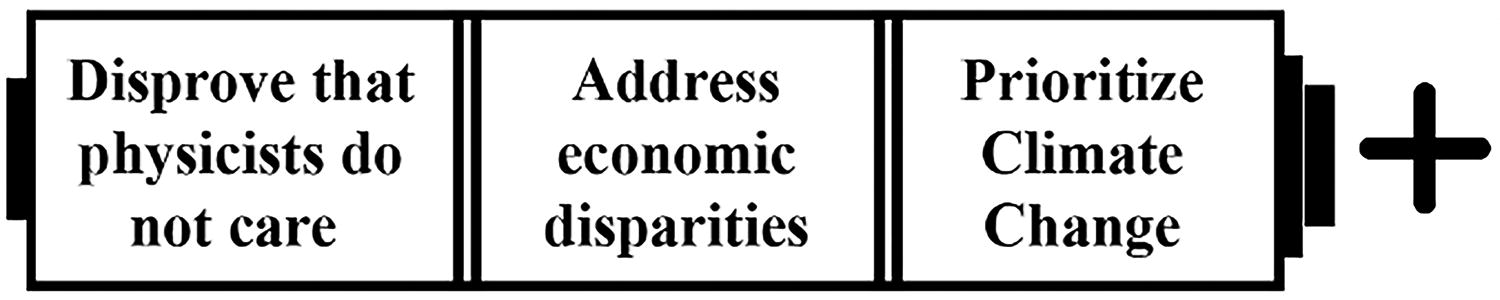
Motivations to teach social and energy justice in physics. This figure summarizes teacher-reported benefits of integrating social and energy justice into physics instruction. Educators noted that justice-centered approaches help dispel stereotypes that physicists are disengaged from social issues, support discussions of economic disparities tied to energy systems, and elevate the importance of prioritizing climate change within physics curricula.
Motivation #1: Disprove that physicists do not care
Given how physics tries to be objective and thus never involve itself as a field in any sociopolitical discussions, it is not a surprise that most people think and believe that physicists do not care. This narrative can even be pushed forward as physics has pushed forward dominant narratives that suppress other ways of knowing and thinking that are not confined to colonial powers.29,30 This push for only dominant narratives is also known as white empiricism. White empiricism as described by Prescod-Weinstein (2020) is “the phenomenon through which only white people (particularly white men) are read as having a fundamental capacity for objectivity.” 31 This means that physics “others” those who do not carry these racial and gender identities. This discourse further centers apolitical and acultural norms, especially in relation to remaining neutral and objective as physicists. Given this analysis, it is no surprise that the notion that physicists do not care about social or energy justice is one that dominates these types of discussions.
Although recent research demonstrates that indeed physics tries to remain acultural and apolitical, what happens to those who embody identities that are often ignored or othered because they are not white cisgender men? This pertains to people of color and nonbinary physicists in this field. Although the dominant narrative may be that physicists do not care, those who have been left out of these dominant discourses do care. As one of our participants, Thomas, a nonbinary physicist, hinted that one of their major motivations to integrate social and energy justice into their classrooms was to go against this dominant narrative. They stated, “I’m tired of people saying that physics teachers do not care about energy justice. There’s like this narrative, that physical scientists don’t care about the world around them.”
For Thomas, it is important to fight against this dominant narrative that excludes them. Although they are white, they are not cisgender, so it has been their motivation to show their students that there are some physicists who care, especially those who are often excluded due to white empiricism. They go on to acknowledge that, “there’s power [in] understanding the physical world that you can affect change within.” Physicists can indeed affect change in the world, as it is a field that indeed has done this. It just needs to be more integrated and adapted to current times.
Motivation #2: Address economic disparities
Recently, we have witnessed economic disparities that are interconnected with energy access. In February 2021, Texas experienced a winter storm that left approximately 4.5 million people without access to electricity for several days. 32 Unfortunately, when Texas went completely dark during these extreme weather conditions, the entire nation witnessed it on national television. 33 In this national televised power outage, disparities that impact vulnerable communities, in particular communities of color, were elevated to national attention. 34 Data also reported that at least 31 people lost their lives due to the lack of electricity to help them withstand this winter storm. 35 Witnessing these disparities was one of the motivations identified by physics educators to include energy and social justice in physics education. Selena, one of our participants and a woman of color, stated, “I think with what happened in Texas with the grid and the cost of energy …and who is able to have access to [energy] or can continue paying for when prices are skyrocketing. Some people had to choose to continue paying thousands of dollars to have energy during this winter storm. [This shows that] we don’t have equal access or equitable access of energy sources.” Her analysis of what occurred in Texas and how certain communities were affected disproportionately because of economic disparities was indeed something that was visualized through this recent case that took place in Texas.
Aisha, another participant and woman of color, also stated, “Texas is a great example of energy injustices. [Witnessing] how one neighborhood had more energy access and seeing who was being placed as a priority versus individuals from lower socio-economic backgrounds, elevated the energy injustices. The infrastructure for energy harnessing is an energy justice issue that can lead to life or death.” Aisha is motivated to integrate social and energy justice in physics education because she understands that access to energy, especially during extreme weather conditions, jeopardizes people of color the most. As it was witnessed during this 2021 winter storm, electricity bills skyrocketed so only those who had the economic status were able to afford them. When the power grid started failing, this led to an increase in electric bills that of course amplified already existing economic disparities among communities in Texas. Physics is one of the scientific disciplines that teaches the concept of energy, and thus, it motivates physics educators to integrate social and energy justice into their curriculum to address these economic disparities. Given that these extreme weather conditions will become more common across the country due to climate change impacts, 36 it is important to acknowledge this motivator to change the discourse of physics education.
Motivation #3: Prioritize climate change
Climate change is derived from modeling and analysis that are grounded in physics theories. As a result, in 2021, the Nobel Prize in physics was awarded to Syukuro Manabe, Klaus Hasselmann, and Giorgio Parisi, three climate scientists who had used physics to expand on the understanding of climate change. 37 Although physics education has been identified as an effective pedagogical environment that facilitates the teaching of climate change, 38 there is rarely strong evidence of physics educators making these relationships between physics and climate change within the classrooms. Physics is already set up as a discipline that can effectively teach about the carbon costs of energy production, 39 yet because the concept of energy is taught in an abstract way, there are few connections made in energy lesson plans. Boeker and Van Grondelle 2011 40 introduced one of the first books that introduces students to physics concepts through the contextualization of these physics concepts within societal problems such as climate change. Textbooks like this support the important narrative that it is crucial to teach students about climate change literacy, as they are the future decision-makers and citizens who will determine the future of climate change. 41 Given that Jarrett and Takacs 2020 concluded that, “Earth’s energy balance and black body radiation were not well understood” 42 by students and how these are important physics concepts that are empirical evidence of climate change, it is important to prioritize climate change in physics.
This prioritization of climate change in physics was also one of the identified motivators by our physics educators. Physics educators were also interested in going beyond just prioritizing knowledge about climate change by also implementing how climate change impacts communities of color the most. Bruce, a physics educator and man of color, stated, “Understanding how climate change is disproportionately affecting poor communities can be taught through energy and social justice. I think it’s tragic how much time I must spend having a conversation on whether it is real to a community that is being hurt by [climate change] the most.” He takes prioritizing climate change through the integration of energy and social justice to also be motivated to speak about climate injustices. Disadvantaged communities (e.g., communities of color) have contributed the least impacts that have accelerated climate change but are the most affected by climate injustices. 43 For Bruce, prioritizing climate change in physics classrooms is interconnected to climate justice, especially when integrating social and energy justice, so this motivates him to do so.
IMPORTANCE OF PHYSICS EDUCATORS’ MOTIVATIONS
Physics is one of the core subjects taught in secondary education, alongside mathematics, history, etc. However, despite it being centered in students’ secondary educational experiences, there continues to be a decline in students’ interest in taking physics beyond their basic requirements. 44 Studies have shown that this is, in hindsight, due to physics continuing to focus its pedagogical approaches on teaching abstract concepts. 45 By teaching concepts as abstract, this does not make physics concepts relatable or relevant to students’ landscapes or environments. 46 Students’ perceptions of physics as an irrelevant or unrelatable subject is no surprise given how fundamental physics concepts continue to be removed from sociopolitical implications prevalent in our societies and landscapes. Such removal creates a wide dissociation between land and gender in physics education that makes it hard to increase student engagement, especially from female students. 47 For example, when we investigate how physics addresses gender inequities, we continue to find how women are portrayed and represented through stereotypes that indicate that physics is not a field for them. 48 Being able to integrate social and energy justice into physics education helps address these gender inequities that persist in the field as well. It also helps increase student engagement which can help address these gender and racial inequities in the field as well. These benefits are alluded to Figure 2. Thus, physics educators’ motivations to do so are important to elevate in the physics discourse.
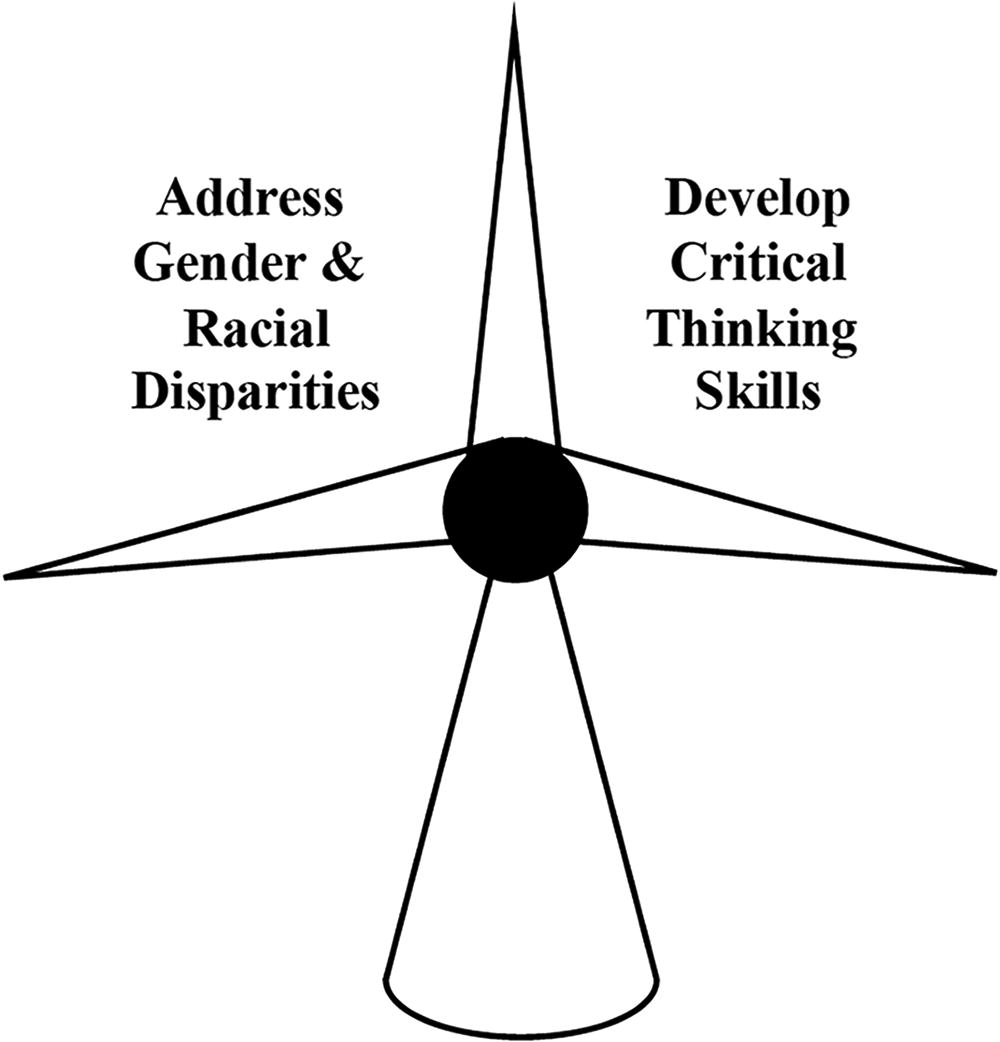
Students’ benefits from educators integrating social and energy justice in physics. This figure highlights the motivations for integrating social and energy justice into physics instruction, emphasizing educators’ goals to reduce gender and racial disparities in science, technology, engineering, and mathematics and to cultivate students’ critical thinking skills. The motivations underscore the role of justice-centered teaching in advancing equity, inclusivity, and analytical engagement within physics learning environments.
CONCLUSION
Physics education has a long way to go in fully incorporating energy and social justice into its core curriculum. Given the current political controversies, these political divides further push physics education to avoid addressing this gap. This gap ends up harming students as integrating social and energy justice can help students develop critical thinking skills. These skills are noted to support student success, especially when tackling physics problems and concepts. Given the lack of an already existing curriculum that bridges this divide and the ongoing political agenda that pushes physics education in the opposite direction, it is imperative to analyze physics educators to push forward. Physics educators’ motivations to push against this narrative and include social and energy justice into their curriculum should be alluded to in these political discussions. In our interview process, 13 physics educators identified three major motivations to integrate social and energy justice into their classrooms. These motivations include disproving that physicists do not care, addressing economic disparities, and prioritizing climate change. Ultimately, integrating social and energy justice can help improve students’ critical thinking skills that are important for their success in physics classrooms. Additionally, it helps students address gender inequities that persist in physics classrooms. The political controversies are distorting the gains students experience when both social and energy justice are integrated in physics. By elevating physics educators’ motivations, we can advocate for why educators should be heard as they ultimately know what is best for their students.
Footnotes
AUTHOR DISCLOSURE STATEMENT
No competing financial interests exist.
FUNDING INFORMATION
This research was supported by the National Science Foundation, DRL No. 1936601.