




Abstract
Building an archive and oral history project for the North Carolina Environmental Justice Network (NCEJN) illuminated some of the challenges and possibilities of creating systems of institutional memory for grassroots movements. Traditional archival practices had to be adapted to cater to the specific needs of this user community, who use the historical information for ongoing advocacy and activism efforts. For several decades, community-based archives have documented the histories of social movements and provided vital resources to grassroots activists. This article adds to the existing literature by offering a case study on the construction of a community archive and oral history project that centers environmental justice activists as archival users. Rejecting neutrality was key in the construction of this activist archive, which modified traditional archival techniques to improve activists’ access to information needed for their current struggles for environmental justice. NCEJN and its community partners expressed excitement about the resources provided by the archive, as well as the opportunity to expand their historical documentation efforts in the future.
INTRODUCTION
Community-driven, activist archives have the potential to preserve and provide vital resources for grassroots movements. 1 Involving environmental justice activists in the construction of archives can center their unique needs as an archival user community. By bringing the needs of activists to the forefront of collections and processing efforts, archivists may innovate systems of institutional memory to better serve these organizers. 2
Community-based and activist archives surged in the 1960s–1970s due to the Black freedom movement, the gay liberation movement, women’s movements, indigenous rights’ movements, and the other social justice movements of that era. 3 These archives sought to fill gaps in the collections at universities and state institutions. Likewise, critical and postmodern theorists critiqued conventional archival techniques for favoring powerful groups and individuals. 4 Historian Howard Zinn raised concerns that institutional archives claimed neutrality although maintaining elite control of institutional knowledge. 5 He argued that archivists ought to “rebel” against elite control—a rebellion that constituted not “the politicizing of a neutral craft, but the humanizing of an inevitably political craft.” 6 That is, archivists could confront the inequities of mainstream institutions by embracing social justice goals in collections efforts, ownership, access, and publication. 7
Scholars have begun examining the archives that document and support activist movements. 8 Flinn and Alexander define archival activism as “activities in which archivists… seek to campaign on issues such as access rights or participatory rights within records’ control systems or act to deploy their archival collections to support activist groups and social justice aims.” 9 Focusing on the latter part of that definition, this article examines the construction of an archive intended to support a community-driven environmental justice organization, the North Carolina Environmental Justice Network (NCEJN). Duff et al. maintain that “archives can both produce and reproduce justice and injustice in the decisions they make on how they shape the past and engage the present.” 10 NCEJN leadership and I saw a community-driven and activist-oriented approach as crucial to the archive’s potential to further environmental justice.
Much scholarship examines the archives that have documented activism, but Cifor et al. point out that “activists are just beginning to be viewed as archival stakeholders by practicing archivists.” 11 This essay adds to existing literature by offering a case study on my construction of a community archive and oral history project that centers on environmental justice activists as archival users. Starting in summer 2024, I created an archive for and about NCEJN. In detailing the steps I took to center activists as archival users, I suggest important considerations and best practices for future activist archives.
DEVELOPING AN ARCHIVE AND ORAL HISTORY PROJECT FOR NCEJN
NCEJN hired me to build a historical archive for their organization in anticipation of the 25th annual North Carolina Environmental Justice Summit. Before this, NCEJN staff had begun collecting artifacts in its storage unit and digital items on its Google Drive, but the nonprofit had no formalized system for archiving its records and resources. Building an archive without knowing what it would house required a clear and flexible system.
Since NCEJN already used Google Drive, organizational leadership and I chose to use Google Sheets and folders for the archive. We discussed potential privacy concerns involved with housing sensitive information in a corporate-owned cloud storage system. However, due to financial limitations, we determined that Google Drive would suit NCEJN best for the early stages of archival construction. As the archive gained funding, we hoped to use the systems honed through Google Drive to switch to more secure storage.
I designed the Google Sheets digital archive so that each tab contained a different resource type (i.e., academic articles, newspaper articles, videos, etc.). This made the archive easy to expand as new types of sources arose. I drew on Dublin Core metadata standards, as well as my experience at the University of Florida Samuel Proctor Oral History Program (SPOHP) under the direction of Dr. Paul Ortiz. 12 Additionally, to ensure that the archive was structured in a way that worked for NCEJN, I held regular meetings with staff to ask questions and request feedback.
When I asked NCEJN leadership where I might find documents from its early years, I discovered that most of the organization’s institutional memory remained only in living memory. As a result, we saw the need for an oral history project to be a key part of the archive.
I completed necessary background research for oral history interviews by adding sources to the archive. I began by searching Google for key terms related to the pieces of NCEJN’s history I already knew. I also combed through digital newspaper archives, and I reached out to long-term NCEJN members to ask if they possessed any sources that they would be willing to share. I received few sources from these requests, but those I did receive proved invaluable. While I built my knowledge of key events, I found few sources that captured activists’ sentiments, motivations, and tactics. I also encountered difficulties tracking the communities NCEJN has supported because, in ensuring communities maintain ownership of their organizing efforts, NCEJN often takes a less public role. Furthermore, due to my reliance on internet searches, information on events before 2010 was limited.
NCEJN leadership developed a preliminary list of people who they believed should be interviewed. My conversations with NCEJN staff and community members informed the interview guides I developed, which varied by narrator. Valerie Yow points out that since oral historians work with “living persons,” we “have the opportunity to find out what is important to them in their history and in their present lives.” 13 She explains that oral historians can utilize this knowledge in formulating research and interview questions. 14 The activist lens of the NCEJN oral history project and the lack of archival information about the organization’s internal workings made shaping the project around its informants’ perspectives not just an important tool but an urgent imperative.
Community connections proved crucial in coordinating oral history interviews. Erin Conlin advises oral historians to “[c]ultivate a meaningful relationship with” “at least one point person in the community who has strong credibility to help you establish trust and gain access.” 15 NCEJN Senior Advisor Naeema Muhammad and founding member and Director of Infrastructure and Development Dr. Valerie Ann Johnson provided these trusted connections.
I conducted oral histories in person and virtually. Following these, I transcribed and processed the interviews for the archive. As I did, I adapted techniques from SPOHP and developed additional strategies to maximize accessibility and usability for activists.
ARCHIVING GRASSROOTS HISTORY FOR ENVIRONMENTAL JUSTICE ACTIVISTS
Archiving the history of grassroots movements for activist use involves considerations that may differ from traditional institutional archives. Scholars have extensively “critique[d] the inherently political nature of archival practices” such that Sellie et al. report that “[t]he veneer of impartiality has been blown off of the archival profession.” 16 Even more, Cifor et al. found that all 12 community archives at the focus of their study “offer a crucial and substantial critique of neutrality and objectivity in their ethical orientations.” 17 Given that archival neutrality is a false paradigm that privileges powerful perspectives, the NCEJN archive claimed no neutrality. Instead, I constructed it based on political aims to support activist users in their pursuit of environmental justice. I devised structures to allow organizers to rapidly identify lessons, stories, and successes from the environmental justice movement.
To increase usability, I drafted an introductory document. The document included an abstract, a note on organization, an explanation of keywords, and a message for researchers. Since a wide range of community members will use the archive, I created this to guide users from nonacademic backgrounds in accessing needed information. I see this explanatory document as a crucial component of this community-owned archive.
I adapted conventional oral history processing practices to expand access to the information conveyed through interviews. Transcription constituted a key step in improving accessibility. Still, in their urgent and fast-paced organizing efforts, organizers may not have time to search through lengthy transcripts, so I developed additional resources to streamline this process. Well-funded archives may use technology like the Oral History Metadata Synchronizer to address these needs, but NCEJN did not have access to those resources. To solve this, I created content guides that serve as tables of contents for each interview. These guides provide lists of topics covered in their corresponding interviews with page numbers.
In developing content guides, I tracked information NCEJN leadership wanted to know. Leadership had informed me that their goals for these projects included: (1) developing a timeline of the organization’s history; (2) understanding the communities, organizations, and people who have worked with NCEJN; (3) collecting reflections on leaders; (4) preserving memories of community organizing efforts; and (5) identifying what factors have contributed to and/or hindered the effectiveness of the organization. Whenever an oral history narrator mentioned information that corresponded with one of these topics, I noted that in the content guide. Focusing on the knowledge NCEJN leadership desired allowed me to tailor the archive to this user community.
As of December 2025, the NCEJN archive contains over 350 sources, including 23 resource types. Notably, the archive houses 127 newspaper clippings (see Fig. 1), over 100 photographs, and 17 oral history interviews, which amount to 23 recording hours. Most sources were born digital. Lacking a professional archival scanner, I utilized the scan documents function on my iPhone to digitize physical documents. Since NCEJN prioritizes community members’ continued ownership of originals, digitization proved crucial. As the archive gains funding, NCEJN plans to purchase a high-quality scanner to rescan these documents and to use in future collections efforts.
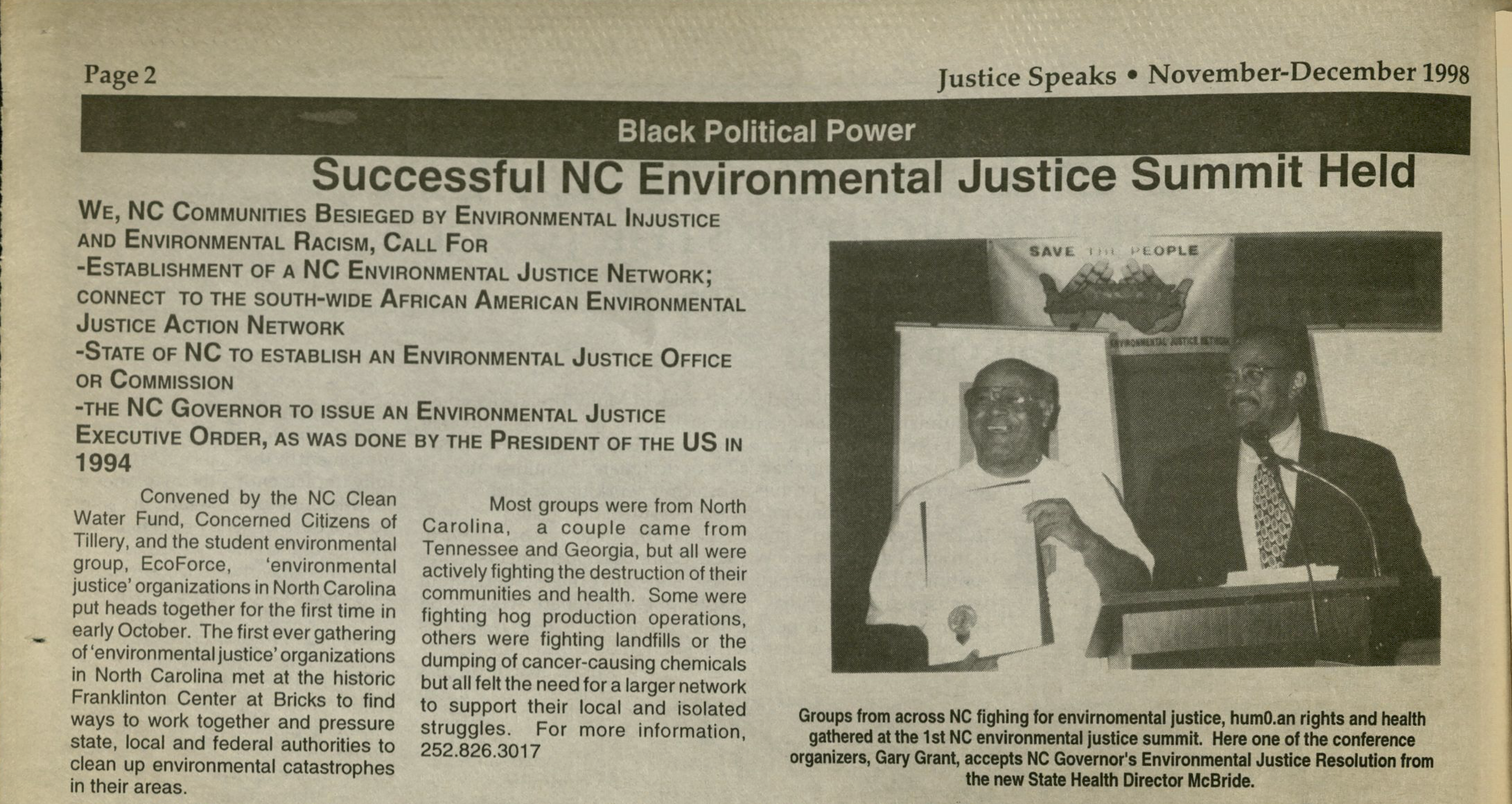
This Justice Speaks clipping depicts the processes by which communities founded NCEJN, as well as the initial goals for the organization. Image courtesy of the NCEJN archive. Document retained by a community member.
Archiving for environmental justice activists resulted in collections priorities that differ from conventional institutional archives. Take for example, the National Archives, which assesses sources according to age, aesthetics, “uniqueness,” “public interest,” and historical or political “significance.” 18 While these terms appear to suggest objectivity, they are value-laden and require subjective assessments by expert archivists. The NCEJN archive’s approach differs from traditional archives most in its shift away from “public interest” toward the interests of communities impacted by environmental injustices. Through digitized donations, oral history interviews, and feedback, community members determine the information included. As a result of activists’ priorities, archival uniqueness takes on diminished importance. That is, since activists expressed the need for rapid access to information, the archive functions as a centralized location for some documents and articles stored in other archives. As a result, in addition to numerous unpublished materials, about half of the sources listed within the archive have been stored elsewhere. NCEJN hopes that creating a central storage system will streamline activist research—a crucial goal given the urgent and fast-paced nature of environmental justice work. In making explicit its political goal to support communities in combatting environmental injustice, the NCEJN archive adopts a unique set of priorities.
In addition to preserving rich life histories of environmental justice activists, the oral history interviews document experiences of activism and perspectives on strategy. Life histories hold intangible significance for communities who hope to pass down activists’ wisdom to youth and to educate outsiders. The trajectories of activism and activists’ reflections on tactics provide strategical insights for communities seeking to build solidarity and/or confront similar opponents. Given concerns about confidentiality regarding the specific, local dimensions ongoing activism, NCEJN and I maintain selectivity about what to share and what not to share with broader public audiences. I share here a few selected examples of the sort of historical information and activist wisdom that NCEJN has found beneficial. An interview with Devon Hall, co-founder and director of the Rural Empowerment Association for Community Help, details the processes by which Hall formed this rural community organization and built solidarity in opposition to industrial hog operations. In particular, he emphasizes that hosting monthly meetings “gave people from different communities a platform to come into one space and talk about what they’re dealing with,” which in turn, supported collective actions that followed. 19 Another interview with Hope Taylor, Executive Director of Clean Water for North Carolina, provides helpful advice for building media campaigns to support protests. 20 Hall and Taylor convey crucial tactical advice for NCEJN. An interview with Dr. Danielle Spurlock reveals the challenges of maintaining “consistency” of activism while ensuring “that our elders get to rest.” 21 The specifics of activist labors and critical activist reflections provide roadmaps and warnings and raise important questions for NCEJN and its community partners in their present-day struggles for environmental justice.
HISTORICAL MEMORY OF A GRASSROOTS MOVEMENT FOR ENVIRONMENTAL JUSTICE
As I built the archive, I quickly understood that the organization has long cared about its history. In an oral history, Muhammad explained that NCEJN has always educated communities on the history of the environmental justice movement as a key component of their organizing efforts. 22 She remembered that NCEJN’s founding co-director, “Gary Grant would talk about the history, including that we started with the Warren County PCBs—would talk about that in detail. And then the starting of the EJ Movement Network, and just give that history and the importance of knowing that history.” 23 Since its inception, NCEJN leadership believed that teaching the history of environmental justice activism in North Carolina supported their solidarity-building efforts.
The oral history interviews revealed that community members see remembering NCEJN’s history as important to ensuring its values remain upheld. Founding member and Board Member Emeritus Don Cavellini emphasized that the organization’s memory of its origins has solidified its founding principles. 24 He explained, “… who we are now has a lot to do with how we started. Because the legacy is there, and the principles are still there. We’ve never compromised our principles.” 25 Cavellini sees knowledge of the organization’s history as necessary to its continued commitment to its ideals.
Cavellini acknowledged that knowledge of NCEJN’s past successes has inspired newcomers to connect with the organization. He explained, “… there are some relatively unrecognized people that have been attracted to the Network because of the legacy and because of the actual work that’s been done and the reputation.” 26 NCEJN members value the group’s historical memory, therefore, for helping them build the environmental justice movement.
In fact, I learned from current staff that NCEJN has incorporated multiple strategies to develop its own systems of institutional memory in the absence of formal archival systems. When NCEJN strategizes for ongoing struggles, staff look to Muhammad for advice based on her extensive career as NCEJN’s grassroots organizer. Additionally, NCEJN has created multiple community history projects at its summits. While the Network did not preserve these projects, they offered community members opportunities to reflect and educate new members on their collective past. In the spring of 2024, students in an University of North Carolina–Chapel Hill course co-taught by Professor Courtney Woods and NCEJN leadership developed an archive on the history of that class. NCEJN leadership and membership have long valued the organization’s history and have created numerous opportunities to reflect on their shared past.
POSSIBILITIES FOR EXPANSION
Building the community archive for NCEJN revealed several ways that historical documentation may support environmental justice activists. Like the activists examined by Cifor et al., leaders of the environmental justice movement wanted to utilize archival information “as inspiration, as evidence, or for strategy.” 27 These goals shaped the archive as I collected materials, and they informed environmental justice organizers’ ideas for expansion.
I held several conversations with NCEJN leadership to discuss expansion to improve the archive’s ability to support impacted communities. They explained that my collections efforts thus far had illuminated several aspects of the organization’s history about which many staff members had been unaware. They conveyed their gratitude for this information, which they maintained would serve as crucial evidence on the breadth and depth of injustices faced as well as the long-term nature of communities’ organizing against these injustices. In fact, NCEJN’s co-directors repeatedly emphasized their need for additional historical documentation of local environmental justice fights in which NCEJN had recently gotten involved. They asserted that such documentation was urgently needed for advocacy and funding efforts.
NCEJN also asked me to use the materials I collected to develop a historical exhibit to present at their 25th annual North Carolina Environmental Justice Summit. Leadership wanted an exhibit to support community members in reflecting on their shared struggles and to educate new members on the environmental justice movement in North Carolina. I centered community voices in the exhibit in several ways. As the exhibit’s centerpiece, I developed a timeline highlighting key events according to the oral histories and archival materials. Additionally, the exhibit featured an audio component with impactful quotations shared in oral history interviews. I also conceptualized participatory elements: (1) an activity where community members added their environmental justice struggles to a map and (2) an activity where community members shared their hopes for the future of the environmental justice movement.
At the Summit, several community members expressed gratitude for the opportunity to document and reflect on their past. Many approached me with interest in creating similar historical projects for their communities. Over a dozen people requested to participate in oral histories to further expand the NCEJN archive. NCEJN’s community partners repeatedly conveyed their excitement about preserving their shared past for the ongoing environmental justice movement.
CONCLUSION
By developing this archive in conversation with the specific activist community who would use it, I catered its structure to their unique needs. I adapted metadata categories and oral history processing to better support these activists’ goals of using the information to inspire, inform, and strategize. In the process, NCEJN’s leaders identified ways in which they wanted to expand the archive to assist in local battles for environmental justice. I adapted the archive to create a clear, coherent structure that people could easily expand upon without formal archival experience.
My collections efforts revealed that telling the history of the environmental justice movement has long remained an important strategy for NCEJN in solidarity building. Throughout my work with NCEJN, many staff and community members expressed their feeling that this archive would assist them in their grassroots organizing efforts. I sincerely hope that this non-neutral, explicitly political archive will support these communities in their pursuit of justice.
Footnotes
ACKNOWLEDGMENTS
The author wishes to extend her sincere appreciation for the mentorship she received from Professor Verena Kasper-Marienberg and Professor Ajamu A. Dillahunt-Holloway as she completed this public history project. She is also deeply grateful for the staff members and community partners of NCEJN for their enthusiasm for this project and their willingness to participate in oral history interviews. She would like to thank the North Carolina State University Libraries for providing access to the scholarly publications cited in this article.
AUTHOR DISCLOSURE STATEMENT
The North Carolina Environmental Justice Network (NCEJN) funded the archive analyzed in this article, and NCEJN provided funding to the author for her work building this archive. As a community-based archive meant to serve NCEJN’s community members, the partnership with the funder helped shape the archive’s development. This funding relationship constitutes a potential conflict of interest. However, the funder had no role or influence in research design, analysis, interpretation, or presentation of findings. The author maintained independent control over the research process.
FUNDING INFORMATION
No funding was received for this article.
AUTHOR’S CONTRIBUTIONS
E.J.D.: Conceptualization, methodology, formal analysis, investigation, resources, data curation, writing—original draft, writing—review and editing, visualization, supervision, project administration, funding acquisition.