




Abstract
Background:
Yucatán, Mexico, has experienced an expansion of swine concentrated animal feeding operations (CAFOs). These operations produce large quantities of concentrated waste that may contaminate surrounding areas and infiltrate surface and groundwater. This pilot study explored the viability of swine fecal contamination testing across several impacted communities and was conducted to build local technical capacity and to address community complaints against the industry.
Methods:
Community and study team members collected well, surface, cenote (natural underground reservoir), and tap water samples in nine and settled dust samples from road signs, apiaries, and outdoor home surfaces in three Mayan communities in Yucatán. Samples were tested for the presence of the swine fecal source tracking marker Pig-2-Bac by quantitative PCR.
Results:
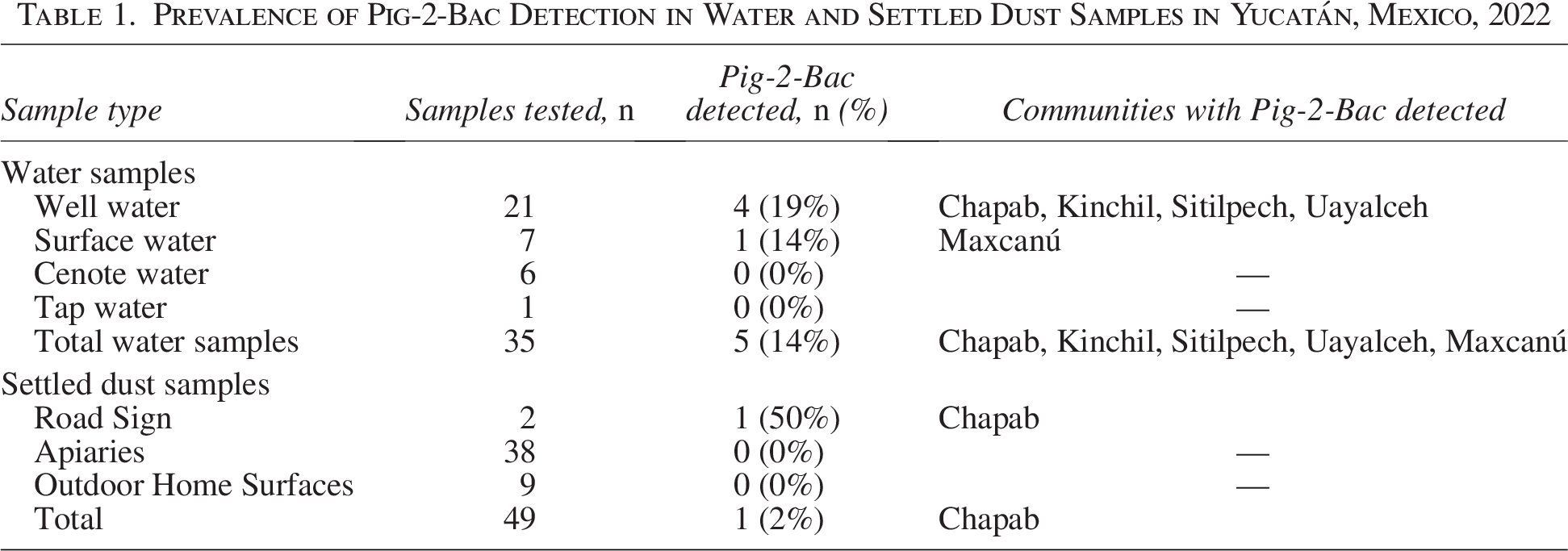
Challenges in shipping from Yucatán, Mexico, to Baltimore, USA, led to prolonged holding times of samples under suboptimal storage conditions. Nonetheless, Pig-2-Bac was detected in 4/21 well, 0/6 cenote, 0/1 tap, and 1/7 surface water samples. Among the settled dust samples, 1/2 road sign, 0/38 apiary, and 0/9 household surfaces tested positive for Pig-2-Bac, providing preliminary evidence of contamination of water and outdoor surfaces with swine fecal waste in multiple communities.
Conclusion:
Despite limitations in sample storage conditions, Pig-2-Bac was detected in multiple communities and media. These and future data can support indigenous Mayan communities and affected residents that are engaged in lawsuits against the CAFO industry. Capacity building and technological transfer of procedures to perform microbial source tracking would improve communities’ ability to expeditiously test environmental samples for pig fecal contamination.
INTRODUCTION
Swine production in North America and worldwide has become increasingly industrialized. 1 Concentrated animal feeding operations (CAFOs) produce large numbers of hogs at high stocking densities in confinement, which produces large quantities of fecal wastes that are often stored in lagoons and disposed of on land application spray fields. The CAFO model of swine production can produce disproportionate and adverse impacts on nearby communities due to airborne, waterborne, and occupational hazards, including exposure to pathogenic and antibiotic resistant microbes in swine fecal waste. Due to many factors, including moratoria on the expansion of swine CAFO general operating permits in parts of the United States, such as North Carolina, industrial swine production has been expanding outside of the U.S., including in the state of Yucatán, Mexico. Yucatán is one of the states with the highest levels of swine production in Mexico and has one of the fastest growing industrially raised hog populations. 2 According to a 2023 estimate by the Mexican Environmental Ministry, up to 368 hog CAFOs may be operating in Yucatán. 3
Waste from these CAFOs are disproportionately impacting indigenous peoples, as 86% of the state’s CAFOs are located in territories with Mayan speakers.2 In response, indigenous Mayan communities have filed human and environmental rights lawsuits against multinational CAFO operators, citing industry expansion and its adverse effects on health, self-determination, clean water, and the surrounding environment. 4 According to Greenpeace, only 22 CAFOs in Yucatán have an environmental impact assessment on file with the Mexican Ministry of Environment and Natural Resources,2 which documents emissions and contaminants including water use, management and discharge activities, similar to general operating and discharge permits in U.S. states. Without adequate permitting regulation and lack of enforcement by the Mexican government, it is difficult to estimate the current and future environmental impact these CAFOs are having on the Yucatán’s fragile ecosystem.
Potential consequences of large swine operations include the contamination of the surrounding waterways and natural environments (soil and air) with swine fecal waste and its byproducts, including antimicrobial resistant (AMR) and disease-causing bacteria, and excess nutrients that could contaminate well and ground water reservoirs and negatively affect Yucatán’s unique biodiversity. 5 A well-established method to assess swine and other fecal contamination in the environment is microbial source tracking (MST). Swine fecal waste can be measured using the swine-specific MST marker Pig-2-Bac. Pig-2-Bac is a marker of swine-specific Bacteroidales, pig gut bacteria that are present in pig feces and can be measured using quantitative polymerase chain reaction (qPCR). 6 Conducting qPCR requires specialized equipment and lab space, as well as people trained in the collection and subsequent processing and analysis of environmental samples. These barriers make it difficult for community members to gather this evidence alone, further demonstrating the discrepancy in resources between communities and the multinational corporations that own hog CAFOs. One way to lessen these disparities is to foster community-driven partnerships to help give those who are impacted by hog CAFOs the resources, knowledge, and agency to gather their own evidence and information about the effects of the operations on their water, land, and cultural heritage sites.
Cenotes, underground sinkholes connected to a vast underground water system, are an example of a potentially impacted biocultural heritage site. The Yucatán Peninsula has a “karst” terrain (rocky, porous, and shallow) and is home to many cenotes. Throughout the history of the region, cenotes have been of great cultural, economic, and ecological significance to the Mayan people and continue to be integrated into their way of life today. Cenotes are considered sacred places by the Mayan people who live in the area. 7 The Ring of Cenotes is a Geohydrological State Reserve and a Ramsar site protected under the Convention on Wetlands (1971). The interconnectedness of water systems in the region makes any contamination significant because of the opportunity for the contamination to spread quickly and widely. Another concern is that the low level of retention and absorption capacity of karstic soil, which makes the region highly vulnerable to pollution from the food animal production industry. 8 , 9
In this pilot study we aimed to collect a variety of surface water, well and drinking water samples as well as surface settled dust samples. We included water samples from cenotes, in addition to wells, as cenotes are historically used as a drinking water source in this area. 10 Additionally, apiary surfaces were sampled, as beekeeping is one of the key economic activities in Yucatán 11 and thus is part of the livelihood of Mayan people in the areas impacted by swine CAFOs. We also wanted to explore the possibility of establishing partnerships between local residents and academia to facilitate Pig-2-Bac testing of water (wells, surface water, and cenotes), and settled dust samples (apiaries, household surfaces, and public road signs), and transfer and establish technical capacity to perform Pig-2-Bac testing locally.
METHODS
Communities were selected based on their interest in participating, and their documented concerns about swine CAFOs, including rights-based actions taken with local networks or civil society groups. In collaboration with local partners, including local networks and civil society organizations, a study team member visited the communities to explain the objectives of this pilot and the methodology and in collaboration with the local people decided on the sampling sites. In this pilot study conducted between July and September 2022, well and surface water samples (75–150 mL each) were collected in sterile collection cups in the communities of Celestún, Chapab, Kinchil, Maxcanú, Paraíso, San Fernando, Sitilpech, Uayalceh, and Yaxkukul in Yucatán, Mexico. Additionally, settled dust samples were collected from outdoor home surfaces, apiaries, and road signs in Chapab, Maxcanú, and Yaxkukul by swabbing 10 cm × 10 cm (100 cm2) areas with a dry flocked swab that was then inserted into 1 mL Amies medium (ESwab, COPAN Diagnostics Inc., Murrieta, CA). Samples were stored in Mérida, Mexico, for up to 11 months, in a variety of conditions, including being refrigerated (due to lack of freezer space) and frozen, while shipping logistics, including adequate documentation for shipping of environmental samples internationally, were worked out. Samples were then shipped on dry ice from Mérida, Mexico, to Johns Hopkins Bloomberg Schools of Public Health (BSPH) in Baltimore, U.S. Surface samples were extracted within a week upon arrival, and stored at −80°C, water samples were stored for ∼2 months at −20°C before processing.
Water samples were vacuum filtered through 0.2 μm polycarbonate filters (Whatman, Maidstone, United Kingdom). Method blanks of phosphate-buffered saline were filtered at the end of each processing batch. The filters were transferred into bead tubes using sterile forceps, and DNA was extracted using the MagMAX™ Microbiome Ultra Nucleic Acid Isolation Kit (Applied Biosystems, Waltham, MA) on a KingFisher Flex instrument (Thermo Fisher Scientific, Waltham, MA) according to the manufacturer’s instructions. Flocked surface swabs were vortexed and expressed. A specimen processing control (SPC; 0.17 µL of mouse cDNA, Zyagen, San Diego, CA) was spiked into each sample prior to DNA extraction. The extracted DNA was eluted in 100 μL elution buffer.
The SPC was detected using mouse beta actin primers and a probe (Mouse ACTB [Actin, Beta] Endogenous Control with FAM Dye/MGB probe, Non-Primer Limited, Applied Biosystems, Waltham, MA) to confirm successful extraction of the sample. Additionally, each sample was assessed for PCR inhibition (PrimePCR Positive Control Probe Assay, Human, Bio-Rad, Hercules, CA). Samples were determined to pass the specimen processing and qPCR inhibition QA/QC criteria if the sample cycling threshold (CT) was lower than the mean plus three standard deviations (SD) of the method blanks (SPC and IAC) and non-template negative controls (nuclease-free water, applicable to IAC only), as described in the EPA method for detection of fecal contamination using TaqMan assays. 12 Samples showing qPCR inhibition were retested at 2-fold serial dilutions (1:2–1:16).
Using the lowest sample dilution without qPCR inhibition (undiluted for most samples, i.e., most samples did show inhibition), samples were tested for Pig-2-Bac. 13 Each 20-μL reaction contained 500 nM primers, 250 nM probe (FAM dye; Integrated DNA Technologies, Coralville, IA), 10 μL 2x TaqMan Fast Advanced Master Mix (Applied Biosystems, Waltham, MA), and 5 uL extracted DNA. Each Pig-2-Bac qPCR plate included a five-point standard curve ranging from 300,000 to 30 copies of Pig-2-Bac DNA in duplicate (custom-made Pig-2-Bac gBlocks, Integrated DNA Technologies, Coralville, IA) and at least two wells containing non-template controls (nuclease-free water). Samples with a Pig-2-Bac CT value ≥38 were retested in triplicate. Samples were analyzed on a QuantStudio 3 Real-Time PCR system (Applied Biosystems, Foster City, CA) using 40 amplification cycles. Each amplification cycle consisted of a denaturing step (1 s at 95°C), and a combined annealing and extension step (20 s at 60°C) under fast cycling conditions.
RESULTS
In collaboration with community members in Celestún, Chapab, Kinchil, Maxcanú, Paraíso, San Fernando, Sitilpech, Uayalceh, and Yaxkukul 35 water samples and 49 settled dust samples were collected (Table 1). Four of 21 well water samples tested positive for Pig-2-Bac DNA (19%) with concentrations ranging from 318 to 10,287 Pig-2-Bac DNA copies/100 mL. One of seven surface water samples (14%) tested positive for Pig-2-Bac (248 Pig-2-Bac DNA copies/100 mL). Among all settled dust surface samples, only one of the two road signs tested positive for Pig-2-Bac (282.5 Pig-2-Bac DNA copies per 100 cm2). Pig-2-Bac was not detected in any of the cenote water, tap water, apiary, or household surfaces tested. Once sample testing was completed, a meeting was held to inform local partners of the results. Results and limitations of these findings were discussed, and conversations focused on sharing results of this pilot study with the affected communities, as well as questions of how to interpret and use the data. Next steps were discussed, including protocols to train local members in sample collection considering lessons learned from this pilot study (e.g., sampling of wood surfaces should be avoided) and how to facilitate local testing to avoid prolonged sample holding times and the need for international shipping, e.g., through local academic partners with the resources and training to complete sample testing and QA/QC procedures.
Prevalence of Pig-2-Bac Detection in Water and Settled Dust Samples in Yucatán, Mexico, 2022
DISCUSSION AND CONCLUSION
This pilot project was conducted to bring community members affected by swine CAFOs together with academic partners who can facilitate testing of environmental samples and generation of data that may support communities in their efforts to protect their water, land, and the air they breathe. The pilot study originated from a 2022 workshop in Homún, Yucatán, Mexico, where local communities, civil society, and academics came together to discuss the impacts of swine CAFOs and related actions that were being taken in the United States and Latin America.
In this workshop, local communities raised issues regarding water pollution in Yucatán and the difficulties in source attribution. At a local level, swine CAFOs have claimed that water pollution in Yucatán is not necessarily related to the industry but rather to other activities. Thus, this pilot was designed to contribute to the identification of swine-specific water and environmental pollution in communities nearby CAFOs. The pilot also transfers the previous experience in water and settled dust sampling in North Carolina to Yucatán. This included sharing information about effective sample collection methodologies, such as where to take surface swabs. To build capacity, we encouraged collaboration with local labs or universities for potential qPCR testing and intend to provide methods and other forms of support to local labs to ensure they have the ability to provide results quicky, and effectively to the communities. The ability for communities to conduct testing and analysis locally would overcome many of the challenges encountered during this pilot study, specifically long sample holding times, international shipping costs and need for documentation, and potential damage to the samples during storage and shipping.
This pilot study brought together members of indigenous communities in Yucatán, local stakeholders involved in lawsuits against the swine industry, and academic partners from Mexico and the U.S. Despite prolonged sample holding times under suboptimal conditions and considerable logistics challenges surrounding sample shipment from Mexico to the U.S., Pig-2-Bac was detected in surface water and in well water samples and in settled dust collected from a road sign, but not on any of the apiary wood surfaces sampled.
These results indicate that Yucatán’s “mega” swine CAFOs could contribute to swine fecal contamination of surface waters and that swine fecal material could have infiltrated the groundwater in surrounding areas, spreading through the Yucatán Peninsula’s complex system of underground rivers and aquifers. This finding contributes to a growing body of literature finding swine biomarkers in a variety of water systems around swine CAFOs, 14 , 15 , 16 suggesting that these operations, despite being regulated as “non-discharge facilities” in the U.S., do contribute to the contamination of water, soil, and sediment through runoff and through dispersal via air.14,15,16
Although we were able to collect a variety of water sample types and settled dust surface samples and detected Pig-2-Bac in a proportion of sample types in several communities surrounding large swine CAFOs, we encountered multiple challenges along the way, which could have contributed to an underestimation of Pig-2-Bac. These included prolonged sample storage times at suboptimal conditions, as some samples were stored in a refrigerator for up to 11 months while the team worked on shipping logistics (documentation for international shipment of environmental samples, customs forms, selection of suitable carrier, distribution of shipping costs). In addition, the shipping costs were much higher than anticipated and are prohibitively high for communities to shoulder on a more regular basis. During shipment some of the water collection containers cracked and/or leaked. Some of the water samples had a large amount of particulate matter, which easily clogged the filter membrane and made it difficult to concentrate larger volumes of water. Finally, apiaries are constructed from wood, which is known to have antimicrobial properties that might make pathogen recovery difficult, 17 particularly anaerobic bacteria like Bacteroidales, which cannot survive outside of the pig gut. Considering these limitations, our results are likely an underestimate of the true levels of fecal contamination present in the communities sampled. These obstacles highlight the importance of equipping local communities and labs with the tools and knowledge necessary to perform testing and analysis locally.
Previous studies that used Pig-2-Bac tested environmental samples collected around hog CAFOs and found evidence of fecal contamination in surface water and in settled dust from indoor and outdoor household surfaces. Mieszkin et al. (2009) found an average of 2.4 log10 Pig-2-Bac copies per mL in surface water. Another study done by Christenson et al. (2022) reported similar levels (2.5 log10 copies per mL) of Pig-2-Bac in surface water collected downstream from swine CAFOs and a mean of 1.7 log10 copies per mL in lagoon waters surrounding swine CAFOs. Our highest reported value of ∼100 copies per mL (2 log10 copies per mL) in well water is in line with these values. However, the surface water concentration of 2.5 copies per mL (0.4 log10) was lower than other values reported in the literature. In Mieszkin et al. (2009), Pig-2-Bac was detected in 62.5% of water samples collected close to pig farms, and in 20% of water samples collected further away in a river downstream from the farm. The detection rates reported by Mieszkin from farther downstream (20%) are similar to the well water detection rates reported here (19%), while the rates for samples collected around the farms are higher (62.5%) than any positivity rates reported here. The lower concentration and percent positive samples for Pig-2-Bac reported here could be due to a variety of factors, including suboptimal and prolonged storage conditions mentioned above. Additionally, other studies may have been able to collect samples in closer proximity to the swine CAFOs or farms or directly from water known to include runoff from a swine farm.
A recent publication by Kurowski et al. (2025) 18 examined Pig-2-Bac detection frequency and quantity in households close to swine CAFOs in North Carolina (NC) and in metropolitan areas of NC. In areas close to swine CAFOs, 35% of outdoor samples collected from industrial livestock operation worker (ILO-W) households and 32% of outdoor samples collected from industrial livestock operation neighbor (ILO-N) households were positive for Pig-2-Bac, while only 0.1% of outdoor surface swabs were positive in metropolitan areas farther away from hog CAFOs. The overall surface swab detection rate reported here (2%) is closer to the metropolitan area detection rate (0.1%) reported by Kurowski et al.(2025). Mean outdoor sample copy numbers from that study were reported as 36 Pig-2-Bac DNA copies per square inch (in2) (ILO-W) and 64 per in2 (ILO-N), with the metropolitan mean outdoor copy number being 0.6 copies per in2. The Pig-2-Bac copy number reported here (18.1 copies per in2) is lower than the average measured on outdoor household surfaces of residents neighboring swine CAFOs in NC, which could be due to the long and suboptimal sample storage conditions.
Future surface sampling in the area will attempt to address the issues of holding time and small number of non-wood surfaces sampled to get a more complete estimate of swine fecal contamination in the area. The presence of swine-specific fecal contamination in groundwater and surface water samples is concerning and could indicate the presence of a variety of other potential contaminants, including air pollutants that are known to cause respiratory distress, heavy metals, and pesticides. 19 Swine fecal contamination has also been linked to a variety of pathogens such as Rotavirus, Bordetella bronchiseptica, Giardia duodenalis, Legionella pneumophila, Staphylococcus aureus, and more.19, 20 AMR genes such as mecA (methicillin resistance) and tet (tetracycline resistance) has also been associated with swine fecal waste and has been found in swine fecal wastewater.18,19 These pathogens, especially when coupled with AMR genes, can have significant health impacts on the people exposed to them. Contamination of groundwater systems from swine CAFOs could threaten the biodiversity of cenotes. Due to the unique geography of the region, many species are found only in the cave system of the cenotes. Some of these species, such as the blind fish Ogilbia pearsei and Ophisternon infernale, are currently at risk of extinction due to the byproducts of swine CAFOs. 21
Detection of Pig-2-Bac in surface and groundwater (well water) samples in this pilot study suggests that there may be cause for action to preserve Yucatán’s rich indigenous and biocultural heritage sites and communities from adverse environmental and public health impacts of swine CAFOs. Further research is needed to evaluate the spatio-temporal extent and distribution of swine fecal contamination of these communities. Additional research will continue in collaboration with indigenous communities to provide those most affected by CAFOs with the evidence needed to inform and change local policy.
AUTHORS’ CONTRIBUTIONS
T.C. contributed to study design, data collection and analysis, and article writing and editing. K.H.V. contributed to the conception of the research, study design, data collection, article writing and editing. N.P. contributed to conception of research, study design, data collection and analysis, and article writing and editing. K.S. contributed to acquisition of funding, conception of research, study design and article editing. K.M.K. contributed to conception of research, study design, data collection, and article editing. B.D.S. contributed to data visualization and article editing. D.L.W. contributed to conception of research, study design, data collection, and article editing. A.M.R. contributed to conception of research, study design, data collection, and article editing. C.D.H. contributed to acquisition of funding, conception of research, study design, data collection and analysis, and article writing and editing.
Footnotes
ACKNOWLEDGMENTS
The authors are grateful to all the community members who contributed to the conception of the project and to the collection of environmental samples. In addition, we want to thank Dr. Eric Vides, researcher for México-CONAHCYT and El Colegio de la Frontera Sur and M.A. Irina Ize Lema, environmental health consultant, for their contribution to collecting the environmental samples.
FUNDING INFORMATION
Funding for this study was provided in part by the Environmental Health Program of the Center for Biological Diversity and the Community Science and Innovation for Environmental Justice (CSI EJ) Initiative of the Johns Hopkins Center for a Livable Future (CLF). TC, NP, KS, BDS, AR, and CDH were supported by the CSI EJ Initiative of the Johns Hopkins CLF. CDH, BDS, and AR were supported by the National Institute of Environmental Health Sciences (NIEHS) P30 Center for Community Health: Addressing Regional Maryland Environmental Determinants of Disease (CHARMED) grant number P30ES032756. CDH, AR, and KMK were supported by the National Institute for Occupational Safety and Health (NIOSH) grant number T42OH0008428.