




Abstract
Wind energy has expanded rapidly in Brazil in recent years, accounting for 15.2% of national electricity generation in 2023. This growth, however, has been accompanied by socioenvironmental conflicts in communities located near wind farms, including livelihood disruptions, forced displacement, and health impacts. Using national census data and georeferenced information on existing and planned wind farms, we examined the racial composition of census tracts hosting these facilities across six states in Brazil’s Northeast Region, which concentrates 91% of the country’s wind power capacity. Our analysis shows that between 56% and 73% of these census tracts, depending on the state, have proportions of racialized groups (Black, Brown, and Indigenous populations) above their respective municipal averages. These findings underscore the need to improve public participation and community consultation processes for wind energy projects in Brazil in order to mitigate the reproduction of structural racism in the sector.
RESEARCH PROBLEM
The increasing need for renewable power generation has been moving investments to rapidly provide renewable energy, justified by the urgent need for energy transition. At the same time, the energy industry is expected to promote a fair, equitable, and inclusive transition from fossil fuels to low-carbon energy systems at a fast enough pace to meet the goals of the Paris Agreement. 1 However, several initiatives of renewable projects have been shown to have social impacts on vulnerable groups.2,3,4
It is no coincidence that installation or operation of wind energy projects has been associated with environmental conflicts. From a global perspective, Nsude et al., 5 using the Global Atlas of Environmental Justice, identified 48 conflicts in 22 countries, including Mexico (9 cases), India (5), France (4), the United States (4), Brazil (3), and Kenya (3), mostly in rural or semiurban areas. The authors also listed a series of socioeconomic impacts, such as damage to livelihoods, loss of traditional practices, forced displacement, human rights violations, and specific impacts on women.
Consequently, the so-called a just energy transition, the operationalization of the environmental justice principles to the energy transition sector, advocates the equitable distribution of benefits and burdens of low-carbon developments and calls for decision-making processes that consider such goals. 6 The just energy transition is featured by the increase in power generation from wind and solar projects, including several economic, technical, and institutional challenges, such as incentives and investment risks, lack of technological standards, conflicts, and legislative reforms. 7 Just policies are needed to foster new employment opportunities, fund social programs for poverty reduction, 8 and mostly, promote initiatives that guarantee meaningful public participation in decisions. 9
Within the debates on just energy transition, recent studies have brought about elements of environmental injustice and renewable energy projects. For example, Cranmer et al. 10 assessed the demographic characteristics of communities surrounding different renewable and nonrenewable energy plants in the United States. As far as wind energy is concerned, they found that although neighboring communities were more white, they had lower income, higher poverty rates, and lower levels of education. In another case, also in the United States, Mueller and Brooks 11 found evidence of injustice in terms of ethnicity (Hispanic communities), rurality, education, labor force participation, and age. Despite the increasing research linking wind energy to situations of environmental injustice in Brazil,12,13,14 these investigations are usually limited to specific case studies.
Therefore, this study aims to assess the spatial distribution of wind farms in the Northeast Region of Brazil and their relationship with the racial composition of the affected populations. We argue that, although wind availability is the central aspect for installing wind farms, within regions with high potential for energy generation, there is a greater chance that projects will be located in areas with a higher concentration of racialized groups (Black, Brown, and Indigenous people). This analysis is relevant due to the various territorial conflicts involving wind farms, resulting from land disputes and the negative social and environmental impacts of these structures. Thus, the text contributes to the debate on environmental racism in Brazil and on the disproportionate distribution of environmental damage to specific social groups.
We organize the article into three main parts, in addition to this introduction. First, we discuss some conceptual elements related to racism and environmental injustice. Next, we describe the process of expansion of wind farms in Northeast Brazil and analyze how this expansion causes disproportionate impacts on racialized groups. Finally, in the last section, we offer some considerations and recommendations.
THEORETICAL FRAMEWORK
The original examination on environmental racism in the United States inspired the research design. Historically, the movement against environmental racism originated in that country in the 1980s, when civil rights movements campaigned against the disposal of hazardous waste in a predominantly Black neighborhood in Warren County, North Carolina. This movement led to the first studies on the relationship between race and the distribution of environmental impacts, conducted by the U.S. General Accounting Office in 1983 and by the Commission for Racial Justice of the United Church of Christ in 1987. 15 The results of these studies indicated “the existence of clear patterns showing that communities with higher percentages of minorities in the population are more likely to be sites for hazardous waste facilities.” 16
Based on the results found in the United States, a few years later, American researcher Robert D. Bullard 17 presented the concept of environmental racism as “any policy, practice or guideline that affects or disadvantages (intentionally or unintentionally) individuals, groups or communities on the basis of race or color.” In opposition to this phenomenon, the author proposed the idea of Environmental Justice, based on the principle that “all people and communities are entitled to equal protection under environmental, health, employment, housing, transportation, and civil rights laws.” 18
Over time, the issue of environmental justice gained ground in political debate and scientific research. Such initiatives have generally combined the work of academics, affected communities, and social movements, opening up new spaces for participatory research and popular epidemiology.19,20 Allegations of racism and environmental injustice then went beyond the assessment of hazardous waste sites. They included exposure to air, water, and soil pollution from economic activities in general, such as steel mills, power plants, and incinerators. 21
As the climate crisis deepened, communities and academics began to identify how the impacts of global warming also disproportionately affected specific social groups. Furthermore, complaints arose that initiatives to mitigate greenhouse gas (GHG) emissions followed the same unfair logic as “traditional” industrial projects. Thus, as new “green” technologies were developed—such as biomass, solar, and wind energy projects—it became apparent that their impacts were also unevenly distributed, falling disproportionately on vulnerable groups. 22
This process led to a convergence between movements debating climate change and those focused on ensuring environmental justice. As a result, the idea of climate injustice emerged. Dolšak and Prakash 23 associated this concept with three dimensions of climate action and inaction. First, there was the disproportionate exposure of specific social groups to the impacts of climate change; second, the unfair distribution of the negative impacts of mitigation and adaptation actions; and, finally, the unequal allocation of the benefits of climate initiatives. This discussion made it clear that energy generation initiatives had significant local impacts, especially on vulnerable or marginalized groups.24,25,26
Complaints about these contradictions led to the emergence of the concept of a Just Energy Transition. This proposal combined the principles of environmental justice in the context of energy transition. Thus, it advocated for the equitable distribution of the benefits and burdens of emission mitigation projects and required democratic decision-making processes that consider these objectives. 27
CASE DESIGN
Our analysis was based exclusively on secondary data available in public databases. Initially, we identified the locations with high potential for onshore wind energy generation based on the Global Wind Atlas. 28 Within these areas, we located existing and planned wind farms according to Empresa de Pesquisa Energética/Energy Research Office (EPE). 29 We then verified the census tract where the plants’ point locations were and compared the racial distribution of each tract with the average composition of the corresponding municipalities, based on information from the 2022 Census, provided by the Instituto Brasileiro de Geografia e Estatística/Brazilian Institute of Geography and Statistics (IBGE). 30 We summarize the number of census tracts and wind farms considered in our analysis in Table 1.
Number of the Census Tracts and Wind Farms Within the Considered Area
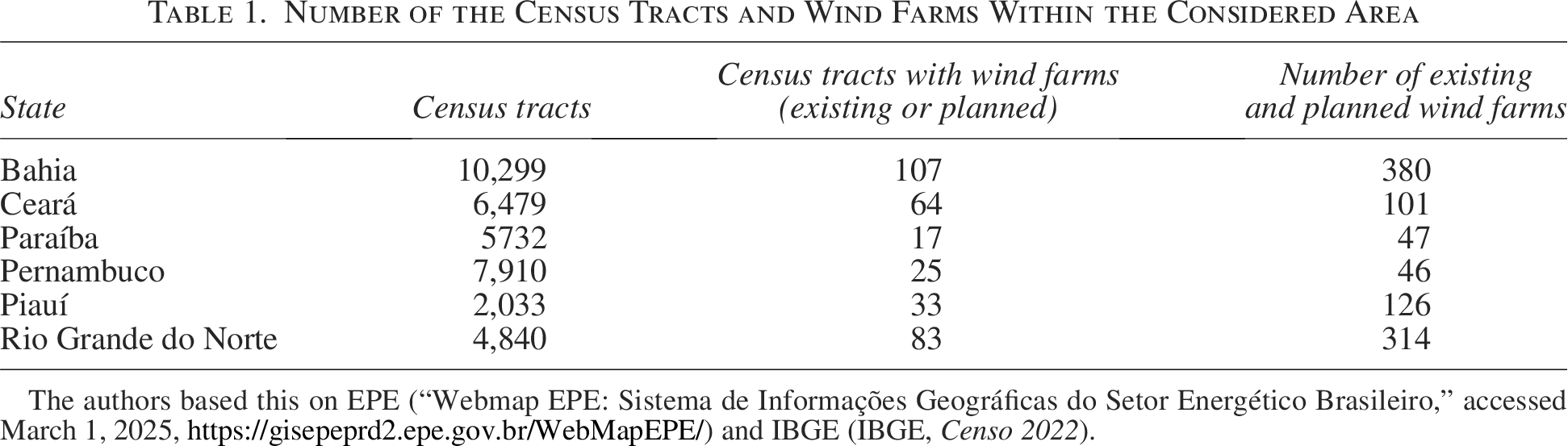
The authors based this on EPE (“Webmap EPE: Sistema de Informações Geográficas do Setor Energético Brasileiro,” accessed March 1, 2025, https://gisepeprd2.epe.gov.br/WebMapEPE/) and IBGE (IBGE, Censo 2022).
The debate on environmental racism incorporates several intersectional elements, such as gender, class, and income.31,32 However, in this analysis, we looked solely at the racial issue, since other relevant census data, such as education and income, have not yet been released. In future studies, we expect to incorporate these other variables. The research did not include the Rio Grande do Sul state, which accounts for 9% of wind farms and where there are also conflicts involving these structures. 33 The method we adopted did not prove appropriate given the historical formation of that state. Again, we might include an analysis of Rio Grande do Sul in future research.
RESULTS
Brazil is a major global wind energy producer. As shown in Figure 1, the wind farms are mainly located in the Northeast and South regions, with the former standing out due to its high generation potential.
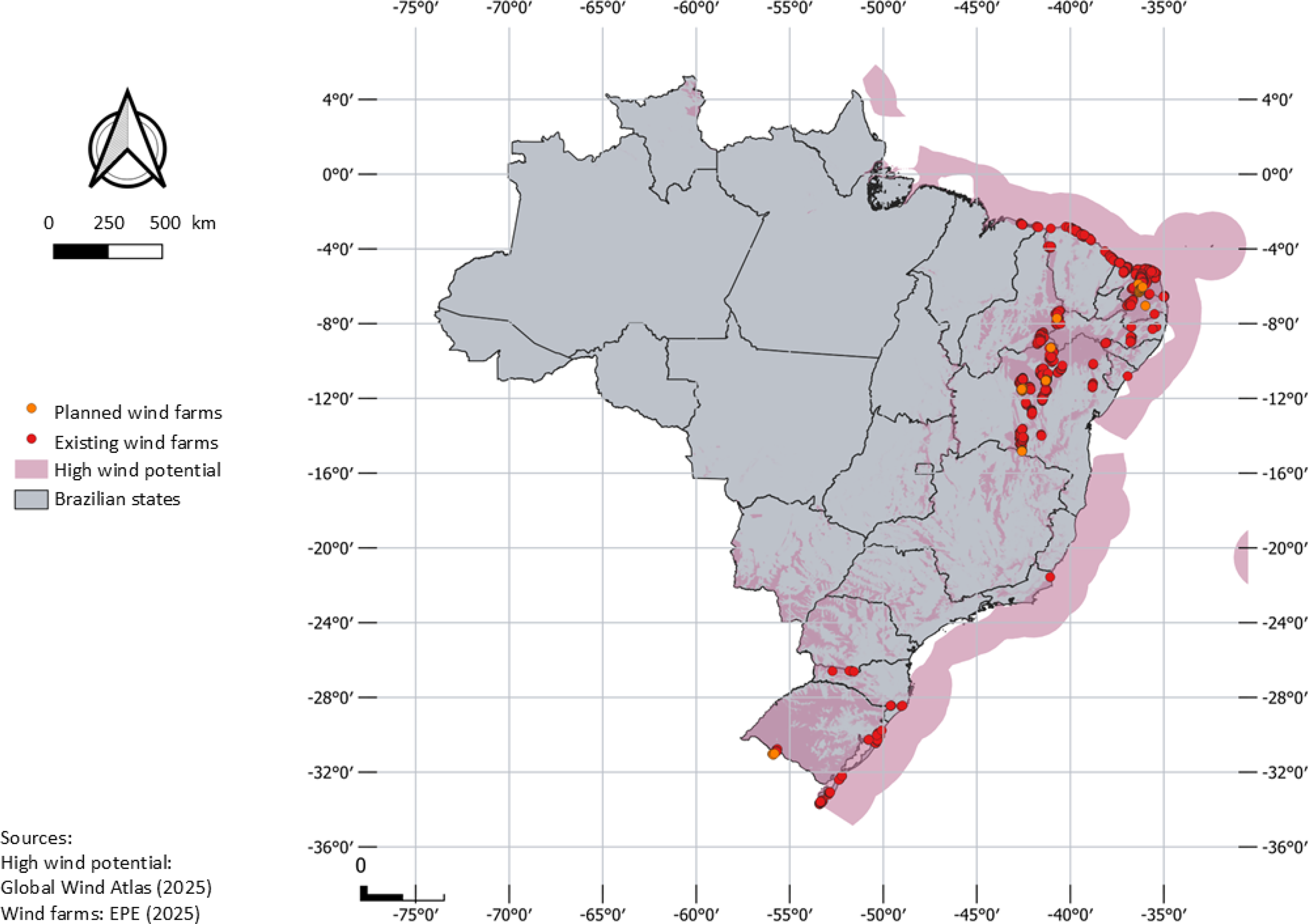
Distribution of areas with high wind energy generation potential and existing and planned wind farms. Source: EPE (“Webmap EPE: Sistema de Informações Geográficas do Setor Energético Brasileiro,” accessed March 1, 2025, https://gisepeprd2.epe.gov.br/WebMapEPE/); Badger et al. (“Global Wind Atlas,” accessed July 1, 2025, https://globalwindatlas.info/en/).
The installation of wind farms in Brazil has been growing exponentially (Fig. 2). With installed capacity reaching 30.45 GW, the sector is increasing its share in the national electricity matrix, reaching 15.2% in 2023. At the national level, 91% of wind energy capacity is installed in the Northeast Region, comprising 988 units. 34 In 2023, the Northeast was the second largest national producer of electricity, accounting for 22.7% of total production; in absolute terms, it generated 161 TWh but consumed only 95 TWh (59%). Most of the energy was transferred to the Southeast Region, which consumed 48% of the country’s electricity. 35
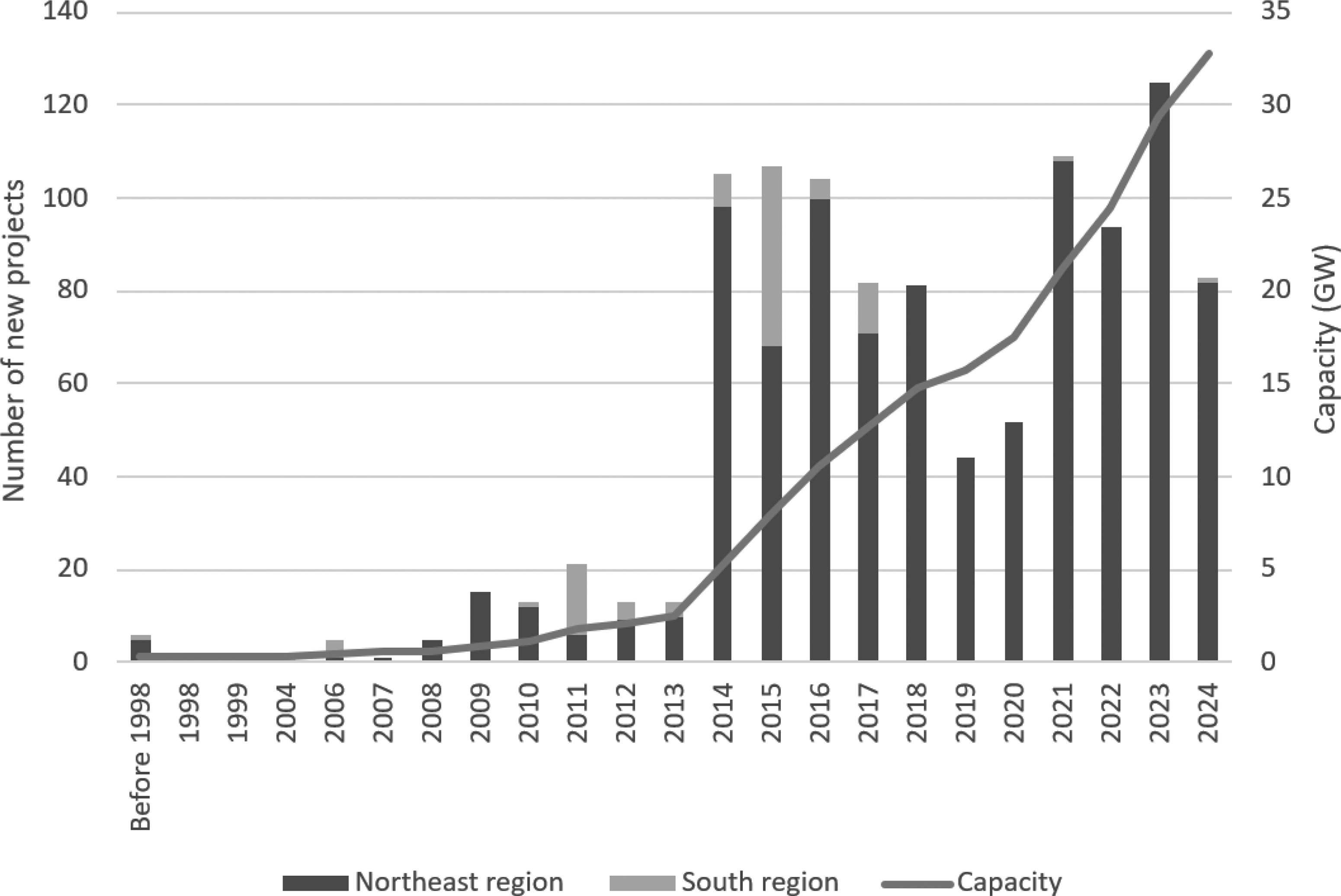
Growth in the number of wind energy projects and installed capacity in Brazil. Source: EPE (“Webmap EPE: Sistema de Informações Geográficas do Setor Energético Brasileiro,” accessed March 1, 2025, https://gisepeprd2.epe.gov.br/WebMapEPE/).
Considering the conceptual aspects discussed in Section 2, the wind energy expansion in the Northeast region already characterizes aspects of climate injustice on a national scale. Thus, there is evident regional inequality in the distribution of the benefits of energy generation, mainly allocated to the Southeast region, and of the negative impacts of wind farms in the Northeast. However, injustices go beyond the unequal distribution of energy. Even in the context of the Northeast region, we identified that racialized social groups are disproportionately exposed to the negative impacts caused by wind energy projects.
With this in mind, it is already possible to identify inequalities in the distribution of wind project impacts in Brazil. There, approximately 120,000 people live in the census sectors where wind farms are located; among them, about 87,000 (72%) are Black, Brown, or Indigenous.36,37
Nevertheless, in the Brazilian case, racial quantitative analyses must consider some specific aspects. In the United States, for example, the white population is in the majority (62%), and other racial/ethnic groups are minorities, such as Hispanics (19%), Blacks (12%), and Indigenous peoples (1%). 38 However, in Brazil, although Indigenous people also represent a small percentage (0.6%), the Black and Brown population totals 56%, while whites represent 43% 39 (See Supplementary Table S1 in the Supplementary Material).
For this reason, instead of examining the racial composition of the affected populations, we chose to compare the racial distribution of the census tracts with the averages of their respective municipalities. As shown in Figure 3, most of these sectors have a higher-than-average presence of racialized groups (Black, Brown, and Indigenous people). This distribution is identifiable in all the considered states. From a regional point of view, 66% of census tracts with wind farms have a racialized population greater than the average for their municipality. We also compared the presence of racialized populations with rural municipal averages. Although the percentages were lower, a similar pattern was observed (see Supplementary Table S2 in the Supplementary Material).
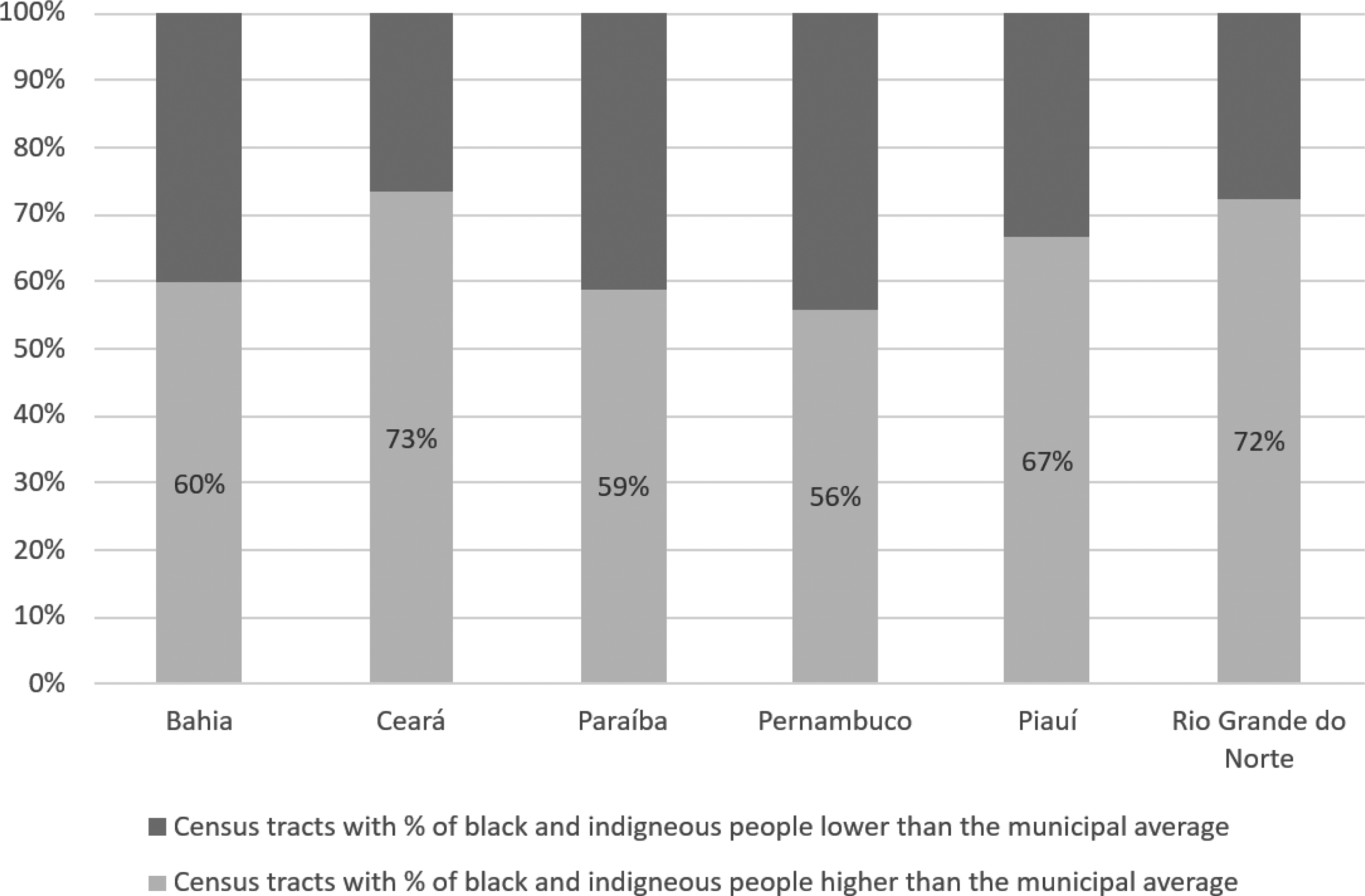
Census tracts with wind farms by percentage of Black, Brown, and Indigenous population. The following number of census tracts were considered in each state: Bahia (107), Ceará (64), Paraíba (17). Pernambuco (25), Piauí (33), and Rio Grande do Norte (83). The states of Maranhão and Sergipe were not included due to the low number of tracts. Source: IBGE (IBGE, Censo 2022); EPE (“Webmap EPE: Sistema de Informações Geográficas do Setor Energético Brasileiro,” accessed March 1, 2025, https://gisepeprd2.epe.gov.br/WebMapEPE/).
Our findings reveal aspects of environmental racism when we consider the various negative local environmental impacts caused by wind energy power plants. For example, Brown 40 argues that these projects are capable of generating positive benefits at the regional level, such as job creation, but produce negative impacts at the local level, such as damage to homes and reduced access to fishing areas.
These conclusions agree with Gorayeb et al., 41 who describe environmental problems at the local level, such as deforestation, silting of natural lagoons, and destruction of dunes in coastal areas. Furthermore, the authors note that social impacts include reduced agricultural production, restricted access to beaches for fishing, and blockages of traditional access routes, which restrain subsistence activities and isolate communities.
Our findings complement the existing literature about the expansion of wind energy production. We investigated racialized information, contributing with additional details to the previous work of Klinger et al., 42 who warn that the rapid expansion of wind energy production in Brazil has exacerbated land conflicts, reflecting preexisting structural inequalities in land ownership. The authors associate this growth with a process of “green grabbing,” which has negative consequences for both local communities and the environment. They further note that the development of wind energy in Brazil is closely tied to large-scale capital investment, with 78% of projects involving foreign companies as owners or investors.
In addition to environmental and territorial issues, wind farms can also have negative impacts on public health. In this field, among the main problems are the stroboscopic effect and the discomfort resulting from the noise caused by the blades. 43 As a result, studies mention the “wind turbine syndrome,” which includes a variety of symptoms such as nausea, dizziness, migraines, anxiety, and increased gastrointestinal sensitivity.44,45
Considering studies with a racial focus, research conducted in Brazil highlights that the affected communities have a specific profile, commonly consisting of Black, Brown, and Indigenous populations, often living in distinct rural environments, such as quilombola 46 territories. For example, Félix-Silva et al. 47 discuss the impacts of wind farm projects on fishing communities in the municipality of Ilha Grande (PI), where 77% of the population is Black or Brown. The authors mention an increasing restriction on the movement of residents and the strategy, by the company’s “social responsibility” department, to co-opt community leaders in order to demobilize local resistance. Traldi and Rodrigues 48 refer to abusive lease agreements between wind energy companies and quilombola communities in the state of Bahia. Lima 49 describes how the installation of wind turbines in Ceará disrupted the Quilombola community of Cumbe, leading to the degradation of the environmental systems on which it depended. Furthermore, Conceição et al., 50 who studied the impacts on the Quilombo do Talhado, in Paraíba, verified structural damages to houses and the decline of watercourses due to deforestation to open areas for wind towers.
The impacts of wind energy facilities on traditional communities, including Indigenous peoples and Quilombolas, are a significant concern in Brazil. Our data allow us to quantify only the presence of individuals who self-identify as Indigenous or Quilombola at the census-tract level. Among Indigenous peoples, the highest representation was observed in Ceará, where they were present in 14% of census tracts hosting wind energy installations. Quilombola populations were identified in 27% of affected census tracts in Piauí and 26% in Bahia. Using a different methodology and focusing on the directly impacted areas of wind energy projects, Milanez et al. 51 found that existing and planned facilities together affect 18 Indigenous lands and 21 Quilombola territories.
As a consequence of all these impacts, wind energy projects in Brazil are usually located close to vulnerable communities. Frate et al. 52 mention that wind farms are installed near communities characterized by a significant dependence on natural resources, a high degree of social inequality, low educational levels, and political marginalization. At the same time, research has described conflicts involving wind projects in various states, including Bahia, Ceará, Piauí, Rio Grande do Norte, and Rio Grande do Sul.53,54
In summary, the above-average presence of Black, Brown, and Indigenous people in the sectors where wind power plants are located can be associated not only with the notion of environmental racism but also with the structural racism that characterizes Brazilian society. Therefore, discussing the origins of this pattern, as well as strategies to overcome it, are urgent measures to reduce racial inequality in the country.
LESSONS LEARNED AND RECOMMENDATIONS
In recent years, there has been a rapid expansion of wind farms in Brazil. As this technology generates less GHG, it is often presented as a “clean energy” source. Despite its low contribution to climate change, it has various negative environmental, social, and health impacts, especially at the local level. In the Brazilian case, our research points to an unequal relationship between the Northeast Region and the Southeast Region. Thus, there is an unequal distribution of the benefits and burdens generated by these structures. At the same time, considering the negative impacts on a local scale, what we see is an unfair distribution of these impacts, with a concentration in places where racialized groups live.
Given this scenario, some actions are required. Even when racially unequal spatial distributions are not the result of explicitly racist public or private policies, they nevertheless reflect elements of the structural and institutional racism embedded in Brazilian society. In such an unequal context, the rights of racialized groups are frequently overlooked by both companies and the state. Institutional and procedural reforms are, therefore, necessary steps toward addressing these inequities.
In this context, it is essential to guarantee access to information and meaningful participation throughout the selection of project location alternatives, the assessment of impacts, and subsequent monitoring. Reestablishing and strengthening public participation in energy planning and environmental impact assessment would constitute an important step in this direction toward including claims of vulnerable groups in decision-making. There is also a need to reaffirm and strengthen procedures for obtaining the consent of communities located near proposed projects, in accordance with their own protocols. 55 In this context, the adoption of Free, Prior and Informed Consent, which remains rarely applied in Brazil, should be reinforced and extended to communities that are not formally recognized as “traditional” by the State.
Addressing these challenges requires institutional changes at multiple levels, which can only be achieved through broad societal mobilization, particularly by affected groups themselves. In this regard, it is crucial to deepen and expand dialogue between the energy and environmental sectors, affected communities, and representatives of Black, Indigenous, and traditional community movements.
From an academic perspective, as discussed throughout this paper, there remains a significant lack of research on how social and racial factors influence the spatial distribution of renewable energy projects in Brazil. This study represents an initial effort to address this gap by analyzing the proximity of wind farms to demographic and racial data at the census-tract level. Its main limitations stem from the availability of census data, which, on the date of the research, were restricted to racial aspects and potentially vulnerable groups, such as Indigenous peoples and quilombola communities, and did not include, for example, economic variables. In addition, this study relies on the location of wind farms rather than the precise positioning of individual wind turbines. Future research could advance this analysis by applying more refined Geographic Information System (GIS) techniques, including spatial proximity metrics and spatial correlation analyses incorporating additional socioeconomic variables. Furthermore, as Brazil expands large-scale photovoltaic projects, similar assessments will be increasingly necessary in the solar energy sector.
Footnotes
ACKNOWLEDGMENTS
The authors would like to thank L. Salgueiro for her contribution to the analysis of the spatial data.
AUTHORS’ CONTRIBUTIONS
B.M.: Conceptualization, formal analysis, funding acquisition, investigation, writing—original draft, and writing—review and editing. J.S.-G.: Data curation, formal analysis, investigation, writing—original draft, and writing—review and editing.
AUTHOR DISCLOSURE STATEMENT
The authors declared no potential conflicts of interest with respect to the research, authorship, and/or publication of this article.
FUNDING INFORMATION
The authors disclosed receipt of the following financial support for the research, authorship, and/or publication of this article: This work was supported by the Ford Foundation Brazil.
Supplemental Material
Supplementary Material
Please find the following supplemental material available below.
For Open Access articles published under a Creative Commons License, all supplemental material carries the same license as the article it is associated with.
For non-Open Access articles published, all supplemental material carries a non-exclusive license, and permission requests for re-use of supplemental material or any part of supplemental material shall be sent directly to the copyright owner as specified in the copyright notice associated with the article.
