




Abstract
Stakeholder engagement is promoted as a cornerstone of conservation governance; however, its practical implementation often produces unintended consequences. This study examines stakeholder engagement in Hluhluwe–iMfolozi Park (HiP), South Africa, using the control–entropy paradox (CEP), which conceptualises governance as both an exercise of control and a generator of disorder. A qualitative case study design was employed, drawing on semi-structured interviews with key stakeholders and document analysis of management planning processes. Data were thematically analysed using the CEP framework. The analysis draws on qualitative data collected between 2017 and 2018 and is framed as a historically grounded, theory-driven examination of enduring governance dynamics rather than a longitudinal assessment. Stakeholder engagement simultaneously broadened governance reach and generated systemic strain. Expanding participation introduced competing agendas, fragmented roles, and increased resource demands. At the same time, key marginalised groups remained excluded. This reveals a central paradox: participation was both under-inclusive and overextended, exceeding institutional and energetic capacity. These dynamics contributed to tokenism, misaligned expectations, and declining engagement. Participatory governance is not inherently stabilising but constrained by informational, institutional, and energetic limits. Stakeholder participation must be matched to institutional capacity, designed to reduce informational breakdowns, and linked to clear decision-making authority. Where engagement exceeds organisational limits or lacks consequence, it can produce fatigue, mistrust, and governance fragility rather than improved outcomes. Effective conservation, therefore, requires participation that is not only inclusive but calibrated (energetically sustainable), communicatively coherent, and demonstrably consequential for management.
Keywords
Introduction
Protected areas (PAs) are recognized as foundational instruments for biodiversity conservation, safeguarding ecosystems and essential ecological processes from the growing pressures of anthropogenic activities (Anderson & Mammides, 2019; Klein, 2015; UNEP–WCMC & IUCN, 2016). However, PAs also function as governance systems that must balance ecological mandates with social and political imperatives, especially in contexts marked by legacies of dispossession and exclusion (Brooks, 2001; Mdiniso & Nzama, 2018). In South Africa, the National Environmental Management Act (NEMA, 1998) and the National Environmental Management: Protected Areas Act (NEMPA, 2003) legally mandate stakeholder engagement in the creation of Protected Area Environmental Management Plans (PAEMPs), to enhance legitimacy, inclusivity, and co-ownership of conservation efforts.
However, stakeholder engagement is far from neutral or frictionless. It is increasingly recognised that participatory governance introduces new complexities, coordination challenges, and resource demands (Bennett et al., 2019; Lockwood, 2010; Reed, 2008). These challenges resonate with broader insights from systems theory, ecological economics, and socio-metabolic research, which emphasise that governance is not only institutional but also biophysical, dependent on flows of energy, materials, and information (Fischer-Kowalski & Haberl, 2007; Georgescu-Roegen, 1971; Haberl et al., 2020; Odum, 1996). As governance systems expand in scope and complexity, they require greater energy and coordination, often generating diminishing returns and unintended consequences (Mitchell, 2009; Tainter, 2000).
This article conceptualises these dynamics through what Hlabisa (2025a) terms the control–entropy paradox (CEP). Drawing on thermodynamic principles of entropy (Prigogine, 1984), socio-metabolic theory, and complexity science, the CEP posits that the extension of governance control inherently generates new forms of disorder that must be managed in turn. In the context of protected areas, stakeholder engagement is intended to stabilise governance by fostering trust, legitimacy, and accountability. Paradoxically, it also intensifies informational flows, multiplies institutional interfaces, and increases energetic demands in ways that may outpace an agency’s capacity to respond.
This tension is particularly evident in Hluhluwe–iMfolozi Park (HiP), one of South Africa’s oldest protected areas and a flagship site for biodiversity and community-inclusive governance (Nsukwini & Bob, 2016). HiP’s history is deeply intertwined with forced removals, unresolved land claims, and evolving benefit-sharing arrangements (Adeleke & Nzama, 2013; Brooks, 2001). In such contexts, stakeholder engagement is both politically necessary and institutionally demanding, as conservation authorities must navigate competing claims while maintaining ecological objectives.
This article advances two central propositions. First, stakeholder engagement should be understood as both a normative necessity and a socio-metabolic burden, an activity that consumes material, organisational, and energetic resources while generating new forms of governance complexity (Fischer-Kowalski & Haberl, 2007; Hlabisa, 2025a). Second, the long-term viability of participatory governance depends on achieving an energetic balance, where gains in legitimacy, cooperation, and ecological outcomes are commensurate with the costs of sustaining engagement. Where this balance is not achieved, participatory processes risk becoming sources of institutional fragility rather than stability.
To explore these dynamics, the study examines stakeholder engagement in HiP management planning processes through the lens of the CEP. The analysis draws on qualitative data collected between 2017 and 2018 and adopts a historically grounded, theory-driven approach. Rather than assessing recent changes, the study focuses on identifying enduring governance dynamics and structural constraints that continue to shape participatory conservation processes.
The dataset has informed earlier analyses of stakeholder engagement in HiP (Zulu, 2021), which examined participatory processes and institutional arrangements. The present study builds on this foundation by reinterpreting the data through the CEP framework, enabling a deeper analysis of the systemic tensions embedded in stakeholder engagement.
Through this secondary analysis, the study examines how engagement processes generate informational, institutional, and energetic forms of entropy, and how these dynamics shape governance outcomes. In doing so, it contributes to debates in political ecology and sustainability governance by integrating insights from thermodynamics, socio-metabolic theory, and complexity science into the analysis of participatory conservation.
Conceptual Framework
Stakeholder Engagement and Participation Debates
Stakeholder engagement has become a defining principle of conservation governance, both globally and within South Africa. From the 1990s onward, participatory approaches were widely promoted as a corrective to exclusionary “fortress conservation” models (Adams & Hulme, 2001; Brosius et al., 1998; Fabricius et al., 2004). The rhetoric of inclusion sought to restore legitimacy, redistribute benefits, and align biodiversity conservation with development goals. In South Africa, these ideals were institutionalised through the NEMA and the NEMPA, which require “interested and affected parties” to be consulted in the formulation of management plans.
However, as critical scholarship has long argued, participation is rarely straightforward. Studies have shown that consultation can reproduce unequal power relations, marginalize local voices, and serve more as a control tool than a means of empowerment (Büscher & Dressler, 2012; Cooke & Kothari, 2001; Cornwall, 2008). In many contexts, including South Africa, engagement is further shaped by histories of dispossession, mistrust, and contested land rights (Kepe, 2009; Lunstrum, 2014). These dynamics raise fundamental questions: does stakeholder engagement in practice advance equity and legitimacy, or does it deepen governance complexity and fragility?
Defining Control in Governance
In this article, control refers to the capacity of governance systems to project authority, coordinate action, and sustain desired ecological or social states across space and time. It encompasses the institutional exercise of authority (laws, policies, and administrative decisions) and the material and energetic infrastructures that make authority effective in practice (transport networks, monitoring systems, staff, and financial resources).
Control in protected area governance is therefore more than rule-making: it is the capacity to ensure compliance, maintain order, and respond to ecological and social feedbacks. As Scott (1998) notes in his analysis of state power, control depends not only on formal authority but also on simplification and legibility, which reduce complexity into manageable forms. From a socio-metabolic perspective, control is also an energetic activity: sustaining it requires continuous inputs of labour, energy, and material resources (Hlabisa, 2025a; Odum, 1996).
The CEP builds on this definition by highlighting its systemic limits. Every extension of control, whether through adding new stakeholders, creating new monitoring mechanisms, or broadening participatory processes, requires additional energetic inputs. These inputs, in turn, generate new forms of disorder (entropy) that must also be governed. Thus, control is both the means of stabilisation and the generator of new fragility.
The Control–Entropy Paradox
To interrogate these dynamics, this study applies the CEP, a systems-theoretical and thermodynamic model of governance (Hlabisa, 2025a). The CEP builds on foundational insights from thermodynamics, complexity theory, and socio-metabolic research, which collectively emphasise that organised systems require continuous energy inputs to maintain order and that increasing complexity is associated with rising coordination costs and systemic strain (Fischer-Kowalski & Haberl, 2007; Georgescu-Roegen, 1971; Mitchell, 2009; Prigogine, 1984; Tainter, 2000).
In thermodynamic terms, entropy refers to the tendency of systems toward disorder, requiring energy to maintain structured states (Hlabisa, 2025b; Prigogine, 1984). In social and ecological systems, this translates into the need for continuous material and organisational inputs to sustain governance arrangements (Haberl et al., 2020; Odum, 1996). Complexity theory further suggests that as systems expand in scale and scope, the costs of coordination, information processing, and integration increase, often leading to diminishing returns (Mitchell, 2009; Tainter, 2000).
The CEP synthesises these insights in a governance context by positing that efforts to extend control across socio-ecological systems inherently generate new costs and forms of disorder. Control requires energy in the form of labour, infrastructure, and institutional capacity. As governance expands, it produces entropy in multiple forms, including informational overload, institutional fragmentation, and resource strain. Governance is thus not only a political process but also a metabolic one, constrained by the availability and organisation of energy and resources.
Applying CEP to stakeholder engagement highlights three interrelated dynamics:
1. Engagement as Extension of Control
Stakeholder engagement broadens the governance surface by incorporating new actors, interests, and knowledge systems. This extension is often normatively desirable, aligning with ideals of democracy, inclusivity, and shared stewardship (Bennett et al., 2019; Lockwood, 2010; Reed, 2008). However, it also multiplies the demands on conservation authorities, each additional stakeholder requiring information exchange, negotiation, and responsiveness.
2. The Production of Entropy
Engagement processes tend to generate disorder across three domains: Informational entropy occurs when divergent priorities, values, and knowledge systems lead to contested agendas and proliferating claims (Cornwall, 2008; Stirling, 2010). In this study, informational entropy is understood not as an increase in the volume of information, but as a degradation in its clarity, coherence, and interpretive meaning as it moves across actors and institutional interfaces. In stakeholder engagement processes, this manifests through translation challenges, selective representation, weak feedback loops, and the loss or distortion of community perspectives within formal decision-making structures. Crucially, this process is not merely technical but social and political: it reflects the filtering, prioritisation, and sometimes marginalisation of particular forms of knowledge, values, and interests. As a result, informational entropy captures a broader erosion of meaning, legitimacy, and shared understanding, reducing the capacity of governance systems to process, retain, and act upon stakeholder knowledge effectively. In this sense, informational entropy overlaps with what may be described as epistemic or political distortions in governance processes (Fricker, 2007; Turnhout et al., 2020). This interpretation is consistent with cybernetic perspectives on control, which emphasise that effective regulation depends on the fidelity of information flows and feedback signals (Wiener, 1948). As system complexity increases, greater volumes of information may paradoxically undermine signal quality and decision-relevance, constraining governance responsiveness (Meadows, 2008; Shannon, 1948; Simon, 1957).
Institutional entropy arises when authority, roles, and accountability are dispersed across multiple actors without effective coordination or integration, leading to ambiguity, weakened responsibility, and the proliferation of symbolic or tokenistic participation (Clement, 2022; Hlabisa, 2025b). Rather than enhancing inclusivity, such institutional expansion can fragment governance processes, making it difficult to trace decision-making authority or translate participation into meaningful influence.
Energetic entropy captures the escalating material, organisational, and temporal costs of sustaining engagement processes, including facilitation, translation, transportation, and staff time, particularly where these investments fail to yield proportional gains in legitimacy, trust, or conflict resolution (Aguilar Delgado & Perez-Aleman, 2021; Jagannathan et al., 2020; Muñoz et al., 2009). In such contexts, participation becomes metabolically intensive yet institutionally unproductive, contributing to stakeholder fatigue and diminishing returns to engagement.
Conceptualising Entropy in Stakeholder Engagement Under the CEP Framework
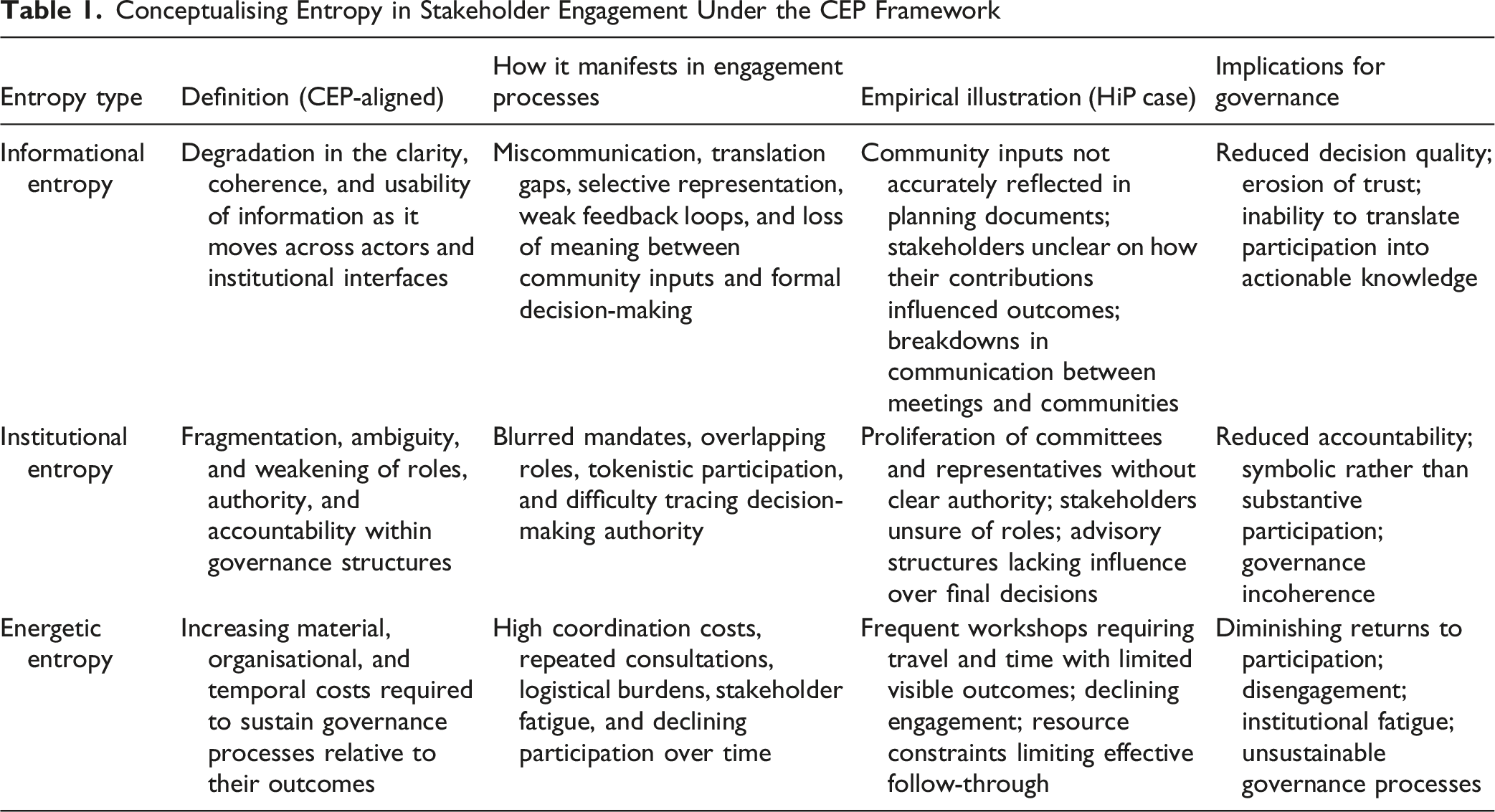
These dimensions highlight that participation processes generate democratic opportunities and distinct forms of systemic disorder, which must be managed if engagement is to remain effective and sustainable. 3. The Search for Energetic Balance
From a CEP perspective, the sustainability of stakeholder engagement depends on whether its returns outweigh its resource costs. Engagement is viable when the energy invested yields durable improvements in trust, legitimacy, and ecological outcomes. Strategies such as subsidiarity, co-design, and adaptive feedback loops are often recommended to reduce entropic spillovers (Bennett et al., 2017; Cundill & Fabricius, 2009). However, the balance between input costs and governance returns is fragile and context-dependent.
Linking Theory and Empirics
This framework bridges the fields of political ecology and socio-metabolic theory. Political ecology has long highlighted how histories of power and inequality shape conservation interventions (Adams, 2017; Büscher & Fletcher, 2020). The CEP adds a complementary systems-theoretical dimension, highlighting the thermodynamic costs of governance. Together, these perspectives allow us to analyse stakeholder engagement as both a political practice and a metabolic process.
The results are organised around the three core dimensions of the CEP: extension of control, production of entropy, and energetic balance, demonstrating how they manifest in practice and what they reveal about the fragility of participatory governance in protected areas.
Case Study Context: Hluhluwe-iMfolozi Park
The study was conducted at HiP, located in the KwaZulu-Natal (KZN) Province of South Africa, approximately 237 km north of Durban and 32 km from the town of Mtubatuba. The provincial conservation authority, Ezemvelo KZN Wildlife (EKZNW), manages the park and is mandated to oversee biodiversity conservation across the province (EKZNW, 2011).
HiP comprises two historically distinct reserves, Hluhluwe Game Reserve in the north and iMfolozi Game Reserve in the south, which were later consolidated into a single protected area. Proclaimed in 1895, it is one of the oldest conservation areas in South Africa and is internationally recognised for its role in the recovery of the white rhinoceros (Brooks, 2001). Today, the park remains a globally significant conservation landscape, hosting a wide range of large mammals, including the “Big Five,” and serving as a major tourism destination. Its core ecological objectives include biodiversity protection, species conservation, habitat management, and the maintenance of ecological processes within a fenced, intensively managed system (EKZNW, 2011).
HiP is embedded within a densely populated rural region characterised by structural poverty, limited infrastructure, and high dependence on natural resources. According to the Integrated Management Plan, the surrounding region has a population of approximately 2 million, with poverty levels exceeding 75% and high economic inactivity (EKZNW, 2011). Livelihoods are largely based on subsistence agriculture, natural resource harvesting, and migrant labour, while infrastructure deficits, such as limited access to roads, water, electricity, and communication services, remain significant. Educational attainment is also relatively low, further constraining local economic opportunities. These conditions are consistent with broader patterns observed in rural southern Africa, where historical marginalisation and uneven development continue to shape socio-economic vulnerability and resource dependence (Cousins, 2007; Shackleton et al., 2001; Statistics South Africa, 2022). These structural conditions shape the socio-economic context within which conservation governance and stakeholder engagement occur.
As with many protected areas in Africa, the park is also shaped by a history of land dispossession and exclusion of African communities during the colonial and apartheid eras (Brooks, 2001; Ramutsindela, 2007). Following South Africa’s democratic transition in 1994, land restitution processes sought to address these historical injustices. However, in protected areas, restitution was accompanied by conditions prohibiting the re-occupation of restored land. Instead, claimant communities were compensated financially and incorporated into benefit-sharing and co-management arrangements linked to conservation areas (Kepe et al., 2005).
The park is surrounded by ten traditional authority areas, which constitute key stakeholder groups. These communities include populations that were historically dispossessed during the establishment of the park and who maintain strong cultural and material ties to the land. Several communities, including Mpukunyoni-Mkhwanazi, abakwaHlabisa, Hlabisa-AbaseMpembeni, Zungu, and Ximba, have successfully lodged land claims. A co-management agreement was formalised in 2008 between EKZNW and the Corridor of Hope Trust, representing the Mpukunyoni-Mkhwanazi, abakwaHlabisa, and Hlabisa-AbaseMpembeni communities (Bukhosini, 2011). These arrangements position management planning processes as key instruments for facilitating stakeholder engagement and negotiating relationships between conservation authorities and neighbouring communities (Lockwood, 2010; Reed, 2008).
Human–wildlife conflict remains a persistent feature of this socio-ecological system. Communities adjacent to the park frequently experience crop damage, livestock predation, and risks to human safety from large predators. At the same time, conservation regulations restrict access to land and natural resources, contributing to tensions between livelihood needs and biodiversity protection (Dickman, 2010; Redpath, 2013). These overlapping dynamics produce competing priorities between conservation objectives and local socio-economic concerns.
Moreover, HiP plays a significant role in the regional economy. The park provides approximately 700 direct employment opportunities and supports a broader network of eco-tourism activities, including accommodation, craft markets, and small enterprises linked to visitor services (EKZNW, 2011). Tourism is a major driver of visitation to the region, with wildlife and natural attractions cited as primary motivations for both domestic and international visitors. However, despite this economic potential, community participation in tourism-related enterprises remains limited, with most facilities privately owned and only a small number of initiatives involving local communities directly (EKZNW, 2011; Nsukwini & Bob, 2016). This uneven distribution of benefits contributes to ongoing tensions regarding access, equity, and participation (Büscher & Fletcher, 2020).
Governance of HiP reflects these complexities, involving multiple actors, including EKZNW, traditional authorities, municipal structures, commercial interests, and community representatives. Participatory processes, particularly the development of Integrated Management Plans (IMPs), are intended to incorporate stakeholder input into conservation decision-making (EKZNW, 2011; Reed, 2008). The park also has a well-documented history of stakeholder engagement through various programmes, alongside EKZNW’s sustained institutional commitment to participatory governance (Mdiniso & Nzama, 2018). This provides a robust empirical basis for examining the dynamics of stakeholder engagement.
However, these processes operate within a context of resource constraints, institutional complexity, and historically shaped power relations (Büscher & Fletcher, 2020; Dressler et al., 2010; Mdiniso & Nzama, 2018). As such, HiP provides a particularly relevant case for examining stakeholder engagement as a socio-political and socio-metabolic process, and for analysing its dynamics through the lens of the CEP.
Methods
This study uses a qualitative case study design to examine how stakeholder engagement in HiP management planning reflects the dynamics of the CEP. A case study approach is appropriate for analysing historically situated governance processes and the relationships between institutional design, participation, and power (Yin, 2018). HiP was selected because of its dual character as South Africa’s oldest protected area and as a contested socio-ecological landscape shaped by forced removals, land claims, and continuing human–wildlife conflict (Brooks, 2001; Kepe, 2009; Mdiniso & Nzama, 2018).
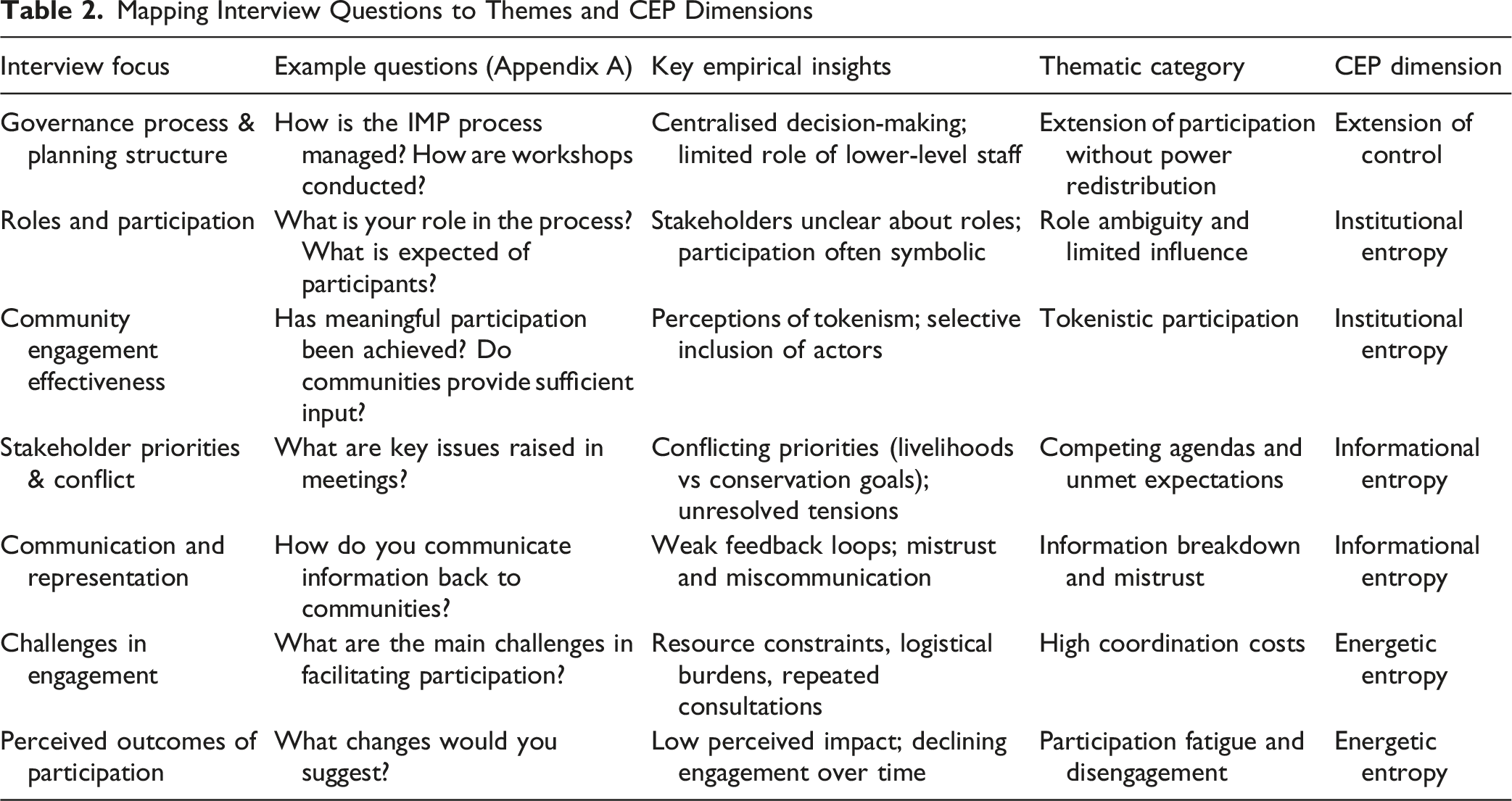
Data were generated through semi-structured interviews and document analysis. These two data sources were combined to enable cross-referencing between stakeholder perspectives and formal institutional records, thereby strengthening the interpretive depth and internal consistency of the analysis. The first author (Zulu) conducted 21 interviews between 2017 and 2018 with stakeholders involved in or affected by the management planning process. These included EKZNW officials, traditional authority representatives from communities surrounding the park, municipal officials from uMkhanyakude District and Big Five Hlabisa Municipality, local business association members, and community stakeholders involved in conservation-related initiatives. Interviews were conducted in English and isiZulu and explored experiences of the planning process, perceptions of inclusion and exclusion, institutional decision-making, resource and capacity constraints, and the perceived outcomes of engagement. The semi-structured interview guide used for data collection is provided in Appendix A.
Document analysis provided a formal account of the governance architecture underpinning participation. Key documents included the HiP Integrated Management Plan (EKZNW, 2018), relevant policy and legislative frameworks, including NEMA and NEMPA, Park Management Committee records, minutes of stakeholder meetings, workshop reports, consultation reports, and internal planning templates. These materials were examined to assess statutory requirements, the design of participatory structures, and the extent to which stakeholder inputs were reflected in planning outputs. The interview questions were designed to elicit perspectives on participation, decision-making, and governance dynamics, and informed the thematic coding of data in relation to the CEP. The integration of interview and documentary data enabled the identification of convergences and divergences between reported experiences and formal governance structures, thereby enhancing the robustness of the findings.
The data were analysed thematically following Braun and Clarke (2006). Coding was guided deductively by the three dimensions of the CEP: extension of control, production of informational, institutional, and energetic entropy, and efforts toward energetic balance. The analysis remained open to inductive themes, particularly around translation, mistrust, and uneven participation. The coding process was iterative and proceeded through multiple stages, including initial familiarisation with the data, open coding, code refinement and grouping, and the development of higher-order themes. Coding combined deductive categories derived from the CEP with inductive insights emerging from the data. A summary of the coding framework, including illustrative codes and their alignment with analytical themes and CEP dimensions, is provided in Appendix A.
Although the data were collected between 2017 and 2018, the analysis focuses on governance dynamics that are recognised as persistent features of conservation systems. Recent studies and institutional reports indicate that challenges related to stakeholder engagement, community relations, and institutional coordination persist across the broader conservation landscape (Dhliwayo et al., 2023; EKZNW, 2024; Fisher et al., 2023). This suggests that the patterns identified in this study reflect recurring structural conditions rather than time-bound observations.
Accordingly, the study adopts a structural, theory-driven approach, focusing on enduring features of stakeholder engagement, including participation processes, institutional roles, and resource constraints. These dimensions are not tied to short-term variation but represent established characteristics of conservation governance in the study area. This approach is consistent with qualitative research on governance, which often draws on historically grounded datasets to analyse institutional dynamics, path dependencies, and structural constraints over time (Mahoney & Thelen, 2010; Pierson, 2004; Yin, 2018).
To enhance transparency and analytical rigour, the interview guide is included in Appendix B, and all interview excerpts are presented using anonymised identifiers indicating interview number and stakeholder category (e.g., INT-03, EKZNW staff). While follow-up interviews could provide additional insight into temporal changes, such an approach falls outside the scope of this study, which is concerned with identifying and interpreting systemic governance patterns through the lens of the CEP.
Mapping Interview Questions to Themes and CEP Dimensions
Results
Extension of Control: Broadening but Centralising Engagement
The HiP management planning process formally widened participation to include both internal and external stakeholders in line with NEMA and NEMPA requirements (EKZNW, 2011). Internal participants included senior biodiversity managers and planners within EKZNW. External participants included traditional authorities, representatives of the Hluhluwe-iMfolozi Park Local Board (HiPLB), municipal officials, and private tourism operators.
Despite this broadening, authority remained concentrated among senior conservation officials. Lower-ranking staff, including section rangers and community conservation officers, were frequently excluded from planning workshops even though they had the most regular contact with neighbouring communities. External participation was also selective. While traditional leaders and local board members were included, youth organisations, women’s groups, and other grassroots actors were seldom represented. As one EKZNW staff member remarked, “decisions are still taken by senior management, we are just invited to be seen” (INT-03, EKZNW staff).
Notwithstanding recognised limitations, stakeholder engagement in HiP has institutionalised formal spaces for interaction between conservation authorities and local communities. Participation is “realised… through a Local Board” and reinforced by a co-management agreement designed “to facilitate… interaction”, alongside commitments to “transparent communication” with stakeholders. Engagement is further linked to material benefit-sharing through “a community levy… administered through the Community Trust Fund”. In practice, participation is iterative rather than episodic, with consultation “not a once-off event” (EKZNW, 2011:39). As one community participant reflected, “we are happy that, at least now, there is room for interaction… in the past, there were fewer opportunities for engagements of this nature” (INT-11, community representative). While imperfect, these mechanisms nonetheless expand opportunities for stakeholder interaction and communication.
Informational Entropy: Misaligned Agendas and Unmet Expectations
Interviews and workshop accounts revealed persistent tension between conservation priorities and community concerns. EKZNW participants emphasised biodiversity protection, zoning, and ecological sustainability, whereas community representatives prioritised employment, infrastructure, and losses associated with wildlife.
These divergent agendas limited the productivity of meetings. Several participants described workshops as “a battle that takes most of the time” (INT-07, community representative), with community concerns often treated as outside the scope of the management plan, despite formal provisions for stakeholder engagement (EKZNW, 2011). Community members, in turn, felt unheard. As one participant stated, “We talk about our problems, but they do not listen. They already know what they want” (INT-12, community representative). Participants from both sides described meetings as repetitive and unresolved.
While meetings were often marked by misalignment and tension, they nonetheless enabled the articulation of community concerns and, for some participants, enhanced awareness of conservation objectives. As one EKZNW staff member noted, …although initial tension is common, discussions become more constructive over time, allowing communities to learn about the park’s scientific work and engage through questions and exchange” (INT-01).
Institutional Entropy: Fragmented Roles and Tokenism
The expansion of stakeholder platforms did not create corresponding clarity about roles, authority, or accountability, even though these structures are formally defined within the management planning framework (EKZNW, 2011). Members of the HiPLB often acted as intermediaries, particularly by explaining technical issues to community participants, but their role remained advisory, and their influence over final decisions was limited.
Third-party facilitators were intended to promote neutrality, yet their reliance on EKZNW staff for translation raised doubts about the process’s independence. One community representative commented, “The facilitator is not sure whether the translator tells it as we say it” (INT-15, community representative). Stakeholders also described participation as tokenistic. In some cases, attendance reflected obligation rather than influence. As one participant explained, “We come because inkosi [chief] says we must” (INT-11, community member).
Across interviews, participants reported uncertainty about who held decision-making authority and how inputs were carried forward. Although multiple actors were involved, many felt that participation did not alter existing power relations.
Participation in HiP is formally institutionalised: “realised… through a Local Board” and sustained through consultation that is “not a once-off event” (EKZNW, 2011:39). These platforms create channels for engagement and provide opportunities to engage with Park management. However, participation remains largely consultative. As one participant observed, engagement is “mostly talk and little action” (INT-12, community member), with inputs solicited but seldom followed up. Stakeholders can speak, but rarely shape outcomes, revealing a persistent gap between formal inclusion and substantive authority.
Energetic Entropy: Costs of Participation and Capacity Strains
Stakeholder engagement imposed substantial logistical and organisational demands on EKZNW. Workshops required transport, venues, staff time, and repeated rounds of consultation, as outlined in planning procedures (EKZNW, 2011). Delays in finalising management plans increased these costs by requiring issues to be revisited over extended periods.
Capacity constraints intensified these pressures. Community conservation officers and junior staff were often insufficiently trained or briefed, weakening their ability to support the process. High staff turnover also undermined continuity and institutional memory. One participant described some officials as “as lost as the community members they were supposed to guide” (INT-05, EKZNW staff).
Communities also bore costs. Repeated meetings consumed time and energy without delivering tangible benefits, such as employment, improved infrastructure, or action against damage-causing animals. One informant summarised this frustration as follows: “We attend, but nothing changes. It is a waste” (INT-15, community representative). Several participants reported that attendance declined over time as confidence in the process weakened.
Energetic Imbalance: Fragility of the Engagement System
Across interviews, stakeholder engagement was described as increasingly difficult to sustain. For EKZNW, participation consumed scarce organisational capacity without generating equivalent gains in legitimacy or stability, despite formal commitments to inclusive planning (EKZNW, 2011). For communities, it required repeated investment of time and attention while socio-economic concerns remained marginal to final decisions.
A recurring perception was that the process protected institutional procedure more effectively than local interests. As one participant asked, “The park protects animals, but who protects us?” (INT-11, community representative). This sense of imbalance was reflected in accounts of fatigue, mistrust, weak follow-through, and declining commitment to participation.
Thematic Synthesis of Stakeholder Engagement Dynamics in HiP

Discussion
The HiP case demonstrates that stakeholder engagement is not merely a procedural requirement or normative good, but a structurally constrained governance process characterised by inherent trade-offs. While the management planning process expanded participation, aligning with statutory expectations under NEMA and NEMPA and broader commitments to inclusive environmental governance, this expansion did not correspond with a redistribution of authority, strengthened integrative capacity, or increased resource availability. Instead, the widening of participation generated additional informational demands, coordination challenges, and resource pressures. This disjuncture lies at the core of the CEP: efforts to extend governance reach can simultaneously intensify systemic strain, destabilising rather than consolidating governance processes.
These dynamics resonate strongly with empirical research on participatory conservation and co-management in South Africa and beyond. Studies consistently show that expanded participation often coexists with limited power-sharing, resulting in procedural rather than substantive inclusion (Cundill & Fabricius, 2009; Kepe, 2009; Thondhlana et al., 2015). Co-management arrangements are frequently characterised by asymmetries in knowledge, resources, and authority, constraining meaningful stakeholder influence. Institutional complexity and overlapping mandates further weaken accountability and produce fragmented governance outcomes (Cundill et al., 2013; Thondhlana et al., 2015), while land restitution and conservation partnerships have often failed to deliver expected benefits, reinforcing perceptions of exclusion despite formal inclusion (Kepe, 2009). Similar patterns are evident across African contexts, where participatory approaches struggle to reconcile conservation objectives with local livelihood needs (Dressler et al., 2010; Shackleton et al., 2009).
These findings suggest that the challenges observed in HiP are not isolated, but reflect recurring structural features of participatory conservation systems. The CEP provides a useful lens for interpreting these dynamics by linking expanding governance scope to increasing informational, institutional, and energetic pressures.
From this perspective, stakeholder engagement in HiP produced a form of inclusion without effective integration. While a broader set of actors was incorporated into planning processes, decision-making authority remained centralised, and institutional mechanisms for translating participation into influence were limited. This reflects a “thin” form of participation, where procedural inclusion coexists with persistent asymmetries in power and capacity.
This condition is further reinforced by institutional entropy. The proliferation of participatory structures (advisory bodies, facilitators, and community representatives) increased the number of governance interfaces without enhancing coherence. Roles remained blurred, accountability diffuse, and decision-making pathways opaque. Rather than strengthening governance, institutional expansion generated fragmentation. This aligns with critiques of “invited spaces” (Cornwall, 2008), but the CEP extends this argument by showing that such arrangements are not only politically constrained but organisationally fragile. Increasing institutional complexity without the corresponding integrative capacity can dilute responsibility and erode trust, leading to tokenistic forms of participation.
Futhermore, stakeholder engagement in HiP imposed significant material and organisational demands. Workshops, facilitation, transport, staff time, and repeated consultation processes required sustained inputs of energy, while communities incurred opportunity costs through participation that often yielded limited outcomes. These dynamics reflect energetic entropy: the dissipation of governance capacity through processes that fail to generate stabilising returns. When the costs of participation exceed gains in legitimacy, coordination, or decision quality, engagement becomes difficult to sustain, contributing to stakeholder fatigue and declining trust.
A key insight emerging from this analysis is the tension between exclusion and overload in participatory governance. Certain groups, including youth and women’s organisations, remain marginalised, reflecting persistent inequalities in access and representation. Simultaneously, the expansion of participation increases the number of actors, claims, and expectations that must be managed, placing growing pressure on limited institutional capacities. This is not a contradiction but a defining feature of the CEP: governance systems can be simultaneously under-inclusive and overextended, excluding key constituencies while lacking the capacity to integrate those who are included effectively.
This dual condition helps explain why participatory processes often fail to deliver either inclusivity or effectiveness. Without alignment between the scope of participation and the institutional and energetic capacity required to support it, efforts to broaden engagement risk amplifying disorder while reproducing inequality. Participation, therefore, is not inherently stabilising; its outcomes depend on the capacity of governance systems to process, integrate, and act upon the complexity it generates.
At the same time, it is important to recognise that stakeholder engagement processes have produced meaningful, if uneven, outcomes. The institutionalisation of participatory structures, such as the HiPLB and management planning processes, reflects a shift away from historically exclusionary conservation models. These platforms have created opportunities for dialogue, representation, and the articulation of community concerns within conservation governance.
In some instances, engagement has contributed to improved communication between stakeholders, increased awareness of conservation objectives, and the partial incorporation of community perspectives into management planning. Although these gains remain limited and inconsistently realised, they represent important developments within a constrained governance environment.
From a CEP perspective, these outcomes illustrate that stakeholder engagement is not only a source of disorder but also a mechanism through which governance systems attempt to generate legitimacy and coordination. The central challenge, as demonstrated in HiP, lies not in participation itself but in institutions’ capacity to sustain and integrate it effectively. Recognising both the productive and constraining dimensions of engagement provides a more balanced and theoretically grounded understanding of participation as a socio-metabolic process within conservation governance.
Implications for Conservation
The analysis of stakeholder engagement in HiP highlights several governance implications for protected areas across the Global South. First, participatory processes are not cost-neutral; they require sustained energetic and institutional investment. In contexts where conservation authorities operate under constrained budgets and limited staffing, expanding participation can generate fatigue, coordination breakdowns, and governance fragility. Designing engagement processes that align with organisational capacity is therefore critical. Participation that exceeds the system’s integrative and resource-based risks undermines, rather than strengthens, conservation outcomes.
Second, reducing informational entropy is essential for effective engagement. Misalignments between conservation authorities and communities often arise not only from conflicting interests but from breakdowns in communication, translation, and trust. Improving the clarity, accessibility, and responsiveness of engagement processes, through skilled facilitation, translation of technical knowledge, and early alignment of expectations, can enhance decision-making quality and reduce conflict.
Third, participatory structures must be both coherent and consequential. The proliferation of committees, forums, and stakeholder platforms does not in itself strengthen governance. Where such structures lack clear mandates, decision-making authority, and accountability, they can increase institutional entropy and reinforce perceptions of tokenism. Strengthening feedback loops, clarifying pathways from participation to decision, and ensuring that stakeholder inputs visibly shape management actions are essential for building legitimacy and trust.
Finally, the findings highlight the importance of evaluating stakeholder engagement not only in terms of inclusivity, but also in relation to its socio-metabolic balance. Participation redistributes both voice and burden, often unevenly. Conservation planners should therefore assess whether the energetic and organisational costs of engagement generate commensurate returns in terms of trust-building, conflict resolution, and ecological effectiveness. Recognising both the democratic value and the thermodynamic limits of participation can support more adaptive, resilient, and socially grounded approaches to conservation governance.
Footnotes

Ethical Considerations
The study received ethical clearance from the UNISA College of Agriculture and Environmental Sciences (CAES) Health Research Ethics Committee (approval reference: 2017/CAES/170). All interview participants provided informed consent prior to participation, and their identities have been anonymised in all reporting. The study also draws on documentary sources, specifically the publicly available Hluhluwe-iMfolozi Park Integrated Management Plan. As such, no additional institutional permission was required for its use. The data used in this study were originally collected as part of a postgraduate research project. While participants were not formally re-engaged for feedback during the preparation of this manuscript, the analysis is presented at an aggregated level, and care has been taken to ensure that participant perspectives are represented accurately and without attribution. The absence of formal participant validation is acknowledged as a limitation of the study. Future research could incorporate participatory validation processes, such as stakeholder feedback workshops, to further strengthen the co-production of knowledge.
Funding
The authors received no financial support for the research, authorship, and/or publication of this article.
Declaration of Conflicting Interests
The authors declared no potential conflicts of interest with respect to the research, authorship, and/or publication of this article.
Data Availability Statement
This study is based on qualitative interview data and management planning documents. To protect participant confidentiality, the full interview transcripts and raw audio files cannot be publicly shared. An anonymized dataset containing coded thematic categories, along with a list of publicly accessible documents used in the analysis, is available from the author upon reasonable request, subject to UNISA’s ethical guidelines and data protection requirements.
Appendix
Coding Framework and Thematic Structure
CEP dimension
Theme
Illustrative codes
Description of codes/Analytical meaning
Extension of control
Broadening of stakeholder inclusion
Stakeholder invitations; formal participation; compliance with NEMA/NEMPA; inclusion of traditional authorities; presence of local boards
Captures the formal expansion of governance reach through the inclusion of multiple stakeholder groups in planning processes.
Selective inclusion and exclusion
Exclusion of youth/women; absence of grassroots actors; marginalisation of junior staff; elite representation
Reflects uneven participation, where inclusion is structured and controlled rather than fully representative.
Centralisation of decision-making
Top-down decisions; limited influence of stakeholders; managerial authority; symbolic participation
Indicates that despite expanded participation, decision-making power remains concentrated within EKZNW.
Informational entropy (epistemic/political dimension)
Divergent stakeholder priorities
Livelihood concerns; conservation priorities; zoning conflicts; employment expectations; livestock predation concerns
Represents competing value systems and priorities between conservation authorities and communities.
Miscommunication and translation challenges
Language barriers; reliance on translators; loss of meaning; technical jargon; unclear messaging
Captures degradation of meaning as information moves across actors and institutional interfaces.
Repetition and unresolved issues
Recurring discussions; unmet expectations; lack of feedback; meeting fatigue
Reflects accumulation of unresolved claims and declining decision-relevance of engagement processes.
Epistemic distortion and mistrust
Perceived exclusion; distrust of process; selective representation; “they don’t listen” narratives
Highlights how stakeholder knowledge is filtered, distorted, or dismissed, reducing legitimacy and trust.
Institutional entropy
Fragmented governance structures
Multiple committees; advisory roles; overlapping mandates; unclear responsibilities
Reflects the proliferation of institutional interfaces without effective integration.
Tokenistic participation
Attendance without influence; symbolic inclusion; obligation-driven participation
Indicates that stakeholders are present but lack real decision-making power.
Weak accountability and coordination
Lack of follow-through; unclear authority; difficulty assigning responsibility; coordination failures
Captures the erosion of accountability due to dispersed authority across actors.
Mediated representation
Role of local boards; intermediaries; filtered communication; facilitator dependence
Highlights reliance on intermediaries that may distort or dilute stakeholder inputs.
Energetic entropy
Institutional resource strain
Staff time; budget constraints; logistical costs; workshop organisation; administrative burden
Reflects the material and organisational costs of sustaining engagement processes.
Capacity limitations
Inadequate training; staff turnover; lack of facilitation skills; weak institutional memory
Captures limits in organisational capacity to manage participatory processes effectively.
Community opportunity costs
Time spent in meetings; lost income; unmet expectations; participation fatigue
Represents the socio-economic costs borne by communities engaging in the process.
Repetition and inefficiency
Repeated consultations; delays in planning; restarting processes; low return on effort
Indicates inefficient use of energy where inputs do not translate into outcomes.
Energetic imbalance (system-level outcome)
Declining returns on participation
Low impact of engagement; lack of tangible outcomes; frustration; disengagement
Reflects imbalance between energy invested and governance outcomes achieved.
Participation fatigue and withdrawal
Reduced attendance; disengagement; apathy; resistance to future participation
Indicates weakening of stakeholder commitment due to unmet expectations.
Governance fragility
Mistrust; conflict persistence; unstable relationships; legitimacy deficits
Captures system-level instability arising from accumulated entropy across dimensions.