



Abstract
This paper discusses the possible consequences of mass media fragmentation over the structure and the functioning of democracy. Media fragmentation and audience segmentation are not new but they greatly increased in the very last years because of the long ongoing tendency towards commercialization and mostly because of the development of new media and the internet in particular. This has determined what is usually defined “the crisis of traditional journalism” that has become the very frequent topic of most of the seminar on journalism today. The last part of the paper looks at the possible consequences of these changes over the structure of democracy beyond the well rooted techno-optimism: increasing social and political polarization, new forms of political socialization, more complex process of social and political negotiation, new forms of public scrutiny.
The Crisis of Journalism: Past and Present
Most of the titles of today’s meetings, conferences, and seminars on journalism contain recurring words: crisis, future, and change. Obviously, this is not fortuitous. The recurrent presence of these words points out that, yes, there is a problem. This diffused feeling started with the 2009 publication in the Columbia Journalism Review, of the report significantly titled “The Reconstruction of American Journalism.” 1 Since the publication of this report, the feeling that, at least, Western journalism is in crisis has gained ground. It has become the dominant image of journalism in this part of the world (Fenton 2010; Franklin 2010; Levy and Nielsen 2010).
The most diffused characteristics of the crisis are well known: the circulation of print press is decreasing, profits are shrinking, and television news is not in better shape. Many news outlets are disappearing from the market and those that remain in the competition are firing reporters and reducing their organizations—fewer correspondents, fewer foreign offices, etc. If one looks beyond print press, the situation of crisis may change its character but it still remains.
To better explain the changes that journalism is undergoing, I would use the expression “blurred identity,” for which I’m indebted to Jan Zielonka. 2 In the Columbia Journalism Review, it is possible to read the same word again in relationship to the changing nature of journalism: “What is a journalist? In Western media circles these days, the boundaries are blurring between online newspapers like the Christian Science Monitor and Guardian.co.uk, ‘blogs’ such as Huffington Post.com, YouTube’s ‘citizen journalism,’ and the rantings of political attack-dogs of all political stripes. Sure, HuffPost has a White House press pass, but beyond that, it’s all semantics, right?” (Pintak and Fouda 2009). The identity of journalism in much of the Western world is becoming “blurred,” more confused, and less stable in terms of both structure and professional identity. The old certitudes are disappearing and new ones are not yet defined. This scenario makes this article very speculative as it deals with changes that are taking place at a very fast speed and that have not yet been investigated in depth by scholars. While investigating the causes of the so-called crisis of journalism, I will try to place them within a larger picture of changes and possible problems affecting also the structure of our democracy.
Professional journalism is changing dramatically for at least two main reasons: increasing commercialization and technological innovation. Both reasons determine what is already well known: mass media fragmentation and audience segmentation. The consequences of this change are even more general, affecting the structure of our democracy and determining strange “paradoxes” regarding the general relation between media and politics that I outline in the next pages.
Indeed, I want to argue that beyond the already well-known evaluations of techno-optimism versus pessimism (Wilhelm 2000; Benson 2010), there are other consequences deriving from the ongoing changes that have not been stressed or discussed sufficiently in the literature. Fragmentation may have very positive consequences as it increases the number of available sources of information and may represent a more diffuse instrument of control, as I argue. But at the same time, fragmentation may produce consequences on the structure of democracy that are not to be underestimated. These consequences may take different forms and may have different intensity in well-established and transitional democracies and different structures of the mass media system. They represent challenges for decision makers and for those who are involved with professional journalism and politics, for they imply new models of socialization and participation.
Already in 1992, my colleague Daniel Hallin wrote an article that in spite of being written in a pre-Internet era, anticipates a description that seems completely applicable to the present situation of the mass media system. In this article, which has been discussed at length by many commentators, 3 Hallin (1992) maintains that the universalism that featured the golden age of American journalism, embodied by figures such as Walter Cronkite and Ed Murrow and rooted on the ideas of professional autonomy, objectivity, and distance from advertising and political pressures, was close to an end. In 1996, Elihu Katz wrote an article that with different words and from a different normative view, discussed a similar situation pointing out the risks of the process of audience segmentation that was replacing the traditional mass audience. For Katz, the increasing commercialization of the mass media system, also stressed by Hallin, determined the end of the common meeting ground ensured by a previously less commercialized media system: the cohesion of the nation-state itself was at stake following increased segmentation of media audiences (Katz 1996).
Cass Sunstein’s idea of “daily me” created by communication technologies is not far from Katz’s argument. “Perhaps you have no interest at all in ‘news’. Maybe you find ‘news’ impossibly boring. If so, you need not see it at all. Maybe you select programs and stories involving only music and weather. Or perhaps your interests are more specialized still, concentrating on opera, or Beethoven, or Bob Dylan, or modern dance, or some subset of one or more of the above (Maybe you like early Dylan and hate late Dylan)” (Sunstein 2007: 2). In this sentence, too, a process of individualization is closely linked to the segmentation of the media system that in Sunstein’s thesis now depends on technological innovations, more precisely on the web, and not just on commercialization.
The changes in the structure of communication may affect the structure of our democracy as Katz underlined. Bruce Bimber (2003) has observed how information technologies have affected American democracy over the years. The most recent situation, which Bimber defines as the “Fourth Information Revolution and Postbureaucratic Pluralism,” is characterized by media fragmentation and the birth of more flexible, less structured and volatile political organizations. The main thesis of his book is as follows: “Technological change in the contemporary period should contribute toward information abundance which in turn contributes toward postbureaucratic forms of politics” (Bimber 2003: 21).This change implies that traditional political organizations are less capable of managing and affecting the political arena, leaving space for new forms of social aggregations strictly depending on the new structure of the communication system.
Media Fragmentation Today
The situation described by both Hallin and Katz has been brought to an extreme by the Internet, and more in general by new technologies. With the Internet, the number of possible sources of information increases and, therefore, the number of consumers is distributed across a larger number of media outlets. This shapes new patterns of consumption that either give life to new consumers or move traditional consumers from old to new media. Mass media fragmentation generates audience segmentation. Many have already talked about the end of the “mass audience” taking place with the fast development of the Internet (Rheingold 2000; Chaffee and Metzger 2001; Castells 2010). Sunstein (2007: 9) writes: "the whole idea of general-interest intermediaries providing shared experience and exposure to diverse topics and ideas for millions was a short episode in the history of human communications.”
What is defined today as the crisis of journalism is grounded in this new process of fragmentation. Even the print press is undergoing a process of internal fragmentation. Indeed, the decrease in the circulation of traditional paid newspapers has been largely compensated in many Western democracies by the birth and development of free newspapers. Although this has brought new readers (and, of course, has taken readers away from paid newspapers), total circulation numbers in many countries has either increased or has remained stable. But here is a first sign of blurred identity: free press journalism is very different from traditional journalism for it demands different kinds of reporters and work procedures.
Traditional analogic television has undergone similar transformations (Prior 2007; Havick 2000; Chaffee and Metzger 2001). Today, with the development of new media, and Internet in particular, citizens have more choices in terms of cultural consumption. Multiplicity and polycentrality are the words that Natalie Fenton (2010) has used to describe the new media environment. John Keane has used the expression “The era of abundance” to indicate the richness that features today’s mass media system. 4 The same expression was used by Blumler and Kavanagh in their paper on the “third age” of political communication (1999).
In a fragmented media market, each new (and old) media outlet is forced to find its own target/audience to distinguish its own product from the others. The old logic by which few companies compete for the broadest audience possible (the so-called golden era of broadcasting) is over. Segmentation is replacing the mass audience. “Niche audience” has become the dominant paradigm (Iyengar and Hahn 2009; Jomini Stroud 2011; Starr 2012). The most discussed example of this tendency is Fox News. There is no doubt that its conservative slant derives from September 11 and the anti-Islamic, strongly nationalist feelings that the attacks aroused in the United States. These contextual factors have been embodied in a definite market strategy: to compete in the crowded U.S. television market with the older and established twenty-four-hour cable channel, CNN. Fox News has chosen its own target/audience: a less sophisticated and clearly more conservative public than CNN’s audience. According to a survey conducted by the Pew Research Center for the People and the Press, “Nearly half of Americans (47 percent) say they think of Fox News as ‘mostly conservative.’” 5 This has been a deliberate choice by Fox News to distinguish itself from its competitors. The initial conservative, anti-Islamic, nationalistic slant has been further championed amid political polarization following the election of President Barack Obama, the approval of health care reform strongly opposed by a large part of American citizens, and the birth of the “Tea Party” movement that has identified Fox as its spokesperson. In this polarized environment, Fox News has found conservative citizens as its primary audience (Iyengar and Hahn 2009).
This conservative slant (such as a possible liberal slant in a potential competing network) takes shape with the adoption of a less neutral and more partisan and aggressive journalism that may appear to be very far away from the traditional liberal model that characterized American journalism in the middle of last century and that today many—as suggested in the aforementioned Columbia Journalism Review—seem to regret.
Discussing the audience of Fox News, Natalie Jomini Stroud (2011) talks of “partisan selective exposure” as the emerging tendency. The results of her study confirm what has been discussed: “Conservatives and Republicans are more likely to read newspapers endorsing a Republican presidential candidate, browse conservative-leaning magazines, listen to conservative talk radio, watch Fox News, and access conservative Web sites. Liberals and Democrats are more likely to read newspapers endorsing a Democratic presidential candidate, subscribe to liberal-leaning magazines, listen to liberal talk radio, watch CNN or MSNBC, and access liberal Web sites” (Jomini Stroud 2011: 169).
Blurred Identities
All this makes today’s journalism “blurred.” First, the process of fragmentation has caused the disappearance and weakening of many traditional and established media organizations, and the birth of new media outlets that cannot be defined as traditional “news organizations.” The Internet, Twitter, and blogs are dramatically changing the nature, procedures, and norms of traditional professional journalism (Witschge and Gunnar Nygren 2009; Lasorsa, Lewis, and Holton 2011).
Back in 2005, Barbie Zelizer (2005) wrote an article around these questions: “Can bloggers be defined journalists?” What kind of professional culture do they perform? Are they reliable sources of news? The differences among blogs, social networks, and journalism are becoming increasingly confusing. There is no doubt that citizens’ journalism increases the circulation and the availability of sources of information. Great for democracy! But at the same time the reliability of news circulating in the Internet decreases dramatically. The process of de-professionalization of web sources seems to advance even further. Writing about the market crisis of Yahoo, the International Herald Tribune put it: “the tale of Yahoo’s misfortunes is not just of management troubles. It is a vivid illustration of the transition from Web sites that publish professional content to a new digital world dominated by mobile phones and sites where users are the creators of content.” 6 In their study of German web sites offering “journalistic” content, Neuberger and Nuernbergk (2010: 321) ask: “Are organizational forms like editorial staffs or trained journalists, who regularly pursue a journalistic profession, still needed in order to gather information and select and disseminate news?” They conclude their study stressing how “participatory media tend to complement rather than to replace professional journalism” (p. 321). While this confirms that traditional media still play a major role in disseminating information, and that we are in a process of dramatic, fast-speed change, the questions raised by new technologies is not only “who are the professional journalists” but “what kind of organizations can produce journalistic content” and their relationship with the traditional ones. With the advent of “disintermediation” (Chadwick 2006), the traditional organizations that were in charge of the operation of “intermediation” enter a crisis of identity or, at least, they are going through a dramatic process of change. Even if bloggers and social networks do not enter the field of “professional journalism,” there is no doubt that they become source of information for much of the world of the so-called professional journalism (what Neuberger and Nuernbergk define as the complementary role of new media). Also, many citizens, mostly young people, rely on these sources for everyday information needs.
The most confusing “blurred boundaries” are between sources of information and political activism. Indeed, most of the time (not always) blogs embody communities identified by common ideological and political feelings. The dramatic and recent diffusion of Facebook and other social network sites clearly reinforce these tendencies as people get together mostly when they share common interests (topics, habits, passion for the same brand or sport team, living in the same community) or common feelings and perceptions that are often political. As Andrew Chadwick (2006: 26) writes, “Most of the claims about the Internet’s role in promoting political participation rest on an underlying view of community. In this perspective, the Internet is medication for the perceived ills of modern society: isolation, fragmentation, competitive individualism, erosion of local identities, decline of traditional religious and family structures, and downplaying of emotional forms of attachment and communication.”
Blogs and social networks are becoming sources of information for final consumers and other news outlets (the so-called old media) that transform what they find in the Internet into a news story for final consumers. Here everything becomes blurred: the goal of informing people overlaps with sharing and reinforcing common feelings and attitudes that frequently represent the goal of the social networks that originate in the news. What happened recently in the Mediterranean is a clear demonstration of this: blogs and social networks were instruments used to spread news but, at the same time, they were instruments to organize activists and mobilize citizens. They were also sources of information for many “traditional” news media outlets around the world.
To sum up, increased commercialization and Internet are dramatically changing the landscape of today’s journalism along three main lines that imply important changes in relation to democracy. If “technological optimism” (Benson 2010) is still valid, it has to be framed within a set of conditions:
Fragmentation: news media addressed to a mass audience are gradually disappearing. Because of the increased commercialization and new technologies, “niche news” become dominant.
Less clear identity of news organization: fragmentation is determined also by the development of many sources of information (blogs, social networks, etc.) that can’t be defined as “news outlets” in the traditional sense. The nature of these online organizations may be different from traditional journalism. While they frequently become sources of information for the “traditional” media, they are also becoming providers of news for many, particularly young, consumers.
Less defined professional identity: Most of those who work on online outlets are not journalists. They do not have any professional training and, what is more important, their main goal is not the circulation of news but mobilization and consensus building. The professional identity of journalists becomes blurred. Expressions such as “citizens’ journalism” and “do-it-yourself journalism,” also used in the scientific literature (Chadwick 2006; Fenton 2010), are the best metaphors for the emerging blurred professional identity.
Consequences on the Structure of Democracy
The changes taking place today in the structure of the mass media system and the professional identity of journalists may deeply affect democracy. In particular, I see four main consequences that are discussed in the next pages, although there is still little evidence of these recent tendencies.
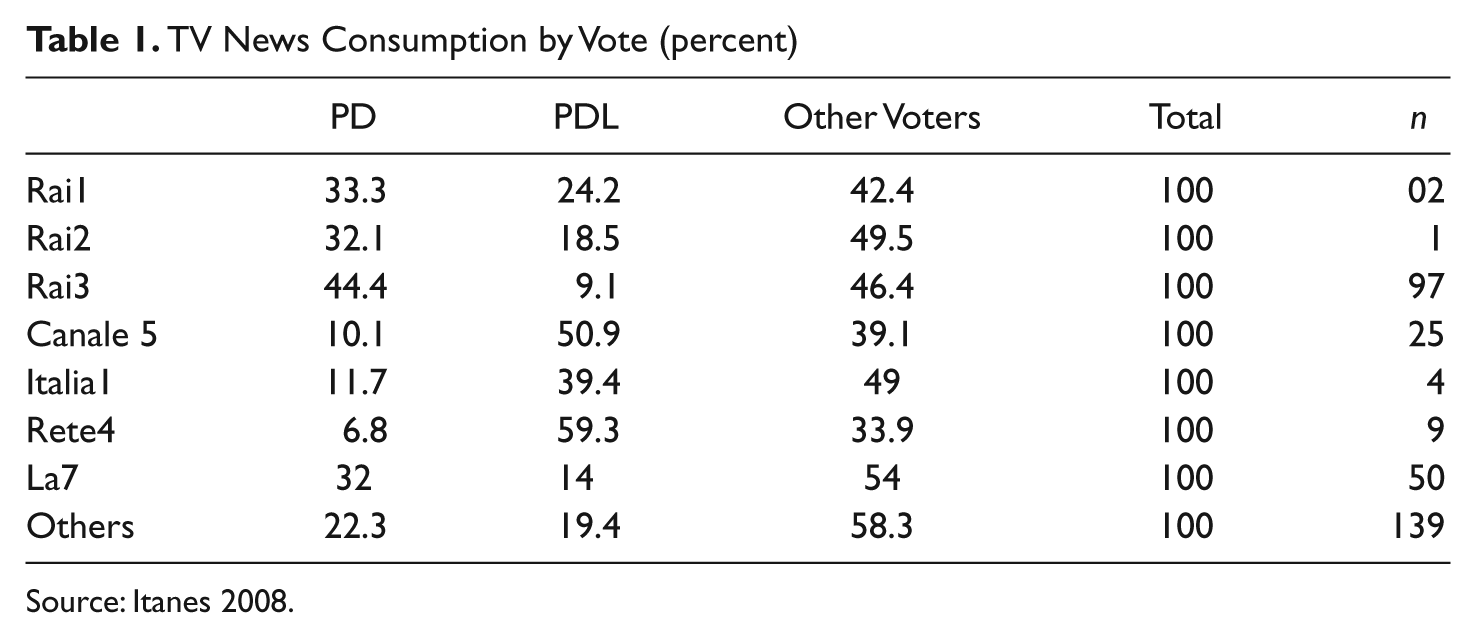
The first possible consequence of media and audience segmentation is an increased social and political polarization. Members of the community rely on already existing knowledge and opinion. Consequently, a place, even of symbolic nature, where one can meet with others and get in touch with their needs, opinions, and proposals may be missing. Citizens will be reinforced in their opinions rather than becoming open to new ideas and feelings. What Table 1 shows about Italy may be a likely future for a world characterized by high media fragmentation. Italy is undoubtedly a polarized country; it has always been since medieval times and it still is. The figure of Berlusconi has further increased the level of political polarization that has always existed but along different lines. The development of a market-driven, mass media system in the 1980s increased the number of media outlets. They have increasingly addressed their own niche audiences following the tradition of political parallelism. It could be said that citizens have been divided into those who watch Mediaset channels and those who watch Rai channels. Those who vote for Berlusconi watch his own networks. By knowing how many citizens watch Canale5, Rete4, or Italia1, one can predict electoral outcomes. Legnante and Sani (2008) write, “the importance of television is associated with one of the major featuring characteristics of the election in the Second Republic: the alignment between electoral choices and TV consumption.” 7
TV News Consumption by Vote (percent)
Source: Itanes 2008.
As shown in Table 1, 50.9 percent of those who watch Canale5 (the major Mediaset channel) vote for Berlusconi’s party (Popolo della libertà, PDL), while only 10.1 percent vote for the major competing party (Partito democratico, PD). On the opposite side, 44.4 percent of those who watch Rai3 (the traditional leftist Rai channel) vote for Partito democratico (Pd), while only 9.1 percent vote for Popolo della libertà (PDL). These data confirm results from previous studies (Itanes 2001, 2006) and suggest high level of political parallelism in the Italian public sphere. This does not facilitate the existence of a common field of interests and values; instead, it pushes toward the polarization of political options and affiliations that have made Berlusconi’s victories possible. In this context, the news media don’t play that function of social integration that could foster necessary negotiations and agreements. They don’t foster the kind of common knowledge and opinions that could make possible a more integrated, more dynamic society open to change.
Mass media and audience fragmentation will increase political polarization particularly in countries where involvement in the public good has been traditionally lower, such as Italy, other Mediterranean countries, and Central and Eastern Europe (Hallin and Mancini 2004), where the government is not able to provide the various resources, services, and policies that make citizens feel part of a community that takes care of them, and where essential rights are not universally ensured and the rules of the democratic game are adapted to different circumstances and actors (Mungiu Pippidi 2010). Media fragmentation may have different consequences in countries where the idea of common good, a common “house,” is stronger. For decades, the mass media in Northern European countries were politically defined as the news media were during the first years of journalism everywhere (Hadenius 1983; Sollinge 1999). Also, along with press subsidies, the sense of belonging to the national community was high because of welfare state policies and other interventions that established and reinforced the sense of common belonging.
Media fragmentation in traditionally homogeneous countries may increase polarization, too. This is what Iyengar and Hahan (2009: 20) observe about the United States: “It is no mere coincidence that the trend toward a more divided electorate has occurred simultaneously with the revolution in information technology. Forty years ago, the great majority of Americans got their daily news from one of three network newscasts. These newscasts offered a homogeneous and generic ‘point–counterpoint’ perspective on the news, thus ensuring that exposure to the news was a common experience. … Given this dramatic increase in the number of available news outlets, it is not surprising that media choices increasingly reflect partisan considerations.”
Baum and Groeling had convincingly demonstrated the increased polarization of American political opinions following the development of the online media environment: “Regardless of their normative implications, our findings offer a striking validation for those who complain about one-sided coverage of politics in the so-called blogosphere. Daily Kos on the left and Free Republic and Fox News on the right demonstrate clear and strong preferences for news stories that benefit the party most closely associated with their own ideological orientations” (Baum and Groeling 2008: 359). They write, “For instance, a 2006 survey on media consumption (Pew Center 2006) reported the percentages of self-reported ‘regular’ users of 21 news genres and outlets who indicated that they prefer news ‘from sources that share [their] political point of view’ to ‘sources that don’t have a particular point of view’” (Baum and Groeling 2008: 360).
The situation of “abundance” in the contemporary mass media threatens the existence of a common place to meet and debate contrasting views. This common place is replaced by partisan outlets whose main goal is to reinforce already existing opinions and to serve as organization tools. “Group polarization” or “blogs polarization” seem to be the emerging tendency while information “cascades,” that is, the continuous flow of information that may derive from an uncontrolled source (Sunstein 2007), further increase social and political polarization and complexity.
Party Systems and New Forms of Participation
Media outlets may progressively substitute political parties and other traditional organizations of political socialization; they may join the already existing ones and/or give space to new forms of social aggregations. At the time of the mass audience, it was clear that news media were replacing political parties as the main sources of information and instruments of political socialization. Now the situation is different: the news media outlets are becoming political actors. Different media outlets and single media figures (anchormen, TV stars) enter the field of politics with either their own organizations or with an organization that they construct thanks to the Internet.
It is not just a matter of celebrity politics, which a vast literature has already pointed out (Marshall 1997). What happens today is that news outlets (and their owners or the members of the star system) become political actors and enter the field of politics and electoral campaign. The case of Silvio Berlusconi is the best example of the opportunities that increased commercialization of the media may create. After establishing his successful media corporation, Berlusconi decided it was time to enter the political arena. He was able to accomplish this largely because of the opportunities offered by his ownership of the Mediaset corporation.
Frequently, blogs and different kinds of social networks that are politically active make the decision to compete in free elections or to assume a clear political position vis-à-vis authoritarian regimes. The recent revolutions in Tunisia and Egypt have demonstrated very clearly how different kinds of online social networks, which played major mobilization and organization roles, take the place of nonexistent or weak political parties. They have been able to serve as instruments to connect people and give voice to their needs and requests. As we know, they were successful in overthrowing authoritarian regimes that had been in power for several decades. This is what the “Arab Spring” has demonstrated, even though it may be risky to overestimate the role of the new media (Shirky 2011). 8
Blogs and social networks have been able to play such an important role not only where traditional, political organizations are absent, but also where political organizations exist and are grounded in experiences of new forms of political organization linked to Web-based media. The Italian Movimento 5 Stelle (Five Stars Movement) illustrates this phenomenon. Some years ago, Beppe Grillo, a well-known show man, started a blog against corrupt politicians and in favor of issues that had been forgotten by political parties. Within a few years Grillo’s blog became the most popular in Italy. Grillo decided, together with young people who had contacted him through the Web, to start a political movement, the “Movimento 5 stelle.” It obtained significant results in the polls, and competed with other center-left parties that were better organized (Lanfrey 2011).
The well-known case of “Pirates” is no different. Established in Sweden in 2006 essentially through the Internet, it spread all over the world and it became the Pirates Parties International, with its main seat in Brussels in 2010. 9 Its main electoral success was in the Berlin state elections, where the German branch of Pirates got 8 percent of the vote. This is a different party compared to the traditional ones: it has a weakly organized structure and its communication channels essentially depend on the Internet. Pirates parties are mostly single-issue parties: they are a perfect example of what Helen Margetts (2006) defines as a “cyber party,” new parties established in the Internet.
One politician interviewed for the project “Media and Democracy in Central Eastern Europe” told us the story of “a problem in Bulgaria with fuel prices. A group was created on Facebook to protest against increasing fuel prices, and after that, this group became a political party.” 10 Interviewed for the same project, Mihai Coman from the University of Bucharest, tells another interesting story on how bloggers and television showmen can establish a political party: “And of course, there have been some cases of journalists or media moguls creating their political parties. An interesting case is Dan Diaconescu—he came from print press, and had worked for some time for the ‘real’ media mogul Dan Voiculescu. He created a weekly, then became independent and started his own television, OTV. It used to have something like 0.0001% of the audience share. Then, something happened—an attorney was killed, but nobody found her body. Her husband, a ‘usual suspect,’ was a policeman. And this guy made a national O.J. Simpson–kind of show out of this case. For one year, he had kept the nation focused at Erodea—this was the name of that lady. The audience ratings went sky-high, and he used that moment to create his own political party.” 11
New technologies also favor the formation of new social movements (very often of an international nature) and may strengthen their organizations by representing powerful instrument of mobilization (Bennet 2008; Mosca and Vaccari 2011). This was already noticed years ago at the time when the diffusion of new communication technologies was much less developed than today (della Porta and Tarrow 2005) and the recent events in the Arab world have further demonstrated the enormous capacity of twitter and blogs in becoming an exceptional instrument of organization (Valeriani 2011).
This appears to be another step toward the progressive weakening of traditional mass parties but also toward the increasing fragmentation of the political landscape that now appears to be open to a number of different competitors very frequently without any previous traditional, political experience. These new entities may be driven by affiliation with and sympathy for new values and attitudes that are of very different nature from the previous political ones. This is the case of the so-called lifestyle politics that finds such a large space in the new online communities (Bennet 1998, 2003, 2008). As it is well known, in this regard scholars have talked about “postbureaucratic” and “decentralized” organizations stressing the changes that the Internet is determining at the level of government and political organizations. The borders of these organizations are becoming blurred and their internal operations less hierarchical and less dependent on the existing formal structure (Bimber 2003; Chadwick 2006). This new “modus operandi” has undoubtedly favored new and smaller parties while better established and older parties have had some difficulties to adapt to the new environment (Margetts 2006).
All this may produce a more complex political environment, crowded with competitors talking different languages, not used to the traditional ways of political bargaining, and being representatives of new and different values, needs, and interests. In all likelihood, these new parties will not be able to win elections but they may increase the fragmentation of the political spectrum and prevent the possibility of a clear majority in parliament. Does it mean that democracy becomes richer? Of course, but more complex, too.
Consequences on Government Scrutiny
The following two sections are more speculative. Studies have not yet been conducted although there are indications of several tendencies at work.
The existing literature stresses the positive consequences of the diffusion of the Internet. Citizens have the opportunity to access an enormous amount of information; government is more transparent and becomes the subject of continuous scrutiny by citizens (Klotz 2004). But at the same time, the development of “group polarization” may favor the formation of different enclaves, what Sunstein defines as the “echo chambers,” places where one can hear just his own voice or similar voices. These groups are becoming numerous, but at the same time they are becoming less powerful vis-à-vis the government as they are more interested in improving their internal capacity for deliberation than looking at alliances with other groups. This is one possible risk of the “daily me” amid the decreasing importance of “general interest intermediaries” and their capacity to build alliances among groups of different nature and affiliation (Sunstein 2007). A possible consequence is that the watchdog function traditionally played by the news media may become weaker because of audience segmentation. Undoubtedly, the possibility of control of the government may increase because of the multiplication of information sources. It needs to be recognized, however, that the traditionally centralized media system of the past was able to play a major watchdog function because of the large number of people, the “mass audience,” that it was able to reach. Today the new media environment is characterized by news outlets addressing “niche” audiences. It was almost impossible for the government not to take into account criticism from “traditional” news media that reached large numbers of people. If the New York Times adopted a position about a particular issue, the U.S. government could not ignore it (Hallin 1986). Today a fragmented media system lacks similar influence. Here a strange paradox emerges: there are more possibilities to control the government but, because of sources fragmentation, the impact may be weaker and scattered. In his study on anti–Iraq war demonstrations, Lance Bennett (2008: 286) makes a similar point: “Many questions can be raised about these emerging styles of activism and mobilization. Perhaps the most important issue is whether such flexible political identifications operating through such personalized political communication channels can produce the kinds of focused collective action that often seem necessary to define common goals, develop power relationships with targets of protest, and ultimately achieve political and social change.” This is an open question that requires further research.
Consequences on Social and Political Negotiations
The nature of advocacy and mobilization of old and “new” news media makes the entire political environment more complex and blurred. Although many organizations may have their “voice” in the decision-making process governance becomes complex and fragmented in multiple and often contradictory levels of interaction (Chadwick 2006). Indeed, next to traditional political actors, there are many actors who represent old and new interests that have a temporary existence. Social movements, particularly given the young age of members and activists, take great advantage of these opportunities, advancing their requests and using new media as mobilization tools (Bimber 2003; Nah, Veenstra, and Shah 2006; Shah et al. 2005). Interest groups, too, benefit from these new possibilities (Bimber 2003; Chadwick 2006), and other social actors emerge in the public sphere by using opportunities offered by the Internet.
Less stable than similar actors in the past, they are the product of contingent and temporary conditions (not rarely of some dramatic nature). Moreover, these new actors don’t have well-established cultural and social roots. They are, in the words of Bruce Bimber (2003), “postbureaucratic” organizations exposed to volatility and informality. They lose control over internal and external flows of information (Bruce and Delli Carpini 2001). They become more vulnerable to pressures and manipulations as their identity is always under threat (Bennett 2003).
Take the example of the Egypt and Tunisia. Social networks had a major role in overthrowing the old regime, but their temporary and “movement” nature is emerging. Because they are the product of strong emotions and improvisations, they are not able to express and support stable and clear issues. They are not able to represent trusted and stable interlocutors for the new regimes (Lakhani 2001). 12
As previously stated, evidence of these tendencies from scholarly research is still poor and fragmented. An example of this new complex framework of negotiation linked to the process of fragmentation is offered by a story by Massimo Gaggi, the Il Corriere della Sera correspondent in Washington. Discussing the difficulty to pass a new budget, Gaggi writes: “Congressmen wander around as crazy ants also because they don’t have any more clear ideas on what public opinion believes and what their voters believe. In the era of digital technologies the old mechanisms of consensus building have disappeared. Not only the old anchormen such as Walter Cronkite who were able to strongly influence public opinion with their sober and moderate discourses don’t exist anymore. The abundance of news channels, the extreme tones of the debate on the internet and on the talk shows, the cable televisions, from CNN to Fox, that roll their drums 24 hours a day, puzzle the spectator—voter citizen who react condemning the entire Washington and the politicians who live there.” 13 It is not coincidental that Gaggi mentions Walter Cronkite, an indication that probably the era of mass audience with its heroes is over. It is a new, more open but a more complex, era. As Rodney Benson suggests (2010), the model of pluralist democracy may gain advantage from the new media, but at the same time it may risk implosion because of increased complexity.
Finally, we should not ignore that the complexity of social and political negotiations is further accelerated by the opportunities that terrorist groups enjoy, largely thanks to the Internet, in getting visibility and influencing the decision-making process. Events in Iraq, Palestine, and Afghanistan clearly demonstrate this process (Oates, Owen, and Gibson 2006). They too become, officially or unofficially, players in a complex game within which roles are not as clear as they were when the public arena was less crowded.
Amid media fragmentation, the consequences discussed here are more likely to happen in transitional or new democracies where political organizations are weaker. In transitional democracies, the state is still under construction and most social organizations are not so deeply rooted in society, unlike stable democracies. In many transitional democracies, civil society does not have any strong, institutional, and political representation (Lewis 2000). Most of the countries of Central and Eastern Europe illustrate this process. It is not surprising that in those countries, the news media are active in politics and that media oligarchs have gained presence (Koltsova 2006; Coman 2010). Older and more established democracies are not free from these possible consequences. Whereas the process of polarization of American politics depends on the communication choices of Fox, the case of Beppe Grillo and the Pirates demonstrate how new media may push polarization even further in Italian democracy.
Final Remarks
The so-called crisis of journalism is not just a problem of professional journalism itself. It raises questions for democracy at large. Indeed, the increased commercialization and the uses of new communication technologies, which seem to be at the origin of this crisis, determine a new “blurred” identity of professional journalism and suggest strange paradoxes about the structure of democracy. These paradoxes have not yet been addressed extensively by scholars, and further research is needed. New topics for future investigations can be identified.
The first paradox is a more diffuse but weaker public scrutiny. There is no doubt that today public scrutiny over the rulers is more diffused as citizens and organizations are now able to exercise that scrutiny that until recently was reserved for organized structures with high levels of institutionalization. Now, public scrutiny is more diffused, but it also may be less effective as it involves fewer people at a time. The mass audience that was mobilized by the New York Times or CBS is now fragmented in many, often competing, niche audiences built by commercialization and opportunities offered by new technologies. These niches audiences are characterized by the so-called “echo chamber” attitude: they are self-referential and may be less available to establish collaborations and coalitions with other groups. The possibility of influencing the government may be at risk because of media fragmentation.
The second paradox is a more segmented but more polarized public sphere. Media fragmentation may increase political polarization as it seems to be happening in well-established democracies, especially in countries where the idea of “common good” is not deeply rooted. In different conditions media fragmentation may foster integration as, for instance, it seems to have taken place in the Arab world (but elsewhere as well), where the new media (Internet, Twitter, etc.) have been powerful instruments of mobilization against dictatorships by aggregating citizens and organizations that otherwise could not have been mobilized. Different outputs can be generated by fragmentation, depending on the level of democracy consolidation, the level of social cohesion, and the structure of the media system. It would be wrong to assume that just one “universal” tendency is valid for all circumstances. This is another matter of investigation.
The third paradox comprises extended possibilities of social aggregations but “blurred” and less stable ones. New media favor the development of new, flexible organizations such as in the case of the Pirates, Beppe Grillo, and many others. These organizations appear less institutionalized and, in some way, more “blurred” than the traditional ones. They have been defined as “postbureaucratic” organizations (Bimber 2003). The minor level of institutionalization may cause higher levels of complexity in social and political negotiations. Today’s public sphere is crowded with a larger number of actors fostering social and political participation. At the same time, the political arena is becoming more complex: the representation of interests is more fragmented; the volatility of new actors often increases and, therefore, determines problems also regarding their ability to be established as reliable and stable interlocutors for government choices and for the decision-making process.
As explained, much of this article has a somewhat speculative nature as it deals with processes of change that are ongoing before our own eyes, but this implies that new questions now face the community of scholars. Investigations are needed as to how new actors enter the political arena through the way of the Web. How do they interact with the more established political actors? What kind of issues do they raise? How does this affect the political complexity of the decision-making process? And, as to journalism: what kind of education is possible in this fragmented and “blurred” environment? What regulations are possible and necessary? Are there evidences of a weaker public scrutiny over government? These questions pertain to both media scholarship and political science.
Footnotes
Declaration of Conflicting Interests
The author declared no potential conflicts of interest with respect to the research, authorship, and/or publication of this article.
