



Abstract
The aim of this article is to review the work of the official inquiry committee headed by Lord Justice Brian Leveson in Britain. It is argued that the existing situation in Britain is far from satisfactory, and that the press should advance more elaborate mechanisms of self-control, establishing a new regulatory body called Public and Press Council that will be anchored in law, and funded by organizations that are independent from government and the media. The new independent regulator should be empowered with greater and unprecedented authority, and with substantive sanctioning abilities.
Introduction
On July 13, 2011, British Prime Minister David Cameron set up an official inquiry committee headed by Lord Justice Brian Leveson to study the culture, practice, and ethics of the press. This was in the wake of revelations concerning phone hacking conducted by the News of the World tabloid into the phones of celebrities, politicians, and other members of the public, including the missing schoolgirl Milly Dowler and her family. In July 2011, News of the World was closed down, and a few days later, Prime Minister Cameron instructed Leveson to focus on the relationships between the press and the public, the press and the police, and the press and politicians. He asked Leveson to make recommendations for change so as to devise a more effective press regulator (The Right Honourable Lord Justice Leveson 2012b, Vol. I, Part A, chap. 1: 3–5).
The lengthy Leveson Report of 1,987 pages was published on November 29, 2012, after some nine months of deliberations. Its most significant recommendation was the regulation of the press by the establishment of a new press standards organization backed by legislation to ensure its effectiveness. The new regulator should be independent of both the press industry and the government. This paper thus focuses its attention on this important issue.
This paper agrees with Leveson that the existing situation in Britain is far from satisfactory; that the press should advance more elaborate mechanisms of education, raising awareness of ethical concerns and self-control, and that while these mechanisms are indeed necessary, they are not sufficient. This essay agrees with Leveson that there is a need of empowering the new regulatory body with legal authority, thus equipping it with substantive ability to sanction.
The article ends with concrete recommendations as to how to improve the work of the press and to ensure that it will adhere to basic ethical and professional standards. Some of the recommendations are in line with those of the Leveson Inquiry. Others draw upon my own experience as a member of the Israel Press Council (1997–2000). As a public representative on the Israel Press Council, I have firsthand insights regarding the extent that public interests are secondary to those of the press. During my time on the Israel Press Council, I embarked on research to study the history of my Council as well as the situation in Britain and in Canada. I found that the three countries have followed the same erroneous model that was built to serve first and foremost the interests of the press industry, not those of the public. Leveson outlines many of the model’s shortcomings.
The Work of the Leveson Inquiry Commission
The Leveson Inquiry heard 337 witnesses and received nearly three hundred written statements. Leveson (The Right Honourable Lord Justice Leveson 2012a: 4) found abundant evidence to suggest, “beyond any doubt,” that on many occasions the press disregarded its public responsibilities. As a result, the press caused “real hardship and, on occasion, wreaked havoc with the lives of innocent people whose rights and liberties have been disdained” (The Right Honourable Lord Justice Leveson 2012a: 4). The evidence showed that large parts of the press had been engaged in a widespread trade in private and confidential information with little regard to the public interest. Although the press was fully aware of the gross transgression, no newspaper conducted an investigation into its own practice or into the practice of others. No newspaper sought to discover or expose whether its own journalists had complied with data protection legislation (The Right Honourable Lord Justice Leveson 2012a: 7). In all, 829 people were regarded by the police as being likely victims of phone hacking by the press in elaborate illegal schemes that involved payments to public officials, computer hacking, mobile phone theft, and other irresponsible and unethical activities (The Right Honourable Lord Justice Leveson 2012a: 8). There has been extensive evidence of the publication of private information without consent and legitimate public interest, exhibiting utter disregard of any ethical standards and very little thinking about the negative consequences for those whose privacy was invaded (The Right Honourable Lord Justice Leveson 2012a: 10). Misrepresentation, distortion, and embellishment became part of the press culture.
Regarding the existing Press Complaints Commission (PCC), Leveson concluded that it had failed to achieve its aims. That same culture vigorously resists or dismisses complaints as a matter of course (The Right Honourable Lord Justice Leveson 2012a: 11). He proposed a new press standards organization that would deal with complaints against newspapers via a cheap and easy arbitration process, so that aggrieved people who feel they have been wronged by the press can find justice without appealing to the courts. The new body would have the power to investigate serious breaches of conduct; be able to fine newspapers up to £1 million if it found they had acted badly, and form an arbitration system for people who felt that they fell victim of press intrusion (The Right Honourable Lord Justice Leveson 2012a: 34; 2012b: Vol. 4, Part K, chap. 7, para. 4.38, p. 1767). It would also promote high standards and encourage transparency. This arrangement would provide the public with confidence that their complaints would be seriously dealt with.
Leveson said this organization must be independent of both the government and the press, and that it must be backed by law. He recommended some kind of “verifying” body to check every two or three years that it was doing its job properly (The Right Honourable Lord Justice Leveson 2012a: 36). Indeed, the government should protect journalists so as to enable them to do their job thoroughly and responsibly. The government should also ensure that appropriate steps are taken when journalists transgress professional boundaries and allow narrow, partisan interests to blind their better judgment.
Leveson proposed that membership in this new organization would be voluntary. Specific advantages will be offered to members, including having access to cut-price tribunal system (The Right Honourable Lord Justice Leveson 2012a: 42).
Media Ownership
The British media is concentrated in the hands of a few owners. The comprehensive Report of the Select Committee on Communications of U.K. Parliament showed that in terms of national market share by circulation, News International controlled 35.5 percent, Trinity Mirror controlled 20.3 percent, Daily Mail and General Trust controlled 19.3 percent, and Northern and Shell controlled 11.9 percent. The four largest national newspaper companies controlled 87 percent of the market (House of Lords Communications Committee 2008: chap. 4). The same is true in the local newspapers: “four publishers now have almost 70% market share across the UK” (Douglas 2010; House of Lords Communications Committee 2008: summary).
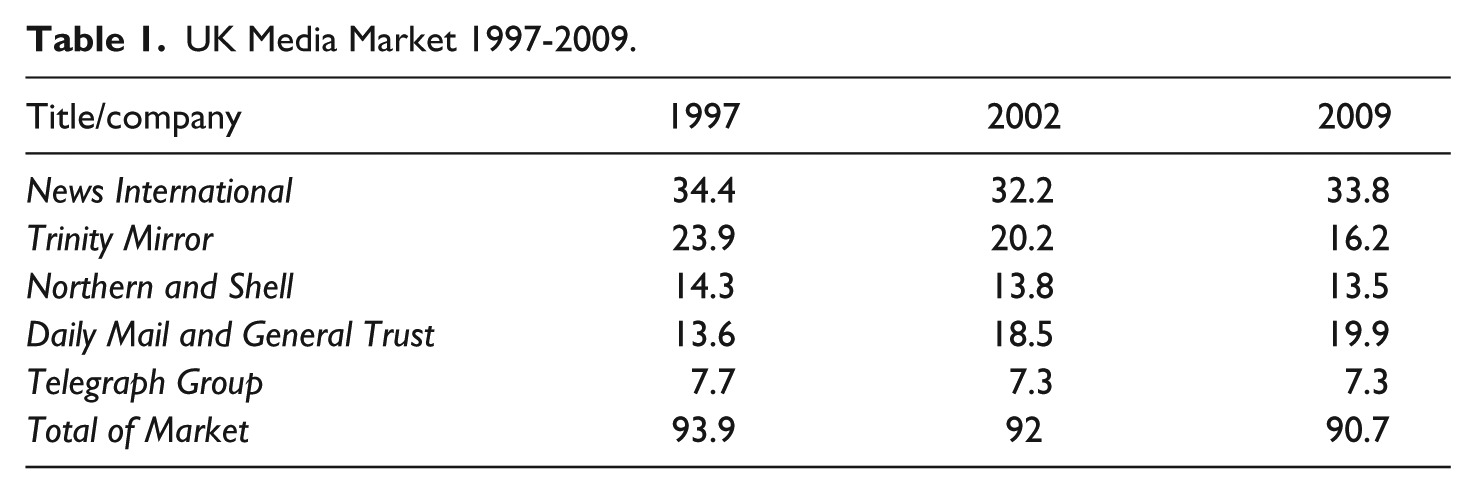
Table 1 shows that over the years, five companies have controlled more than 90 percent of the media market in the United Kingdom (House of Lords Communications Committee 2013: 134).
UK Media Market 1997-2009.
Current media ownership rules do not adequately protect diversity and plurality of views. Leveson was certainly aware of the problem, accentuating the importance of maintaining a plural media and of having many different sources of news, controlled by many different people: It is only through this plurality, specifically in relation to news and current affairs, that we can ensure that the public is able to be well informed on matters of local, national and international news and policy and able to play their full part in a democratic society. (The Right Honourable Lord Justice Leveson 2012a: 29)
Leveson (The Right Honourable Lord Justice Leveson 2012b: Vol. 1, chap. 4, pp. 180–92, and Vol. 3, chap. 9) dedicated two chapters of his Report to the issue of plurality. He recommended that the levels of influence that would give rise to concerns in relation to media plurality be lower (“probably considerably lower”) than the levels of concentration that would give rise to competition concerns (The Right Honourable Lord Justice Leveson 2012b: Vol. 3, chap. 9, p. 1470). Leveson (The Right Honourable Lord Justice Leveson 2012b: Vol. 3, chap. 9, p. 1473) concluded that the Government should consider whether periodic plurality reviews or an extension to the public interest test within the markets regime in competition law is most likely to provide a timely warning of, and response to, plurality concerns that develop as the result of organic growth recognising that the proposal for a regular plurality review is more closely focussed on plurality issues.
The establishment of powerful media empires in England feeds the debate on social responsibility. Free speech entails freedom to scrutinize the market, not to buy it. Liberal governments should not allow a “free market” situation in which media barons may buy whatever they wish, thereby increasing their power and their maneuverability to promote partisan interests (Cohen-Almagor with Seiterle 2004; Curran and Seaton 2010: 291–395; Fenton 2009; Frost 2007: 187–245). Decentralizing ownership defuses potential threats to democracy.
Leveson considered the question of whether to introduce a specific cap on the percentage of media ownership. Following consultation with relevant people and organizations, Leveson (The Right Honourable Lord Justice Leveson 2012b: Vol. 3, chap. 9, p. 1468) decided to avoid setting a cap because this might leave no room for flexibility and might risk commercial sustainability and innovation. Instead of resorting to specific quantitative terms that are not opened for interpretation and cannot be manipulated by media barons, Leveson (The Right Honourable Lord Justice Leveson 2012b: Vol. 3, chap. 9, p. 1469) played into their hands by adhering to qualitative terms about “sufficiency of plurality” and recommending “behavioural remedies” that would enforce standards and ensure plurality. Leveson thus missed the prospect of setting the terms and restrict media ownership, and media cross ownership in Britain. While we should encourage business people to invest in the press and in the media at large, and while we appreciate that these people will remain in business only if they make a profit, there should be a limit on the profit, and the power they accumulate with it. This limit should be set in clear words as well as numbers. Setting a cap of 15 percent of the press market (The Right Honourable Lord Justice Leveson 2012b: Vol. 3, chap. 9, p. 1466), 1 while allowing up to 10 percent additional ownership of digital media, 2 would ensure that the business will be sustainable, with scope for innovation while at the same time would ensure plurality of interests and sufficient market competition. The power and influence of media moguls must be constrained.
Journalism as a Profession
Money is a powerful asset and so is knowledge. Journalists are our eyes and ears on the world. As we do not have the time to study each and every decision that is of interest, including those decisions that may affect our lives, we rely on agents to collect this vital information for us. Without professionals who provide us with the facts, who bring us the news, who watch the governmental decisions and inform us of important policy changes, we would remain in the dark and might make uninformed decisions that might harm our best interests. We as a society have vested interest in a vibrant, professional and responsible press.
Emphasis should be placed on professionalism, answerability, accountability, and responsibility. Professionalism refers to the ability of a field of practice to settle boundaries and avoid intrusion from external factors. It is about the specialization of labor and control of occupational practice. Compared with occupations, professions are characterized by having a social contract with the state (Waisbord 2013: 84). At the same time, they distance themselves from politics and politicians, something that journalists do not do nor do not wish to do. Many, if not most journalists, perceived their profession as a hack, a trade, or craft. As Michael Jordan was born with a basketball in his hand, so they believe they were born with a pen (or keyboard) in their hands. They were blessed with a gift of God to write and uncover “the truth.” This gift, this talent, is enshrined in them. They need not study it. Thus, they wish to have some elements of professionalism, and first and foremost work autonomy (Waisbord 2013: 44). Autonomy is necessary for journalists to offer a critical view of society, its politics and economy (Cohen-Almagor 2013). But they do not welcome other trademarks of the profession: defined rules, body of knowledge, accreditation, exams, monitoring bodies, responsible ethics, and the possibility of sanctions (Aldridge and Evetts 2003; Cohen-Almagor 2005a; Deuze 2005; Keeble 2001; Lambeth 1992; Meyers 2010; Overholser and Jamieson 2005; Pritchard 2000; Rosen 1999). Many journalists are content to have loosely or ambiguously defined ground rules that are enforced or ignored according to their own personal discretion. The loose ends provide them with an open playground that perfectly fits their work “ethics.” The ambiguity creates fuzzy boundaries and allows “creative” and sometimes adventurous conduct. However, as agents of a powerful resource in society, journalists must conduct their affairs carefully and should not overstep their boundaries. Power must have boundaries; otherwise, the temptation for abuse might be too compelling. The boundaries are set by professional codes and standards (Couldry 2012; Curran 2011; Frost 2007; Harcup 2004; Jacquette 2007: 95–125, 268–73; Kieran 1998; Knowlton and Reader 2009: 3–16, 44–65; Scheuer 2008: 61–82). As it is unthinkable to allow other agents of power in society to act without proper professional standards, so it is unthinkable to allow journalists to act with complete freedom and oblivious attitude to risks and harmful consequences. An engineer who builds unsafe bridge would face harsh sanctions for endangering public safety and human life. A physician who amputates the wrong leg would be required to account for her wrongful conduct. A lawyer who fails to follow legal directives might pay with her job. A banker who attempts to embezzle clients’ money may face prison. A pilot who jeopardizes passengers’ lives by drinking alcohol deserves to be fired. Similarly, a journalist who recklessly destroys a person’s life and reputation or unjustifiably undermines state security should be held responsible for her wrong conduct and face significant sanctions both as retribution and deterrence for others. Journalism should not be stripped of professional standards. Freedoms of expression and of the press are vital for democratic life but unlimited freedom might lead to anarchy and lawlessness.
The concept of answerability implies responsiveness to the views of all with a legitimate interest in what is conducted, whether as individuals affected or on behalf of society. It includes a willingness to explain and justify actions of publication or omission. The outcomes of answerability express and reaffirm various norms relevant to the wider responsibilities of an organization in society. The emphasis is on the quality of performance (McQuail 2003: 204).
Answerability is closely related to accountability. The former accentuates more the need to respond to external claims, pressures, demands, providing explanation for one’s conduct. The accompanying concept of accountability refers to a person or organization that is able to answer for one’s conduct and obligations. In turn, when we speak of social responsibility, we refer to the responsibility of individuals, groups, corporations, and governments to society. The difference between responsibility, on one hand, and answerability and accountability, on the other, is that the first connotes a more voluntary and self-directed character. The accountable person or organization is also answerable.
Responsibility and accountability are important as sometimes people and organizations seek independence from their responsibilities. Ambrose Bierce (1911), an American journalist and satirist, described responsibility as a “detachable burden easily shifted to the shoulders of God, Fate, Fortune, Luck or one’s neighbor. In the days of astrology it was customary to unload it upon a star.” Of course, there is in Britain a tradition of progressive and professional journalism in the mainstream media that reports the news in an excellent fashion. 3 But there are also profit-driven tabloids that would publish anything that may increase their sales, with little notice to ethical standards and professional ethics. Because of that reckless conduct, the Leveson Inquiry was established. When a story is regarded as big enough, Leveson (The Right Honourable Lord Justice Leveson 2012a: 10) acknowledged, the ethical and legal provisions count little. They are either manipulated or broken.
To ensure that some ethical and professional standards are maintained, the press must have a strong, independent, and effective council, with significant powers of sanction and with transparent policies, processes, and responsibilities. The suggested organization should promote responsible press freedom while protecting public interests. “Public interest” concerns matters that could potentially affect the public at large. Thus, for instance, public interest relates to the promotion of freedom of expression and freedom of the press, the promotion of ethical standards in journalism, the promotion of professional accountability, the promotion of the underpinning democratic values of respecting others and not harming others, the detection of crime or serious impropriety, the protection of public health and safety, and the prevention of the public from being misled by an action or statement of an individual or organization (Editors’ Code of Practice—UK, henceforth Editors’ Code UK; Ethics guidelines—The Canadian Association of Journalists 2011, henceforth Canadian). Achieving these goals simultaneously might prove to be a difficult task. Thus, there is a need to strike a balance between competing and sometimes conflicting interests in accordance with a predetermined or ad hoc set of priorities for the public good.
Instituting the Public and Press Council
This new organization should be called The Public and Press Council, its name reflecting the dual responsibility it has to protect and promote freedom of expression and freedom of the press and, at the same time, ascertain that vital public interests such as individual privacy, state security, and press accountability remain intact.
The Public and Press Council should publicize itself, its powers, work, and adjudication to make itself known to the public and to gain its trust. The budget to run the council’s affairs should be far larger than it now is. Leveson (The Right Honourable Lord Justice Leveson 2012a: 12) noted that the PCC has been run on a tight budget and without sufficient resources.
Leveson has made many important observations. Many of his recommendations are in the right direction for more responsible press that enshrines the basic values that enable its operation in democracies—respect for others and not harming others. Individuals should be perceived as ends, never as means. The dignity of the person should be cherished and respected unless the person in question acted wrongly, in violation of these same basic liberal values. Under all other circumstances, the pursuit of profit, laziness, overconfidence, arrogance, dismissiveness, dogmatism, incuriosity, self-indulgence, contempt, the search for glory, and any other partisan motive are never justified as reasons for submitting people to invasive reporting and unprofessional conduct, stripped of any regard to the harmful consequences of the unethical conduct.
Code of Practice, Journalist Oath, and Conscience Clause
Journalists are also citizens. Like every citizen, they must obey the law. Therefore, journalists need to familiarize themselves with the legal directives that are relevant to their profession. In addition, journalists are required to conduct their affairs in accordance with a known, transparent and public set of moral principles and standards. Indeed, the Public and Press Council’s adjudication should be made in accordance with a written Code of Practice. Such a code signifies professionalism and responsibility. It is an instrument of conscience-raising and has important ethical and educational implications. The Code can also fulfill important public relations function in promoting the stature of the journalistic profession. The Code should be written by members of the Public and Press Council (possibly with the advice of external experts in media studies) in clear language that lay people can comprehend. The Code of Practice should not cover areas that are covered by the law but should set normative standards for ethical and professional reporting. The Code of Practice should be circulated among press circles and among the public at large so people will be aware of its existence.
The Code of Practice should be incorporated into the contracts of editors and reporters. Editors should see that the Code is on the desk of every reporter. When I was a member of the Israel Press Council, I studied many codes of ethics from different countries, including the United States, Australia, Canada, Israel, and Europe and had many conversations with the leading Israeli experts on code of ethics, Professors Asa Kasher and Yehiel Limor, who have collected such codes for many years. 4 The Code should contain the following ethical principles and norms:
Human dignity of every individual must be respected (German Press Council Guidelines, MediaWise 2001, henceforth German; Council for Mass Media in Finland 2011, henceforth Finland).
Respect diversity, pluralism, and multiculturalism (Canadian).
Minimize harm (Society of Professional Journalists 1996, henceforth SPJ): Do not harm anyone unless you have strong moral justification; do not harm people caught up on the fringes of events that are not of their own making.
Accountability: Be accountable to the public for the fairness, honesty, and reliability of reporting (Norms of Journalistic Conduct, India, Press Council of India 2010, henceforth Norms India; Australian Press Council 2011a, henceforth Australian; Canadian).
Responsibility: Think about the likely consequences of your report prior publication and weigh justifications for reporting against important countervailing considerations.
Privacy is a human right. As a general rule, do not invade personal privacy (Norms India; Australian; Editors’ Code UK; Press Council of Ireland, henceforth Ireland; New Zealand Code: Press Council’s Statement of Principles, henceforth New Zealand Code; Code of Ethics for Press, Radio and Television in Sweden). You may invade privacy only when you are certain it is in the public interest, to be distinguished from prurient motives. Following the lessons of the Princess Diana affair (Brown 2008; Cohen-Almagor 2006; Stanyer 2013), it is unacceptable to use long-lens photography to take pictures of people in private places without their consent.
Accuracy: Strive for accurate reporting. Attempt at collecting all relevant facts and applying pertinent considerations. Do your homework before writing. Deliberate distortion is never permissible (Norms India; Australian; SPJ; Israel Code: Rules of Professional Ethics of Journalism 1996, henceforth Israel Code; Editors’ Code UK; Canadian; Ireland; New Zealand Code; Barker and Evans 2007).
Always check and recheck your resources and your own conduct (New Zealand Code).
Invite dialogue and criticisms (SPJ). Doing so is beneficial as it could lead to further knowledge. Inviting criticisms is always a win–win situation: either you verify your data, or you save yourself from publishing error.
Distinguish between comment, conjecture, and fact (Norms India; Editors’ Code UK; Ireland; New Zealand Code; Finland; Barker and Evans 2007).
Distinguish between editorial text and advertisements (German).
Admit error and strive to correct it promptly with due prominence (SPJ; Israel Code; Canadian; Ireland).
Grant fair opportunity to reply to inaccuracies (Canadian).
Give voice to the voiceless (SPJ).
Treat interviewees with respect and fairness. “Interviewees have the right to know in advance the context in which their statements will be used. They must also be told if the interview will be used in multiple mediums. The interviewee must always be told whether the conversation is intended for publication or will be used exclusively as background material. It is worthwhile consenting to interviewee’s requests to read their statements prior to publication, if the editorial deadline permits. This right only concerns the personal statements of the interviewee, and the final journalistic decision cannot be surrendered to any party outside the editorial office” (Finland). 5 Recording of interviews requires the consent of the interviewee (Norms India).
Protect confidential resources (Editors’ Code UK; Ireland).
Apply ethical discretion when paying for stories. Paying criminals, terrorists, racists, and other antisocial people for their stories is problematic. When payment is made, disclose this to the public and explain how public interest was served (Editors’ Code UK; Canadian).
Keep the business side of the paper (influence of companies owned by the publisher) from dictating content to the editorial side (news and views) (Israel Code; Schudson 2008; Steel 2012).
Be vigilant and courageous when you seek justice and aim to hold those with power accountable for their deeds (SPJ; Himelboim and Limor 2011).
Never plagiarize (SPJ; Israel Code; Norms India; Canadian).
Do not mislead, misrepresent, fabricate, or plagiarize (Israel Code).
Avoid altering images and sound in a way that might mislead the public (Canadian; New Zealand Code; Finland).
Do not obtain or seek to obtain information or pictures through harassment, intimidation, extortion, threats, or persistent pursuit (Israel Code; Ireland).
Do not aid in staging, promoting, or exaggerating events or rumors (SPJ).
When using social networking sites to obtain information, do not use subterfuge to gain access to private information; verify the credibility of sources; apply ethical considerations and transparency (Canadian; New Zealand Code).
Avoid undercover, misrepresentation, deceit, subterfuge, or other clandestine methods of gathering information except when all traditional open methods of information gathering were exhausted and failed to yield information vital to the public (SPJ; Israel Code; Barker and Evans 2007; Canadian; Editors’ Code UK; Ireland). The use of unlawful means of obtaining information might seriously impair public trust in journalism.
Every person wishes to protect her good name. Avoid smearing people by innuendo or implying guilt by association. Avoid malicious misrepresentation and unfounded accusations (Ireland).
Avoid publication of material intended to cause grave offense, harm, or to stir up hatred against an identified individual or group (Ireland). The application and employment of violence, terror, and racism should be condemned in explicit language. Norms India stipulate, “While reporting news with regard to terrorist attacks or communal riots, the media should refrain from publishing/telecasting pictures of mangled corpses or any other photographic coverage which may create terror, or revulsion or ignite communal passion among people. Newspapers/journalists shall avoid presenting acts of violence, armed robberies and terrorist activities in a manner that glorifies the perpetrators on their acts, declarations or death in the eyes of the public. Publication of interviews of anti-social elements by the newspapers glorifying the criminals and their activities with the resultant effects are to be avoided” (Norms India).
Avoid prejudicial, discriminatory, or pejorative reference to a person’s race, color, religion, sex, or sexual orientation, and to any physical or mental illness or disability (Israel Code; Editors’ Code UK; Canadian; New Zealand Code). Moreover, editors must make concerted, sustained efforts to recruit, retain, and develop staffs that reflect the variety of the communities they serve.
Do not accept gifts, favors, free goods or services, and other benefits from news sources or organizations that the newspaper may cover (SPJ; Canadian).
Do not use or pass to others financial information revealed during research.
Remain free of associations and activities that may compromise integrity or damage credibility (SPJ; Israel Code; Canadian).
Children deserve particular care and consideration. Do not exploit the innocence of children to get information (Guidelines on Media Reporting on Children, India; Israel Code; Editors’ Code UK; Canadian; Ireland; New Zealand Code; Barker and Evans 2007).
Furthermore, the press may adopt its own Journalist Oath, similar to the Hippocratic Oath in medicine (http://www.indiana.edu/~ancmed/oath.htm). The oath should outline in stringent terms values that would not change over the years. It would become public knowledge if any press agency decided not to accept the oath.
The contract of press journalists should also include a conscience clause that would protect them from being coerced into doing clearly unethical work that negates their conscience. The conscience clause would enable them to resist pressures to breach the ethical code without fearing of losing their job. It is noted that the National Union of Journalists (NUJ) has argued for a conscience clause for many years and, in 2003, was backed by the Commons Select Committee on Privacy and the Media. However, the PCC opposed the proposed measure, arguing instead that editors were the keepers of ethics in the newsroom and that journalists had nothing to fear. Leveson (The Right Honourable Lord Justice Leveson 2012a: 16) begged to differ, saying that he was struck by the evidence of journalists who felt that they were hard pressed to contravene the code of practice. He thus suggested including a conscience clause in the journalists’ contracts. The president of the International Federation of Journalists (IFJ), Jim Boumelha, welcomed the backing of the conscience clause, saying, In too many cases journalists face the choice of either undertaking work with which they are not comfortable or face the prospect of losing their job . . . [Journalists] need to be given the confidence to abide by their union’s code of conduct and to say no without fear of disciplinary procedures. (Ifex 2012)
Membership
The appointment of the chair and all members of the Public and Press Council must be independent and transparent. The chair should be a senior public representative who has experience in working with the press, understanding how it works, its advantages, constraints, and how it makes decisions. In Australia, the chair is appointed by the Council from people who have not had previous connections involving ownership or employment by the media (Australian). In Israel, often the president of the Press Council is a retired Justice of the Supreme Court. 6 Similarly, the Danish and the Swedish Press Councils are chaired by a respected judge (Higham 2012; Sweden Press Council).
The Public and Press Council should not be too big or too small to enable effective decision-making process. It should thus have between ten and thirty members. The Council will be comprised of public representatives and representatives of the press industry, of the proprietors, and of the editors. A special and independent Select (or Appointment) Committee, selected by leading publishers and prominent journalists, would decide who would serve on the Public and Press Council among those who offer their candidacy. Leveson (The Right Honourable Lord Justice Leveson 2012a: 32; 2012b; Vol. 4, Part K, chap. 7, para 4.8, p. 1760) recommended that the appointment panel should be appointed in an independent, fair, and open way; contain a substantial majority of members who are demonstrably independent of the press; include at least one person with understanding and experience of the press; and include no more than one present newspaper editor.
The independent public representatives should have a majority within the body and include the chairperson—this to avoid a partisan majority and a leader who would care more for the interests of the industry than for those of the public. The Public and Press Council should not include any serving editor as well as any present members of the Government and the House of Commons.
Members of the Public and Press Council should serve for a period of five years. 7 They could be reelected by their colleagues for an additional five years if the majority of members felt that they could continue carrying out their duties and if the representatives felt that they were able to continue to commit themselves. After a maximum period of ten years, members should retire so as to allow the introduction of new members.
The Public and Press Council should convene at least six times a year, once every two months. The chair will have the discretion to call more meetings if she sees it necessary. All meetings will be fed online live on the Council’s website unless special circumstances necessitate close-door meetings.
For effective work of the Public and Press Council, it is essential that senior, qualified public representatives would assume this role upon themselves, and that the press industry would be fully represented. Thus, incentives should be offered to ensure that the public and the press interests are promoted. The incentives may include the following:
Members of the Public and Press Council should be paid for each meeting in which they take part. One of the inherent problems in the working of the PCC concerned its voluntary character. The PCC was composed of relatively prominent people who did not have the time and the will to adequately meet the responsibilities involved. Volunteering is a lofty idea, but it hindered the effective working of the PCC. Serving on the Public and Press Council should be considered a heavy responsibility that deserves some financial recognition. The exact payment should be decided in accordance with the budget of the Council. In any event, the payment should not be seen in terms of a salary but as a token of appreciation for the commitment, time, and effort invested by the members.
Membership in the Public and Press Council should be perceived as a badge of honor. Each newspaper will be required to inform its readers on its first page that it is a member of the Council. As the Public and Press Council gains prestige, members of the Council will be happy to comply with this requirement. Thus, the public becomes aware that the paper it reads assumed some ethical and professional responsibilities and is abiding by the accepted Code of Practice.
The government would reward members of the Public and Press Council by inviting their reporters to official press meetings, engage with members in informing the public about ministries’ operations, decision-making processes, and policies. Newspapers that opted out of membership in the Public and Press Council would not enjoy the same rights and privileges.
Public officials working for the government, hence for democracy, should be encouraged to cooperate with the responsible press.
The publication of public advertisements in papers that are affiliated with the Public and Press Council should be encouraged.
Leveson (The Right Honourable Lord Justice Leveson 2012a: 16) suggested that only members of the new body will have access to its litigation system. If by declining membership in the regulatory system a newspaper has deprived a claimant of access to a quick, fair, low-cost arbitration, the court could then deprive the newspaper of its costs of litigation even if it had been successful, as success could have been achieved far more cheaply if it was a member of the new regulatory body. In other words, newspapers that decided to opt out would face paying all the legal costs of court proceedings against them for, say, defamation or invasion of privacy.
Similarly, Leveson (The Right Honourable Lord Justice Leveson 2012a: 16) proposed that if newspapers that chose not to subscribe to the new regulatory body were found to have infringed the civil law rights of a claimant, they could be considered to have shown willful disregard of professional standards and thereby lead to a claim for exemplary damages.
Thus, it is suggested to create a two-tier press system of those who accept the professional responsibilities associated with membership in the Public and Press Council and those who do not. Those who prefer to be associated with the Council ipso facto declare that they see themselves as credible and professional. It is in their best interest to safeguard and protect the adopted Code of Practice. Association with the Council should be looked on as adding to the good standing and reputation of journalism. The public would grow in awareness to differentiate between those newspapers that accept and abide by ethical standards and accordingly publish news that are fit to print, and other newspapers that would print any news that are fit to sell.
In line with the Leveson Report (The Right Honourable Lord Justice Leveson 2012a: 15), it is suggested that the Public and Press Council hear complaints about the conduct of the press, order appropriate redress, promote high standards, investigate serious breaches of the Code of Practice, and provide a fair, quick, and inexpensive arbitration service. For processing complaints, it is suggested that alongside the Public and Press Council, an Ethics Tribunal should be established to deal with complaints.
The Ethics Tribunal
The Tribunal size will be determined by the number of complaints: the more complaints, the larger its size. If needed, the Ethics Tribunal will have hundreds of members. Its flexible size will ensure quick and effective handling of complaints. Each panel of the Ethics Tribunal should consist of three members: a public representative who understands the work of the press, a lawyer, and a former employee of the press. The chair of the Ethics Tribunal will appoint the panel at her discretion per the case at hand with the aim to ensure that the public and the press will receive adequate representation on the panel. Attempt at reaching consensus will be made but two-to-one decisions will be binding if the desired consensus would not be reached.
Members of the Ethics Panel dealing with complaints should convene by the end of each month, or every two or three months, depending on the number of complaints, for a weekend during which they would hear complaints and adjudicate. 8 They will study the complaints and will issue a reasoned response within a month.
It is assumed that it will be a great honor and privilege to sit on this Panel. Members of the Ethics Panel will receive payment for their involvement. The payment per session should reflect appreciation for their effort, expertise, and goodwill in resolving public complaints in a professional and timely fashion.
An Appeal Panel may be convened in case of need, appointed by the chair of the Ethics Tribunal and in her discretion. Both sides—the public and the press—will have the right to appeal against the decision of the Ethics Panel. The Appeal Panel will consist of five members, representatives of the public and the press. The decision of the Appeal Panel will be final and binding.
By the end of each year, the Ethics Tribunal will issue an annual report about its work, which will be freely available to all interested parties and could be read on the relevant media website. The reports will be as detailed as possible, including the terms of practice, how the terms were implemented, reflections on past-year work, lessons, reasoning for specific decisions, and recommendations for the future.
Sanctions
The press industries have perceived the press council and the PCC more or less as lightning rods. They existed to show that the press cared about ethics, that it grappled with ethical dilemmas, and that it was interested in public concerns; therefore, there was no need for restrictive legislation. Generally speaking, press councils are designed to receive and deal with public grievances as well as to calm intolerant tendencies on the part of the legislature. They are aligned with the interests of the press, at the expense of protecting and promoting public interest.
In Britain, the only power that the press council and the PCC had was the publication of adjudication against the papers. This was a very limited power. Newspapers in Britain that opted out and were not members of the press council were not obliged by its adjudication. Papers that did publish adjudication of justified complaints against them did not necessarily grant the adjudication a prominent place in the newspaper. The suggested Public and Press Council must be equipped with far more significant powers.
Furthermore, for effective operation, the Public and Press Council must secure the trust of the people. Large segment of society were unaware of the work of the PCC, and many of those who were aware of its work did not appreciate it. 9 This was because the PCC was a voluntary body, with little authority and powers, with very limited abilities, questionable transparency, and only qualified support of the industry. Leveson (The Right Honourable Lord Justice Leveson 2012a: 12) noted that the PCC has not monitored press compliance with the Code of Practice and the statistics it published lacked transparency (Fielden 2011). The press industries wanted the council to act as a preventive body, to preempt measures that would interfere with press freedom. They did not really want the PCC to represent the public interests. They funded the work of the PCC, and through this, they secured their dependence. The result was that the public perceived the work of the PCC as a “sold game,” and most of it remained indifferent or uninterested in what the PCC did.
Some of the papers, while upholding the idea of press freedom, abused that freedom. This should not be allowed. It is essential that the Public and Press Council be accorded the powers to humiliate, to expose hideous and ghastly publications and behavior. These powers should include the following:
The publication of adjudication: Any newspaper against which a complaint has been upheld should publish in full the Public and Press Council’s adjudication on that complaint. The publication should appear in a prominent place in the newspaper as well as on the Public and Press Council’s website. If the Council is unhappy with the placement of the adjudication in the newspaper, it should be able to ask the paper to republish the item on a specific page. The Public and Press Council should be able to decide where, on what page, the adjudication should be published, so as not to allow newspapers to bury the adjudication in small letters on a back page. This power is the only power that is granted to press councils nowadays throughout the world, including the Australian, the New Zealandian, the Canadian, and the Israeli (Cohen-Almagor 2007).
The ability to impose significant fines on newspapers for gross misconduct. In Denmark, the failure to comply with the Press Council’s directives could potentially lead to a fine (Denmark Press Council; Fielden 2012: 72).
The fines should be given to designated charities. Because of the inherent conflict of interests, the fines should not be made available to sponsor the work of the Public and Press Council. After the tragic death of Princess Diana in 1997, the PCC contemplated this idea, but in the end, it was decided not to expand the powers of control. Leveson (The Right Honourable Lord Justice Leveson 2012a: 34; 2012b: Vol. 4, Part K, chap. 7, para. 4.38, p. 1767) proposed that the new body will have the power to impose financial sanctions up to 1 percent of turnover with a maximum of £1million. 10 The ability to impose fines would enhance the effective working of the Public and Press Council.
The ability to suspend journalists for gross misconduct for a limited period of time. At the same time, I would not recommend sanctions to suspend or expel members of the Public and Press Council. The Council has a vested interest to encompass as many organizations as possible as this would promote responsible and professional journalism.
The ability to suspend publication of newspapers. This is another point of disagreement with Leveson. Leveson (The Right Honourable Lord Justice Leveson 2012a: 34; 2012b: Vol. 4, Part K, chap. 7, para. 4.38, p. 1767) concluded that the new body should not have the power to prevent publication of any material at any time. I think a threat to suspend publication even for one day would be effective, even more than fines. In Britain, the competition between the tabloids is particularly fierce. Readers looking for their usual paper would not find it when suspended, then they would buy another paper and might switch their allegiance.
Complaints to the Public and Press Council should be made in writing, snail mail and/or electronic mail, free of charge, as is the case now. The procedure should be fast, informal, and available to ordinary people. One should not have to have a lawyer to be represented.
Funding
Funding is an essential prerequisite for independence of the councils. Leveson (The Right Honourable Lord Justice Leveson 2012a: 15; 2012b: Vol. 4, Part K, chap. 7, paras. 4.14–4.17, pp. 1761–62) suggested that funding would have to be agreed between the new body and the industry with security of funding over a reasonable planning period. I disagree. I think this is one of the major flaws of the Leveson recommendations. The Public and Press Council should be funded by an independent body— a charity or a foundation—that cares about the press and understands its significant role in a democratic society. The assumption is that the regulatory body would not easily bite the hand that feeds its activities. The Public and Press Council is required to be apolitical, and without any affiliation to the media. There should not be any financial strings to the government or to the industry, both have a strong inclination to influence and shape the work of reporters. Existing bodies such as the British Educational Communications and Technology Agency, Goldman Sachs Gives, or the Becht Family Charitable Trust would be suitable; alternatively, special charities (“Concerned Citizens for Accountable Media”) could be founded. We must change the existing situation where proprietors fund the council that is supposed to scrutinize its conduct. This creates an obvious conflict of interest. There is room to suspect that the public interests are not adequately served when the entire funding comes from the industry.
Legislation
When I was appointed member of the Israel Press Council, I was very much against free press legislation. I was, quite innocently, convinced that self-regulation of the press is essential and that it would suffice for maintaining ethical and professional standards. My three-year membership on the Council had slowly made me reconsider the issue. The fieldwork conducted in Britain and Canada provided me with further food for thought, as all data came to suggest that self-regulation simply does not work (Cohen-Almagor 2002, 2005a, 2005b). The history of the Press Council and the PCC amply demonstrates that there is a need to legally underpin the independent self-regulatory system, to facilitate its conduct, and to anchor its sanctioning powers in legislation. Leveson (The Right Honourable Lord Justice Leveson 2012a: 17) came to the same conclusion. He explained that legislation would enshrine a legal duty on the government to protect freedom of the press; it would reassure the public that the newly instituted body is credible and effective; it would validate the code of practice and the benefits given to those who deserve them, and it would institute dispute resolution mechanisms.
The legislation would reassure the public that the basic requirements of professionalism, independence, transparency, accountability, and effectiveness are met. The legislation would validate the Press Code of Practice and would empower the Public and Press Council to impose sanctions when these are deemed warranted.
Education and Training
Legislation is very much needed, but it should not come at the expense of promoting ethical standards and professionalism. Journalism is neither a simple job nor a sort of divine endowment with which one is blessed. Reporters should cultivate ethical behavior, be aware of ethical concerns, the potential for conflict of interests, and the burdens of responsibility. Many of the problems we presently witness within the British press can be resolved if journalists develop a rigorous ethical framework that prescribes their bounds of conduct, and raises their awareness as to what practices can be adopted and what is simply not to be done. Media ethics courses in institutions of higher education, and in-house training can be instrumental in developing and promoting standards of good, professional practice. The Public and Press Council should be able to recommend minimum levels of training for industry professionals (Barker and Evans 2007: 91).
Online Content
One of the significant oversights of the Leveson Report was the lack of sufficient attention paid to online content and the challenges facing journalism in respect of technological developments, particularly in relation to social media. Leveson (The Right Honourable Lord Justice Leveson 2012b: Vol. 1, chap. 3, pp. 167–69) said that the relative lack of Internet-specific regulation is unlikely to change and provided a general overview of the Internet, including blogs and social networking sites. Here, Leveson used a very broad brush to paint a situation that is difficult to control. The relatively few pages dedicated to this sphere shows that the Internet was not foremost on his mind. Alas, the Internet deserves a very close scrutiny as its implications on journalism are substantial and far-reaching. Due to the proliferation and fragmentation of the news market, the field of journalism is changing, with noteworthy effects on its professional culture (Lee-Wright et al. 2011; Zelizer 2009). Between 35 and 40 percent of news consumers in the United Kingdom use the Internet for news; of them, 8 percent make the Internet as their main source of news (Brock 2012: 520). A total of 19 percent of people who use the Internet as source of news use Facebook and Google News while 9 percent use Twitter as a source of news (Ofcom 2012: 12). The press as well as broadcast networks are pushed to engage with digital technologies in their business and production models. They digitize their operations and try to cope with the new online practices that have arisen from rapidly developing technologies and social network sites. The Leveson Inquiry had a golden opportunity to relate to the changing nature of journalism by presenting “outside-the-box” ideas that combine innovation, self-regulation, and governmental incentives to empower professional and responsible journalism. Unfortunately, Leveson had missed that golden opportunity.
People will grow accustomed to the many advantages of online reporting and would prefer it more and more over the print press. There will be growing open discussions about the merits and flaws of the new forms of media. Attempts will be made to remedy the flaws. Thus, it is time to consider the introduction of appropriate standards for online media organizations. Speedy communication, competition, and the urge for rapid publication should not compromise professional standards of accuracy, fairness, verification, answerability, responsibility, and accountability. All efforts should be made to make the media sites and the links they contain credible; indeed, links to other sources should be made available after careful scrutiny. Online content should be edited and reported as carefully as print content. The same Code of Practice outlined above is applicable also to the Internet. All media organizations, both online and offline, are required to adhere to standards of moral and social responsibility, commitment to preserving and promoting security online and offline, respect for intellectual property and copyrights, and adherence to the liberal principles we hold dear: liberty, tolerance, human dignity, respect for others, and not harming others.
The entire process of debating, implementing, and promoting standards should be transparent, opened for critique and feedback. The Internet via its social media networks, blogs, and other forums provides a platform for a democratic, deliberative, and reflective dialogue between readers and reporters. Forums can be created for debating issues of the day, including the way they are reported and analyzed. Readers should enjoy the opportunity to comment on news and opinions, to provide feedbacks and to submit complaints. The ease of communication encourages talkative, controversial views that would keep debates lively and engaging. Netcitizens 11 will be welcomed to provide criticism on the media Hotline (or Feedback Forum) and will receive an answer within twenty-four hours. Netcitizens will have the option to make their feedback public or private, with or without attribution.
The Hotline (or Feedback Forum) will be operated by a team of professionals who will provide effective and speedy response to all questions and criticisms. The Hotline/Feedback Forum will provide easy accessibility, high availability, and an assured response. Both queries and answers will be transparent. They will be posted on the Hotline/Feedback Forum hosted by the media outlet. Transparency also means that the rules and procedures according to which concerns will be processed are adequately explained and so are retractions and corrections. The system will be explained in detail, and additional help will be made available if needed. Netusers should have the ability to track their concerns throughout the process, and they should be informed of the final outcome of the process. The relevant media organization will make publicly available annual reports on the basic statistics and experiences with the Ethics Tribunal and the Hotline/Feedback Forum.
This is a rough proposal. I hope it will attract deliberations and challenges, evoke attention, and gather momentum.
Conclusion
The press is first and foremost a business. Often, when editors and reporters are faced with situations where they have to decide between economic interests and other interests (reporting the news, serving as a watchdog of government offices, conducting an investigative reporting), the decision is likely to be influenced by business considerations. The reality is simple: Newspapers exist to make money. They could continue doing their work only if they are economically sound and sustainable. Thus, the need to institute an organization that would adequately represent the public. Calling that organization “The Public and Press Council” accentuates the need for balancing public interests against press interests. Equipping that organization with substantial powers is essential for ascertaining that crude business interests will not override legal dictates and ethical norms.
Freedom of speech and of the press is an important value in every democratic society, sine qua non for furthering individual autonomy and promoting civic rights. Freedom of the press must include the duty to keep the public informed about developments relating to its common good. Free press is an instrumental good, good as far as it results in the promotion of public interest and the reinforcement of the democratic ideals (Petley 2012: 537). It is certainly not freedom to conduct any business, falsely using concepts like the “public right to know” as a pretense to transgress law and ethical norms.
The British model of press regulation has influenced other countries, including Australia, Canada, and Israel, that adopted similar models for regulating their own media outlets. Thus, it is reasonable to assume that these and other countries will carefully observe changes in the British model. It is quite likely that the Leveson bulky report will make some impressions, but it is too early to say which of its many recommendations will be adopted. Future studies will reflect on the report’s implications and impact on the British and other presses.
Journalism is in transition as it is challenged by growing competition and rapid technological developments. It grapples with print, broadcasting, and online platforms as well as with financial austerity. The financial health of the news industry is failing, mainstream audiences are on the decline, and professional authority, credibility, and autonomy are eroding (Peters and Broersma 2012). The ease of access to the Internet, its low cost and speed, its chaotic structure (or lack of structure), the anonymity that individuals and groups may enjoy, and the international character of the World Wide Web make the Internet an attractive alternative to the print press. With the rise of the Internet, the average net circulation of tabloid newspapers in the UK decreased by 49 percent while broadsheets have experienced a fall of 32 percent, and mid-market newspapers have lost 21 percent of their net average circulation (Ofcom 2012: 24). There is a little doubt that innovation will continue to be one of the main features of new journalism. In its experimental stage, the Internet was based on open dialogue, where scientists posted Requests for Comments (RFC); on free exchange of information and ideas; and on collaboration rather than competition. 12 There were no barriers, secrets, or proprietary content. Indeed, this free, open culture is critical to the development of new technologies and for the shaping of new media. In the same spirit of Request for Comments in the early days of the Internet, I invite readers to reflect on the ideas presented here and to explore new ways of thinking about new journalism, the advantages, the challenges, and the appropriate ways to address those challenges.
Footnotes
Acknowledgements
I thank Richard Collin, Bhikhu Parekh, as well as Silvio Waisbord and three referees of the International Journal of Press/Politics for their most instructive comments.
Declaration of Conflicting Interests
The author declared no potential conflicts of interest with respect to the research, authorship, and/or publication of this this article.
Funding
The author received no financial support for the research, authorship, and/or publication of this article.
Notes
Author Biography
 . He was Visiting Professor at UCLA (1999–2000) and at Johns Hopkins (2003–2004), and Fellow at the Woodrow Wilson Center for Scholars (2007–2008). In 2003–2007, he was the Founding Director of the Center for Democratic Studies, University of Haifa. He published extensively in the fields of politics, philosophy, law, and ethics. Among his more recent books are The Right to Die with Dignity (2001), Speech, Media and Ethics (2001, 2005), Euthanasia in the Netherlands (2004), The Scope of Tolerance (2006, 2007), The Democratic Catch (2007, Hebrew), his second poetry book Voyages (2007, Hebrew), and Public Responsibility in Israel, coedited with Ori Arbel-Ganz and Asa Kasher (2012, Hebrew).