



Abstract
Across a sample of twenty-seven European nations, we examine variation in the level of factual political knowledge in relation to self-reported exposure to news programs aired by public or commercial channels, and to broadsheet or tabloid newspapers. Unlike previous studies, we estimate the effects of exposure to these news outlets while controlling for self-selection into the audience. Our results show that the positive effects of exposure to broadsheets and public broadcasting on knowledge remain robust. Finally, we show that only exposure to broadsheets (and not to public broadcasting) narrows the knowledge gap within nations; relatively apathetic individuals who read broadsheet newspapers are able to “catch up” with their more attentive counterparts.
Introduction
The news media represent the principal intermediary between real-world events and the public. Since people depend on the media for information about the course of public affairs, the exercise of informed citizenship requires not only motivated citizens but also a media environment that provides an abundant supply of news.
Communication scholars have identified both between-nation and within-nation variation in the production and delivery of news. The former is attributable to differences in national media systems (see Hallin and Mancini 2004). In public service systems—countries that support public broadcasting and actively regulate commercial broadcasters—television newscasts with considerable substantive content air frequently during peak viewing hours. In market-based systems, on the contrary, unregulated commercial networks respond to market forces and offer news programming that is superficial and sporadic (Aalberg et al. 2010). Thus, public service systems provide greater opportunities for citizens to encounter informative news (Aalberg and Curran 2012; Curran et al. 2009; Iyengar et al. 2010; Soroka et al. 2013).
At the within-nation level of analysis, there is variation in news programming across print and broadcast news sources. Most studies document that the effects of exposure to broadcast news on knowledge gain are typically null or even negative, whereas exposure to print sources is associated with significant gains in knowledge (Delli Carpini and Keeter 1996; Newton 1999; Price and Zaller 1993; Robinson and Levy 1976).
Within-nation variability in the informative effects of the news media is not limited to the differential effects of particular sources. There is also the possibility of a further contingency: that exposure to news programming facilitates political learning among different strata of the news audience. Because attentive citizens are more likely to learn, exposure to news may increase the existing gap in political knowledge between the “haves” and “have-nots.” According to this derivation of the knowledge gap hypothesis (Donohue et al. 1975; Hwang and Jeong 2009), groups higher in socioeconomic status or political motivation acquire media-transmitted information at a faster rate than lower status or less motivated strata.
This article attempts to bridge the comparative and within-nation literatures on source differentials in the transmission of information. We examine variation in the level of factual political knowledge in relation to self-reported exposure to print and broadcast news outlets that offer a preponderance of soft or hard news programming. Using a sample covering twenty-seven European democracies, fifty-eight television networks, and eighty-four daily newspapers, we show that exposure to hard-news-oriented sources (especially broadsheet newspapers but also public broadcasting) produces significant information gain while exposure to soft-news-oriented outlets (e.g., tabloid newspapers) does not. The differential ability of sources to transmit politically relevant information also explains why it is possible for relatively apathetic individuals who read broadsheet newspapers to “catch up” with their more attentive counterparts at least in the relatively information-rich context that we analyze here, namely, the 2009 European Union electoral campaign.
The methodological contribution of the study is to disentangle the effects of exposure to news sources on political knowledge from the opposite possibility, namely, that more attentive citizens seek out hard news. We demonstrate that the observed effects of exposure to broadsheet newspapers and public television newscasts remain robust—albeit weakened—after we implement an estimation methodology (propensity score matching) that takes into account the tendency of more informed individuals to self-select into the audience for broadsheet newspapers and public broadcasting. Thus, unlike the vast majority of previous studies, our estimates of the effects of particular media sources on political knowledge take into account motivational or resource-related biases in the use of these sources.
Theoretical Expectations
The debate about the potential effects of the media on political knowledge is well alive in the communication literature. While there is little doubt that the news media matters as providers of political information for citizens, the empirical record about the informative effects of media exposure is mixed. Past studies lamented the low quality of information provided by the media (especially television) and linked media exposure to a decrease in citizens’ political knowledge (Putnam 2000). Others, however, show that media exposure is related to political learning (Norris 2000) while still others emphasize the contingency of media effects on political learning and knowledge, reporting null or even negative effects of television and positive effects of newspapers (Delli Carpini and Keeter 1996; Eveland 2001; Newton 1999).
It is difficult to interpret the available evidence because these studies are plagued with methodological problems, the most important being the fact that they do not consider the content of the media in their analysis. In contrast, they tend to use approximate self-reported measures of media use (Barabas and Jerit 2009). These shortcomings can produce systematic over (infra) estimations of the informative effects of the mass media (Druckman 2005). There is, however, a recent trend in the literature that addresses this limitation by including measures of media content in their empirical analyses, thereby going beyond the general (and somehow ambiguous) hypothesis that media coverage impinges on citizens’ knowledge to actually demonstrating which elements of media coverage matter for knowledge. More specifically, these studies have demonstrated that the informative effects of news stories depend very much on the density of information they contain (Jerit et al. 2006); on the volume, salience, and prominence of news media coverage (Barabas and Jerit 2009); and on the type of news stories (i.e., hard news vs. soft news; Curran et al. 2009). Or put differently, the informative effect of the media depends very much on the content delivered by different media sources: Serious, in-depth news can inform the public whereas superficial and sensationalist news does not.
Although previous studies hypothesize a slow but permanent process of convergence between national media systems (see Hallin and Mancini 2004), the truth is that systematic comparative tests of the hypothesis are scarce and their results inconclusive. While some studies show a general increase in the commercialization of television channels (Klimkiewicz 2010) and the convergence of journalistic norms (Plasser 2005), a recent comparative study shows clear differences across media systems both in the supply of news and in the potential informative effects of such news (Aalberg and Curran 2012). Moreover, there is an abundance of evidence showing that public broadcasters deliver substantive news more frequently than privately owned television networks (Aalberg and Curran 2012; Brekken et al. 2012; Curran et al. 2009, 2012; de Vreese and Boomgaarden 2006; Iyengar et al. 2010). Unlike commercial networks, which have compelling incentives to “popularize” the content of their news offerings (by emphasizing sex, sleaze, and scandal), public broadcasters are mandated to deliver news programs that educate rather than entertain and to air their newscasts during periods of high viewership (Curran et al. 2009; de Vreese and Boomgaarden 2006; Hallin and Mancini 2004: 280; Holtz-Bacha and Norris 2001; Newton 1999). These programming differences make for stronger learning effects exerted by the public broadcaster (e.g., Curran et al. 2009; Iyengar et al. 2010). This constitutes the first hypothesis (H1) we test here.
While differences in the content and frequency of news programming delivered by public and commercial broadcasters are well known (see Aalberg et al. 2010), researchers have given less attention to a parallel distinction within the print sector, with equally important consequences for the supply of news. We refer to the distinction between broadsheet and tabloid daily newspapers. From the days of the “penny press,” tabloid newspapers have consistently attracted relatively large circulations by responding to popular demand. Tabloids focus heavily on entertaining subject matter including celebrity life, scandals, and sports (Rooney 1998; Tiffen 2011). Given their distinctive emphasis, tabloids are derided by journalism scholars who treat broadsheets as the print equivalent of the public service broadcaster (Tiffen 2011; for a dissenting view, see Örnebring and Jonsson 2004). However, there is only limited evidence concerning the differential contributions of tabloids and broadsheets to their audience’s level of political knowledge. Exposure to broadsheet newspapers is positively associated with political knowledge in Denmark, the Netherlands, and the United Kingdom (de Vreese and Boomgaarden 2006; Newton 1999), but ours is the first study to replicate this finding across a large sample of nations and outlets. The second hypothesis we test (H2) states that in comparison with tabloids, broadsheets are more likely to inform citizens.
A final question derived from the informative effects of the media literature addresses the extent to which news sources tend to inform all citizens equally. The hypothesis that media exposure can potentially increase the existing knowledge gap among citizens has a long tradition in the discipline of communication and derives from the original work of Tichenor et al. (1970) who argued not only that the information rich get richer when exposed to media outlets but also that this gap might increase as mass media circulation expanded. This hypothesis has generated a substantial body of research and an ongoing active debate over the existence and nature of a socially structured knowledge gap (Hwang and Jeong 2009).
Higher status socioeconomic or politically motivated groups are expected to acquire media-transmitted information at a faster rate than lower status or less motivated groups. As a result, media exposure exacerbates existing inequalities in political knowledge. However, exposure to sources regularly offering high levels of substantive content may actually decrease the knowledge gap (Eveland and Scheufele 2000), especially during periods when news coverage peaks, for example, election campaigns. Under these circumstances (i.e., information-rich contexts), exposure to newspapers and television news programs may reduce rather than increase the knowledge gap (van Aelst et al. 2012).
Previous studies have shown not only that information-opulent environments accentuate the abilities and willingness of citizens to pay the cost of becoming informed about politics but also that information-rich settings contribute to a reduction of the inequalities in knowledge (Berggren 2001; Fraile 2013; Iyengar et al. 2010). More specifically, these studies show that the importance of abilities (Berggren 2001), motivation (Iyengar et al. 2010), and socioeconomic status (Fraile 2013) in explaining political knowledge varies across contexts, being less important in information-rich environments, but especially relevant in information-poor contexts. Thus, our last hypothesis (H3) stipulates that those media sources presenting informative effects in information-rich contexts (such as the context of the EU election campaign under analysis here) reduce the knowledge gap between low status and unmotivated citizens, and their high status and motivated counterparts.
Research Design: Data and Techniques
To test our hypotheses, we rely on comparative data consisting of twenty-seven democracies included in the 2009 European Election Survey (EES); data can be accessed at http://www.piredeu.eu/public/Data_Release.asp. These countries encompass significant variation in the structure of media markets, the extent of regulation of commercial broadcasters, and the relative strength of the mass circulation press. These are critical system-level attributes that are the basis for differentiating between particular media systems (Hallin and Mancini 2004).
Although this study focuses on differences across news outlets (and not across countries), we believe that maximizing the number of countries under analysis makes our results more generalizable. The existing cross-national literature on information gain through media exposure typically focuses on a limited set of nations representing the market-based and democratic corporatist models of media systems (see, for instance, Aalberg and Curran 2012). In contrast, the data used here allows us to test for difference in source effects across twenty-seven European nations representing a variety of media systems.
The 2009 EES data were collected following the 2009 European Parliament elections (between June 4 and 7, 2009). The intended sample size was one thousand successful interviews within each of the twenty-seven EU member states. Data collection was done by computer-assisted telephone interviewing (details about data collection can be seen in van Egmond et al. 2010).
Our analysis is based on a multi-item measure of political knowledge. The survey included seven fixed-choice questions (using a true/false format) measuring various aspects of citizens’ knowledge of the EU (e.g., identifying EU member states, awareness of EU institutional arrangements, etc.) as well as their knowledge of domestic national politics (e.g., the identity of a major cabinet minister and the rules of the “democratic game” of each respective country). Our measure of knowledge is the number of correct responses provided (from zero to seven correct responses). Unfortunately, the survey did not include questions that refer explicitly to current events or soft news. Our indicator is thus a blend of “civics” or general knowledge and some hard news knowledge. The online appendix contains the exact wording of the seven questions (Table 1). Since general political knowledge is known to depend primarily on long-term, pre-dispositional factors such as education and political attentiveness and is less susceptible to short-term factors such as the level of media coverage (see Jerit et al. 2006), our dependent measure provides a conservative test of the role of media content. Any effects of the information environment on general knowledge would likely be weaker than the corresponding effects on issue-specific or event-centered political knowledge. 1
The Informative Effects of Exposure to Broadcast and Print Sources (Multilevel Estimation).

Source. Our elaboration on the 2009 European Election Survey (EES) Voter Study (Advanced Release, July 2010).
Note. Dependent variable is the number of correct answers (from 0 to 7). Independent variables include general weekly exposure to the media (“In a typical week, how many days do you follow the news?” From 0 to 7 days), weekly exposure to public broadcasting news, weekly exposure to commercial broadcasting news, weekly broadsheet reading, weekly tabloid reading, education (from 0 to 6), male (1 for male, 0 for female), age (in years), political interest (1 for those who declare to be very and quite interested in politics, 0 for those who are not interested in politics). The specific broadcasts and newspapers considered for each country and their correspondent classification (public vs. commercial; and broadsheet vs. tabloid) are listed in the online appendix (Tables 3 and 4).
p < .05. **p < .01. ***p < .001.
Next, we analyze the measure of knowledge as a function of individual-level exposure to particular broadcast and print sources. Respondents were first asked, “In a typical week, how many days do you watch the following news programs?” In each country, the response options included the two or three main national news broadcasts including at least the most widely watched public and commercial television newscast. 2 On the basis of this item, we measured respondents’ level of exposure to newscasts aired by public or private broadcasters.
In the case of exposure to newspapers, the survey asked, “In a typical week, how many days do you read the following newspapers?” The choice set included up to three major daily national newspapers. For each country, the 2009 EES study included one right-wing and one left-wing broadsheet paper and one tabloid paper. For countries without a pure tabloid, the most sensationalist-oriented daily newspaper was included. Respondents who reported reading either a tabloid-sensationalist or broadsheet newspaper were scored according to their frequency of exposure to each type of newspaper from zero to seven days a week. 3
A detailed list of the broadcasts and newspapers considered here for each country and its correspondent classification as public or commercial and broadsheet or tabloid-sensationalist is given in the online appendix, Tables 3 and 4 (for broadcasts and newspapers, respectively). For the case of the broadcasts, the distinction is clear (public vs. commercial channels). In the case of newspapers, as noted above, only seventeen countries included a proper tabloid. Another four included a newspaper that is clearly sensationalist: Il Giornale in Italy, De Telegraaf in the Netherlands, Vesti Segodnya in Latvia, and Correio da Manha in Portugal. The remaining six countries (Cyprus, France, Greece, Luxemburg, Malta, and Spain) included only broadsheets and no tabloids.
We validated our classification of newspapers and television channel in two ways. First, we analyzed the content data of the European Parliament Election Study, which spans a total of 142 news outlets. We calculated the percentage of total stories provided by each outlet that could be considered either hard news or soft news. The results show that in general newspapers provide a higher level of hard news coverage than television. More importantly, they show that “quality” (i.e., broadsheet) newspapers present more hard news than tabloids or sensationalist newspapers, with only two exceptions. Finally, the findings also show that commercial channels tend to provide a lower ratio of hard news than public television channels. 4
Our second validation method is based on the European Media System Survey (Popescu et al. 2010) in which a group of country experts rated particular news sources according to the extent these sources provide accurate information based on credible and expert sources. 5 Without exceptions, the experts rated sources classified as public broadcasters and broadsheet newspapers more favorably than commercial broadcasters and tabloid-sensationalist newspapers. 6
Once we have validated the classification scheme and demonstrated that broadsheets and public broadcasts provide more hard news coverage than tabloids and commercial broadcasts, we turn to the individual-level survey data to assess the effects of exposure to sources on political knowledge. The typical methodology for estimating the impact of exposure to news sources on political knowledge is ordinary least squares (OLS) regression. When the data are structured in two levels (as is the case here, individuals and countries), the appropriate estimation model is multilevel regression. However, conventional regression analysis cannot disentangle learning effects (i.e., knowledge gain) stemming from exposure to particular sources from compositional differences in the audience for different sources. Clearly, exposure to media sources is endogenous to political knowledge; people more interested in politics gravitate to news sources that cater to their interests.
We adjust for self-selection into particular audiences by using propensity score matching. Matching is typically used as an observational substitute for randomization. In the case of news audiences, the selection of news sources is not based on randomization but instead on choice; therefore, any estimate of “treatment effects” stemming from exposure to particular sources will be upwardly biased. Propensity score-based matching attempts to reduce the bias in the estimate of the treatment effect by comparing individuals in the exposed and non-exposed conditions who have equivalent scores on relevant covariates. These covariates, of course, include the standard antecedents of knowledge, that is, individual differences in motivation and ability (Althaus 2003; Delli Carpini and Keeter 1996; Luskin 1990)
The first-stage estimation equations for deriving the propensity to be exposed to any of the four sources considered here include covariates theorized to be substantively related to citizens’ exposure to news: education, sex, age, political interest, and a measure of general exposure to media (and not news). Several studies analyzing individual-level variation in citizens’ news consumption across countries in Europe have found that these are the strongest predictors (see, for instance, Aalberg et al. 2013; Blekesaune et al. 2012; Elvestad and Blekesaune 2008; Shehata and Stromback 2011). We then compute the mean effects of exposure to different news sources on the measure of knowledge after matching on the relevant propensity scores.
Our final analysis explores the extent to which exposure to sources that deliver hard news narrows or widens the knowledge gap (defined in terms of both resources and motivation). Here, we revert to the conventional, multilevel regression approach since these results were not undermined by the propensity score matching analysis.
Results
We begin by presenting the results of a conventional multilevel regression analysis of the effects of self-reported exposure to different sources on political knowledge (Table 1). While exposure to newscasts from public broadcasters exerts significant positive effects on knowledge, exposure to news provided by commercial broadcasters has the opposite effect. Similarly, the coefficient for exposure to broadsheet newspapers is positive and significant, while exposure to tabloids is not. Overall, the results show clearly that the relationship between media exposure and knowledge is conditional on source. News sources more likely to deliver hard news (public broadcasters and broadsheets) contribute to the acquisition of political knowledge, while sources more likely to emphasize soft news (commercial broadcasters and tabloids) do not.
We can visualize the magnitude of the source effects identified in Table 1 by plotting the fitted political knowledge scores in relation to changes in weekly exposure to media sources from the minimum (never) to the maximum value (seven days a week). As shown in Figure 1, the gray area on either side of the fitted line represents the 95 percent confidence band around the point estimate. 7
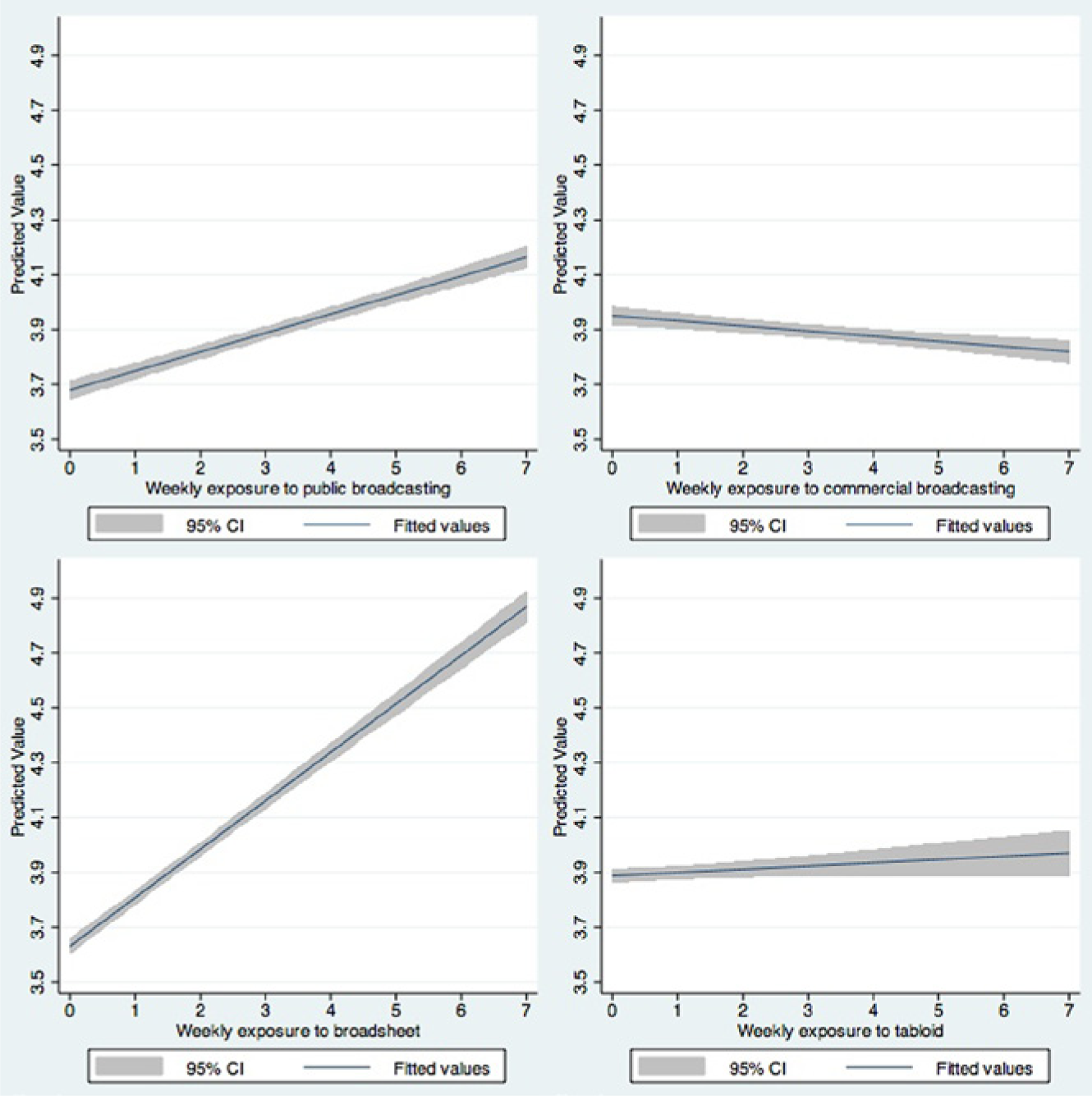
Predicted values of knowledge as exposure to news sources increases.
Although exposure to public broadcasters and broadsheet newspapers both boost knowledge, the effect of broadsheet newspapers appears to exceed that of public broadcasting. The fitted value of political knowledge for a given citizen who self-reports no exposure at all to news programs aired by the public broadcaster is 3.7 (see the top left graph in Figure 1). This value increases to 4.2 for a citizen reporting the maximal level of exposure. This amounts to an effect size of around half an additional correct answer out of the seven political knowledge questions. Exposure to broadsheet newspapers shows a stronger effect size (more than double the effect of the public broadcaster) of around 1.2, that is, moving from the minimum to maximum level of exposure results in slightly more than one additional correct answer. (The predicted mean knowledge increases from 3.6 to 4.8 correct answers as shown in the bottom left panel of Figure 1.) In contrast, the effects of exposure to commercial newscasts and tabloid newspapers appear negligible (see the corresponding graphs in Figure 1).
Thus far, we have relied on conventional multilevel regression to document that exposure to hard-news-oriented sources is related to higher levels of general political knowledge in Europe. We must treat these results with some skepticism because of the inherently self-selected nature of media audiences. In general, more motivated, informed and knowledgeable citizens are the most likely to seek out hard news. Of course, we cannot definitively overcome this causal circularity between knowledge and source selection since we do not have longitudinal data.
While the panel design (see, for instance, de Vreese and Boomgaarden 2006; Jenssen 2009) provides some leverage over questions of changes in knowledge, it does not directly address the problem of endogeneity. People who read broadsheets may register greater increases in knowledge over time not because of the political content delivered by the broadsheet but because they are especially attentive to political news. An alternative strategy for estimating treatment effects in non-randomized contexts is propensity score analysis (Levendusky 2011). The underlying idea is to implement a series of comparisons between treatment and control groups within subgroups defined by covariates that predict selection into the treatment group. This means we are, in fact, comparing cases that are essentially indistinguishable with respect to background factors, except for the fact that some are exposed to a particular news source and others are not.
Propensity score matching was designed to overcome failures of random assignment in experiments where compliance with assignment to treatment is often correlated with attributes of the subject population. In observational studies, where physical control over the treatment is impossible, assignment to “treatment” is typically conditional on a selection process that is driven by the very same factors that affect the outcome variable. The fact that the audiences for hard news are drawn disproportionately from the ranks of the politically engaged makes it necessary to estimate the average treatment effect after first adjusting for self-selection into the treatment group (for reviews of the matching methodology, see Caliendo and Kopeinig 2008; Imbens 2004). Since we have information on the main factors structuring exposure to media sources (covariates), we can at least partially overcome the problem of self-selection and recover an unbiased estimate of the treatment effect.
Of course, matching does not overcome all problems of endogeneity in the estimation of the media effects. Instead, a properly specified propensity score equation only yields more accurate (and typically more conservative) estimates of treatment effects in comparison to the estimates obtained by the standard OLS regression technique. In short, we see propensity score matching as a potentially useful technique to ameliorate some, though not all of the problems associated with self-selection (for a similar view, see Levendusky 2011; Soroka et al. 2013). This is especially true considering that there are relevant content differences across the media outlets analyzed here (see the results summarized in Tables 5 and 6 in the online appendix), with broadsheets presenting the highest percentage of hard news followed by public broadcasts, commercial broadcasts, and finally tabloids.
To compute the propensity scores, we first define exposure to the treatment by reducing the scale of the weekly exposure question to a simple dichotomy. In effect, we contrast those with some exposure to the source in question (e.g., public-broadcasting-oriented news) with those not exposed at all. This strategy is necessary to generate propensity scores for exposure to each of the media sources analyzed here (Levenduski 2011; Soroka et al. 2013). Since the logic of matching is to compare treated and untreated observations, we need to dichotomize exposure to news. Following previous studies (see, for instance, Soroka et al. 2013), and for the sake of statistical efficiency (i.e., having enough observations in each of the two categories), we created binary treatment variables that divide the sample roughly in half. This is true for all four treatment variables except one: exposure to tabloids (where the distribution is skewed with 17.08 percent of respondents declaring to be exposed vs. 82.92 percent unexposed). 8
We then estimate first-stage equations for each of these treatment variables as a function of the standard predictors of news media exposure: respondents’ education, sex, age, political interest, as well as an indicator of general media use (not specifically referring to news). For each of the four treatment (source) variables, the propensity score matching equation satisfied the necessary balancing properties. 9
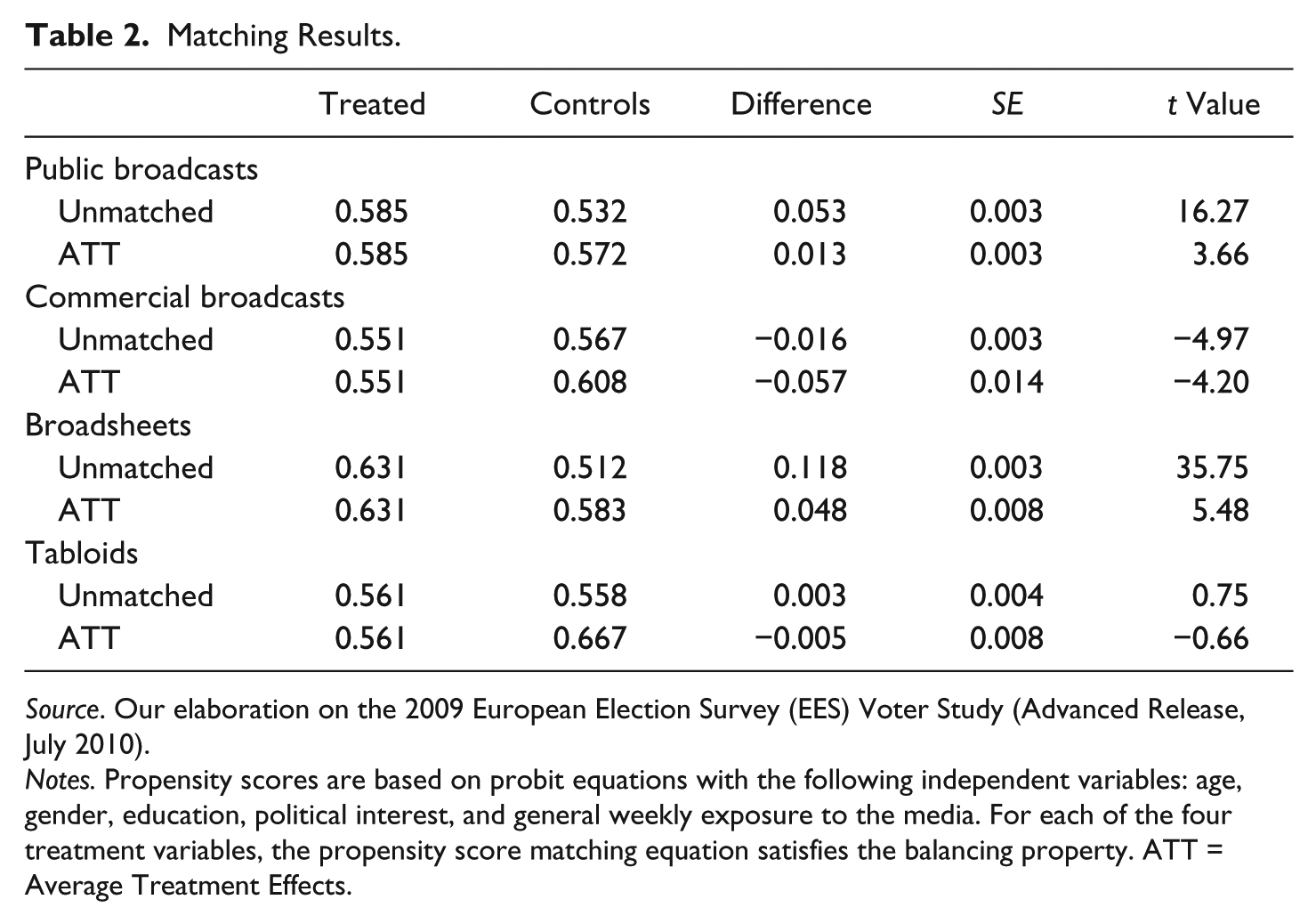
Table 2 shows the matching results contrasting the differences in knowledge between the treated and untreated group (i.e., citizens exposed and not exposed to a given source). More specifically, for each outlet, we see in the first line the differences in knowledge between respondents exposed versus not exposed before matching, while in the second line, we see the same differences after matching (i.e., once we implemented the matching technique). In the online appendix—following the approach suggested by Becker and Ichino (2002)—we also provide a comparison of results based on four different propensity score matching algorithms (see Table 7 in the online appendix). While none of them is a priori superior to the others, their joint consideration offers a way to assess the robustness of the estimates (Becker and Ichino 2002).
Matching Results.
Source. Our elaboration on the 2009 European Election Survey (EES) Voter Study (Advanced Release, July 2010).
Notes. Propensity scores are based on probit equations with the following independent variables: age, gender, education, political interest, and general weekly exposure to the media. For each of the four treatment variables, the propensity score matching equation satisfies the balancing property. ATT = Average Treatment Effects.
The most noteworthy result in Table 2 is that the informative effects of exposure to broadsheet newspapers survive the implementation of matching (and according to Table 7 in the online appendix, no matter which matching method is employed). Although the magnitude of the coefficient measuring the treatment effect decreases noticeably after matching, the pattern of results obtained in Table 1 (Equation 2) persists. This is also the case for exposure to public broadcasting where matching shrinks the magnitude of the coefficient. Moreover, Table 7 in the online appendix shows cases of estimated average treatment effects on the treated that are non- significant (e.g., in the case of estimation with the Radius matching algorithm). Thus, both the informative effects of exposure to news programs aired by public broadcasters and news from broadsheet newspapers appear to survive this second more conservative estimate of treatment effects. These findings are consistent with a recent study based on a smaller sample of nations that also implements matching technique (Soroka et al. 2013).
Having demonstrated that the effects of exposure to broadsheet newspapers and public broadcasting on knowledge are robust, we proceed to examine the extent to which these particular media sources contribute to widen or narrow information inequalities between the “haves” and “have-nots.” There are two main sources of information inequality: inequality stemming from differential motivation or differential resources. For this analysis, we revert to conventional multilevel regression analysis since we have demonstrated that it provides a valid (although somehow less conservative) estimate of the informative effects of newspapers and public broadcasts.
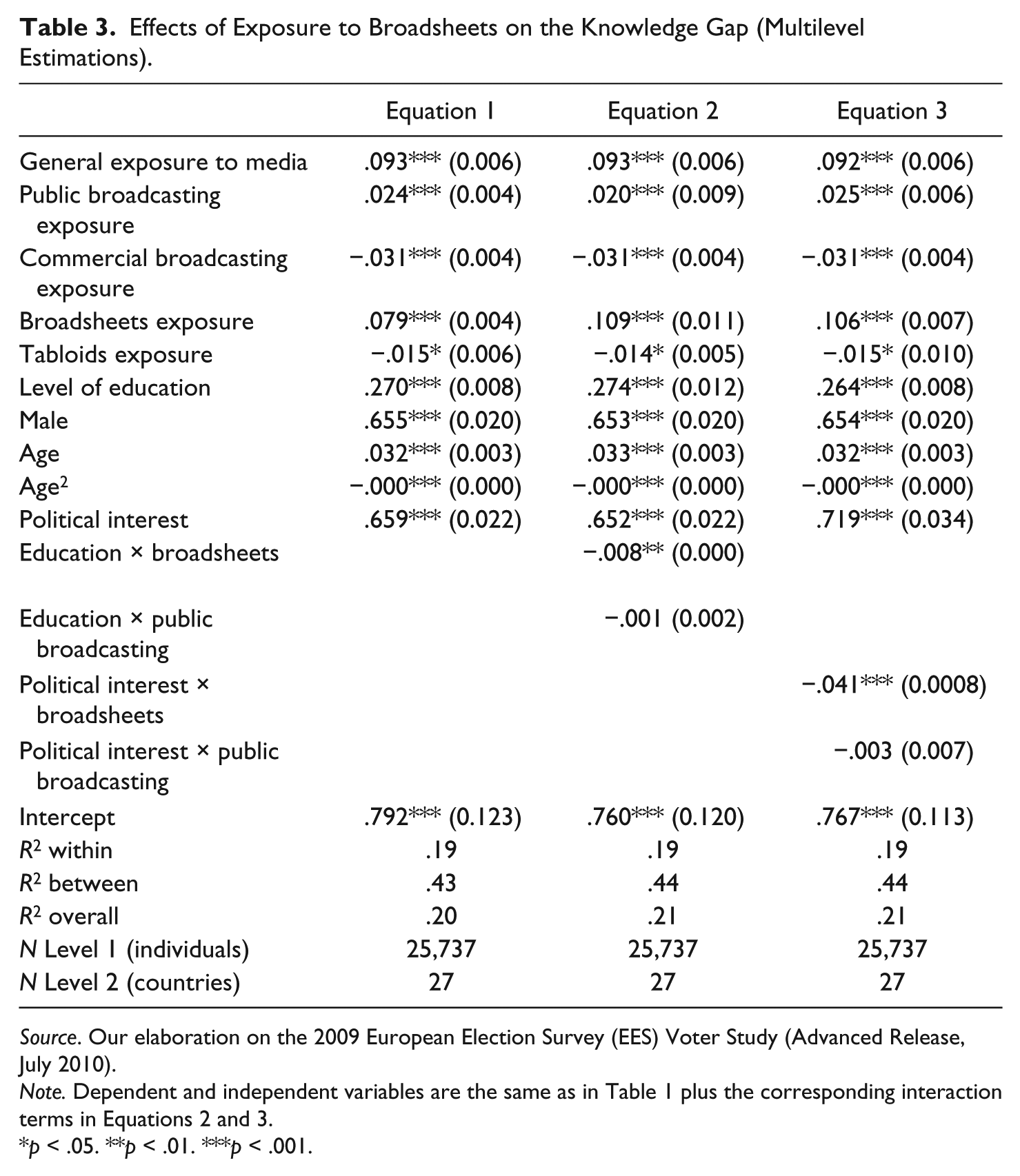
We estimate the effects of exposure to broadsheet and broadcasting news on information inequality by specifying an interaction term between exposure to broadsheets (and public broadcasting) and education (an indicator of resource inequality) on the one hand, and exposure to broadsheets (and public broadcasting) and political interest (an indicator of motivational inequality) on the other. The obtained results are shown in Table 3 (Equations 2 and 3, respectively).
Effects of Exposure to Broadsheets on the Knowledge Gap (Multilevel Estimations).
Source. Our elaboration on the 2009 European Election Survey (EES) Voter Study (Advanced Release, July 2010).
Note. Dependent and independent variables are the same as in Table 1 plus the corresponding interaction terms in Equations 2 and 3.
p < .05. **p < .01. ***p < .001.
Equation 1 in Table 3 replicates Table 1. Equation 2 adds the interaction terms between exposure to both broadsheet newspapers and public broadcasts and education, while Equation 3 adds the corresponding interaction terms for political interest. Thus, while Equation 2 explores the contribution of both broadsheets and public broadcasts to the resource-based knowledge gap, Equation 3 addresses the impact of both broadsheets and public broadcasts on the motivation-based knowledge gap.
The results from Table 3 indicate that exposure to broadsheets, but not public broadcasting, has the expected leveling effect on the knowledge gap. The interactions between exposure to broadsheets and education and interest were both significant and negatively signed. In contrast, the interactions did not reach statistical significance for the case of public broadcasting.
The assessment of the magnitude of the interactions requires that we plot the expected marginal effect of each of the components of the knowledge gap (education and interest) for individuals either exposed or not exposed to broadsheet newspapers (see Brambor et al. 2006). The solid sloping line denotes the marginal effect, and the dashed lines indicate a 95 percent confidence interval based on the estimates of Equations 2 and 3 in Table 3, respectively. When the value 0 of the predicted marginal effect is not within the upper and lower bounds of the confidence interval, the marginal effect is statistically significant. As can be seen in Figure 2 (see the top graph of the figure), the marginal effect of education on knowledge is always significant, but it slightly decreases (from .28* to .21*) as weekly exposure to broadsheets increases. 10

The leveling effect of exposure to broadsheets news on the knowledge gap.
The results are also relevant in the case of the motivational knowledge gap (see the bottom graph of Figure 2). Here, the marginal effect of political interest on knowledge is always significant but decreases substantially (from .71* to .41*) as citizens’ weekly exposure to broadsheets rises. Or put another way, among less exposed citizens, the effect of political interest on knowledge is about twice as large (.71*) as among highly exposed citizens (.41*). Clearly, the reading of broadsheet newspapers contributes to a leveling of the knowledge gap. We discuss these findings and their implications for future research in the last section.
Discussion and Conclusion
The practice of serious journalism contributes to an informed public. Our evidence shows that exposure to broadsheet newspapers and public broadcasts that typically cover hard news results in higher levels of knowledge. This implies that it is not the medium per se but the content delivered by particular media sources that matters. In-depth treatment of public affairs informs, superficial and sensational treatment does not.
Notwithstanding the argument that all news sources are increasingly responding to consumer demand, thus creating “convergence” of content across sources (see Plasser 2005), our analysis confirms that news programs aired by the public broadcaster tend to be more substantive than the offering of commercial channels. After adjusting for selection into the public broadcaster’s audience, our analysis finds that viewers exposed to newscasts delivered by the public broadcaster are better informed than those who tune in to commercial broadcasters. In addition, our study breaks new ground by showing that the distinction between public and private broadcasters is overshadowed by the distinction between broadsheet and tabloid daily newspapers. More specifically, we demonstrate that the audience for tabloids is substantially less informed about public affairs than readers of broadsheet newspapers. In the case of broadcast sources, we find that the advantages associated with exposure to the public broadcaster also survive controls for self-selection into the audience, but the magnitude of their informative effects appear somehow smaller than those of the broadsheets. Consequently, it is only broadsheets and not public broadcasters who also have the capacity to narrow the gap in knowledge between more and less advantaged citizens.
These last findings confirm not only that information-rich contexts can overcome the costs of becoming informed about politics but also that information-rich environments contribute to a reduction of the inequalities in knowledge (Berggren 2001; Fraile 2013; Iyengar et al. 2010). In the case of the EU electoral campaign (which can be reasonably considered an information-rich context), broadsheet newspapers present relevant informative effects that reduce the knowledge gap between low resource and unmotivated citizens and their high resource and motivated counterparts.
Despite previous studies arguing the impossibility of systematically demonstrating media influence on political attitudes and behavior (see Bennett and Iyengar 2008; Mondak 1995; Newton 2006), we demonstrate that news stories containing serious and in-depth information have the capacity to inform their audiences. In line with recent innovations in the study of knowledge acquisition (Barabas and Jerit 2009; Curran et al. 2009; Jerit et al. 2006), we overcome some of the methodological problems affecting previous studies. Our study considers not only measures of media content but also implements a more conservative estimation strategy (propensity score matching) to document the informative effects of media sources.
Of course, our conclusions are subject to several caveats. Most notably, we have focused on within-country differences across outlets but have ignored differences across countries. In countries where there is greater variation in news content across sources, we would expect strengthened source effects on knowledge. The extent to which the conditional effects of sources on knowledge are further conditioned by country or media system attributes, however, is the subject of future research.
In comparison with the extant literature, our evidence is relatively robust. Despite the difficulty of untangling cause and effect relationships in observational mass media research, and despite the fact that the data analyzed here are cross-sectional, we have adjusted for self-selection tendencies within particular audiences, something that to the best of our knowledge represents an innovation in media effects research (for a parallel effort, see Soroka et al. 2013). The use of matching bolsters our claim that the informative effects of broadsheets and public television news are genuine, rather than an artifact of self-selection.
In closing, we reiterate that our analysis provides conservative estimates of the effects of media content on political knowledge given the nature of the survey questions comprising our dependent variable. General knowledge is known to depend more on long-term pre-dispositional factors (such as education or motivation) and less on short-term contextual factors (Jerit et al. 2006). With alternative measures of knowledge that tap awareness of issues and events in the news, the effects of sources on information gain will likely be enlarged, thus strengthening the argument that the delivery of news is a significant determinant of what citizens learn about the political world.
Footnotes
Declaration of Conflicting Interests
The author(s) declared no potential conflicts of interest with respect to the research, authorship, and/or publication of this article.
Funding
The author(s) disclosed receipt of the following financial support for the research, authorship, and/or publication of this article: Marta Fraile acknowledges the financial support for the research of the Spanish Ministry of Science and Innovation (Grant CSO2008-03819/SOCI) and the Spanish Ministry of Economy (Grant CSO2012-32009).