




Abstract
Social actors see exposure in the news media as attractive for publicity purposes and are under pressure to adapt their press work to a “media logic” to be attractive sources for journalists and editors. This article investigates the European Parliament’s press officers’ professional practices in the light of mediatization and government communication theories. Without one pan-European public sphere, the European Parliament, like the other European Union (EU) institutions, competes with national actors for the news media’s attention in the EU’s twenty-eight national public spheres, where EU affairs do not tend to get a media coverage that matches the EU’s considerable influence on European citizens’ daily lives. This study, which is based on in-depth interviews with European Parliament press officers, concludes that these professionals are indeed attuned to a “media logic” in their communication efforts, and that they face a daily professional challenge as they attempt to promote the European Parliament and its activities to the news media in a way that will not compromise their credibility as government sources. The study provides new insights into communicative aspects of EU governance, and particularly into the thinking that guides the efforts of these European Parliament officials to increase European citizens’ awareness of, and support for, the European Parliament that is meant to voice the citizens’ concerns in political processes at the EU level.
Introduction
In present day Western democratic societies, most citizens rely on the news media for information and debates about the society they belong to. Social actors, such as political parties, candidates for public office, interest groups, corporations, and government institutions therefore see the news media as an efficient channel to influence public opinion. One of the implications of the increasing mediatization of Western societies (Hjarvard 2013; Strömbäck 2008) is that actors in search of media coverage seek to make themselves attractive to journalists and editors by adapting their efforts to “media logic” (Altheide and Snow 1979). This article investigates the strategic thinking behind the European Parliament’s (EP’s) press work in the light of mediatization and government communication theories.
The three big EU institutions, that is, the European Commission, the Council, and EP, hardly have a reputation as frontrunners when it comes to external communication. In the decades following the creation in 1957 of the European Economic Community (which later developed into the European Union [EU]), the polity’s political processes by and large took place behind closed doors, and its institutions did not interact much with the news media. 1 However, the Danish rejection of the Maastricht Treaty in 1992 sparked the EU institutions to put a stronger focus on external communication as a means of increasing their popular support and legitimacy among European citizens (Laursen 2012). Since the mid-1990s, the EU institutions’ external communication effort has therefore become broader and more proactive (Curtin 2007) in an attempt by the institutions to overcome the EU’s alleged “communication deficit” (Anderson and McLeod 2004; Meyer 1999). Today, EU executives see media coverage as essential for the institutions’ image among European citizens, 2 and each of the three big institutions has its own press office with considerable numbers of civil servant personnel dedicated to interacting with journalists. 3 This development can be seen as the EU institutions’ organizational adaptions to the increasing mediatization of society. However, as the three big EU institutions’ media communication is underresearched (Reckling, Weiß, and Müller 2014), knowledge about the degree to which these institutions have also adapted their day-to-day communication practices to media logic is limited. Nothing seems to be known about EP in this respect, and the few studies of the European Commission’s and the Council’s routine media communication efforts (for a brief overview, see Valentini and Laursen 2012) hardly indicate communication strategies adapted to a mediatized reality.
This explorative and mainly inductive study heeds the call for more empirically based insights into EU institutions’ interactions with the media (Martins, Lecheler, and De vreese 2012) by shedding light on EP press officers’ (POs’) professional practices as perceived by the POs themselves. On the basis of interviews with EP POs, we seek insights into the logics that guide these communicators’ media relations efforts.
The article is structured as follows. First, we review the relevant literature and account in more detail for our focus. This first part is followed by a presentation of our methodological considerations and our main findings. We round the article off by discussing our findings and providing some suggestions for further research.
Mediatization, Government Communicators, and the News Media
The concept of mediatization refers to processes whereby the logic and institutionalized norms of the media affect the behavior of actors and institutions belonging to other societal subsystems (Hjarvard 2013; Strömbäck and Esser 2014; Strömbäck and Van Aelst 2013). According to this strand of research, social actors have become increasingly dependent on the news media and have reacted by adapting to the logic of the news media in various ways. This logic is defined by Strömbäck and Van Aelst (2013) as “the institutional, technological, and sociological characteristics of the news media, including their format characteristics, production and dissemination routines, norms, and needs, standards of newsworthiness, and . . . the formal and informal rules that govern news media” (p. 373).
Social actors’ adaptions to mediatization processes include organizational measures such as the hiring of increasing numbers of staff who have an intimate knowledge of how the news media work and who are therefore in a position to strategically manage the actors’ relationships with the media (Manning 2001; Negrine 2008). In their theoretical study of how political parties adapt to news media logics, Strömbäck and Van Aelst (2013) found that adaption processes take place not only at the organizational level but also at the level of routine communication practices. Through their interactions with the news media, political parties thus seek to “proactively shape the media agenda and promote their issues and frames through the media” (p. 344); adapt their messages to fit the media’s standards of newsworthiness, for example, in the form of “information subsidies” (press releases, press conferences, or other events) “designed to attract the media and provide information in forms and scheduled at times that conform to the media’s production routines” (p. 345); and establish personal relationships with journalists “by meeting in formal and informal settings, and by providing journalists with exclusive information” (p. 345).
The increasing mediatization of society is a significant aspect of the context in which EP POs operate. So is the fact that, as civil servants in EP’s Secretariat, the POs are embedded in a “formal organization in the public sector” (Christensen, Roness, and Røvik 2007: 8). While private-sector organizations exist to generate a profit to their owners, public-sector organizations exist to serve the public interest (Rainey 2009). Civil servant government communicators engage in external communication activities because their tax financed institutions have a democratic and ethical obligation to inform about their activities (Christensen, Roness, and Røvik 2007; Édes 2000; Neeley and Stewart 2012; Viteritti 1997). 4 Public-sector organizations in Western democratic societies vary a lot (within and across countries) when it comes to structures and tasks, but their common denominator is that they are the result of democratic political decisions; that is, they are “instruments of elected bodies in carrying out public policies” (Wæraas and Byrkjeflot 2012: 188). Therefore, they are obligated to “emphasize wider and often conflicting . . . values and interests” (Wæraas 2008: 210). Government organizations and their civil servant staff furthermore tend to be held to high standards of honesty, openness, and objectivity, including when it comes to communicating about the organizations’ activities (Christensen, Roness, and Røvik 2007; Mulgan 2007; Rainey 2009). Government communicators’ efforts help to provide “the foundation for deliberative democracy and for the exercise of rational choice between competing political positions” (McNair 2007: 96). They are generally expected to act as reliable information sources and to engage in external communication that is sober, balanced, concise, and truthful (Édes 2000; Gelders and Ihlen 2010; Sanders, Crespo, and Holtz-Bacha 2011). Their practices have been characterized as “apolitical” and “non-partisan” (Glenny 2008: 153) as well as “rational” (McNair 2007: 96). Other scholars have argued convincingly that the dissemination of impartial information for the sake of the common good is not government communicators’ only concern and that they also seek to gain public support for and legitimize their institutions (Lee 2012; Liu et al. 2012; Sadow 2012).
Mediatization processes and public-sector ethos together form the backdrop against which government communicators negotiate their relationship with journalists. The news media play a central democratic role in Western societies and relay information to citizens about “government actions, problems, issues, and politics affecting the public” (Christians et al. 2009: 144). Government communicators are important sources for journalists (Butler 1998; Strömbäck et al. 2013; VanSlyke Turk 1986), and the two professions together play an essential role for the way in which politics is socially constructed (Davis 2010). The relationship between sources and journalists is based on an exchange of resources: Journalists control access to the media but need information from government sources, who, in turn, control this information, which they offer journalists in exchange for media exposure. The framing of politics in the news can therefore be seen as “a coproduction of news sources and journalists” (Strömbäck et al. 2013: 34), and the interaction between the two parties has been conceptualized as a collaboration between parties with mutual interests, where each party seeks to further its own interests (Cook 1989; Larsson 2009; Strömbäck et al. 2013). There is scholarly disagreement as to which of the two parties holds the upper hand (Davis 2010). The increasing mediatization of society might suggest that the balance of power is tipping in favor of the journalists but research indicates that social actors can play a substantial role in shaping the news media’s agendas (Larsson 2009; Walgrave and Van Aelst 2006). Besides influencing media agendas, social actors’ concerns include “reach[ing] the mass public . . ., influenc[ing] the media framing . . . build[ing] public support that can put pressure on other political actors . . ., and, ultimately, influenc[ing] public opinion formation processes” (Strömbäck et al. 2013: 32)
The EU Institutions’ Press Work
With a few exceptions (Martins, Lecheler, and De vreese 2012; Meyer 1999), scholars have investigated the relationship between reporters and the EU institutions from the point of view of one of the two parties. In this review, we focus on the institutional side of the relationship. Meyer (1999) as well as Anderson and McLeod (2004) focused on managerial and organizational aspects of the Commission’s and EP’s press work, respectively, and criticized these institutions’ media communication performances. Both studies blame the lack of communication expertise, and EP communicators were found unable to attract journalists’ attention because they were “ignor[ant] of key basic principles of a successful press and public relations strategy” (Anderson and McLeod: 916). Lack of communication expertise on the part of the Commission may also explain why national media’s uptake of the Commission’s press releases is limited and why the media’s coverage of issues raised in that institution’s information subsidies often does not reflect the Commission’s angle (Bijsmans and Altides 2007). Other findings suggest that the Commission’s media communication to some degree (low to moderate) is adjusted to the logic of the news media (Meyer 2009), and that this is more the case for the institution’s oral than its written communication (Balcytiene et al. 2007). Finally, Spanier (2010) found that the Commission’s spokespersons tend to focus on a community of Brussels-based transnational experts as well as the specialist press, while ignoring broader audiences such as national news media.
The Council seems to not have adapted its press work to media logic in any noticeable way. This institution’s POs take a more reactive than proactive approach to their work and see themselves as non-partisan communicators who provide objective information to journalists (Laursen 2012; Laursen and Valentini 2013).
In-depth scholarly insights into EP’s routine press work seem to be non-existing. Our main aim is to fill this void by investigating the logics that guide EP POs’ professional practices. We also seek insights into how these communicators handle two specific challenges they face in their daily work and which are linked to the increased mediatization of society. We refer to these two challenges as the civil servant challenge and the national media challenge.
EP’s POs are employed as European civil servants, and the civil servant challenge concerns the tension that exists between the media’s news criteria and the POs’ status as civil servants. Playing by the rules of the media implies among other things adapting messages to fit the media’s institutionalized news criteria, such as timeliness, identification, sensation, conflict, relevance, and so forth (Schultz 2007). This is likely to involve trimming the institution’s messages in various ways, such as presenting facts in a particular light to fit specific news criteria as well as selecting certain facts and omitting certain others to ensure that the messages are in keeping with current media agendas. Such selective strategic communicative behavior may lead to biased messages that violate key principles and values traditionally associated with professional Western public-sector organizations (Richards and Smith 2000). We seek to shed light on how EP’s POs handle the tension between media logic and public-sector values.
The national media challenge is a consequence of the heterogeneity of the European market for EU news. The news media serve as public spheres for debates between societal actors, but scholars have pointed out that a supranational European public sphere, understood as shared mediated spaces where citizens and social actors from the twenty-eight EU member states exchange views on the basis of converging news agendas, has still not emerged and may never emerge (Schlesinger 2007; Trenz 2008, 2012). This implies that, by and large, European citizens receive their information about the EU from their national media outlets. This is not only a democratic problem (Magnette 2003) but also a major challenge for EP’s press work. The problem for EP is that editors and journalists assess the relevance and newsworthiness of EU news on the basis of their perceptions of the national contexts in which their media outlets are embedded. The existence of twenty-eight different public spheres therefore implies that an EU issue that hits the front pages in one member state may be deemed irrelevant by the news media in another. How do EP POs address the problem that national media provide the main link between EP and European citizens?
In summary, this explorative study has the following three focus points: EP POs’ communication logics, their handling of the civil servant challenge, and their handling of the national media challenge.
Method
Our study is phenomenological and interpretivist in nature as it focuses on the perceptions of individuals in a particular organizational setting (Bryman 2012; Daymon and Holloway 2011). Through the use of qualitative research methods, we seek to provide a rich description of how EP’s POs make sense of their own day-to-day professional realities. This focus involves investigating the behavioral, emotive, and social meanings that these government communicators attribute to their own and others’ actions (Guest, Namey, and Mitchell 2013; Kvale 1996). Our findings are based on semi-structured interviews with nine Brussels-based EP POs, including one of the press unit’s three press coordinators, and on a number of internal and external documents produced by EP’s Press Service. Interviewing took place in February 2012.
As EP POs are organized according to the policy areas they cover and their member state of origin, we made sure that our sample of interviewees reflected an appropriate variety in these respects. Our interviewees furthermore varied in terms of educational background (all nine had university degrees, five in journalism or public relations and four in other fields), seniority in the EP press service (between six months and seven years with an average of around four years), and previous professional experience (more than half had previously worked as journalists or public relations practitioners and several had held other positions in EU institutions, for example, as translators and assistants to Members of EP [MEPs]). The nine semi-structured interviews lasted approximately sixty minutes each and consisted of open-ended questions organized around the following five themes: tasks, goals, and tools, selection of topics for and framing of information subsidies, transparency, interactions with journalists, and internal/external collaboration partners. To provide internal validity, copies of transcripts of the audio files were sent to the interviewees for approval and comments (Lincoln and Guba 1985). Inductive thematic analysis was used to analyze and make sense of the transcripts to elicit “the stories and experiences voiced by study participants as accurately and comprehensively as possible” (Guest, MacQueen, and Namey 2012: 16). The process consisted of a close reading of the textual data with a view to identifying and coding themes, followed by an interpretation of the content of the themes (Guest, Namey, and Mitchell 2013). 5
Findings
Our interviews focused on gaining insights into key logics that guide the POs’ professional practices but also provided us with important insights into organizational dimensions of EP’s press work. These insights are crucial for understanding the POs’ communication logics and furthermore shed light on the two major challenges described in the literature review. We first present findings related to the organizational aspects and later proceed with findings directly related to the POs’ communication logics. We address the POs’ handling of the two challenges in the “Discussion and Conclusion” section.
Organization of the POs’ Work
Legislative processes in EP take place at two levels. The bulk of EP’s legislative work takes place in the twenty standing parliamentary committees that are organized according to policy areas. In each committee, forty to sixty MEPs discuss legislative proposals submitted by the Commission and draw up a report that may include suggested amendments to the proposal. The report is submitted to the second parliamentary level, the plenary, where all 766 MEPs formally adopt EP’s final position on the proposal. 6
Five different EP sources provide information to journalists about the institution’s activities: the president’s press service, the political groups’ press offices, individual MEPs and their staff, EP’s information offices based in the twenty-eight capitals, and EP’s central Brussels-based press office. This paper focuses exclusively on the last EP source. EP’s Brussels-based press office is part of EP’s Media Directorate, which is one of four directorates in the Directorate-General Communication of EP’s Secretariat. EP’s Secretariat has a staff of some four thousand officials.
In the press service, a team of 24 civil servant POs provides journalists with information about EP’s activities. 7 Officially, the information provided is “objective, factual and trustworthy” (European Parliament 2010: 5). One of the official aims of EP’s press service is to ensure “the largest possible press coverage of the European Parliament and its decisions at the plenary and committee levels” (European Parliament 2010: 6).
All interviewed POs stated that they follow EP’s work in general and the proceedings in one or two committees in particular. Therefore, they are familiar with the major debates and decisions in the institution and furthermore have a precise knowledge of what goes on in “their” committee(s). Besides the policy area specialization, most POs also specialize in one official language and/or member state. This organization of the press work mirrors the heterogeneity of the POs’ “clientele.” Our interviewees reported that they serve very well-informed reporters, who are permanently based in Brussels, specialize in EU affairs, and follow the EU/EP’s work on a daily basis, some of them with a particular focus on a limited number of policy areas. The POs also serve less well-informed reporters, who are based in a member state, follow EU affairs on a more irregular basis, and go to Brussels only when there are major EU events to cover. According to most interviewees, the POs’ specialist knowledge is particularly valued by the group of well-informed, specialized EU reporters, with whom the POs communicate in English, whereas the less well-informed and often member state–based journalists tend to prefer to approach the POs in their native language and to seek national and regional angles on EP’s work.
A significant part of the POs’ communication activities are supervised by an “editorial committee,” which is a unit in the press office that establishes strategic guidelines for EP’s press work and decides when and on which topics the POs should communicate. The POs reported that they can also suggest communication initiatives themselves, but that their own initiatives are subject to approval by the committee. Being able to suggest initiatives was found by the interviewees to be particularly relevant when it comes to communicating national angles on EP issues or otherwise adapting to specific circumstances.
The POs’ Communication Logics
In this section, we present findings that indicate how EP POs make sense of their work practices. Our data suggest that the POs see themselves as impartial information providers and as publicists. 8
Impartial Information Providers
The POs see themselves as being at the service of journalists covering EU affairs. One interviewee describes the essence of his work as “making life easier for journalists.” This role primarily implies providing written information to journalists about EP’s ongoing legislative activities and having dialogues with individual journalists face-to-face or by telephone/email. Furthermore, it implies providing assistance to journalists in their research processes.
The bulk of the POs’ work is to inform about EP’s legislative work. When an EP committee has adopted a report as a result of its discussions of a legislative proposal from the Commission, the PO covering the committee issues a press release stating, for example, that the committee rejected or endorsed (elements of) the Commission’s proposal, and/or that it suggested amendments to the proposal.
Our interviewees indicated that reporting from committee meetings can be delicate. Unanimity among the committee’s MEPs makes the PO’s job easier, but when MEPs in political groups disagree, the PO must be careful to provide a balanced account. Besides stating the main points of the Commission’s proposal and the substance of the committee’s position, the PO generally also, to some degree, accounts for the different political positions represented in the committee. Interviewees’ accounts of how they handle this delicate reporting task differ. One interviewee saw it as his job to give “a kind of overall view of the majority vote in the committee,” whereas others reported that that they devote more attention to also accounting for dissent.
When the legislative dossier has been finalized at the committee level, it moves to plenary. After the plenary, the PO writes a press release accounting for the political outcome along the lines described above.
Our data indicate that when POs report from committees and plenaries, they seek to strike a balance between the perspective of the media and that of the institution. Some interviewees mentioned that they would be able to increase media interest significantly by focusing more on what separates the MEPs than on what they agree on and thus accommodate journalists’ appetite for political debate and conflict. However, the vast majority of our interviewees reported that, as EP officials, they need to provide an institutional and more consensual account that is acceptable to all MEPs and political groups.
EP’s POs see themselves as EP’s institutional voice. Therefore, they communicate in the name of the institution and not in the name of EP’s political actors (political groups and individual MEPs): “We are neutral in our information to the journalists. We’re impartial, so we don’t give preference to, for example, the socialist viewpoint” (interviewee). Several interviewees pointed out that this rationale is in complete contrast to that of EP’s political groups and individual MEPs, who tend to communicate to make themselves attractive to their electorates and to position themselves in political battles.
Most interviewees strongly underlined that in their professional practices, they seek to give politically unbiased accounts of what goes on in EP, and that this particular aspect of their communication is valued by the journalists, who often come to the institution’s POs to get the facts: When they [journalists] get a message from a political group and then a different one from another political group, they come to us and ask: “ok, what is in the [legislative] text? What does the directive, regulation, or whatever, say exactly?”
To avoid accusations of being biased in their communication, the POs stick to texts that have been formally adopted by EP and generally avoid controversial information and political speculations. When they include MEP quotes from the political debates, the POs are very careful not to favor particular political positions. As one interviewee said, “If you quote one, you have to quote the other. So the balance, you have to get it right.”
Necessary input to journalists’ coverage of political processes in EP includes insights into both the substance under discussion (e.g., legislative proposals) and the political groups’ and individual MEPs’ political views on the substance. The POs can help journalists to get access to this journalistic raw material by providing facts, numbers, dates, names, access to reports, minutes from meetings and other substance-specific and non-confidential information, and by establishing contact between journalists and MEPs for interviews. EP POs therefore sometimes play important roles in key journalistic research processes, especially in situations where journalists are working under time pressure and the amount of available information on the issue is overwhelming. Interviewees reported that in such situations, journalists do not have much time to do their own research and therefore see the POs as a convenient source of assistance. One interviewee was very blunt: “We are doing half of their job.” More specifically, the POs are often asked by journalists in need of time to summarize, prioritize, and select issues and topics.
Publicists
Our data indicate that EP POs do not knowingly disseminate inaccurate and politically biased information because that would compromise their trustworthiness and reputation among both MEPs and journalists. However, telling the truth is not the same as giving the full picture, and not having specific agendas to push. Indeed, all interviewees were very aware that they are in the business of strategic communication, and that their objectives include increasing EP’s visibility in the media and shaping EP’s image. One interviewee said that “Our aim, after all, is to sell the institution.”
The POs’ professional practices are guided by a logic according to which, the more attractive and relevant journalists perceive the POs’ communication to be, the more likely it is that they will make use of it and thereby increase EP’s media exposure: “I should try to get Parliament presented in the press, so I have to pick out things where I think we could get some coverage.” However, as they are their institution’s official voice, the POs must be cautious not to “oversell things or give them too much spin” (interviewee).
Most interviewees have previous work experience as journalists and/or public relations practitioners and therefore have a very good understanding of how the news media function. They are familiar with journalists’ working conditions (e.g., deadlines and editorial guidelines) and the rationale that guides journalistic work processes (e.g., news selection criteria, research and drafting processes, tailoring and framing of news stories to various audience types). Their insights into media logic allows the POs to tailor their communication to the needs and preferences of the journalists and thus to “get them on the hook”, as one interviewee put it. As described below, media logic guides the POs’ communication in several ways.
Selection of Topics
The POs stressed that they do not simply write a summary of every decision the EP has made. They make what one interviewee referred to as “editorial decisions,” that is, they are very selective when it comes to their own “coverage” of EP’s activities. They down-tone “boring” (interviewee) matters of legal procedure and focus on issues and aspects that they believe to be attractive to journalists, and do not seek to provide a balanced overview of the dossiers. One interviewee observed that “In a legislative report of maybe 100 pages with just two pages about animal testing, we may choose to focus on those two pages because we think they are of most interest to the media.”
The media agenda is essential, but it is not the only concern when the POs and the editorial committee select their issues. The institutional agenda also plays a role. Some issues and occasions lend themselves better to promoting the EP perspective than others, and the POs are instructed by their management to take these opportunities to make their institution’s voice heard, and if possible at the expense of those of the Commission and the Council, which are seen by the POs as EP’s competitors in the fight for visibility and public support. “When Parliament has really obtained a victory because it felt that what the Council wanted was unacceptable, and it succeeded in the negotiations with Council in obtaining what Parliament wanted, then clearly we’re going to communicate that,” said an interviewee.
The institutional agenda is a permanent concern, and the POs always have their communicative focus on EP’s amendments rather than on the Commission’s proposals. One interviewee described this aspect of her work as “giving specific examples of where Parliament plays a role and how important it is in the negotiation process with Council and Commission.” This focus may lead POs to highlight issues that are of minor importance in the bigger EU picture and may thus result in communication that gives a skewed picture of the overall EU legislative processes. The institutional agenda and EP’s institutional power are at their highest when the MEPs approve or reject the EU budget and the composition of the European Commission.
EP’s POs thus seem to have their focus on EP and not to care much about the legitimacy and reputation of the EU as such. Contacts with Commission and Council POs are rare, and there is no formal inter-institutional collaboration at the level of the POs. Although one interviewee recognized that “in a way” EP’s POs are always representing the whole of the EU, she made it clear that “we are representing and defending Parliament’s position . . . and it’s the Council’s POs’ job to represent Council’s position.”
Presentation
As EP press releases have official status, they should be written in a polished, neutral, and trustworthy style. However, by using a lively and appealing writing style, the POs do what they can to make their texts appealing to journalists without compromising the texts’ “official” flavor.
They avoid “bureaucratic” language and seek to follow the internal guideline recommending them to include direct quotes from MEPs in their texts because quotes “make it [the text] more authentic” (interviewee), and because journalists like to reuse the quotes in their own articles.
A Focus on “Multipliers”
Several interviewees reported that they have a focus on a particular type of journalists that they refer to as “multipliers.” These are trusted niche journalists from influential media who are renowned by other journalists for their competence and who therefore serve as sources for other journalists. If a PO wants a message to spread among Brussels-based EU reporters, a multiplier can be a more efficient means than a press release placed on EP’s Web site.
The same logic governs the selection of journalists to be invited to so-called press breakfasts, which are “unofficial, small-scale press conferences” (interviewee). At these occasions, and to raise interest and obtain coverage for EP, the PO responsible for a particular policy area usually invites six to ten multipliers to a breakfast where they get the opportunity to meet key MEPs in an informal setting.
Discussion and Conclusion
The overall aim of this study was to investigate the logics that guide EP POs’ communication practices. We start by summarizing these logics and then turn to discussing how the POs handle the two major challenges identified in the literature review.
Communication Logics
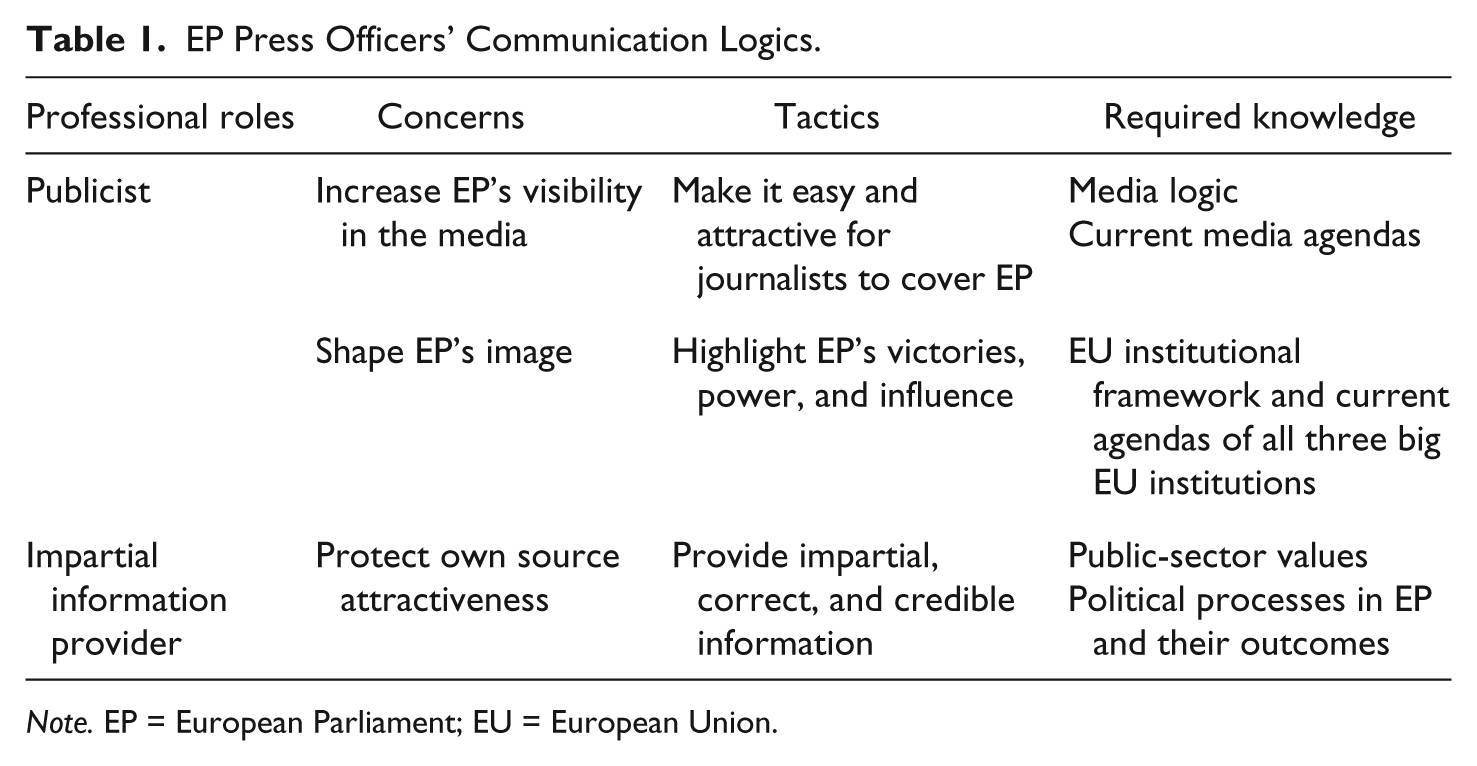
Our findings, systematized and summarized in Table 1, suggest that EP POs see themselves as performing two roles: as publicists and as providers of impartial information (first column).
EP Press Officers’ Communication Logics.
Note. EP = European Parliament; EU = European Union.
The first role is linked to concerns about EP’s media visibility and image, whereas the second role is linked to concerns about the POs’ own attractiveness as sources for journalists (second column). Columns 3 and 4 account for the tactics used and the knowledge required to perform the two roles and to address the three concerns. To increase EP’s visibility in the media (concern), the POs draw on their knowledge of media logic and current media agendas (required knowledge) to make it easy and attractive for journalists to cover EP issues (tactic). When they highlight EP’s victories, power, and influence (tactic), the POs tend to do so with the intent to shape EP’s image (concern). As this tactic sometimes involves bolstering EP at the expense of the two other big EU institutions, the POs need insights into all three institutions’ characteristics and current agendas (required knowledge). Finally, the POs protect their own source attractiveness (concern) by always seeking to provide impartial, correct, and credible information (tactic). This requires access to updated information about political processes and decisions in EP (required knowledge).
Our findings suggest that the POs’ communication logics mirror the mediatization of society in significant ways, and, as it appears from Table 1, that their insights into journalists’ needs, professional standards, and work processes (media logic) is a key asset when they perform their role as publicists.
The Civil Servant Challenge
Our findings confirm that EP’s press officers do indeed find themselves in a professional dilemma because of their status as civil servants. By upholding public-sector values such as credibility and impartiality, they seek to protect and increase their attractiveness as sources for journalists. And by promoting their institution and its agendas, they risk to compromise the very same values and thereby their own attractiveness as news sources, because such behavior could lead journalists to see them more as publicists than as impartial information providers. In their daily work, the POs seek to balance the two sides of their work.
The government context in which EP’s POs operate may imply both strategic limitations and opportunities. EP’s stated focus on the impartial and factual nature of its press communication is in line with what is generally expected of Western government communication, although expectations may vary from one country to another. The fact that our interviewees see themselves as impartial information providers and are concerned about their attractiveness as sources for journalists suggests that EP’s POs seek to act in line with these expectations. At first sight, these context-specific moral expectations may be seen as limiting the POs’ room for strategic communicative maneuvering compared with politically committed communicators, such as MEPs and non-government communicators, who are likely to be held to less strict moral standards by the public when it comes to impartiality, completeness, and credibility (Mulgan 2007). However, government communicators’ limited room for communicative maneuvering does not seem to reduce their attractiveness as sources for journalistic news production; on the contrary, several studies have found that civil servants dominate political news coverage (Bennett 1990; Cook 1998; Strömbäck et al. 2013; Thrall 2006), and Davis (2000) has suggested that this source type’s authoritative status is “‘structurally determined’ by routine practices and values of journalists” (p. 47). Journalists’ tendency to see civil servant communicators as a particularly attractive source type is confirmed in the EU context. Morgan (1995) and Statham (2008) found that the EU institutions’ own POs are among EU reporters’ most important sources. In the same vein, our interviewees reported that they are regularly consulted by journalists who seek confirmation of information obtained from other sources perceived by journalists as less credible, and POs in the Council were found to play a similar role (Laursen and Valentini 2013). Together these findings suggest that the EU institutions’ POs are generally perceived by journalists to be highly credible sources.
The government context and the POs’ reputation as credible sources, which seems to be linked to that particular context, may be seen as an asset and a lever for generating news coverage and shaping the institution’s image because sources that are perceived by journalists as credible are more likely to get media coverage than sources that journalists perceive to be less credible (Thrall 2006). Source credibility seems to make journalists weaken their defenses and to spur them to “construct news stories more quickly and with greater confidence in their accuracy and relevance” (Thrall 2006: 409). EP POs’ high credibility may therefore help them to perform their publicist role and occasionally allow them to get away with putting a spin on their messages—getting elements and perspectives from the institutional agendas on to the media agendas, particularly in situations where busy journalists use them as research assistants, for example, by asking them to select, prioritize, and summarize EP news items. However, such “covert” publicist behavior is delicate because it inevitably involves the risk of undermining the POs’ attractiveness as sources.
The National Media Challenge
EP and its POs handle the non-existence of one single European public sphere with a shared news agenda by devoting considerable attention to national angles on EP news. This constant and institutionalized sensitivity to national contexts seems appropriate for publicity purposes because it is fully in line with what is known about patterns of national news media’s coverage of EU affairs. Several scholars found a significant variation in the coverage of EU affairs in general across member states. This suggests that sensitivity to the twenty-eight different national contexts is essential for successful EU press work. National influences shaping the coverage include national political parties’ positions toward the EU (Boomgaarden et al. 2013; Boomgaarden et al. 2010; Schuck et al. 2011) and levels of public satisfaction with national democratic systems (Peter and De Vreese 2004). When it comes to the coverage of EP and its activities, knowledge is scarce, and most of what is known concerns the coverage of EP during election times and not during routine periods, which is our focus. However, Gattermann’s (2013) work is an exception. She studied the coverage of EU parliamentary affairs in six member states during a routine period of decision making and found that developments in the national contexts influence the way national newspapers cover EP. More specifically, she found that “public support for the EU increases the number of reports about the European Parliament” (p. 436), and that “higher levels of party political contestation over the EU and trust towards the national parliament lead to lower coverage” (p. 436). Gattermann’s findings thus confirm the patterns of coverage of EU affairs in general. They furthermore suggest that a one-size-fits-all approach to communication with European journalists is insufficient, and that information subsidies tailored to national contexts (in terms of, for example, language and/or selection and framing of EP news items) are likely to be more attractive in the eyes of many journalists and therefore more efficient for publicity purposes.
Theoretical Implications and Future Research
The mediatization literature has been used by political communication scholars as a framework for investigating politicians’ behavior. This study shows that central tenets of this literature can also shed light on civil servants’ professional behavior (cf. also Sanders, Crespo, and Holtz-Bacha 2011; Schillemans 2012). Our findings support the idea that mediated politics is constructed through the interaction between journalists and their sources, and that sources can have a considerable influence on the co-construction process (Davis 2010; Larsson 2009; Strömbäck et al. 2013). The exact mechanisms of this process, and in particular the role played by the organizational setting in the process, are not fully understood. This study provides insights into how the government context shapes civil servants’ contribution to the co-construction process.
We found that POs contribute to the co-construction of politics as EP’s institutional voice. More specifically, we found that, besides the media logic, a civil servant logic shapes EP POs’ professional behavior and is at the root of some of the communication dilemmas that these communicators face. Although our study focuses on EP’s institutional actors and only peripherally sheds light on the institution’s political actors, remarks from our interviewees nevertheless suggest that this political arena’s political actors are guided by concerns and tactics that differ significantly from the POs’ civil servant logic. Political actors’ exchanges with journalists seem to be guided by a political logic (Strömbäck and Esser 2014). Further research should provide more insights into this concept.
EP resembles many other regional, national, and international political arenas in Western democratic societies in significant ways. In and around Western political arenas, three important actor types interact to co-construct the news media’s picture of politics that citizens rely on to form their opinions, namely, civil servants, political actors, and journalists. Knowledge about the general communicative dynamism between these actors in this specific type of organizational setting is scarce, but our findings provide a good point of departure for future research on this topic. As public-sector values, such as credibility and impartiality, play a role in most Western government institutions, we hypothesize that civil servant government communicators in other political arenas in mediatized Western societies face similar dilemmas and therefore contribute to the co-construction process in similar ways. Future research should investigate whether this is the case, and should furthermore shed light on, for example, political actors’ influences on institutional actors’ communication and vice versa, journalists’ perceptions of the contributions of the two source types, and the effects of the two source types’ efforts to influence the co-construction process.
Footnotes
Declaration of Conflicting Interests
The authors declared no potential conflicts of interest with respect to the research, authorship, and/or publication of this article.
Funding
The authors received no financial support for the research, authorship, and/or publication of this article.