




Abstract
This study assesses the scope and applicability of the “protest paradigm” in non-Western contexts by examining the news coverage of Brazilian, Chinese, and Indian protests in their domestic media. Two publications from each nation, one conservative and one progressive, are content analyzed for adherence to a series of marginalization devices that have often been used by the U.S. media to ridicule protest movements and portray them as violent. The Indian media emerge as the least likely to follow the protest paradigm, while Brazilian and Chinese media conform to it in moderate levels. Comparative analysis suggests the historical legitimacy of informal power negotiations in a political culture makes news media more willing to take protesters seriously and limits adherence to the protest paradigm. In contrast, a news organization’s ideological affiliation with the government of the day, rather than any ideology per se, makes it relatively more likely to conform to the protest paradigm. Marginalization devices such as circus, appearance, and eyewitness accounts are rarely used in any of these nations. But disparity of sources, (non)reference to protesters’ causes and violence, and violence blame appear to be abiding features of news coverage of protests everywhere.
Keywords
An unprecedented spate of political protests has irrupted across the atlas in recent years, inspired by the self-immolation of a Tunisian street vendor who refused to endure harassment at the hands of local officials (Castells 2012). The geographical diversity of these protests offer political scientists and communication scholars an opportunity to study a well-established concept in political communication—the protest paradigm—in international contexts. Decades of research suggested that U.S. news media either ignored protest movements or represented them as cults of riotous radicals who were out of touch with public opinion and political reality (Gitlin 1980; Hertog and McLeod 1995). More recent studies have drawn attention to the role of protesters’ issues, goals, tactics, and ideologies in shaping news coverage (Boyle et al. 2004; Weaver and Scacco 2013). Many scholars attribute the protest paradigm to the institutional and ideological affiliations of American news organizations—affiliations that obtain from the interlinks between U.S. media and political systems (Boykoff 2007; Shoemaker 1984). Comparative studies can now allow scholars to assess the extent to which the protest paradigm prevails in other parts of the world and identify particular aspects of media and political systems—and their interaction—that shape news coverage of protests.
But much of the recent political communication research on global protests elides this objective. Many scholars, for instance, are examining the role of information and communication technologies in facilitating contentious politics (Bennett and Segerberg 2013; Castells 2012). Other scholars have investigated the coverage of protests taking place in one nation in the news media of other nations (Boyle et al. 2012; Harlow and Johnson 2011). Using the protest paradigm as a conceptual framework for such studies amounts to what Giovanni Sartori (1970) called “conceptual stretching”—applying concepts in contexts they were not intended for (p. 1036). The paradigm stems from relations of power that are immanent within a political system—it ought to be studied in domestic news coverage of protests as that is where those relations reside and operate.
A handful of studies have attempted to do that, but they have mostly been idiographic (Becker and Machado 2014; Ibrahim 2012; Suman 2011). Such research can, however, be conducted in a manner that also allows for meaningful cross-national comparisons and theory-building. That is the objective with which this study has been designed. We examine domestic news coverage of recent protests in Brazil, China, and India—three countries with very different political and media systems. Our analysis takes place at two levels: intra- and cross-national. We first look at the extent to which newspapers in each of these nations adhere to the protest paradigm, focusing especially on variations in coverage between progressive and conservative media. This allows us to develop a nuanced understanding of how the paradigm operates in each case. Next, we compare cross-national similarities and differences to identify those features of the paradigm—a composite of multiple “marginalization devices”—that may or may not be applicable outside the United States. We focus our inferences on identifying the conditions in which news media give favorable or unfavorable coverage to protests.
Theoretically, our paper (1) assesses the scope and applicability of the protest paradigm in three non-Western nations, and (2) identifies systemic characteristics that influence news media’s adherence to the paradigm in these nations. In doing so, we also answer the call to “de-Westernize” media research by looking at the relevance of ideas and concepts developed in the West in non-Western media systems as well as structural factors that are often neglected in the West but carry significant weight elsewhere (Curran and Park 2000; Waisbord and Mellado 2014). Methodologically, we adopt a systematic comparative approach that may serve as a guide for future research using the protest paradigm in international contexts.
Literature Review
The Protest Paradigm
News media tend to ignore social movements at the margins (Shoemaker 1982; Sobieraj 2011). When movements start to grow bigger or disruptive enough to engage media attention, the coverage they receive is often antagonistic—as a vast array of research spanning decades of media reporting of protest movements has established. Journalists have accorded hostile treatment to antiwar protests (Gitlin 1980), labor protests (Glasgow Media Group 1976), abortion law protests (Rohlinger 2014), antipolice demonstrations (McLeod and Hertog 1992), antinuclear movements (Entman and Rojecki 1993), and antiglobalization protests (Smith 2001), among others—often by ridiculing them or portraying them as violent.
Scholars have identified recurring elements that embody media hostility toward protest movements. These elements constitute the protest paradigm (Chan and Lee 1984), defined as a “routinized pattern or implicit template for the coverage of social protest” (McLeod and Hertog 1999: 310). Drawing on McLeod and Hertog (1999) and McFarlane and Hay (2003), Dardis (2006) developed a comprehensive typology of fourteen “marginalization devices” used in media coverage of protests. Nine of these are (1) general lawlessness, when news media focus on protesters engaging in violence, vandalism, blocking traffic, trespassing, and so on; (2) police confrontation, when they stress conflict between protesters and the police; (3) freak show, which “emphasizes physical oddities among the protesters, such as body piercings, long or strange hair, funny clothes, bare feet, and so on” (Dardis 2006: 120); (4) Romper Room/idiots at large, or highlighting protesters’ “childlike” behavior, such as dancing in the streets, playing games, and so on; (5) carnival, or portraying protests as a spectacle or theatrical performance; (6) public opinion polls, or using surveys to suggest the protesters do have popular support; (7) generalizations, or making claims about public perceptions of the protesters without resorting to actual statistics; (8) eyewitness accounts, or quoting bystanders at protest events to underline the deviance of protesters’ views and tactics; and (9) official sources, or relying on “government agents, police, business leaders, lobbyists, bureaucrats, and public relations managers” (Dardis 2006: 121) for opinion and information rather than the protesters themselves. In addition, Dardis (2006) identified five marginalization devices specific to the coverage of antiwar protests: protest as treason, as anarchy, and as antitroop, inclusion of counterdemonstrations, and historical comparisons.
Chan and Lee (1984) and Hertog and McLeod (1995) suggested that mainstream and right-leaning media favored the status quo while left-leaning/alternative media supported protesters. This view assumes that protesters themselves are typically left-leaning. But recent studies of media coverage of the right-wing Tea Party movement in the United States showed the left-leaning media as supportive of the status quo in this context, and right-leaning news organizations as being more sympathetic to the movement (Boykoff and Laschever 2011; Weaver and Scacco 2013)—indicating that the ideological tilt of a particular news organization is also a factor. Boyle et al. (2004) content analyzed protest stories published over four decades in local U.S. newspapers to find that protest issues (labor, social, police, and war protests) and their degree of deviance (supporting status quo, moderate reform, and radical reform) influenced how they were covered. News outlets treated protests aiming for radical or even moderate reforms with more hostility than pro-status quo protests (see also Shoemaker 1984). Boyle et al. (2012) argued that the more violent the protests, the more critical the news coverage.
These studies indicate that the protest paradigm is not quite as ubiquitous in the U.S. media as initial research suggested. Comparative analyses of American and European media coverage of social issues also support this view. Ferree et al. (2002) found that representatives of political parties and the institutionalized political process dominated the news about abortion a lot more in Germany than they did in the United States. Benson (2013) argued that French newspapers, although less dependent on advertising revenue, were no more critical of businesses than their U.S. counterparts in the immigration debate. The French media, however, did a better job of providing multiple perspectives on the issue and were also less likely than the U.S. media to present immigrants as a threat to public disorder.
Media and International Protests
Research on media coverage of international protests may be classified into three categories. The first comprises transnational studies that look at the coverage of protests in one nation in the news media of another nation—usually, although not always, the United States. Harlow and Johnson (2011) examined the coverage of Egyptian protests in the New York Times alongside the Twitter feed of New York Times journalist Nick Kristoff and the Global Voices citizen journalism blog. They found the newspaper adhered most closely to the protest paradigm by framing protests as a spectacle, quoting official sources, and delegitimizing protesters. But using the protest paradigm to explain the coverage of Egyptian protests in the U.S. media is an example of “conceptual stretching”—using concepts in contexts they were not intended for (Sartori 1970). Sartori warned that the expansion of international political research was leading scholars to use available theoretical concepts in ways that undermined their connotative precision. Harlow and Johnson, for instance, do not explain why the protest paradigm—an outcome of institutional and ideological linkages between a nation’s media and political systems—would be a valid framework to study protests in one nation in the news media of another. Some of their findings are ambiguous as a result. Quoting officials is presented as evidence of the protest paradigm, but the authors do not clarify whether the officials being quoted are Egyptian or American. As the U.S. government eventually backed the demands of Egyptian protesters, news reports quoting U.S. officials would actually undermine the protest paradigm in this case.
A second category includes comparative studies that examine the coverage of protests in both domestic and international media. Ghobrial and Wilkins (2015) studied the reporting of Egyptian protests in Egyptian, Tunisian, Saudi Arabian, and U.S. newspapers. They found that while local and regional media prioritized Egyptian government sources, “U.S. news sources were instead more likely to begin their stories with quotes from American government officials” (Ghobrial and Wilkins 2015: 141). Such findings raise concerns about the use of the protest paradigm in the transnational category of studies, as noted above. Similarly, Boyle et al. (2012) examined protest stories from thirteen English-language newspapers in three regions—Asia, North America, and the Middle East. The authors found evidence of the protest paradigm across the range of newspapers they studied, concluding that “systemic biases in news coverage . . . are not limited to particular countries [or] regions” (Boyle et al. 2012: 139). Ferree et al.’s (2002) study of abortion-related news in the United States and Germany, and Benson’s (2013) research on news about immigrants in the United States and France, compared domestic media coverage of common issues in different nations. Although these studies focus on broader social concerns rather than social movements or protests, they underline the importance of comparative analysis to put things in context.
The third category comprises idiographic studies that focus on the coverage of local protests in the local media of a single nation. Ibrahim (2012), analyzing the coverage of Egyptian protests in two Egyptian newspapers, found that while government-affiliated Al-Ahram framed protesters as violent rioters, privately run Al-Masry Al-Youm portrayed them as the voice of the “people”—reflecting the significant impact of institutional and ideological affiliations on media coverage. Tenenboim-Weinblatt’s (2014) interviews with Israeli journalists covering Israeli protests demonstrate that journalists’ individual views vis-à-vis protests shape initial coverage, but “give way to professional values and owners’ pressures in the second stage” (p. 424). News values and news organizations’ ideological orientation remain influential all through.
The present study is designed to integrate the strengths of the second and third categories while avoiding their weaknesses. Like idiographic studies, it examines news coverage of protests in the domestic media—thus evading the problem of “conceptual stretching.” But rather than focus on one country, it takes a comparative look at the applicability of various dimensions of the protest paradigm in three very different nations—Brazil, China, and India.
Media and Protests in Brazil, China, and India
In Brazil, residents of Sao Paulo began marching on June 6, 2013, against a hike in bus ticket prices. In the following days and weeks, the protests spread to major cities and took on a broader character, spanning issues such as police violence, corruption, quality of government services, and public funding of forthcoming sporting events such as the 2014 Fédération Internationale de Football Association (FIFA) World Cup and the 2016 Olympics. The center-left government of President Dilma Rousseff was in power. Social media played a vital role in helping protests grow (Moretzsohn 2013), while traditional media outlets became a target of the protesters (Santos 2014). Becker and Machado (2014) argued that mainstream media reported the protests without context, even as alternative media outlets engaged with protesters on the streets to provide richer coverage.
Protests in China began in September 2014 as sit-ins against proposed changes to Hong Kong’s electoral system and remained limited to the region. Protesters said that so-called electoral reforms would give Beijing a say in who could contest elections in Hong Kong, undermining the democracy promised under its basic law. While the mainland Chinese press seldom reported these protests, they were covered extensively in newspapers circulated in Hong Kong. Academic studies on media coverage of these protests is yet to be published, but research on media and protest movements has a long history in China. Chan and Lee’s (1984) classic study of news about protests in Hong Kong is counted among the pioneering works in protest paradigm research. Chan et al. (1992) found journalists in Hong Kong were critical about China on one hand while practicing self-censorship on the other (see also C-C. Lee et al. 2002).
In India, social activist Anna Hazare went on an indefinite hunger strike on April 5, 2011, demanding changes that would give more teeth to an anticorruption bill. The demand followed exposés of several corruption scandals while the center-left government of Prime Minister Manmohan Singh was in power, and caught the national imagination. Social media forums such as Facebook and Twitter helped the movement grow. Traditional media were initially hesitant to cover the protests but could not avoid them eventually (Suman 2011). Rodrigues (2014) argued that media coverage ranged from blind support of the movement to a skeptical view of its leaders (see also Ashutosh 2012).
While the protests in these countries were not identical, they had broadly similar characteristics. They all erupted in the aftermath of the Arab Spring. They all focused on issues of government reform, although the specific goals were somewhat different. In terms of tactics, they all began as peaceful sit-ins against specific government policies—bus ticket prices in Brazil, electoral law in China, and antigraft law in India. Eventually, violence broke out in all cases. Their scope did, however, differ: Protests in Brazil and India took on a national character while the Chinese protests remained limited to Hong Kong.
Comparing Media Systems
Hallin and Mancini’s (2004) influential study classified the national media systems of North America and Europe into three models—the Polarized Pluralist Model of Southern Europe, the Democratic Corporatist Model of Northern and Central Europe, and the Liberal Model of Western Europe and North America. Non-Western media systems, with their unique histories and variegated markets embedded in starkly different political cultures, are difficult to map on to these specific models (Nyamnjoh 2005; Zhao 2012). However, Hallin and Mancini (2004) also identified the dimensions for comparing national media systems: the historical development of mass media, links between news media and organized political interests, journalistic professionalism, and degree of state intervention. These parameters have helped scholars engage in comparative studies of media systems worldwide.
Brazilian media system
Until the 1950s, Brazilian news organizations were dependent on government investments and advertising from political groups for survival. Their coverage was thus closely tied to political interests (Albuquerque 2012; Waisbord 2000). But the 1964 to 1985 military regime weakened the competitive party system. The growth of market economy and investments from the military regime helped entrench the news business financially, leading media organizations to adopt a “market-driven, catch-all attitude” and “distance themselves from particular political groups” (Albuquerque 2012: 81). In an attempt to reduce communist journalists, the regime imposed a law that required every journalist to have a university degree. But as universities themselves became a hotbed of resistance to the regime, even more radical journalists joined the profession (Almeida and Weis 1998). While the readership of news organizations remains elite-oriented, journalists view themselves as playing an active role in the political process (de Lima 2004), characterized by a multiparty system and the prevalence of “informal political negotiating mechanisms” (Armijo et al. 2006).
Chinese media system
Historically, the Chinese Communist Party has rigidly controlled the national media through its propaganda department. Controlled commercialization since the 1990s has had two effects. First, it has helped interlock the state and capital into a system of “party-market corporatism” (C-C. Lee et al. 2007; see also Zhao 2000). The media have been transformed from command mouthpieces to profit-making propaganda units “wearing a socialist face with a capitalist body” (C-C. Lee 2003: 18, see also Pan 2000). At the same time, it has engendered admiration for “Western” professional norms and journalistic values (Wang and Lee 2014). Trained in the liberal arts tradition, young journalists in particular view themselves as “watchdogs” monitoring government misconduct. Investigative reporting also enjoys market success as audiences love to read stories portraying the government in a different light (Pan and Chan 2003). Hong Kong is a microcosm of both these trends in China’s media system. Owners of news organizations often have political and business ties with mainland China. Chinese officials also indirectly specify the norms of political correctness for Hong Kong media through warnings and criticisms, and many news organizations practice a high degree of self-censorship (Fung 2007; F. L. F. Lee and Chan 2008). Simultaneously, there is a “progressive” section of the media that is relatively independent in its operations and makes use of the absence of direct censorship to take an antigovernment stance (Tang and Lee 2014).
Indian media system
The news media in India are highly diverse, partly on account of the country’s sheer size—it is the world’s biggest newspaper market, more than double the size of the U.S. market (Moro and Aikat 2010)—and partly because of the heterogeneous character of the country itself as well as its political and economic structures. Chakravartty and Roy (2013) underline the historical legitimacy of informal politics—power negotiations outside the domain of political parties, organized civil society, trade unions, and business associations—as an especially important structural peculiarity that shapes the nation’s media system. Newspapers have largely remained free from direct government control (Shrivastava 2008). Neoliberal reforms beginning in the early 1990s and increasing commercialization have turned the media’s focus away from the country’s rural masses to the growing urban middle class (Mudgal 2011). Chakravartty and Roy (2013) argue that the media “brings together and literally mediates between state and market forces, thus enabling and supporting the ‘state-market’ alliance in contemporary India” (p. 353). At the same time, the news media, once a part of the country’s freedom movement, “still continue to be prime movers of citizens’ pursuit of freedom, civil rights, and social justice” (Rao and Mudgal 2015: 617).
Brazil, China, and India, thus, have vastly different media systems interacting with dissimilar political structures: authoritarian rule in China, presidential democracy in Brazil, and parliamentary democracy in India. The evolutionary trajectories of these media systems have also varied greatly. In recent decades, capitalist restructuring and commercialization have spurred contradictory tendencies in each of them: links between news media and organized political interests, journalistic professionalism, and degree of state intervention. On one hand, these changes have made newspapers more elite-oriented and bolstered institutional linkages between media corporations and the state. On the other hand, the news media also view themselves as active participants in these nations’ political processes and agents shaping national destiny—whether on account of professionalization (Brazil), influence of “Western norms” (China), or their own historical role (India).
With this perspective in mind, the key objectives of the present study are to examine how—and how much—do the news media in Brazil, China, and India employ the protest paradigm, which marginalization devices are less or more relevant in each country, and how they compare with each other. To develop a richer understanding, we look at newspapers from either side of their political spectrums. Finally, we address how the characteristics of their respective media systems may account for the nature of their protest coverage.
Method
Our comparative analysis follows a “different systems” design (Przeworski and Teune 1970). We look for similarities in coverage across different media systems to discern structural factors that would account for how the protest paradigm is employed. We use content analysis to study media coverage, defined by Berelson (1952) as “a research technique for the objective, systematic, and quantitative description of the manifest content of communication” (p. 18). Making the methodology systematic was especially important for this study as it aimed to compare news texts from different countries and in different languages (Portuguese, Chinese, and English). To do so, we (1) selected data samples from each country using similar keywords and random sampling procedures, (2) prepared a common codebook based on extant research, (3) discussed coding protocols with the coders, (4) checked for intercoder reliability, (5) coded the entire samples, and (6) conducted the statistical analysis to arrive at results.
Coding Scheme
Our coding scheme drew heavily upon Dardis (2006) and McLeod and Hertog (1999). But we tweaked our variables and coding protocols to (1) account for deviations from U.S.-based protest paradigm research that have already been reported in international research, and (2) keep our coding scheme open enough to account for further deviations from U.S. standards.
To code for sources, we compared the total number of official and protester sources used in a news story and reported it on a three-point scale: 1 = only or more protester sources, 2 = equal number of protester and official sources, and 3 = only or more official sources. “Official sources” were defined as belonging to the police, administration, or experts. Eyewitness accounts were coded as 1 = positive, 2 = neutral, and 3 = negative. “Eyewitnesses” were defined as neither officials nor protesters, but passersby or other “common people” affected by protests being quoted in a news story. Public opinion was defined as references in a news story to the general public’s evaluation of the protests, either based on formal surveys or in the form of generic statements not backed by empirical evidence. It was coded as 1 = positive, 2 = neutral, and 3 = negative.
Cause, defined as references to why protests were taking place or the goals of the protesters, was coded as 1 = not mentioned, and 2 = mentioned. While most U.S.-based research has assumed that the very mention of protesters’ causes contravenes the protest paradigm, we surmised that a negative evaluation of these causes would actually affirm the protest paradigm. Therefore, we used another variable, cause evaluation, measured as 1 = positive, 2 = neutral, and 3 = negative. Circus and appearance were coded as 1 = not mentioned, and 2 = mentioned. Circus was defined as the portrayal of protests as a spectacle, carnival, or generally odd or deviant. Appearance was defined as references to how the protesters looked and what they wore.
Peacefulness accounted for explicit references to the protests being peaceful, coded as 1 = not mentioned, and 2 = mentioned. Violence accounted for explicit references to the protests being violent, coded as 1 = not mentioned, and 2 = mentioned. We used both these variables as a story could mention the protests as starting peacefully but turning violent, or vice versa. We also coded for violence blame, or who the stories held responsible for the violence, as 1 = on administration, 2 = balanced, and 3 = on protesters. Two other variables—protester evaluation and administration evaluation—accounted for how a news story generally appraised the protesters and the administration (police and government officials), respectively. Both were coded as 1 = positive, 2 = neutral, and 3 = negative.
For most of these variables, higher scores represented an affirmation of the protest paradigm. The three exceptions—cause, peacefulness, and administration evaluation—were recoded before the statistical analysis. In addition, we coded for newspaper ideology (1 = progressive and 2 = conservative).
Content Samples
Two newspapers each from Brazil, China, and India—one conservative and one progressive—provided the samples for the study. The distinctions between conservative and progressive news outlets are complex, multidimensional, and contingent upon every nation’s unique political, social, and economic structures and history. For the purposes of this study, we defined conservative news organizations as traditionally supportive of the status quo and progressive news organizations as traditionally opposed to the status quo. But all the newspapers studied were mainstream publications with large circulations, rather than mouthpieces of interest groups or social movements.
From Brazil, we selected the conservative O Globo and the progressive Folha de S. Paulo, the two highest circulated Portuguese-language dailies in the country. The sampling covered a 30-day period beginning June 6, 2013, when the first of a series of marches took place. To draw the sample, all articles from the two newspapers containing the words “protesto” or “manifestante” or “manifestações” were retrieved from the Factiva database. The search yielded 951 from O Globo and 818 articles from Folha de S. Paulo. A systematic random sample of 120 articles was drawn, divided equally between the two publications.
From China, we selected the conservative Wen Wei Po and the progressive Apple Daily—both of which are Chinese-language dailies based in Hong Kong, where the protests were taking place. Sampling covered a 30-day period starting September 26, 2014, the first day of the protests, using the keywords “protest” or “Occupy Central” or “Umbrella revolution.” Keywords specific to the Chinese protests had to be used as the sample was otherwise yielding a large number of articles about protests outside China. The search yielded 436 articles from Wen Wei Po and 1,057 articles from Apple Daily. A systematic random sample of 120 articles was drawn, divided equally between the two publications.
From India, we selected the Times of India, a conservative newspaper, and The Hindu, a progressive newspaper, both of which are English-language dailies with large nationwide circulations. Unlike Brazil and China, where we chose local-language newspapers, English-language newspapers are the only ones with substantial nationwide circulation in India—the vernacular press is regional in scope. The sampling began on April 1, 2011, in the run-up to Anna Hazare’s indefinite hunger strike four days later, and covered a 30-day period. The keywords “protest” or “protester” or “demonstration” or “demonstrator” and “Anna Hazare” were used. The last keyword was included to focus the sample on the domestic protests. The search yielded 149 articles from the Times of India and 158 from The Hindu. A systematic random sample of 120 articles was drawn, divided equally between the two publications. Of these, two articles were replicated and had to be discarded, leaving the study with a sample of 118 articles from India.
Intercoder Reliability and Data Analysis
Separate teams of two coders—familiar with Portuguese, Chinese, and English, respectively—recorded the data for each of the three samples. Intercoder reliability was calculated on the basis of 20 articles from each sample, or about 16.5 percent. The Cohen’s kappas ranged from 0.65 to 1.0 for India, 0.81 to 1.0 for Brazil, and 0.74 to 1.0 for China. The only variable below the 0.7 threshold was administration evaluation in the Indian sample.
Results
Protest Paradigm in Brazil
The Brazilian news coverage of protests displayed four broad trends. First, the media followed the protest paradigm in some important ways. Overall, nearly half the stories used only or mostly administrative sources while about 29 percent relied only or mostly on protester sources (see Table 1). About two-thirds of the stories mentioned violence: of these, half blamed the protesters while less than a quarter blamed the administration. Second, despite their use of these marginalization devices, the Brazilian media covered the protests as a legitimate part of the political process. Nearly 72 percent of the stories mentioned protesters’ causes. About 30 percent of these evaluated the causes positively compared with 21 percent that evaluated them negatively. The media also did not try to delegitimize the protesters: marginalization devices that ridicule protesters, such as circus (6%), appearance (13%), and eyewitness reports (13%), were used infrequently.
Frequency Distributions of Marginalization Devices in Indian, Brazilian, and Chinese Coverage.

Note. All figures are in percentages.
Third, the media exhibited independence and agency by remaining critical toward both the administration and the protesters. More stories evaluated the protesters negatively (30%) than positively (14%). However, more stories also evaluated the administration negatively (33%) than positively (11%). Finally, statistically significant differences between the two outlets were found in the use of only three variables: use of sources, peacefulness, and protester evaluation (Table 2). On all these counts, however, the progressive Folha de S. Paulo was more likely to follow the protest paradigm while the conservative O Globo gave protesters relatively more positive coverage. A center-left government was in power in Brazil at the time of the protests—suggesting that ideological affinity with the government swayed news coverage in its favor.
Differences in Coverage between Brazil’s Folha de S. Paulo (Progressive) and O Globo (Conservative) Newspapers.

Note. Progressive and Conservative figures are in percentages.
p < .05. **p < .01. ***p < .001.
Protest Paradigm in China
First, the Chinese news coverage of protests displayed several indications of “party-market corporatism.” Overall, more than half the stories had only or mostly administrative sources, compared with a third that had only or mostly protester sources (Table 1). Nearly two-thirds of the stories did not mention the cause of the protests. Second, the coverage had some paradoxical characteristics. For instance, while only a third of the stories mentioned the protesters’ cause—a trend that conformed to the protest paradigm—67 percent of these stories evaluated the cause positively, which was not in line with the paradigm. Most stories that mentioned violence, in consonance with the paradigm, also blamed the administration for the violence—contradicting the paradigm.
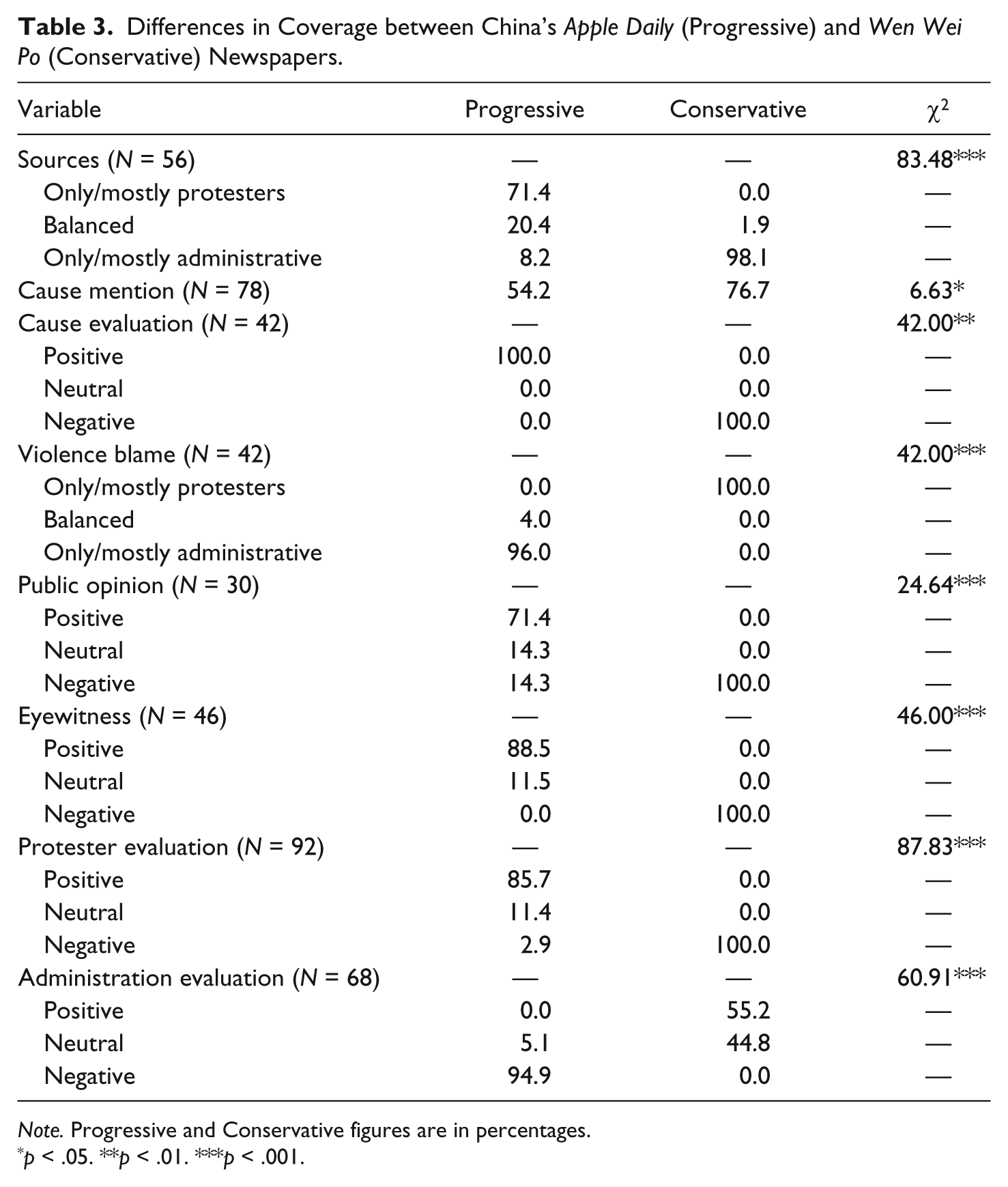
Third, these incongruities signaled a sharp divide in the coverage, which became clearer when we compared the coverage of the two newspapers. The progressive Apple Daily and the conservative Wen Wei Po differed significantly on almost all variables (see Table 3). Apple Daily was more likely to use protester sources while Wen Wei Po was more likely to use administrative sources. Apple Daily was more likely to mention the cause of the protest and to evaluate it positively. Wen Wei Po was more likely to use hostile eyewitness reports and suggest that public opinion was against the protesters. The ideological orientation of a news organization thus substantially influenced its protest coverage. Finally, the conservative press was more likely to conform to the protest paradigm in China, suggesting that ideological affinity with the government led to more hostile coverage of protests.
Differences in Coverage between China’s Apple Daily (Progressive) and Wen Wei Po (Conservative) Newspapers.
Note. Progressive and Conservative figures are in percentages.
p < .05. **p < .01. ***p < .001.
Protest Paradigm in India
The Indian media largely refrained from using the protest paradigm. About two-thirds of the stories had only or mostly protester sources, compared with just over a quarter with only or mostly administrative sources (Table 1). Some 86 percent of stories mentioned the protesters’ cause, and 92 percent of these also evaluated the cause positively. Public opinion was mentioned in 30 percent of the stories—97 percent of them reported the public supported the protests. The only marginalization device used extensively was blaming the protesters for violence, noted in 82 percent of the stories that explicitly mentioned violence. But even this element of the coverage was mitigated by the fact that only 10 percent of stories reported violence in the first place. These numbers indicate that the news media, as a whole, viewed protests as a legitimate part of the political process.
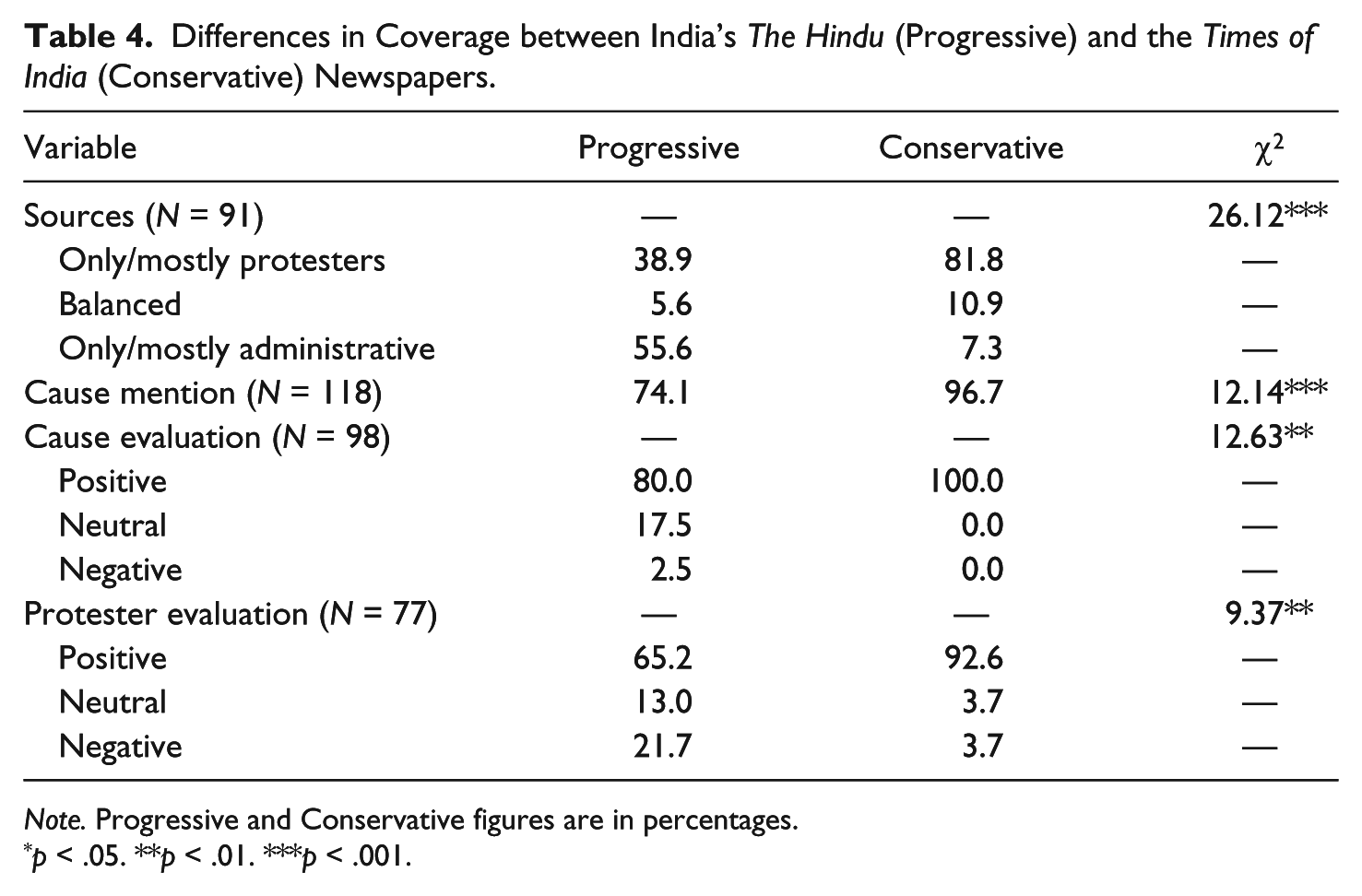
Second, despite the diversity of the Indian media system, variations in coverage between the two newspapers studied were quite limited. The conservative Times of India and the progressive Hindu differed significantly on only four variables (Table 4). Times of India was more likely than Hindu to rely on protester sources and evaluate the protesters positively. It was also more likely to mention the cause of the protests and evaluate them positively. Thus, while the overall coverage was itself quite pro-protesters, the progressive newspaper was a little less likely to accord sympathetic treatment to the protests. As India was ruled by a center-left government at that time, we once again witness that ideological affinity with the government can tilt coverage in its favor.
Differences in Coverage between India’s The Hindu (Progressive) and the Times of India (Conservative) Newspapers.
Note. Progressive and Conservative figures are in percentages.
p < .05. **p < .01. ***p < .001.
Cross-National Comparison
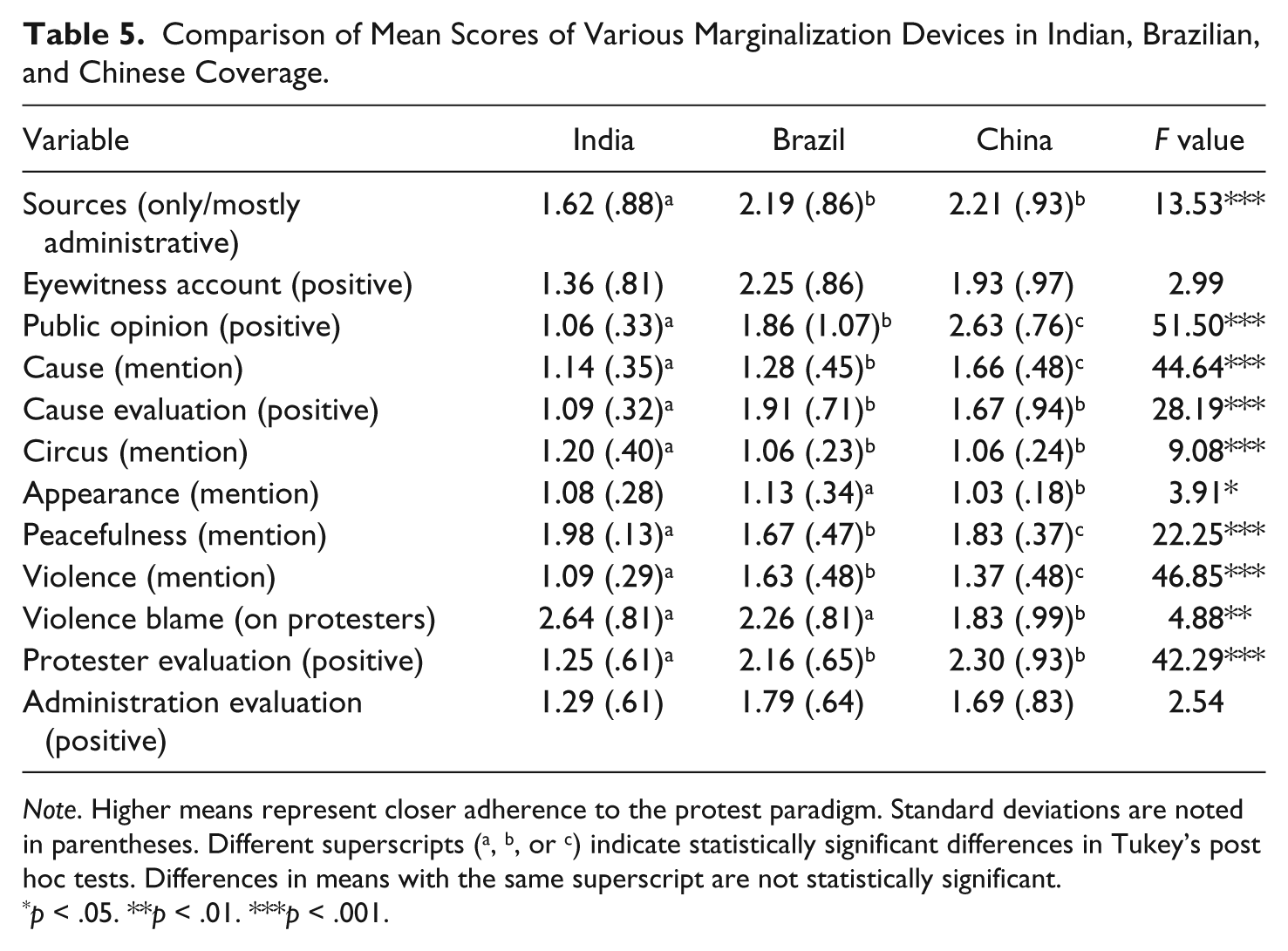
Cross-national trends were examined on the basis of overall frequencies from each nation, using analysis of variance (ANOVA) and Tukey’s post hoc tests. Differences were statistically significant for all variables except eyewitness reports and administration evaluation (see Table 5). For each variable, higher means represent closer adherence to the protest paradigm. Three broad trends can be identified. First, the Indian media were the least likely to follow the protest paradigm. Their coverage recorded the lowest means on almost all significant variables except circus (F = 9.08, p < .001) and appearance (F = 3.91, p < .05), which were generally on the lower side for all three countries. This is likely a fallout of both the structural legitimacy of informal politics in the country as well as the media’s historical participation in shaping national affairs.
Comparison of Mean Scores of Various Marginalization Devices in Indian, Brazilian, and Chinese Coverage.
Note. Higher means represent closer adherence to the protest paradigm. Standard deviations are noted in parentheses. Different superscripts (a, b, or c) indicate statistically significant differences in Tukey’s post hoc tests. Differences in means with the same superscript are not statistically significant.
p < .05. **p < .01. ***p < .001.
Second, the Brazilian media coverage recorded lower means than the Chinese coverage on three variables—public opinion (F = 51.50, p < .001), cause mention (F = 44.64, p < .001), and peacefulness (F = 22.25, p < .001). This reflects the greater willingness of the media in Brazil—another nation where informal political negotiations are common—to accord legitimacy to protests than the media in China, where politics is highly formalized. Third, the Chinese coverage recorded lower means than the Brazilian coverage in terms of violence mention (F = 46.85, p < .001), and violence blame (F = 4.88, p < .01). This has two implications. Reporting political violence remains a taboo under an authoritarian regime such as China’s. The very mention of violence would imply the administration’s inability to control its detractors and could incite more trouble—the self-censoring press would, therefore, be reluctant to talk about it, bringing down the mean of the violence mention variable. By the same token, journalists who do report violence would be more likely to blame the administration for it.
Discussion
Brazil, China, and India have complex media systems. They not only differ from one another but each of them is fairly diverse itself. Our account of how news media in these nations covered recent protests is thus quite nuanced. We see the interplay of opposing tendencies in each context: the pressures of political linkage, sometimes exacerbated by commercialization, versus the demands of a broad readership, professionalization, and journalists and news organizations’ view of their own role as social and political agents shaping their nation’s destiny. Here, we outline five general conclusions we can draw from our findings.
The most significant implication of our comparative study is that the historical legitimacy of informal political negotiations in a nation reduces the likelihood of its news media adopting the protest paradigm. Hallin and Mancini (2004) identified the linkage between media and “organized” political interests as a key dimension for comparing media systems, but that is because politics in Europe and North America has long been organized and formal (Lipset and Rokkan 1967). That is not always the case in non-Western contexts, and this structural difference bears upon media coverage. Social movements typically exist outside any nation’s formal political system; protests, rallies, and demonstrations are their way of negotiating with the system from without. In India and Brazil, where various forms of power negotiations beyond the domain of political parties and organized interest groups remain a part of the political culture (Armijo et al. 2006; Chakravartty and Roy 2013), news media made the least attempt to delegitimize protesters. Journalists reported the causes being espoused by protest groups and, more often than not, evaluated them positively. They rarely resorted to marginalization devices that ridiculed protesters. Perhaps, most importantly, this was true across the ideological divide in India and Brazil—but not in China, where politics is a lot more formal. This indicates that in the United States, too, news media’s tendency to use the protest paradigm is partly the fallout of its highly formal political culture—where political demands are deemed legitimate only when they are channeled through the organized political system (Streeck and Kenworthy 2005). This finding is also in line with Shoemaker’s (1982) early observation that hostile U.S. news coverage of protests was mainly an issue of political legitimacy.
Our second significant conclusion is that ideological affiliation with the government of the day, rather than any ideology per se, enhances the likelihood of a news organization conforming to the protest paradigm. Center-left governments were in power in both India and Brazil when the protests took place. In both nations, the progressive press was relatively more likely to follow the paradigm than the conservative press—although, as noted above, their media content overall was tilted against the paradigm. In China, however, the conservative press followed the paradigm more closely than the progressive press. This runs against the traditional view that the progressive media would as a rule be sympathetic toward protesters (Chan and Lee 1984; Hertog and McLeod 1995) but echoes more recent findings in the U.S. context (Boykoff and Laschever 2011; Weaver and Scacco 2013) that ideological affinity between a media organization and the protest group can lead to supportive coverage.
Third, some key features of the protest paradigm, especially disparity of sources, references to protesters’ causes, violence, and violence blame, are relevant elements of media coverage of protests even outside the United States. Their direction of fit varies among nations, and among differently oriented newspapers within nations, but they appear to be abiding features of news about protests everywhere. This indicates that the protest paradigm, despite its limitations, can offer valuable insights for international research (see also Boyle et al. 2012). Many of its features may be viewed as parameters on which media content may be measured and analyzed rather than as “marginalization devices,” especially given the differences in the direction of fit that we find. Future studies may, therefore, consider adapting the paradigm to local contexts rather than creating idiosyncratic frameworks for each nation, allowing for systematic accumulation of knowledge and theoretical development.
Fourth, we show that scholars also need to look at the evaluative dimension of several key features of the protest paradigm, including causes, eyewitness accounts, and public opinion, as well as who is being blamed in the media coverage for violence. Traditional studies have often assumed that the very mention of eyewitness accounts, public opinion, and violence indicates a pro-administrative stance, as does the absence of protesters’ cause in media coverage. However, eyewitness accounts and public opinion could be pro-protesters, too; violence may be blamed on the administration rather than the protesters; and cause may be mentioned but evaluated negatively. Understanding valence thus makes protest paradigm research more fine-grained.
Finally, our study indicates that national media systems remain meaningful ontological entities even in the era of globalization. Scholarly debate on the relevance of media systems mapped over national boundaries has been brewing for years. Several authors have argued that the notion of nationally bound media systems is anachronistic when more people are consuming news through the Internet and social media, and national boundaries are themselves wearing thin (Couldry and Hepp 2012; Napoli 2011; Scolari 2012). But despite these strains, media systems around the world remain primarily “national” in both infrastructure and character (Flew and Waisbord 2015; Nossek 2004), and audiences continue to prefer “local” over “global” media content (Kraidy 2005; Straubhaar 1991). By finding substantial differences in the relevance of various features of the protest paradigm across nations, our study buttresses the latter view. This is also the reason why, despite the flurry of research on the role of information and communication technologies in enabling protest movements (Bennett and Segerberg 2013; Castells 2012), it remains necessary to study the coverage of protests in traditional media worldwide.
Our examination of news coverage of protests thus helps clarify the scope and applicability of the protest paradigm in international contexts, especially non-Western media systems. Our comparative approach not only identifies those elements of the protest paradigm that are relevant in different media systems but also uncovers structural factors that previously were not accounted for, such as the legitimacy of informal power negotiations in a political culture. Our analysis lends support to the view that ideological affiliation with the government of the day, rather than the tenets of a particular ideology, makes news organizations more likely to follow the protest paradigm. In addition, our account sheds more light on the news media in Brazil, China, and India, specifically on how structural factors and political affiliations shape news coverage in these systems.
While our study focuses on structural and institutional factors behind the protest paradigm, the protests we looked at in the three countries were broadly similar. Future research can examine factors such as protest issues, protesters’ tactics, and degree of deviance in international contexts in a comparative manner. Mapping the changes in news coverage as protests themselves organically evolve over a period of time is another important site of contextually sensitive comparative investigation. Methodologically, we suggest that while much of the protest paradigm literature is based on content analysis and experiments, newsroom ethnographies can be a very useful means of looking into how institutional and ideological influences make their way into news coverage of protests—in the United States and around the world.
Footnotes
Declaration of Conflicting Interests
The authors declared no potential conflicts of interest with respect to the research, authorship, and/or publication of this article.
Funding
The authors received no financial support for the research, authorship, and/or publication of this article.