



Abstract
The use of social media has risen exponentially in Asia in the past decade, but there have been few comparative studies examining social media news engagement in the region. We use online survey data to examine the relationships among political social networks, internal political efficacy, and social media news engagement in six countries (Taiwan, Japan, Korea, Hong Kong, Malaysia, and Singapore). Findings across the samples showed that individuals in political social networks comprising cross-cutting and like-minded political views engage in social media news more, and internal political efficacy accentuated the relationships between cross-cutting/like-minded political social networks and engagement. Implications for the findings are discussed in relation to current debates on the potential for social media news engagement to engender a more deliberative democracy; or lead to greater ideological segregation and echo chambers in social media spaces.
Keywords
Rapid economic development in East and Southeast Asia in the past few decades have fundamentally transformed many societies in these regions, and investments in communications infrastructure has exponentially increased Internet access and use, providing citizens new channels for information consumption and personal expression. The past decade has also seen a surge in the use of social media technologies. For example, the monthly active users of Facebook in the Asia-Pacific constituted only 11 percent of its total users in 2009 (Nasdaq 2012). By 2016, the figure was 36 percent, and the region now comprises the company’s largest user segment—larger than North America and Europe combined (Facebook 2017).
With the proliferation of the Internet and social media in Asia, the important question then arises as to whether increased connectivity and opportunities for political discussion will engender greater citizen engagement in politics and civic life (Skoric et al. 2016; Willnat and Aw 2014). Theoretical debates and studies in Western contexts about the sociopolitical roles of communication technologies have focused mostly on their implications for developed democracies, such as the affordance of new forms of online expression and democratic engagement (Shah 2016). Discourses in the Asian context, however, have also been framed in terms of the emancipatory potential of the Internet and social media, and whether they can engender greater democratization, especially in the region’s semiauthoritarian states, such as Singapore, Malaysia, and Hong Kong (Abbott 2013; Chan 2016; Kluver and Banerjee 2005).
Whatever the geographic region, political theorists have long argued that any responsive democracy is contingent on citizens’ willingness to deliberate with others who have opposing views and opinions because such interactions should instill greater empathy and tolerance for others and greater cognitive involvement with issues affecting their lives (Delli Carpini, Cook, and Jacobs 2007). The extent to which social media can engender and sustain such an ideal has, therefore, been an important area of inquiry as researchers examined whether users of social media are indeed exposed to opposing, or cross-cutting, viewpoints; or only engage with like-minded people in their network, which may further fragment society along ideological lines and lead to cyberbalkanization of the social media space. Most work, however, has focused on Western democracies, particularly the United States (e.g., Bakshy et al. 2015).
Using data from the Reuters Institute Digital News Report 2017 (Newman et al. 2017), this study addresses the gap by examining the conditions in which citizens would post, comment, and share news on social media in six Asian countries (Table 1). Although the news content may not necessarily be political in nature, general news engagement has important consequences because it is a catalyst for political expression, civic participation, and political participation (Chan et al. 2017; Gil de Zúñiga et al. 2012). Therefore, the level of social media news engagement among citizens in these countries provides an important indicator of the potential for citizen deliberation in social media spaces in Asian democracies.
Basic Media and Political Indicators of the Six Asian Countries.

Sources. a(Newman et al. 2017).
Freedom House (2017) Digital News Report, We Are Social (Available at https://freedomhouse.org/sites/default/files/FOTP_2017_booklet_FINAL_April28.pdf).
Social media penetration: Japan, Hong Kong, Taiwan, South Korea (Available at https://www.slideshare.net/wearesocialsg/digital-in-2017-eastern-asia).
Malaysia, Singapore (Available at https://www.slideshare.net/wearesocialsg/digital-in-2017-southeast-asia).
Given the collectivist orientation of many Asian societies, which prioritizes in-group harmony and goals (Triandis 2001), the role of individuals’ political social networks deserve attention; along with political efficacy, which previous studies have shown are related to a variety of news use, expression, and participation-related behaviors (e.g., Chan et al. 2017; Park 2015). Although the six countries in this study all share a common Confucian heritage, they have different media systems and are at different stages of democratic development. Thus, it is also possible to examine contextual factors that may explain the findings.
Literature Review
From News Consumption to Expression
For a long time, audiences of news were considered passive receivers of content delivered in a top-down fashion by political and media elites. This is not to say that people did not “engage” cognitively with what they read or saw in newspapers and television, and learned something important and relevant to their everyday lives. But, with very few exceptions (e.g., talk-in radio, letter to the editor), they had no influence in the process of news creation. Nor did they have many avenues in which to share the news they receive beyond conversations in face-to-face settings with family, friends, and coworkers. News engagement was thus for a very long time a predominantly consumptive rather than an expressive activity, and the hierarchical and unidirectional flow of news allowed authoritarian regimes to effectively control what information reached their citizens though the control of the media and censorship of news content (Kluver and Banerjee 2005).
The growth of the Internet and social media gave rise to even more sources of news consumption. An examination of the Reuters Institute Digital News Report 2017, for example, shows that social media is among the top sources of news in Taiwan, Hong Kong, Malaysia, and Singapore (57 percentage–61 percentage; see Appendix A), which may be due to the respective political and media systems as well as culture. As noted by Skoric et al. (2016), in authoritarian political systems (i.e., China and Malaysia) where the mainstream press is under tight control by the government and heavily censored, social media can provide an alternative and less-regulated space to access and engage with a wider variety of news. Similarly, in hybrid political systems, such as Hong Kong and Singapore, there is only nominal freedom of the press because the mainstream media are by and large aligned with the interests and agendas of the respective ruling governments. Social media thus provides an important channel for citizens in the two city states to consume alternative news, opinions, and perspectives. In comparison, in developed democracies such as South Korea and Japan, citizens have wider and freer access to news from a variety of channels, which may lessen the reliance on social media for news.
What makes social media particularly influential are their expressive affordances, which enable individuals to leverage their online social networks to share information and news to exponentially more people than what was possible before. These can engender what Hermida et al. (2012) call “mediated publics” where news can be disseminated quickly and within bounded online social networks and those in the network can in turn react and engage with the news. Yet, it is also the bounded nature of such networks, which some fear may lead to “echo chambers,” such that individuals who interact only with like-minded individuals are exposed only to one-sided information and opinions (Sunstein 2009). Over time, this may lead to increased social and political polarization and segregation of citizens in the social media space, which is hardly conducive for a deliberative democracy. Attempts by researchers to uncover such online echo chambers, however, have not provided definitive findings, though admittedly much of the research has focused on the United States. One study of Twitter showed some evidence of ideological segregation among Twitter networks, but this is dependent on what kind of issue being discussed (Barberá et al. 2015). Another analysis of over 10 million U.S. Facebook users showed that users do get exposed to some opposing viewpoints (Bakshy et al. 2015), but the authors noted that “how much cross-cutting content individuals encounter depends on who their friends are and what information those friends share” (p. 1131).
Therefore, to assess whether there is potential for echo chambers to form in Asian social media spaces, an important starting point is to examine the composition of individuals’ political social networks. But, rather than focus on what news they share, it is useful at this early stage to examine whether individuals engage with news on social media at all.
The Role of Political Social Networks
A fundamental characteristic of social media news engagement whether it is through posting, commenting on, or forwarding news to others, is that it is often “publicly observable” (Hayes et al. 2006). That is, users are not anonymous and their behaviors on social media are viewable by others in their online social networks, which are typically comprised of people who they already know offline. Therefore, what users express or do on social media can have important social implications on their relationships, and it is the consideration of such consequences that may determine whether users engage in social media news. For example, Hampton et al. (2014) found that American adults were generally only willing to discuss the controversial Snowden–NSA story on Facebook if they perceived that their opinion would be shared with others. In the context of the Hong Kong election, Chan (2018) found that people were less willing to express support for a party or candidate on Facebook under conditions of average to high political disagreement among their social networks. Both studies attributed these patterns of behaviors to spiral of silence theory and the idea that people are less willing to express opinions if they perceive the opinion climate to be hostile to their views (Noelle-Neumann 1974). To avoid social isolation, they would, therefore, stay silent, especially among social networks that comprise close interpersonal ties that are important to them (Oshagan 1996). Based on this logic, “like-minded” rather than “cross-cutting networks” or “dissimilar networks,” that is, the extent in to which one’s social network hold political views to oneself (Mutz 2002), should be more conducive for social media news engagement because it provides a “safe” space in which individuals can share and comment on news.
This may be particularly important in Asian societies that tend to be more “collectivist” as people generally emphasize group goals and social harmony over personal goals so as to conform to in-group norms (Triandis 2001). If there is perceived consensus on certain political or social issues among the network, individuals should be more comfortable to post news, make comments, or share news on social media, which is then viewable by others in the network. Yet, it is exactly this willingness to engage in social media news only in a congenial political and social environment that political theorists claim may contribute to ideological segregation in the longer term, as individuals only share news and information that they perceive are agreeable to others and does not incur any social sanctions.
This is not to say that citizens in Asian societies will not engage in social media news in cross-cutting networks or in networks in which many of their close friends have opposing political viewpoints. Indeed, studies have shown that such networks provide necessary exposure to opposing or different views, which in turn can spur greater engagement in political and civic life (Kim and Chen 2016). Spiral of silence of theory also acknowledges that there are often “hardcore” individuals who would express themselves regardless of the opinion climate, particularly for those who have strong attitudes toward a particular issue (Matthes, Morrison and Schemer 2010). But, by and large, given the collectivist orientation of these societies, the general trend should be toward social media news engagement in like-minded rather than cross-cutting and dissimilar political social networks.
At the other end of the spectrum, a distinctive feature of Asian democracies is that individuals often do not know where their close friends stand with regard to their political views. Indeed, data from the Reuters Institute Digital News Report 2017 showed that as low as 21 percent of Korean and as high as 53 percent of Japanese respondents do not know the political views of their close friends. This contrasts with typical studies in the United States where it is often assumed that respondents know whether their close friends are liberal/conservative or Republican/Democrat. Again, this is understandable in the context of Asian cultures where politics can be divisive and threaten in-group dynamics and social harmony. Therefore, there may be implicit understandings among some individuals and their close friends not to talk about politics. In these situations, the opinion climate may be completely uncertain, which may inhibit social media news engagement even more so than cross-cutting networks because at least in the latter case half of the network still hold similar views as the individual. Based on the previous discussion, we ask the following research question:
Given that a deliberative democracy is premised on citizens’ exposure to opposing and diverse viewpoints, the next important point of examination are the contingent conditions in which individuals in cross-cutting and dissimilar political social networks may engage more in social media news. In other words, what can possibly attenuate the potential for echo chambers to form? The next section will focus on the role of internal political efficacy.
The Contingent Role of Internal Political Efficacy
Subjective perception of one’s self-efficacy has long been considered a core predictor of a variety of participatory behaviors because it helps a person to “process and transform transient experiences into cognitive models that serve as guides for judgment and action” (Bandura 2001: 267). More specific to the field of communication, internal political efficacy is the belief that one can understand and has the ability to participate in politics (Niemi et al. 1991). Thus, individuals with high levels of internal efficacy are more likely to consume news to stay abreast of what is happening in society, and they are more motivated and empowered to engage in a variety of expressive and participatory behaviors. These relationships have been consistently demonstrated in studies using Western and Asian samples, and suggests a robust relationship regardless of cultural context (e.g., Chan et al. 2017; Gil de Zúñiga et al. 2014; Moeller et al. 2014). Therefore, it is reasonable to expect that in the six countries in this study, higher levels of internal efficacy should predict greater levels of social media news engagement.
However, less work has examined the possible joint dynamics between internal efficacy and composition of political social networks despite their respective importance in predicting different forms of expression and engagement. For example, in like-minded political social networks, it is possible that efficacious individuals may feel even more motivated and empowered to share and comment on news that are viewable by others because they are more likely to get a positive reaction. Experiments have shown that this in turn instills a greater sense of influence and prompts further cognitive engagement in the news story (Oeldorf-Hirsch and Sundar 2015).
Conversely, for individuals in cross-cutting or dissimilar networks, high levels of internal efficacy may help overcome the fear or concern with the social consequences of news engagement, because efficacious individuals feel that they are able to deal with the potential tension or conflict arising from sharing news content that may not be so well-received by others (H. Lee et al. 2015). In the bigger picture, internal political efficacy may be one of the crucial individual-level variables that can shape the flow of information and news, as well as potential deliberation, in social media spaces that have cross-cutting and dissimilar social networks. The structure of the online social network itself is already “preconfigured” for disseminating diverse views and opinions. Efficacious individuals in these networks can provide the necessary “push” to initiate deliberation by posting and sharing news on social media.
Based on these suppositions and the research evidence, it is expected that internal efficacy may play a moderating role that may accentuate or attenuate the relationship between political social network and social media news engagement depending on the subjective perceptions of agreement or disagreement within an individual’s network. Thus, the final research question is raised:
Method
Sampling
Data for this study were obtained from a large-scale survey conducted by YouGov in partnership with the Reuters Institute for the Study of Journalism at the University of Oxford (Newman et al. 2017). Respondents from the six Asian countries were obtained from opt-in online panels administered by YouGov, and they were invited to complete online surveys during January to February 2017 based on preassigned demographic quotas (e.g., age and gender). All samples were weighted based on census/industry data, respectively, for each country, so they are generally representative of the populations that have access to the Internet rather than the general population as a whole. The final sample sizes were 1,017 for Taiwan, two thousand for Japan, 2,002 for Korea, 2,015 for Hong Kong, 2,108 for Malaysia, and two thousand for Singapore. Operationalization of key variables and related descriptive statistics are summarized in Appendix B.
Dependent Variable
News engagement on social media
Social media news engagement refers to an individual’s interactions with news on social media that can be observed and acted upon by others in the individual’s online social network. Respondents answered “Yes” (1) or “No” (0) on whether they engaged in the following activities during an average week: (1) Comment on a news story in a social network (e.g., Facebook or Twitter), (2) share a news story via a social network (e.g., Facebook, Twitter, LinkedIn), (3) share a news story via an instant messenger (e.g., WhatsApp, Facebook Messenger), (4) post or send a news-related picture or video to a social network site, and (5) talk online with friends and colleagues about a news story (e.g., by e-mail, social media, instant messenger). Answers were then summed to form an index of social media news engagement. Cronbach’s alpha was .62.
Independent Variables
Political social networks
Respondents were asked to select one of the following statements that applied to them: (1) “Almost all of my close friends share my views on politics,” (2) “Most of my close friends share my views on politics,” (3) “Around half of my close friends share my views on politics” (i.e., cross-cutting network), (4) “Most of my close friends do not share my views on politics,” (5) “Almost all of my close friends do not share my views on politics,” or (6) “I don’t really know what most of my close friends think about politics” (i.e., unknown network). To simplify subsequent analyses, 1 and 2 were combined into one category: like-minded network (i.e., mostly/totally agree) and 4 and 5 were combined into one category: dissimilar network (i.e., mostly/totally disagree). This is a generic measure that does not distinguish between an individual’s offline and online network of close friends, though they often overlap (Dunbar et al. 2015).
Internal efficacy
Respondents answered their level of agreement (1 = strongly disagree to 5 = strongly agree) to the following two questions: (1) “I feel that I have a pretty good understanding of the important political issues facing our country,” and (2) “I consider myself well-qualified to participate in politics.” The answers were then combined and averaged to form a measure of internal political efficacy (r = .64, p < .001).
Control Variables
Demographics and pertinent variables related to online news use identified in previous research (Fletcher and Park 2017; Kalogeropoulos et al. 2017) were included as controls.
Interest in hard news
Respondents answered their level of interest (1 = not at all interested 5 = extremely interested) to a list of news types after the question: “How interested are you in the following types of news?” The list included international news, political news, business and economic news, health and education news, and science and technology news. The items were combined to form a single measure. Cronbach’s alpha was .77.
News trust
Respondents answered their level of agreement (1 = strongly disagree to 5 = strongly agree) to the following two questions: (1) “I think you can trust most news most of the time,” and (2) “I think I can trust most of the news I consume most of the time.” The answers were then combined and averaged to form a measure of news trust (r = .72, p < .001).
Political ideology
Respondents answered their political ideology stance from (1 = very left wing to 7 = very right wing). Answers of 1, 2, 6, and 7 (i.e., “fairly” and “very” were recoded as “1” and the remainder as “0” (i.e., “slightly” and “center”).
Face-to-face news discussion
Respondents answered “Yes” (1) or “No” (0) on whether they talk with friends and colleagues about a news story face-to-face.
Demographics
Basic democratic data were collected based on respondents’ registration to the opt-in online panels. These included gender, age, and education level, which ranged from 1 (I am currently in school/full-time education) to 6 (Masters or Doctoral degree).
Results
Engagement in Different Political Social Networks
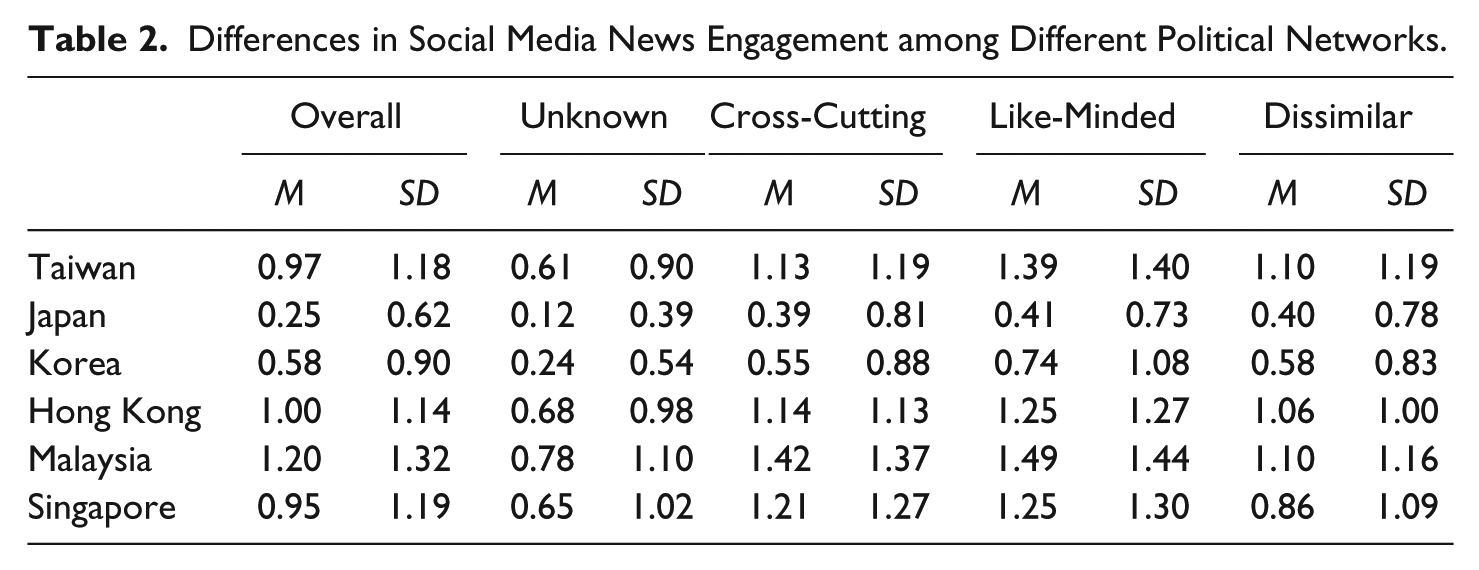
Table 2 summarizes the mean social media news engagement by country and by political network type. Overall, Malaysia has the highest level of engagement followed closely by Hong Kong, Singapore, and Taiwan. Comparatively, Japan and Korea had relatively low levels of engagement. One-way ANOVA analyses were conducted to compare social media news engagement across the different types of political social networks in the six countries (RQ1). All models were significant at p < .001. Across all countries, individuals in like-minded networks exhibited the highest levels of social media news engagement and those in unknown networks showed the lowest. Post hoc comparisons using the Scheffe’s Test further showed that the differences between like-minded versus unknown networks and cross-cutting versus unknown networks were significant at p < .001. There were also significant differences between dissimilar versus unknown networks in Japan, Korea, Hong Kong, and Malaysia. In Malaysia and Singapore, there were significant differences between cross-cutting versus dissimilar networks and like-minded versus dissimilar networks. And finally, for Korea there was a difference between cross-cutting versus like-mined networks.
Differences in Social Media News Engagement among Different Political Networks.
Testing the Moderating Role of Internal Political Efficacy
Ordinary least squares regression analyses using the PROCESS macro for SPSS (Hayes 2013) were run to examine the extent to which internal political efficacy moderated the relationship between political social networks and social media news engagement in the six countries (RQ2). Gender, age, education, hard news interest, news trust, political ideology, and face-to-face news discussion were entered as controls along with internal political efficacy and political social network. Because the latter was a multicategorical variable, four groups were coded: Unknown (i.e., “I don’t really know what most of my close friends think about politics”), Cross-cutting (i.e., “Around half of my close friends share my views on politics”), Like-minded (i.e., “Almost all/Most of my close friends share my views on politics”), and Dissimilar (i.e., “Most/Almost all of my close friends do not share my views on politics”). Three interaction terms were entered into the models that crossed internal political efficacy with cross-cutting, liked-minded, and dissimilar networks. Unknown served as the reference category.
All regression models were significant and are summarized in Table 3. With regard to the controls, younger age, frequency of face-to-face news discussion, and news interest were related to social media news engagement for all samples (p < .001). Moreover, omnibus tests of the overall interaction effect of internal political efficacy on the relationship between political social network and new engagement were significant for all samples at p < .05 with the exception of Singapore, which was marginal (p = .10). Following suggestions by Hayes and Montoya (2017), the OGRS (Omnibus Groups Regions of Significance) macro for SPSS was used to implement the Johnson–Neyman procedure for examining the specific point of the scale in which the moderator transitions from nonsignificance to significance. Using the criteria of p < .001, the results showed that internal political efficacy exerted its moderating influence starting from the value of 2.70 for Hong Kong, 2.24 for Japan, 2.71 for Korea, 2.21 for Malaysia, 2.28 for Singapore, and 2.42 for Taiwan. Figure 1 summarizes the interactions and the horizontal lines mark the region of statistical significance.
Models Predicting Social Media News Engagement.
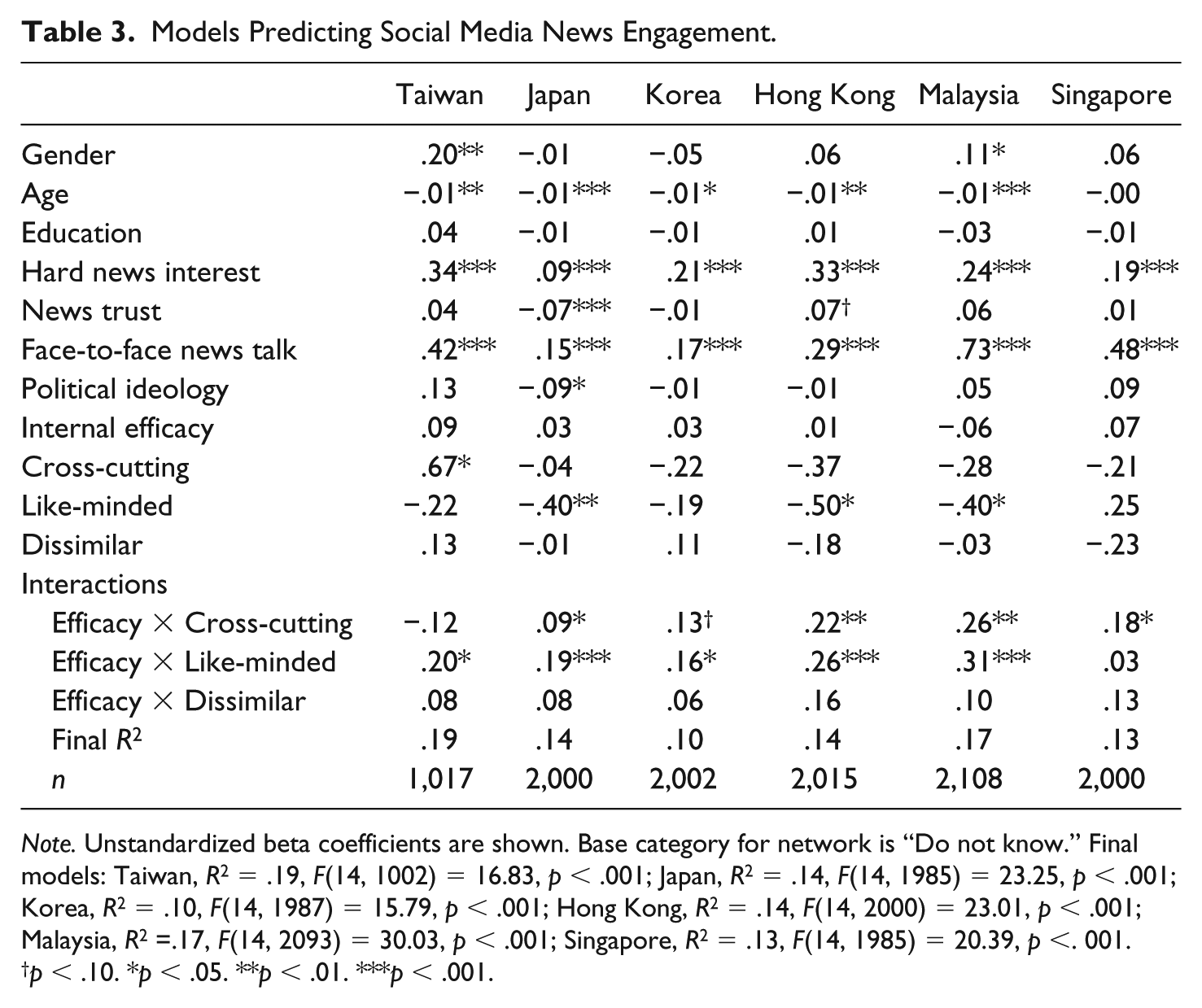
Note. Unstandardized beta coefficients are shown. Base category for network is “Do not know.” Final models: Taiwan, R2 = .19, F(14, 1002) = 16.83, p < .001; Japan, R2 = .14, F(14, 1985) = 23.25, p < .001; Korea, R2 = .10, F(14, 1987) = 15.79, p < .001; Hong Kong, R2 = .14, F(14, 2000) = 23.01, p < .001; Malaysia, R2 =.17, F(14, 2093) = 30.03, p < .001; Singapore, R2 = .13, F(14, 1985) = 20.39, p <. 001.
p < .10. *p < .05. **p < .01. ***p < .001.
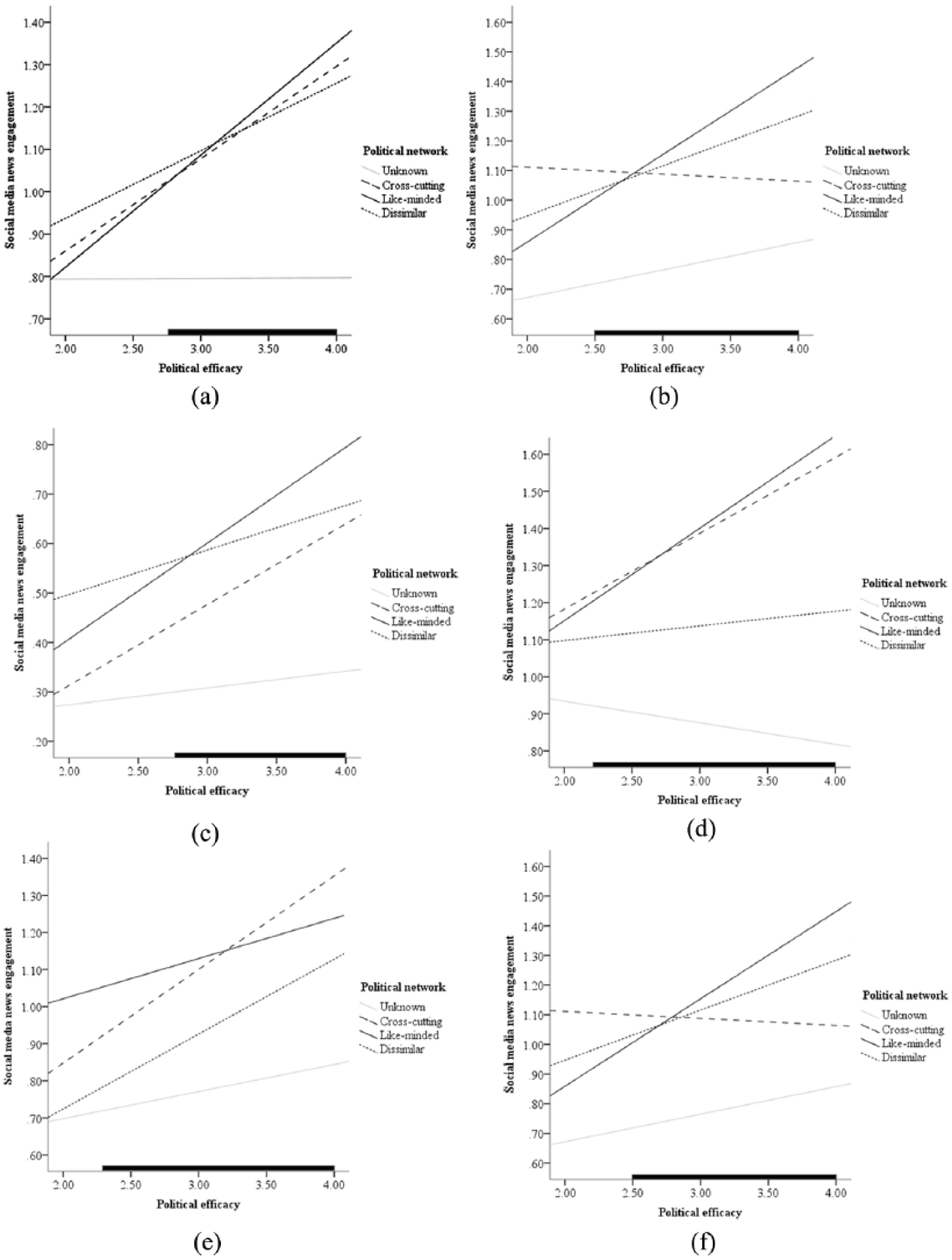
Interactions of internal political efficacy and political social networks on social media news engagement: (a) Hong Kong, (b) Japan, (c) Korea, (d) Malaysia, (e) Singapore, and (f) Taiwan.
An examination of the lower-order interactions to some degree confirms what can be ascertained from visual inspections of the figures. That is, internal political efficacy accentuated the effect of like-minded political networks on news engagement in Taiwan, Japan, Korea, Hong Kong, and Malaysia, as well as accentuated the relationship between cross-cutting political networks and engagement in Japan, Korea, Hong Kong, Malaysia, and Singapore. Implications of the findings are discussed next.
Discussion
This study aims to assess the prevalence of social media news engagement in six Asian societies that have diverse political and media systems. It is an important endeavor given the rapid rise of social media penetration in the region, which provides not only new channels for information, but also new ways to engage with the news in ways that are fundamentally social. Unlike the ephemeral nature of news discussion in face-to-face interactions, news engagement in social media is a publicly observable act that can be disseminated among and seen by multiple people instantaneously within an online social network. Therefore, in examining the democratizing potential of social media in Asia in its political and social development, it is important to assess the prevalence of social media news engagement that can potentially engender democratic norms or “mediated publics” (Hermida et al. 2012) as part of a deliberative democracy; or instead lead to ideological segregation and the formation of echo chambers that may have debilitating consequences. Several findings in this study are worth noting.
Uneven Engagement
First, social media news engagement is quite uneven across the samples. It is lowest for the developed democracies Japan and Korea and highest among the semiauthoritarian states. This is understandable in the context of their media systems, which fall under different levels of government control and cooptation. Press laws in Singapore and Malaysia severely curtail the traditional mass media and its ability to question or criticize the ruling status quo (Gomez 2014; Zhang 2016) whereas in Hong Kong much of the press since the 1997 handover has been bought or coopted by entities that are pro-China or have economic interests in China (Lee et al. 2017). In such environments, the relatively less-regulated social media channel may be a preferred or alternative source for users to engage with news. In the case of Japan and Korea, it should also be noted that certain forms of political discourse on social media were until recently tightly regulated (Iosifidis and Wheeler 2016), which may serve to inhibit engagement. Second, there are several predictors that are universally related to social media news engagement across the samples. Those who are younger, interested in hard news, talk about the news with others in face-to-face settings, and feel that they are efficacious in politics, are more likely to engage in social media news.
The Important Roles of Political Social Networks and Internal Political Efficacy
Because social media news engagement has social implications, the study examined the role of political social networks. These networks can constitute important opinion climates that may encourage or inhibit news engagement that is publicly observable. In line with theoretical expectations, regardless of the overall levels of social media news engagement for each country, individuals in like-minded social networks tend to engage more and those in unknown social networks the least. Indeed, the percentage of respondents who did not know the political views of their close friends ranged from 21 percent to 53 percent. This is perhaps indicative of a segment of the population that is either disinterested in news; or they purposefully avoid discussing or sharing political topics so as to avoid social conflict or tension with close friends.
The differences become more pronounced when internal political efficacy is included as a moderator. For five of the countries, internal political efficacy accentuated the impact of like-minded political networks on news engagement relative to networks where individuals are not aware of their political stances. This is understandable in the sense that efficacious individuals may feel more empowered and confident that what they post or share on social media will be accepted and supported by those who share similar political views. It is under these conditions that are generally more conducive to the formation of echo chambers as individuals within the online social network may share similar or one-sided news over time. Yet, it is also important to note that in five of the samples, efficacious individuals are also more likely to engage in social media news in cross-cutting networks. In these situations, efficacious individuals may feel that they have the ability to deal with possible negative feedback from others, or that they feel confident enough to challenge their friends’ political views. In doing so, the network as a whole may be exposed to diverse news with perhaps different viewpoints and perspectives. These patterns of findings may bode well for the potential democratizing potential of social media in Asia. Political scientists have long noted the importance of political disagreement within individuals’ social networks because it is the exposure to diverse views and opinions that would lead to meaningful deliberation and discussion of issues (Huckfeldt et al. 2004). Indeed, a closer examination of the descriptive data (Appendix B) does show that the composition of political social networks is far from homogenous, and the number of respondents who are in cross-cutting networks is actually greater than those in like-minded networks (Taiwan, Korea, Hong Kong, Singapore). This suggests that there are indeed certain segments within each of the countries where citizens with high levels of efficacy are willing to engage with social media news despite the possible social consequences to close friendships. At the same time, it should be noted that there were no significant interactions between internal political efficacy and dissimilar political networks, suggesting that even efficacious individuals may be reluctant to engage with social media news when they constitute the minority view in the political network.
Overall, the findings provide suggestive evidence for both sides of the debate as to whether social media news can engender a deliberative social media space or lead to ideological segregation. A key contribution of the present study is the demonstration of commonalities that underlie the findings despite different absolute levels of engagement as well as the diversity of political systems and cultures among the samples. Of course, more research is needed to further assess the democratizing potential of social media in Asian democracies, especially in terms of the characteristics of individuals who engage in news on social media. For example, beyond demographics and interest, what kinds of users are likely to be in cross-cutting networks? What kinds of users are willing to share news despite the potential social costs? This study has identified internal political efficacy as an important variable to consider, though there may be several others, and some may be more salient in certain societies than others. For example, lack of trust in news is related to social media news engagement in Japan.
Limitations and Conclusion
Before concluding the study and specifying avenues for further research, it is necessary to highlight some of the limitations of the study, chief of which is the cross-sectional nature of the comparative data and the use of an online-only sample. Granted, Internet access is indeed very high in the six countries (81 percentage–94 percentage), but care should be taken to generalize the findings to the general population as it is possible that social media engagement has been overreported and traditional media underreported. Moreover, only data from six countries in Asia were collected. Even though they were selected to be broadly representative of the different political and media systems, they could hardly be representative of “Asia” as a whole. Future studies would also benefit from more contextually specific measures of social media news engagement rather than the generic measures used in the present study, which may have contributed to the marginal Cronbach’s alpha score. Past studies strongly suggest that different uses of the Internet often lead to different outcomes (Choi 2016). For example, “commenting” on news posts often require more cognitive effort compared with just “sharing” them. Therefore, a more precise definition and measurement of “news engagement” may be required. A related limitation is that the measures of news engagement did not consider whether the content shared is indeed political or ideological. It is possible that those in cross-cutting political networks simply engaged in more “neutral” news content whereas those in like-minded networks feel more empowered to engage with one-sided news.
It is still too early to conclude whether the Internet and social media indeed has “democratizing effects” in Asia (Abbott 2013; Skoric et al. 2016), and social media news engagement is just one kind of behavior. However, news has long been considered by political scholars to be the catalyst for discussion and action, and the findings in this study point to the potential for social media to engender an informed and deliberative citizenry, especially in authoritarian states where social media has become an important and popular source of information. Thus, future studies need to continuously track the use of social media for news in Asia and extant models of political and civic learning as well as participation can be used to assess whether social media news engagement leads to desirable democratic outcomes or not. Longitudinal studies would offer some important insights.
The other possibility of the role of social media news in Asia is somewhat less optimistic, where only partisan news is shared among like-minded others, leading to filter bubbles as social media algorithms preselect the same kind of content to appear on user’s feeds, and eventually to the cyberbalkanization of different discursive spaces. The end result may be greater political and social polarization in society (Shah et al. 2017). Hence, examining the effects of social media in Asian society and politics will be an ongoing and important endeavor.
Footnotes
Appendix
Descriptive Statistics of Key Variables in Study.

| Taiwan | Japan | Korea | Hong Kong | Malaysia | Singapore | |
|---|---|---|---|---|---|---|
| News engagement | ||||||
| Comment on a news story | 19% | 6% | 11% | 18% | 20% | 14% |
| Share a news story via SNSs | 36% | 8% | 12% | 30% | 34% | 27% |
| Share a news story via social media apps | 14% | 4% | 13% | 29% | 34% | 25% |
| Post or send news picture or video to SNSs | 12% | 2% | 6% | 9% | 13% | 9% |
| Talk online with friends and colleagues about news story | 16% | 5% | 12% | 14% | 19% | 20% |
| M | 0.81 | 0.20 | 0.43 | 0.86 | 1.01 | 0.75 |
| SD | 1.00 | 0.53 | 0.77 | 1.00 | 1.14 | 0.99 |
| Independent variables | ||||||
| Political social network | ||||||
| Unknown | 42% | 53% | 21% | 35% | 22% | 42% |
| Cross-cutting | 28% | 23% | 38% | 30% | 27% | 25% |
| Like-minded | 27% | 17% | 32% | 30% | 39% | 23% |
| Dissimilar | 3% | 7% | 9% | 5% | 12% | 10% |
| Face to face news talk | 27% | 19% | 25% | 28% | 30% | 38% |
| Interest in news | ||||||
| M | 3.57 | 3.84 | 3.56 | 3.60 | 3.47 | 3.59 |
| SD | 0.91 | 0.87 | 0.77 | 0.84 | 0.88 | 0.87 |
| Internal efficacy | ||||||
| M | 2.93 | 2.87 | 3.33 | 2.94 | 2.81 | 2.90 |
| SD | 0.89 | 0.80 | 0.78 | 0.84 | 0.88 | 0.87 |
| Demographics | ||||||
| Gender (female) | 51% | 52% | 50% | 55% | 50% | 52% |
| Age | ||||||
| M | 44.26 | 49.31 | 44.98 | 46.23 | 40.13 | 40.90 |
| SD | 14.07 | 15.38 | 14.36 | 14.11 | 14.09 | 14.88 |
| Education | ||||||
| M | 4.35 | 4.06 | 4.20 | 3.90 | 3.97 | 3.96 |
| SD | 1.20 | 1.18 | 1.34 | 1.26 | 1.25 | 1.34 |
Declaration of Conflicting Interests
The authors declared the following potential conflicts of interest with respect to the research, authorship, and/or publication of this article: All authors have agreed to this submission and the article is not currently being considered for publication by any other print or electronic journal.
Funding
The authors received no financial support for the research, authorship, and/or publication of this article.
