



Abstract
Previous research has attributed media convergence to, among other things, where the news was originally published. That research, however, has struggled to identify causal relationships between a news item’s publication in a particular outlet and journalists’ perceptions of a story’s newsworthiness. This relationship is difficult to identify because of the correlation between publication in a particular outlet and many other factors that also impact newsworthiness. This paper uses an experiment embedded within a survey of over 1,500 U.S. political journalists to test the impact of a news story’s previous publication history on journalists’ views of the newsworthiness of that news item. Compared with previously unpublished stories, the publication of a news story in a national paper has no significant positive effect on the perceived newsworthiness of a story. The origin of a story in a local outlet, however, causes journalists to perceive that story to be less newsworthy.
It would worry the shit out of [editors] if their Washington reporter happened to come up with a page-one story that was different from what the other guys were getting. And the first goddam thing that happens is they pick up the phone and call this guy and say, “Hey, if this is such a hot story, how come AP or the Washington Post doesn’t have it?”
The media has power to shape public agendas through news coverage (King et al. 2017; McCombs and Shaw 1972). Media coverage affects both the opinions and the actions of citizens (Abrajano et al. 2017; Iyengar and Kinder 1987; Martin and McCrain 2019). Because democratic institutions are dependent on the free flow of information (Dahl 2005), it is essential to understand how media outlets choose stories to publish. Understanding the nature of media convergence on a story sheds light on the institutional structure of the media, how news spreads in society, and may partially explain the nationalization of American politics (Hopkins 2018; Popkin 2006). This paper specifically looks at whether a news story’s previous publication history (or lack thereof) influences journalists’ views of the story’s newsworthiness and thus might explain patterns of news coverage.
News cycle patterns (Boydstun 2013; Breed 1955; Crouse 1972) and media slant (Gans 2004; Gentzkow and Shapiro 2010; Shoemaker and Reese 1996; White 1950) show that the production of news is not an unbiased process. News coverage both converges on stories (media convergence) and follows news leaders in how they frame and cover certain stories (pack journalism).
Observational research has detailed similarities in coverage (both media convergence generally and pack journalism) across outlets and scholars have used this evidence to argue that editors and journalists, while claiming their own editorial discretion, look to other media outlets, specifically national outlets, for direction about what to cover (Boczkowski 2009, 2010; Breed 1955; Crouse 1972) and eschew unpublished news (Crouse 1972) or news previously published in local outlets (Breed 1955). 1 By these arguments, a story’s publication history influences journalists’ perceptions of the story’s newsworthiness and, consequently, subsequent decisions to publish that story (media convergence) and which frames to use (pack journalism).
However, any relationship between a story’s publication history (or lack thereof) and its perceived newsworthiness could also be driven by other factors besides a story’s publication history. 2 Given the resource advantages of major outlets, higher interest news stories should be more likely to appear in those outlets. Media convergence also arises from similarities in the way that journalists pursue news stories (Breed 1955; Crouse 1972; Fishman 1980; Reese 2001; Schudson 1982; Shoemaker and Reese 1996), their social circles (Crouse 1972; Mourão 2015; Tuchman 1978), and the training and institutional norms that surround the profession (Gans 2004; Tuchman 1976; White 1950). Newspapers may not explicitly desire to publish stories appearing in nationally reputable outlets over other potential news items, but rather national outlets just might be more likely to break stories that the media view as newsworthy. In short, there are many alternative explanations for why stories in national media outlets are picked up by smaller media outlets.
Because of the difficulty of identifying causal relationships using observational data, this research leverages an experimental design to isolate the effect of story origin on the perceived newsworthiness of a story. Using a survey experiment of over 1,500 U.S. political journalists, editors, and newspaper publishers, I find that previous coverage of a story in a national outlet does not increase journalists’ perceptions of a story’s newsworthiness compared to a previously unpublished story or a story published in a mid-sized media outlet. Thus, while previous publication in a national media outlet may be correlated with subsequent media coverage, it is not a causal mechanism to increase a story’s perceived newsworthiness relative to unpublished news or news published in a mid-sized daily newspaper.
However, at the same time, the results from the experiment also show that a story’s publication history is not irrelevant in the evaluation of a story’s newsworthiness. Specifically, previous coverage in a local news outlet has a negative effect on the perceived newsworthiness of a story. Journalists consistently viewed stories as less newsworthy if they had been published in a local media outlet relative to stories with other publication histories.
On the whole, in an era where politics in the United States has become more nationalized with a greater focus on national issues rather than local political issues and contexts (Hopkins 2018; Jacobson 2015) and where local papers have struggled (Abernathy 2016), these results suggest one possible motivation may be the media’s disdain for stories originating in local media.
The Value of News by Its Origin
How media converge on a particular news story has significant implications for the distribution of information in society. Different media gatekeepers result in significantly different flows of information and, as a result, societal organization (Gans 2004; Martin and McCrain 2019; Shoemaker and Reese 1996; White 1950). Control over information or the coverage of a particular story has implications for how politics is organized (Popkin 2006). Prioritization of news items published in national outlets relative to those published in local outlets diminishes local coverage and results in a more nationalized political environment.
While this paper focuses explicitly on media behavior in the United States, these findings are also relevant to other contexts. Certain political features of the United States, including its polarized presidential system, legislative gridlock, and organized pluralism, as well as media system features, such as the balance of public and commercial media, may affect the processes by which media privilege certain stories (Hallin and Mancini 2004; Semetko and Mandelli 1997). However, if anything, this particular case provides a difficult test of anti-local news media bias. Comparative newspaper markets vary significantly in their balance of local, regional, and national newspapers. The United States has historically been dominated by local papers rather than the national outlets (Hallin and Mancini 2004). Recent trends, however, show that Americans are relying significantly more on national media. Thus, while the media ecosystem continues to have large numbers of local media outlets, their audience has declined significantly (Hayes and Lawless 2015, 2018).
Scholars have previously provided some evidence that suggests that the perceived newsworthiness of news in the United States might be influenced by its publication history. However, there are also reasons to believe that increased coverage of news originating in national outlets may be driven by other factors. Below I outline the arguments in support of and in opposition to the idea that a news item’s publication history might influence its perceived newsworthiness.
The Potential Importance of a News Item’s Publication History
Many scholars have provided evidence supporting the idea that publication histories affect the likelihood of subsequent news coverage. These accounts argue that the choices of media outlets about what to cover and how to cover it are dependent on the choices of national news institutions (Beckers et al. 2019; Boczkowski 2009, 2010; Boczkowski and De Santos 2007; Breed 1955; Crouse 1972; Gans 2004; Wheatley and O’Sullivan 2017). Specifically, news is more newsworthy if it has been published in a national outlet compared with news not previously published (Crouse 1972). By these arguments, editors are concerned about their credibility which may be undermined if they publish a different story from national media outlets: 3
This research has also suggested that journalists are more likely to deem a story less newsworthy if it appeared in a local media outlet (Breed 1955). 4 By this argument, news editors’ editorial decisions go “from larger papers to smaller ones, as if the editor is employing, . . . editors of the larger paper to help ‘make up’ his page” (Breed 1955: 278), but that editors rarely looked to local papers for guidance about what to cover (Breed 1955). We might expect this trend to increase as journalism resources have decreased and time pressures have increased. Modern journalists rely more on repackaged material previously published elsewhere (Wheatley and O’Sullivan 2017).
Moreover, we might expect journalists to eschew local news because politics in the United States has become increasingly nationally focused. In recent years, audiences have shifted away from outlets covering local politics to outlets focused on national politics (Hopkins 2018). As such, editors and journalists may view stories originating in local papers as less interesting because citizens have expressed interest in national news through subscription decisions (Hopkins 2018; Jacobson 2015) This devaluation of local news may be exacerbated by the decline of local news outlets (Abernathy 2016). Thus, coverage of a story in a local outlet might decrease journalists’ perceptions of the story’s newsworthiness:
Likewise, previous qualitative work has argued that preferences for news from national outlets are driven by the desires of editors to not lack news that national media outlets have (Crouse 1972). Thus, we might expect these effects to be greatest among journalists’ expectations of their editors’ perceptions of newsworthiness:
Finally, given the assumption that larger papers explicitly do not look to smaller papers for potential news items (Breed 1955), the discrimination against news published in local papers might be greatest for individuals not working for local newspapers: 5
Other Explanations of the Downstream Flow of News
On the other hand, there are a number of explanations for these patterns of news coverage not dependent upon publication history. Foremost, larger media outlets have greater resources allowing them to identify news before other outlets. It could be that larger media outlets are not causing the news stories they print to become more newsworthy, but rather these media outlets are more likely to identify newsworthy stories.
National papers also have greater incentives to pursue stories of interest to a larger number of outlets than local or regional newspapers because of their diverse readership. Small papers are more likely to focus on news relevant to their more localized readership and not of interest to other newspapers. The culture and values (and even organizational structures) of local news organizations are fundamentally different from larger, more nationally oriented, news organizations (Jenkins and Nielsen 2019; but see Ross 2006) and have different definitions of success (Ali et al. 2019). Thus, the documented flow of news from larger to smaller papers could be due to the fact that larger papers pursue stories that are also of interest to other outlets. Local newspapers might be more likely to pursue stories of little interest to other outlets because of their unique focus and organizational norms and values.
In addition, news convergence can also be explained through other means. Journalists across media outlets work in the same environment and rely on the same networks of sources (Crouse 1972; Fishman 1980; Tuchman 1976). Similarly, journalists follow the same standard newsmaking procedures (Boydstun 2013; Gans 2004; Schudson 1989; Shoemaker and Reese 1996; Tuchman 1978) and espouse the same values (Berkowitz and Limor 2003; Gans 2004; Tuchman 1976). Moreover, the similar technical constraints across news organizations restrain the ability of newspapers to deviate substantially from other organizations (Shoemaker and Reese 1996; Tuchman 1972, 1976). Journalists operate largely within the same societal culture and thus are susceptible to the same pressures and expectations for what is news (Mourão 2015; Schudson 1989) and journalists and reporters also conform to the perceived expectations of their readers (Flegel and Chaffee 1971; Gentzkow and Shapiro 2010; Tuchman 1972). When the institutional processes and social norms are the same, we should not be surprised when coverage is similar. As before, the larger resources available to larger media outlets mean that they are more likely to identify and break newsworthy news.
Finally, even if previous publication in a national paper did once play a role in the evaluation of a story’s newsworthiness, cue taking from other outlets may have declined significantly (Beckers et al. 2019) as online sources have become more salient relative to national media sources (Van Leuven et al. 2018). 6 The rise of cable and the diversification of news has encouraged news entities to focus on specific markets (Gentzkow and Shapiro 2010; Hamilton 2004), fundamentally transforming the field of journalism (Tandoc and Jenkins 2017). Moreover, in an era of journalism increasingly driven by online metrics, journalists might rely less on cues from other media outlets and more on analytics to discern what stories their readership would prefer (Tandoc 2014; Vu 2014). Likewise, journalists have also increased their reliance on public relations material (Lewis et al. 2008) in part because of decreasing resources and the hyper-temporally driven professional environment (Wheatley and O’Sullivan 2017). Journalists now have many more tools to identify news and judge its significance beyond just cues from a story’s publication in another outlet.
These possible alternative explanations for the prevalence of stories originating in national newspapers unrelated specifically to an item’s publication history (or movement away from a reliance on an item’s publication history in recent times) outlined above lead us to these alternative hypotheses:
Moreover, changes in the media environment may have discouraged the practice of privileging previously published material from any source. Although some argue that the growth of news sources has increased mimicry (Shaw 1989), the compacted news cycle and the ability to publish news in real-time has encouraged journalists to become increasingly concerned about speed and unpublished news (Saltzis 2012). Competition with other outlets for coverage of an event may cause a media entity to ignore or deemphasize that news item in order to not appear to be beholden to the other media outlet’s coverage (Boczkowski 2010; Breed 1955; Gans 2004). As such, the publication of a news item by any other media outlet may actually decrease the perceived newsworthiness of that news item:
Estimating Causal Effects of News Story Origins
As noted, there are reasons to expect that a story’s publication history could or could not have an influence on its perceived newsworthiness. Given the range of possible confounding factors, previous observational attempts to answer the question of the influence of a news item’s publication history on journalists’ perceptions of newsworthiness or preferences for publishing certain stories struggle with internal validity. Observational research designs with large representative samples provide realistic environments to test expectations (high levels of external validity), but have lower levels of internal validity, making it harder to evaluate whether outcomes are caused by changes in independent variables or by other factors (McDermott 2011).
In this case, the question is whether larger outlets are just more likely to publish newsworthy stories or whether stories published in those outlets are judged to be more newsworthy because of their publication there. With the advantages that national media outlets have in identifying news, it may be that correlations between a story being reported first in a national media outlet and subsequent coverage elsewhere are not the result of being published in a national media outlet, but rather reflect the resource advantages that large media outlets have to identify stories. As such, the causal relationship between publication in a certain type of media outlet and perceived newsworthiness is hard to disentangle through observational methods.
In his study, suggesting that national papers have an influence on the news coverage found in smaller papers, Breed (1955) notes that explicit proof of such “would require experimental study” (p. 279). This paper provides just such an experimental design. This design provides a clear test of the causal relationship between previous coverage of a news item in one media entity on journalists’ perceptions of the newsworthiness of that news item.
Research Design
To estimate the causal relationship between prior publication in a national outlet and perceptions of newsworthiness, this paper relies on a national survey experiment of journalists conducted in the late summer of 2017. The sample for the survey experiment was collected using U.S. Newspaper List (usnpl.com). U.S. Newspaper List is an online national media directory of over four thousand newspapers operating in the United States which provides, among other things, links to each media outlet’s website and social media. Using U.S. Newspaper List, a team of researchers visited the website or Facebook page of every newspaper listed to gather the email addresses of political editors, political reporters, and publishers between May of 2017 and July of 2017. 7 In the case where a specific reporter or group of reporters or editor or group of editors was not explicitly designated as being assigned to political news, the email addresses of all reporters and editors were collected. The data gatherers explicitly excluded reporters and editors designated as covering some aspect other than politics (e.g., lifestyle, business, or crime). Given the role of the media in the nationalization of politics (Hayes and Lawless 2018; Hopkins 2018), the focus on political journalists was intentional. This process resulted in a population of 11,565 journalists. The survey was distributed on Qualtrics’ survey platform via email in late August and September of 2017. A total of 1,510 journalists responded to the survey for a response rate of 13.1 percent, although response rates to individual questions are lower (for the experimental portion, the response rate was 9.2 percent). These response rates are similar to other surveys of political elites (Dynes et al. 2019) and almost double other surveys of journalists (McGregor and Molyneux 2020). The survey asked respondents about items related to politics and their responsibilities as journalists. More details, including descriptive statistics, are available in the Supplementary Material.
Embedded in the survey was an experiment designed to isolate the effect of previous coverage on respondents’ perceptions of a news story’s newsworthiness. Respondents were randomly assigned to one of four groups by Qualtrics’ randomization process. Each group saw the same information about a news story. The story was about a disabilities advocacy group suing a local city for discrimination against homeless individuals with disabilities in homeless shelters and on public transportation. 8 The only variation across groups was whether the story had been covered previously by another news outlet and, if so, what type of news outlet it was. Respondents either were told that the story had “not been published previously in a paper,” or that it had been broken by a “local paper,” by a “mid-sized city daily,” or by a “nationally recognized paper.” The full text of the news story and the experimental treatments are in the Supplementary Material.
For the dependent variable, respondents indicated how important it was to their readers that they cover the story on a scale from 0 to 10, with 10 being incredibly important and 0 being not at all important. In addition, because others have indicated that it is editors who care most about their own coverage matching coverage in national media (Crouse 1972; Flegel and Chaffee 1971; Tuchman 1978), respondents also indicated how important it was to their editors that they cover the story. 9 Most respondents viewed the story as a story of significant interest both to their readers (an average rating of 7.1 with a standard deviation of 2.4) and to their editors (an average rating of 7.8 with a standard deviation of 2.3).
By relying on random assignment to a treatment, this research design maintains constant a number of other mechanisms (as outlined previously) that might also lead to a convergence around (or the rejection of) a set of news stories broken by a particular media outlet while varying only a story’s previous publication history (or lack thereof). This design allows for the direct estimation of how much more newsworthy journalists perceive a story to be if that story has already been picked up by certain type of media outlet. The experiment allows for confidence that the outcomes are a direct result of the manipulations imposed—in this case, changing the publication history of the news item. 10
Results
In Figure 1, I report journalists’ perceptions of the newsworthiness of the story to readers and to editors conditional on the news story’s prior publication history. Because we might expect these results to be different depending on whether the respondent is in a management or reporting roll (and it may be unrealistic to ask editors how important the story would be to their editors), Figure 2 reports journalists’ perceived newsworthiness of the story with various publication histories only for reporters who responded to the survey. 11 Below I detail the results from difference in means tests for statistical significance of differences between groups.
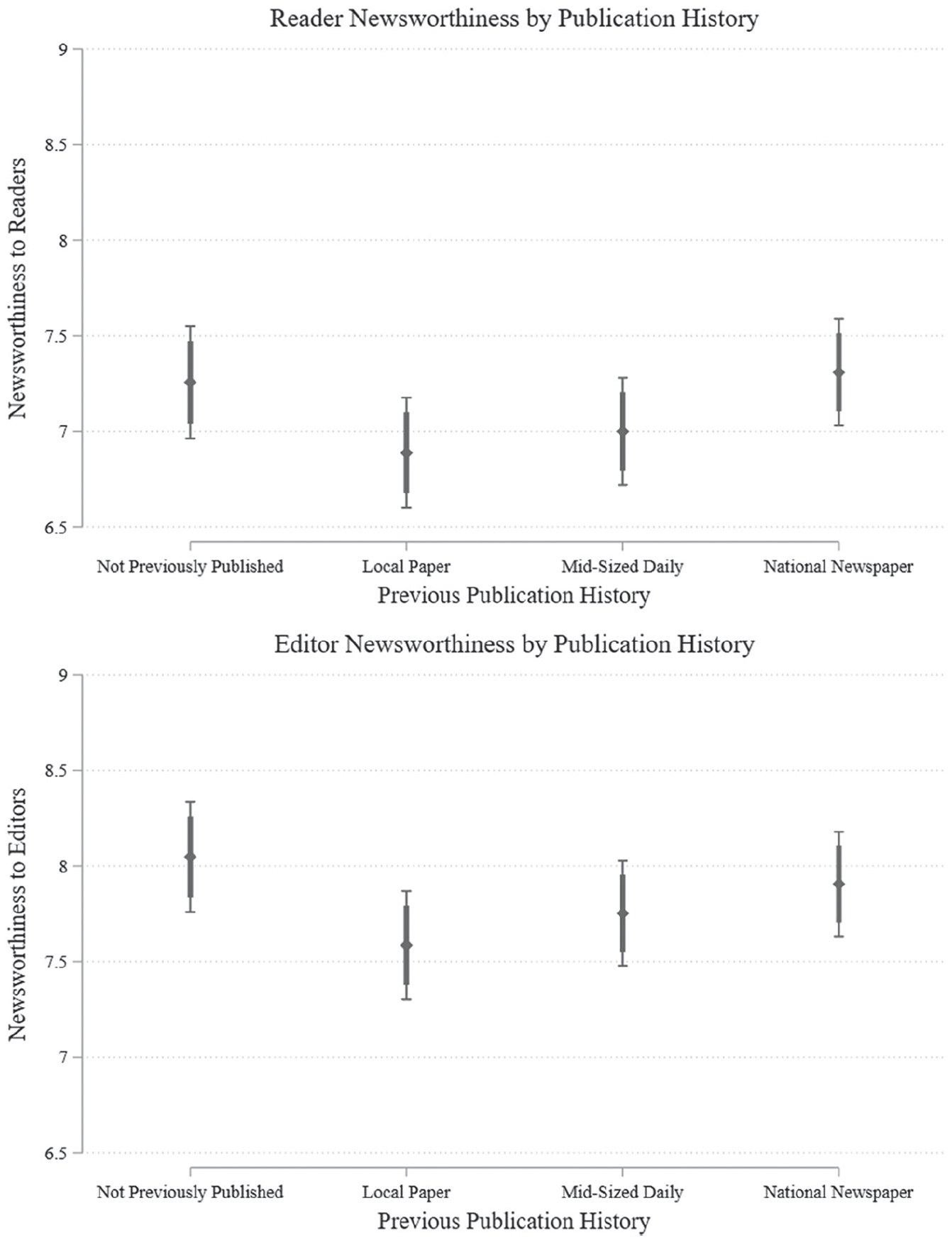
Effect of story coverage on perceived reader and editor interest.
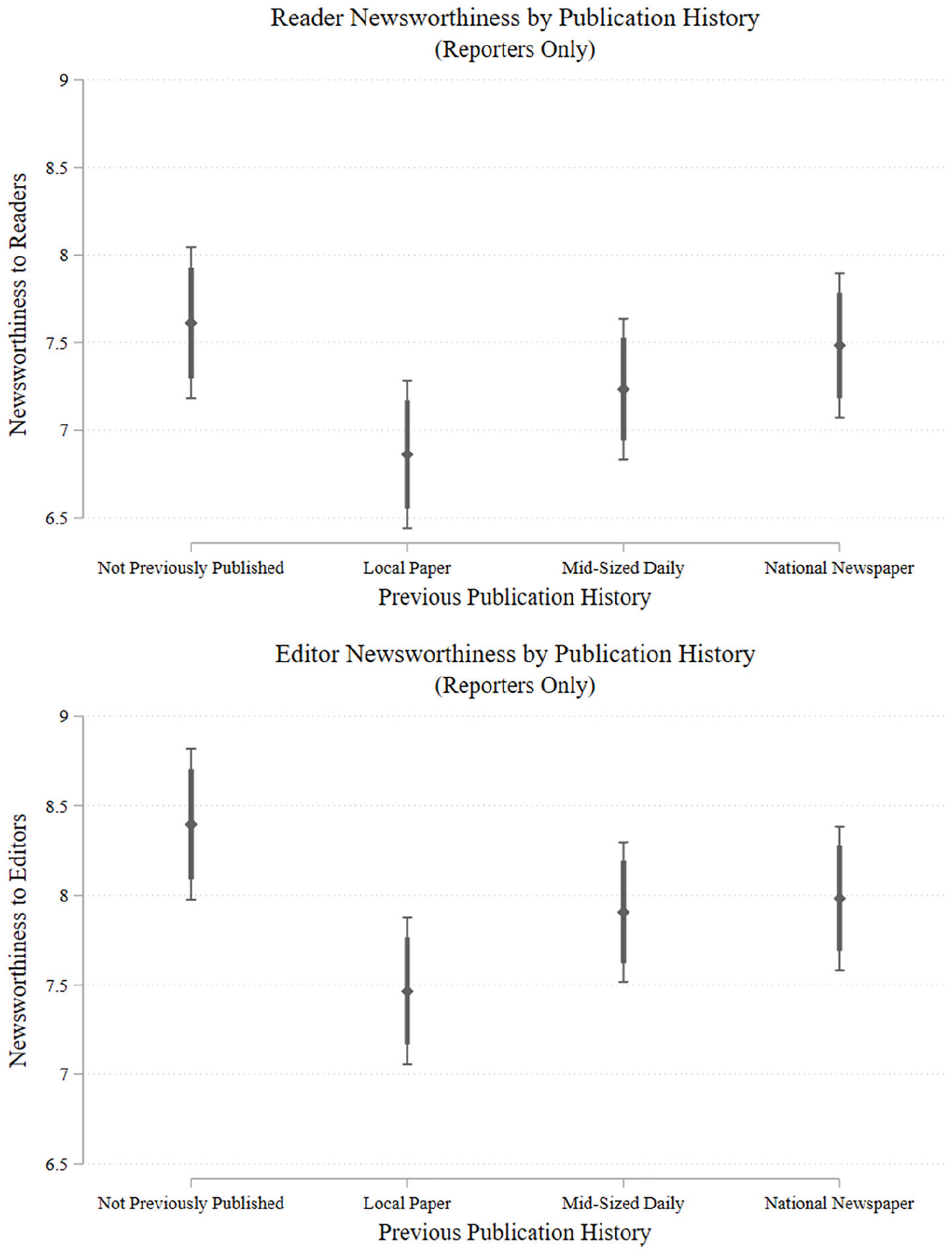
Effect of story coverage on perceived reader and editor interest (reporters only).
Hypotheses 1, 1A, 3, and 5 deal with the importance of previously unpublished news relative to news that had been previously published in a national outlet (or any outlet in the case of Hypothesis 5). In contrast to previous accounts that detail journalistic preferences for stories that have been previously covered in national outlets relative to previously unpublished news (which prompted Hypotheses 1 and 1A), there are no significant positive effects of coverage in a national outlet on the perceived newsworthiness of the news story relative to an unpublished story (consistent instead with Hypothesis 3) as shown in both panels in Figures 1 and 2 (p < .81 and p < .49 for the newsworthiness for readers and editors, respectively, for the full sample [Figure 1] and p < .68 and p < .17 for the newsworthiness for readers and editors for the sample of only reporters [Figure 2], all two-tailed tests).
In addition, there are also no significant differences between the newsworthiness of a news story that had not been published previously and the same story that had been previously published by a mid-sized daily (p < .22 and p < .15 for the perceived newsworthiness for readers and editors, respectively, for the full sample [Figure 1] and p < .21 and p < .10 for the perceived newsworthiness for readers and editors, respectively, for the reporters only sample [Figure 2], all two-tailed tests). Indeed, if anything, the direction of the effects suggests a slight preference (albeit none of the effects are statistically significant) for previously unpublished news over news published in a national newspaper (or a mid-sized daily newspaper). These findings provide weak support for Hypothesis 5 which stated that previously unpublished news would be considered more newsworthy than news previously published elsewhere. These results show that convergence and preference for a news story is not the result of reporters and editors viewing stories previously published in national outlets as more newsworthy. 12
Hypotheses 2, 2A, 2B, and 4 focused on the perceived newsworthiness of news published in local media outlets relative to identical stories published in national outlets (or other outlets in general in the case of Hypothesis 2). Both panels of Figures 1 and 2 do show a consistent discounting of news that is first published in smaller outlets relative to the same news story but with a different previous publication history consistent with Hypotheses 2 and 2A (and counter to Hypothesis 4) with the exception of news published in mid-sized dailies. As shown in the both panels of Figures 1 and 2, compared with the news story published in a local newspaper, previously unpublished news was perceived as more newsworthy for editors and readers (p < .03 and p < .08 [two-tailed test] for editors and readers, respectively, in the whole sample [Figure 1] and p < .01 and p < .02 [two-tailed test] for editors and readers, respectively, in the sample of only reporters [Figure 2]). Likewise, news published in a national paper was also consistently perceived as more newsworthy for editors and readers compared with news in local outlets although the differences in perceived newsworthiness for editors do not quite reach standard levels of statistical significance (p < .12 and p < .04 [two-tailed test] for editors and readers, respectively, in the whole sample [Figure 1] and p < .08 and p < .04 [two-tailed test] for editors and readers, respectively, in the sample of only reporters [Figure 2]). These findings provide support for Hypothesis 2A and provide support (although not all comparisons reach the p < .05 level) for Hypothesis 2. On the whole, journalists viewed stories broken by a local newspaper as less important to their readers and less important to their editors compared with previously unpublished stories and stories published in a national newspaper.
Furthermore, these differences are extenuated when we focus on journalists who do not work for small local newspapers in line with Hypothesis 2B. Figure 3 reports journalists’ perceptions of the newsworthiness of a story to readers and to editors conditional on the news story’s prior publication history but only for journalists who indicated that they did not work for a small paper.
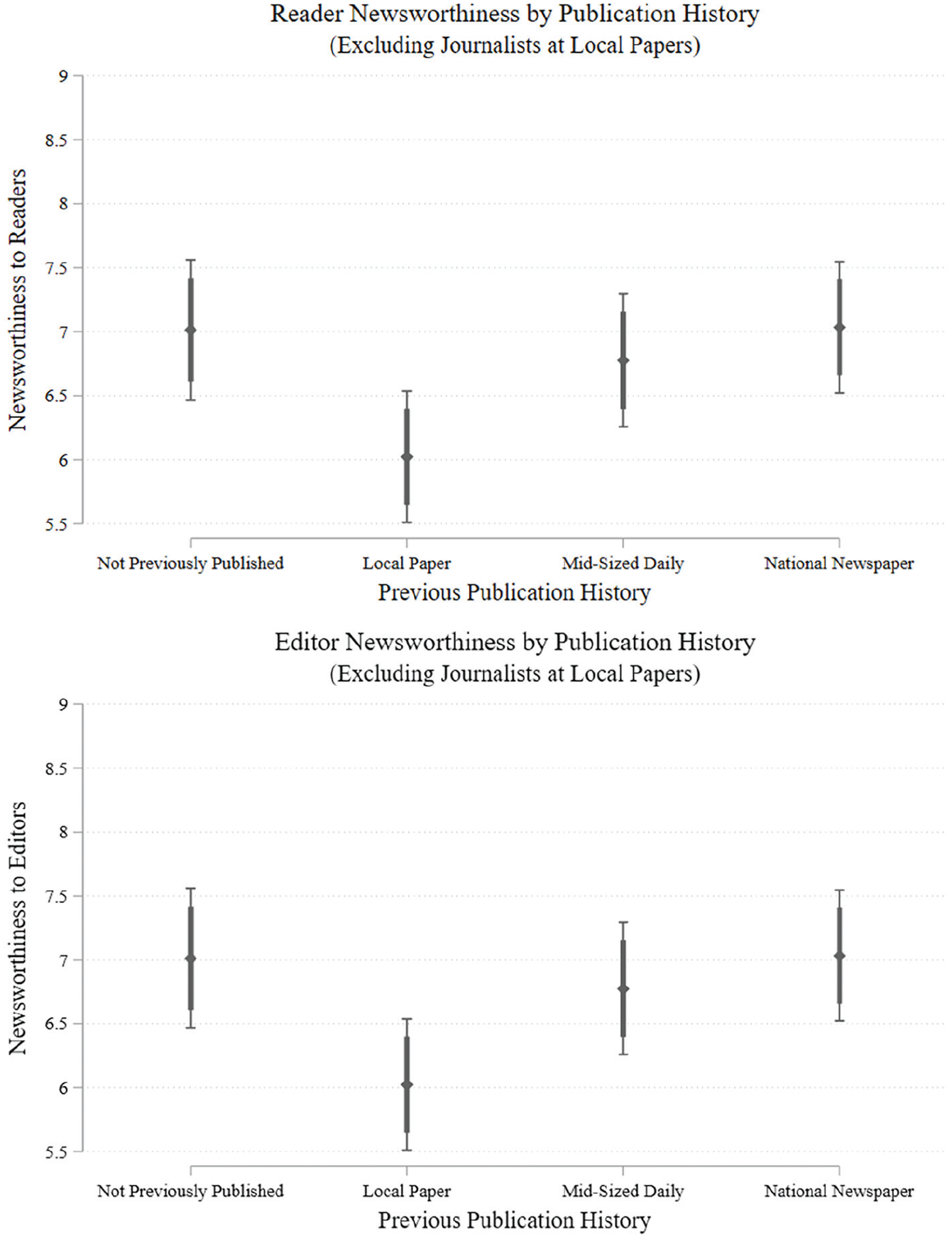
Effect of story coverage on perceived reader and editor interest (excluding journalists at local papers).
The results from both panels in Figure 3 show that there is a negative effect on the perceived newsworthiness of the story when that story had been covered previously in a local paper relative to all other possible publication histories although the difference in one of those measures—the perceived newsworthiness for editors of a story published by a local paper compared to that published by a mid-sized daily—is not quite significant (p < .02, p < .05, and p < .01 [two-tailed test] for the perceived newsworthiness for readers of a news item published in a local newspaper compared with unpublished news, news published in a mid-sized paper, and news published in a national journal [top panel of Figure 3], respectively, and p < .04, p < .07, and p < .04 [two-tailed test] for the perceived newsworthiness for editors compared with the same [bottom panel of Figure 3], respectively). As shown in Figure 3, the effect of publication in a local paper on the perceived newsworthiness to readers and to editors is consistently negative. Journalists perceive a story to be of more interest to their readers and editors when that story does not originate in a local paper. 13
Compared with the same story originating in a local paper, journalists at larger outlets perceived a previously unpublished story and a story originating in a national outlet as about 9 percent more newsworthy (an increase of roughly 1 point on the 0–10 scale) to readers and about 7 percent more newsworthy to editors. Similarly, journalists working at larger outlets evaluated stories originating in mid-sized dailies as about 6 percent more newsworthy to editors and readers than stories originating in local outlets although the effect size does not quite reach statistical significance for the perceptions of newsworthiness to editors as noted previously. These effects show that news covered in a local paper is perceived as less newsworthy than the same stories covered in larger outlets or stories not previously covered.
Conclusion
Journalistic coverage tends to follow a pattern whereby a story is broken and then patrolled extensively (Boydstun 2013). In anecdotal and qualitative evaluations of media convergence and pack journalism, scholars have routinely noted that newspapers look to other newspapers as a source for news. These studies have argued that the news item’s publication history influences the perceived newsworthiness of that news item. These previous studies have argued that the publication of a story in a national outlet increases the perceived newsworthiness of the story over a previously unpublished story. Likewise, these studies also indicate journalists are less likely to view stories published in local media outlets as newsworthy because of their origin in local papers.
Whereas previous attempts to analyze the influence of news story origins have used observational methods, this paper uses a survey experiment conducted with political journalists, editors, and publishers to test these propositions. This experimental analysis allows us to separate the effect of publication in another outlet from other attributes of the story that might also affect perceptions of a story’s newsworthiness. The analysis shows that previous publication in a nationally recognized newspaper does not increase the perceptions of the newsworthiness of an item relative to a previously unpublished item (counter to the expectations in Hypotheses 1 and 1A, but in line with Hypothesis 3). The analysis of variance (ANOVA) shows that individuals working in political journalism do not view stories published in national and mid-sized media outlets as more important (and may even consider them less important) to their readers or editors relative to previously unpublished news (in line with the expectations outlined in Hypothesis 5).
At the same time, publication in local outlets has a negative impact on the perceived newsworthiness of a story relative to a story with a different publication history. Individuals working in journalism (especially those working in larger outlets) view news stories that have been published in small local outlets as significantly less newsworthy and of less interest to their readers and their editors (consistent with Hypothesis 2, Hypothesis 2A, and Hypothesis 2B, and counter to Hypothesis 4).
The results suggest that the journalists do consider the status of the source in their evaluation of a news story, but that previous publication of a news item in a national outlet does not increase the perceived newsworthiness relative to previously unpublished news. In the era of twenty-four-hour news coverage where the news cycle turns over rapidly, individuals working in the business of reporting the news do not appear to view previously published news as more newsworthy. However, as detailed in Figure 3, journalist who worked in larger news outlets who were told a story originated in a small local publication were significantly less likely to indicate that the story would be newsworthy to readers and significantly less likely to indicate that the story would be newsworthy to their editors relative to previously unpublished news and news published in national newspapers (and nearly significantly less likely to view a story as newsworthy relative to a story published in a mid-sized daily).
On the whole, these results suggest that journalistic mimicry and the extensive coverage of news in the United States that originates in national publications does not appear to be driven by perception that previously unpublished news (or news published in mid-sized outlets) is less newsworthy. Instead, these results suggest that patterns of news convergence around nationally reported stories are more likely the result of a greater abundance of resources in national media outlets which advantage them in identifying news before other outlets do or the result of a greater incentive to pursue stories that would be of greater interest to a larger number of outlets. It could also be that whereas journalists in previous eras did privilege nationally reported news, journalism practices and norms have changed (Van Leuven et al. 2018). These results suggest that modern examples of news outlets mimicking their national counterparts are not merely the result of desires to ensure that “nobody else has got anything that they don’t have” (Crouse 1972: 10). In these cases, the judgment of the value of news does not appear to be influenced by whether the story is a new news story or a previously broken news story covered in a national media outlet.
At the same time, these results also suggest that the media is less inclined to pick up stories that originate in local media outlets because they are published in local outlets thus reducing their perceived newsworthiness. It is not possible in this study to identify the origins of this distain for news emanating from smaller outlets, whether that be driven by recent changes in the journalism industry fueled by analytics, segmentation, and the role of social media, or whether this is just a continuation of assumptions of newsworthiness and trends that newspapers have a “drive toward cosmopolitanism . . . [where] the small paper may try to simulate the bigger one” rather than the small paper (Breed 1955: 282).
It is important to note that future research would do well to continue to probe these effects both in the United States and elsewhere. While this survey experimental design increases the internal validity of the conclusions (where previous observational studies are much weaker), the survey experimental limits the ability to generalize to a wider variety of news stories or other media contexts (thus limiting external validity). The use of specific controlled scenarios in survey experiments allows us to attribute changes in outcomes to the specific treatments (internal validity), but may still remain uncertain about how the specific treatments might work in other scenarios (external validity). Yet, as McDermott (2011) explains, “without first establishing internal validity, it remains unclear what process should be explored in the real world” (p. 28). Future research should identify whether these effects are similar for other types of stories both political and non-political. Likewise, future research should also examine whether these same patterns exist in other media environments. While the United States media system is dominated by local and regional outlets, a media system where we might most expect journalists to privilege news originating in local outlets, it is important to test these findings elsewhere.
Similarly, experiments should be replicated to validate external validity and better understand the conditions that elicit the responses here (McDermott 2002). For instance, the framing of the story as being published in a “nationally recognized outlet” or a “mid-sized daily” may not elicit the same reaction from journalists that a specific nationally recognized outlet would. Individual reputations of individual news outlets vary significantly and effects might be more pronounced when using specific outlets.
However, these results do suggest that a news item’s publication in a nationally recognized outlet does not influence perceptions of newsworthiness relative to unpublished news. These results suggest that newsworthiness of stories published in national outlets is driven by other factors such as the content of the story or the norms surrounding journalism about what to cover.
Yet, this is not to say that publication history does not matter. These results show journalists place a larger emphasis on previously unpublished news and news originating in nationally recognized outlets (and suggestive evidence that journalists also privilege news published in mid-sized outlets) over news originating in smaller outlets. 14 Given the strong role that the media has on raising the salience of issues and directing citizen attention (Abrajano et al. 2017; Martin and McCrain 2019; McCombs and Shaw 1972), the diminished standing of news originating in local outlets can have significant consequences for politics (Hayes and Lawless 2015, 2018). In the United States, politics has continued to nationalize (Hopkins 2018; Jacobson 2015), and it is not unreasonable to suggest that this trend is related to the news media’s disdain for news in local outlets. While stories in national news outlets are not advantaged over previously unpublished news as previously suggested, news originating in local outlets is perceived as less newsworthy relative to previously unpublished news and stories published in national outlets.
Supplemental Material
Hassell-WMNN__online_supp – Supplemental material for What Makes News Newsworthy: An Experimental Test of Where a News Story Is Published (or Not) and Its Perceived Newsworthiness
Supplemental material, Hassell-WMNN__online_supp for What Makes News Newsworthy: An Experimental Test of Where a News Story Is Published (or Not) and Its Perceived Newsworthiness by Hans J. G. Hassell in The International Journal of Press/Politics
Footnotes
Acknowledgements
I am grateful to Amber Boydstun and Josh McCrain for discussions at APSA 2018 about this project, to Shannon McGregor, Matt Pietryka, Jeremy Pope, and three anonymous reviewers for their comments and suggestions, and to Matthew Christiansen, Aubrey Kohl, and Zach Stoll for their research assistance. A previous version of this paper was presented to Brigham Young University’s Thursday Group meeting and I am also thankful for their comments and insights.
Declaration of Conflicting Interests
The author(s) declared no potential conflicts of interest with respect to the research, authorship, and/or publication of this article.
Funding
The author(s) received no financial support for the research, authorship, and/or publication of this article.

Supplemental Material
Supplemental material for this article is available online.
Notes
Author Biography
References
Supplementary Material
Please find the following supplemental material available below.
For Open Access articles published under a Creative Commons License, all supplemental material carries the same license as the article it is associated with.
For non-Open Access articles published, all supplemental material carries a non-exclusive license, and permission requests for re-use of supplemental material or any part of supplemental material shall be sent directly to the copyright owner as specified in the copyright notice associated with the article.
