



Abstract
This study analyzes the visual self-representation of current Brazilian President Jair Bolsonaro, who is considered to be one of the exponents of the recent rise of rightwing neopopulism. Despite the growing body of literature analyzing contemporary populism, little has been said about the deployment of images in the construction of public meanings relevant to popular understandings of populist leaders. This research draws from the social media analysis of Casullo to investigate how the images posted on Bolsonaro’s Instagram account show him (1) as a mirror of the people, (2) someone extraordinary, and (3) quick to appropriate symbols of power. Referencing the work of Butler, we document how the visual self-representation of Bolsonaro is marked by eccentricity and unsophistication, which makes his demeanor, body, and appropriation of institutional power function as a series of parodies. His performance hyperbolizes the transgressive aspect of populism, producing a vertiginous and pleasurable ambiguity toward the figure of the leader. In emptying the presidency from its extraordinary dimension, the parody paradoxically does something extraordinary by reestablishing the distance that it seeks to eliminate. His eccentric rejection of basic social standards, over-the-top masculinity, and impromptu use of everyday objects as props work to construct an image that he is just an ordinary man, extraordinarily occupying the presidency.
Keywords
Populism is at the heart of contemporary debates in political science. An enormous amount of literature is currently devoted to discussing its conceptual underpinnings (Colliot-Thélène 2018; Kaltwasser et al. 2017; Laclau 2005; Mudde 2017; Ostiguy 2017; Urbinati 2019; Weyland 2017), investigating its historical roots and enabling conditions (Bucy et al. 2020; Cossarini and Vallespín 2019; Eichengreen 2018; Galston 2018; Hawkins and Kaltwasser 2017), and mapping its most recent manifestations (Aggio and Castro 2019; Alvares and Dahlgren 2016; de Vreese et al. 2018; Engesser et al. 2017; Ernst et al. 2019; Gerbaudo 2018; Hunter and Power 2019; Moffitt 2016; Norris and Inglehart 2019). The crisis of traditional forms of representation and the increasing importance of social media in politics (Chadwick 2013; Keane 2013; Krämer 2017; Postill 2018; Van Dijk and Hacker 2018) mark these debates and shed light on the centrality of the communicative dimension of populism (Aalberg et al. 2016; de Vreese et al. 2018).
Despite the growing scholarly attention given to populism, few studies have focused on its visual expressions. What does populism look like? How is it represented in media coverage and on social media platforms? How is it visually experienced? These seem to be pressing questions in a context deeply marked by spectatorship, in which most citizens experience politics by watching rather than actively participating (Green 2010). Investigating how populists represent themselves visually can thus help deepen our understanding of the phenomenon.
Bucy and colleagues (2020) recently distilled the core elements of a populist communication style, including simplification, emotionalization, and negativity, to document the “transgressive” performance of Donald Trump during the 2016 U.S. presidential debates. Their study employed detailed coding of the verbal, nonverbal, and tonal markers of Trump’s communication repertoire during the first general election debate with Hillary Clinton to document his repeated violations of normative boundaries. Piontek and Tadeusz-Ciesielczyk (2019) have similarly analyzed televised debates between Bronisław Komorowski and Andrzej Duda in Poland. Their analysis revealed that both candidates employed nonverbal cues, including eye contact, facial expressions, and gestures, to emphasize references toward the people or negative attitudes toward elites expressed in their verbal messages. Yet, beyond a handful of studies that are beginning to address visual aspects of populism in the context of political debates, “little is known about the nonverbal components of the populist style of political communication” (Piontek and Tadeusz-Ciesielczyk 2019: 151).
In the area of social media analysis, Casullo’s (2018) work offers a productive avenue for documenting the visual dimension of populism on digital platforms. Drawing from Laclau (2005), Casullo proposes that the leader’s body functions as a primary signifier of populism, which gives the corporeal presence of populist politicians a distinctive role in the visual analysis of the concept. The present article draws from her discussion to push forward a dynamic framework for the investigation of the visual self-representation of populist leaders. It does so through the case study of Brazilian president Jair Bolsonaro, specifically through the analysis of the images posted to his Instagram account between August 2018 and June 2019, encompassing his electoral campaign for the presidency and first six months of his government. Our hypothesis is that the visual self-representation of Bolsonaro is attuned with the current Zeitgeist, which challenges traditional hierarchical forms of political representation (Bennett and Segerberg 2013; Mendonça and Bustamante 2020; Tormey 2015).
This article is divided into four sections. In the first section, we briefly discuss populism and its communicative dimension. In the second section, we deal with the relationship between images and politics, devoting special attention to the visual nature of populism. In the third section, we present our case study, justifying our methodological choices. The fourth section discusses the data and results. The analysis looks at how Bolsonaro attempts to build a self-representation that (1) mirrors the people, (2) displays extraordinariness and (3) appropriates symbols of power (Casullo 2018).
Bolsonaro’s visual self-representation is deeply marked by eccentricity and ordinariness, which makes his demeanor, his body, and his appropriation of institutional power function as a series of parodies. His performance hyperbolizes the transgressive aspect of populism, producing a vertiginous and pleasurable ambiguity toward the figure of the leader. While stripping the presidency from its extraordinary dimension, the parody paradoxically does something extraordinary by reestablishing the distance it sought to eliminate. Bolsonaro’s eccentric rejection of basic social standards, over-the-top masculinity, and impromptu use of everyday objects as props work to construct an image that he is just an ordinary man, extraordinarily occupying the presidency. In doing so, he becomes attuned with the contemporary quest for horizontality and abjection to hierarchy that have been reshaping representative politics over the past several decades.
Populism and Its Communicative Dimension
The avalanche of recent studies on populism points to the concept’s capacity to speak to the current political climate. For decades, populism was regarded as able to describe only a limited number of political experiences, focused on the strength and personality of certain leaders when democratic institutions were not well consolidated in countries across Latin America, Asia, and Africa. The past decade has led to a blossoming literature on populism, updating the debate on the concept and employing it to make sense of a changing world with unexpected electoral results (such as Trump in the United States and Bolsonaro in Brazil), influencing popular decisions (such as the Brexit vote), massive leaderless protests (such as recent demonstrations in Iceland, Egypt, Greece, Spain, Turkey, France, Hong Kong, the United States, and Chile), and the rise of radical leaders in many other countries. To sum up, populism is trendy once again (Kaltwasser et al. 2017: 1).
Historically, populism has been marked by massive popular mobilization, charismatic leaders, anti-elite rhetoric, and appeals to founding myths (Kaltwasser et al. 2017). Looking at the classic cases of charismatic leaders in the developing world between 1930 and 1960, such as Juan Perón and Getulio Vargas, Casullo (2009) finds secularist and modernizing agendas with nationalist and anti-liberal features, in a context marked by an unusual association with the urban working class and creation of parties cutting across traditional cleavages. Contemporary neopopulism is somehow different as it looks backward: It is often reactionary, defensive, xenophobic and associated with racial animosities, less inclusive, and void of the possibility of a redeeming future. In the populist imaginary, the nation’s founding myths are regarded as a glorious past that has been corrupted by ruling elites and which should be reestablished at all costs, even if that requires considerable social disruption (Finchelstein 2017).
Scholars have long contended that there are many different types of populism, ranging from farmers’ radicalism in nineteenth-century America to populist dictatorships and populist democracies in the twentieth century and beyond (Canovan 1981). Canovan makes clear the need for a nuanced approach to grasp the slippery and diverse phenomena placed under the same populist umbrella. More recently, scholars have pointed to the ambiguity, breadth, and shape-shifting nature of the concept (Moffitt 2016; Mudde 2017; Tormey 2019; Weyland 2017), which could explain many of the “constant semantic squabbles” around it (Waisbord and Amado 2017: 1330–31).
The Oxford Handbook of Populism distinguishes three main approaches to the concept. The first one is the ideational approach, which defines populism as a specific, thin ideology that builds a notion of a morally pure people who antagonize the corrupt elite in the name of the general will (Mudde 2017). According to this approach, populist discourse “claims that the people have been betrayed by the elites in charge who are abusing their positions of power, and it demands that the sovereignty of the people must be restored” (Ernst et al. 2019: 2). The second conception is the political-strategic approach, focused on a form of mobilization capable of establishing a direct and institutionalized relationship between the leader and followers. This conception focuses on how populists “pursue and sustain political power” (Weyland 2017: 50). Third, the socio-cultural approach emphasizes the way populists behave and lead through “low” or crass appeals, capable of resonating with politically important groups (Ostiguy 2017). Populism here is marked by closeness and transgressive provocations that manifest the improper (Bucy et al. 2020). The approach is hence focused on performativity looking at the style of leadership, including brazen language, disruptive behaviors, demonstrative gestures, and an overall posture of defiance toward established institutions. It understands populism as uninhibited, nativist and personalist, defying the so-called high standards of society (Moffitt 2018; Ostiguy 2017).
For the purposes of this article, the ideational and sociocultural approaches hold particular relevance, as they emphasize the way in which populist ideas are embodied in certain forms of expression. Recent studies have highlighted the need to investigate how populism encompasses a performative style (Bucy et al. 2020), a style of political communication (Tóth 2020), or, more broadly, a style of politics (Moffitt and Tormey 2014). The centrality of the communicative dimension in this agenda has been particularly strengthened by the plethora of recent studies focused on social media (de Vreese et al. 2018).
In their quest to comprehend contemporary political discourses through the lenses of populism, Engesser, Fawzi, and Olof (2017) look specifically at the structure of online opportunities that can foster populism. Their research operationalizes the concept in a cross-national study of political leaders’ usage of social media in Austria, Italy, Switzerland, and the United Kingdom. The results suggest a populist Zeitgeist, with mainstream parties adopting populist language to communicate with citizens in a malleable and inclusive way. In addition, Engesser et al. (2017: 1123) show how social media is particularly well suited for populist communication, granting actors the freedom “for the use of strong language when attacking the elites and ostracizing others.”
The affinity between social media and populism is in fact a trendy agenda in both communication studies and political science, since social media is used to challenge established politicians and policies as a network for the like-minded to gather (Aggio and Castro 2019; Cossarini 2019; Gerbaudo 2018; Schumann et al. 2019). From a comparison of social media and talk show content from 110 politicians in six Western countries, Ernst et al. (2019) concluded that populist communication is more frequent in Twitter and Facebook than in televised talk shows. Interestingly, they also map the stylistic elements employed, linking populism to forms of expression that involve appeal to emotions, colloquialism and intimacy. Similarly, Cossarini and Vallespín (2019) have argued that emotions play a central role in both contemporary and historical forms of populism. Social media reinforces the formation of affective communities based on feelings, and images play a relevant role in this regard.
A growing number of scholars have highlighted how social media affects the emergence and management of emotions, with clear political implications (Castells 2013; Curato 2019; Ferreira 2020; Illouz 2011; Panger 2017; Papacharissi 2015). The political dimensions of social media are particularly salient in processes of mobilization and identity building (Gerbaudo 2016; Jasper 2011) at the heart of the emergence of publics who propel populism (Cossarini 2019; Curato 2019; Hameleers et al. 2017). A good illustration of this is Nagle’s (2017) analysis of the formation of the North American alt-right movement through online communities that share a very specific type of sensibility. Nagle understands the alt-right as an identitarian community based on transgression, leaderlessness, faux-irony, and playfulness, built mainly online and which now carries the main values of Trump’s populist performance. Importantly, shared visual materials, which are an effective means of orienting people toward political action, are widely used as mobilizing devices in rightwing messaging (McLaren 2013: 48).
Moffitt (2019) also discusses the relationship between populism, social media, and emotions. He reminds us, nonetheless, that populism was not created by social media; its origins lie deeper and its political dimensions and causes are various. Moffitt (2018) highlights how social media does not enable the establishment of unmediated forms of interaction between leaders and “the people”; rather, it creates new forms of mediation. This is consistent with Urbinati’s (2019) proposal that populism should be conceived of, paradoxically, as a form of direct representation. The notion grasps populists’ discursive claim of creating a direct leader–follower relationship, without losing sight of the fact that it is actually just a form of representation—and as such is pervaded by many mediations. Social media is, itself, a relevant dimension of this mediated relationship.
Another note of caution concerning the attempt to establish a linear relationship between populism and social media can be found in Waisbord and Amado’s (2017) investigation of Twitter usage by Latin American presidents. They conclude that social media did not deeply alter the modes of communication already practiced there. The populist style of interaction in fact was similar to that of non-populist leaders in Latin America, notwithstanding populists also using Twitter to “harass individuals and organizations critical of official positions and policies by taking advantage of the platform’s unmediated capabilities” (Waisbord and Amado 2017: 1342).
This analysis aligns with these cautious approaches. We do not endorse deterministic readings of the relationship between social media and populism, neither do we claim that social media enables populist leaders to establish a direct relationship with publics. We regard social media as platforms through which many symbolic processes that are essential to politics take place (Van Dijck et al. 2018). As such, we consider that many of their affordances are part of the broader political ecology that helps to explain the contemporary expansion of populist experiences. In establishing channels for the voiceless to speak, conditions for massive, rapid, and diffuse interactions, and possibilities for intense and affective large-scale mobilizations, social media plays a critical role in the communicative processes of building contemporary populism.
However, despite the volume of literature investigating populism and social media (Aalberg and de Vreese 2017), the role of images used in populist messaging remains underinvestigated. With few exceptions, including Bucy et al.’s (2020) investigation of transgressive performances in the 2016 U.S. presidential debates and Piontek and Tadeusz-Ciesielczyk’s (2019) analysis of nonverbal communication in the 2015 Polish presidential elections, most studies of populism focus on texts and verbal utterances. There is an overwhelming neglect of the visual context of populist communicators. Despite the centrality of Instagram and other visual platforms in contemporary political communication (Baldwin-Philippi 2019; Eldin 2016; Filimonov et al. 2016; Lalancette and Raynauld 2017; Larsson 2019; Muñoz and Towner 2017) and the significant role that images play on Twitter and Facebook, most social media investigations of populism remain fundamentally attached to a logocentric understanding of politics.
This study challenges this outlook by furthering the visual analysis of populism. An analysis of visual-centric platforms makes it untenable to ignore the visual elements of political messaging that can provide robust insights on the phenomenon of populism (Baldwin-Philippi 2019: 393). Political images are popular with audiences on account of their graphic appeal and capacity to signal much in a brief and compact way (Lalancette and Raynauld 2017). Before moving on to our case study, we briefly review the relationship between images and politics.
Images, Politics, and the Visual Representation of Populism
As this discussion has established, images are an integral part of politics, playing a crucial role in the way power is enacted and challenged. Yet, mainstream political science has neglected images or dealt with them in a rather superficial way. Sartori’s Homo videns is a powerful example of the inadequacy with which some political scientists have conceived the political role of images. Sartori (2011) simply opposes images and reflexive thinking, blaming our visual culture for many of the political problems of modern democracies. Contemporary scholarship is, nevertheless, gradually focusing attention on the topic and advancing an aesthetic turn in political thought (Bleiker 2018; Doerr et al. 2013; Kompridis 2014; Rancière 2013). This turn is linked to the previous “pictorial” and “visual” turns in the social sciences more generally, diagnosed by Mitchell (1995) and Jay (2002), respectively.
Classical political philosophers such as Machiavelli, Rousseau, Kant, and Arendt reflected on the aesthetic and visual dimensions of politics, and poststructuralism has brought new momentum to the field. Recent historical and technological developments have transformed these reflections, as visuals circulate quickly and vastly through platforms at unprecedent speeds and directions. Producing and consuming images has become an extremely relevant part of how citizens experience and document all manner of events, including political action, and how contemporary societies narrate themselves (Chadwick 2013).
Due to the ubiquity of smartphones and the popularity of visual platforms, we are immersed in an avalanche of images. Altogether, users upload an estimated ninety-five million images to Instagram daily and spend in sum more than a billion hours watching YouTube videos everyday. 1 This visual immersion is a central element of contemporary politics (Bottici 2014; Doerr et al. 2013; Ercan et al. 2019). Through visual narratives, demonstrators report protests across the world, shed light on police and state brutality, or portray the image of a “powerful people” who will not be easily mollified (Castells 2013; Silva 2014). Images can provide arguments in the public sphere (Mendonça et al. 2020), foster awareness of human rights violations (Sliwinski 2011), and even work as mediators in the formation of a people to the extent that spectatorship marks the most communal activity citizens are engaged in (Green 2010).
The full implications of this context of communicative plenty are not clear (Bolter and Grusin 2000; Ercan et al. 2019). If images nurture monitory networks, which can strengthen democracy, they can also threaten democratic institutions and the political process through which subjectivities are produced. Psychoanalysis has pointed to the ambiguous way in which images are drastically changing our concepts of intimacy (Illouz 2011), reality, and truth. Wajcman (2011), for example, warns against the strong blinding effect of the “empire of images,” with its false promises of full transparency, commodification of private life, illusory feeling of participation, and, above all, discouragement of any kind of deep reflection on what is not, and cannot be, represented visually.
As politicians and political figures are also well aware of the powerful influence of this empire of images, they increasingly make strategic use of visual-centric social media platforms like Instagram to advance their candidacies and agendas (Lalancette and Raynauld 2017). Regular and even overexposure to a leader’s private life is now a central part of political communication (Keane 2013). The digital-era obsession with full transparency, spontaneity, and individualization informs this change. As Bottici (2014: 106) puts it, the hypertrophy of the imaginal, or metastasizing of political visuals, has made it impossible to conceive of any political experience “outside of the continual flow of images.”
As in other political domains, these trends should be evident in different forms of populist representation. Nonverbal communication plays a key role in the way populism is enacted and sustained (Bucy et al. 2020; Piontek and Tadeusz-Ciesielczyk2019). Examining images of populism implies consideration of the very relations of power that they inflict. Scholars have recently posited that populism may be visually analyzed from the perspective of performance (Bucy et al. 2020; Casullo 2018). For Casullo, the bodies of populist leaders work as symbols that personify the bond of representation between the leader and the people. Populism can thus be marked by a synecdochical representation, in which “the leader’s body carries with it the presence of her followers in a transgressive manner” (Casullo 2018: 1). Different leaders hybridize the dimensions of ordinariness, exceptionality, and power in diverse ways, but these three dimensions are for Casullo always at the heart of populist embodiment.
In this analysis, we mobilize Casullo’s threefold framework to investigate the visual self-representation of Jair Bolsonaro on Instagram. We discuss how Bolsonaro performs ordinariness, exceptionality, and power in ways that resonate with the current climate of deep skepticism toward political institutions and hierarchical forms of organization. In times marked by the strengthening of individualization, characterized by challenges to traditional forms of political mediation (Bennett and Segerberg 2013) and impediments to building overarching collective frames (Brown 2015), Bolsonaro’s self-representation seems absolutely in tune with the current Zeitgeist.
Parody and Populism
In our analysis of the Brazilian president’s self-representations, we find that they can be characterized as a series of parodies. Parody is a form of humorous repetition that deconstructs meanings by producing significant displacements of understood arrangements (Phiddian 1997: 683). Through the display of a hyperbolic imitation, parodies expose and subvert high/low, inner/outer, and top/bottom distinctions, mocking the way in which an established style, discourse, or order sustains its coherence. Parodies give primacy to the interpreter, wrapping their statements in layers of ambiguity, irony, and playfulness. In Butler’s (2006) view, a parody can be understood as a performance that is successful in occupying an ambivalent position toward a stable discourse, meaning a performance which embodies constitutive aspects of the power regime it opposes.
To the extent that they produce a collective loss of the sense of normality (Butler 2006: 189), parodies can be said to generate social pleasure or entertainment. Butler analyzes, for instance, how a drag performance becomes a parody when the performer, regardless of their intentions, embodies simultaneously contradictory truth statements about the power regime by which they themselves are oppressed. It can hold contradiction without becoming inconsistent. Hyperbole plays a crucial role in this movement, mainly because it is a form of repetition that exposes the excess in the referenced discourse.
Bolsonaro’s populist style can be seen as a form of parody to the extent that it hyperbolizes the ordinary and extraordinary traits that characterize populist performance, enhancing the transgressive aspect of populism itself. On the one hand, by exaggerating the ordinary, he turns his features and bodily traits into something grandiose and extraordinary, alluding to the grotesque. By the grotesque, we refer here to Bakhtin’s (1984) conceptualization of a form of social transgression through popular culture. It takes the shape of carnivalesque mockery to criticize social hierarchies and subvert designations of what is established as the high and low elements of a culture. Grotesque realism has degradation as its main principle. Through the depiction of the leader’s body in its most down-to-earth aspects (e.g., eating, sleeping, crying, undressing), it aims to reflect the struggles of the people against their fear toward superior powers. Fear is defeated by laughter, sometimes at the leader himself or herself.
On the other hand, the grotesque is always ambivalent, as it reinstitutes forms of power while displacing them. In this sense, by exaggerating the extraordinary, Bolsonaro simultaneously manages to bring the presidency to a more down-to-earth level as if his body misfits the extraordinariness of the presidency itself. Through parody, his images, like those of other populists, “seduce an audience who, through the hyperbolic staging of the scene, will be drawn into the abjection it wants both to resist and to overcome” (Butler 1993: 132). His parody simultaneously challenges social hierarchies (Bakhtin 1984: 9) and forms of social identification, reconfiguring the meaning of offices, institutions, and the presidency itself. Paradoxically, by undermining the presidential institution, he manages not only to displace but also to reinstitute its power—a phenomenon we explore in the sections that follow.
Case Study and Methods
The case study presented in this article analyzes the visual self-representation of the current president of Brazil, Jair Bolsonaro. Making extensive use of social media and presenting himself as a representative of the global rise of rightwing populism, Bolsonaro was elected with almost 57.8 million votes in 2018 (against 47 million votes of his main opponent). His rise to office took place in a polarized context, marked by persistent political instability, including massive street demonstrations since 2013 (Galvão and Tatagiba 2017; Mendonça 2018), the contestation of electoral results in 2014, massive corruption scandals challenging the legitimacy of political institutions, the controversial impeachment of former President Dilma Rousseff in 2016, and the short-lived term of the extremely unpopular Michel Temer, who had an approval rate of just 3 percent in 2017 (Nunes and Melo 2017; Santos and Tanscheit 2019). All of this was followed by the conviction and subsequent ineligibility and imprisonment of former president (and major Bolsonaro adversary) Lula da Silva in 2018.
Bolsonaro was a former military officer who left the army as a captain in 1988 after being accused of planning a bomb attack in Rio de Janeiro. Elected to serve in the Brazilian Congress from 1991 and 2018, he changed parties seven times during this period. Throughout these years, he was considered an outsider with little political influence. During his seven terms in office, Bolsonaro became known for his aggressive speeches in support of the military dictatorship (Fonseca 2018). He also achieved notoriety for gender-related polemics, including the statement that a member of congress “did not deserve to be raped” due to her alleged “ugliness,” (Cunha et al. 2018), a comment for which he was later prosecuted and convicted for insulting her dignity.
Deep skepticism toward political institutions characterized especially male voter attitudes during Bolsonaro’s race to the presidency (Pinheiro-Machado and Scalco 2020). With scant political support and restricted funding, he was at first considered to have little chance of winning; however, he kept rising in the polls. A month before the first round of elections, he was stabbed during a rally by a person later diagnosed with mental illness. This episode was crucial in his newfound self-presentation as a victim of the country’s disorder, on the one hand, and as the radical change needed to bring order back to Brazil, on the other.
Campaigning through social media, with extensive use of WhatsApp groups and confrontational rhetoric, Bolsonaro progressively grew his network of supporters (Chagas et al. 2019). Social media was essential not only for the mobilization of this network but also to generate unexpected exposure to messages through viral and targeted dissemination of contents. Memes, emojis, and images were at the center of the discursive battle to build pro-Bolsonaro interpretive frameworks. His campaign, as Evangelista and Bruno (2019: 17) noted, used social media “to exacerbate political feelings [already] present in the political debate.”
Offering the image of a savior capable of “cleansing” the country from corrupt leaders, communists, and activists, Bolsonaro became the 38th President of Brazil (Silva 2019). As a political figure, Bolsonaro seems to satisfy all the criteria of a neopopulist according to current understandings of the phenomenon. He claims to give sovereignty back to the people, fighting the unpatriotic elites through unconventional methods. Challenging traditional institutions, he seeks to communicate with his followers through social media, deeming those who do not agree with him as enemies. His harshness and political incorrectness, usually framed as indicators of his sincerity, are central elements of his discourse. In addition, he is famous for publicly praising many contemporary rightwing populists.
Although Bolsonaro’s rhetorical style on Twitter and Facebook has already received critical scrutiny (Aggio and Castro 2019; Joathan and Rebouças 2020), we argue Instagram can offer a different angle on his communication. Over the last decade, this visual and identity-centric social media platform has become paramount to political marketing (Eldin 2016; Filimonov et al. 2016; Larsson 2019; Muñoz and Towner 2017) and has expanded from thirty million users in 2012 to almost one billion in 2020. As the platform offers a particularly personalized form of mass self-presentation through images, it holds undeniable value for political leaders, serving as a key channel for the construction of their visual rhetoric (Lalancette and Raynauld 2017).
In fact, Bolsonaro’s Instagram profile is prominent in comparison with his other social media profiles; as of September 2020, he had more followers on Instagram (17.6 million) than on Facebook (13.6 million) or Twitter (6.6 million). A comparison with the Instagram accounts of other Brazilian politicians underscores the uniqueness of Bolsonaro’s success in the social media space. Fernando Haddad, Bolsonaro’s main adversary in the 2018 elections, for example, has only 1.7 million followers. Like Donald Trump in the U.S. case, Bolsonaro is a noticeable exception in contemporary politics, and his visual presentation adds powerful significance to his persuasive arsenal (Lalancette and Raynauld 2017). By analyzing Bolsonaro’s self-presentation on Instagram, we intend to grasp key elements of the construction of his political image. These elements remain neglected, as most of the social media literature on Bolsonaro’s election has focused on the innovative and essential role played by WhatsApp in his campaign (Chagas et al. 2019; Evangelista and Bruno 2019). Due to the existence of private and public groups, it is hard to know the exact size of his WhatsApp network, but messages from his campaign were distributed through at least 1,500 groups. 2
Thinking of populism as performance (Bucy et al. 2020; Moffitt 2016; Ostiguy 2017) and grounded on the threefold methodological framework advanced by Casullo (2018), we investigate how Bolsonaro endeavors on Instagram to (1) mirror the people, (2) establish distance from “others,” and (3) appropriate power symbols through his self-presentation. Informing our understanding of visual rhetoric is the notion that images of the body in particular can articulate certain symbolic messages to voters (Strachan and Kendall 2004).
For our visual corpus, we downloaded all images, 845 photographs in total, that appeared on Bolsonaro’s personal Instagram feed between August 2018 and June 2019. This period encompasses the three months of his electoral campaign, the two months following his victory, and the first six months of his presidency. For this analysis, we focus only on images that placed Bolsonaro’s body in evidence. Adopting the perspective of visual rhetoric that intentionally eschews a focus on words (DeLuca 1999), we selected images that depicted his body, which constituted 47.9 percent of our visual corpus. We discarded text-based posts that included personal quotes, screenshots of tweets and Facebook posts, links to media outlets, and other word-based messages. This comprised 44.6 percent of all posts initially collected. The remaining 7.5 percent of the database comprises images of other people, places, and objects that do not depict Bolsonaro. Although these images naturally also play a role in his visual rhetoric, we chose here to restrict our focus to his self-representations.
As an exploratory study, the aim of this analysis is not to offer a definitive quantitative account of Bolsonaro’s self-presentation but rather to highlight some noteworthy trends that help to make sense of contemporary populist communication. For the purposes of this article, after having coded 405 images, we selected seven for further analysis. These were identified as representative of his overall visual narrative and gathered elements that were recurrent in the elaboration of Bolsonaro’s visual self-performance. The images selected for analysis combine elements pervading a series of other photos that he posted to his account, thus shedding light on the broader picture of his Instagram narrative. Grounded in interpretive approaches to politics (Yanow and Schwartz-Shea 2014), our visual analysis pays particular attention to each image’s compositional aspects and cultural significances (Rose 2016). The choice for this specific methodological approach is rooted in the attempt to offer a detailed descriptive and interpretative account of the cultural and symbolic aspects of Bolsonaro’s self-representation to disclose its ambivalences.
We do not claim, therefore, to offer a comprehensive analysis of his visual narrative, despite the fact that we have started by coding the three dimensions suggested by Casullo (2018) to grasp the overall picture of his visual self-representation and to organize the presentation of our interpretation. Among the 405 images representing Bolsonaro’s body in our sample, 52.1 percent mirrored the people in some way, 22.6 percent created distance from “others,” and 68.4 percent appropriated symbols of power. These categories were not mutually exclusive. The coding was performed inductively: As we went through the images, we identified when and how they spoke to our broad conceptual categories.
In coding for “mirroring the people,” we considered two basic features: (1) the representation of crowds and gatherings when bodies touched other bodies, and (2) everyday activities, including the depiction of household chores, family scenes, meals, and portraits of Bolsonaro playing with children or sleeping. In “establishing distance from others,” we considered images with markers of exceptionality as well as indicators of “vigor and physical prowess” (Casullo 2018) in which Bolsonaro was shown above others or in contexts not accessible to ordinary citizens. Three types of elements were particularly helpful in coding this dimension: (1) military signs (including the portrait of soldiers and guns), (2) his recovery from the knife attack during the election, and (3) his horse riding prowess, along with other above average skills. Finally, in regard to the “appropriation of symbols of power,” we looked for “possessions of markers of institutional power: presidential emblems, military uniforms displays of wealth or higher education, and the like” (Casullo 2018). We identified (1) Bolsonaro playing institutional roles (at meetings, press conferences, ceremonies, presidential rituals, signing official documents, etc.) and (2) displaying public symbols of power in Brazil (e.g., wearing a presidential sash, images featuring public buildings at the center of the country’s political system).
Throughout the analysis, Bolsonaro projects a visual aesthetic that combines a sense of being of the people while at the same time projecting an understanding of himself as a charismatic exceptionality. Curiously, he achieves this contradictory combination by emphasizing the extremes of each theme through exaggeration. He navigates patriarchal and authoritarian stereotypes, eccentrically reinforcing the idea that he is a genuine representative of the people yet makes use of naiveté as a sign of sincerity. This particular hyperbolized combination is what constitutes the parody in Bolsonaro’s image on Instagram. When his body is depicted in everyday situations, it performs elements of grotesque realism (Bakhtin 1984) in which the excess of his “bad manners’’ is turned into something positive and carnivalesque, inverting the preestablished logics of “high” and “low.”
Mirroring the People
To analyze Bolsonaro’s performance in mirroring the people, we looked for images that portrayed him in everyday situations or immersed in crowds. In Figure 1, a crowd cheers Bolsonaro while carrying him. This a typical populist representation: a photo of the leader surrounded by the people while wearing the nation’s colors, in which he is clearly merging with the masses or emanating from them. There is an overtly masculine quality to the image, as his followers seem to be mostly men. Their plainclothes, the shoulder lifting of the leader, and the gun hand sign in the foreground reinforce traditional patterns of masculinity. Bolsonaro’s body is elevated to a position above all other men. Yet, as his raised hands and arms make evident, he is also symbolically elevating the other men with him. He is immersed in an ocean of ordinary masculinity that, nonetheless, forges a people.
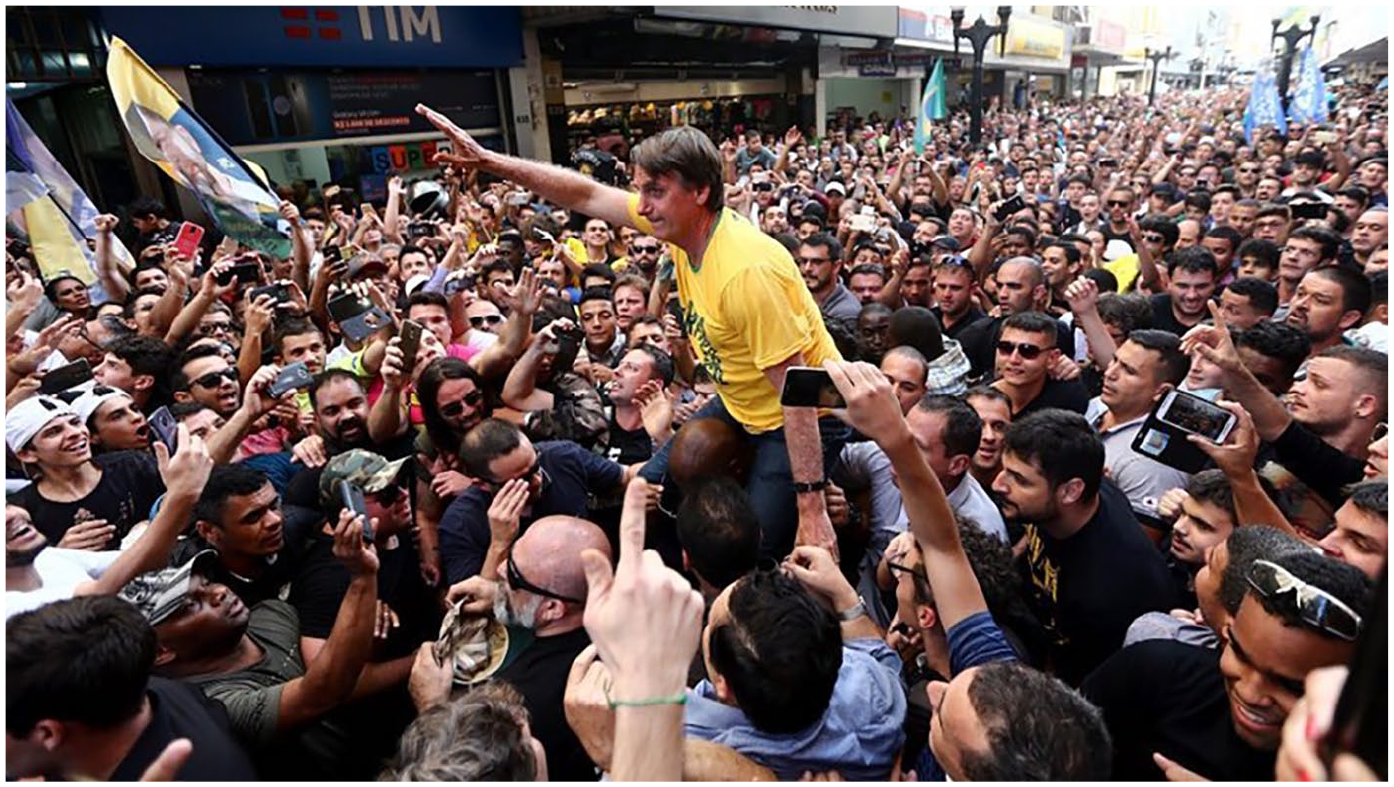
Published on November 4, 2018. Available at: https://www.instagram.com/p/BpxFDmhAvVm/?igshid=m1ixk9k6wjum (accessed December 12, 2019).
Such masculinity is also reinforced by images in which Bolsonaro emerges surrounded by women, as a sort of “ladies’ man.” Presenting himself as a contemporary idealization of love and desire between heterosexual couples, Bolsonaro attempts to show that he is not hated by women, countering claims by the #EleNão movement. 3
Figure 2 shows Bolsonaro at breakfast, displaying his astonishing ordinariness. First, one is drawn to Bolsonaro’s replica football jersey. 4 This detail offers a transgressive effect, placing the Brazilian president in the condition of someone who rejects traditional social class standards. This class transgression is reinforced with the realization that he refuses to use plates, napkins, or placemats. The food itself is overwhelmingly simple: ordinary bread rolls with sweetened condensed milk, poured directly from the can. Meanwhile, Bolsonaro scrolls on his plugged-in phone, facing a round of common national cheese with a knife stuck to the top. Nothing could be more ordinary, yet the accumulation of commonplace elements adds oddity and eccentricity to the picture.

Published on October 19, 2018. Available at: https://www.instagram.com/p/BpHLNk_nZtV/?igshid=1b1yxcpyxon4k (accessed December 12, 2019.
These images evoke how Bolsonaro’s body mirrors the people through an excess of masculine stereotypes. He is a man that rises from, and with, other men; he is an object of desire for women; and he has no concern for social dress codes or table manners. Bolsonaro seems to update an idealized form of masculinity by making the figure of the underestimated ordinary man, who, though he is dressed down and fails to reach high social standards, retrieves the stereotype of desirability by bringing masculinity and authority down to an attainable level, all the while campaigning as a member of the upper class.
Creating Distance
Second, through signs of vigor and physical power, mostly derived from his military trajectory, Bolsonaro distinguishes himself from everyday citizens. Figure 3 shows Bolsonaro wearing a suit, standing in a shooting position with an Israeli rifle. Notwithstanding the gun’s sufficient allusion to power, Bolsonaro breaks expectations in this case by wearing formal attire, without protection or security assets (e.g., a rifle strap and ear muffs). His image here is one of ambidexterity: It is, simultaneously, that of the well-trained military man who can perform power in a natural way and transition seamlessly to the civil world, and that of the civilian man who can transition effortlessly to the military world. The image shows the naturalized expression of vigorous masculinity. Once again, through his eccentricity, Bolsonaro is able to bring elements of ordinariness into an extraordinary situation, which simultaneously approaches and distances him from everyday civilians.

Published on April 1, 2019. Available at: https://www.instagram.com/p/BvuPtuGnSdN/?igshid=17upmdw7swiy9 (accessed December 12, 2019).
His image at the hospital (Figure 4) reinforces this paradoxical form of representation. While his body’s vulnerability is at stake, there is still power in having survived a serious knife attack. By exhibiting the bodily consequences of the attack and presenting himself as a survivor who will soon again thrive, Bolsonaro regains control over violence. The scene, which shows him in direct camera gaze while wearing an oxygen cord, expresses resilience. Just like any other person, Bolsonaro is vulnerable; unlike the common folk, however, the “wounded soldier” survives his attack and moves forward.

Published on September 16, 2018. Available at: https://www.instagram.com/p/BnzF5_tncUG/?igshid=15jm39ye8a2ze (accessed December 12, 2019).
Power Appropriation
Finally, we focus on images in which Bolsonaro is shown performing his presidential duties in what appears to be a surprisingly unprofessional way. Remarkable here is the reiterated carelessness and amateurism in his appropriation of power, which constitutes an eccentric form of naiveté as one of his most prominent signatures. Performing the behavior of a character who unintentionally fails to act seriously while simultaneously displaying strong, earnest emotions, Bolsonaro becomes an illustration of the naïve camp as described by Sontag (1964), that is, he presents himself as a potent mixture of exaggeration and playfulness, which allows him to fiercely appropriate an image of political formidability while still appearing innocent and sincere.
In Figure 5, we see Bolsonaro wearing a football jersey again. This time, however, he is at a meeting, discussing state affairs with official counterparts as the President of Brazil. His body dramatically stands out, producing a quirky and ridicule effect, as the soccer jersey contrasts with all the other elements (the people, table, documents, and conference room) that stand for a high degree of institutional seriousness. The ridicule theme is enhanced as the people in the room seem indifferent or oblivious to such an incompatible contrast.
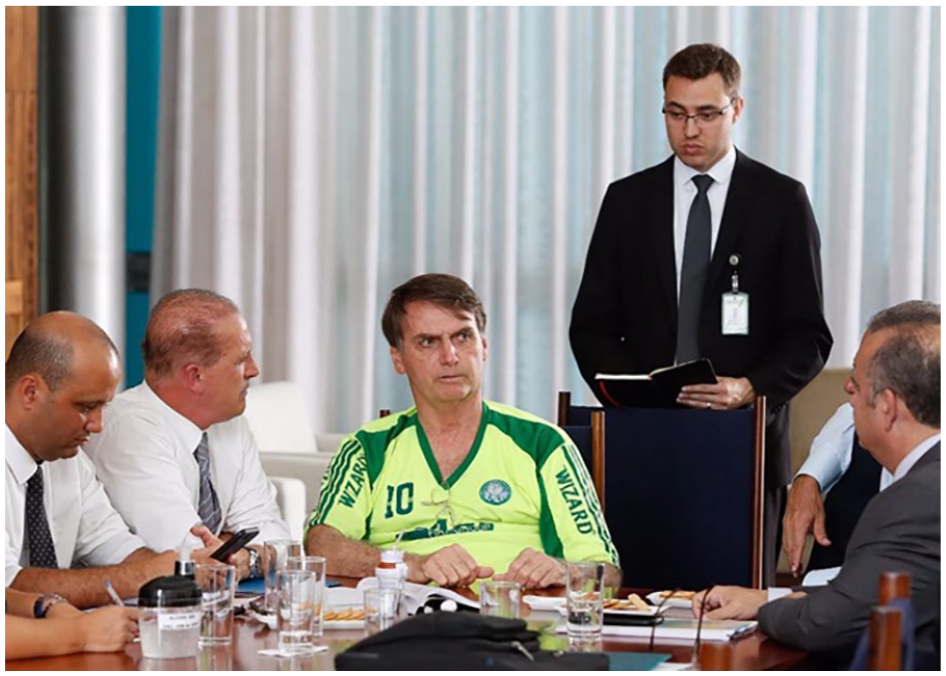
Published on February 14, 2019. Available at: https://www.instagram.com/p/Bt4Dz-jnv2-/?igshid=ofpukpyffgoy (accessed December 12, 2019).
Figure 6 shows a semi-naked body underneath hospital sheets, signing documents. He does so, noticeably, with an ordinary blue ballpoint pen, a preference he often addresses explicitly. The officer’s clothing, his serious facial expression, and the very act of signing official documents contrast with his body exposition. In this picture, Bolsonaro becomes the embodiment of the motto, “the emperor has no clothes.” He performs his presidential duties unbothered by his own nudity and vulnerability, which adds a sense of drama and humor to the image and, consequently, to the presidential function itself. Bolsonaro seems to appropriate institutional power without an embodiment of the presidential habitus (Bourdieu 1979), that is, his body appears disinvested of the symbolic aura of the institution.

Published on January 31, 2019. Available at: https://www.instagram.com/p/BtT-lZ5HfPx/?igshid=7p4e3jlc4o9k (accessed December 12, 2019).
Finally, Figure 7 depicts Bolsonaro holding a press conference in his garage. In front of him, sustaining the audio recording equipment, stands a blue and green beach bodyboard precariously balanced on a kludge. Between him and the equipment, a barrier has been erected with what seems to be traffic poles. The improvised airs of this scenario create an ambiguity that allows the image to be read both as a mockery of establishment media and simply, once again, as a reiteration of Bolsonaro’s self-built eccentric naiveté. Bolsonaro presents himself as if he were an ordinary man making due as best he can with the resources available to him, who, perhaps by chance, has just become president. As in a parody, Bolsonaro again makes two contradictory visual statements coexist in a single scene, appealing to both dramatic seriousness and extreme playfulness.
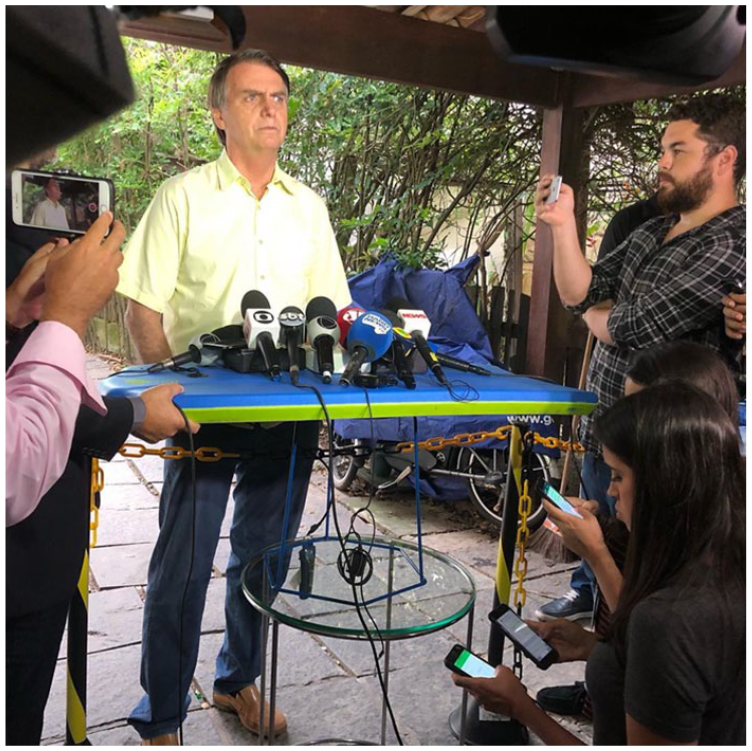
Published on November 1, 2018. Available at: https://www.instagram.com/p/BppxhOPgUPl/?igshid=ix37nvb97aco (accessed December 12, 2019).
In a global sense, each of these images reinforces the theme of distancing from the institutions of government that Bolsonaro seeks to control. In a double move, Bolsonaro concurrently distances himself from the traditional structures and trappings of power while bringing ordinariness to their very heart. By presenting himself in close proximity to established power but not as a constituent element of it, he ends up achieving distance: from the people, as an exceptional figure, and from political institutions, as a noninstitutional performer. Through his lack of extraordinariness, he becomes even more extraordinary, and by emptying the presidency of its rituals, he reinstitutes an aura of exception and singularity both to the institution and to himself.
Because Bolsonaro presents himself as an extremely eccentric and ordinary man, he establishes enough degrees of freedom from conventional political performance to distance himself from the people and from the state while continuing to identify with both. He presents himself as the one individual who is able to truly refuse hierarchical authority at its kernel, paradoxically using that proposal to justify his own interest in occupying the presidency. Transgressively, Bolsonaro invites the people to laugh at the presidency with him as he enacts the role of the president in a carnivalesque way, thus giving new meaning to the authority of the office through the denial of its standard forms.
This is where his performance becomes its most vertiginous and attuned to the populist context. Bolsonaro’s parody is nothing less than a resignification of the abjection toward authority, performed through an exaggerated and comic repetition of its most “grotesque” aspects, which results in an extraordinary displacement of rejection while still maintaining the uneven aspects of the same structure. Bolsonaro is able to sell his representation of the claims for anti-elitism or more horizontal forms of power precisely as he distances himself from the people by embodying their most ordinary traces, reminding them that their own ordinary lives can, and do, carry a trace of extraordinary charisma or glamour (which only he can wield).
Discussion
Using the lenses of parody and performance, this article has presented a qualitative analysis of the visual self-representation of Jair Bolsonaro from images shared on his Instagram profile. Acknowledging the centrality of images in politics and highlighting their growing importance in times of communicative abundance, we have highlighted the capacity of visuals to shed light on the performative dimension of neopopulism. Borrowing from Casullo’s recent work, we have examined Bolsonaro’s Instagram imagery as a form of political performance that seeks to resonate with audiences within the popular context of rejecting institutional sanctity and hierarchical forms of representation. Bolsonaro’s ordinariness mirrors that of the people’s, building extraordinariness through the way in which he appropriates symbols and representations of power.
Bolsonaro’s eccentric performance functions as a parody, capable of embodying excess. In the case of his visual self-representation, the excess is produced in the political context of denying hierarchy and authority. His body overcomes the figure of the leader’s authority by bringing the most ordinary and mundane circumstances to the presidency. His denial of hierarchy triggers the possibility of simultaneous rejection of and identification with authority. Ultimately, this means Bolsonaro does not obliterate power structures. Rather, his performance is an ironic way of repeating power relations, albeit in a displaced fashion. His self-representations on Instagram illustrate how the context of political crisis and quest for horizontality open opportunities for forms of representation that embody parody, or mimicry through hyperbole, rather than pastiche, which is an assemblage of hodgepodge. 5 Though seemingly amateurish, Bolsonaro’s self-portrayals are quite strategic.
In its ambivalence, parody effectively produces a feeling of participation and empowerment in subjects who bear witness to the hyperbolic staging of the scene, as they are themselves part of the enacted transgression of the joke. Nonetheless, in this very movement, the parody also manages to conceal the power structures that sustain the individual who embodies the main role in the scene, pointing to the ambivalence of the grotesque portrayal—a style that remains noncommittal to overt and traditional forms of power all the while seeking it. The ambiguous humor stimulated by the parody, which is often performed with a defiant or portentous subtext, simultaneously challenges and revives the fear that people may feel in the face of the leader.
While exploratory, the findings presented here help to illuminate the ironic appeal and current strengthening of populism. Besides the verbal statements that establish allegedly people-centric and anti-elitist goals, populist leaders need to trigger emotions and find resonance with the context from which they emerge. As we have attempted to show, visual portrayals on social media can play an important role in this process, creating a scene and presenting a body that can speak to social fears and desires. Through Instagram, Bolsonaro displays a self-image that emphasizes his ordinariness and deconstructs institutional rituals. In parodying the presidency through his ordinariness, he paradoxically creates a new form of distance. As the result of this parody, “The Myth” (as his supporters name him) reinstitutes the distance necessary for the rise of a populist leader.
Footnotes
Acknowledgements
An earlier version of this article was presented in seminars at the University of California San Diego (UCSD), at the University of California Irvine (UCI), at San Diego State University (SDSU) and at the Brazilian National Institute for Digital Democracy (INCT.DD). We are thankful to the participants of these events, particularly to Daniel Hallin, Russell Dalton, Eneida Desiree Salgado, Emerson Gabardo, Robert Nyenhuis, Janaina Maudonnet, Scott Desposato, Cristiane Batista, Wilson Gomes, Camilo Aggio, Tatiana Aneas, João Senna and Fabiano Santos. We are also grateful to Luiza Caetano, Thays Prado, Simone Chambers, Erik Bucy, Clara Ratton, Ângela Marques and to the anonymous reviewers of IJPP. The article was developed under the Project “Deliberative Democracy in the Face of Democratic Crisis,” which was partially funded by the Coordenação de Aperfeiçoamento de Pessoal de Nível Superior—Brasil (CAPES)—Finance Code 001 and 88887.370393/2019-00. It also benefited from funding from CNPq (423218/2018-2 and 305813/2017-0), Fulbright, and Fapemig.
Declaration of Conflicting Interests
The author(s) declared no potential conflicts of interest with respect to the research, authorship, and/or publication of this article.
Funding
The author(s) declared the following potential conflicts of interest with respect to the research, authorship, and/or publication of this article: Coordenação de Aperfeiçoamento de Pessoal de Nível Superior (CAPES) (Finance Code 001 and 88887.370393/2019-00); Conselho Nacional de Desenvolvimento Científico e Tecnológico (CNPq) (423218/2018-2 and 305813/2017-0); Fulbright; and Fapemig.
