



Abstract
A certain social-political geography recurs across European and North American societies: As post-industrialization and mechanization of agriculture have disrupted economies, rural and nonmetropolitan areas are aging and declining in population, leading to widening political and cultural gaps between metropolitan and rural communities. Yet political communication research tends to focus on national or cross-national levels, often emphasizing networked digital media and an implicitly global information order. We contend that geographic place still provides a powerful grounding for individuals’ lifeworld experiences, identities, and orientations to political communications and politics. Focusing on the U.S. state of Wisconsin, and presenting data gathered in 2018, this study demonstrates significant, though often small, differences between geographic locations in terms of their patterns of media consumption, political talk, and anti-elite attitudes. Importantly, television news continues to play a major role in citizens’ repertoires across locations, suggesting we must continue to pay attention to this broadcast medium. Residents of more metropolitan communities consume significantly more national and international news from prestige sources such as the New York Times, and their talk networks are more cleanly sorted by partisanship. Running against common stereotypes of news media use, residents of small towns and rural areas consume no more conservative media than other citizens, even without controlling for partisanship. Our theoretical model and empirical results call for further attention to the intersections of place and politics in understanding news consumption behaviors and the meanings citizens draw from media content.
Introduction
It is well known that political differences between citizens living in different types of geographic areas have widened in recent decades, with residents of rural areas now politically quite distinct from their urban fellow citizens in many countries of the West (Foa and Wilmot 2019; Hopkins 2017). This is colorfully illustrated in the United States, where the “red” and “blue” color of states on American electoral maps are in fact reflections of differences at smaller scales—those of counties and even smaller municipalities, with population centers distinctly blue, rural areas much redder, and suburbs a complex mix.
Such political divides are accentuated by discourses that explicitly call attention to them, such as the “rural consciousness” described by Cramer (2016) and heartland populism invoked by conservative politicians and media (Peck 2019). Both highlight differences between rural communities and urban centers and the purported disdain felt by the latter for the former. As a primary axis of growing political difference and discussion, geography is thus an important component of contemporary democratic crisis and polarization.
Yet despite the apparent magnitude of this divide, the field of communication has little explored the communication dynamics that may shape it or result from it (Friedland 2001; Usher 2019): We know surprisingly little about how the media use of residents from different kinds of communities vary, or how their patterns of talk about politics differ, or to what extent these dynamics figure in oft-noted differences of public opinion (though see Heikkilä et al. 2020).
Our overarching question concerns how citizens’ perceptions of the world around them develop as a result of the combination and intersection of (1) their embeddedness in specific localities and (2) their choices and interpretations of mediated communication. In what follows, we collect much of what is known about political communication patterns across lines of socio-geography; offer a framework for analyzing socio-geographic differences in communication; and present a study of citizens’ media repertoires, talk networks, and opinion on an issue of high relevance to contemporary discussions of politics: anti-elite attitudes.
A Note on Terminology
Two important dimensions of variation are widely recognized in studies of political geography (McKee and Teigen 2009), and we adopt their terminology here: The word “region” is used to denote geographic areas that are geographically contiguous and share notable cultural, economic, political, or historical affinity (e.g., the American South, Germany’s Saxony).
“Location,” on the other hand, refers to characteristics of a particular area that may be shared with other, noncontiguous, areas. It is often operationalized as population density, but density is quite a rough measure of location, and we modify it in our operationalizations below. In what follows, we use “location” to refer to different types of communities in our study, from large metropolitan areas to smaller outstate cities, to rural communities.
Research Context
The context for our study is the U.S. state of Wisconsin, a setting that may appear narrow but offers several advantages. First, there is analytic leverage in a geographically constrained study. Focusing on a subregional area allows us to largely remove regional variation from our study and allows us to concentrate on differences across location. Second, focusing our sample within Wisconsin improves our sampling across different types of communities, categorized at the zip code level—a level of granularity well suited to our research questions. Finally, despite the inherent uniqueness of any given context, in many ways Wisconsin mirrors larger polities in Europe and the United States: It contains overwhelmingly white communities in rural areas and small towns, a large, relatively diverse city (Milwaukee), a medium-sized capitol and university city (Madison) and diversifying suburbs; and it has experienced the disruptions of post-industrialization, including a steady decline in manufacturing and the depopulation of rural areas and small towns as younger generations have sought opportunities in metropolitan areas (Cramer 2016).
“Rural-Urban” Divides in Western Politics
The scarcity of research programs focused on political differentiation by geography stand in contrast to widening divisions. In the United States, Hopkins (2017) describes this trend as accelerating in the past several decades; Foa and Wilmot (2019) describe similar dynamics at work in several European countries. In the United States, Britain, Australia, and Canada in particular, the vote share of left-leaning parties has become increasingly concentrated in locations of greater population density—from global metropolises to the county seats of otherwise rural regions (Rodden 2019).
Cramer’s (2016) The Politics of Resentment makes clear that geographic categories have also become potent signifiers in citizens’ perceptions of politics. She demonstrates that many rural residents hold a worldview, “rural consciousness,” that understands politics as fundamentally a struggle of hard-working, culturally conservative (and implicitly white) rural Wisconsinites against political and cultural urban elites with more lax values and little interest or concern for rural communities’ well-being. And she shows how perceptions related to rural consciousness connect to a range of political, social, and cultural values, attitudes, and opinions.
Complicating the Rural-Urban Divide
Despite its importance, the urban-rural divide is also an oversimplification. Place is both a physical reality and a social construct, with political dynamics of the past reverberating today (Lichter and Ziliak 2017; Rodden 2019). And there is significant diversity within any broad category social scientists might define (Scala et al. 2015).
The presence of locations between urban and rural is one confounder of a binary urban-rural view. Suburbs are spatially situated between urban and rural areas, but politically their role is often more complex: in the United States, suburbs emerged as predominantly Republican—more so than many rural areas, especially those in the South. And early suburbanites brought with them attitudes that looked on cities with skepticism if not hostility (Hopkins 2017). In recent decades, however, suburbs have diversified, both ethnically and politically, if unevenly (Hopkins 2019).
Small cities represent another unique geographic formation. Data from recent presidential election voting make clear that most American cities tend to produce highly similar patterns of residential partisanship, with even very small cities typically having a Democrat-leaning core surrounded by Republican outer areas (Rodden 2019).
The origins of geographic political difference have been explored from several angles. The relatively more conservative/traditionalist attitudes of rural residents, combined with the politicization of those issues by the major political parties beginning in the 1980s has been documented (Hopkins 2017). The evolution of the knowledge economy and the increasing concentration of high-paying jobs and GDP production in large urban centers (Moretti 2013) are also important, and have been magnified in the years since the Great Recession. That urban centers attract knowledge workers with growing economic cachet and culturally cosmopolitan values (Rodden 2019) is consistent with findings that psychological dispositional differences may lead some of the most ambitious, educated, and independent residents away from rural areas in search of new opportunities (Jokela 2009). And growing rates of mental and physical health distress in less urban areas are also important to note (Monnat and Brown 2017). As we see below, however, neither the differential repertoires of communication media use that may accompany these political-cultural differences, nor the role communication media may play in differentially shaping the views of residents of different types of communities, are well known.
Communication Patterns across Geography
Like cognate fields of social psychology and public opinion research, a great part of the communication field has embraced an individual-centered model of media exposure. Although we reside within communities with physical boundaries, social institutions, and public goods, we tend to think of media exposure as something that happens to individuals with individual characteristics, needs, and desires (but see Ball-Rokeach et al. 2001; Friedland 2001).
It is fair to say that the “network society” perspectives that have become influential in recent decades (e.g., Castells 2010; Rainie and Wellman 2012) have further drawn our field’s attention away from geographic place and into the “space of flows” in which social media are presumed to operate. Note, however, that contrary to the tenor of many references to his work, Castells (2010) is quite explicit that most citizens live not in the space of flows: “people make their living in the space of places” (p. xxix.). And as Wellman’s most recent work shows, even the most networked individuals describe using digital media primarily to connect to people with place- or kin-based affiliations (Wellman et al. 2020: 302–305).
Our field also has built knowledge about variation in the provision of public information across place. The formation of news deserts is well documented and traced to declining newspaper availability, concentrating local broadcast ownership, and changing cable news penetration (Napoli et al. 2017). These information gaps have been amplified by structural, educational, and economic barriers to broadband Internet access and smart phone technology (Correa and Pavez 2016). Such difference in accessibility has societal consequences; access to radio (Strömberg 2004), television (Prior 2007), newspapers (Darr et al. 2018), and broadband Internet (Trussler 2020) have all been shown to influence voter and communication behavior.
The notion of communication processes detached from place also defies years of tradition in which newsmaking was practiced—and branded—in local communities (Usher 2019). Local editors imagine communities of niche readers toward whom they align coverage (Beetham 2006). It is not surprising, then, that the few studies that have seriously explored geographic location have shown differential communication effects: Beaudoin and Thorson (2004) found that relationships between mass media use and social capital production and pro-social behaviors differed between rural and urban communities.
Despite this work, Althaus et al. (2009) note, “contextual factors that might condition individual news consumption choices have been neglected almost entirely in studies of individual-level news exposure” (p. 250). Rather, communication scholars have examined how mass-mediated and interpersonal communication intersect with contextual characteristics to shape political discussion and participation (Paek et al. 2005; Shah et al. 2001), but have paid limited attention to contextual effects on patterns of media consumption.
Location also impacts interpersonal communication networks, with individuals mapping their ideological distance from others and adjusting interactions depending on local network homophily (Baldassarri and Bearman 2007). Huckfeldt and colleagues (2004) note that geography is relevant to the construction of a network of social contacts, but not the only determinant; social space and physical space are not coterminous, given that “social space is defined in terms of the communication network within which an individual is embedded” (p. 49).
Here sociology offers some helpful pointers, showing that different locations’ features vary in their tendency to induce choice homophily (the ability of individuals to choose similar others), while others constrain possibilities for friendship choice (McPherson et al. 1987). Existing work suggests that dense urban locales offer greater choice, and thereby generally more homophilous networks, than small rural communities (Fischer 1982; Macgregor 2013).
Social media, meanwhile, are often thought of as tools of the networked individual par excellence. But our field’s rhetoric tends to overlook the extent to which the actual networks that make up individual’s social media contacts are defined by physical proximity and family. Friends on Facebook, by far the platform most used by Americans, are largely accretions of people from the places we have inhabited: high school, college (for those who attend), work, community, family. While early studies documenting these structures (e.g. Hampton et al. 2011) are clearly in need of replication, contemporary work by Wellman et al. (2020) suggests this pattern persists. In this sense, Facebook networks transcend time, not space.
Finding Place in Twenty-First-Century Communication
In the context of powerful political-geographic divisions within Western societies, we are interested in how location and communication dynamics intersect to shape the sense citizens make of their political circumstances. We approach this problem theoretically by adapting a broadened understanding of the framework of opinion formation, anchored in the phenomenological concept of lifeworld, developed by Schutz ([1973] 1989) and extended by Habermas (1985). More recently, the concept has been reintroduced into communication studies by Couldry and Hepp (2016), who argue that the lifeworld (the social world that anchors experience) is constructed through media, that is to say, “mediatized.” The social world is changed because it is “sustained in and through media and their infrastructures” (p. 15), although they stress that this varies geographically. For us, to render the concept more empirically useful it is necessary to start with local context and the anchoring in the social. More specifically, we argue that geographic locality, social location, and forms of communication intersect in ways that communication scholars have not sufficiently theorized or measured.
Our working model places individuals’ lifeworlds at the center of a series of concentric circles (Figure 1). The immediate impressions an individual forms of her/his world are shaped by everyday experiences: the conditions of life, whether of deprivation or abundance; the occupations and attitudes of the people around him or her; and physical surroundings, including conditions of storefronts, schools, public, and private spaces. In a second layer, individuals’ social and talk networks—including most social media networks—are largely tied to this localized area, and those networks in turn greatly shape the flow of political communication in and through social groups (Huckfeldt et al. 2004; Katz and Lazarsfeld 1955). Such networks are critical in producing the meaning that people perceive in their local communities and the depictions of the wider world that reach them via media (Ball-Rokeach et al. 2001; Cramer 2016; Strauss 2012).
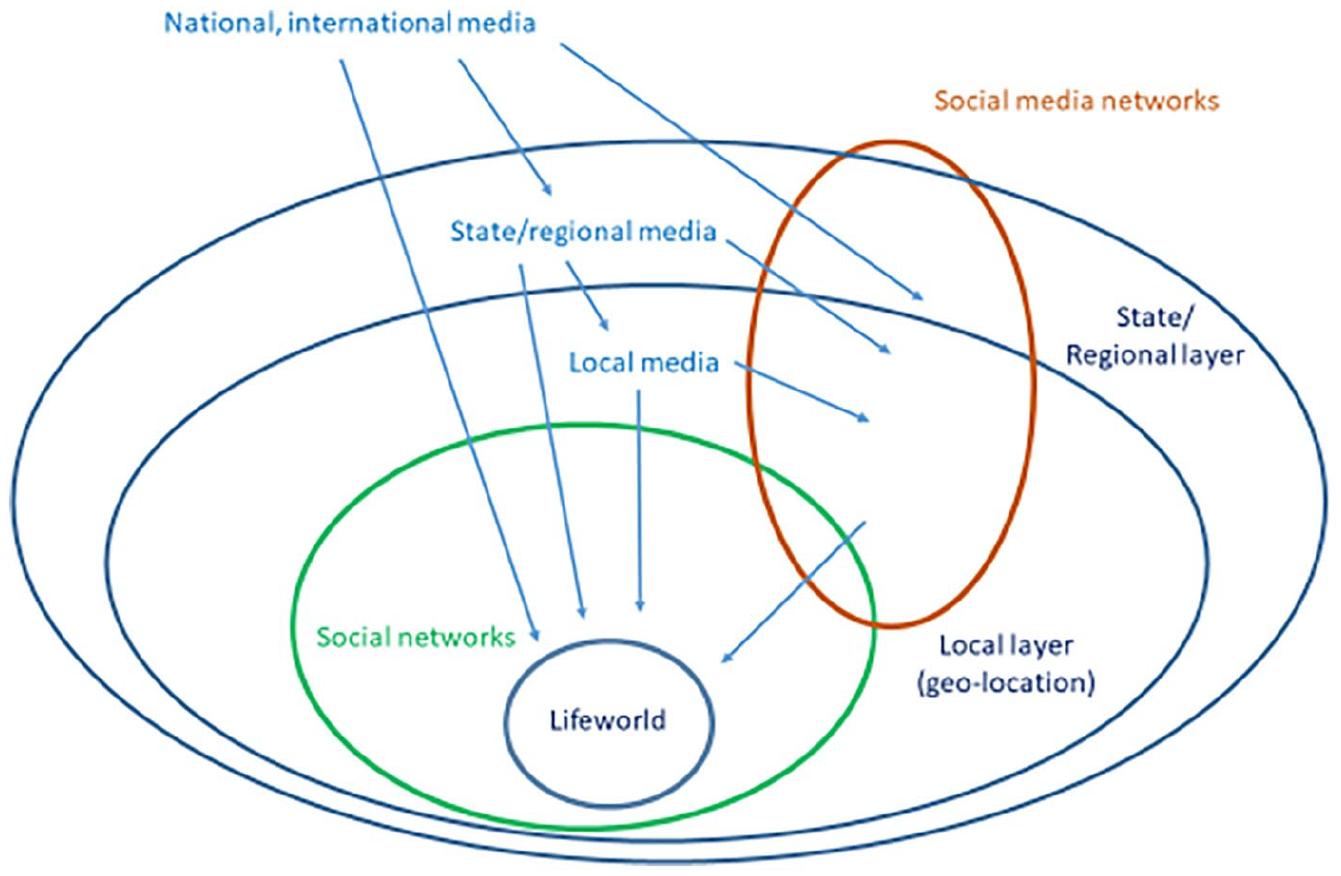
Framework for integrating geographic place, talk networks, and media use in the lifeworld experience of citizens.
Mediated portrayals of social-political reality beyond the individual’s direct experience and social networks can be thought of as further concentric circles, with sources of local, national, and international media often reaching consumers directly through their choice to consume them (represented with arrows in Figure 1). But as just noted, those media consumption choices are themselves embedded in social contexts that predispose individuals to uses of certain media.
The social media age adds a further layer of complication. Now, news content from myriad sources reach citizens through any of a variety of channels, which may reflect personal selection, sharing on the part of social contacts, the targeting of algorithms or other processes (Anspach 2017; Thorson and Wells 2016). To reflect this complexity but also the rootedness of social media networks in local geography, in Figure 1 social media networks appear as an oblong shape, reaching from the ego’s own geo-location to the national and international space, and serving as a potential intermediary for content from all levels of media.
Research Questions
Taking geographic location as the focal dimension of lifeworld variation, we seek to answer research questions related to how communication uses and effects vary by geographic location. We proceed in three steps, examining respondents’ talk networks, media use, and attitudes about political elites.
First, drawing on the discussion above, we anticipate that residents of different locations may vary in the political diversity of their talk networks, owing chiefly to the way population density leads residents to be more or less siloed in enclaves of political homophily (Fischer 1982):
Second, our model implies several reasons to expect media repertoires to vary across geographic location. We know that individuals have a tendency to select media that affirm their worldviews (Stroud 2011) and that such worldviews vary along lines of socio-geography (Hopkins 2017). It follows that media options catering to different worldviews (e.g., Peck 2019) should be differentially popular across geographic locations. We know of little existing research on this point, but Heikkilä and colleagues (2020) did show that Finland is seeing a widening of differences of media repertoire along by socio-political lines: They particularly note that consumers of a limited, “narrow” repertoire of media are distinctly less urban and less socio-culturally advantaged than citizens with wider and diverse media diets.
Another reason to anticipate this sort of variation is that, as our model implies, media choices themselves are socially embedded such that one’s likelihood of consuming certain content is partly a function of its presence within personal networks, and within geographic contexts more broadly: Given the increasing partisan sorting along the geography, we would expect such contexts to create environments in which certain information flows or resources are more available and better received, thus reinforcing certain media consumption patterns.
Third, accessibility and availability is likely to impact individuals’ media consumption differentially across locations. Broadband access varies significantly, and it is likely to impact citizens’ news diets. This is what Trussler (2020) found, albeit indirectly: The availability of broadband appeared to make online news media relatively more attractive to consumers, with the political consequence that residents of communities with broadband seemed to employ more national considerations in voting in legislative elections. Similarly, differentially declining supply and quality of local news will differentially reduce its availability and attractiveness, with citizens of rural communities likely to be hardest hit (Abernathy 2018; Wahl-Jorgensen 2019).
Finally, as noted above, one of the striking features of contemporary politics is its powerful anti-elite ethos, a critical component of the multinational rise of populism (Foa and Wilmot 2019). We also have some bases for anticipating variation in anti-elitism by location. Cramer (2016) emphasizes the sense among rural Wisconsinites that they are left out of conversations that take place in the halls of power. Results from the 2016 Republican primary confirmed an intraparty divide between residents of southeast Wisconsin, who supported Ted Cruz, the (relatively more) party establishment candidate, and residents of the wider outstate, who broke for Trump. 1 In the Democratic primary, meanwhile, Sanders defeated Clinton in every county except Milwaukee, most by double-digit margins. These results indicate substantial anti-elite sentiment on both sides of the aisle, but varying across place.
Method
Mapping Wisconsin
To categorize geographic locations within Wisconsin, we used the Rural Urban Commuting Area (RUCA) system, which classifies zip codes in terms of proximity to, and commuting relationship with, urban areas and small cities using a 1–10 scale (U.S. Department of Agriculture 2019). Zip codes with high RUCA scores (4–10) we classified as Small Town/Rural. These include very rural areas as well as towns with populations of less than 50,000. Zip codes with RUCA values of 2 and 3 we designated Outstate Suburbs. These areas are not themselves urbanized areas, but have at least 10 percent of primary commuter flow going into such an area. This type of configuration captures the general sense of the idea of suburbs.
We distinguished several unique facets of urbanized areas (where RUCA = 1) of Wisconsin. First, zip codes with an RUCA of 1 lying within the counties of Dane and Milwaukee we designated Madison and Milwaukee, respectively; these are the state’s two major urban areas. Second, any zip code lying primarily within the counties of Washington, Ozaukee, and Waukesha we designated WOW Suburbs. This is a commonly recognized and politically salient band of suburbs surrounding Milwaukee. Any other zip code with a RUCA of 1 we designated Outstate Cities. A map of our zip code classification (Figure 2) indicates that this includes the cities of La Crosse, Eau Claire, Superior, Wausau, Janesville, Kenosha/Racine, and Sheboygan, and the metropolitan corridor of the Fox River Valley.

Wisconsin zip codes represented in our data, categorized by geographic location.
Survey Data
Our individual-level data come from a statewide survey of Wisconsin residents (N = 2,058) conducted between October 26 and November 4, 2018, just prior to the midterm elections. Respondents were recruited as part of an online panel by LHK Partners using a nested quota sampling procedure stratified by age and gender based on Census data from the state, and they completed the survey online. 2
Table 1 presents descriptive statistics for key demographic variables, partisanship, and political interest by geographic location. These measures fall in line with our expectations about differences across the state. It is worth noting that levels of political interest differ significantly, with residents of Small Town/Rural areas following politics substantially less than others, and residents of Outstate Cities relatively low on that measure.
Descriptive Statistics of Demographic Variables, by Geographic Category.
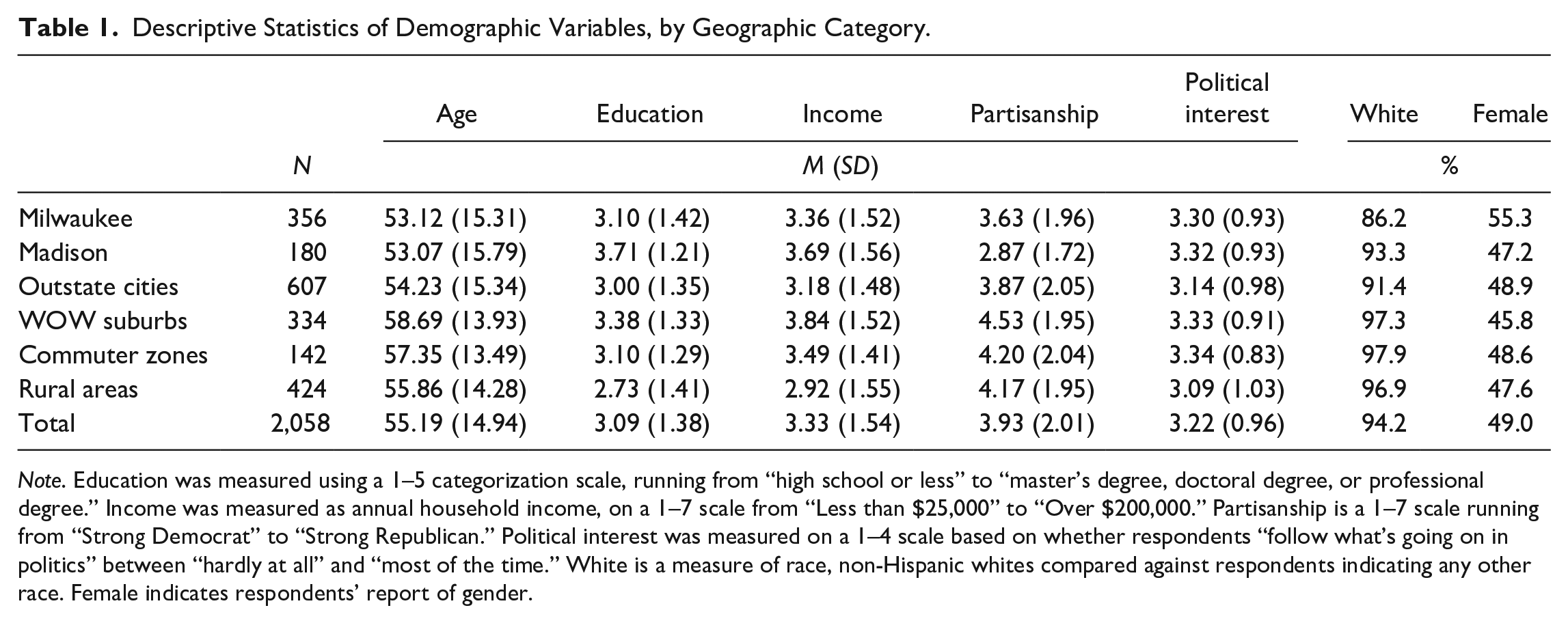
Note. Education was measured using a 1–5 categorization scale, running from “high school or less” to “master’s degree, doctoral degree, or professional degree.” Income was measured as annual household income, on a 1–7 scale from “Less than $25,000” to “Over $200,000.” Partisanship is a 1–7 scale running from “Strong Democrat” to “Strong Republican.” Political interest was measured on a 1–4 scale based on whether respondents “follow what’s going on in politics” between “hardly at all” and “most of the time.” White is a measure of race, non-Hispanic whites compared against respondents indicating any other race. Female indicates respondents’ report of gender.
Talk Networks
We asked respondents about their patterns of political talk by asking them to name close talk partners: “Looking back over the last 6 months, who are the people with whom you discussed matters important to you?” Respondents typed the names or initials of their talk partners and were encouraged to enter up to three people (Huckfeldt and Mendez 2008). Respondents then indicated their estimate of each partner’s political partisanship, from strong Democrat to strong Republican, on a 7-point scale. We summarized the results with two dichotomous measures: whether a respondent had one or more Democrats (defined as being a “Strong Democrat,” “Democrat” or “Independent who leans Democrat”) among the talk partners they named (48.6 percent did), and whether they had one or more Republicans (46.2 percent did).
Media Use
We followed previous approaches of studying media repertoires (Edgerly 2015; Edgerly et al. 2018) in using principal components analysis to guide our exploration of the media use patterns of our respondents. Specifically, we used measures of use of 27 types of media, ranging from a variety of forms of television content to multiple forms of social media. Using a principal components analysis with Varimax rotation, we selected a solution with six factors (the sixth factor had an eigenvalue of .98, but we retained it as it produced a theoretically sensible factor combining the use of Facebook and news aggregators for news). We also disaggregated local newspaper use from the television component it had scaled with, and removed two forms of little-used television entertainment programming.
Each media item was rated by respondents on a 1–5 scale in terms of how often they used each type of media content (“Never” to “Very often”), which were averaged to create the scales:
Television news included the use of local TV news, morning TV news, and evening TV news (M = 2.80, SD = 1.16, Cronbach α = .78).
Local newspaper use was measured with a single item (M = 2.97, SD = 1.42).
Facebook included the use of Facebook and news aggregators such as Google News (M = 2.19, SD = 0.99, r = .283).
Prestige media use included the use of national newspapers, international news, online news, and NPR (M = 1.77, SD = 0.88, Cronbach α = .79).
Centrist/Liberal media use included MSNBC, CNN, TV satire programs and evening television talk shows (M = 1.80, SD = 0.92, Cronbach α = .81).
Conservative media use included Fox News and conservative talk radio (M = 1.67, SD = 0.98, r = .57).
Finally, other social media included use of Instagram, Reddit, Snapchat, YouTube, Twitter, conservative blogs and liberal blogs (M = 1.26, SD = 0.53, Cronbach α = .87).
Anti-Elite Attitudes
In terms of analyzing respondents’ political attitudes, we home in on antipathy toward elites, a particular slice of populism, but one of its fundamental elements. Respondents indicated (1–5 scale, “Strongly disagree” to “Strongly agree”) to what extent they agreed that (1) “politicians should only follow the will of the people”; (2) “people, not politicians, should make our most important policy decisions”; (3) politicians are much more different from “the people” than the people are from one another; (4) “I would rather be represented by a citizen than by a professional politician”; (5) politicians claim to defend the people, but only care for themselves; and (6) “the established elite and politicians have often betrayed the people” (Spruyt et al. 2016; M = 3.64, SD = 0.75, Cronbach α = .82).
Results
Talk Networks
Our analysis begins with respondents’ talk networks, which we conceptualize as being integral to the political dimensions of the lifeworld. We are especially interested in the makeup of those talk networks in terms of political diversity, which we operationalized in two logistic regressions modeling the likelihood of having at least one talk partner who was a Democrat, and at least one partner who was Republican.
The models of political talk diversity are displayed in Tables 2 and 3. In each table, we introduce the variables in steps to allow the reader to compare variables’ coefficients with and without covariates. We wish to convey both aggregate differences, that is, differences that may be attributable to other variables, such as partisanship, but nonetheless reflect the general tenor of communication in a given place, and the independent contribution location makes to outcomes when controlling for other variables. We thus begin with a sparse model considering only age, gender, and place of residence. Table 2 makes clear that before controlling for other factors, residents of Madison and Milwaukee are far more likely to have at least one Democrats among their talk partners (Model 1), making clear that the social-structural makeup of those places parallels the daily talk their residents encounter. The introduction of additional controls (Model 2) changes that picture: Not only being a Democrat oneself (the negative coefficient on Party ID), but education, income, and interest are all important predictors of having a Democratic talk partner. As those controls are entered, the significant coefficients disappear from the community variables.
Logistic Regressions Predicting Likelihood of Having at Least One Close Democratic Talk Partner.
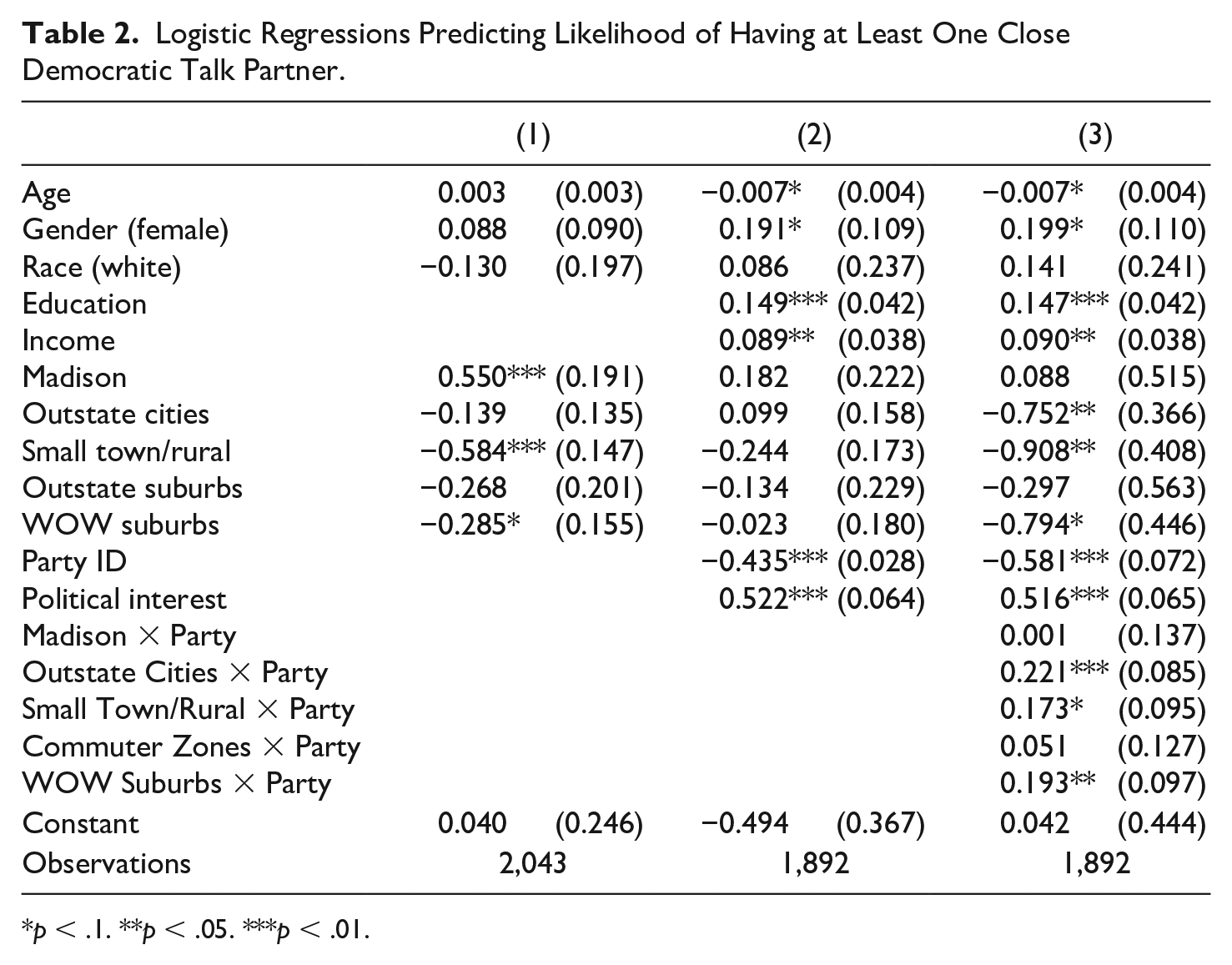
p < .1. **p < .05. ***p < .01.
Logistic Regressions Predicting Likelihood of Having at Least One Close Republican Talk Partner.
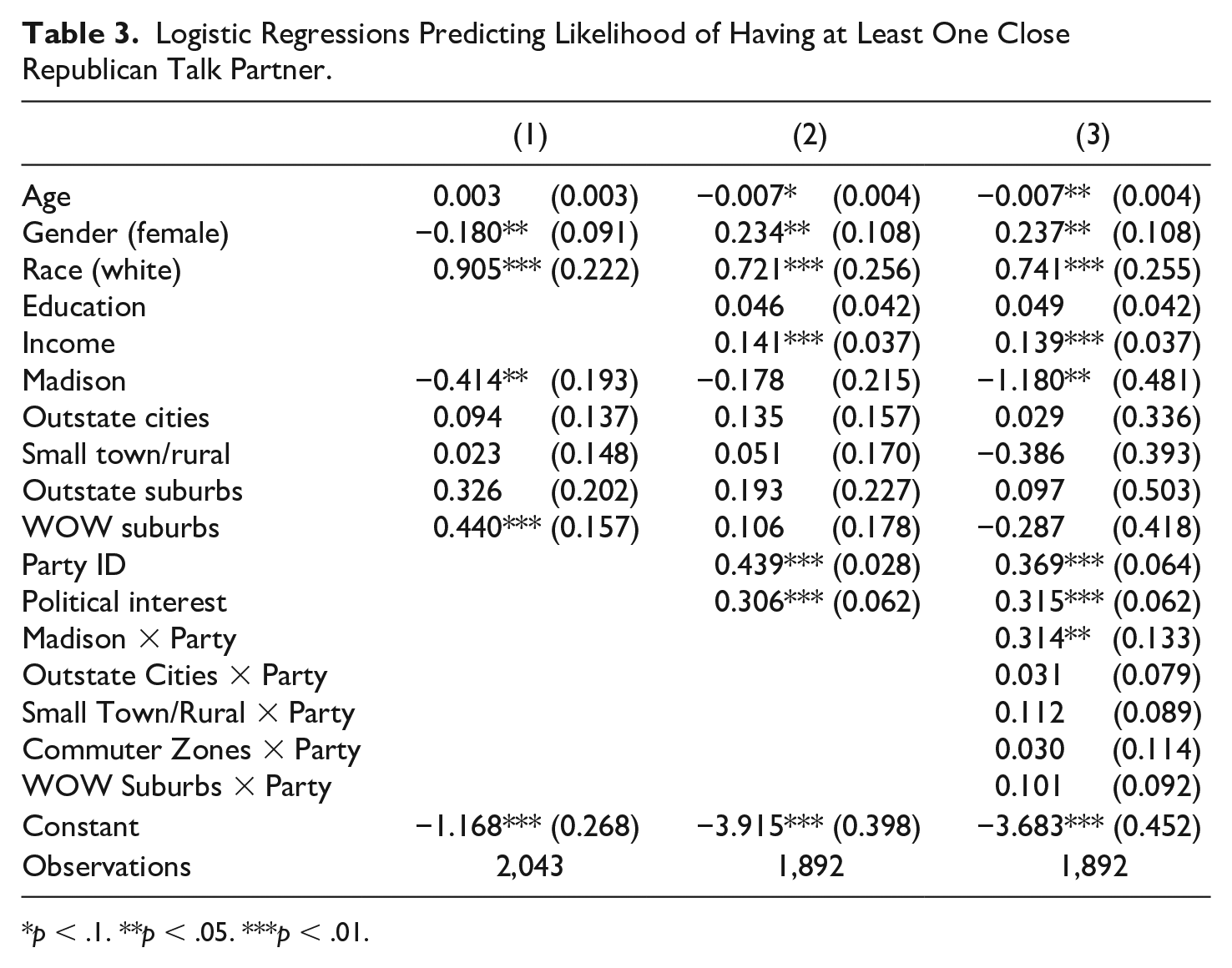
p < .1. **p < .05. ***p < .01.
Another way to think about diversity of talk networks concerns how partisanship’s strength in defining talk networks varies across geographic contexts. We examine this question by introducing interaction terms between Party ID and each of the community types (Model 3). We see three significant coefficients there: Outstate Cities has the strongest, followed by WOW Suburbs and Small Town/Rural areas. Figure 3 displays these results.

Model-predicted likelihood of having a Democratic talk partner, by partisanship and geographic category.
Being more Republican (moving from left to right) is associated with declining likelihood of having a Democratic talk partner, reflecting the powerful main effect of partisanship. What is unequal is the rate at which this drop-off occurs: For residents of Madison, Milwaukee, and Outstate suburbs, this drop-off is most rapid, from the highest levels of likelihood of having a Democratic talk partner at the left of the graph to the very lowest on the right. The lines for Outstate Cities, Small Town/Rural areas and WOW Suburbs cut across this trend, indicating that being more Republican in those places is associated with a slightly lesser decrease in likelihood of talking to a Democrat.
The story for predicting Republican talk partners (Table 3) is nearly the perfect mirror image. Residing in the WOW Suburbs makes a respondent substantially more likely to have a Republican talk partner—as compared with residents of Milwaukee, the reference category; living in Madison makes one less so. In Model 2, once again, partisanship and political interest seize the lion’s share of the variance, leaving geographic type explaining none to a significant degree. The significant interaction term in Table 4 is found on Madison × Partisanship and is graphically displayed in Figure 4.
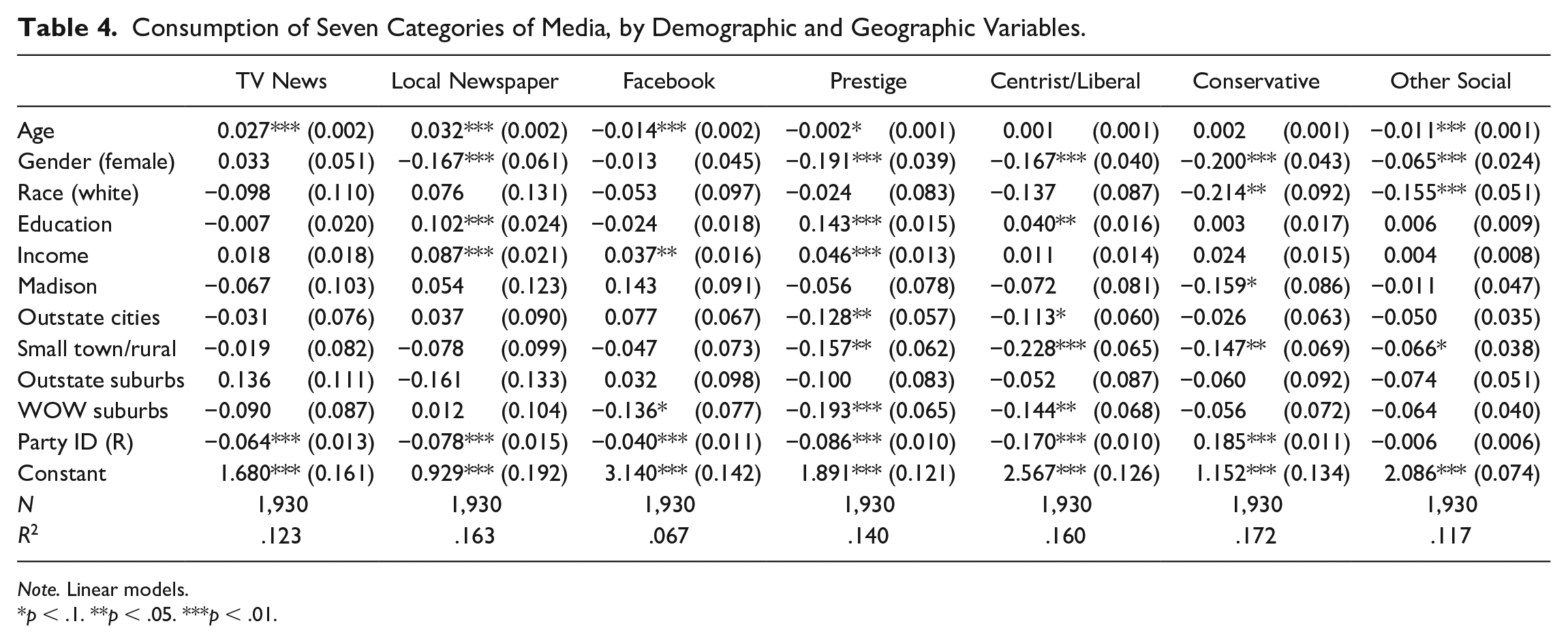
Consumption of Seven Categories of Media, by Demographic and Geographic Variables.
Note. Linear models.
p < .1. **p < .05. ***p < .01.

Model-predicted likelihood of having a Republican talk partner, by partisanship and geographic category.
Once again, it is residents of Madison whose likelihood of talking to a Republican is most fully defined by their partisanship, much more so than residents of other locations. In both Figures 3 and 4, our findings suggest that different geographic locations foster the development of talk networks with greatly differing levels of political diversity.
Media Use
We next turn to respondents’ media use. Once again, we wish to portray both aggregate differences and unique contributions made by geographic variables. Figure 5 displays the mean use of several forms of media, with 95 percent confidence interval, by residents within each category of community. For ease of interpretation, a representative item from each scale is presented. Data are weighted to population parameters on age and gender (per the U.S. Census’ Current Population Survey) for this set of population estimates. Table 4, meanwhile, presents regression models with covariates.
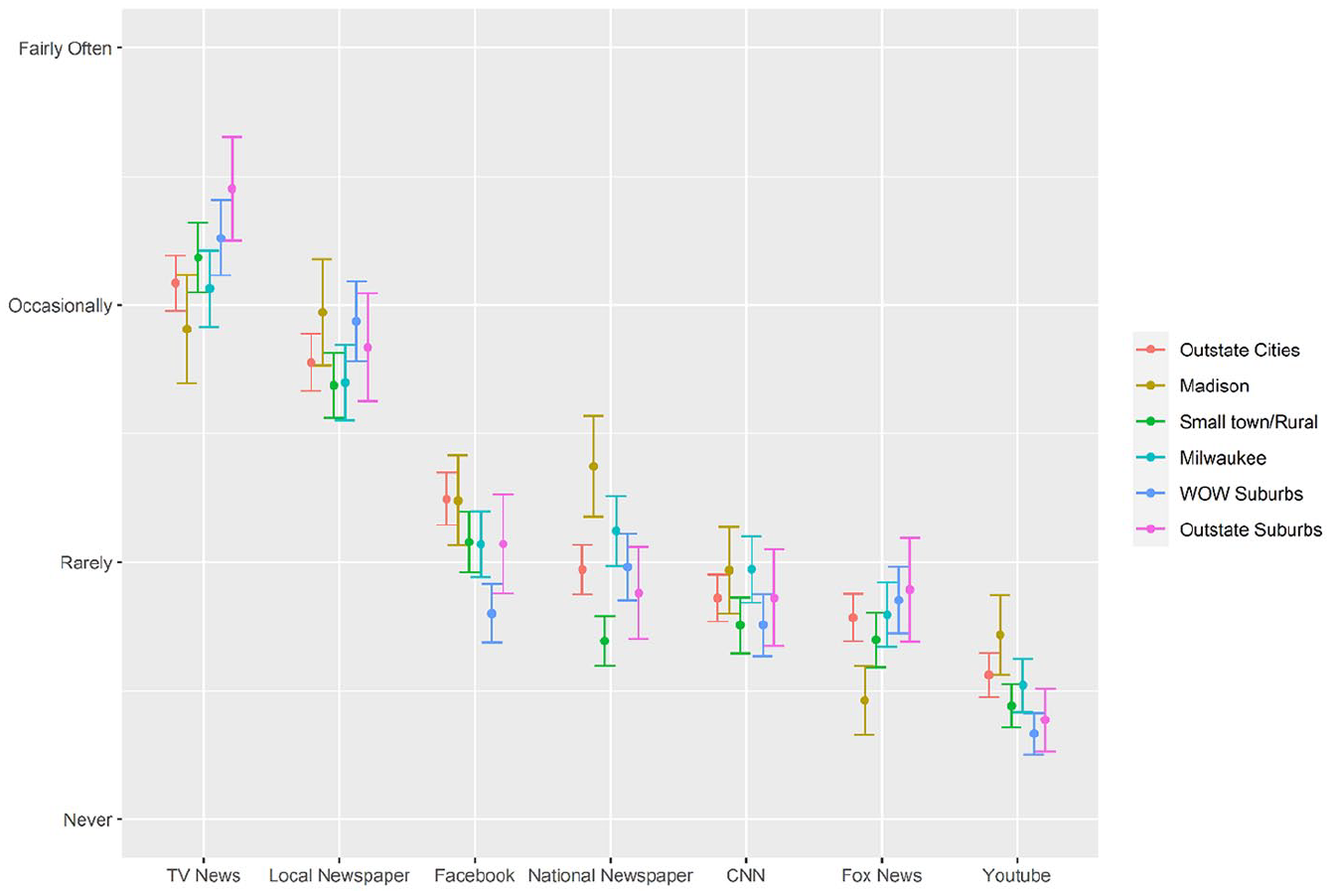
Mean use, with 95 percent confidence intervals, of select media, by location of residence.
Both presentations demonstrate that there is marked similarity in the news media consumption repertoires of residents across the state. Figure 5 makes clear that overall rates of use between media (e.g., local television vs. Fox News) are greater than differences between locations. It also indicates that local television news remains a dominant news source for Wisconsinites. In every type of community but Madison, local TV news was more heavily consumed than any other form of media. This finding is comparable to other surveys of Americans’ news use in 2018 (e.g., Shearer 2018). 3
Keeping this similarity in mind, several differences between locations are worth noting. Residents of Outstate Cities, Small Town/Rural areas, and WOW Suburbs all report lower levels of prestige and Centrist/Liberal media use than residents of our reference category, Milwaukee. (Notably, those same three locations stood out for their relatively lesser political homophily within discussion networks above.) Among small towns and rural areas in particular, we see generally lower levels of news media consumption. This is striking in the case of conservative media, which only residents of Madison consume less than rural citizens. Notably, use of news content on social media did not differ greatly by location when accounting for other variables. Residents of WOW Suburbs reported somewhat less use of news on Facebook and news aggregators, but in general it was being younger, being more wealthy, and being liberal that accounted for variance on that scale.
Anti-Elite Attitudes
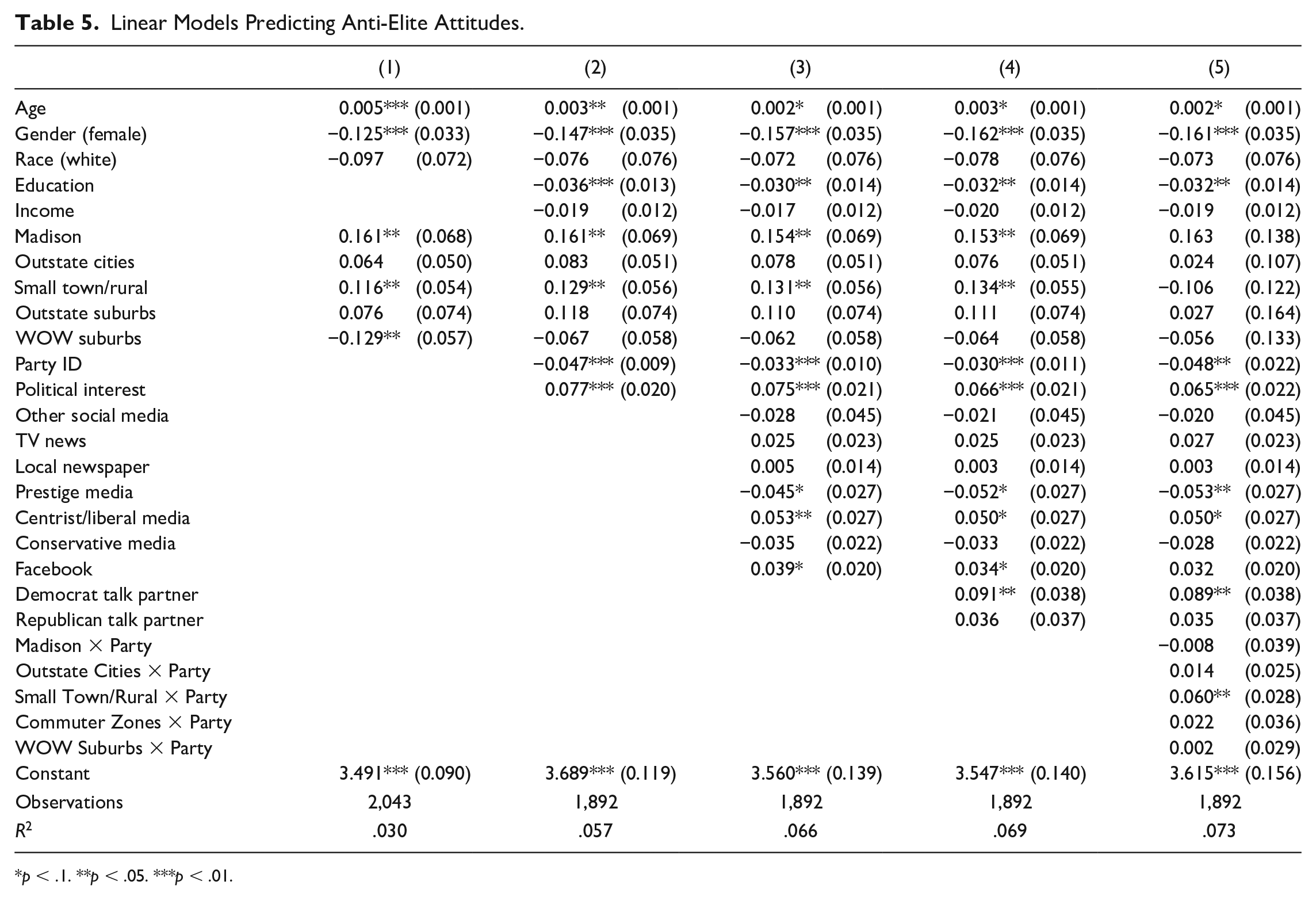
Table 5 displays linear regressions predicting our anti-elitism scale. It is worth noting that anti-elitism is prevalent across all Wisconsin regions, with a mean well above “neutral” on the items. Model 1 indicates a baseline level of anti-elitism in Milwaukee, Outstate Cities and Outstate Suburbs, while residents of WOW Suburbs are significantly lower, perhaps reflective of these counties’ role as the home of establishment Republicanism in the state.
Linear Models Predicting Anti-Elite Attitudes.
p < .1. **p < .05. ***p < .01.
Interestingly, Madison and rural areas, dissimilar in many ways, here share the highest levels of anti-elitism in the state—and coefficients whose significance survives the addition of covariates. Those controls suggest that being more Democratic, consuming more liberal media, and having at least one Democratic talk partner are all associated with higher anti-elitism. These findings run counter to narratives emphasizing the anti-elitism of the political right, and perhaps instead reflect more conventional patterns in American politics, of an establishment Republican party and a more working class-oriented Democratic one (Hopkins 2017).
We can deepen our understanding of these dynamics by again introducing interaction terms between the geographic categories and partisanship (Model 5), yielding a significant interaction between partisanship and rural/small town residence, which we plot in Figure 6.
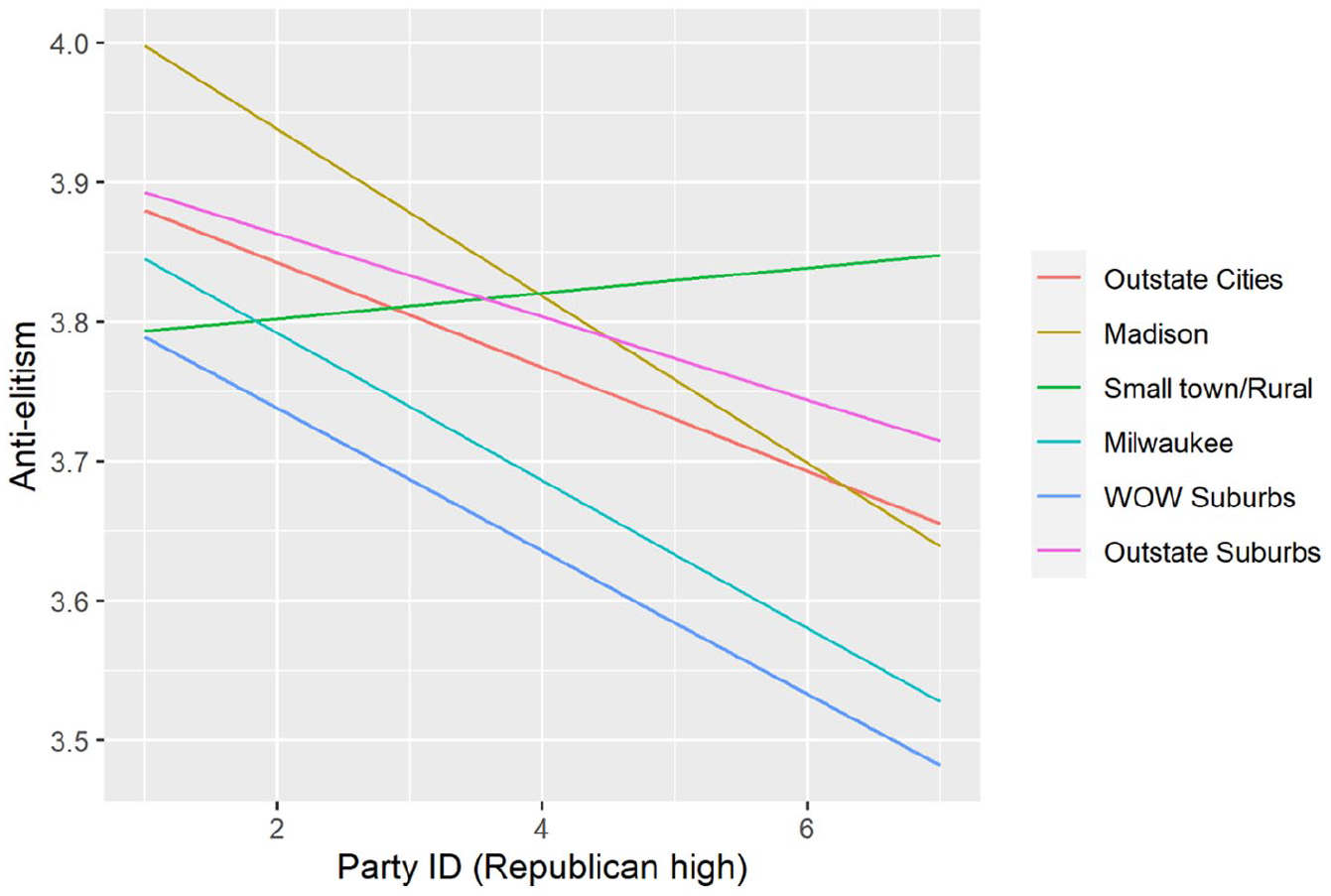
Anti-elite attitudes in terms of Party ID, by geographic category.
The general trend of the figure is from upper left to lower right, indicating that in most communities being more Republican is associated with lower levels of anti-elitism. However, respondents from small towns and rural areas run counter to this pattern. Though Democrats in such areas express anti-elite sentiments roughly in line with citizens in other areas, it is in small towns and rural areas that Republicans are somewhat more anti-elite than Democrats. At the most conservative side of the scale, it is clear that strong Republicans in rural areas hold substantially stronger anti-elite attitudes than Republicans elsewhere in the state.
Discussion
Our model and analyses begin to sketch the nature of communication patterns across political geography. We saw that the lifeworlds of different locations include talk with different political profiles. In Madison—Wisconsin’s political and academic center—talk networks were significantly more neatly politically sorted than in other parts of the state. It was in small towns, smaller cities, and the WOW suburbs that partisanship was relatively less defining of networks. This strongly suggests the impact of choice homophily (Fischer 1982) on the talk networks of urban dwellers, as well as possibly a cultural effect related to the high profile of politics in Madison.
On media use measures, the urban areas of the state, Madison and Milwaukee, stood out for generally higher news media consumption, especially of more cosmopolitan, liberal forms, such as our “Prestige” and “Centrist/Liberal” categories. These findings underscore that both urban areas and the somewhat rarefied cultural contexts in which many researchers live (i.e. the capitol and college town of Madison) differ importantly from most of the country in terms of both talk networks and news media consumption.
But not exactly in the ways stereotypes would have us expect. Respondents from rural areas reported less conservative media use than residents of most other locations, and it was residents of Milwaukee who consumed the most (after controlling for other variables), a finding in line with Cramer’s (2016: 256) observation that in her study, it was a group from suburban Milwaukee that most readily cited Fox News. In fact, rural residents reported lower consumption of most forms of media (cf. Heikkilä et al. 2020). This result should prompt further inquiry into how features of rural environments are related to news consumption: Lack of information resources, in the form of either “news deserts” or other infrastructural issues, such as lack of broadband capacity, is a possibility as information availability has been linked to a number of types of communicative engagement (Cho 2011). While these explanations imply deprivation, future work should consider the wider lifeworld features that could explain this result, including more optimistic interpretations, such as that rural residents may prefer other activities to consuming news (see Weiss 2014).
We must also not lose sight of larger similarities: Whatever their location of residence, at least as of 2018, Wisconsinites consumed television and local newspaper news by far the most heavily (Robinson et al. 2018), followed by the news they see on Facebook and news aggregators. This is an important reminder for our field not to neglect mundane news media, even as they wane in popularity.
Understanding Anti-Elitism
Further research is also warranted to better explain our findings concerning anti-elitism. The geography of anti-elitism we observed implies place-oriented interpretive frameworks. The conservative WOW Suburbs stood out for their low anti-elite attitudes, reflecting a sort of Republican conservatism often absent from contemporary headlines. In contrast, Republicans from rural areas stood out for high levels of anti-elitism. This suggests (cf. Cramer 2016) that being conservative in the two places comes with quite different meanings and life experiences.
Madison, meanwhile, stood out for anti-elitism grounded in the political left, which was bolstered by Centrist/Liberal news media use and Democratic discussion partners. These patterns point again to the importance of carefully conceptualizing the political and communication dynamics of the variety of types of communities beyond the centers of large metro areas. Exploration in this direction may help to explicate how widespread democratic dissatisfaction in our society is channeled into very different political movements, and what role the life experiences of citizens from different locations plays in this process.
Limitations
The cross-sectional nature of our data means our analysis is better suited to describing existing differences between geographic locations than to explaining how they came to be. One of the great challenges to testing our theory, like other analyses of place-based social or political characteristics, is distinguishing socialization homophily from choice homophily: do people in a particular place have distinctive characteristics because they grew up in that place and absorbed prevailing norms (socialization)? Or did they move to that place in search of a local culture that fit their existing predispositions (choice)? The theoretical framework we have proposed leans toward the socialization explanation, but our ability to test this causal story is limited; future research should consider incorporating measures of migration history to better compare these processes.
The problem of self-report assessments of media use is also present here. We relied on respondents’ abilities to make at least relative assessments about the different kinds of media they consume, and assumed that the scale units (“rarely,” “occasionally,” etc.) are understood similarly across our sample. But these assumptions are limitations; it would be greatly preferable to have more direct measures of what respondents’ actually saw. This is especially the case when it comes to social media, whose contents we have no access to. Unfortunately, without greater cooperation from Facebook in sharing content with at some type of individual level, many studies will experience comparable limitations (Freelon 2018).
Footnotes
Acknowledgements
The authors wish to express their thanks to Charles Franklin for his assistance with weighting the data.
Declaration of Conflicting Interests
The author(s) declared no potential conflicts of interest with respect to the research, authorship, and/or publication of this article.
Funding
The author(s) disclosed receipt of the following financial support for the research, authorship, and/or publication of this article: This research was supported by grants from the University of Wisconsin - Madison Office of the Vice Chancellor for Research and Graduate Education with funding from the Wisconsin Alumni Research Foundation, the William and Flora Hewlett Foundation, and the John S. and James L. Knight Foundation.
