



Abstract
Media scholars have long recognized the potential for falsely balanced reporting to distort public opinion, but existing empirical evidence is inconclusive. In this study, we examine the effect of falsely balanced reporting and explicit journalistic intervention on perceptions of voter fraud in U.S. elections through original internet survey experiments conducted in the United States shortly before and after the 2020 U.S. presidential election held on November 3, 2020. The results show that exposure to falsely balanced reporting largely has a null effect on perceptions of voter fraud, though we also find evidence of partisan-based heterogeneity in its effect. The results of the study also show that explicit journalistic intervention equally decreases belief in voter fraud among both Democrats and Republicans before the election, but among Republicans the corrective effect of intervention disappears in the post-election period, suggesting that there are sharp contextual limits on the effect of explicit journalistic intervention.
Introduction
A great share of research has been devoted to studying the spread of misperceptions on social media. Yet, traditional mainstream mass media also play an important role in the spread of misinformation and the reinforcing of misperceptions. The effect of balanced reporting has been of particular concern in this regard. When a balance of evidence in support of each side of a political issue does not exist, this style of reporting may create the misleading impression that there is roughly equal evidence on both sides of the issue, otherwise known as “false balance” (Boykoff and Boykoff 2004; Dearing 1995). Exposure to such reporting may strengthen or reinforce individuals’ misperceptions about important political issues.
However, existing evidence provides an insufficient empirical basis for evaluating the effect of exposure to falsely balanced information. Research in this regard has tended to examine the effects of either openly biased reporting or straightforward corrective messages, and it largely suggests that individuals process factual corrections with accuracy motivations rather than partisan motivations (Swire-Thompson, Degutis, and Lazer 2020). But what happens when corrective information is couched in a falsely balanced manner, in which one side is supported by incorrect but ideologically reassuring information? Will it reduce misperceptions even if the corrective information contradicts an individual’s prior partisan beliefs? These are important questions because partisan media are apt to report on factual matters in a falsely balanced manner in order simultaneously to avoid the appearance of outright bias while also allowing the reader to draw partisan-tinged conclusions from the information, especially when the balance of evidence undermines a partisan view a given media outlet is associated with.
This study advances the literature by empirically assessing the impact of falsely balanced reporting and explicit journalistic intervention on perceptions of voter fraud through original survey experiments conducted before and after the 2020 U.S. presidential election. The experimental treatment is exposure to a mock news article that discusses Former President Donald Trump’s claim that U.S. elections are rife with voter fraud. The article is made to vary by reporting style (false balance/explicit intervention) and source attribution (CNN/Fox News). The treatment is followed by survey items that measure respondents’ beliefs about the extent to which voter fraud is a problem in U.S. elections.
The results of the analysis do not support the contention that exposure to falsely balanced information about voter fraud increases belief in the severity of voter fraud. In fact, even falsely balanced reporting mostly reduces belief in voter fraud among supporters of the Democratic Party. On the other hand, we do find some differences between the effects of false balance reporting among Republicans and Democrats, suggesting that false balance reporting may be more conducive to partisan-based information processing. We find that explicit journalistic intervention reduces belief in voter fraud by a roughly equal magnitude among both Republicans and Democrats. However, the post-election results suggest that among Republicans the corrective effect of explicit journalistic intervention disappears after the 2020 presidential election. Thus, while explicit journalistic intervention can more effectively reduce misperceptions about voter fraud among a highly polarized political electorate, these effects can be negated by a shift in political and media environment.
Misperceptions and the Problem of False Balance
Misperceptions are “beliefs that are false or contradict the best evidence available in the public domain” (Flynn et al. 2017: 128). There is substantial empirical evidence that misperceptions are widespread (Ramsay, Kull, Lewis, and Subias 2010; Uscinski, Klofstad, and Atkinson 2016). Some of these misperceptions, such as the belief that the 1969 U.S. moon landing was staged on a Hollywood sound set, have few direct connections to policy actions. But others, such as the belief that the 2020 U.S. presidential election was fraudulent, have direct connections to policy questions and political attitudes. These latter types of misperceptions are the most concerning for liberal Democracy in that they result in a misalignment between citizen self-interest and their political preferences, distorting the representative function of democratic government, and potentially threatening the legitimacy of the state itself (Norris 2014).
A great deal of research on this subject has focused on social media (Allcott and Gentzkow 2017; Bode and Vraga 2015; Vosoughi et al. 2018), but recent scholarship suggests that traditional news media organizations play a key role in misinformation eco-systems (Benkler et al. 2018; Jungherr and Schroeder 2021; Skjeseth 2017; Kellner 2018; Boczkowski and Papacharissi 2018). Although mainstream media tend to avoid repeating outright falsehoods, the manner in which journalists report on salient political issues has the potential to contribute to public misperceptions about these issues. Of particular concern in this regard is the journalistic norm of “balance”, which Entman (1989) defines as reporting that emphasizes neutrality and that provides “roughly equal attention” to the views of “legitimate spokespersons” of each side of an issue debate (Entman 1989: 30).
The way this norm is applied and the logic behind its application varies. Sometimes it is used as a reliable means of producing quality journalism, such as when well-known views are presented in a point-counterpoint fashion (Gans 1979). It can also be a way to efficiently present audiences a holistic view of a political dispute without regard to public awareness of these views or the extent to which such views are supported by experts (Griffin and Dunwoody 1997), or as a means of reducing the marginal cost of reporting (Pingree et al. 2014).
Balanced reporting can provide the public with a basic overview of important issue debates, thereby allowing informed citizens to formulate their own opinions about the issue. More cynically, falsely balanced reporting can be used as a way for partisan media to maintain a veneer of objectivity. When journalists fail to report the relative weight of evidence in support of each side of an issue, or when they do not provide assessments of the veracity of claims made by disputants, balanced reporting may give audiences the impression that there is equal evidence in support of both sides, resulting in what is referred to as “false balance” (Boykoff and Boykoff 2004; Corbett and Durfee 2004; Koehler 2016). This effect can occur because of the tendency of individuals to “impose a two-fold partition” (Koehler 2016: 3) on the distribution of evidence when presented with two conflicting views (Fox and Rottenstreich 2003; Koehler 2016), because of difficulties individuals have recognizing biased selection of opinions (Koehler and Mercer 2009), “cancelling out” (Nisbett et al. 1981), or simply because conflicting opinions induces uncertainty (De Neys et al. 2011).
False Balance Reporting of Politicians’ Speech and Partisan Motivated Reasoning
We might be especially concerned about the false balance reporting when the subjects of a news report are politicians and their statements (Benkler et al. 2018; Skjeseth 2017; Boczkowski and Papacharissi 2018; Kellner 2018; Weeks and Gil de Zúniga 2019). It is well-known that politicians engage in various levels of mendacity, from outright falsehoods to carefully crafted narratives intended to lead receivers toward a specific political conclusion (e.g, Fritz, Keefer, and Nyhan 2004). It is very likely that receivers will process the information contained in such reports with partisan goals in mind. That is, receivers might engage in partisan motivated reasoning (PMR), or the differential processing of information according to one’s prior ideological leanings and values, wherein information that runs counter to one’s ideological priors is more highly scrutinized than pro-attitudinal information (Bartels 2002; Bolsen et al. 2014; Kunda 1990; Taber and Lodge 2006).
Because most of the existing research on false balance concerns aggregate effects for relatively narrow scientific matters that have become politicized (e.g., Dixon and Clarke 2013; Koehler 2016), it is not clear to what extent such studies are helpful in understanding the effect of exposure to fundamentally political questions. Nor do many existing studies examine partisan differences in the effects of exposure to falsely balanced reporting. Partisan motivations might be stronger given the relatively weaker bearing of scientific authority, but empirical evidence suggests that this is only likely to matter for individuals high in deference to scientific authority (Dixon and Clarke 2013).
Correcting Misperceptions Through Journalistic Intervention
Irrespective of the effects of falsely balanced reporting, one would think that the solution to this problem is simple: instruct journalists to report the weight of evidence and provide corrections of falsehoods and misleading statements. Indeed, media scholars have long encouraged them to do so (Dunwoody 2005; Jamieson and Waldman 2004). Further, if selective exposure is not as prevalent as previously supposed (e.g., as suggested by Eady et al. 2019; Guess 2021), we should expect a significant reduction in misperceptions were journalists to widely adopt such a norm insofar as partisans of all types should be exposed to a certain amount of corrective information, in expectation.
Unfortunately, even if it were possible to enforce such practices it might not be enough. First, existing studies find only modest differences between the effects of falsely balanced articles and those containing explicit factual corrections. Kortenkamp and Basten (2015), for instance, find that including weight-of-evidence information has marginal and highly conditional effects on perceptions of environmental risk. The results of a survey experiment presented in Dixon et al. (2015) do not show evidence of a statistically significant difference between falsely balanced articles and articles with weight-of-evidence information on beliefs that vaccines do not cause autism. Clarke et al. (2015) find that including weight-of-evidence information in news articles about vaccines does not increase certainty that vaccines are safe and not linked to autism relative to false balance-type articles.
Second, while some studies show larger effects for particular corrective methods, it is not clear that such methods are easily adaptable to a wide variety of issues. Dixon et al. (2015), for example, show that incorporating a graphical display of the scientific consensus increases certainty in the belief that vaccines do not cause autism relative to the false balance condition. Cook et al. (2017) find that audiences can be “inoculated” against the uncertainty inducing effects of false balance by warning audiences of the threat of misinformation and refuting the arguments associated with these falsehoods before discussing them. While these may be effective methods of reducing the risk of spreading misperceptions associated with reporting on scientific controversies, it is less clear that these techniques can be successfully applied to other types of salient political issues, especially where an objective scientific consensus does not or cannot exist.
Third, it is possible that explicit factual corrections can have a “backfire” effect, meaning that exposure to factual corrections can increase belief in a misperception relative to a pre-correction or no correction baseline as a result of PMR (Swire-Thompson et al. 2020; Nyhan and Reifler 2010, 2012; Guess and Coppock 2020; Hart and Nisbet 2012). Backfire effects can occur for a number of reasons (Lewandowsky et al. 2012), but particular attention has been given to worldview backfire effects, particularly with regard to highly politicized issues, or where individuals hold strong convictions (Flynn et al. 2017; Lewandowsky et al. 2012). While some doubt the general robustness of the backfire phenomenon (e.g., Swire-Thompson et al. 2020), research suggests that backfire effects are likely for those high in political knowledge, or those with a high level of interest in a particular political issue (Nyhan and Reifler 2015). It is also possible that these effects vary across time. As Rosenzweig and Udry (2016) note, causal estimates of effects can be sensitive to events of the time frame during which they were estimated. It might be the case that backfire effects are more likely during periods of high political polarization, since polarization is known to increase motivation for PMR (Levendusky 2010). Moreover, even if PMR does not result in backfire effects, it could still result in corrections having a null or muted effect on misperceptions when those corrections undermine a partisan belief.
Americans’ Beliefs About Voter Fraud
“Voter fraud” refers to illegal interference in elections, such as in-person impersonation, voting multiple times, casting fraudulent absentee ballots, and tampering with voting equipment (Gilbert 2015). Existing evidence suggests that voter fraud in U.S. elections is extremely rare. A report issued by the Brennan Center, for instance, finds the voter fraud incidence rate to be between 0.0003% and 0.0025% (Levitt 2007). Moreover, while fraud does occur, most empirical evidence suggests that it is very unlikely to have an impact on election outcomes (Bump 2014). Beliefs about voter fraud are important because they affect fundamental political attitudes, such as perceptions of democratic legitimacy, as well as level of support for voter ID laws (Norris 2014; Wilson and Brewer 2013).
Despite the low prevalence of electoral fraud, a consistently high share of Americans believe that voter fraud is a significant problem in U.S. elections (Levitt 2014; Minnite 2010). Since the 2020 presidential election, the issue of voter fraud has arguably become central political issue, with a large majority of Republicans believing voter fraud to be either a problem or a major problem in U.S. elections, whereas a much smaller fraction of Democrats believed this to be the case (Pew Research Center 2020). These beliefs are known to impact support for laws the make it more difficult to vote, such as voter registration laws (Wilson and Brewer 2013). These considerations make voter fraud an appropriate and important issue to investigate with respect to the relative effects of balanced coverage and journalistic intervention.
Hypotheses
Given that there is existing evidence showing that journalistic intervention—that is, explicit corrections of falsehoods contained in quoted or reported speech, along with weight-of-evidence information (hereafter referred to as “hard corrections”)—reduces belief in voter fraud among both Democrats and Republicans regardless of source (Holman and Lay 2019), we expect exposure to information about voter fraud that contains hard corrections to reduce belief in the severity of voter fraud. Conversely, we expect exposure to one-sided reporting on claims of voter fraud to increase belief in the severity of voter fraud (Berlinski et al. 2021).
We might also expect the effects of information about voter fraud to vary by news source and partisanship (Berinsky 2015). Because it is difficult to specify the exact nature of these differences without first knowing the main effects, we pose the following research questions:
Finally, given the heightened post-election salience of the issue, we might expect to find differences between the pre- and post-election treatment effects among Republicans and Democrats.
Data and Method
We test our hypotheses with data from two between-subjects online factorial survey experiments conducted in autumn, 2020. 1 Broadly representative samples of U.S. residents were drawn from Lucid panel respondents using quota sampling based on age, sex, income, and education. 2 Lucid provides samples suitable for a wide range of social scientific experimental research (Coppock and McClellan 2019). The first experiment was conducted between October 30 and November 1, prior to the U.S. presidential election (N = 2,849). The second experiment was conducted on November 6, three days after the election (N = 1,398). 3 Both samples contain only respondents who passed a pre-treatment attention check. The pass rate for the first wave was about 85% and that for the second wave was about 82% (See Table A9 in the Supplementary Information file section III). 4 The experimental groups are broadly similar across a range of demographic variables (Tables A5-A8 in the Supplementary Information file).
Experimental Design
In the pre-election study, survey respondents were blocked according to partisanship (Democrat or Democrat-leaning, and Republican or Republican-leaning), then randomly assigned to either a treatment or control condition. The experimental manipulation consists of exposure to a mock news article about voter fraud. This study considers the effect of two main factors: reporting style (false balance/hard correction) and media source attribution (CNN/Fox News). For comparison, we include a control group that is not exposed to a treatment (referred to as “No Message” below), as well as a one-sided treatment group with a generic source attribution for additional comparison, making this a six cell experiment (CNN/Fox False Balance, CNN/Fox Hard Correction, One-Sided, and No Message). 5 We use CNN and Fox as source attributions because they are the most common news sources for Democrats and Republicans, respectively (Pew Research Center 2014). The mock articles contain information about voter fraud that is centered on Donald Trump’s claim that voter fraud is a major threat to U.S. elections (See Supplementary Information file for full details and descriptive statistics).
In the false balance version of the article these claims are followed by a discussion of the opposing side of the issue, which argues that voter fraud is infrequent and unlikely to compromise U.S. elections, and presents facts to support this argument. In the hard correction condition, by contrast, the initial mention of claims of voter fraud is followed by an explicit rebuttal that begins as follows: “These claims are false. All existing evidence suggests that voter fraud is exceptionally rare.” Respondents in the control condition were assigned to one of two groups: a pure control group and a one-sided group. Those assigned to the pure control group did not read any article. Those assigned to the one-sided group read only the first section of the mock article that mentions claims of voter fraud. The one-sided mock article was attributed to a generic non-partisan news source. The one-sided condition does not contain manipulation of source-attribution because, following Dixon et al. (2015), we primarily consider it an additional reference group to aid interpretation of the main effects. Further, an existing study has shown that source effects are unlikely for biased information (Nyhan and Reifler 2010). The experimental design for the post-election experiment is nearly identical to that of the pre-election experiments. The only exception is that the post-election study does not include either of the two control groups, due to the high likelihood that the control groups would be contaminated by the post-election political environment.
Dependent Variable
The main dependent variable is level of agreement that voter fraud is a serious problem in U.S. elections. It is measured through two items using a five-point Likert scale (1 = “Strongly Disagree,” 5 = “Strongly Agree”). Respondents were asked about their level of agreement with the following statements: a) “Voter Fraud is a Major Problem with U.S. elections”, b) “I have serious doubts about the legitimacy of U.S. election results because of voter fraud”. A scale was created by averaging participants’ responses to the two items (mean = 4.69, SD = 2.14, Cronbach’s alpha = 0.90).
Party Identification (Party ID)
Party ID is indicated by a dummy variable that equals one if a respondent is a supporter of the Republican Party or leans Republican, and zero if they are supporter of the Democratic Party or leans Democratic. This measure is based on two survey items. First, respondents are asked “in politics, as of today, which political party do you feel closest to?” The possible responses are Republican, Democrat, Independent, Green, and Libertarian. Respondents choosing one of the latter three are then asked which of the two major parties they prefer. 6 We follow the common convention of treating “leaners” as partisans, as most “leaners” are not true political independents, and instead often behave as true partisans (Petrocik 2009; Keith et al. 1986). 7
Analytical Method
Ordinary Least Squares (OLS) regression is used to calculate all treatment effects (difference of means) and interactions. Each treatment variable is indicated by a dummy that takes on the value of one if the unit is in a treated group, and a value of zero if it is in the control group. For all analyses in the main text, we use the “no message” condition as the control group. 8 All estimands estimated are average treatment effects (ATEs) unless otherwise noted. Hypotheses regarding main effects and inter-partisan differences are tested using the full pre-election data set. Estimates of intra-partisan interaction effects are estimated separately with data subset by partisanship. All tests of statistical significance conducted in this study are two-tailed tests with 0.05 as the desired level of statistical significance.
Results
Pre-election Experiment
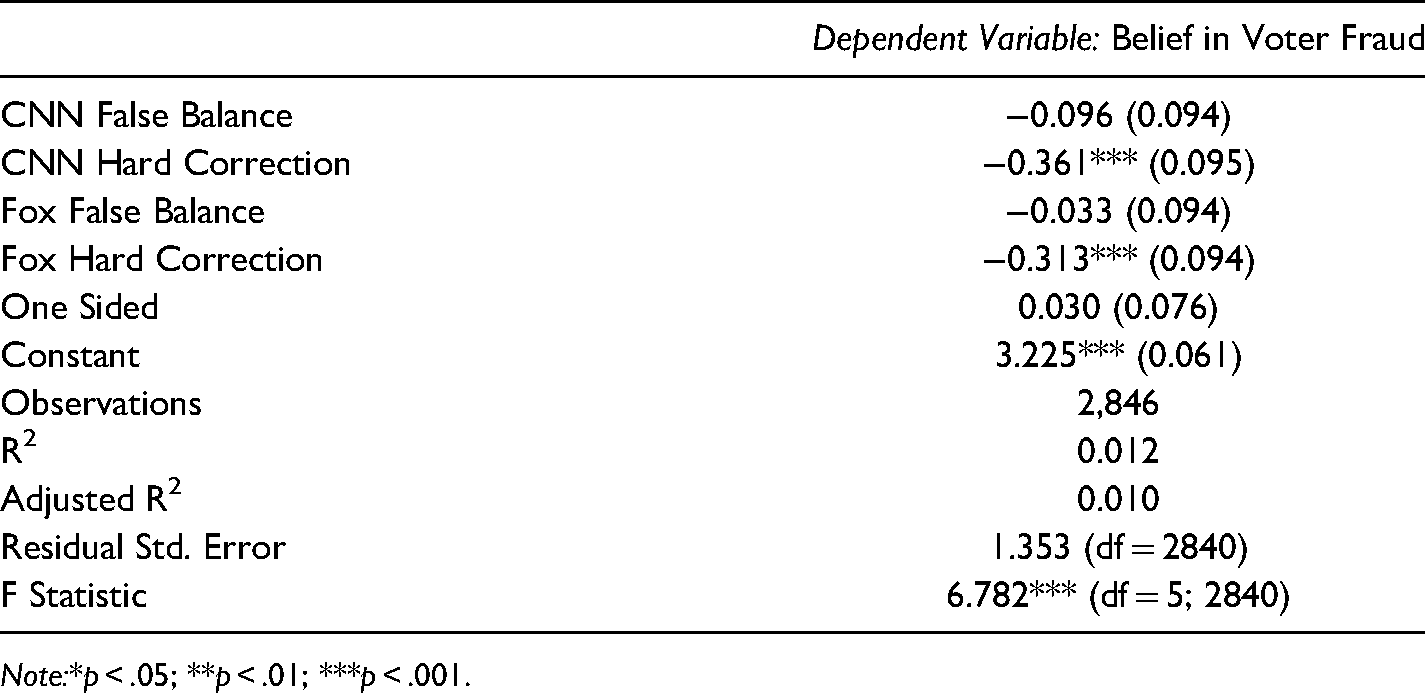
The results of an OLS regression of level of agreement that voter fraud is a severe problem in U.S. democracy on treatment group is shown in Table 1. The coefficients in Table 1 indicate OLS estimates of the difference between the mean value of the dependent variable of respondents in the treatment conditions and those in the “no message” control condition. These coefficients are plotted in Figure 1 along with whiskers indicating 95% confidence intervals. With regard to RQ1, the results of the analysis do not support the claim that exposure to falsely balanced information about voter fraud increases belief in voter fraud. As shown in Table 1 and in Figure 1, the coefficients on both the CNN and Fox versions of the false balance treatment effects are negative and small in magnitude. The p-value of the Fox-attributed false balance treatment effect is 0.724 and that of the CNN version is 0.309, indicating that we are unable to reject the null hypotheses that the false balance treatment effects are equal to zero.
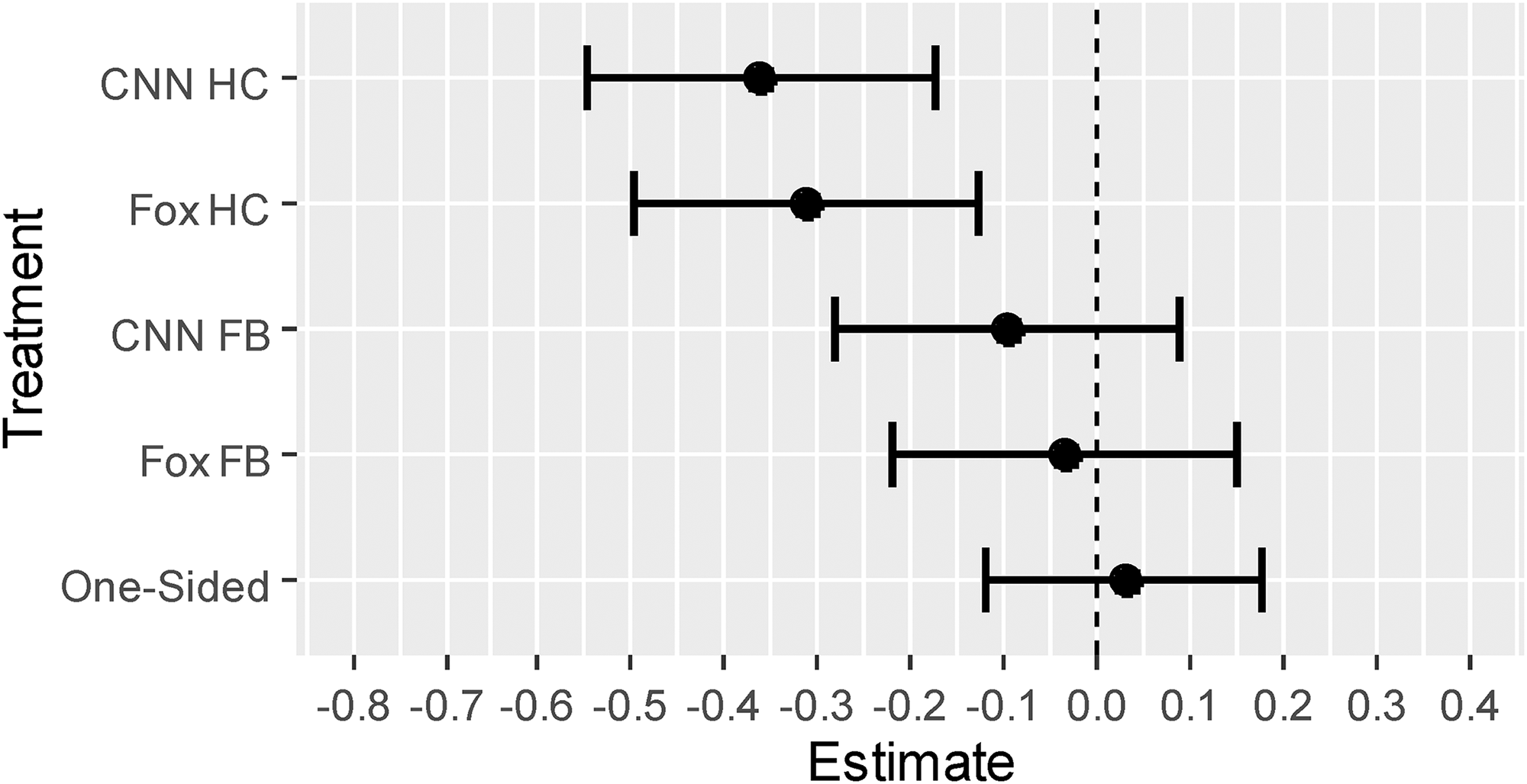
Average treatment effects relative to “no message” baseline.
Average Treatment Effects Relative to “No Message” Baseline.
Note:*p < .05; **p < .01; ***p < .001.
In support of H1, both the Fox and CNN versions of the hard correction treatment decreased belief in the severity of voter fraud by about 0.3 (d ≈ 0.21). We interpret this as indicating a small effect size. The 95% confidence interval for the CNN hard correction condition treatment effect is [−0.548, −0.175], and that for the Fox version is [−0.500, −0.128]. In H2 we hypothesized that exposure to the one-sided article would increase belief fraud. The coefficient on the treatment estimate shown in Table 1 is indeed positive, but it is not statistically significant (p = .689).
RQ2 asks whether explicit intervention more effectively reduces belief in voter fraud relative to false balance reporting. Post-hoc F-tests of the statistical equivalence of coefficients indicate that the difference between the effect of the CNN version of the hard correction treatment and the CNN false balance treatment is highly statistically significant (95% CI: [−0.421, −0.110], F = 6.776, p value = .009), as is the difference between the Fox-attributed hard correction condition and the Fox-attributed false balance condition (95% CI: [−0.435, −0.124], F = 7.607, p value = .006). In fact, as shown in Table A18 in the Supplementary Information file, all hard correction treatment effects estimates are statistically different from all false balance treatment effects. Thus, we can answer RQ2 in the affirmative; exposure to journalistic intervention does more strongly reduce belief in voter fraud relative to false balance reporting.
Source Effects (RQ3)
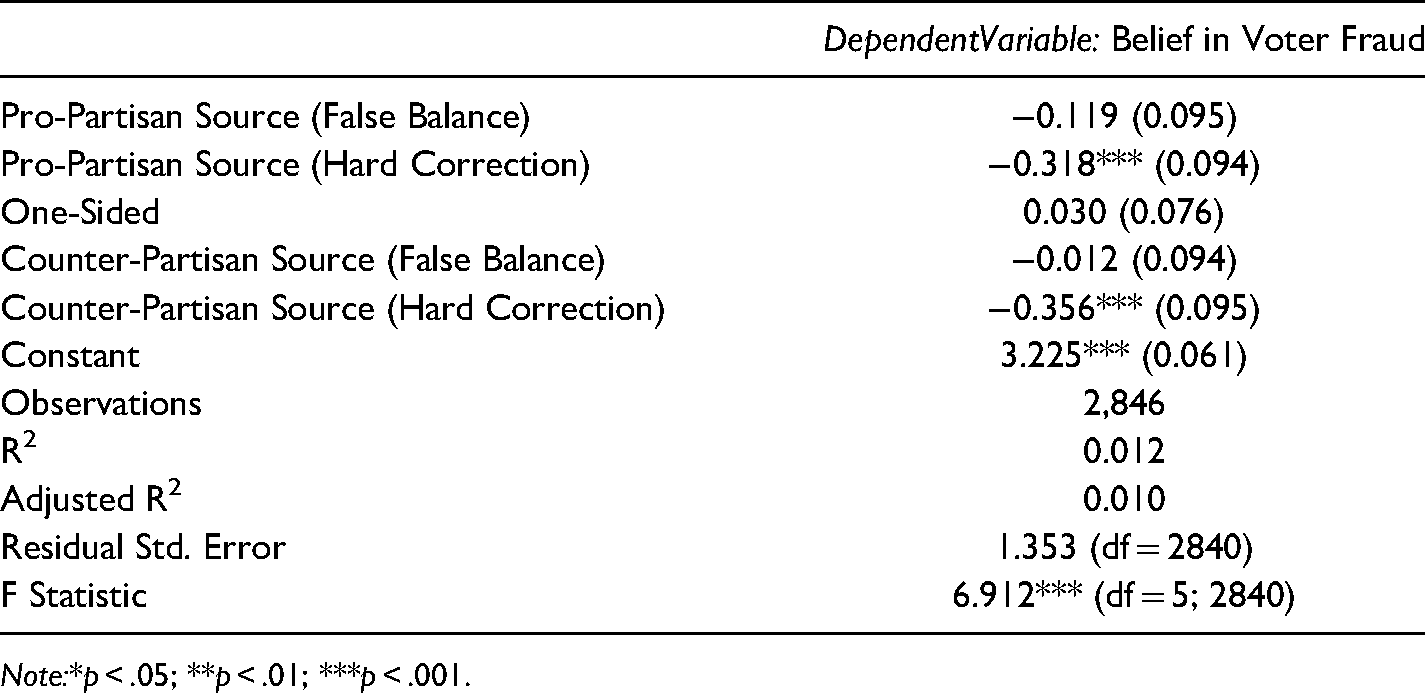
We now turn to RQ3, which asks whether the treatment effects vary according to whether the information comes from a pro-partisan or counter-partisan news source. In order to estimate the effect of news source we created a series of dummy variables that grouped respondents according to whether they were exposed to a pro-partisan or counter partisan news source and whether they were exposed to a false balance or hard correction-type article. For example, Republican identifying respondents who read a CNN-attributed false balance article were grouped together with Democrats who read a Fox-attributed false balance article. We regress these dummies on belief in voter fraud using OLS. The results are shown in Table 2. In order to assess source effects we performed post-hoc F-tests of the statistical equivalence of the coefficients from Table 2. The results of these F-tests are shown in Table 3.
Results of Regression of Source Congeniality/Treatment on Belief in Voter Fraud.
Note:*p < .05; **p < .01; ***p < .001.
F-Tests of Statistical Equivalence of Coefficients from Table 2.

Looking at Table 2, we see that the ATEs associated with the pro and counter-partisan versions of the treatments are very similar. Further, as shown in Table 3, the results of the F-tests indicate that we are unable to reject the null hypothesis that the treatment effects of the articles containing pro-partisan news source attributions are statistically equivalent to those that contain counter-partisan news source attributions. We can infer from this that source attribution does not moderate the main treatment effects.
Between-Partisan Differences in Treatment Effects (RQ4)
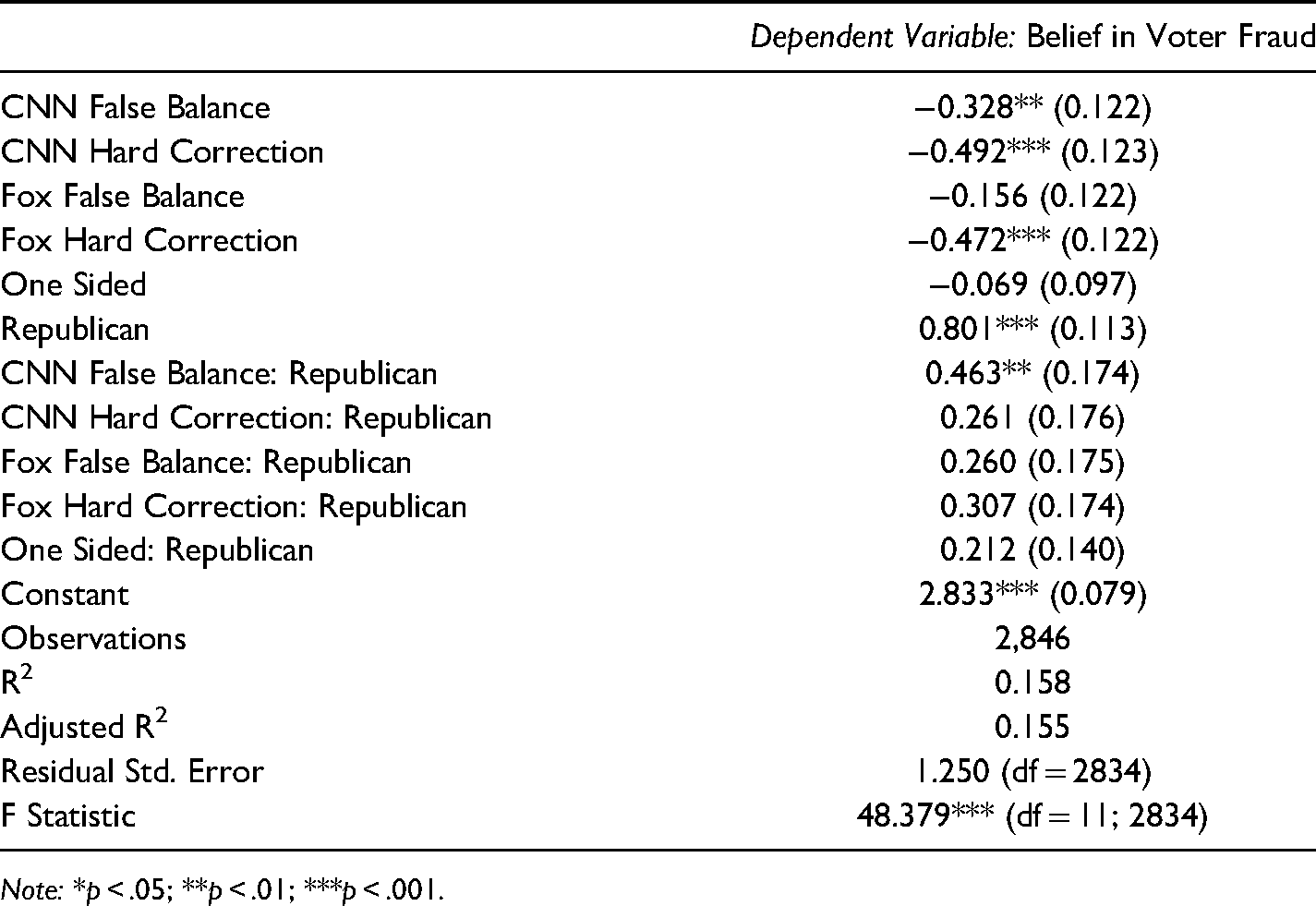
In order to determine if there are any statistically significant between-partisan differences in the treatment effects, we estimate the interaction between the treatment dummies and party ID using OLS. The resulting coefficients are shown in Table 4 and Figure 2. The coefficients shown in Table 4 and Figure 2 are estimates of the difference between the Republican ATEs and Democrat ATEs (both ATEs are relative to the pure control baseline, as above). Specifically, they indicate the ATE for each treatment among Republican respondents less the corresponding ATE among Democrat respondents.
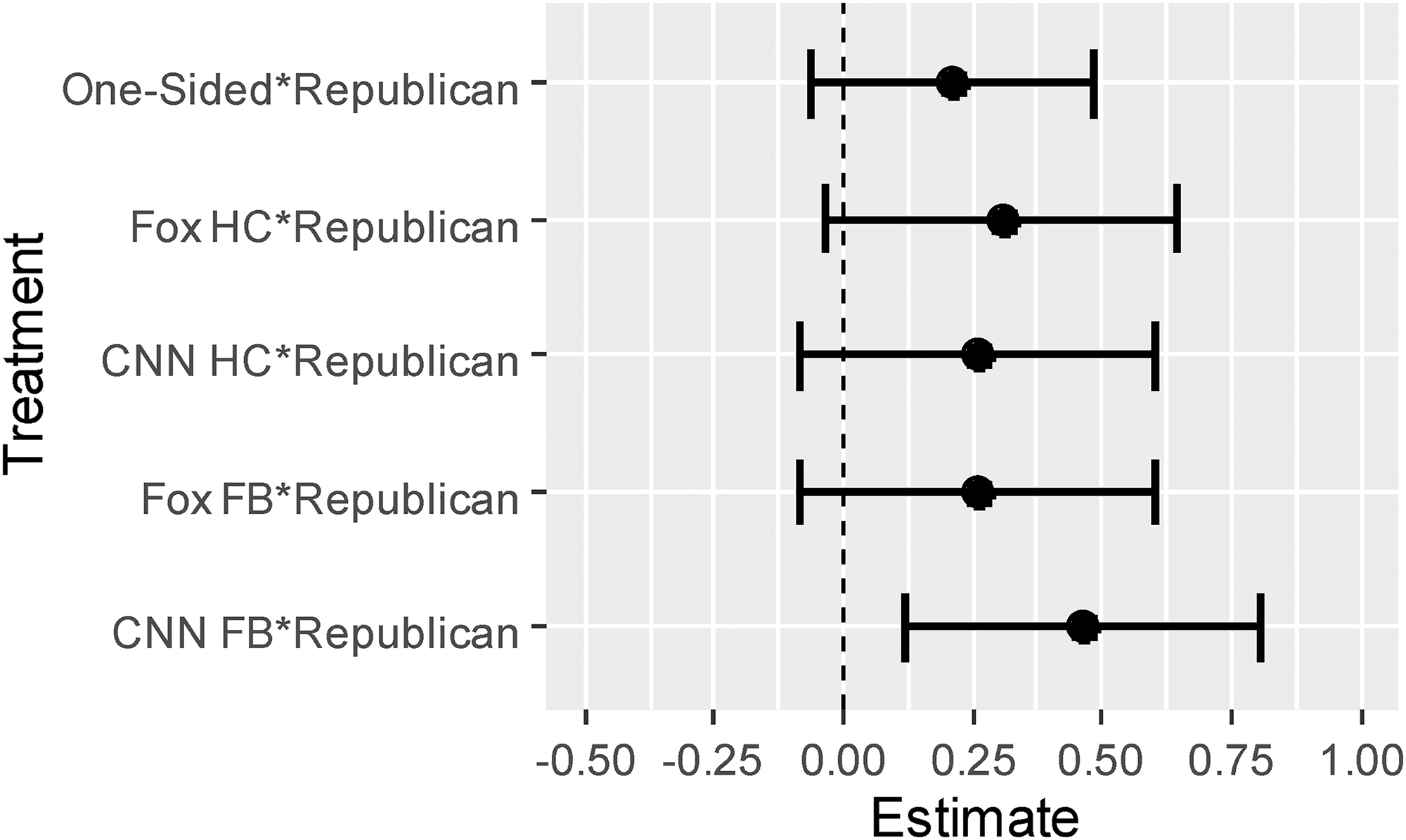
Difference between republican and democrat ATEs (“no message” = baseline).
Results of Interaction Between Treatment and Party Identification (Estimates Calculated with OLS Regression; Baseline: “No Message” Condition).
Note: *p < .05; **p < .01; ***p < .001.
The results of the analysis leave us unable to reject the null hypothesis that the difference between the Republican and Democrat hard correction ATEs is zero. In other words, party ID does not appear to moderate the hard correction treatment effect.
With regard to differences in the false balance treatment effects, on the other hand, the CNN-attributed false balance ATE does appear to be statistically different for the two groups (p < .01). Interpreting this difference estimate is somewhat tricky because the sign and significance of the two coefficients is different. As indicated in Table A19 in the Supplementary Information file, the corresponding coefficient as calculated within each partisan subset is negative and statistically significant among Democrats (−0.328), whereas it is positive and statistically insignificant among Republicans (0.135). Hence, computing the difference between the two ATEs yields a positive difference estimate, since we are subtracting a negative value from a positive value.
As Table 3 shows, this difference estimate is 0.463 (95% CI: [0.122, 0.805]), indicating that the CNN-attributed false balance treatment ATE among Republicans is between 0.122 and 0.805 higher than the corresponding ATE among Democrats. To phrase it somewhat more intuitively, we can interpret this as indicating that the CNN false balance treatment reduced belief in voter fraud by about 0.463 more among Democrats than Republicans, on average. Because the difference between the CNN and Fox false balance coefficients is not statistically significant (F = 1.723, p = .190), we conclude that this is not a source effect, but rather a difference in main effects between the two groups of partisans. In order to support this interpretation, we calculated these interaction effects using a single main treatment dummy (hard correction/false balance) along with a separate source dummy (Fox/CNN) added to control for source effects. The results are shown in the Supplementary Information file (Table A17). The false balance ATE is about 0.362 higher among Republicans than among Democrats (p < .05), supporting our interpretation of this difference as a difference in the main effect of the false balance treatment.
Post-election Results (RQ5)
RQ5 asks whether the pre-election and post-election treatment effects vary by party ID. In order to get a sense of these differences, we present the mean value of the dependent variable for each experimental condition and partisan group in the pre-election and post-election periods in Figure 3.

Pre-election and post-election experimental group means by party id.
The dotted horizontal lines indicating the pre-election mean value of the dependent variable for the no message condition are included for reference, as are the pre-election means for the one-sided conditions. Among Republicans, the mean values of all treatment groups in the post-election period are higher than that of the pre-election control group mean. Further, the post-election means are nearly equivalent across all experimental conditions, indicating that the corrective effect of explicit intervention among Republicans observed in the pre-election period has largely disappeared in the post-election period. By contrast, we see observe few differences between the pre-election and post-election treatment means among Democrats (Results for Democrats shown in Table A11 in the Supplementary Information file).
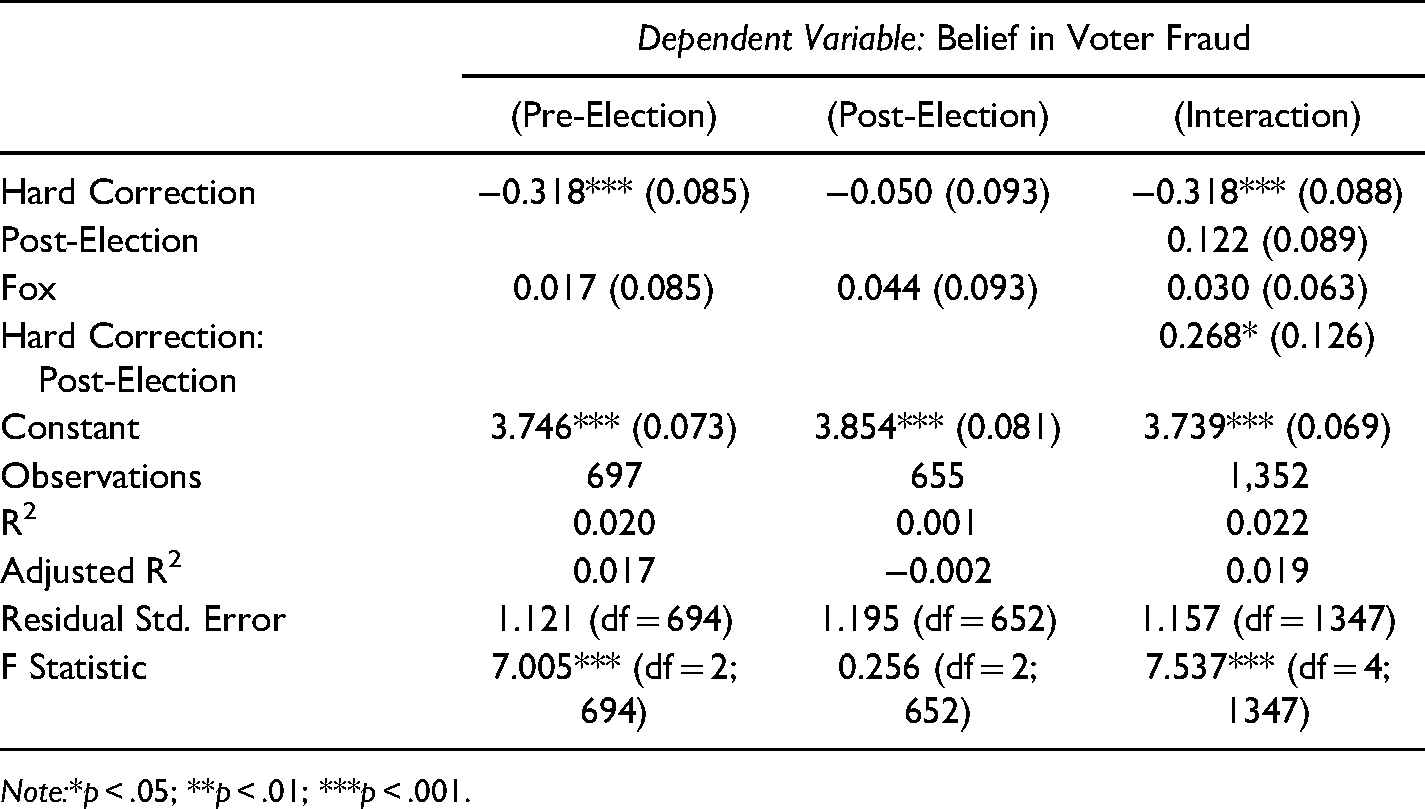
In order to formally assess differences in pre- and post-election treatment effects among Republicans, we use OLS regression to estimate the difference between the hard correction and false balance group means separately for each time period for Republican respondents only. The results are shown in the first two columns of Table 5. We then use the pooled pre-election and post-election data to calculate the difference between the pre-election and post-election treatment effect differences. This is done by interacting a dummy indicating the post-election period (0 = pre-election, 1 = post-election) with the hard correction treatment dummy using OLS. The results are shown in third column of Table 5.
Difference Between Hard Correction and False Balance Group Means (Republicans Only; False Balance Is the Reference Group).
Note:*p < .05; **p < .01; ***p < .001.
Looking at Table 5, we see that the difference between the hard correction and false balance condition means is substantively and statistically significant in the pre-election period, but that is close to zero and statistically insignificant in the post-election period. The interaction term in the third column of Table 5 suggests that this change in differences is itself statistically significant. These results are robust to controls for demographic variables and political knowledge (Table A10 in the Supplementary Information file).
Discussion
The results of the analysis of pre-election data including all respondents provide us with two primary implications. First, despite the fact that this study was conducted in the midst of a tense election in a highly polarized electorate, exposure to information that contains partisan claims of voter fraud was shown to reduce perceptions of the severity of voter fraud in U.S. elections, but only when it contained both corrective information and explicit journalistic intervention (i.e., hard corrections). Importantly, neither party ID nor news source attribution appear to have significantly moderated the effect of explicit journalistic intervention. Whereas theories of partisan motivated reasoning and heuristics might have led us to expect Republicans to ignore journalistic intervention, in the pre-election period, at least, they did not respond this way. Second, when this corrective information lacks explicit journalistic intervention, and is instead phrased in a mechanically balanced manner (i.e., false balance), it does not appear to have much of an effect on beliefs on voter fraud, on average.
This second finding can be interpreted two ways. On the one hand, it should allay fears of the potentially distortive effects of false balance reporting, in so far as it does not appear to increase belief in misperceptions about voter fraud. On the other hand, information that is ostensibly sufficient to lead readers to the conclusion that voter fraud is not so widespread in U.S. elections does not appear to actually have this effect, at least not among the analysis of pre-election data including all respondents. Overall, then, false balance reporting appears to have the effect of diluting corrective information that might otherwise decrease misperceptions.
These two main implications come with two important caveats. First, the analysis of pre-election data subset by party ID contained in the supplemental Supplementary Information file shows some evidence of treatment effect heterogeneity for the false balance treatment, as does the party ID-treatment interaction analysis. Among supporters of the Democratic Party, the false balance treatments largely reduce belief in voter fraud, whereas among Republicans the false balance treatment effects estimates are positive and not statistically significant. The formal test of interaction effects provides some evidence that the false balance treatment effects are higher for Republicans than for Democrats. As noted above, we interpret this as indicating that the false balance treatment more strongly reduced belief in voter fraud among Democrats. This suggests that false balance reporting may be more conducive to partisan-based information processing.
Second, the corrective effect of journalistic intervention relative to the false balance condition among Republicans disappears entirely in the post-election period. This is likely due to a combination of factors. In section VIII of the Supplementary Information file, we highlight the potential role of the increase in the supply of partisan information about voter fraud in the post-election period.
One result that warrants explanation is the lack of significance of the one-sided treatment in the analysis of pre-election data. While we cannot say for certain, we believe this to be due to party ID and political knowledge-based heterogeneity. Among Democrats, it is possible that the one-sided treatment effect may not have been as strong as it would have been if it had featured a less divisive politician. It might also be a result of source attribution, but the lack of consistent source effects for the main treatments suggests that this is unlikely. Among Republicans, the one-sided treatment is nearly significant. As we show in section VII in the Supplementary Information file, there is significant heterogeneity in the treatment effects conditional on political knowledge. Both the one-sided and false balance treatments are positive and statistically significant among high knowledge Republicans. Given the constraints on sample size, we note that these estimates may be unstable, but they do suggest that the effect of false balance reporting may depend on the strength of prior partisan cognitive commitments. Alternatively, these may simply be ceiling effects.
Conclusion
How journalists report on contentious political issues is important. In this study, we have shown that corrective information about voter fraud is likely to have a null overall effect on belief in voter fraud when it is written in a falsely balanced manner. Additionally, our analysis suggests that falsely balanced reporting may be somewhat more likely to induce partisan interpretation of political information. On the other hand, when corrective information is accompanied by explicit corrections and weight of evidence information it can reduce belief in voter fraud, even among a polarized electorate. However, corrective effect of journalistic intervention appears to be sharply constrained by the supply of partisan cues in the media and political context.
This study has limitations that we hope future studies will improve upon. One issue we cannot assess with the present data is the full range of temporal and contextual sensitivity of the effects observed, such as whether or not the corrective effects of journalistic intervention after media attention to voter fraud returns to pre-election levels. We also suggest that future researchers consider the effects of source quotes and other aspects of the design. In particular, it is possible that news source attribution may be important for assessing the effect of one-sided information. Because we do not vary source attribution for the one-sided condition, we are unable to fully confirm the presence or absence of treatment effects for biased information. Further, as noted above, the generalizability of our results may be somewhat limited due to differences between our samples and the population. Lastly, we hope that future researchers strive to connect individual level effects to broader trends in supply and demand for particular types of political news content.
Supplemental Material
sj-docx-1-hij-10.1177_19401612221111997 - Supplemental material for Trump Lies, Truth Dies? Epistemic Crisis and the Effect of False Balance Reporting on Beliefs About Voter Fraud
Supplemental material, sj-docx-1-hij-10.1177_19401612221111997 for Trump Lies, Truth Dies? Epistemic Crisis and the Effect of False Balance Reporting on Beliefs About Voter Fraud by Matthew David Jenkins and Daniel Gomez in The International Journal of Press/Politics
Footnotes
Declaration of Conflicting Interests
The author(s) declared no potential conflicts of interest with respect to the research, authorship, and/or publication of this article.
Funding
The author(s) disclosed receipt of the following financial support for the research, authorship, and/or publication of this article: This work was supported by the Gyeongsang National University (grant number Social Sciences).

Supplemental Material
Supplemental material for this article is available online.
Notes
References
Supplementary Material
Please find the following supplemental material available below.
For Open Access articles published under a Creative Commons License, all supplemental material carries the same license as the article it is associated with.
For non-Open Access articles published, all supplemental material carries a non-exclusive license, and permission requests for re-use of supplemental material or any part of supplemental material shall be sent directly to the copyright owner as specified in the copyright notice associated with the article.
