




Abstract
This article examines whether states under the Every Student Succeeds Act (ESSA) are prioritizing education leadership to improve schools. Examining all 52 consolidated plans, we found that while the federal law increases states’ flexibility toward such ends, states have taken advantage to varying degrees. We argue that forces at both the state and federal levels are responsible. Recommendations are further discussed as to how the next reauthorization can better address this important link in practice.
Introduction
For the past decade, increasing evidence has shown that quality leadership can improve school outcomes (Ni et al., 2019; Orphanos & Orr, 2014; Young et al., 2009). After teachers, school leaders are the most important school-related factor affecting student learning (Leithwood et al., 2004). During this time, the federal government, states, and local districts have taken notice, implementing a host of policies aimed at better preparation and development of school leaders (E. Anderson & Reynolds, 2015). Notably, in 2015, President Barack Obama signed into law the Every Student Succeeds Act (ESSA; 2015). Reauthorizing the Elementary and Secondary Education Act (ESEA), ESSA recognizes education leadership as a key theory of action (Castagna et al., 2016; Haller et al., 2016; New Leaders, 2018; Riley & Meredith, 2017). States are provided flexibility and funding avenues to support innovative principal preparation and development. Our article examines the extent to which states are using these provisions to leverage education leadership as a key theory of action. Reviewing all 52 consolidated plans and related studies, we find that while the federal law promotes flexibility, states are prioritizing education leadership to varying degrees. We submit that forces at both the state and federal levels are responsible.
As of September 2018, all consolidated state plans have been approved by the U.S. Department of Education (U.S. DoE). These plans foreground what states intend to do with federal education funding (Sunderman & Kim, 2007). By analyzing them, we provide a current view of how states are prioritizing education leadership (i.e., preparation and development) to improve schools. We understand that consolidated plans do not represent the entirety of state action on education leadership, but they do constitute a statement of priorities, and we submit that what states choose to include is important. Therefore, we first highlight background literature on the importance of quality leadership and our research question. Second, we pay particular attention to preparation and development as a conceptual framework for addressing quality leadership, and how ESSA aligns. Third, we detail our methods. Fourth, we present findings regarding what action states under ESSA are proposing for leadership preparation and development. Fifth, we discuss why states are prioritizing such pathways to varying degrees. Sixth, we offer conclusions and recommendations regarding how the next ESEA reauthorization can further build on ESSA’s recognition of education leadership as a policy lever for school improvement.
Background and Research Question
As school leaders have transitioned from primarily being managers to becoming instructional leaders, research shows quality leadership matters more than ever (Grissom & Barten, 2019; Leithwood & Jantzi, 2008). Quality leadership is associated with improved levels of student achievement (Branch et al., 2012; Coelli & Green, 2012; Grissom & Loeb, 2011; Leithwood et al., 2004). Leaders also affect every aspect of schooling, becoming “powerful multipliers of effective teaching” (Manna, 2015, p. 7) and student success (Day et al., 2016; Ingersoll et al., 2017). Over the past decade, this research has particularly expanded (Crow & Whiteman, 2016; Donmoyer et al., 2012; Rowland, 2017), offering key insights into preparing and developing a strong leadership pipeline (Korach & Cosner, 2016; Orr, 2011; Tucker et al., 2016).
At the same time, we must further point out that the importance of quality leadership is magnified for schools and students most in need (Branch et al., 2012; Day, 2007; Day et al., 2009; Finnigan & Stewart, 2009; Jacobson et al., 2005; Klar & Brewer, 2013; Murphy, 2008; Ylimaki & Jacobson, 2011). Low-income students and students of color disproportionately suffer from leadership turnover (Edwards et al., 2018; Loeb et al., 2010; Rangel, 2018). Each year nearly 30% of principals in high-poverty schools leave their school, whereas nationally, 82% remain in the same school (Goldring et al., 2018). Quality leadership is also needed to successfully implement equity-based turnaround models (Béteille et al., 2012; Boyd et al., 2011; Grissom, 2011; Leithwood & Strauss, 2008; Murphy, 2008). Leaders thus play a critical role in fostering school improvement across a host of contexts (Auerbach, 2009; Brooks et al., 2010; Khalifa, 2010; McKenzie et al., 2008; Pont, 2017; Robinson et al., 2009; Scanlan & López, 2012; Theoharis & O’Toole, 2011; Youngs & King, 2002).
Under ESSA, this research base has been recognized (Castagna et al., 2016; Haller et al., 2016; New Leaders, 2018; Riley & Meredith, 2017). Notably, the law provides states flexibility and fiscal support to implement two evidence-based pathways: leadership preparation and leadership development (L. M. Anderson & Turnbull, 2019; Turnbull et al., 2015; Young et al., 2009). Our study addresses whether and how states intend to use these pathways. We ask the following research question:
While prior authorizations have supported education leadership pathways for school improvement, ESSA specifically provides funding for leadership preparation and development to an unprecedented degree (Haller et al., 2016). Therefore, we examine this relationship in an effort to assess the prioritization of school leadership across states. To date, no known study has singularly focused on this relationship.
Conceptual Framework
As a conceptual framework to analyze our research question, we first unpack literature discussing leadership preparation and development. Second, we detail related provisions found in ESSA.
Leadership Preparation
Because most principals will retire in approximately 8 years if they remain in their current system (National Association of Elementary School Principals [NAESP], 2018), creating quality leadership preparation pathways is imperative. Such pathways are cost-effective (Kaufman et al., 2017) and produce leaders better prepared for high-need schools (Darling-Hammond et al., 2007; Huang et al., 2012). Methodological challenges aside (Grissom et al., 2019), a growing research base has shown that the design of these programs matters (Cosner, 2019; Crow & Whiteman, 2016; Darling-Hammond et al., 2007; Davis & Darling-Hammond, 2012; Young, 2015). As a framework for what makes principal preparation exemplary, the Darling-Hammond et al. (2007) study is frequently cited (Cosner, 2019). Examining eight different university-based programs, they found that rigorous recruitment and selection, research-based content, curricular coherence, field-based internships, problem-based learning strategies, cohort structures, mentoring or coaching, and collaboration between universities and school districts were important considerations. We briefly discuss two of these considerations found in ESSA: (a) field-based internships, and (b) collaboration between universities and school districts.
Once a source criticism (Levine, 2005), as of 2018, at least 38 states require field-based internships as part of their traditional school leader preparation programs (16 of these are deemed high quality; see E. Anderson & Reynolds, 2015). Strong field-based internships “provide [aspirants] an extended opportunity to grapple with the day-to-day demands of the principalship by engaging them in authentic leadership practice and design making” (Darling-Hammond et al., 2007, p. 68). However, research also shows that these internships are the “most challenging feature to deliver” (Orr, 2011, p. 155). This is because of the work experience afforded (Chandler et al., 2013; Cunningham & Sherman, 2008; Gray & Bishop, 2009; Lehman, 2013; McCarthy, 2015; Young & Brewer, 2008) and the developmental support needed in relation to that experience (Anast-May et al., 2011; Clayton et al., 2013; Jamison & Clayton, 2016; Lehman, 2013). Consequently, states have supported field-based internships to varying degrees (E. Anderson & Reynolds, 2015) and the depth of these internships remains inconsistent.
Addressing these issues, many scholars detail the importance of a sustained internship model, often as much as a year (e.g., Darling-Hammond et al., 2007; Oleszewski et al., 2012; Orr & Barber, 2007; Perez et al., 2011). Longer internships allow for significant relationship building and contextual understandings between teachers, students, and parents/guardians (Thessin & Clayton, 2013). Equally, Cosner, De Voto, & Andry Rah’man (2018) point out how clinically enacted, course-embedded work tasks help interns learn leadership theory and apply that theory in practice. Combined with leadership coaching and mentorship, material and social resources are drawn into an aspirant’s field-based internship.
In addition, collaboration between universities and school districts is becoming an important element of consideration. Prior to ESSA, 13 states adopted leadership preparation policies formalizing such collaborations (E. Anderson & Reynolds, 2015). Although the impact of such collaboration is not fully understood (King, 2014), research is beginning to show that these partnerships provide mutual benefits (Wang et al., 2018) for both urban (Orr et al., 2010) and rural (Fusarelli et al., 2018) districts. For example, Orr and Barber’s (2007) study showed that urban and rural programs implementing university–district partnerships had both greater preprogram and postprogram levels of commitment. These findings are further reinforced by Korach et al. (2019) who argue that university–district partnerships form a “shared vision of preparing leaders to disrupt the status quo and the authority to create the structures and systems to support [this] vision . . .” (p. 46). By coconstructing, leadership districts share current practice and build contextual understanding while universities ensure “theoretical and conceptual anchors” to promote critical thinking (Korach et al., 2019, p. 2). Finally, Cosner et al. (2015) demonstrate that, over time, a quality leadership pipeline can be built by providing a uniquely prepared workforce.
Leadership Development
Although preparing future school leaders is necessary, developing current school leaders cannot be ignored. Evidence shows investing in principals’ continuous training is important (Coggshall, 2015; Daresh, 2004). Benefits include improved student outcomes (Grissom & Harrington, 2010; May et al., 2012), decreased staff turnover (Jacob et al., 2014), and more attention to instructional improvement (Barnes et al., 2010). However, similar to leadership preparation, not all leadership development correlates positively with these benefits. Grissom and Harrington (2010) find two considerations are acutely associated: coaching and mentoring. As part of our conceptual framework, we highlight literature detailing these pathways, their perceived benefits, and select design features.
Indeed, many scholars point out that coaching is uniquely different from mentoring (Rhodes & Fletcher, 2013). According to Rhodes and Fletcher (2013), coaching almost exclusively focuses on skills development. Roughly half of all school leaders have had some coaching (Wise & Cavazos, 2017), especially early in their careers (James-Ward, 2013; Lochmiller, 2014; Silver et al., 2009). Coaching programs and interventions that engage more experienced principals are also being documented and examined (e.g., Cardno & Youngs, 2013; Goff et al., 2014; Weathers & White, 2015), but to a lesser degree. States have thus recognized the potential developmental benefits (Silver et al., 2009), which include personalized support, critical reflection, and a renewed commitment to education (Silver et al., 2009).
More broadly, research shows that their design features are important variables to consider. For example, proper matching is required to instill trust within the coach–coachee relationship (Weathers & White, 2015). This enables critical feedback to transpire (Nicolaidou et al., 2016). A coherent set of defined goals is equally important (Lochmiller, 2014). These goals help to measure progress over time. Finally, the structures, routines, and tools become important design considerations (Cosner & De Voto, 2019). These provide both the space and processes needed to promote continuous development.
On the contrary, leadership mentoring has less to do with developing concrete skills and more to do with developing self-efficacy (Rhodes & Fletcher, 2013). A number of states have instituted formal mentoring programs for new school leaders (Gimbel & Kefor, 2018). Still, the vast majority of mentoring remains informal (Fry et al., 2006; Gimbel & Kefor, 2018), limiting our understanding of its benefits. But when formalized, mentorship has been shown to improve school leaders’ professional values and knowledge (Barnett et al., 2017; Tahir et al., 2016). Benefits also extend to the mentors themselves, such as greater collegiality, professional commitment, and satisfaction (Mitgang, 2007). Features enabling these benefits include modeling, empowering, and supporting (Schechter & Firuz, 2015). And similar to coaching, trust and training remain important design considerations (Hansford & Ehrich, 2006; Zepeda et al., 2014).
In sum, leadership preparation and development are shown to be key pathways toward promoting quality leadership (L. M. Anderson & Turnbull, 2019; Turnbull et al., 2015; Young et al., 2009). Research shows that by developing leaders’ practice across their career trajectories, such pathways can improve schools. We highlighted several evidence-based considerations for each pathway. In an effort to examine them as part of our research question, we now detail related provisions found in ESSA.
Related Provisions Found in ESSA
Under ESSA, “school leadership is explicitly acknowledged as a valid target of educational-improvement activities across the titles” (Herman et al., 2017, p. 3). However, Title II (a.k.a. “Preparing, Training and Recruiting High Quality Teachers, Principals or Other School Leaders”) is where the majority of provisions addressing leadership preparation and development reside. Under this Title, states can use up to 2% of their funds to create or expand teacher-, principal-, or leadership preparation programs for those serving in high-need schools. We next discuss specific provisions related to each pathway.
Most funding in Title II is provided to local education agencies (LEAs). However, avenues are available for state-level activities. Concerning principal preparation, ESSA affords the creation of leadership “preparation academies.” States can work with traditional or alternative programs that serve high-need schools. Goals of the leadership academy include receiving “a significant part of [aspirant] training through clinical preparation” using a mentor, and increasing “the number of effective [school leaders] who will demonstrate success in increasing student academic achievement” (ESSA, 2015, p. 114). Other provisions require that the leadership academy limit admission to those “who demonstrate strong potential to improve student academic achievement” and have “a record of success in improving student performance” (ESSA, 2015, p. 115).
Concerning principal development, Title II broadly funds “the development and implementation of high-quality professional development programs for principals that enable the principals to be effective and prepare all students to meet the challenging state academic standards” (ESSA, 2015, p. 120). In particular, states can implement instructional coaching and mentoring programs for current leaders. Unlike preparation academies, however, no goals or requirements are suggested for how these programs should operate. Accordingly, states have sole discretion in allocating potential funding under this provision.
Finally, states can reserve up to 3% otherwise allocated to LEA subgrants for state-level activities supporting education leadership. This is significant, as prior ESEA reauthorizations have not afforded this option.
More than any other reauthorization, ESSA provides states increased flexibility to leverage education leadership for school improvement. We are consequently in a period of transition—from simply providing lip service to education leadership to actually investing time and money. To this end, we examine whether and how states intend to use such flexibility. In the following section, we highlight the methods of our study.
Method
Indeed, ESSA has been well received across stakeholders (Curran & Kellog, 2017). While it is still too early to empirically measure ESSA implementation as it relates to school and student outcomes, our study provides a timely window into how states are prioritizing education leadership specifically. At present, no known study singularly addresses this focus. To do so, we analyzed all 52 consolidated state plans (50 states, District of Columbia, and Puerto Rico). Mandated under each ESEA reauthorization, these consolidated plans give states the opportunity to map out their overall vision and goals for school improvement (including education leadership). Ranging from 100 to 300 pages, they are the only universal data from which to examine our research question. All state plans were collected from the U.S. DoE website in fall 2018.
Given their length and complexity, however, we chose to examine these plans from multiple vantage points. First, we systematically read through their content ourselves (i.e., document analysis). We looked for evidence of state-level principal preparation and development activities outlined in our conceptual framework. Under “Title II, Part A: Supporting Effective Instruction” as defined by the U.S. DoE (2017a) template, states have flexibility to incorporate these activities. Thus, our analysis mainly centered on this section’s content across all plans. We also looked at executive summaries to see whether education leadership activities were mentioned. This supplementary search further helped us judge whether such activities were prioritized by each state, and how they intended to implement them.
Second, we examined prior independent studies analyzing these plans. This included one study conducted by the University Council for Educational Administration (UCEA); both authors participated in this study. Intended to examine how states treat school leadership more broadly, UCEA created a rubric to standardize data collection and support cross-state comparison. The rubric aligned to the structure and content of the U.S. DoE ESSA template provided to states. 1 The rubric probed the following education leadership activities: (a) use of 3% set-aside for state-level activities; (b) stakeholder engagement; (c) principal preparation and development, and quality and effectiveness; (d) certification; and (e) equity and access. Across these activities, research teams had to determine whether each was addressed: (a) not at all, (b) for teachers only, (c) for educators (which could imply principals), or (d) for principals only. Most teams consisted of two graduate student reviewers and one faculty mentor. Effort was made to recruit teams from within the state or territory whose plan they were reviewing. Each team carefully reviewed the assigned consolidated state plan and extracted the data requested by the rubric using Qualtrics, a data software package. If an affirmative response was provided, indicating that a state included a description of how it planned to address the activity specifically for principals, reviewers were asked to provide reference text and page numbers from the consolidated plan for verification. The analysis centered on the content of the plans because it sought to understand what the states chose to include and what they chose to leave out of the priority-setting document. To ensure accuracy, all submitted data on individual plans were later relayed to the respective state education agency (SEA) for comment and editing.
We also gathered several other independent studies from policy organizations (Aldeman et al., 2017; Haller et al., 2016; Herman et al., 2017; New Leaders, 2018; Riley & Meredith, 2017), scholarly journals (Black, 2017; Stosich & Bae, 2018; Williams & Welsh, 2017), and media outlets (Superville, 2018). Similar to the UCEA study, these sources focused on the prioritization of school leadership more broadly under ESSA. But together, these additional data sources provided trustworthiness in our analysis of education leadership specifically.
In analyzing collected data, we employed the constant comparative method (Charmaz, 2000, 2006; Glaser, 1965; Glaser & Strauss, 1967). This method involves analyzing data multiple times so as to find emergent core themes. Typically used as part of classical grounded theory, the constant comparative method can be a pragmatic, qualitative heuristic approach (Charmaz, 2000, 2006). Thus, we utilized this method in such a way as to conduct a thorough document analysis across all the 52 state plans and prior studies gathered.
Given that our research question examines the use of leadership preparation and development by states under ESSA, these activities became our units of analysis (i.e. parent codes). They also became our coding scheme. All data were uploaded to ATLAS.ti., a computer software package. During the first phase, the first author coded all instances where principal preparation and development activities were mentioned in the 52 plans. Afterward, they started to breakdown each unit of analysis into subunits of analysis (i.e., child codes) related to the specific provisions found in ESSA (see conceptual framework). Concerning principal preparation, subunits included the leadership “academies” and “certification” systems. We were particularly interested in how many states intended to implement the academies over certification activities. Concerning principal development, subunits included state investments over a leader’s “career trajectory” (i.e., early, middle, and later), with particular attention to “mentoring” and “coaching” (as identified in our conceptual framework). Finally, the first author also coded how many states intended to use the 3% set-aside under Title II for education leadership.
In an effort to triangulate our independent document analysis with those studies gathered from UCEA, other policy organizations, scholarly journals, and media outlets, the first author coded their content in a similar fashion. Memos were then created for each child code related to provisions found in ESSA. For example, the “leadership academies” code traced how many states aim to implement them for aspiring school leaders. It also, where applicable, detailed what states divulge about their processes and goals. From there, we were able to constantly compare how many states prioritized various education leadership activities and to what ends (see findings for details).
By examining the consolidated state plans ourselves and comparing them with prior studies more broadly, we were afforded a comprehensive analysis of our particular research question. That said, we recognize that there are several limitations. First, because consolidated plans are only a template for how states intend to address evidence-based activities such as education leadership, we cannot account for what states actually will do with ESSA funds over time (i.e., content vs. meaning). Second, these plans do not reflect prior investments made by states to support education leadership. For example, principal preparation programs in Illinois were redesigned in 2014 following evidence showing that many were of low quality (Klostermann et al., 2015). Third, given that some states elected to include school leaders within the broad term “educators,” the extent to which education leadership is expressly mentioned in plans may not be an accurate measure of a state’s overall intent.
Notwithstanding, we argue that this study provides a timely and unique window into whether ESSA’s increased flexibility has translated into states’ prioritizing education leadership for school improvement. On one hand, these consolidated plans are a political statement of priorities. Although they do not tell us about ground-level implementation, they do tell us about the conditions for it, thereby offering insight regarding what states elected to include or not include. Equally, as ESSA addresses education leadership as an evidence-based activity, we find it important to examine whether states identify leaders independently from educators, and to what ends. The next section illustrates our findings across collected data.
Findings
Examining the 52 consolidated plans and related prior studies, we find that all states intend to invest in school leadership (New Leaders, 2018), and that all states solicited feedback from school leaders during their design (Reedy & Doiron, 2018a). However, we find that the extent to which education leadership (i.e., principal preparation and development) is prioritized toward such ends varies across states. We first discuss how states are using leadership in Title II more broadly. Following our conceptual framework, we then highlight how states are addressing principal preparation and development specifically. Finally, we discuss whether states are using the 3% set-aside under Title II for education leadership.
Title II
As discussed, the bulk of ESSA’s provisions geared toward education leadership are found in Title II. Under this Title, education leadership is one of two explicit pathways for school improvement (the other being teacher preparation/professional development). Data show nearly all (48) states indicate an intention to invest in “educators” for this purpose. Yet the extent to which leaders are specifically mentioned as a school improvement strategy for high-need schools similarly varies; only 16 states describe such efforts. See Figure 1 for details (Reedy & Doiron, 2018b).

Number of States using Title II, Part A funds to provide low-income and ethnic minority students with greater access to quality educators.
However, two states do stand out in our analysis. Nebraska has organized the ESSA Educational Leadership Learning Council (ELLC) to support school leaders and identify levers associated with ensuring equitable opportunity and access. In communicating their goals, the ELLC stated, “If we intend to provide equitable learning for our increasingly diverse population . . . school leaders are our highest impact lever for escalating equitable student learning” (Nebraska Department of Education, 2018, p. 143). They specifically plan to (a) build the capacity of school administrators to serve as instructional leaders, and (b) advance equity-focused conversations and activities across the state. In addition, New York State is assisting LEAs and universities in developing comprehensive leadership systems that meet the needs of all their students. Specifically, the state intends to (a) attract more diverse, culturally competent, and highly effective leaders; (b) provide options, opportunities, and pathways for aspiring leaders to better meet the needs of all students; (c) provide early career and ongoing support to improve their practice over time and retention; and (d) form committees of practice to disseminate effective leadership skills among peers. In doing so, they believe they can ensure that “each student is prepared for success in college, career, and citizenship” (New York State Education Department, 2018, p. 141).
We now examine the extent to which states intend to prioritize principal preparation and development for school improvement under ESSA. Where applicable, we similarly provide examples across states.
Leadership preparation
Although 43 states intend to invest in preparation programs more broadly, we find that less than half (21) indicate principal preparation activities (Doiron & Reedy, 2018a). Of these, only 14 are investing in ESSA’s promising new “preparation academies” (New Leaders, 2018), with even fewer linking them to school improvement. In its place, most state efforts have involved principal licensure/certification systems (20; Doiron & Reedy, 2018b), a trend that predates ESSA (see E. Anderson & Reynolds, 2015). Presumably, most states are leaving such pathways to LEAs via state subgrants.
In contrast, we do find several states demonstrating thoughtful attention. For example, Vermont plans to establish the Leader’s Professional Learning Academy. This academy will concentrate on improving the capacity of aspiring school leaders, especially those seeking to manage high-need schools. Areas of concentration include “standards-based, data-driven, and differentiated instruction, equitable access to high quality instruction, cultural competence, subject and content-specific issues, and the effective leveraging of resources to address equity and excellence” (Vermont Agency of Education, 2018, p. 99). Similarly, New York State proposes to increase its “development of P-20 educator preparation partnerships” for aspiring leaders (New York State Education Department, 2018, p. 113). Specifically, they are partnering with university-based preparation programs to ensure “school leaders have comprehensive, differentiated supports that help them transition from pre-service to employment.” One strategy includes providing mentors to all incoming leaders as part of a residency model.
Leadership development
Despite the lack of leadership preparation activities on behalf of most states, we found most (42) describe how they want to enact leadership development. This included improving their quality and effectiveness (40; Doiron & Reedy 2018a). Along a leader’s career trajectory, 36 states are investing in teacher leadership, 10 states are investing in assistant principals, and 21 states are investing in induction support for new principals (New Leaders, 2018). As expected, we do not find any states investing in veteran leadership specifically. But states are investing in evidence-based strategies, including (a) mentoring and coaching, (b) improving principal capacity to provide feedback and develop teachers, and (c) advancing shared leadership. Another common strategy was teacher evaluation training although no known research examines its efficacy toward school outcomes.
Regarding professional development to address school improvement, we also find a collective effort among states. Thirty-three states describe how they want to increase the number of principals who are effective in improving student achievement (Reedy & Doiron, 2018b). For example, Oklahoma intends to “provide district and school leaders with the training and support needed to improve instruction in their schools” (Oklahoma State Department of Education, 2018, p. 153). To support school leader development, the state proposes using ESSA funding for two professional development programs currently offered—Lead to Succeed (L2S) and Moving UP. L2S is a 24-session intensive training series grounded in curricula from the National Institute for School Leadership, and Moving UP focuses on equipping assistant and novice principals with skills and supports to assist in the transition to head administrator. In addition, Washington State is partnering with the Association of Washington School Principals (representing 98% of the state’s principals) to craft development that will ensure principals or other school leaders have the instructional leadership skills to help teachers teach and to help students meet such challenging state academic standards (Washington Office of Superintendent of Public Instruction, 2018).
On the contrary, 30 states plan to develop school leaders’ skills in identifying students with specific learning needs and providing instruction based on those needs. This is encouraging, given that the top-ranked concern by principals in 2018 was addressing student socioemotional needs (NAESP, 2018). However, we only find 13 states linking such activities to their School Quality or Student Success indicator. These findings are congruent with Fuller and colleagues (2017) who show that access to quality teachers and leaders in low-performing schools remains challenging. Consequently, states show limited engagement in linking these activities with actual school improvement. As states implement their plans, this finding will be important to follow.
State Investment in Education Leadership
Indeed, improving education leadership across states begins with financial investment. As discussed, ESSA notably allows states to set aside an additional 3% of their Title II funding for such activities. However, we find only 22 states explicitly chose to exercise this option (Reedy & Doiron, 2018c). 2 Furthermore, states were far less clear on how they planned to use such funding. See Figure 2 below.
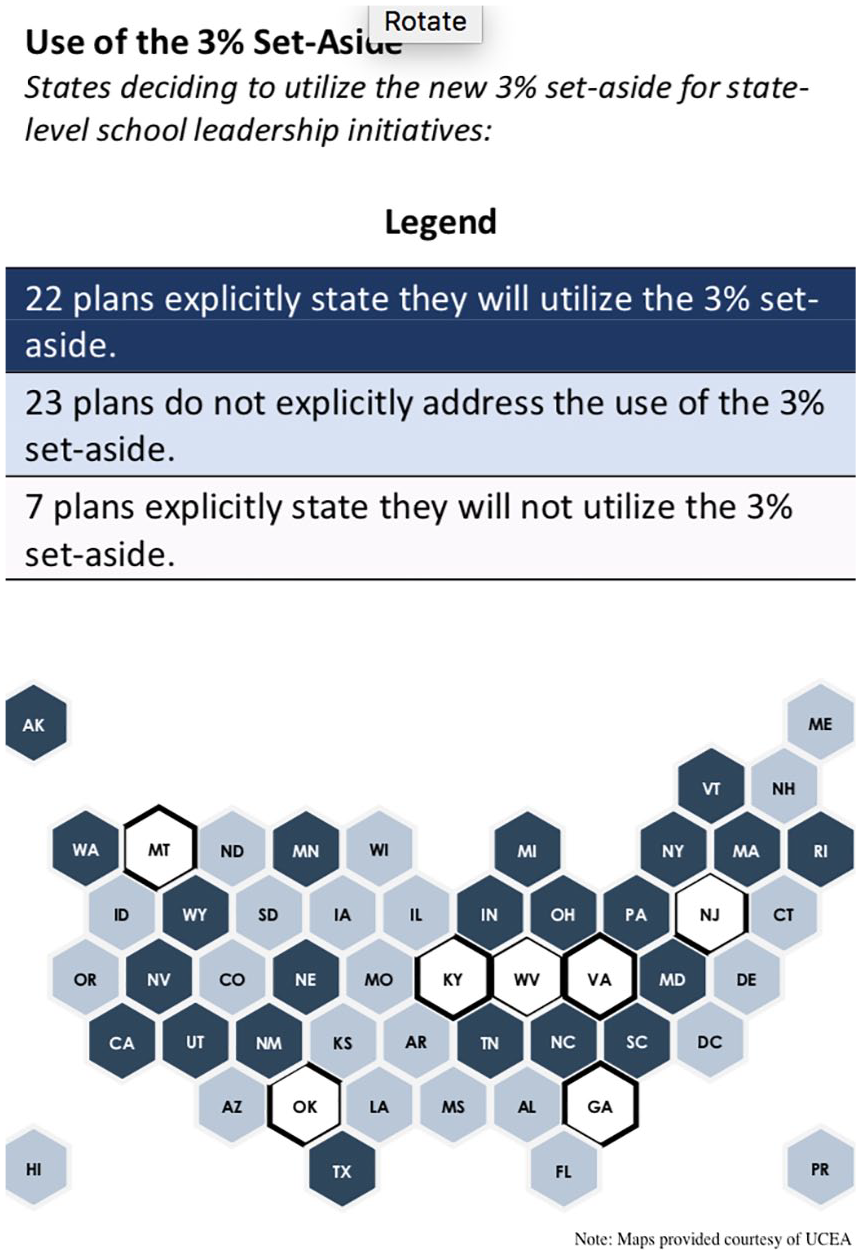
States deciding to utilize 3% set-aside for education leadership.
One exception was Vermont, which provided a thorough explanation of all activities they intended to implement. They focused their efforts on the following areas: (a) “developing, improving, or providing assistance to LEAs to support the design and implementation of teacher . . . evaluation and support systems,” and (b) “developing and providing training to principals, other school leaders . . . on how to accurately differentiate performance, provide useful and timely feedback, and use evaluation results to inform decision making about professional development, improvement strategies, and personnel decisions” (Vermont Agency of Education, 2018, p. 120).
Taken together, despite research showing that education leadership is a key theory of action for school improvement, we find its prioritization across state consolidated plans is rather mixed. Some states (including those highlighted) have proposed a range of innovative, evidence-based strategies. Yet many do not make comprehensive investments along a principal’s career trajectory, thus becoming piecemeal. In the next section, we analyze these divergent findings, illustrating how both federal- and state-level forces have played a role.
Discussion
Although it would be premature to completely assess ESSA’s influence on education leadership across states, our examination of their consolidated plans yields early promises and pitfalls. We argue that these divergent findings are reflective of enduring implementation challenges at the federal and state level under the ESEA more broadly. Two enduring challenges are highlighted in this section: (a) the lack of coherence at the federal level, and (b) the lack of capacities at the state level.
Lack of Coherence at the Federal Level
Since 1965, the ESEA and subsequent reauthorizations have become a key policy tool for leveraging the federal government’s role in education (Superfine & De Voto, 2016). Although this role has changed over time, the law’s incoherence has not (Superfine, 2013). In an effort to provide states latitude, reauthorizations (e.g., ESSA) have supported “promises without specificity” (Aldeman et al., 2017, p. 5). States have consequently not taken full advantage of ESSA “where school leadership is not explicitly called out” (Herman et al., 2017, p. 4). Using the transition from No Child Left Behind (NCLB) to ESSA, we briefly illustrate this point and its impact on prioritizing education leadership across states.
More than any other authorization, NCLB (2002) centralized the federal role in education (Sunderman & Kim, 2007). States and districts were forced to comply with mandated provisions like Adequate Yearly Progress (AYP) or face a myriad of sanctions. The assumption was that strengthening the federal role would hold states more accountable for student performance. However, the law did not provide a clear blueprint for reform (Superfine & De Voto, 2016). Many states were thus confused about how to implement its mandated provisions (Pinkerton et al., 2004; U.S. Government Accountability Office, 2004), which undermined intended outcomes (Shelly, 2008).
With this in mind, ESSA has decentralized the federal government’s role (Saultz et al., 2016). States are given more flexibility to prioritize school improvement strategies they deem paramount (Saultz et al., 2016). Analogous to NCLB, however, the law has not specified how states will/can implement such strategies. Combined with the Trump Administration’s elimination of many U.S. DoE support structures (Balingit & Dougals-Gabriel, 2017; Douglas-Gabriel, 2017; Whitaker et al., 2017) and threats to take away Title II funding (Chenoweth, 2017; Johnson et al., 2018; Klein, 2017; Superville, 2018), most state officials accordingly find the law incoherent (Rentner et al., 2017).
Our point is not to advocate for centralizing or decentralizing the federal role, but to show how either approach leads to implementation challenges when coherence is absent. Without coherence, states lacking the necessary capacities are unable “to assess the efficacy of particular resources and interventions” (Egalite, L. et al., 2017 p. 775). We find this has resulted in states’ prioritizing education leadership to varying degrees. We further discuss below.
Lack of Capacities at the State Level
As Orfield (2016) surmises, ESSA “has unrealistic assumptions about the resources and capacities of state governments and individual districts” (p. 288). Indeed, this has historically been a challenge with prior reauthorizations (e.g., Berman & McLaughlin, 1978; Darling-Hammond & Marks, 1983; Egalite et al., 2017; Elmore & Fuhrman, 1990; Forte, 2010; Gottfried et al., 2011; Manna, 2010; Superfine, 2013); the federal government has simply underestimated what resources states need to successfully implement the law (Jennings, 2015). In the process, we illustrate that many consolidated plans have not addressed education leadership to the extent ESSA affords. Provisions not prioritized include “preparation academies” and developmental activities across school leaders’ career trajectories. The law can therefore provide states flexibility toward education leadership, but requires that local leaders have the structural resources and support to do so. To date, this has not been the case under the ESEA (Superfine & De Voto, 2016).
Meanwhile, Education Secretary Betsy DeVos has further decentralized the federal role (Balingit & Dougals-Gabriel, 2017; Whitaker et al., 2017). She downsized the U.S. DoE’s workforce and streamlined the proposal template that states completed (and that we analyzed), requiring only what was “absolutely necessary” (U.S. DoE, 2017b, para. 1). As a result, federal guidance is largely absent, making selecting, overseeing, and implementing ESSA more difficult (Burnette, 2016). So while we highlighted some states demonstrating the necessary resources/capacities, the vast majority either do not have them or are not compelled to use them.
Overall, we submit that these two enduring challenges explain our divergent findings. Together, they have undermined the extent to which states have prioritized education leadership. The final section provides an overview of how the next reauthorization can perhaps address such challenges, further prioritizing this key theory of action for school improvement.
Conclusion and Recommendations
Against the backdrop of NCLB, states and districts overwhelmingly find ESSA to be an improvement (Curran & Kellog, 2017; NAESP, 2018; Williams & Welsh, 2017); they have more ownership and flexibility to prioritize evidence-based activities such as leadership preparation and development (Williams & Welsh, 2017). Nevertheless, our analysis shows some variability in the extent to which states intend to do so. Some states have explicitly detailed innovative pathways toward such ends. Conversely, many have not. In the process, we fear these plans serve as a harbinger for variable resources/capacities by states to support education leadership. But only the passage of time will confirm this belief.
At the same time, the assumption that increased flexibility (i.e., decentralization) under ESSA will translate into states’ better serving vulnerable populations across districts and schools must be critically questioned. Our examination of consolidated plans demonstrates a fine line between flexibility and accountability across contexts. Indeed, an independent review found state plans to be “uncreative, unambitious, unclear, or unfinished” (Aldeman et al., 2017, p. 2). Whereas NCLB demonstrated the cautions of heightened federal accountability, ESSA is potentially demonstrating the cautions of heightened state flexibility. And over the next several years, the federal government will be carefully watching. ESSA is set to expire in early 2021. Preparations to either reauthorize or change the federal law could start soon (Black, 2017; Jennings, 2018). If states continue to meet the “soft bigotry of low expectations” (The White House, 2006, par. 23), we could see a return to a centralized federal role absent coherence. Hence, the current devolution of federal authority depends on state and local leaders’ being supported and prepared. Otherwise, this design is weakened because leaders may not be adequately prepared to assume their increased roles. In addition, it will be incumbent on education researchers to further study the link between a state emphasis on education leadership and school outcomes. Positive data from states emphasizing leadership can then be used to persuade unconvinced states to make the investment.
From a bird’s eye view, these issues present an opportunity to ask what the federal role should be in prioritizing education leadership. Indeed, research shows such pathways can improve school improvement (V. Robinson et al., 2008). Not a single case has been found of a quality school absent quality leadership (Leithwood et al., 2004). Yet lawmakers have struggled for decades to find the proper mix of federal, state, and local decision-making. Enduring implementation issues like incoherence and incapacity have kept the ESEA from becoming an efficacious policy tool across contexts. Still, we believe that the federal government should (and can) play a pivotal role, for education leadership or otherwise.
However, after 50-plus years, evidence shows neither top-down nor bottom-up reform is a complete theory of action (Superfine & De Voto, 2016). Rather, we need to start thinking about “what works, for whom, and under what conditions?” (Bryk et al., 2015, p. 93). We must embrace variation not simply by providing more flexibility—as is the case under ESSA—but by devoting significant attention to helping states understand the specific problems of their setting and developing evidence-based strategies to address them. This starts with providing more coherent guidance in the law itself, as well as the plan template SEAs must complete. Additional funds must also be appropriated explicitly for improving the technical capacities of SEAs to meet ESEA’s provisions. Whereas the Obama Administration provided a “dear colleague” letter (U.S. DoE, 2016a) and “non-regulatory guidance” (U.S. DoE, 2016b) outlining such efforts, under DeVos, these are no longer prioritized (Brown & Benner, 2017). If these circumstances change, perhaps subsequent reauthorizations can become a strong blueprint for prioritizing education leadership across states.
Footnotes
Declaration of Conflicting Interests
The author(s) declared no potential conflicts of interest with respect to the research, authorship, and/or publication of this article.
Funding
The author(s) received no financial support for the research, authorship, and/or publication of this article.
