



Abstract
This article presents a social constructivist grounded theory of school principal legal learning. The author analyzed 10 interviews with K-12 school principals and 10 school law faculty documents to investigate how principals develop the knowledge and skills to address legal issues in schools. Two themes emerged. The first theme was source of legal learning, with categories that included theoretical legal learning and practical/reality-based learning. The second theme was supports for legal learning, with categories that included supports of school law faculty, attorneys, policies, building level–specific content, professional development, and a combined practice of reflection to develop a common-sense approach.
The K-12 school principal has a dynamic and complicated role, created in part by the interplay of numerous laws governing schools. Principals are expected to address legal issues in the school context, requiring that school leaders possess a foundational knowledge of law, the ability to apply such knowledge in the practice of school leadership, and even the ability to weave legal requirements into their own leadership framework (Doctor, 2013; Shariff, 2004). In fact, knowledge of the law, application of the law, and the ability to interpret legal standards for the community exist within the current widely accepted standards for school leaders (National Policy Board for Educational Administration, 2015). The potential ramifications of improper legal decisions are substantial; individual rights can be violated and the financial costs tremendous (Petty, 2016).
Given the expectations, standards, and the potential ramifications of decisions inconsistent with the law, principals are acutely aware of their responsibility to address legal issues and apply legal requirements. Principals recognize that they are faced with accountability requirements that call for knowledge of legal guidelines (Himmetoglu et al., 2017) and frequently face new legitimate federal legal challenges that have “huge implications for the day-to-day operations” (Petty, 2016, p. 26). Principals have been calling for the knowledge and skills to properly address legal issues in schools (Hess & Kelly, 2003; Shariff, 2004).
Yet, despite this call, research on school leader learning often focuses on the principal’s development of knowledge and skills to impact instruction and student achievement (Ylimaki, 2014). In the same way there is an intentional focus on principal learning to impact instruction, there needs to be an intentional focus on principal legal learning. For the purposes of this research, legal learning is defined as the process through which principals acquire the foundational knowledge of legal constructs and requirements necessary to address legal situations within schools. This definition recognizes the principal is not a lawyer but is required to adopt a practice-focused application of relevant laws and institutional policies that implement such laws in their schools (Doctor, 2013; National Policy Board for Educational Administration, 2015).
The process of legal learning is unique in several ways. First, unlike developing knowledge and skills to impact instruction, principals typically have no prior background in the law. Second, unlike developing knowledge and skills to impact instruction, principals have no preparational requirement for legal coursework (Petty, 2016). Third, unlike developing knowledge and skills to impact instruction, principals have a limited level of ultimate authority over legal issues, requiring contact with superintendents or attorneys for the ultimate authority to act.
Research Purpose
It is time to answer the K-12 principal’s call for the tools necessary to help avoid costly legal mistakes. The first step is to better understand the process of school principal legal learning and the purpose of this research is to take that first step. The unique nature of legal learning requires recognition of how learning is experienced by the principal and intentionally developed by school law faculty. This research applies a social constructivist grounded theory (Charmaz, 2014) methodology within the framework of Adult Learning Theory (McGrath, 2009), to develop a theory of school principal legal learning that is grounded in the voices and experiences of both principals and school law faculty. The application of this methodology allowed the researcher to answer the following questions: How do K-12 school principals experience legal learning? and How do K-12 school principals develop the requisite knowledge and skills to address legal issues in schools?
Method
The social constructivist grounded theory approach allowed for the research to be loosely situated in an existing theoretical framework while allowing the researchers and participants to co-construct reality, shaped by participants’ experiences. The subjective participant experiences generated the data, but the researcher negotiated the meaning of those experiences to more deeply understand the principal legal learning process and to generate a theory of that process (Charmaz, 2014; Creswell & Poth, 2018). This approach allowed the researcher to recognize prior professional experience as an education law attorney, and how this background impacted the interpretation of data.
Theoretical Framework and Lens
Professional learning of any kind, legal learning included, is rooted in the theory of adult learning through andragogy, promulgated by Malcom Knowles (McGrath, 2009; Merriam, 2001). Knowles theory of andragogy and adult learning challenges the theory of pedagogy, which assumes that individuals simply learn what they are told (McGrath, 2009). By contrast, andragogy assumes adult learning is predicated on five key tenets: (a) adults must be aware of the purpose and practical relevance of the learning materials, (b) adults must learn independently and self-directed so they can develop strong self-concept, (c) adult learning must be grounded in practical experience, (d) adults want to learn and their motivation is a combination of both intrinsic and extrinsic factors, and (e) adults learn best in a safe environment where they are free to explore examples and situations without judgment (McGrath, 2009).
Using adult learning tenets to guide principal legal learning requires such learning be based on relevant and practical subject matter that leads to personal mastery (Thompson et al., 2004) of relevant laws; that such learning be transformative where principals are free to engage in discourse (Calvert, 2016) about legal issues; that such learning have varied experienced-based activities that allow for application (Zepeda, 2012) of laws; and that such learning be self-directed to facilitate the principal’s own agency, capacity, and intrinsic desire to prepare to address legal issues (Calvert, 2016; Zepeda, 2012; Zepeda et al., 2014). Moreover, understanding how principals learn necessarily requires reflection on how the principals were taught (McGrath, 2009) school law.
Within the context of adult learning theory, the researcher viewed principal legal learning through a pragmatic lens (Muneja, 2015). The pragmatic lens allowed the researcher to navigate the world in which principals practice (Charmaz, 2014) toward development of a practical outcome-based theory (Creswell & Poth, 2018) of principal legal learning.
Participants
School principal participants were sampled using two-part sampling strategy of initial purposeful and snowball sampling followed by theoretical sampling, consistent with grounded theory methodology (Charmaz, 2014; Creswell & Poth, 2018). This process yielded a sample of 10 principal participants and 10 sets of school law faculty documents. Principal participants spanned four different building levels: primary, elementary, middle, and high school, and two different states: Virginia and North Carolina.
Data Collection
The primary source of data collection methods included participant interviews. Interviews were structured to gather a broad range of issues associated with principal legal learning. Each interview consistent of the following semi-structured interview questions, in addition to demographic and snowball sampling questions: (a) In what ways have you learned about school law? (b) When do you first remember learning about school law? (c) What do you remember learning about school law? (d) In what ways do legal issues come up in your work, if at all? (e) How do you prepare to address legal issues that you may face in your school? (f) What do you feel about the adequacy of your preparation to address school law issues? and (g) Can you describe a school law issue you addressed recently in your position and how you came to learn the information that helped you address that issue?
The secondary source of data was the document review of school law faculty syllabi and course activities. These documents served as an additional source of objective information as part of theoretical sampling (Charmaz, 2014), a source of context for interview data (Newman, 2013), and to ensure richness of perspectives. The inclusion of school law faculty via syllabi and course activities provided the pedagogical perspective on principal legal learning. Ultimately, connecting the faculty pedagogical perspective as well as the principal perspective has the potential to lead to the establishment of a more coherent principal learning system (Brown et al., 2014). School law faculty documents were identified and collected from the principal interview participants as well as an internet search for publicly available school law course documents.
Data Analysis and Trustworthiness
Through rigorous analysis and constant comparison, the researcher analyzed interview data intertwined with collection using an iterative process of initial line-by-line coding with gerunds, memoing and focused coding to bring relationships and patterns between initial codes into categories and themes, and memoing and axial coding to bring dimension to the emerging themes (Charmaz, 2014). A similar process was followed for the school law faculty document analysis. The written content of each document was coded using initial line-by-line coding and focused coding. The focused codes of the document review were then combined with the focused codes of the interview data and synthesized within the axial coding process.
Ultimately, through this process, a theoretical coding process emerged. The theoretical codes illuminated patterns among the data, made relationships more coherent, and identified the conditions under which the principal legal learning process emerged into a theory (Charmaz, 2014; Creswell & Poth, 2018). To ensure trustworthiness as the theory emerged, the researcher generated reflexive memos to recognize and bias, created a space where the participants told their own story in their own words, utilized multiple data sources, and solicited thick and rich descriptions.
Findings and Discussion: The Theory of Principal Legal Learning
The theory of principal legal learning that emerged from the research comprises two major themes: the source of principal legal learning and the support for principal legal learning. The source of principal legal learning as a theme signifies that principals receive knowledge and models of skill development from a variety of sources. Two categories (learning legal theory through textbooks and practical/reality-based legal learning) and four subcategories within practical/reality-based legal learning (learning through course content, learning through scenarios in practice, learning through professional networks, and learning through teaching others) illustrate the theme of the source of principal legal learning. The support for principal legal learning as a theme signifies that certain elements scaffold principal legal learning both pre-service and in-service. Six categories (school law faculty support, attorney, and access to legal information support; policy support; professional development support; building level–specific content support; and applying common-sense with reflection support) related through a pattern of complex dimensions to illustrate the theme of support for principal legal learning. Throughout the entire legal learning process, principals expressed an overarching dichotomy between the external and the internal through which they navigated their legal learning.
Although the purpose of the research was not to validate tenets of adult learning theory, these tenets were clearly interwoven throughout the process through which principals develop the knowledge and skills to address legal issues in schools. Yet, at each stage of the principal legal learning process, principals experience some unique variation of adult learning theory, specific to legal learning.
Theme: Source of Legal Learning
The principal learning experience can first be classified by the source of the learning. The categories related in a way that the participants seem to experience legal learning from thematical sources of learning legal theory and practical learning. Facilitating this relational pattern was the idea that learning legal theory is not reality-based, whereas practical learning is grounded in reality. For Participant X, learning legal theory was “food for thought, but not what we do” in reality.
Category: Learning legal theory through textbooks
The sole source of learning about legal theory was textbook learning. Each principal identified having taken one school law course with a significant component of textbook learning. Overwhelmingly, principals identified the value of textbook learning as providing the history of the law and understanding the theoretical “why” laws exist. Principal U defined this as “where we are and why we are” for school law issues. Participant R spoke of the necessity of understanding the legal theories behind the “landmark cases” and how they may shape schools today.
Despite the acknowledgment of the textbook as a source of understanding the “where” and “why,” the learning legal theory through textbooks showed varying levels of value provided by this source of learning for principals in the reality of day-to-day practice. Each principal spoke about the textbook and its relevance. Several proudly noted or pointed to the textbook’s presence on the office shelf during the interview. Some recalled the value of theoretical textbook learning in practice. In particular, Participant Q found the theoretical textbook learning valuable to understanding how to interpret legal documents and legalese.
The presence of the textbook and the recollection of the value of theoretical textbook learning did not, however, equate to current, practical use. Participant S noted that the books were left on the shelf from a former principal and referred to the textbook at “merely words on paper.” Likewise, Participant Q described the text as “just a giant book of cases.” Participant R said the textbook was present but not used, at least not at this point in the principal’s career. Participant R’s comment presents an interesting insight into the progression of legal learning. The textbook may have been used early in Participant R’s career to show knowledge and power but later in a principal’s career, common sense and reality take the place of the textbook.
The variation in principal feelings toward the value of learning legal theory did not change the fact that each principal specifically noted a disconnect between learning the theory of law from applying those theories in the daily practice of addressing school law issues. Participant T noted that “studying case law and living it are very different.” Further, whether overtly or interpreted through language choice, every principal confirmed how Participant Z initially described theoretical textbook learning, as more passive “knowledge acquisition” at a static point in time as opposed to active, dynamic, continuous legal learning.
This idea of theoretical textbook learning as mere knowledge acquisition was underscored in the school law faculty syllabi review. Syllabus A refers to the section on textbooks as “knowledge base.” A Syllabus B learning objective was “students will become familiar with. . .” and, likewise, a Syllabus C learning objective used the terminology to “inform” students. This suggests that direct objectives or goals of school law coursework are textbook knowledge or one-way foundational knowledge acquisition. School law faculty action reinforces the principal’s voice, that theoretical textbook learning is about passively acquiring knowledge rather than ensuring active learning. However, principals seemed to describe this in a negative way and school law faculty maintain it as an intentional course objective.
Category: Practical/reality-based legal learning
Principal acknowledgment of theoretical textbook learning as “mere knowledge acquisition” presented an interesting dichotomy between theory and reality. As the second component of this dichotomy, practical or reality-based learning was specifically distinguished from theoretical textbook learning.
Practical or reality-based legal learning was not limited to one sole source of learning as was learning legal theory through textbooks. Practical or reality-based legal learning occurred through four subcategories or subprocesses: learning through course content, learning through scenarios in practice, learning from professional networks, and learning from teaching others. Learning within each of these subcategories and subprocesses is not of equal value. Figure 1 illustrates a greater and more significant depth of learning through scenarios in practice and through professional networks than it does through learning through course content scenarios and learning from teaching others.
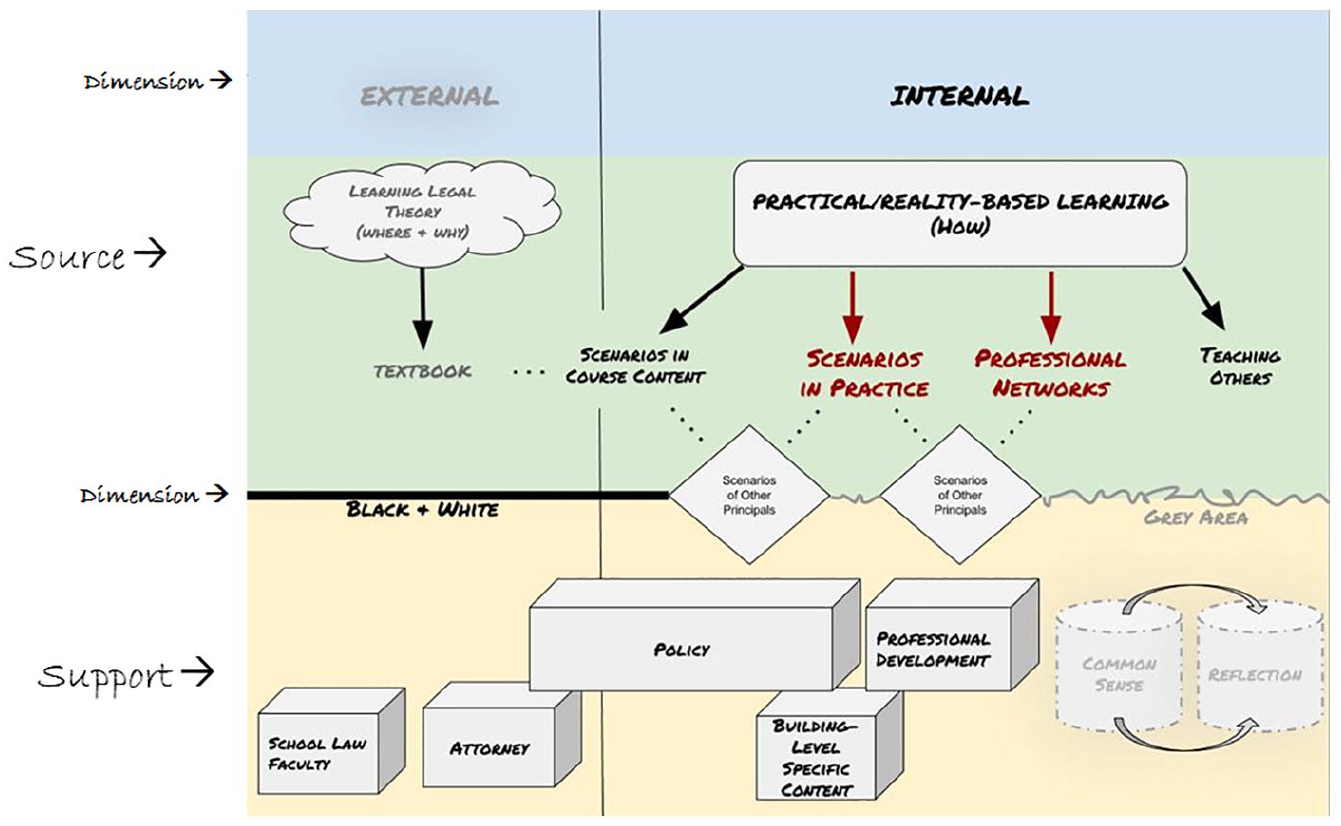
Theory of principal legal learning.
Subcategory: Learning through course content
Consistent with the theory/reality dichotomy, practical or reality-based learning through course content occurs through the use of scenarios. These scenarios are the vehicle that connects the theory to the real-life legal situations faced by principals.
Adult learning theory would suggest that scenarios are only effective when job embedded experience-based (Zepeda, 2012). However, principal participants identified value from scenarios in course content as well, specifically through scenarios faced by other principals in prior court cases and scenarios faced by other principals who have been invited to the course to share their experiences. Participant U found the course as “powerful” in learning from the experiences of others to deepen the development of legal knowledge, highlight the relevance of legal knowledge in practice, and initiate the application of legal knowledge to real-life situations.
School law faculty are relying on the value of learning through textbook scenarios as an integral part of the coursework. The syllabi indicate substantial intended use of scenarios in the form of case law to move the foundational knowledge acquisition toward more practical learning. In each of Syllabi A through J, learning activities included briefing cases. This seems to be one way in which the foundational knowledge acquisition of cases requires students to analyze and make a direct connection to their own context. Syllabus A specifically noted “school-based hypotheticals” would be used as “applications of a selected legal topic to local situation” for “examination of existing practices,” and Syllabus C noted this as the importance of activities “for many roles within schools.”
However, not all principal participants found the scenarios in textbook course content effective. Participant Q described reading scenarios through textbook cases as diverging from what principals face in practice. Participant S likewise found the textbook cases detached from what principals actually face.
However, at the same time, Participant S validated the secondary aspects of learning through scenarios in course content, learning from practicing principals discussing scenarios as part of course activities. Participant S described a unique variation on the school law course that facilitated principal learning by effectively bringing textbook scenarios into reality through practicing principals. Participant S’s coursework preparation was two semesters in length. During the second semester, students witnessed a panel of practicing principals discussing legal scenarios that they experienced. Students were given a direct opportunity to learn through the experiences of other principals.
Subcategory: Learning through scenarios in practice
The experience of learning through the scenarios of other principals not only emerged as a subcategory, it also seemed to form a bridge between course content textbook scenarios and the principal’s own experience learning through legal scenarios and issues in practice. According to Participant V, legal learning is most effective through understanding a wide variety of experiences. That begins with hearing about the experiences of others in course content. However, Participant V went on to unequivocally express that learning on the job is most valuable as only actual experience can “prepare me to be able to make decisions when they need to be made in a timely, effective fashion.” Participant W echoed that sentiment, suggesting that coursework and scenarios of others provide the guiding rules, but it is only through on-the-job experience and active learning-by-doing that the guiding rules become engrained to that point that decision-making becomes natural.
Without exception, every participant emphasized that it is only by learning through scenarios or legal issues personally experienced in practice when the most significant and largest component of legal learning occurs. Although participants expressed their legal learning process at this stage differently, they described the result of significant legal learning occurring when they personally experienced legal scenarios in practice. Participant S’s statements evoked the dimension of reality that exists in practical experience by describing learning taking place during “the act of something actually occurring” and further explaining that nothing can really prepare a principal like personally dealing with a situation and not hypotheticals. Participant T echoed that sentiment, suggesting the learning occurs more quickly and drastically at this stage, describing it as “baptism by fire.”
Surprisingly, an element of learning through scenarios in practice that adult learning theory would predict to emerge, professional development (Zepeda, 2012) did not emerge. Although a few participants acknowledged having legal professional development sessions as a principal, not a single principal expressed professional development as a source of legal learning. Instead, professional development emerged, at most, according to Participant R, as a form of support for staying updated and current on changes in the law.
Subcategory: Learning through professional networks
The process of legal learning forms a clear progression from a principal’s personal learning through scenarios to sharing those experiences and learning from the experiences of others in a professional network. As participants described this progression, again, the idea of learning through the scenarios of others forms a bridge in this process. These professional networks were equally as significant a source of legal learning as a principal’s own personal learning through scenarios in practice. Although not every participant described the professional network using that terminology, every participant spoke of legal learning by reaching out to a collection of other school professionals for information, support, and advice about legal issues.
The benefits of professional networks were clear and unequivocal, principal participants spoke of the “power of a network” and found significant learning value in “working together” to have “great conversations.” This type of collaboration allowed principals to have another individual helping them to think through a legal issue and ensure that principals are not acting as “lone rangers” trying to navigate an issue on their own. Interestingly, Participant T surmised that this type of collaborative networking is occurring as a direct result of the absence of legal professional development. Thus, another benefit of professional networks is to fill the gap in other sources of legal learning.
Professional networks do not have consistent or required membership. Although it was clear that each participant maintained a professional network, members of each professional network were unique to the principal participant. Participant R offered the idea that membership in a professional network can fluctuate over time, based on a principal’s needs at different points in their careers. The following were noted as potential members of a professional network, in order of frequency and expressed value to the principals: other principals, supervisors, mentors, non-principal colleagues, school resource officers, external government support agency contacts, and professional associations. Professional networks were not limited to participants internal to the organization as could be expected when dealing with private legal issues. In fact, not a single principal limited members of the professional network to internal members only. Participant T expressed a common sentiment of the principal participants, that the most important characteristic of a professional network member is that they are “trusted,” regardless of whether they are internal or external to the organization.
Given the breadth of membership, it is perhaps more noteworthy to identify the individuals not included in the professional network. Overwhelmingly, principal participants did not include attorneys in the professional network for learning and discussing legal issues. In addition, no participant discussed professional network members as including any colleagues from coursework. Though every syllabus included an element of small group work and collaboration in coursework, that collaboration does not seem to continue into practice.
Subcategory: Learning through teaching others
The process of principal legal learning culminates with principals reaching the next level of learning through teaching others. It is surprising that principal legal learning includes learning through teaching others, given that legal instruction typically comes from an authority with formalized legal training, which principals do not have. Yet, principal participants spoke of learning about legal issues so that they would be able to convey the issues to third parties.
Principals routinely identified third parties as belonging to two groups: staff members and parents. Participant X most directly spoke to this issue and having to interpret legal ideas and legal concepts to teachers because teachers have not had any foundational school law courses. Participant T expressed the importance of developing an accurate understanding of legal issues such that they could convey those issues for staff members and help them to place legal knowledge in the classroom context. Participant T further explained that this would make staff members “more likely to take ownership” of legal issues. Participant X also talked about interpreting law as a form of external communication and public relations with parents. Participant X explained that this most frequently occurs when the principal must share a standard or explain legalese. Participant Y spoke of needing to have a thorough understanding of the legal issues not only to be able to explain the issues to parents but also to “facilitate a shared understanding.” Principal T illustrated the complexity of instructing parents on legal issues, indicating that parents have asked whether the principal is an attorney when the principal was trying to explain the legal guidelines and the school’s practice related to custody. When challenged in this manner, a principal must have developed the right depth of principal legal knowledge.
It was clear from the syllabi, that school law faculty are privy to the idea that principals need to reach that level of transformative learning. Every syllabus reviewed had a presentation component where future principals were required to instruct fellow students and teach their legal learning to others, presumably to reach that level of transformation.
This element of the principal legal learning process, though unexpected, is directly connected to adult learning theory and the point at which adult learning reaches the next level of transformative learning. The transformation occurs when the learner is cognitively aware of their learning and can analyze, evaluate, and create knowledge to transfer learning to others (Desimone, 2009; Ylimaki, 2014).
Theme: Supports for Legal Learning
Principal legal learning does not occur in a vacuum. The principal participants, through their shared experiences, identified elements that support their sources of learning. The supports emerged with a dimension that spanned from supports that provide a very clearly defined, black-and-white, legal information to legal information that facilitated learning through the less clearly defined, gray areas of the law. The black-and-white supports include the school law faculty, the attorney, and to a certain extent, policy. The gray area supports include policy, building level–specific content, professional development, and a process of developing common sense through reflection. The distinction between the black-and-white and gray areas seems to be the support’s ability to provide clear, concise direction as well as the support’s credibility with accuracy of legal information.
Category: School law faculty support
Principal participants spoke of the school law faculty as having significant credibility as a source of accurate legal information. Principals indicated that the school law faculty, in conjunction with the course materials, provide principals with knowledge about what can and cannot be done without room for interpretation. Participants Z, Y, X, and V all spoke of the value of the school law faculty and the textbook that continues to be present on their office shelf for continued learning support.
Category: Attorney and access to legal information support
Each participant principal noted the school’s attorney as a source of legal information. The attorney is seen as a source of black and white with Participant W stating this directly. Participant V relayed a statement from the school law faculty that they remember to this day. The school law faculty informed Participant V that the attorney knows the law and that the principal is not a lawyer, they are an educator. When the principals need to know the black-and-white law, they need to contact the attorney. Participant U spoke of the attorney providing the “straight talk” necessary for principals to know where to draw the legal lines. To that point, Participant R agreed that the attorney’s focus is strictly law and should be contacted only for the law. It is up to the educator to apply the law in a “realistic common-sense situation.”
While each principal participant saw the attorney as a source of legal information, access to that source of legal information differed drastically. Overwhelmingly, every single participant has stated that they do not, as a principal, directly contact the school attorney. Every single person uses an internal intermediary up the chain of command, and even indirectly, had varying degrees of access to the attorney. Factors that seem to influence that access are the approachability of the general counsel, the barriers to access or gateways to access presented by the principal’s supervisor, and the culture of the school to be either proactive or reactive in addressing legal issues. It is this lack of access that may also explain why the attorney is never part of the principal’s professional network. In fact, Participant S referred to the attorneys as “the untouchables” and Participant Z indicated an unwillingness to contact the attorney when the attorney is presented as a “disciplinarian.”
Category: Policy support
Every participant, unprompted, mentioned some form of policy and procedure, sometimes in the form of a code of conduct, used in practice to support principal legal learning. However, variation emerged as to whether policies were seen as black-and-white or gray and as to how policies were used as part of legal learning.
The black-and-white dimension of policies emerged most frequently within the code of conduct when principal participants use policies to identify legal provisions as references and definitions. Every participant has discussed the inclusion of law explicit in school policy and noted these documents as the first line of information for addressing a legal issue that arose in the school. Or as Participant X explained, policy is something to “fall back on” and to help address the “run-of-the-mill” situations. More explicitly, Participant Y discussed the idea of policies as “tightly written” boundaries. Likewise, Participant W and Participant V both spoke of using the code of conduct to instruct parents, in particular using definitions and code provisions as a point of reference (even literally pointing to it). To that end, written policies are seen as less likely to be challenged and are a form of implementing structured due process that ensures fairness and equity for all.
Conversely, the gray area dimension of policy is in how it is utilized and interpreted. Participants R and S did not see policy as a support for legal decision-making. Participant R uses policy as merely a source of authority to show to others. Similarly, Participant S identified the law being equated with policy that can provide a source of first guidance but noted that policy is written broadly with room for interpretation and decision-making at different levels. It is within that gray area of decision-making at different levels that principals can and should apply their own educational philosophies to address a legal situation.
Category: Professional development support
Professional development did not emerge as a source of legal learning but did emerge as a form of support. Participant S described potentially supportive benefits of professional development by describing a legal professional development session that was valuable. That particular session did not contain legalese, was chunked and extemporaneous, timely with school planning, provided consistency in what to do and what not to do, and facilitated collaboration and communication through “hands-on” activities as that is “where the learning and processing [took] place.” Participants R and Q echoed a similar sentiment by sharing that professional development is better when the faculty member is not “lawyer-ish” and when provided in plain English, not legal jargon.
However, professional development did not emerge as a significant source of learning as it has typically had limitations. Every principal participant described their professional development as district-wide not school-specific without any input from the principals. Participant T noted that legal professional development is often outdated, compliance-driven, and not connected to issues faced at buildings and practice.
Category: Building level–specific content support
First emerging within the discussion of professional development, overwhelmingly, principals are learning legal information that is not specific to their context, specifically, their building level. Every principal participant noted that when they do encounter legal information, it is never building level–specific. Principals identified the content areas specific to their building level where useful legal information can be tailored to context and facilitates legal learning. For primary/elementary building levels, those areas include custody, discipline, teacher-administrator rights and responsibilities, special education, allergies, or extra-curricular activities, and mental health. For middle school and high school building levels, those areas include substance abuse, discipline, Title IX, and social media.
The syllabus review confirmed the experiences of the principal participants. Each syllabus clearly identified content areas that would be covered in the course. Those areas are consistently broad and consistently absent of any connection to building level needs in practice.
Category: Applying common sense with reflection for support
A final area that emerged as a source of support for principal legal learning is a principal’s ability to apply common sense and reflective practice. Almost every principal participant specifically used the term “common sense” when speaking about addressing legal issues. Most notably, Participant R spoke directly to this issue, stating that where the gray area exists, common sense needs to be applied to take appropriate action without overreaching.
To facilitate the development of common sense to address legal issues, principal participants spoke of engaging in reflective practice. Participant Z and Participant Y both discussed the idea of “hindsight” or “reflective practice.” When principals can analyze and reflect upon their actions, whether successful action or mistake, principals learn how to better address the legal issue moving forward and deepen their legal learning. Furthermore, Participants R, S, and T, all spoke about taking additional steps toward legal learning to avoid “negative reflection.” Much of this reflective practice occurs within the professional network.
The theory of principal legal learning is illustrated in visual form in Figure 1.
Limitations
This study was limited by the potential for participants to feel pressured or influenced by the researcher’s background as an attorney. Given this prior experience as an education attorney, there is a potential for participants to feel like the researcher was judging or evaluating their knowledge of school law. To compensate, the researcher was transparent about this professional background and assured participants that the purpose of the research was to understand the legal learning process and not to judge principal actions. This served to lessen any intimidation and interaction power differences (Charmaz, 2014).
Implications for Practice
Research about the process of principal legal learning has implications for two different groups: principals and school law faculty. Principals, as adult learners of school law, need to understand how they develop knowledge and skills that will inform their own practice. Principals have expressed desire for knowledge and skills to address legal issues in schools (Hess & Kelly, 2003; Shariff, 2004). This research presents two key implications for principals who desire to develop legal knowledge and skills and deepen legal learning: get exposure to scenarios in practice until legal decision-making becomes instinctual by cultivating professional networks and gain access to a wide variety of supports that use the black-and-white to practice reflection to the point at which learning becomes transformative.
Principal participants emphasized that learning occurs in practice after exposure to actual legal scenarios. While it is most beneficial to personally experience the legal scenarios, it is certainly not advisable to create legal issues in schools merely for the benefit of principal legal learning. Instead, principals continually express the benefit of exposure to scenarios, from any source. Although principals found the most value in their own experiences, they did not entirely discount the benefit of course content and textbook scenarios. The course content and textbook scenarios provide the foundational knowledge. Principals can actively recall and build upon that foundational knowledge by intentionally revisiting scenarios in practice. One valuable way of building upon that foundational knowledge is through professional networks where scenarios are discussed with trusted colleagues, mentors, and supervisors.
These networks and the intentional and active discussion of scenarios can and should occur both formally and informally. In the formal setting, though principal participants have not had regular, job-embedded legal professional development, they desire for such formal learning opportunities. Principals can and should solicit opportunities that are current, are not presented in legal jargon, are chunked and tailored to building-level content, are timely with school planning, provide consistency in what to do and what not to do, and facilitate collaboration and communication through “hands-on” activities. These formal sources of learning should be supplemented with the informal discussions within the professional network. It is within the ongoing activities and informal discussions of scenarios that deep legal learning becomes instinctual legal decision-making.
Principal participants identified a wide variety of supports that are not sources of legal learning but can serve to facilitate legal learning. However, the breadth of those supports seems to be underutilized. It is clear that school policy can provide clear black-and-white legal decision-making guidelines. Moreover, policies were often cited as a mechanism for principals learning by teaching others about school law issues, both teachers and parents. Furthermore, principal participants indicate that professional development, when done right, can also be a source of current, credible, explanation of what to do and what not to do. Again, this is a source of black-and-white that principals can use to navigate legal issues and translate those legal issues to teachers and parents. Principals must recognize the existence of these supports, request these supports, and utilize these supports until legal learning reaches that instinctual, common sense, level of transformative learning.
School law faculty need to continually develop valuable and meaningful school law programming. There is national principal shortage that some attribute to the weakness of principal preparation and development (Gates et al., 2014). In this new era of school autonomy, accountability (Gates et al., 2014; Himmetoglu et al., 2017), and the rush to legally challenge issues previously discussed (Petty, 2016), there is corresponding need to understand how principals develop knowledge and skills to address legal issues in schools. This research can help to refine current methods of principal school law instruction and programming. Over time, this may help to attract and retain quality principals to the profession and reduce legal fees.
One way to refine current coursework is to incorporate more real-life scenarios from practicing principals. A second way to refine current coursework is to recognize and emphasize building-level content differences. While principals need to be prepared to practice at any level, it is beneficial for principals to be aware of building-level legal issue differences so that they may draw upon that knowledge in practice. A third way to refine current coursework is to begin to facilitate a professional network for principals entering practice. School law faculty can and should consider pairing practicing principals with principals in preparation specifically to discuss legal issues. Doing so would facilitate all three recommendations for refined coursework. It would give the practicing principals the opportunity to discuss real scenarios, ideally based on intended building-level practice, and would initiate a trusting collegial relationship to provide the foundation for a strong professional network.
It should be recognized that the syllabi indicate that school law faculty are trying to incorporate these elements into current coursework activities consistent with current knowledge of adult learning theory. The syllabi demonstrate how school law faculty are seeking to facilitate self-directed learning through student/school administrator choice of learning activities. The syllabi also demonstrate that school law faculty incorporate scenarios and activities establishing current connections to practice and ensuring learning is grounded in practical experience. Finally, syllabi have elements of small group work and/or collaboration. It is not entirely clear whether this is intended to initiate the development of a professional network. However, this research illustrates that even if school law faculty are intending to facilitate adult learning theory tenets in school law coursework, principals are not understanding the purpose of learning activities or need a modified learning approach, specific for the unique intricacies of legal learning.
Implications for Future Research
Several areas emerged that would warrant future research. While this research produced valuable implications for refining school law coursework, there is still much research that could be done to understand why school law coursework is valuable for some principals and only a source of knowledge or information for others.
The attorney is often identified as a source of significant credibility and legal knowledge. Yet, mechanisms are not in place that facilitate direct principal contact with attorneys. There was much variability in identifying mechanisms that would facilitate principal and attorney interactions. Additional research that further explores the relationship of the school attorney and school principals who need legal advice to navigate legal issues is warranted.
Professional development is an underutilized source of principal legal learning. Professional development that is provided is internal and arranged by supervisors. In some instances, the professional development is tailored to the needs of the district, whereas in others it is not. In many instances the professional development is in response to a significant legal case or law that would directly impact the district or school. In all cases, the professional development is described as district-wide, not school-specific. Additional research to identify the most effective elements of legal professional development is warranted.
Footnotes
Declaration of Conflicting Interests
The author(s) declared no potential conflicts of interest with respect to the research, authorship, and/or publication of this article.
Funding
The author(s) received no financial support for the research, authorship, and/or publication of this article.
